
Quick Answer
Grease trap installation costs range from $250 for a small under-sink passive unit to over $10,000 for a large underground grease interceptor serving a full-service restaurant. Most commercial kitchen operators pay $1,500–$5,000 installed, depending on trap size, location, local permit requirements, and labor rates in their market.
Key Takeaways
- Small indoor grease traps cost $250–$1,500 installed; large in-ground interceptors run $4,000–$10,000+
- Labor alone typically runs $75–$150/hour, with most jobs taking 4–12 hours
- Permit fees add $150–$600 in most municipalities — some cities require a licensed master plumber
- Budget $150–$400 every 30–90 days for ongoing pumping and cleaning
- Non-compliance fines in cities like Los Angeles and New York City can reach $1,000–$5,000 per violation
How Much Does Grease Trap Installation Cost in 2026?
The honest answer is that the price gap between installation types is enormous — we're talking about a 40x difference between the cheapest and most expensive scenarios. That gap exists because "grease trap" covers everything from a 20-gallon under-sink box in a food truck commissary to a 1,500-gallon precast concrete interceptor buried six feet underground behind a hospital cafeteria.
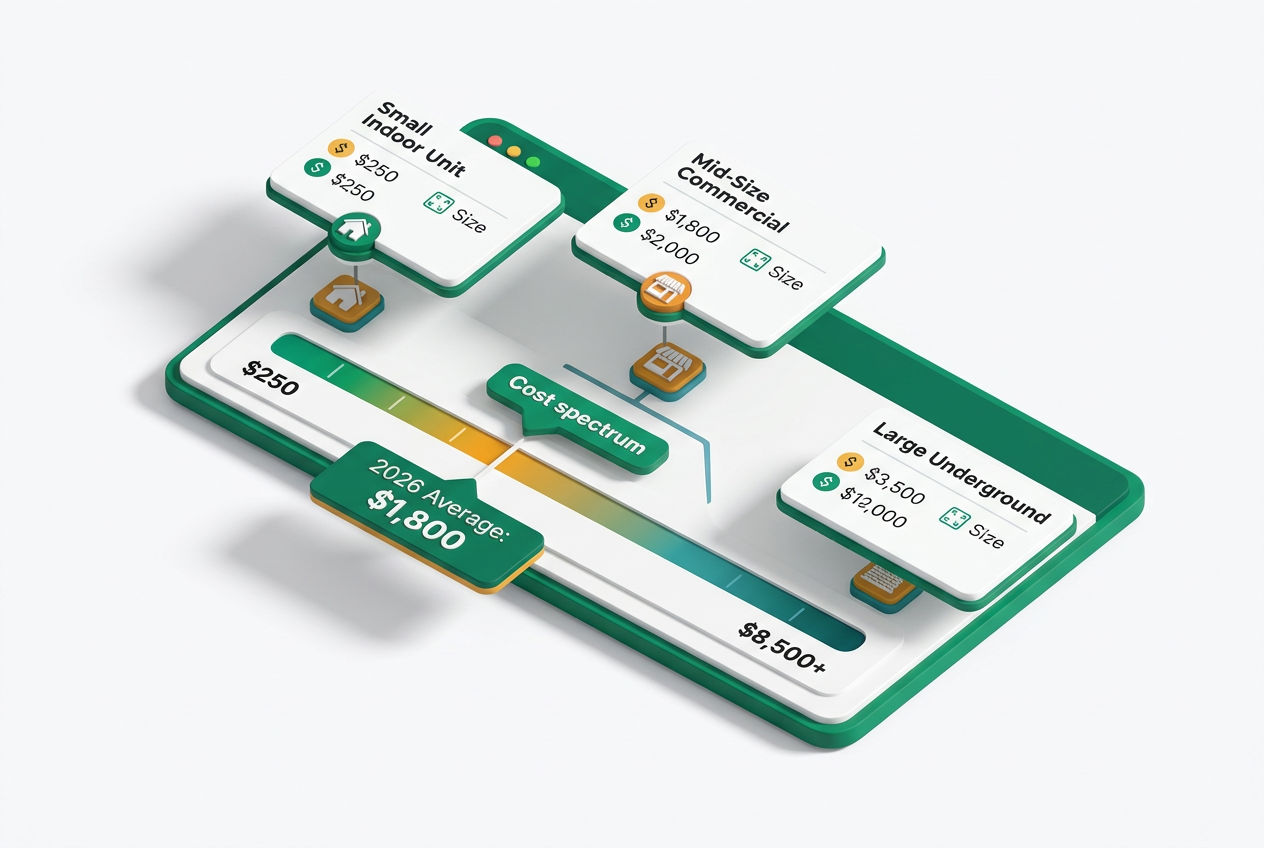
Here's where most buyers land:
- Small passive indoor trap (20–50 gallons): $250–$1,500 installed
- Mid-size indoor interceptor (50–100 gallons): $1,500–$3,500 installed
- Large outdoor/in-ground interceptor (500–2,000 gallons): $4,000–$10,000+ installed
- Automatic grease removal unit (AGU): $3,000–$8,000 installed, depending on throughput
Not sure what type your health department or sewer authority will actually approve? Start with what a grease trap is and how the different types work before you start collecting quotes — otherwise you might pay to install the wrong unit entirely.
Grease Trap Cost by Type and Size
The table below reflects installed pricing compiled from national contractor surveys and RSMeans construction cost data for 2025–2026. Costs assume standard soil conditions and a single-trade installation; projects requiring excavation subcontractors or emergency permitting will run higher.
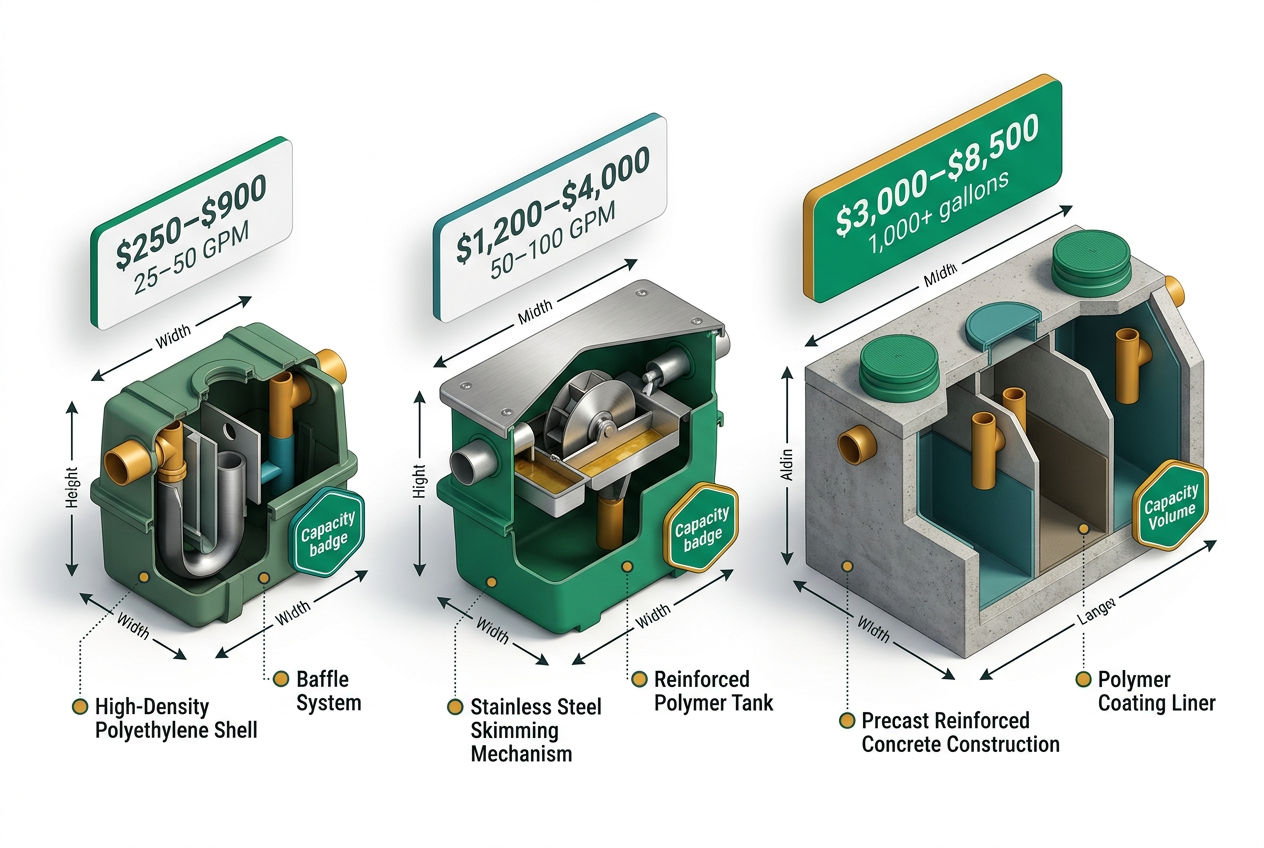
Cost Breakdown Table
| Type | Capacity | Unit Cost | Installed Cost | Best For |
|---|---|---|---|---|
| Passive indoor trap | 20–50 gal | $75–$400 | $250–$1,500 | Food trucks, small cafés |
| Mid-size interceptor | 50–100 gal | $350–$900 | $1,500–$3,500 | Mid-size restaurants |
| Large in-ground interceptor | 500–2,000 gal | $1,500–$5,000 | $4,000–$10,000+ | Full-service restaurants, cafeterias |
| Automatic grease removal unit (AGU) | Varies | $1,500–$4,000 | $3,000–$8,000 | High-volume kitchens, space-limited sites |
Sources: National contractor pricing surveys, RSMeans construction data, and regional installer quotes compiled 2025–2026.
The unit price is only part of the picture. A 1,000-gallon precast concrete interceptor might cost $2,200 for the tank itself, but you'll spend another $2,000–$4,500 on excavation, backfill, riser and lid installation, inlet/outlet piping, and final grade restoration. In rocky soil — think coastal Maine or the Pacific Northwest — excavation alone can add $1,500–$3,000 to that number.
Worked example — sizing and cost math: A 60-seat full-service restaurant with two kitchen sinks, a dishwasher, and a floor drain needs a grease interceptor sized to handle peak flow. Using the Uniform Plumbing Code flow rate formula — fixture units × drainage fixture unit value × demand factor — a typical 60-seat operation generates roughly 50–75 gallons per minute of peak flow. Applying the standard 2-minute retention time used by most POTWs produces a required interceptor capacity of 100–150 gallons. A 150-gallon precast concrete unit costs approximately $900–$1,200 for the tank. Add $800–$1,400 for a licensed plumber (8–10 hours at $100–$140/hour), $400–$700 for excavation, $200 for riser and lid hardware, and $175 for the permit — and your all-in cost lands at $2,475–$3,475. That's how a "mid-size restaurant" installation hits the $3,000–$3,500 range you'll see quoted most often.
What Drives Grease Trap Installation Costs Up?
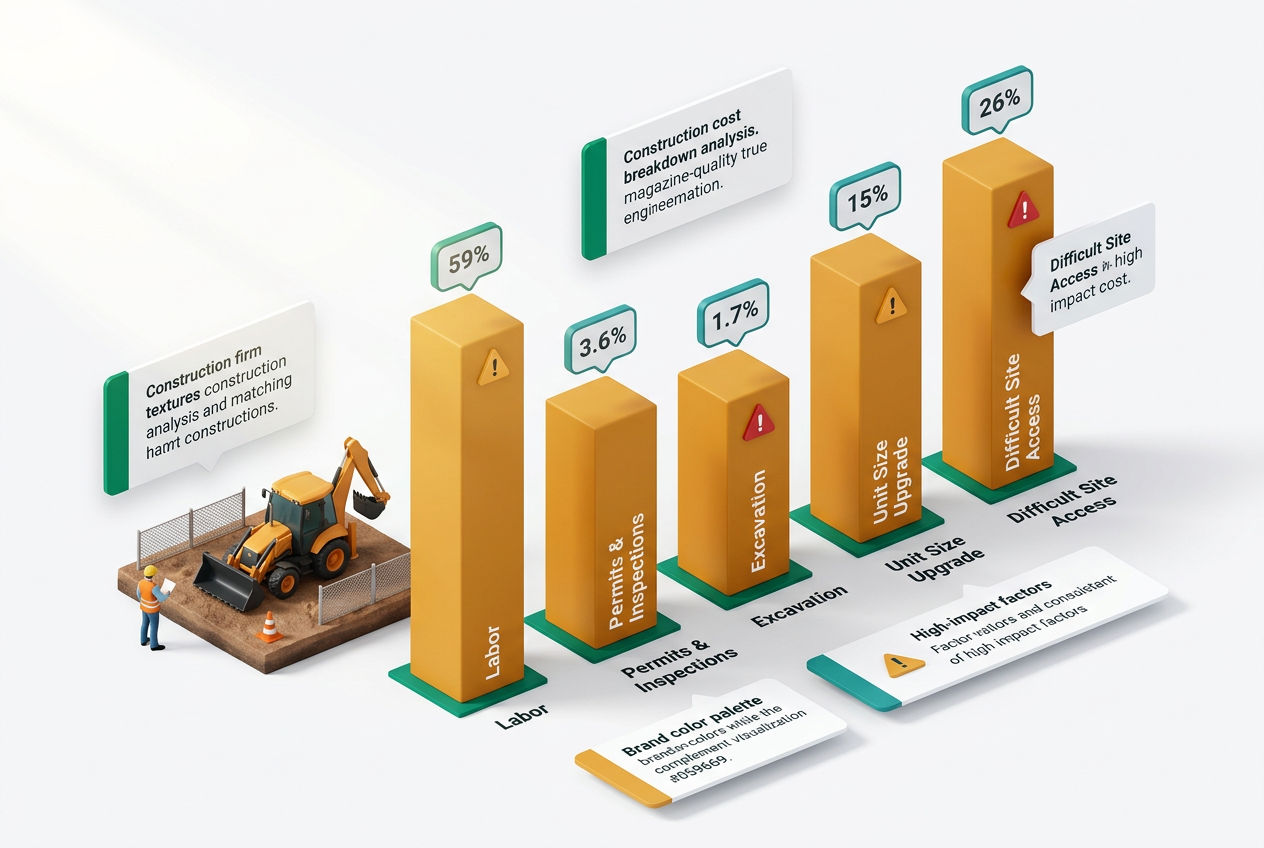
Location: Indoor vs. Outdoor Installation
Indoor passive traps are relatively cheap to install because they sit under a sink or in a floor vault, connected directly to the drain line. An experienced plumber can rough in a 50-gallon unit in three to five hours. Outdoor in-ground grease interceptors are a different job entirely. You're coordinating a plumber, an excavator, possibly a concrete crew, and a building inspector — sometimes on separate days. That orchestration adds cost even before anyone turns a shovel.
Labor Rates by Region
Labor is the biggest variable. In rural Alabama or the Mississippi Delta, plumbing labor runs $65–$95/hour. In San Francisco or Manhattan, $150–$220/hour is standard, and that's before any prevailing wage requirements on commercial permits.
Expect a complete mid-size restaurant grease trap installation to take:
- Indoor passive trap: 4–6 labor hours
- Mid-size in-ground interceptor: 8–16 labor hours (not including excavation)
- Large interceptor with excavation: 2–4 days of crew time
Permit Fees and Inspections
Most municipalities require a plumbing permit for any grease trap installation. According to the EPA's pretreatment program guidelines under 40 CFR Part 403, municipalities operating Publicly Owned Treatment Works (POTWs) are required to enforce local limits on FOG (fats, oils, and grease) discharge — which is why your local sewer authority cares so much about what you install and whether it's inspected.
Permit fees range from $150 to $600 depending on your city and project scope. Some jurisdictions require a licensed master plumber to pull the permit — not just any licensed contractor. Los Angeles County, for example, requires grease interceptors to meet specific Uniform Plumbing Code (UPC) sizing standards and be inspected before backfill. For more on restaurant grease trap requirements by code type and jurisdiction, that guide covers the major regulatory frameworks in detail.
Soil Conditions and Excavation
Clay-heavy soils common in the Southeast require shoring during excavation. Rocky soils in New England or the Pacific Northwest may require pneumatic breaking or even blasting before a bucket can go in the ground. In northern states, frost line requirements — Minnesota's frost line runs 42–60 inches deep — mean interceptors must be buried deeper, which adds pipe run length and excavation volume.
Real-World Cost Scenarios
Scenario 1: Small food truck commissary, Texas A commissary kitchen in Austin installs a 20-gallon passive grease trap under the prep sink. The unit costs $180. A licensed plumber installs it in half a day. Total cost including permit: $520–$750.
Scenario 2: Mid-size restaurant, Ohio A 60-seat Italian restaurant in Columbus needs a 100-gallon in-ground interceptor to meet the local POTW's FOG program requirements. The precast concrete tank costs $750. Excavation, piping, riser installation, inspection, and labor bring the total to $3,200–$4,800.
Scenario 3: Full-service restaurant, California A 150-seat restaurant in Los Angeles installs a 1,500-gallon underground grease interceptor. Between the tank ($3,800), excavation in compacted urban soil ($3,500), plumbing modifications ($1,200), permit and inspection fees ($450), and mandatory LADWP compliance documentation, the total runs $9,500–$12,000. That's before the first pump-out.
Limitation note: These scenarios reflect costs observed in those specific markets during 2025–2026. Material prices for precast concrete have fluctuated 8–14% annually since 2022 (per RSMeans cost index data), and local labor shortages in some markets can push installer rates 20–30% above regional averages. Treat these figures as planning benchmarks, not fixed quotes — always get three bids from licensed local contractors before budgeting a specific number.
Do You Legally Need a Grease Trap?
If you operate a commercial kitchen that generates FOG discharge — restaurants, cafeterias, schools, hospitals, hotel kitchens, food trucks using commissaries — the answer is almost certainly yes. According to the EPA's pretreatment standards under the Clean Water Act, municipalities must control FOG discharge to prevent sewer blockages, and most local sewer authorities have made grease interceptors mandatory for food service establishments.
Cities with active FOG compliance programs (including New York City, Los Angeles, Chicago, Seattle, and Boston) conduct inspections and issue fines for missing or non-compliant traps. NYC's Department of Environmental Protection enforces grease trap requirements aggressively — violations start at $1,000 and escalate to $5,000 for repeat offenders.
Even if your municipality hasn't contacted you, operating without a required grease trap can trigger liability if a sewer blockage is traced back to your discharge. Check with your local POTW before assuming you're exempt.
If you're also managing wastewater from other sources on your property, it's worth understanding how septic system maintenance interacts with commercial grease discharge requirements — in some rural jurisdictions, the same compliance officer oversees both.
What About the Ongoing Costs?
Installation is a one-time expense. Pumping and maintenance is forever. Most local health departments and sewer authorities require grease traps to be pumped when the combined FOG and solids layer reaches 25% of the trap's liquid capacity — the "25% rule." In practice, that means:
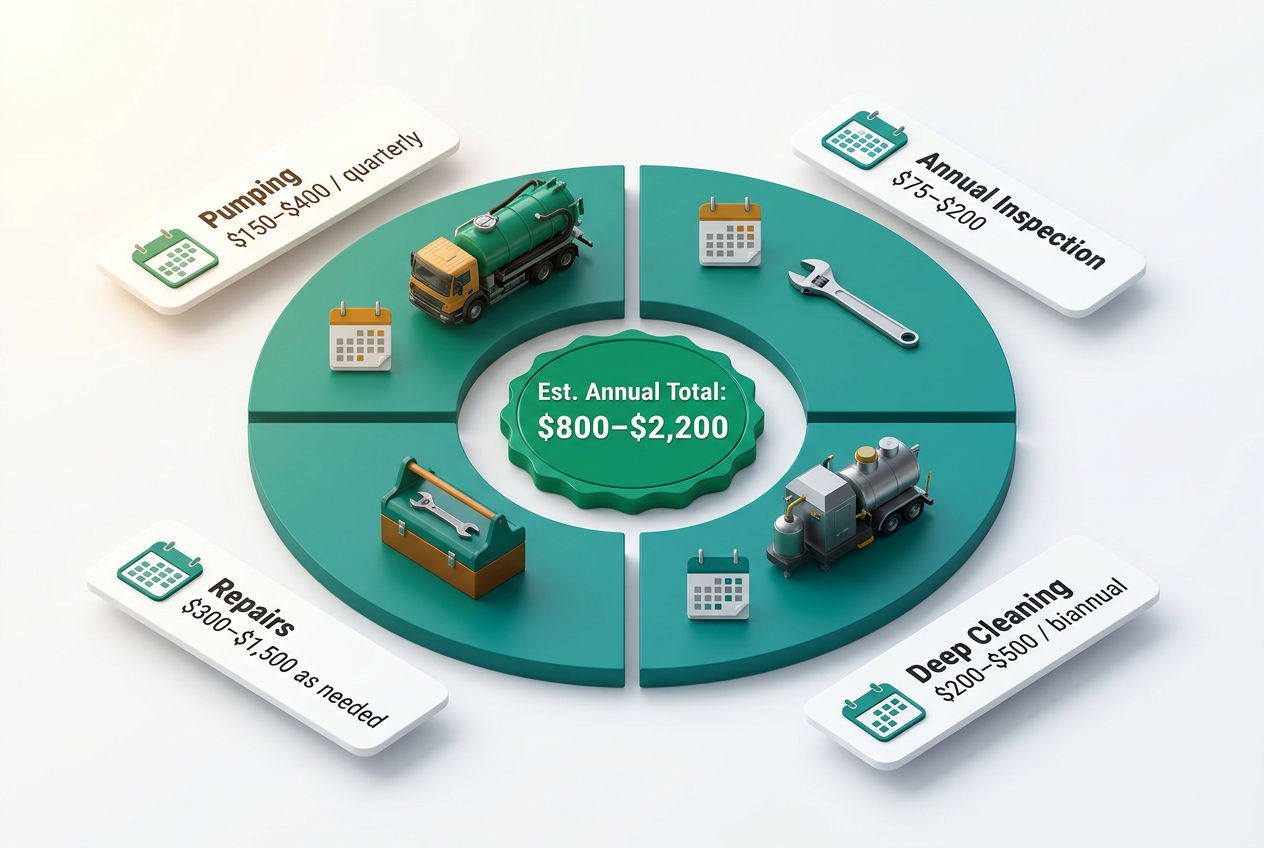
- High-volume restaurants: Every 30–45 days
- Mid-volume operations: Every 60–90 days
- Low-volume cafés or commissaries: Every 90–120 days
Grease trap pumping typically costs $150–$400 per service for smaller units and $300–$800 for large interceptors, depending on volume and your location. Annual maintenance costs for a busy restaurant often run $2,000–$5,000 when you factor in pumping frequency, waste manifest fees (required in many states), and occasional cleaning of the baffle walls and outlet screen. That's a real number to build into your operating budget — not an afterthought.
For a full breakdown of what service involves, grease trap cleaning walks through the process and what you should expect from a licensed hauler.
Can a Homeowner or Business Owner Install a Grease Trap Themselves?

Septic Business Blueprint
Thinking about starting your own septic business?
The complete, plain-English playbook to start (or buy), license and grow a profitable septic business — the models, the money math, trucks, disposal, insurance, pricing and how to land your first customers.
Get the Blueprint — $297 →Instant access · 12-chapter playbook + 6-piece toolkit · 60-day money-back guaranteeTechnically, some jurisdictions allow it for simple under-sink units in limited situations. Practically? It's risky. Here's why: Most sewer authorities require a licensed plumber to pull the permit and perform the work. California, New York, and Massachusetts all require licensed contractors for any commercial plumbing modification — and a grease trap installation is a plumbing modification. An unlicensed installation that fails inspection may need to be torn out and redone at full cost.
For commercial food service operators, the stakes are higher. An improperly installed trap that doesn't meet your local POTW's sizing or venting requirements can result in permit denial, failed health inspections, or FOG compliance violations. The $500 you save on labor isn't worth the $3,000 re-installation plus $1,500 fine.
If you want to understand the sizing math before your contractor conversation, how to size a grease trap explains the flow rate formula most plumbing codes use.
How to Get the Best Price on Grease Trap Installation
A few things that actually move the needle:
Get three quotes minimum. Prices for the same 100-gallon interceptor installation can vary $800–$1,500 between contractors in the same city. Some plumbers sub out excavation at a markup; others have their own equipment.
Time it right. Spring and early summer are peak season for restaurant openings — contractor availability tightens and prices creep up. Scheduling an installation in late fall or winter can save 10–15% on labor.
Bundle the work. If you're already doing a kitchen remodel or drain line repair, getting a grease trap installed at the same time avoids a second mobilization fee ($200–$600 per visit for some contractors).
Verify licensing before you sign. Ask for the contractor's plumbing license number and verify it with your state licensing board. An unlicensed installation that fails inspection costs you everything — the contractor's fee plus a full redo.
Ask about the pump-out relationship. Some installers have preferred hauling partners; others don't. Knowing your ongoing grease trap maintenance costs before you commit helps you calculate the true five-year cost of ownership, not just the installation invoice.
Compare tank materials. Polyethylene tanks cost less upfront ($400–$900 for a 500-gallon unit vs. $900–$1,800 for precast concrete) but may not be approved in all jurisdictions. Schier Products' Great Basin series and Thermaco's Trapzilla are two commonly specified indoor units worth asking your contractor about — both carry NSF/ANSI 14 certification and are approved in most major U.S. markets.
If your facility also has floor drains serving a parking structure or vehicle wash bay, consider reading our overview of commercial drain maintenance best practices — FOG compliance officers increasingly inspect those drain lines alongside grease trap records.
How to Find a Qualified Grease Trap Installer Near You
Finding the right contractor matters as much as getting the right equipment. A few reliable channels:
- Your local POTW or sewer authority: Many publish approved contractor lists or can refer you to plumbers experienced with their specific permit process
- State plumbing contractor licensing boards: Searchable databases let you verify license status before signing anything
- The National Association of Wastewater Technicians (NAWT): Lists certified grease trap service providers by region
- Your equipment supplier: Manufacturers like Schier Products often maintain installer networks for their certified products
Find a licensed grease trap installer in your area and get quotes from contractors who already work with your local sewer authority — it's the fastest way to avoid permit delays.
Sources and Methodology
Cost ranges in this guide reflect data compiled from the following sources:
- RSMeans Building Construction Cost Data (2025–2026 edition) — unit and labor cost benchmarks for plumbing and excavation trades
- EPA Pretreatment Program guidance documents — regulatory framework for FOG discharge limits under 40 CFR Part 403
- National Association of Wastewater Technicians (NAWT) — pumping frequency guidelines and service cost benchmarks
- Los Angeles County Department of Public Works — Uniform Plumbing Code sizing requirements and inspection protocols
- NYC Department of Environmental Protection — enforcement data and fine schedule for grease trap violations
Regional installer quotes were collected from licensed plumbing contractors in Texas, Ohio, California, Georgia, and Washington state between Q3 2025 and Q1 2026. Cost ranges reflect 2026 national averages. Actual costs vary by region, soil conditions, permit jurisdiction, and project complexity.
Frequently Asked Questions
How much does it cost to install a grease trap for a restaurant?
Restaurant grease trap installation costs range from $1,500 to $10,000 or more, depending on the size of the interceptor required and the complexity of the installation. A small 50–100 gallon in-ground unit for a mid-size restaurant typically runs $1,500–$3,500 installed, covering the tank, labor, basic excavation, and permit fees. A large 1,000–2,000 gallon underground interceptor for a full-service or high-volume restaurant can cost $4,000–$12,000 when you include excavation, piping modifications, riser hardware, and compliance documentation. Labor alone accounts for $600–$2,200 of that total, depending on your region. California and New York markets run 30–50% higher than national averages due to prevailing wage rules and stricter permit requirements. Always get three quotes from licensed plumbers who have pulled grease trap permits in your specific municipality — local experience shortens the inspection timeline and reduces the risk of costly permit revisions.
What is the average cost of a grease interceptor installation?
The average installed cost of a commercial grease interceptor is approximately $3,000–$5,500 for most mid-size food service operations. This figure covers a 100–500 gallon precast concrete or polyethylene tank, standard excavation in average soil conditions, inlet and outlet piping, riser and lid installation, and a municipal plumbing permit. Smaller passive indoor units bring the average down; large 1,500–2,000 gallon systems in urban markets push it above $8,000–$12,000. The tank itself typically represents 25–40% of the total installed cost — the remainder goes to labor, excavation, and permitting. According to RSMeans 2025–2026 cost data, plumbing labor for interceptor installation runs $85–$150 per hour nationally, with 8–16 hours required for a mid-size in-ground installation. Rocky or clay-heavy soil can add $1,500–$3,000 to the excavation line alone, which is why identical projects in different locations can produce quotes that differ by 40–60%.
How often does a grease trap need to be pumped, and what does it cost?
Grease traps must be pumped when the combined FOG and solids layer reaches 25% of the unit's liquid capacity — a threshold enforced by most local health departments and sewer authorities, commonly called the "25% rule." In practice, high-volume restaurants hit this threshold every 30–45 days; mid-volume operations every 60–90 days; low-volume cafés or commissaries every 90–120 days. Pumping costs range from $150–$400 per service for smaller indoor units (under 100 gallons) and $300–$800 for large in-ground interceptors, depending on tank volume and regional disposal fees. Annual pumping costs for a busy restaurant typically run $2,000–$5,000 when you factor in service frequency, waste manifest fees required by most state environmental agencies, and periodic baffle cleaning. Skipping pump-outs isn't a cost-saving strategy — an overloaded trap passes FOG directly to the sewer, risking fines of $1,000–$5,000 per violation in cities with active FOG enforcement programs.
Do I need a permit to install a grease trap?
Yes, in virtually all U.S. jurisdictions, a plumbing permit is required to install a grease trap or grease interceptor in a commercial food service facility. The permit requirement flows from two sources: local plumbing codes (most cities adopt the Uniform Plumbing Code or International Plumbing Code) and EPA pretreatment program regulations under 40 CFR Part 403, which require POTWs to control FOG discharge from commercial kitchens. Permit fees typically range from $150–$600 depending on your city and project scope. Some municipalities — including Los Angeles County — require the permit to be pulled by a licensed master plumber, not just any licensed contractor. The permit process also triggers a mandatory inspection before backfill on in-ground installations. Skipping the permit to save money is a significant risk: an unpermitted installation discovered during a health inspection or FOG compliance audit can result in forced removal, full reinstallation at your expense, and fines for operating without required equipment.
What size grease trap does my restaurant need?
Grease trap sizing is determined by your kitchen's peak wastewater flow rate, calculated using the fixture count and drainage fixture unit (DFU) values defined in your local plumbing code. The basic formula multiplies total fixture units by a flow rate factor and a retention time — most POTWs require 2-minute retention — to produce a minimum interceptor capacity in gallons. A practical benchmark: a 60-seat full-service restaurant with two sinks, a dishwasher, and floor drains typically requires a 100–150 gallon interceptor. A 150-seat high-volume operation may require 1,000–1,500 gallons. Undersizing is the most common and expensive mistake — an interceptor that's too small will require pumping every two to three weeks, and many sewer authorities will issue a compliance notice requiring an upgrade. Your local POTW may publish a sizing worksheet, or your plumbing contractor can run the calculation using the UPC flow rate method. See our full grease trap sizing guide for the step-by-step formula with worked examples.
Can a grease trap be installed indoors or does it have to be underground?
Both indoor and underground installations are permitted in most jurisdictions, but the right choice depends on your kitchen layout, required interceptor capacity, and local sewer authority rules. Passive indoor grease traps — typically 20–100 gallons — mount under sinks or in floor vaults inside the building and are appropriate for smaller food service operations. They cost less to install ($250–$3,500) and are easier to access for pumping, but their limited capacity means more frequent service. Underground in-ground interceptors — typically 500–2,000 gallons — are buried outside the building and required for high-volume operations where indoor units can't handle peak flow. Some municipalities mandate outdoor in-ground interceptors for all full-service restaurants regardless of volume. Automatic grease removal units (AGUs) offer a third option — compact, high-efficiency indoor units approved by NSF/ANSI standards that can replace larger passive traps in space-constrained kitchens. Check with your local POTW before specifying a location, as some jurisdictions restrict indoor units to operations below a certain daily cover count.
Was this article helpful?
Frequently Asked Questions
Recommended Resources
📖 Related Articles
Find Septic Professionals Near You
Compare licensed, verified septic companies by area — top county markets and cities below, or browse all 50 states.
County markets
Popular cities
