
Quick Answer
A restaurant grease trap is a plumbing interceptor designed to capture fats, oils, and grease — collectively called FOG — before they reach the municipal sewer system or your on-site septic system. Without one, that grease cools, hardens, and causes blockages that can shut down your kitchen, damage city infrastructure, and trigger serious regulatory penalties.
Key Takeaways
- Grease traps (also called grease interceptors) are required for most food service establishments serving 50+ meals per day
- The EPA estimates FOG causes approximately 47% of all sewer overflows in the U.S.
- Most restaurants need grease trap cleaning every 1–3 months; high-volume kitchens every 2–4 weeks
- Cleaning costs range from $150–$400 for small indoor units and $400–$1,000+ for large outdoor interceptors
- Non-compliance fines run $1,000–$10,000+ per violation depending on your municipality
What Is a Restaurant Grease Trap, and How Does It Work?
A restaurant grease trap is a gravity-separation device installed in the plumbing line between your kitchen drains and the sewer or septic system. Wastewater from sinks, dishwashers, and floor drains flows into the trap, slows down, and separates into three distinct layers: floating grease and oils on top, relatively clean water (effluent) in the middle, and settled solids on the bottom. Only the middle layer passes through to the sewer. The FOG stays trapped — until you pump it out.
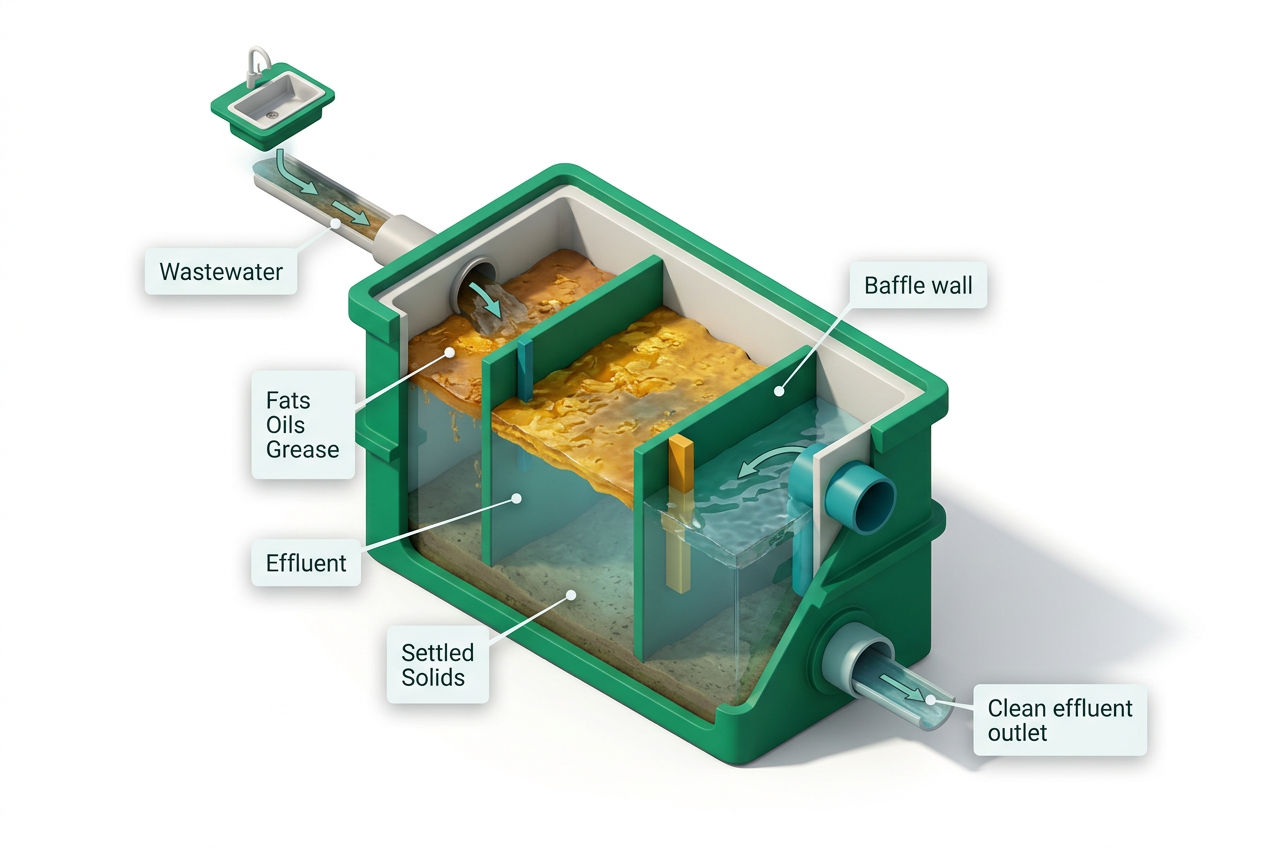
For a deeper look at the mechanics, see our guide on what is a grease trap.
There are two main types. Hydromechanical grease interceptors (HGIs) are small, indoor units — typically 20–100 gallons — installed under a sink or in a utility room. They're common in cafés, delis, and smaller food service operations. Gravity grease interceptors (GGIs) are large, outdoor tanks buried underground, ranging from 500 to 2,000+ gallons. Fast food chains, full-service restaurants, and institutional kitchens typically need these.
Picking the wrong type — or the wrong size — causes headaches from day one. More on sizing in a moment.
What Size Grease Trap Does a Restaurant Need?
Sizing a grease trap comes down to flow rate. The standard formula is:
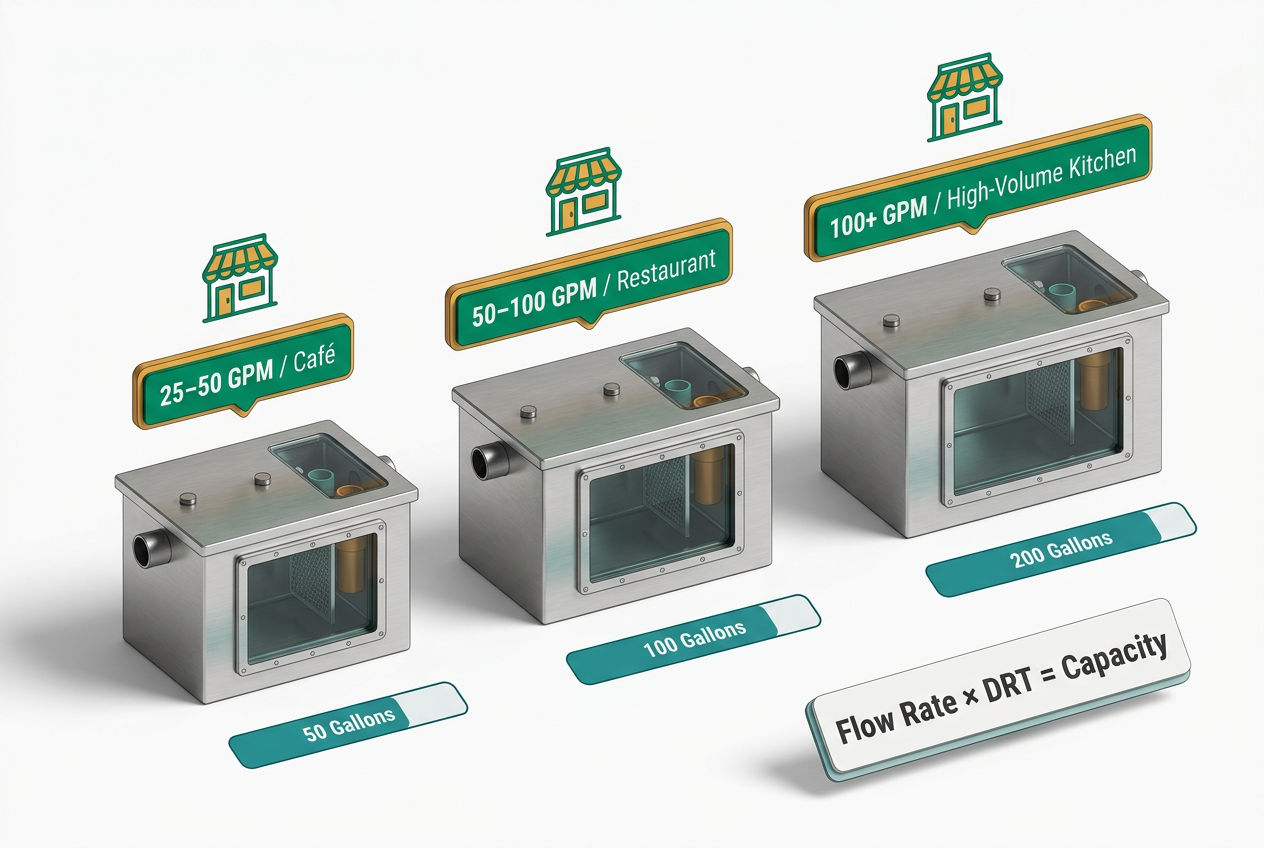
Minimum trap size (gallons) = GPM flow rate × 2
Or, put another way: you need roughly 1 gallon of trap capacity for every 1 gallon per minute (GPM) of connected fixture flow. A three-compartment sink rated at 20 GPM, for example, needs at least a 40-gallon trap as a starting point.
In practice, most municipalities have their own sizing tables based on fixture count, seat count, and meal volume. Many require interceptors for any food service establishment serving 50 or more meals per day, though that threshold varies widely. Check with your local public works department or municipal pretreatment program — they'll have a sizing worksheet specific to your jurisdiction.
A few real-world benchmarks:
- Small café or deli (under 50 seats): 40–75 gallon HGI under the sink
- Mid-size full-service restaurant (50–150 seats): 500–1,000 gallon outdoor GGI
- High-volume fast food or institutional kitchen: 1,500–2,000+ gallon outdoor GGI
Need detailed sizing help? Our guide on how to size a grease trap walks through the full calculation.
Use the calculator above to estimate the minimum interceptor size for your kitchen's fixture configuration.
How Often Does a Restaurant Grease Trap Need to Be Cleaned?
The industry benchmark is the "25% rule": clean your grease trap when the combined depth of the floating grease layer and settled solids reaches 25% of the total liquid depth. At that point, separation efficiency drops off, FOG starts passing through, and you're heading toward a violation.
In practice, that 25% threshold translates to:
| Operation Type | Typical Cleaning Interval |
|---|---|
| High-volume (fast food, large chains) | Every 2–4 weeks |
| Full-service restaurant, mid-volume | Every 1–3 months |
| Café, deli, low-volume kitchen | Every 3–6 months |
| Seasonal or event-based operations | After each operating season |
Source: Industry standard "25% Rule," municipal FOG ordinance guidelines, EPA pretreatment program recommendations.
Those are averages. A burger joint frying 500 pounds of product a week will hit 25% accumulation in three weeks. A coffee shop steaming milk and running a small prep kitchen might stretch to four months. Don't assume — measure. A sludge judge (a clear acrylic tube used to measure layer depths) costs about $30 and takes the guesswork out of scheduling.
Summer and holiday seasons accelerate accumulation significantly. If November through January is your busiest stretch, book an extra cleaning in October. During the holiday rush, reputable pumping companies book up fast. Plan ahead or you'll be scrambling.
For a full breakdown of service scheduling, see grease trap maintenance.
What Happens If a Restaurant Doesn't Clean Its Grease Trap?
Skip a cleaning, and you're not just dealing with a bad smell. Here's what actually happens.
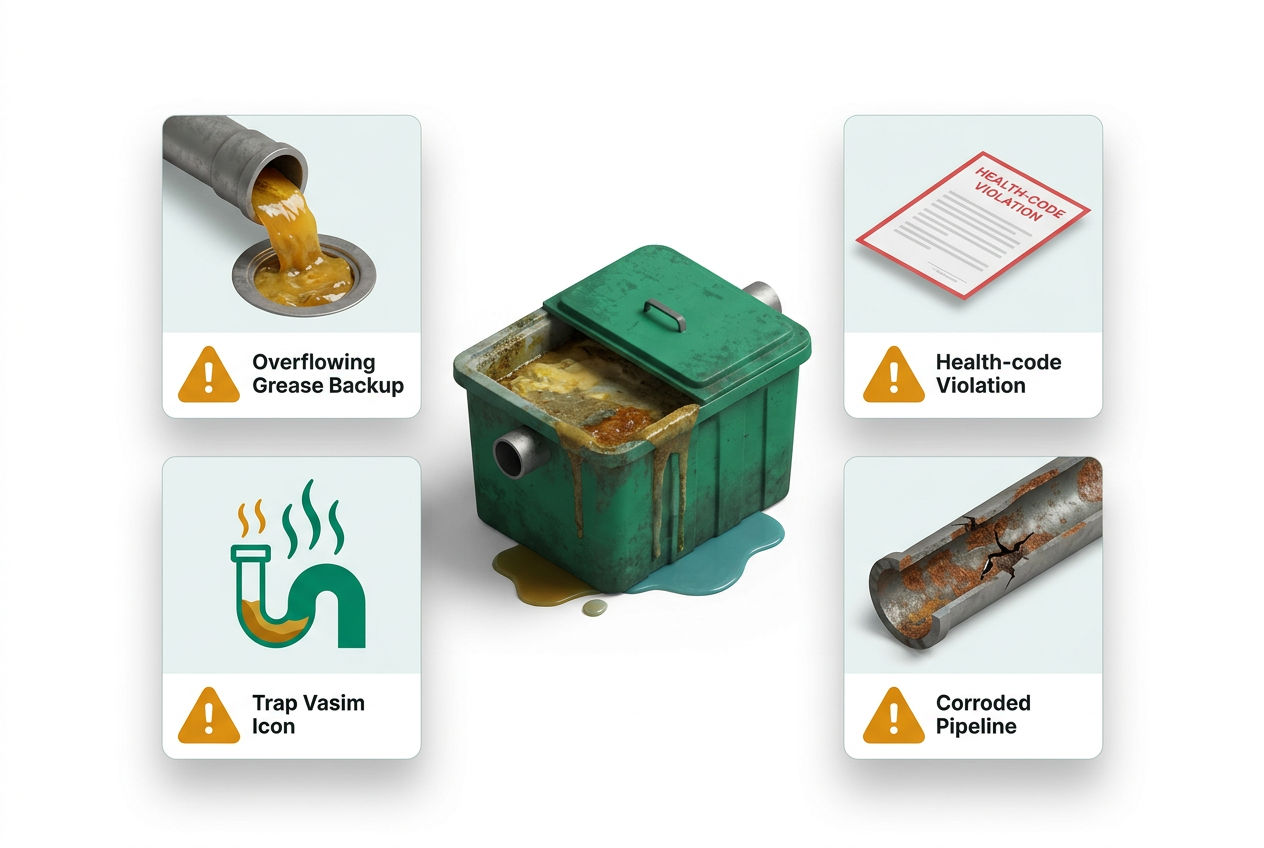
First, the trap stops separating effectively. Grease passes straight through into the sewer line, where it cools and hardens on the pipe walls — a process called grease accretion. Over time, that buildup restricts flow. Eventually, it blocks the line entirely. Picture your kitchen backing up mid-Saturday dinner service. Every drain in the house is gurgling. Your three-compartment sink is overflowing. That's the plumbing problem.
The regulatory problem is worse. The EPA regulates FOG discharge under the Clean Water Act (CWA) via municipal pretreatment programs. Most cities have specific FOG ordinances that require cleaning logs, inspection access, and documented disposal manifests. Fines for non-compliance range from $1,000 to $10,000+ per violation, depending on the municipality. Cities like Los Angeles and New York have levied fines exceeding $25,000 for repeat offenders.
Beyond fines, your health department can issue a notice of violation that triggers an inspection of your entire facility. In serious cases, they can order you to cease operations until the interceptor is serviced and re-inspected.
The EPA estimates that FOG causes approximately 47% of all sewer overflows in the United States. That's why enforcement has tightened significantly over the past decade, especially in dense urban markets like the Northeast and Sun Belt.
How Much Does Grease Trap Cleaning Cost?
Grease trap pumping costs depend on unit size, location, and how often you've been pumping.
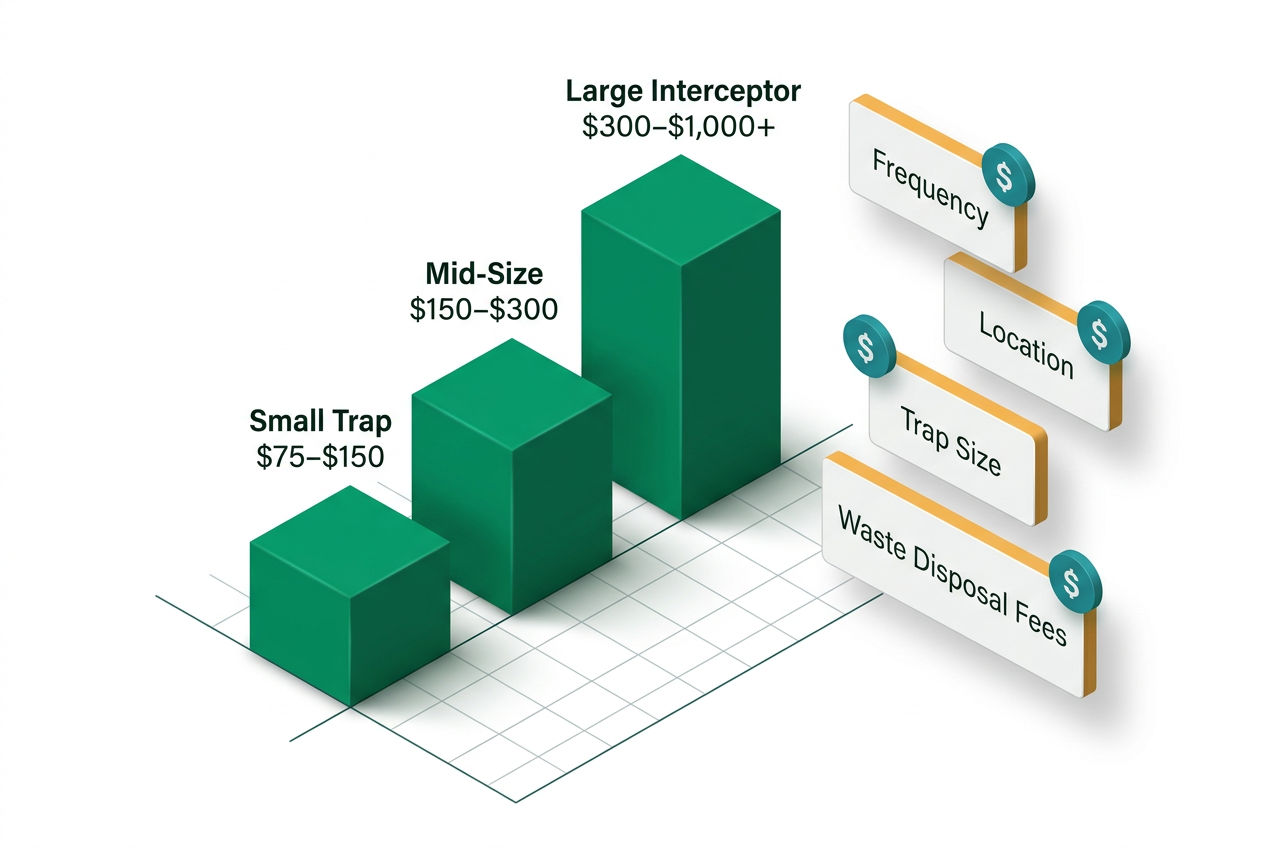
- Small indoor HGI (20–100 gallons): $150–$400 per service
- Large outdoor GGI (500–2,000+ gallons): $400–$1,000+ per service
- Emergency or after-hours service: Add 50–100% to standard rates
Geography matters. A 1,000-gallon outdoor interceptor in Houston runs $350–$600 per pump-out, reflecting competitive market pricing and year-round access. The same tank in Manhattan can run $800–$1,200 because of labor costs, permit requirements for street access, and disposal fees at licensed receiving facilities.
Installation costs are a separate conversation entirely:
- Indoor HGI installation: $250–$500 (unit + basic plumbing)
- Outdoor underground GGI installation: $5,000–$15,000+, depending on tank size, excavation requirements, and local permit fees
For full installation cost detail, see grease trap installation cost.
Ready to get quotes from licensed service providers in your area? Find a grease trap cleaning service near you through our directory.
What's the Difference Between a Grease Trap and a Grease Interceptor?
Technically, every grease trap is a grease interceptor — but not every grease interceptor is what people picture when they say "grease trap." In common usage, "grease trap" usually refers to a small, indoor hydromechanical unit installed under a sink or in a utility closet. "Grease interceptor" is the broader regulatory term that covers all FOG-capturing devices, including the large outdoor gravity units.
Your local FOG ordinance may use either term. California's State Water Resources Control Board uses "grease interceptor" in its regulatory language. New York City's sewer code refers specifically to both "grease traps" and "grease interceptors" as distinct categories with separate sizing requirements.
When you're talking to a contractor or health inspector, ask them to specify which type they mean. The sizing, maintenance schedule, and installation requirements are different enough that the distinction genuinely matters.
Who Is Responsible for Grease Trap Maintenance?
In most jurisdictions, the food service establishment operator — meaning the restaurant owner or lessee — bears legal responsibility for grease trap maintenance and compliance. If you rent your commercial kitchen space, read your lease carefully. Some landlords retain responsibility for shared interceptors. Most don't.
This matters for multi-tenant buildings. If you share an outdoor interceptor with two other tenants and one of them is a high-volume fryer operation, their FOG loads your shared system fast. You need either a clear contractual agreement on service costs and scheduling, or separate interceptors.
Required documentation typically includes:
- Cleaning logs with dates, service provider name, and volume pumped
- Disposal manifests showing waste was delivered to a licensed receiving facility
- Inspection records retained for a minimum of 3 years in most jurisdictions
Keep those records organized. During a health department inspection, a missing manifest is as damaging as a missed cleaning.
Can a Restaurant Clean Its Own Grease Trap?
Technically, yes — in some jurisdictions. Practically, it's rarely the right call.
Small indoor HGIs can be manually cleaned by kitchen staff using the baffle-removal and scraping method: shut off water flow, remove the cover and baffles, scoop out the floating grease layer into a sealed container, scrape accumulated solids from the bottom, and dispose of everything through a licensed waste hauler. Some municipalities allow this for units under 50 gallons.
But there are real limits to DIY grease trap cleaning. Most cities require that waste be transported by a licensed grease hauler with a manifest — meaning even if you clean it yourself, you still need a licensed hauler to pick up the waste. Large outdoor GGIs cannot be DIY-pumped; they require a vacuum truck and licensed operator.
The more important issue: DIY cleaning often misses significant accumulation on the walls and inlet/outlet pipes, leading to faster recontamination. For most commercial kitchens, professional service every 1–3 months is safer, better documented, and often only marginally more expensive than the labor cost of doing it in-house. For a detailed walkthrough of the grease trap pumping process, see our service guide.
Grease Trap Regulations: What Does the Law Actually Require?

Septic Business Blueprint
Thinking about starting your own septic business?
The complete, plain-English playbook to start (or buy), license and grow a profitable septic business — the models, the money math, trucks, disposal, insurance, pricing and how to land your first customers.
Get the Blueprint — $297 →Instant access · 12-chapter playbook + 6-piece toolkit · 60-day money-back guaranteeFederal baseline requirements come from the EPA's National Pretreatment Program under the Clean Water Act. This program requires municipal sewer systems to establish local pretreatment standards — and those local standards are where grease trap requirements actually live. The federal government sets the framework; your city or county sets the specific rules.
Most municipal FOG ordinances require food service establishments to:
- Install an adequately sized grease interceptor (sizing standards vary by jurisdiction)
- Maintain the interceptor per the 25% rule or a specific schedule defined in the ordinance
- Document every service with a cleaning log signed by the service provider
- Retain waste disposal manifests proving FOG went to a licensed receiving facility
- Allow inspection access to municipal pretreatment inspectors with reasonable notice
State-level examples:
- California: The State Water Resources Control Board requires local agencies to enforce FOG control programs. Los Angeles County mandates BMP (Best Management Practice) documentation and annual self-inspections in addition to cleaning logs.
- New York: NYC DEP requires manifest submission within 30 days of service for any food service establishment connected to the city sewer. Failure to submit is treated as a separate violation from failure to clean.
- Texas: Enforcement is city-level. Houston, Dallas, and San Antonio each have distinct FOG ordinance requirements — don't assume compliance in one city transfers to another.
Always verify your specific requirements with your local public works department or municipal pretreatment coordinator. Regulations change, and "my neighbor's restaurant does it that way" is not a compliance strategy.
Grease Traps and Rural Restaurants: A Special Consideration
Restaurants on private septic systems face a different set of challenges than those connected to municipal sewer. Without a functioning grease interceptor, FOG enters the septic tank, floats to the top, and passes into the drain field. There, it coats the soil absorption surface with a biomat layer — a dense microbial film that progressively kills the soil's ability to absorb and treat wastewater.
Once a drain field develops a significant biomat from FOG loading, recovery is difficult and expensive. Drain field replacement runs $15,000–$50,000+ depending on soil conditions, site access, and local permit requirements. In most cases, the root cause — uncontrolled FOG discharge — has been operating for months or years before failure is noticed.
The solution is straightforward but must be implemented correctly: a grease interceptor installed before the septic tank, not after. The interceptor captures FOG before it ever enters the tank, protecting both the tank's bacterial ecosystem and the drain field's absorption capacity. Sizing requirements for septic-connected systems often differ from municipal requirements — consult your state's department of environmental quality or a licensed septic engineer.
For more on how commercial operations intersect with private wastewater systems, see our commercial septic system guide and septic tank maintenance resources.
How Do You Find a Qualified Grease Trap Service Provider?
Not every pumping company is equipped or licensed to handle commercial grease interceptor service. Here's what to verify before signing a service contract:
Licensing: Most states require waste haulers to carry a specific permit for grease waste transport. Ask for the hauler's permit number and verify it with your state environmental agency. An unlicensed hauler — even one who does a good job cleaning — cannot produce a legally valid disposal manifest, which means you're non-compliant regardless of whether the cleaning happened.
Disposal chain: Ask where the grease waste goes. Legitimate haulers deliver to licensed greywater receiving facilities, rendering plants, or biodiesel processors. A hauler who can't name a receiving facility is a liability risk. If they dump illegally, your name is on the manifest.
Service documentation: A reputable company provides a cleaning log signed by the technician, the volume pumped, and a disposal manifest within a week of service. If a company doesn't provide these automatically, find another company.
Experience with your interceptor type: Outdoor GGI service requires vacuum truck equipment and operators experienced with confined-space access. Indoor HGI service is less complex but still requires proper waste handling. Confirm the company services your specific interceptor type.
Find licensed grease trap cleaning professionals near you through the SepticTankHub directory — all listed providers carry verified licensing and disposal credentials.
Frequently Asked Questions
What is a commercial grease trap and do I need one?
A commercial grease trap — also called a grease interceptor — is a plumbing device that captures fats, oils, and grease before they reach the municipal sewer or septic system. Most food service establishments are legally required to have one. Specifically, any operation producing FOG-laden wastewater — restaurants, cafeterias, bakeries, food trucks with fixed plumbing, ghost kitchens, and institutional food service — typically falls under local FOG ordinance requirements. The threshold is commonly set at 50 or more meals per day, though it varies by municipality. Operating without a required grease interceptor exposes you to fines ranging from $1,000 to $10,000 or more per violation, plus potential shutdown orders. If you're unsure whether your operation requires one, contact your local public works department or municipal pretreatment coordinator — they can confirm requirements and provide a jurisdiction-specific sizing worksheet before you invest in equipment.
How often should a restaurant grease trap be pumped?
A restaurant grease trap should be pumped when the combined depth of the floating grease layer and settled solids reaches 25% of the total liquid depth — the industry-standard "25% rule." In practice, that means high-volume operations like fast food chains need grease trap pumping every 2–4 weeks, mid-volume full-service restaurants every 1–3 months, and lower-volume cafés or delis every 3–6 months. These are averages; your actual interval depends on menu type, meal volume, and FOG load. A burger joint frying 500 pounds of product weekly hits 25% accumulation far faster than a café running a small prep kitchen. To take the guesswork out of scheduling, use a sludge judge — a $30 clear acrylic tube that lets you measure layer depths directly. Measure after each service cycle until you know your kitchen's accumulation pattern, then set your pumping schedule accordingly.
What is the difference between a grease trap and a grease interceptor?
The terms "grease trap" and "grease interceptor" are often used interchangeably, but they refer to distinct equipment types in most regulatory contexts. A grease trap typically refers to a small, indoor hydromechanical grease interceptor (HGI) — a 20–100 gallon unit installed under a sink or in a utility room, common in cafés, delis, and smaller food service operations. A grease interceptor, in broader regulatory usage, covers all FOG-capturing devices, including large outdoor gravity grease interceptors (GGIs) ranging from 500 to 2,000+ gallons. California's State Water Resources Control Board uses "grease interceptor" exclusively in regulatory language. New York City's sewer code defines both as separate categories with distinct sizing requirements. When speaking with a contractor, health inspector, or municipal pretreatment coordinator, always ask them to specify which type they mean — the sizing formulas, maintenance schedules, pumping equipment, and installation costs differ significantly between the two.
How much does grease trap cleaning cost for a restaurant?
Grease trap cleaning costs for restaurants range from $150 to $400 per service for small indoor hydromechanical units (20–100 gallons) and $400 to $1,000 or more per service for large outdoor gravity interceptors (500–2,000+ gallons). Emergency or after-hours service adds 50–100% to standard rates. Geography has a significant impact on pricing: a 1,000-gallon outdoor interceptor in Houston typically runs $350–$600 per pump-out, while the same tank in Manhattan can run $800–$1,200 due to higher labor costs, street-access permit requirements, and licensed disposal facility fees. Annual cleaning costs for a mid-volume full-service restaurant with a 1,000-gallon interceptor cleaned quarterly typically run $1,200–$3,000 per year. Installation costs are separate: indoor HGI installation runs $250–$500, while outdoor underground GGI installation ranges from $5,000 to $15,000 or more depending on tank size, excavation, and local permit fees.
What are the grease trap regulations restaurants must follow?
Restaurant grease trap regulations operate at three levels: federal, state, and local. The federal baseline comes from the EPA's National Pretreatment Program under the Clean Water Act, which requires municipalities to establish local pretreatment standards. Your actual compliance obligations are set by your city or county FOG ordinance. Most municipal FOG ordinances require food service establishments to install an adequately sized grease interceptor, maintain it per the 25% rule or a defined schedule, document every service in a signed cleaning log, retain disposal manifests proving FOG was delivered to a licensed receiving facility, and allow municipal inspector access. State-level requirements add additional layers: California mandates BMP documentation and annual self-inspections; New York City requires manifest submission to NYC DEP within 30 days of service; Texas enforcement is city-specific, with Houston, Dallas, and San Antonio each operating distinct FOG programs. Always verify your specific requirements locally — regulations change and vary significantly by jurisdiction.
Can a restaurant use a grease trap enzyme treatment instead of pumping?
Enzyme and bacterial additive products marketed as grease trap treatments are not a substitute for mechanical pumping and are prohibited under many municipal FOG ordinances. These products work by breaking FOG into smaller particles — which then pass through the interceptor into the sewer line, making the downstream problem worse rather than better. The EPA's pretreatment guidance specifically cautions against biological additives that transfer FOG accumulation downstream rather than capturing it. Some municipalities have explicitly banned enzyme treatments in grease interceptors by ordinance. A handful of biological maintenance products are designed to supplement — not replace — pumping by slowing accumulation between service intervals, but their effectiveness is inconsistent and they do not satisfy cleaning log or disposal manifest requirements. If a product vendor claims their enzyme treatment eliminates the need for pumping, that claim is not consistent with EPA guidance or standard municipal FOG ordinance requirements. Always verify with your local pretreatment coordinator before using any additive.
Sources & Methodology
Primary regulatory sources:
- U.S. Environmental Protection Agency, National Pretreatment Program — Clean Water Act Section 307(b) and (c) framework; FOG guidance documents
- EPA statistic: "Approximately 47 percent of all reported SSOs [sanitary sewer overflows] were caused by FOG" — sourced from EPA's Report to Congress: Impacts and Control of CSOs and SSOs (EPA 833-R-04-001)
- California State Water Resources Control Board, Statewide General Waste Discharge Requirements for Sanitary Sewer Systems (Order No. 2006-0003-DWQ)
- New York City Department of Environmental Protection, Rules of the City of New York, Title 15, Chapter 19 — Grease Trap/Interceptor requirements
- Los Angeles County Sanitation Districts, FOG Control Program — BMP documentation requirements
Industry standards:
- The "25% Rule" for grease interceptor cleaning frequency is established in the Plumbing and Drainage Institute (PDI) Standard G101 and widely adopted in municipal FOG ordinances across the U.S.
- Hydromechanical grease interceptor (HGI) and gravity grease interceptor (GGI) classifications per ASME Standard A112.14.3 and PDI G101
Cost data methodology: Cost ranges are compiled from contractor pricing surveys, municipal permit databases, and industry service rate benchmarks current as of early 2025. Regional variation is significant; figures presented represent typical ranges, not guaranteed pricing. Obtain local quotes for accurate estimates.
Regulatory disclaimer: FOG ordinance requirements vary by jurisdiction and are updated periodically. All regulatory information in this article was verified against primary sources as of the published date. Always confirm current requirements with your local public works department or municipal pretreatment coordinator before making compliance decisions.
Was this article helpful?
Frequently Asked Questions
Recommended Resources
📖 Related Articles
- What Is a Grease Trap? How It Works, Sizing & Rules
- How to Size a Grease Trap (Formula + Chart)
- How to Handle Grease Trap Maintenance: Step by Step
- Grease Trap Installation Cost: 2026 Price Guide
- Grease Trap Pumping: The Complete Guide
- What Is a Septic System? How It Works (Visual Guide)
- The Complete Septic Tank Maintenance Guide
🔧 Services
Find Septic Professionals Near You
Compare licensed, verified septic companies by area — top county markets and cities below, or browse all 50 states.
County markets
Popular cities
