
Quick Answer
An under sink grease trap is a small, passive interceptor device installed in the drain line beneath a kitchen sink to capture fats, oils, and grease (FOG) before they reach your plumbing or septic system. Units range from 2 to 35 gallons and cost $50–$800 depending on size and material.
Key Takeaways
- Under sink grease traps (also called hydromechanical grease interceptors) capture FOG before it clogs your drains or damages your septic system.
- Commercial kitchens almost always need one by code. Residential need is situational — but septic homeowners benefit significantly.
- Size is determined by flow rate (GPM), not just sink volume. Most small commercial units run 10–50 GPM.
- Clean your trap when the grease and solids layer hits 25% of total capacity — typically every one to four weeks in commercial use.
- Neglecting cleaning turns a $150 maintenance call into a $500–$2,500 drain backup repair.
What Is an Under Sink Grease Trap and How Does It Work?
An under sink grease trap is a passive intercepting device plumbed directly into the drain line beneath a kitchen sink. It slows wastewater flow, allows it to cool, and uses the natural density difference between water and fat to separate grease before it travels downstream.
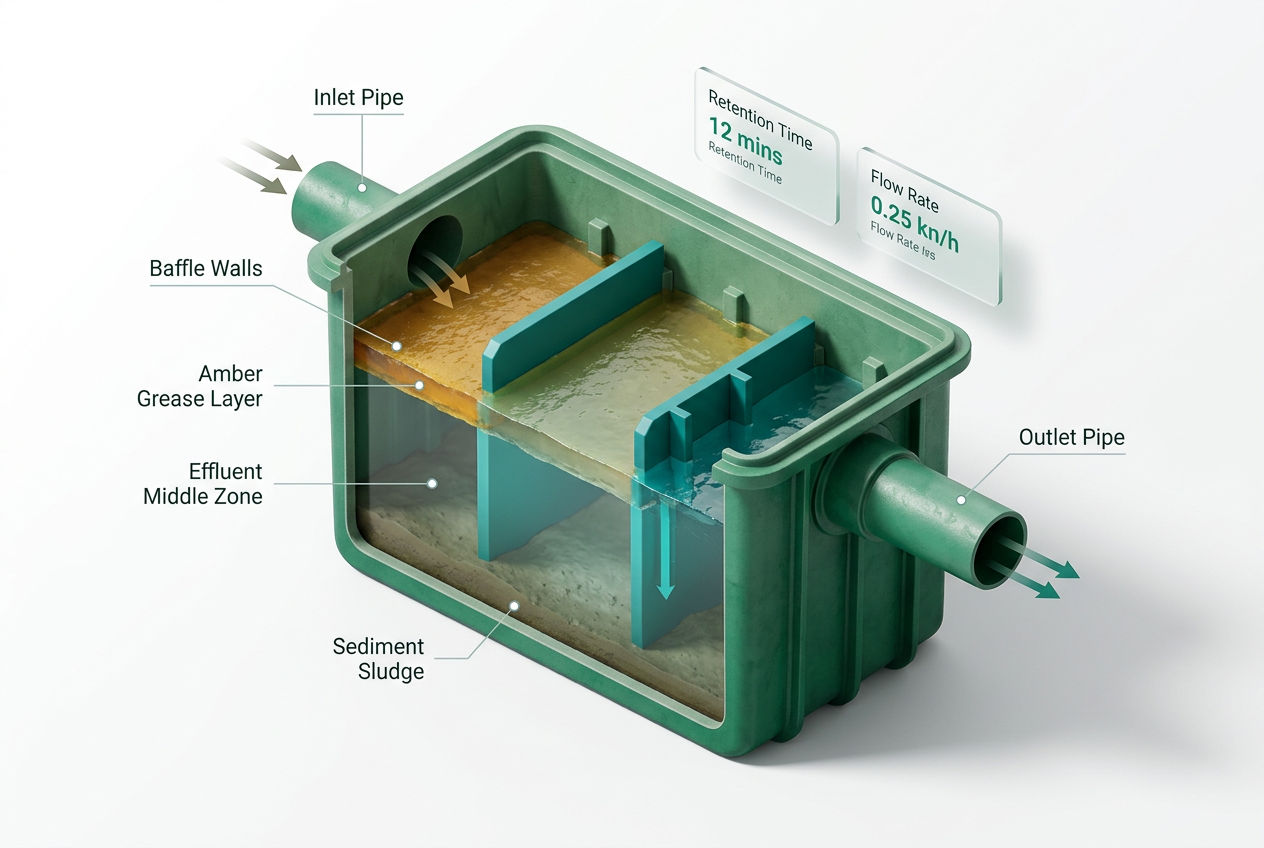
Here's the physics: grease floats. Water drains away through an outlet baffle positioned below the grease layer, while FOG accumulates at the top of the trap chamber. Heavier solids sink to the bottom. The middle layer — relatively clean water — exits through the outlet and continues to your drain or septic system.
Per PDI G101 standards (Plumbing & Drainage Institute testing criteria), passive hydromechanical grease interceptors must provide a minimum 2.5-minute retention time for grease separation to occur effectively. That's why water temperature matters so much. Hot dishwater above 65°F keeps grease in liquid suspension, reducing separation efficiency. If employees are dumping near-boiling water directly into an interceptor, you're losing a significant chunk of the trap's effectiveness.
Properly maintained units achieve 85–90%+ grease removal efficiency, which is why they're the first line of defense for any kitchen connected to a municipal sewer or private septic system.
For a deeper look at how grease traps fit into the broader wastewater picture, the what is a grease trap guide covers the full system context.
Do You Actually Need an Under Sink Grease Trap at Home?
Most residential homeowners do not need an under sink grease trap — but that answer changes fast if you're on a private septic system.
For homes connected to a municipal sewer, the city's wastewater treatment plant handles residual FOG. Residential cooking volumes are typically low enough that standard drain maintenance keeps things moving. Your local municipality almost certainly doesn't require one for a single-family home.
The exception: homes on septic systems. Fats, oils, and grease are devastating to septic tank bacteria. FOG coats the microbial community in your tank, suppresses digestion, and eventually passes into the drain field as a sticky biomat that clogs the soil. The EPA has linked FOG to approximately 47% of the 36,000+ sewer overflows that occur annually in the U.S. — and the same chemistry destroys residential drain fields.
If your household fries food regularly, runs a home daycare, or operates any kind of food-prep business out of the home, an under sink grease trap is worth serious consideration. A 5-gallon or 10-gallon passive unit costs $75–$200 and could save you from a drain field replacement that runs $5,000–$20,000.
The calculus is even clearer in the Southern U.S. — Florida, Texas, Georgia — where a large share of rural homes rely on septic. Installing a small grease trap is cheap insurance.
What Is the Difference Between a Grease Trap and a Grease Interceptor?
These terms get used interchangeably, but there's a real technical distinction worth knowing.
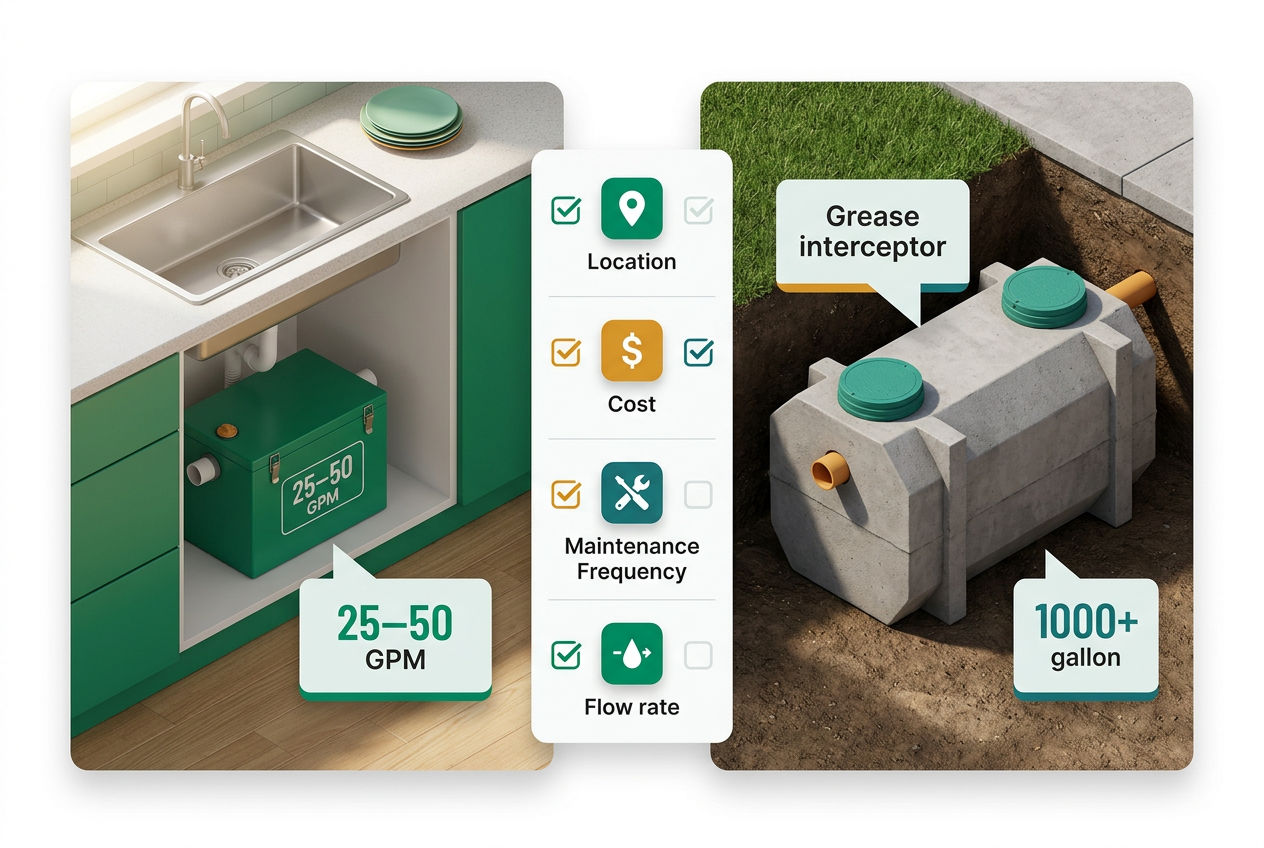
Grease trap typically refers to smaller, passive, hydromechanical units installed indoors — under a sink or in a floor — in close proximity to the fixture. They're governed by ASME A112.14.3 (the hydromechanical grease interceptor standard) and PDI G101 testing protocols. Capacities usually run from 2 to 50 gallons with flow rates of 5 to 50 GPM.
Grease interceptor more commonly refers to large, gravity-type units installed outdoors underground, downstream from the building. These are concrete or fiberglass tanks ranging from 500 to 2,000+ gallons. Installed cost runs $3,000–$10,000+. They serve high-volume food service operations — full-service restaurants, institutional kitchens, school cafeterias.
For most small food businesses, cafes, food trucks with commissary access, and septic homeowners, the under sink grease trap is the practical choice. Larger restaurants often need both: under-sink units at each prep sink and a large exterior interceptor before the building connection.
Are Under Sink Grease Traps Required by Law for Restaurants?
For commercial food service establishments, the answer is almost universally yes — though the specific requirement depends on your municipality.
Most cities and counties require any food service establishment to install a grease trap or interceptor before connecting to the municipal sewer system. Many jurisdictions reference the Uniform Plumbing Code (UPC) or International Plumbing Code (IPC), which mandate interceptors for facilities that produce FOG. Local health departments typically enforce these requirements through permitting and periodic inspection.
In dense urban markets — New York City, Chicago, Los Angeles — FOG ordinances are aggressive. NYC's Department of Environmental Protection requires approved grease interceptors in virtually all food service facilities and mandates documented cleaning logs. Violations carry fines that can reach hundreds of dollars per occurrence.
In rural counties, enforcement is more variable, but the requirement often still exists on paper. If you're opening a food business and connecting to a municipal sewer, call your local health department before your plumber finalizes the rough-in. Getting caught without a required trap after installation means expensive retrofit work.
For detailed requirements by region, the restaurant grease trap requirements article breaks down commercial compliance specifics.
What Size Under Sink Grease Trap Do You Need?
Sizing a grease trap correctly is the most common mistake people make — and an undersized unit fills up in days, not weeks.
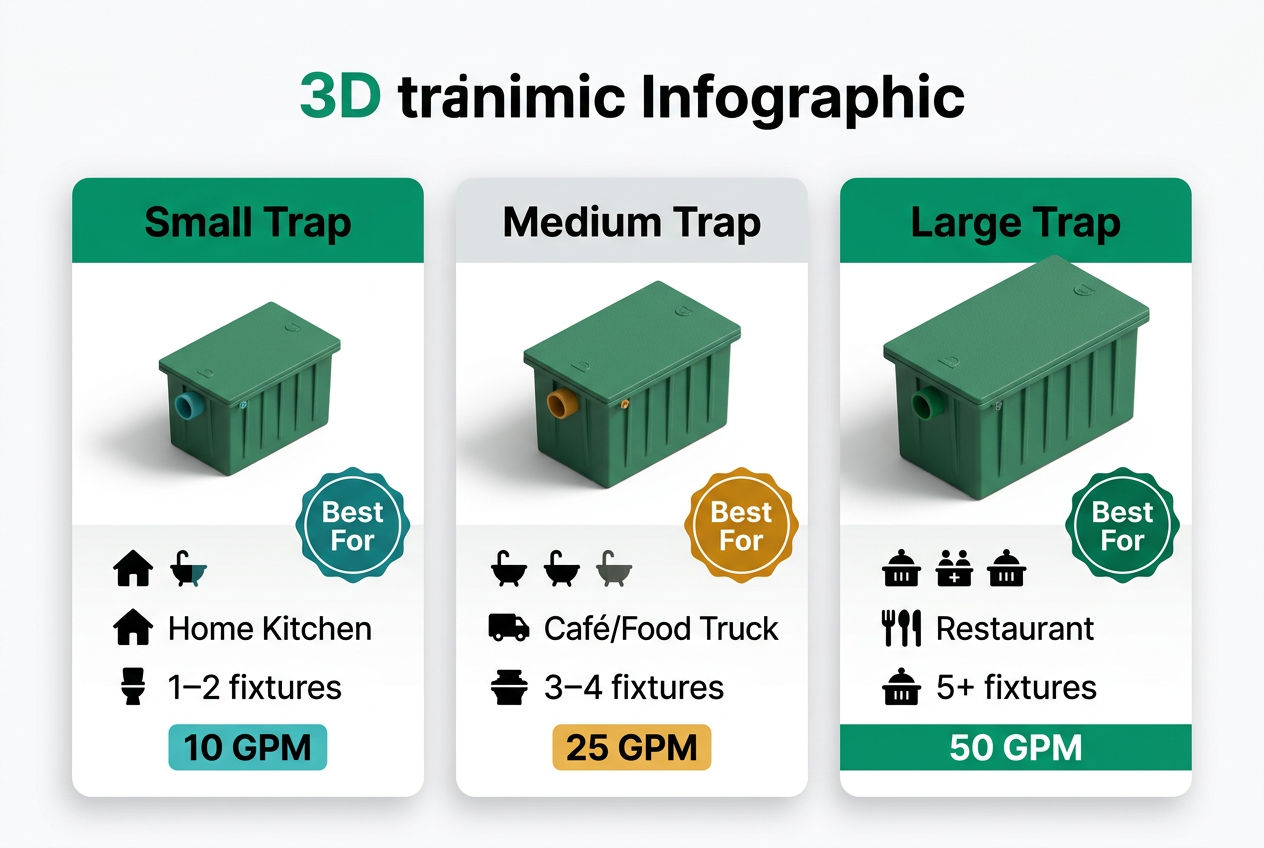
The PDI sizing method calculates required trap capacity based on flow rate in gallons per minute (GPM), not sink volume. The standard formula:
GPM = (Sink length × width × depth in inches) ÷ 231 × drain factor
In practice, most plumbing supply houses and the PDI sizing guide simplify this. Common under-sink units are rated at 5, 10, 15, 20, and 25 GPM, which roughly correspond to trap capacities of 20, 35, 50, 70, and 100 pounds of grease retention.
Here's a real-world sizing example. A small café with a two-compartment prep sink that drains at 20 GPM needs at minimum a 20 GPM-rated unit — something like a Watts WD-35 (35-gallon capacity) or equivalent. That same unit would be dramatically oversized for a home kitchen but appropriate for a food truck commissary sink.
| Application | Typical Flow Rate | Recommended Capacity | Unit Cost (Approx.) | Cleaning Frequency |
|---|---|---|---|---|
| Residential (septic) | 5–10 GPM | 5–10 gallons | $50–$150 | Monthly–quarterly |
| Small café / food truck | 10–15 GPM | 20–35 gallons | $150–$350 | Weekly–biweekly |
| Deli / bakery | 15–20 GPM | 35–50 gallons | $300–$500 | Weekly |
| Full-service restaurant | 20–50 GPM | 50–100 gallons | $400–$800 | Weekly or more |
| Institutional kitchen | 50+ GPM | Exterior interceptor | $3,000–$10,000+ | Per manifest |
Sources: PDI G101 sizing standards; EPA FOG management guidelines; manufacturer published specifications.
For a full sizing walkthrough, the how to size a grease trap guide includes the PDI calculation worksheets.
Can You Install an Under Sink Grease Trap Yourself?

Septic Business Blueprint
Thinking about starting your own septic business?
The complete, plain-English playbook to start (or buy), license and grow a profitable septic business — the models, the money math, trucks, disposal, insurance, pricing and how to land your first customers.
Get the Blueprint — $297 →Instant access · 12-chapter playbook + 6-piece toolkit · 60-day money-back guaranteePhysically, yes — the plumbing involved is straightforward. An under sink grease trap installs in the drain line between the sink's P-trap and the wall stub-out. Most units use standard 2-inch or 3-inch slip-joint connections. A competent DIYer with basic plumbing experience can complete an installation in two to four hours.
That said, commercial installations almost always require a licensed plumber and a permit. Your local health department will want to inspect the installation before issuing a food service license. Even if you install it yourself, a licensed plumber typically needs to sign off.
For residential septic applications, many homeowners handle their own installation without issue. You're looking at roughly $75–$250 in materials for a 5- to 10-gallon unit. Professional installation runs $200–$600 including labor and any drain line modifications needed to accommodate the trap.
A few installation details that matter:
- Position the trap as close to the sink as possible. The further downstream it sits, the more time grease has to cool and stick to pipes before reaching the trap.
- Ensure the unit is level. An unlevel trap disrupts the grease/water separation layer.
- Don't bury access panels. You're going to be opening this thing regularly. Make it reachable.
Check the grease trap installation cost guide for a full breakdown of professional versus DIY cost scenarios.
How Often Does an Under Sink Grease Trap Need to Be Cleaned?
The industry standard is the 25% rule: clean the trap when the combined grease layer (floating at the top) and solids layer (settled at the bottom) equal 25% of the trap's total liquid capacity.
In commercial kitchen terms, that often means weekly to biweekly cleaning during normal operations. A busy restaurant during summer season — or the Thanksgiving-through-New Year period when cooking volume spikes — can hit the 25% threshold in four to five days.
For a residential installation with moderate cooking, monthly cleaning is typical. If you're largely frying or cooking proteins daily, bump that to every two to three weeks.
Professional grease trap cleaning for small under-sink units costs $100–$400 depending on your location and the service provider. In high-cost urban markets like NYC or LA, expect the upper end of that range. Rural areas typically run $100–$200. The waste material — called "brown grease" — must be hauled to an approved disposal facility by a licensed hauler.
Neglect has a steep price. A grease trap that overflows or passes accumulated FOG downstream causes:
- Drain backups requiring hydro-jetting: $300–$700
- Pipe replacement if corrosion sets in: $500–$2,500+
- Septic drain field damage that requires full replacement: $5,000–$20,000
The math on regular maintenance isn't close. See grease trap cleaning and grease trap pumping for service options near you.
What Happens If You Don't Clean Your Grease Trap?
Skip enough cleanings and the trap stops functioning as a trap. Once the grease layer exceeds 25% of capacity, FOG begins bypassing the outlet baffle and continuing downstream. From there, it re-liquefies, travels through your drain lines, and eventually solidifies somewhere cooler — often deep in your lateral pipe, at the connection to the main sewer, or in your septic tank.
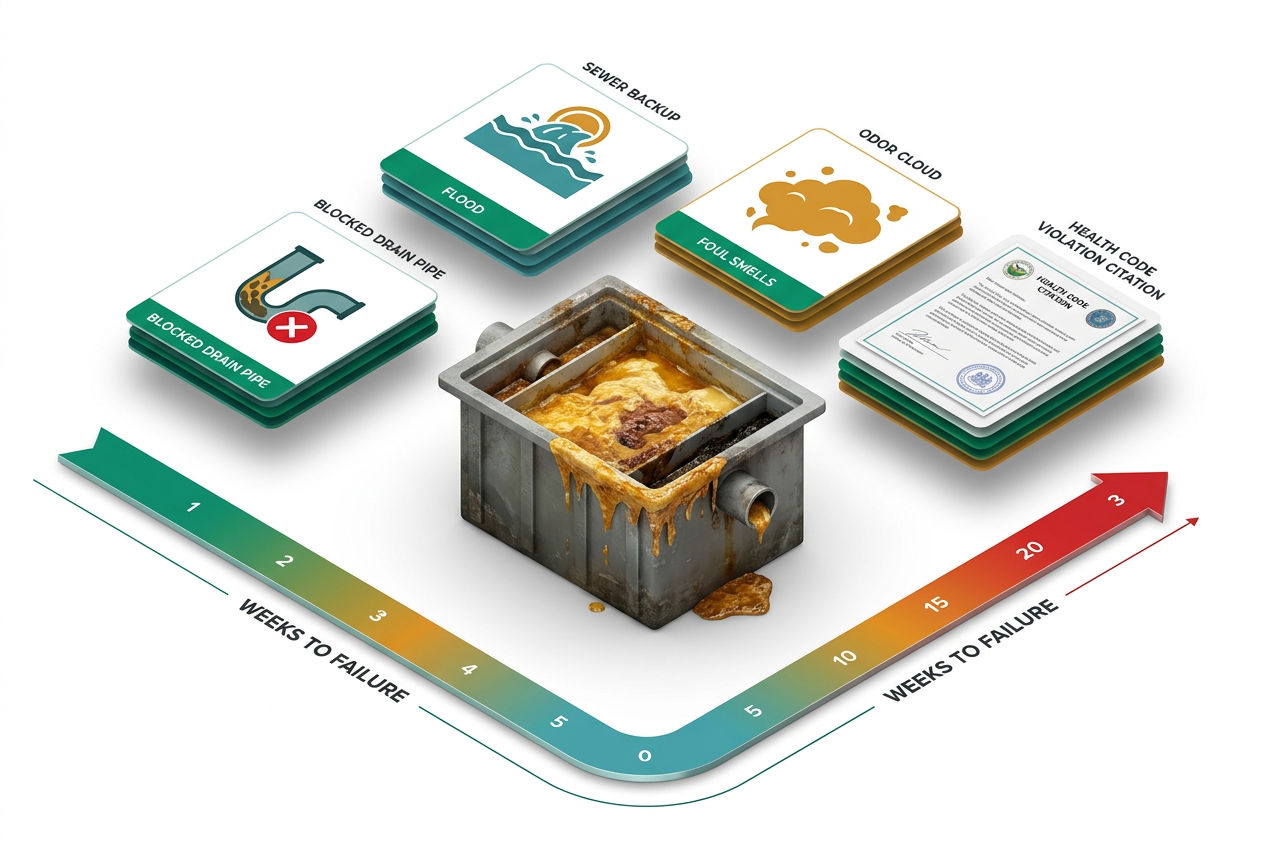
Inside a septic tank, accumulated grease forms a thick scum layer that septic tank bacteria cannot break down efficiently. That leads to premature tank failure, solids passing into the drain field, and the dreaded biomat clog that suffocates soil absorption. Recovering a biomat-clogged drain field is expensive — and sometimes impossible without full replacement.
There's also the odor issue. An overfull, undertreated grease trap produces hydrogen sulfide gas — the rotten-egg smell that customers notice immediately. In a commercial kitchen, that's a health department violation waiting to happen.
Some operators use biological grease trap treatments — enzyme or bacterial additives — to extend time between cleanings. These products can help supplement regular maintenance by digesting lighter FOG components, but they are not a substitute for physical pumping. Just like septic additives, biology helps a healthy system stay healthier; it won't rescue a neglected one.
How Much Does an Under Sink Grease Trap Cost?
Here's a full cost picture:
Equipment:
- Small residential (2–10 gallon, plastic): $50–$150
- Commercial passive (20–35 gallon, plastic): $150–$350
- Commercial passive (50–100 gallon, stainless steel): $400–$800
Installation:
- DIY residential: $75–$250 in materials
- Professional installation: $200–$600
Ongoing maintenance:
- Professional cleaning (small units): $100–$400 per service
- Annual cleaning cost (weekly service, small café): $5,200–$20,800/year
Consequence costs if neglected:
- Hydro-jet drain clearing: $300–$700
- Drain line repair: $500–$2,500+
- Septic system repair: See septic repair cost
Stainless steel units cost more upfront but last significantly longer in commercial environments where plastic bodies degrade from heat cycling and cleaning chemicals. For a single-location food business, the mid-range Thermaco Big Dipper or Watts WD-35 series offer a solid balance of capacity, durability, and compliance-ready documentation.
For grease trap cleaning services in your area, the SepticTankHub directory connects you with licensed FOG haulers and septic professionals.
Troubleshooting Common Under Sink Grease Trap Problems
Trap fills too quickly. You're either undersized for your flow rate, or someone is dumping hot cooking oil directly into the drain. Size up to the next GPM rating and post a "No Direct Grease Disposal" sign.
Persistent bad odor even after cleaning. Check the inlet baffle for cracks or displacement — a damaged baffle allows septic gases to vent back through the sink drain. Also verify the trap lid seal is intact. Hydrogen sulfide escaping from a small gap is enough to make a kitchen unbearable.
Water draining slowly through the trap. The outlet screen or baffle is probably partially blocked with solids. Full cleaning required. If slow drainage persists after cleaning, check for a grease hardening event in the downstream pipe — this is common in cold climates where pipes run through unheated crawl spaces in winter.
White or gray residue instead of brown grease. This is saponified grease — a soap-like compound formed when FOG reacts with alkaline cleaning chemicals. It's harder to pump and requires chemical treatment before mechanical removal. Avoid dumping high-pH degreasers directly into the trap.
Refer to grease trap maintenance for a seasonal inspection checklist.
Sources & Methodology
-
EPA — Fats, Oils & Grease (FOG) Resources: Referenced for annual sewer overflow statistics and FOG management guidelines. epa.gov
-
PDI G101 — Plumbing & Drainage Institute Testing Standard: Basis for flow rate sizing methodology, retention time requirements, and grease removal efficiency benchmarks. Referenced by name per PDI published standards.
-
ASME A112.14.3 — Hydromechanical Grease Interceptors: Referenced for technical definitions distinguishing grease traps from gravity interceptors and performance specifications.
-
Manufacturer specifications: Thermaco (Big Dipper series), Watts Drainage Products (WD series) — referenced for typical sizing and cost ranges.
-
SepticTankHub service provider network: Regional cost ranges for cleaning and installation derived from professional listings and verified provider data across the SepticTankHub directory.
Frequently Asked Questions
Was this article helpful?
Frequently Asked Questions
Recommended Resources
📖 Related Articles
- What Is a Septic System? How It Works (Visual Guide)
- What Is a Grease Trap? How It Works, Sizing & Rules
- Restaurant Grease Trap: The Complete Guide
- How to Size a Grease Trap (Formula + Chart)
- Grease Trap Installation Cost: 2026 Price Guide
- Grease Trap Cleaning: How It Works, How Often & What It Costs
- Grease Trap Pumping: The Complete Guide
- How Septic Tank Bacteria Work (And Why They Matter)
- Do Septic Tank Additives Actually Work? (The Science)
- How to Handle Grease Trap Maintenance: Step by Step
💰 Cost Guides
🔧 Services
Find Septic Professionals Near You
Compare licensed, verified septic companies by area — top county markets and cities below, or browse all 50 states.
County markets
Popular cities
