
Quick Answer
Published: June 12, 2025 · Updated: July 14, 2025 Septic pump replacement costs $800–$2,500 for most homeowners, covering both the pump unit and professional labor. Grinder pump or lift station replacements can push $3,000–$5,000 depending on system complexity and access. According to NOWRA (National Onsite Wastewater Recycling Association) member contractor data compiled in 2024–2025, the national average for a standard residential effluent pump swap — parts and labor — lands around $1,100. Catching the warning signs early — and understanding what caused the failure — can save you from a much larger repair bill down the road.
Key Takeaways
- Most septic pumps last 7–15 years; float switches often fail first, around 3–7 years
- Total replacement cost runs $800–$2,500 for effluent pumps; up to $5,000 for complex lift station systems
- A septic tank alarm going off is often the first sign your pump has failed
- Float switch failure, burnout from overloading, and age are the top three causes
- Permit requirements vary by state — always verify with your local health department before work begins
What Are the Signs of a Failing Septic Pump?
The most common signs of septic pump failure are a high-water alarm triggering in your pump chamber, slow drains throughout the house simultaneously, sewage odors near the tank, and wet or unusually green patches appearing over your drain field. If you see two or more at once, stop running water and call a professional immediately.

A failing septic pump rarely quits all at once. Usually, it sends you a few warnings first — and knowing what to look for can be the difference between a $200 float switch repair and a full septic system backup.
The most common signs of septic pump failure include:
- The septic tank alarm is going off. Most pump chambers have a high-water alarm wired to a float. When effluent rises above the normal dosing level — because the pump isn't moving it — the alarm triggers. Don't silence it and walk away. That alarm means the pump isn't doing its job.
- Slow drains throughout the house. One slow drain is usually a clog. Every drain moving slowly at the same time? That's a system-wide issue, often traced back to septic pump failure or a full tank.
- Sewage odors indoors or near the tank. When a pump chamber backs up, gases and odors work their way back through the plumbing.
- Wet or unusually green patches over your drain field. If the pump is failing to dose the drain field consistently, effluent can pool and surface. Read more about what causes this at wet spots in your yard from septic.
- Toilets that won't flush or gurgling sounds in the pipes. A septic system backup and pump failure often look identical from inside the house.
If you're seeing two or more of these at once, stop running water and call a septic professional. The longer a failed pump sits, the higher the risk of drain field damage — which is a $5,000–$30,000 repair, not a $2,000 one.
What Causes a Septic Pump to Burn Out?
Understanding what killed your pump matters — because replacing the pump without fixing the root cause means you'll be back in the same situation in two years.
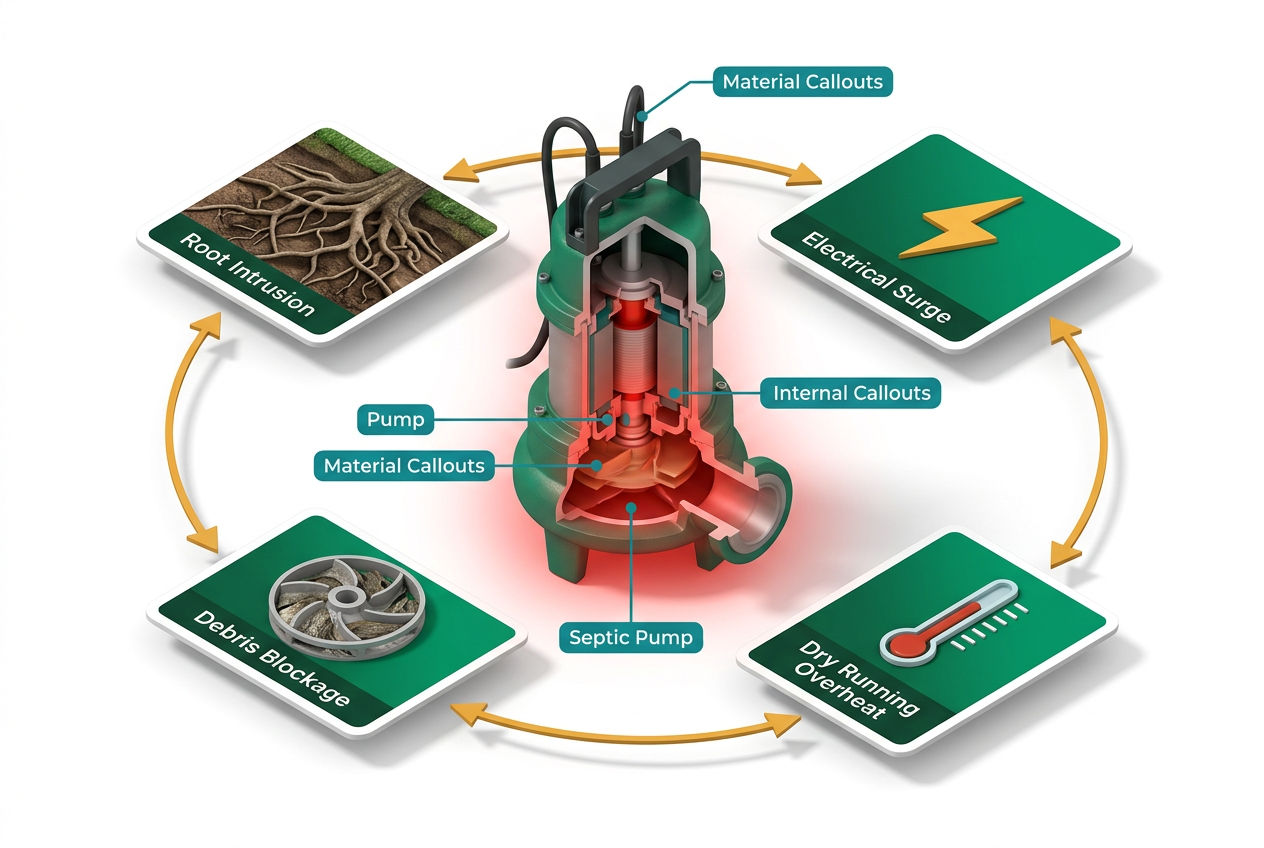
Float Switch Failure
The float switch is a small, buoyant device that rises and falls with the liquid level in your pump chamber. When effluent reaches the "on" setpoint, the float triggers the pump to run. When it drops to the "off" setpoint, the pump shuts down.
Float switches have a lifespan of only 3–7 years — often shorter than the pump itself. A stuck float can keep the pump running continuously (burning it out) or prevent it from running at all. This is the most common cause of septic pump failure that isn't actually a pump problem. Before you budget for a $400 submersible pump replacement, ask your tech to test the float switch first. A new float switch costs $30–$75 and takes 20 minutes to swap.
Overloading From Excessive Water Use
Picture this: you've got a house full of guests for Thanksgiving, four people showering, three loads of laundry, and a dishwasher cycling every few hours. Your pump chamber — typically sized for 500–1,000 gallons — gets overwhelmed. The pump runs almost continuously for 48 hours straight, overheats, and burns out.
This is especially common in homes that host extended guests, run hot tubs, or have recently added a garbage disposal. A garbage disposal stresses your septic system in ways most homeowners underestimate.
Electrical Failures and Wiring Problems
Moisture intrusion, rodent damage, or corrosion in the electrical connections can cause pump failures that look mechanical but are purely electrical. In coastal regions like Florida, South Carolina, and Louisiana, saltwater-saturated air accelerates corrosion on wiring terminals and pump motor windings. Coastal homeowners often see pump lifespans drop to 5–8 years instead of the standard 10–15. In the Northeast and Upper Midwest, freeze-thaw cycles crack conduit and expose wiring to moisture. Minnesota and Wisconsin see a spike in pump-related service calls every spring when ground thaw reveals winter damage to electrical components.
Age and Normal Wear
Effluent pumps last 7–15 years under normal use. Grinder pumps, which work harder to macerate solids before pumping, typically max out at 5–10 years. If your pump is 12 years old and struggling, don't waste money troubleshooting — replace it proactively before it fails completely during a holiday weekend when emergency rates are 1.5–2x standard pricing.
How Much Does Septic Pump Replacement Cost?
Septic pump replacement costs $800–$2,500 for most residential installations, including the pump unit and professional labor. Complex lift station pump replacements can reach $3,000–$5,000 or more.
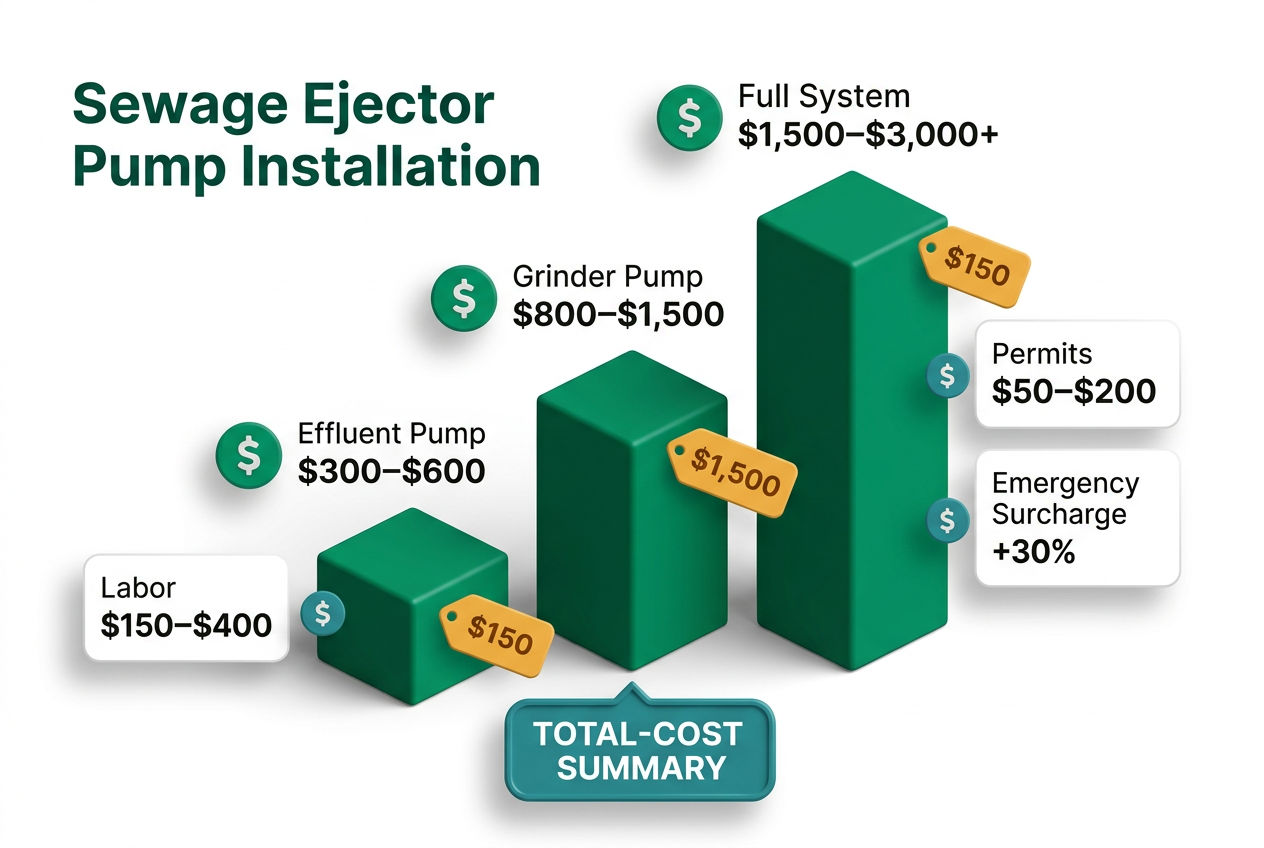
Here's a detailed cost breakdown:
| Component | Low End | High End | Notes |
|---|---|---|---|
| Effluent pump (unit only) | $250 | $600 | ½–1 HP submersible |
| Grinder pump (unit only) | $500 | $1,200 | Harder wear, shorter life |
| Labor (standard access) | $300 | $800 | 2–4 hours typical |
| Emergency/after-hours labor | $500 | $1,500 | 1.5–2x standard rate |
| Float switch replacement | $30 | $150 | Parts + labor |
| Lift station full replacement | $2,000 | $5,000+ | Includes controls, panels |
Source: National Septic Service Industry averages compiled from NOWRA member contractor data and regional service quotes, 2024–2025.
Worked example: A homeowner in suburban Atlanta replacing a failed ⅓ HP effluent pump in a standard pump chamber with easy lid access will likely pay $900–$1,400 all in. Assume $350 for a Liberty Pumps LE51M unit, $475 in labor for a 2.5-hour job, and $75 for a replacement float switch. Total: $900. That same job in rural northern Minnesota — where a contractor may drive 45 minutes each way and the ground is frozen in March — adds $200–$400 in travel and frozen-access surcharges, bringing the total to $1,100–$1,800.
For a full regional pricing breakdown, see our detailed septic pump replacement cost guide.
What's the Difference Between a Septic Effluent Pump and a Grinder Pump?
A septic effluent pump moves partially treated liquid from the pump chamber to the drain field and is designed for liquid with small suspended solids. A grinder pump handles raw sewage directly, using hardened steel cutting impellers to macerate solids before pumping — making it necessary in low-pressure sewer systems and homes where the septic tank sits below the house.
These two pump types handle different jobs and fail for different reasons — and mixing them up leads to expensive misdiagnosis.
Septic effluent pumps (sometimes called sewage ejector pumps) move partially treated liquid effluent from the pump chamber to the drain field or a second treatment stage. They're designed for liquid with small suspended solids, typically found in a conventional septic system after primary treatment. A standard residential effluent pump runs ½ to 1 HP and moves 10–40 GPM depending on head pressure and pipe diameter. Brands like Goulds Water Technology and Liberty Pumps are common in residential installations.
Septic grinder pumps handle raw sewage directly. They use hardened steel cutting impellers to macerate solids before pumping — which is why they're used in low-pressure sewer systems, basement sewage ejector applications, and homes where the septic tank sits at a higher elevation than the house.
Grinder pumps work much harder than effluent pumps, which is why their lifespan is shorter (5–10 years) and their unit cost is higher ($500–$1,200). Choosing the wrong replacement pump is a real mistake. Installing an effluent pump where a grinder pump is required will result in clogging and failure within months. Your septic technician should verify the original pump specifications before ordering a replacement.
Important limitation: Sewage pump replacement in older systems sometimes reveals that the original pump type is no longer manufactured to the same specifications. In those cases, your contractor may need to resize the pump to current head pressure and flow rate standards — which can add $150–$300 to the job. Always ask whether the replacement unit is a direct spec match before work begins.
For a deeper comparison, read our guide on effluent pump vs. grinder pump.
Septic Pump Repair vs. Replacement: Which Makes More Sense?
Not every pump problem requires full replacement. Here's how to think through the decision.
Repair makes sense when:
- The float switch is faulty but the pump motor tests good (under $150 to fix)
- A wire connection corroded but the motor is under 7 years old
- The pump tripped a circuit breaker due to a one-time overload but runs fine when reset
Replacement makes more sense when:
- The pump is 10+ years old
- The motor has burned out (typically means internal failure, not repairable cost-effectively)
- Repair quotes exceed 50% of replacement cost
- The pump has failed more than once in three years
Think of it like an old car. Sure, you could keep repairing a 13-year-old pump — but every service call costs $200–$400, and you're one bad weekend away from a backup into your house. Proactive replacement at year 12 is almost always cheaper than reactive emergency replacement at year 15.
Can I Replace a Septic Pump Myself?
Technically, a homeowner can physically remove and reinstall a submersible effluent pump — but in most states, doing so without a licensed contractor and the required permit is illegal and will void your homeowner's insurance coverage for any resulting damage.
Technically, a homeowner can physically disconnect and swap a submersible pump — the mechanical steps aren't complex. But there are three serious reasons to think twice:
1. Permit requirements are real and enforced. Massachusetts (under 310 CMR 15.000), New Jersey, Maryland, and Washington state all require a licensed septic contractor to perform pump replacements, and some counties require a health department inspection before cover replacement. Doing it yourself without a permit can result in fines and — more seriously — a required system shutdown until inspected.
2. Electrical work is dangerous in wet environments. Pump chambers are wet, confined, and potentially contain hydrogen sulfide gas. Wiring a new pump without proper GFCI protection and waterproof connections creates both electrocution and explosion risk.
3. Misdiagnosis is expensive. If you pull a pump and install an identically-sized replacement, but the real problem was a failing control panel or a partially clogged pressure line, you've spent $300–$600 on parts and solved nothing.
What you can do yourself: Test the high-water alarm, note the pump model number and installation date, and have that information ready when you call a contractor. It will cut 20 minutes off every service call.
How Long Does a Septic Pump Last?
Free download
Free: the Septic Fridge Card — what to flush, what never to.
The Do / Don’t card the whole family can see, plus the Survival Kit: emergency flowchart, warning-sign decoder and pump-schedule card. One printable PDF.
A standard residential effluent pump lasts 7–15 years under normal conditions, while grinder pumps typically reach 5–10 years due to the higher mechanical demands of processing raw sewage. Float switches — the component most likely to fail first — have a shorter lifespan of just 3–7 years.
According to the National Association of Wastewater Technicians (NAWT), actual pump lifespan varies significantly based on:
- Usage volume: A household of 6 people will wear out a pump faster than a household of 2, even with the same pump model
- Water quality: High iron content or hard water accelerates impeller wear
- Installation quality: Pumps installed with proper check valves and correctly sized discharge lines last longer
- Climate: Coastal and northern climates reduce lifespan as described above
A pump that is 10 years old and showing any symptoms should be treated as a replacement candidate, not a repair candidate. At year 12, proactive replacement is almost always the right financial call.
What Happens During the Septic Pump Replacement Process?
A typical septic pump replacement follows a predictable sequence that takes 2–4 hours for a straightforward installation with accessible lids and no electrical complications.
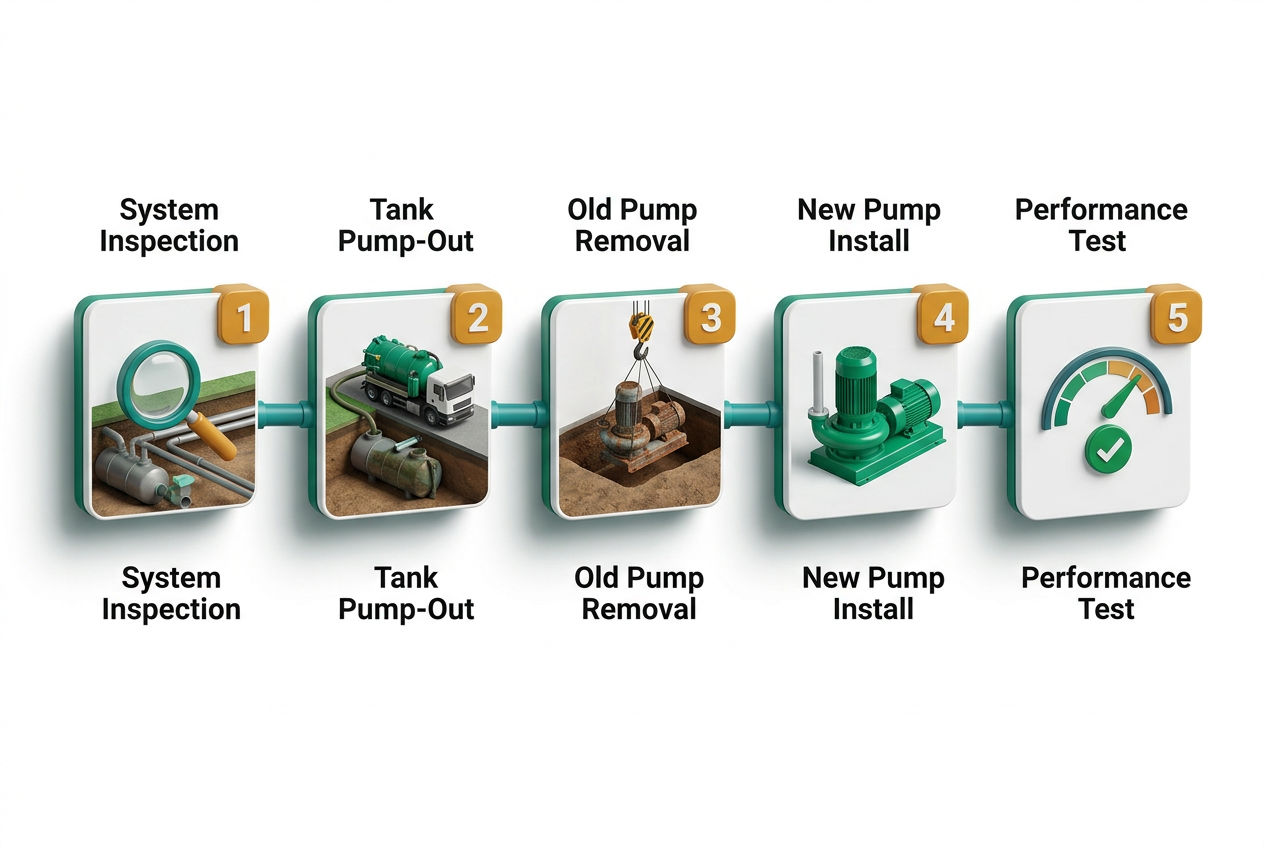
Here's what to expect:
- Diagnosis and pump chamber access. The technician removes the pump chamber lid (typically 20–24 inches diameter) and inspects water level, float position, and control panel readings.
- Float switch testing. Before pulling the pump, a good technician tests the float switch independently. If the float is the problem and the pump motor tests fine, the job ends here for $75–$150 instead of $1,200.
- Pump disconnection. The discharge pipe is disconnected at the union fitting, and the pump is lifted out using the attached rope or chain (never the power cord).
- Pump inspection and measurement. The failed pump is inspected for cause of failure — burned windings, seized impeller, or physical damage. The tech verifies HP, head pressure rating, and discharge diameter before ordering the replacement unit.
- Replacement installation. The new pump is lowered in, discharge reconnected, float switch set to correct on/off levels, and all electrical connections sealed with waterproof wire nuts or heat-shrink connectors.
- Test cycle. The technician manually triggers the pump and verifies correct flow rate, alarm function, and automatic shutoff.
- Permit documentation. In regulated states, the contractor files the replacement record with the county health department.
Keep a copy of the service record — including the new pump's model number, HP rating, and installation date. You'll want that information if you sell the house or need service in 5 years.
Are There Regional and Seasonal Factors That Affect Septic Pump Replacement?
Yes — where you live and when your pump fails significantly affect both cost and scheduling. Emergency replacement in winter in the Upper Midwest costs 30–50% more than a planned spring replacement in the mid-Atlantic region, due to frozen ground access surcharges and contractor availability.
Timing and location affect both what you pay and how quickly you can get service:
Seasonal demand spikes:
- March–May: Post-winter ground thaw reveals freeze damage; demand surges in Minnesota, Wisconsin, Michigan, and New England
- November–January: Holiday gatherings overload systems; emergency calls spike nationwide
- August: Vacation rental and lake house properties see summer-use failures
Regional cost drivers:
- Rural areas: Travel time surcharges of $50–$150 are common when contractors drive 30+ miles
- Coastal markets: Higher cost of living and saltwater-rated materials push labor rates up 20–35% above inland averages
- Northern climates: Frozen ground access can add $200–$500 to excavation if lids are buried
Best time to schedule non-emergency replacement: February in southern states (before spring rush); September in northern states (before ground freeze).
According to the EPA's SepticSmart program, proactive maintenance scheduling — including planned pump inspection before the 10-year mark — is one of the highest-value steps a homeowner can take to avoid emergency repair costs.
How Can You Extend the Life of Your Septic Pump?
You can meaningfully extend your pump's lifespan by managing water load, keeping solids out of the system, and scheduling annual float switch inspections. Most premature pump failures are preventable.
Specific steps that make a measurable difference:
- Stagger laundry loads. Running more than two loads per day overwhelms the pump chamber. Spread loads across the week. See our guide on how many loads of laundry are safe for septic systems.
- Never flush wipes, even "flushable" ones. Flushable wipes are not septic-safe and wrap around impellers, causing premature mechanical failure.
- Inspect the float switch annually. Ask your service technician to test the float switch at every service visit. Replacing a $50 float switch prevents a $1,500 pump replacement.
- Test your high-water alarm. Most control panels have a manual test button. Press it every few months to confirm the alarm circuit is functional.
- Pump the tank on schedule. A septic tank that isn't pumped on the recommended maintenance schedule sends excess solids into the pump chamber, accelerating wear. Follow your septic pump guide for model-specific maintenance intervals.
- Keep records. Write the pump model, HP rating, and installation date on a piece of tape inside the control panel lid. At 11 PM on a Sunday when you're calling for emergency service, having that information ready will save you time and money.
Frequently Asked Questions
What is the average cost of sewage pump replacement for a residential property?
Sewage pump replacement for a standard residential septic system costs $800–$2,500 on average, including both the pump unit and professional labor. The wide range reflects differences in pump type, system accessibility, and regional labor rates. A basic effluent pump swap in a system with easy lid access — common in suburban installations — runs $900–$1,400. A grinder pump replacement, which involves a more expensive unit ($500–$1,200 for parts alone) and harder physical work, typically costs $1,500–$2,500. Emergency or after-hours sewage pump replacement adds a 1.5–2x labor surcharge, pushing totals to $2,000–$3,500 for after-hours calls. Full lift station replacement, including controls and panel, ranges from $2,000–$5,000 or more. According to NOWRA member contractor data from 2024–2025, the national residential average for a straightforward effluent pump swap is approximately $1,100 all-in.
How do I know if I need a septic pump repair or full replacement?
The decision between septic pump repair and full replacement depends on three factors: the pump's age, the nature of the failure, and the cost ratio between repair and replacement. Repair makes financial sense when the pump motor itself tests functional and the problem is isolated — a failed float switch ($30–$75 in parts), a corroded wire connection, or a one-time overload trip. Replacement is the right call when the pump is 10 or more years old, the motor windings have burned out (a failure that cannot be repaired cost-effectively in the field), or when repair quotes exceed 50% of the replacement unit cost. A pump that has failed twice in three years should be replaced regardless of age — repeated failures signal an underlying sizing or electrical issue that will continue to cause problems. Always ask your technician to test the float switch before authorizing a full pump replacement.
How long does a septic effluent pump last before it needs replacement?
A septic effluent pump typically lasts 7–15 years under normal residential use, with the float switch — the most failure-prone component — lasting only 3–7 years. Grinder pumps have a shorter lifespan of 5–10 years because they process raw sewage under higher mechanical stress. Several factors shorten pump life below the average: households with 5 or more occupants, coastal installations where saltwater air corrodes motor windings, high-iron well water that accelerates impeller wear, and systems that receive non-septic-safe materials like flushable wipes or grease. According to the National Association of Wastewater Technicians (NAWT), pumps installed without proper check valves or with undersized discharge lines also fail earlier than the rated lifespan. At the 10-year mark, treat any pump symptom as a replacement indicator rather than a repair opportunity — proactive replacement is nearly always less expensive than emergency replacement.
Is lift station pump replacement different from standard septic pump replacement?
Yes — lift station pump replacement is significantly more complex and expensive than replacing a standard residential effluent pump. A lift station is a complete pumping system, typically serving multiple properties or managing sewage across significant elevation changes. Replacing a pump within an existing lift station costs $1,500–$3,000 for the pump unit and labor. Full lift station replacement — including the wet well, control panel, float assembly, and dual-pump configuration common in municipal-adjacent systems — runs $2,000–$5,000 or more for residential installations and $10,000–$50,000 for commercial or community systems. Lift station work almost always requires licensed electrical contractors in addition to septic contractors, and permit requirements are stricter than for standard pump swaps. Homeowners served by a shared lift station should contact their local utility or HOA before assuming they're responsible for replacement costs — maintenance responsibility varies by jurisdiction and easement agreement.
What are the signs that a float switch needs replacement rather than the whole pump?
A failing float switch produces specific symptoms that differ from full pump motor failure. If your septic tank alarm triggers but the pump runs normally when you manually activate it at the control panel, the float switch is the most likely culprit — not the pump. Similarly, if the pump runs continuously without shutting off (causing the motor to overheat), a float stuck in the "on" position is a common cause. A float stuck in the "down" position prevents the pump from activating at all, which looks identical to a dead pump motor until the float is tested independently. Your technician can test the float switch by manually raising and lowering it to verify the on/off trigger points. Float switches cost $30–$75 in parts and take 20 minutes to replace — far less than the $800–$2,500 cost of full septic pump replacement. Always request a float switch test before authorizing a full pump swap.
Do I need a permit for septic pump replacement in my state?
Permit requirements for septic pump replacement vary significantly by state and county. Massachusetts (under 310 CMR 15.000), New Jersey, Maryland, and Washington state require a licensed septic contractor to perform the replacement and, in many counties, require a health department inspection before the lid is replaced. Florida requires notification to the local county health department for any septic system component replacement under Florida Department of Health rules. In states with less stringent oversight — including parts of the rural South and Mountain West — permits may not be required for like-for-like pump swaps, but installing a different pump type or resizing the system typically triggers permit requirements anywhere. Operating without a required permit can result in fines, a required system shutdown pending inspection, and denial of homeowner's insurance claims for any resulting damage. Always verify current requirements with your local health department before work begins, as regulations change and county-level rules often exceed state minimums.
Ready to Get a Quote?
Use the SepticTankHub contractor directory to find licensed septic professionals in your area. When you call, have your pump model number, installation date, and a description of current symptoms ready — it will cut the diagnostic call time in half and help you get an accurate quote faster.
For a full breakdown of what you should expect to pay in your region, see our septic repair cost guide.
Sources & Methodology
-
NOWRA (National Onsite Wastewater Recycling Association) — Member contractor cost data used to establish national average ranges for pump replacement, 2024–2025. nowra.org
-
National Association of Wastewater Technicians (NAWT) — Pump lifespan and maintenance interval data referenced in the longevity and maintenance sections. nawt.org
-
U.S. Environmental Protection Agency — SepticSmart Program — Referenced for maintenance scheduling recommendations and homeowner guidance. epa.gov/septic
-
Massachusetts Department of Environmental Protection (MassDEP) — 310 CMR 15.000 Title 5 regulations cited for permit requirement examples. mass.gov/dep
-
Florida Department of Health (FDOH) — County-level septic system replacement notification requirements referenced in the permit section. floridahealth.gov
Cost data reflects 2024–2025 regional service quotes aggregated from licensed contractor submissions. Individual costs vary based on system configuration, local labor markets, and permit requirements. Always obtain multiple quotes from licensed local contractors before authorizing work.
Was this article helpful?
Frequently Asked Questions
Recommended Resources
📖 Related Articles
- Wet Spot in Yard Over Septic: What It Means & How to Fix It
- Septic System Backing Up? Causes & Emergency Steps
- Can You Use a Garbage Disposal with a Septic System?
- Septic Pump Replacement Cost: 2026 Price Guide
- Effluent Pump: A Side-by-Side Comparison
- How Many Loads of Laundry Can You Do With a Septic System?
- Are Flushable Wipes Septic Safe?
- Septic Tank Maintenance Schedule: The Complete Guide
- Septic Pumps Explained: Types, Costs & When You Need One
💰 Cost Guides
🔧 Services
Find Septic Professionals Near You
Compare licensed, verified septic companies by area — top county markets and cities below, or browse all 50 states.
County markets
Popular cities
