
Quick Answer
A proper septic tank maintenance schedule includes monthly visual inspections, effluent filter cleaning every 6–12 months, professional inspections every 1–3 years, and tank pumping every 3–5 years based on household size and tank capacity. Sticking to this residential septic maintenance schedule can extend your system's life to 40 years or more and prevent repairs that routinely cost $15,000–$30,000.
Key Takeaways
- The EPA recommends pumping most residential septic tanks every 3–5 years — but your actual schedule depends on household size and tank capacity.
- A well-maintained system lasts 25–40 years. A neglected one can fail in 15 years or fewer.
- Monthly visual checks cost nothing. A pump-out runs $300–$600. A failed drain field runs $3,000–$15,000+.
- Several maintenance tasks — effluent filter cleaning, lid inspection — are genuine DIY jobs. Pumping and full inspections are not.
- What you flush and pour down the drain is as important as any scheduled service.
About 21 million U.S. households rely on a septic system, according to the EPA — roughly 1 in 5 homes. Most of those homeowners have no idea what their system needs until something goes wrong. A backed-up toilet, a soggy patch of yard, or a sulfur smell that hits you when you open the back door. By then, you're looking at a problem that probably started two or three years earlier.
This guide gives you a complete septic system maintenance schedule, broken down by task and frequency. Bookmark it. Print it. Set calendar reminders. Your tank will thank you — and so will your wallet.
What Maintenance Does a Septic System Need?
Septic system maintenance covers four categories: routine monitoring, periodic cleaning, scheduled professional services, and everyday household habits. Miss any one of these and the others can't fully compensate.
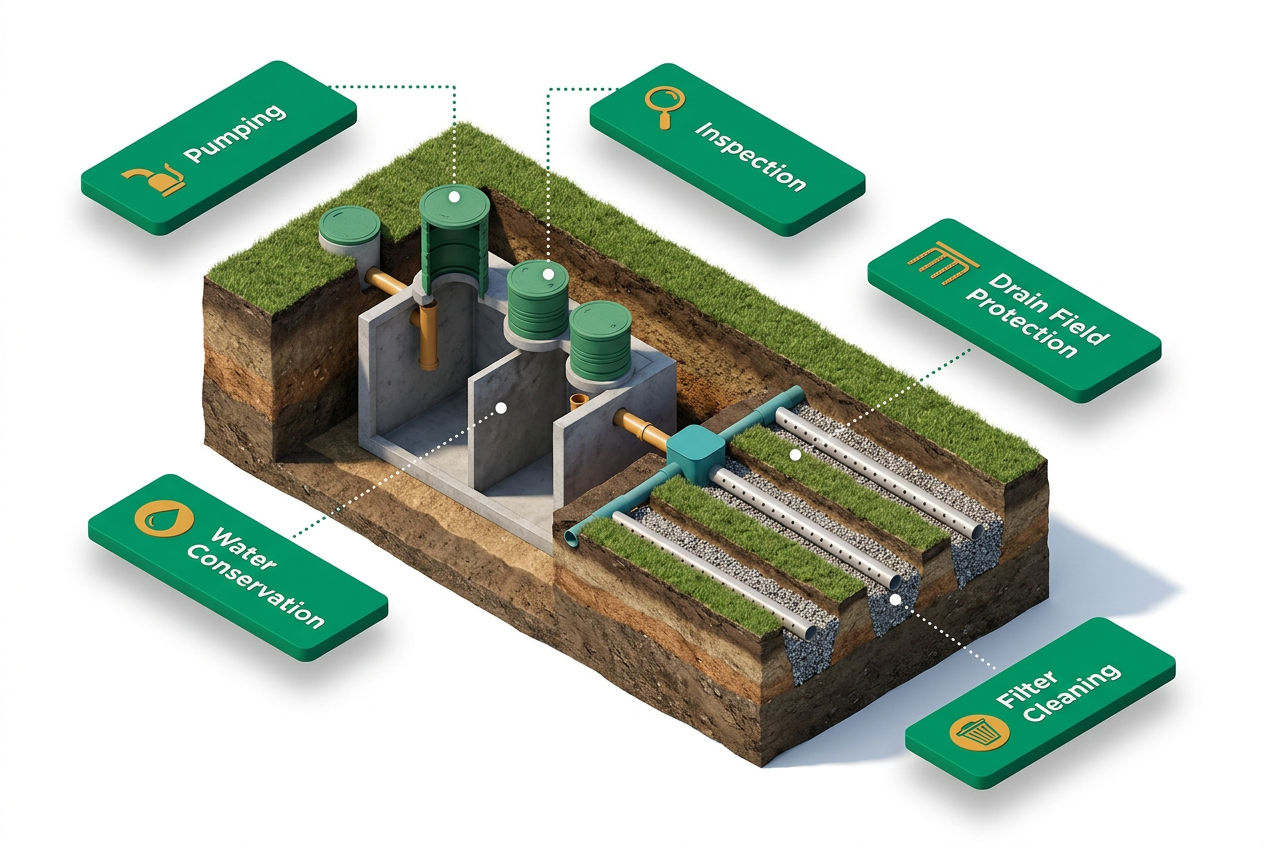
Here's the full task list organized by frequency:
| Task | Frequency | DIY or Pro? |
|---|---|---|
| Visual check (yard, lids, drainfield) | Monthly | DIY |
| Effluent filter cleaning | Every 6–12 months | DIY or Pro |
| Aerobic system motor/timer check | Every 6 months | Pro |
| Riser lids and risers inspection | Annually | DIY |
| Septic tank inspection (professional) | Every 1–3 years | Pro |
| Tank pumping | Every 3–5 years | Pro |
| Drainfield condition assessment | Seasonally | DIY + Pro as needed |
Source: EPA SepticSmart guidelines; NAWT (National Association of Wastewater Technicians) inspection standards.
Every one of these tasks exists for a reason. The monthly visual check catches saturated soil or cracked lids before they become emergencies. The effluent filter — typically a Polylok PL-122 or Sim/Tech STF-100 — keeps solids from migrating into your drainfield laterals. Cleaning it takes about 15 minutes with a garden hose. Replacing a clogged drainfield costs between $3,000 and $15,000.
How Often Should a Septic Tank Be Pumped?
For most households, septic tank pumping should happen every 3–5 years. The EPA uses that range as its baseline recommendation, but the honest answer is: it depends on your tank size and how many people live in your home.
Here's how the math actually works. A 1,000-gallon tank accumulates roughly 50–80 gallons of sludge and scum per person per year. Once solids exceed about 30% of tank capacity, effluent quality drops and your drainfield starts receiving partially treated waste. That's when you get biomat formation in the leach laterals — a thick biological layer that clogs soil pores and eventually kills the field.
Septic tank pumping schedule by household size (1,000-gallon tank):
- 1–2 people: every 5 years
- 3–4 people: every 3–4 years
- 5+ people: every 1–2 years
Add a garbage disposal? Drop those intervals by about 50%. Garbage disposals send significantly more organic solids into the tank than toilet waste alone. A 4-person household with a disposal and a 1,000-gallon tank should plan on pumping every 2 years, not every 3–4. For more detail on this tradeoff, see our guide on garbage disposals and septic systems.
If you have a 1,500-gallon concrete tank and two adults living in a house year-round, you can realistically stretch to six or seven years between pump-outs — but only if a licensed pumper uses a sludge judge to measure actual sludge depth before making that call.
Want to calculate your household's specific pumping interval? Use the estimator below:
Free download
Free: the Septic Fridge Card — what to flush, what never to.
The Do / Don’t card the whole family can see, plus the Survival Kit: emergency flowchart, warning-sign decoder and pump-schedule card. One printable PDF.
For a deeper look at pumping frequency variables, our article on how often to pump a septic tank covers edge cases like vacation homes, high-occupancy rentals, and older tanks with damaged baffles.
Is There a Month-by-Month Septic Maintenance Checklist?
Yes — and keeping a written septic maintenance checklist is one of the most effective ways to stay on schedule. Here's the complete breakdown by frequency.
Monthly (Takes 5 Minutes)
Walk your yard. Look at the ground directly over your tank and drainfield. You're looking for:
- Saturated soil or standing water (not explained by recent rain)
- Unusually green or fast-growing grass over the drainfield
- Odors near the tank lid or cleanout access
- Cracks or visible damage to risers and lid covers
That's it. You don't need to open anything or touch anything. This quick check catches slow leaks, rising water tables, and early drainfield saturation. If something looks off, call a pro before it escalates.
Every 6–12 Months
Clean the effluent filter. This is the single most underrated maintenance task for most homeowners. The effluent filter sits in the outlet baffle of your tank, between the tank and the drainfield. It catches suspended solids that would otherwise travel into your leach laterals.
Pull the filter cartridge, rinse it into a bucket (don't hose it directly into the yard), and reinstall. Models like the Polylok PL-122 and Zabel A1800 are designed for homeowner cleaning without special tools. If you notice the filter is heavily loaded every time you check it, that's a sign your tank may need pumping sooner than scheduled.
If you have an aerobic septic system, every 6 months is also when you check the aerator motor (commonly a Hiblow HP-80 or HP-120 linear air pump), inspect the float switches in the pump chamber, and verify the timer settings are correct for your system's spray or drip cycle.
Annually
Have a professional inspect your risers, lids, and baffles. This is also a good time to check the distribution box if your system has one. Distribution boxes — also called D-boxes — are small concrete or plastic structures that split effluent flow evenly across your leach laterals. A tilted or cracked D-box causes one lateral to receive all the flow while others sit dry, dramatically shortening drainfield life.
Check that your riser lids are locked or bolted down and haven't cracked from UV exposure or frost heave. An unsecured lid is a safety hazard — the opening is large enough to be a fall risk for children or pets.
Every 1–3 Years
Schedule a professional septic tank inspection. A visual inspection typically runs $100–$250. A full inspection, which includes pumping, measuring sludge depth with a sludge judge, inspecting baffles, and flow-testing the drainfield, runs $250–$500. For a detailed breakdown of what those fees cover, see our septic inspection cost guide.
The NAWT recommends inspections every 1–3 years. Some states have mandatory schedules — Minnesota's MPCA requires licensed pumpers to file disposal manifests with the county after every service. Washington State requires inspections at property transfer. If you're buying a home with a septic system, read our guide on septic inspections for home buyers before you close.
Every 3–5 Years
Pump the tank. This is non-negotiable. Even if your system seems to be working perfectly, solids accumulate. You cannot see inside your tank from the yard. Only a licensed pumper with a vacuum truck and a sludge judge can tell you whether your tank has 8 inches of sludge or 24 inches.
For a realistic breakdown of what this service costs in your region, see our septic pumping cost guide.
What Should You Do Each Season for Septic Care?
Residential septic maintenance isn't one-size-fits-all across the calendar year. Each season brings different stress patterns and different maintenance priorities.
Spring
Spring is the best time for your annual inspection and, if you're due, your pump-out. Once the ground thaws, a licensed inspector can properly assess drainfield drainage. Watch for soggy spots after snowmelt — saturated soil over the drainfield in spring can indicate a drainage problem that was hidden all winter.
Heavy spring rains can temporarily overwhelm even a healthy system, so be conservative with water usage during extended wet periods.
Summer
Peak water usage season. House guests, extra laundry, kids home from school — all of it stresses your system. Spread laundry loads across the week rather than running six back-to-back on Saturday. Avoid parking vehicles or placing any heavy structures (sheds, trampolines, decorative boulders) over the drainfield. Summer's dry soil conditions make it the best time for drainfield repair work if needed.
Fall
If your tank is approaching its pumping interval, pump it before Thanksgiving — not after. Holiday gatherings push water usage through the roof. A tank that's 70% full handles two extra people fine; a tank that's 90% full handles no margin at all. Fall is also the time to insulate the first 10 feet of your inlet pipe with foam pipe insulation if you're in a cold climate, and to clear any leaves or debris that have accumulated over the drainfield surface.
For specific guidance on protecting your system in northern climates, see our article on septic pipes and freeze prevention.
Winter
Reduce unnecessary water use during extended cold snaps. A frozen inlet pipe — common when frost lines reach 42–60 inches deep in Minnesota, Wisconsin, and upstate New York — can force sewage back into the house within hours. Keep drains running at a slow trickle during hard freezes only if your inlet pipe is shallow and uninsulated. Never run a vehicle or machinery over the drainfield in winter; frozen ground looks solid but compresses the gravel bed underneath. If you have a surface irrigation aerobic system, winter spray cycles need careful management to avoid ice accumulation on the dispersal area.
DIY vs. Professional Septic Maintenance: What Tasks Can You Do Yourself?
Be honest about what you can and can't do safely. The septic industry has a clear dividing line: tasks that require a vacuum truck, licensed disposal of septage, or diagnostic equipment stay on the professional side. Tasks that require observation, basic hand tools, and a garden hose are reasonable DIY territory.
DIY-appropriate tasks:
- Monthly visual inspection of yard and lids
- Effluent filter cleaning (Polylok PL-122, Zabel A1800, or similar models)
- Riser lid inspection and tightening
- Keeping records of pump-out dates and service history
- Water conservation practices
- Keeping the drainfield area clear of vehicles, structures, and deep-rooted plants
Professional-only tasks:
- Tank pumping and septage disposal
- Baffle inspection and replacement
- Distribution box leveling and repair
- Drainfield pressure testing and flow testing
- Camera inspection of inlet/outlet pipes
- Aerobic system service, certification, and component repair
Some counties require licensed professionals to perform any work that involves opening the tank. Check your local ordinance before attempting anything beyond the effluent filter. Our septic pumping and cleaning service page explains what a professional pump-out includes and what to expect on service day.
For a full discussion of which maintenance activities are realistically DIY versus what that approach actually costs you in risk, see our guide on cleaning a septic tank without pumping.
What Are the Signs Your Septic System Needs Attention?
The following warning signs each indicate an active problem — not a future one. Any of these warrant an immediate call to a licensed inspector or pumper, not a spot on next year's maintenance calendar.
Inside the house:
- Slow drains across multiple fixtures simultaneously (not just one clogged drain)
- Gurgling sounds from toilets when running the washing machine or dishwasher
- Sewage odors inside the house, particularly in the lowest floor drains
- Toilets that don't flush completely even after plunging
Outside the house:
- Soggy, spongy, or permanently wet soil over the drainfield
- Bright green, lush grass growing directly over drainfield laterals while surrounding lawn is dry
- Sewage odor in the yard, particularly near the tank or cleanout access
- Visible sewage surfacing on the ground
During a pump-out:
- Pumper reports sludge depth exceeding 12 inches in a 1,000-gallon tank
- Baffles are cracked, missing, or heavily degraded
- Effluent in the outlet chamber appears dark or carries heavy solids
Any surfacing sewage, significant baffle damage, or lateral backup requires immediate professional intervention. See our full breakdown of signs your septic tank needs pumping for photos and detailed descriptions of each symptom.
What Should You Never Put in a Septic Tank?
The biological process inside your tank depends on a functioning colony of anaerobic bacteria — primarily Bacteroides and Clostridium species — that break down organic solids. Anything that kills those bacteria, introduces non-biodegradable solids, or overloads the system with fats and oils will shorten the life of both the tank and the drainfield.
.](https://ik.imagekit.io/34qr7twyt/blog-infographics/septic-tank-maintenance-schedule-3.png)
Never flush or drain these:
- Antibacterial soaps and cleaners in large quantities
- Bleach poured directly down drains (small amounts from laundry are generally acceptable)
- Flushable wipes — they don't break down in septic tanks, regardless of labeling
- Feminine hygiene products, cotton balls, paper towels
- Cooking grease, fats, or oils
- Medications — pharmaceuticals don't break down biologically and contaminate groundwater
- Paint, solvents, thinners, pesticides
- Cat litter, even "flushable" varieties
The flushable wipe problem deserves extra emphasis. Unlike toilet paper, which begins breaking down within minutes in water, most wipes — even those labeled "flushable" — remain intact for months in a septic tank. They accumulate in the inlet chamber, clog effluent filters, and require manual removal during pump-outs.
For a detailed list of household products rated for septic compatibility, see our guide to septic-safe products and our article on what you can flush with a septic system.
Do Septic Tank Additives Work?
Biological additives — products that introduce bacterial cultures or enzymes into your tank — are marketed as a way to enhance or replace regular pumping. The concept is sound: healthy bacterial populations do improve solid digestion. The problem is what the research actually shows about commercial products.
A study from the University of Arkansas Cooperative Extension evaluated multiple commercially available septic additives and found no statistically significant reduction in sludge accumulation compared to control systems receiving no additives. The existing bacterial ecosystem in a functioning septic tank is already well-established and self-sustaining under normal conditions. Adding more bacteria doesn't meaningfully accelerate digestion when the limiting factor is solid accumulation rate, not bacterial population.
Where additives may offer limited benefit: systems that have been treated with large doses of antibiotics or disinfectants, newly installed systems that haven't yet established full bacterial populations, or vacation homes that sit unused for extended periods. In those narrow cases, re-inoculating with a bacterial additive can help re-establish normal digestion activity.
What additives cannot do: remove accumulated sludge. That requires a vacuum truck. If your tank is approaching or exceeding the 30% solids threshold, no additive reverses drainfield biomat or substitutes for pumping. For a complete evaluation of the product category, see our article on whether septic additives work.
How Much Does Septic Maintenance Cost?
Septic maintenance costs vary by region, system type, and service frequency. Here are the real ranges based on current contractor pricing:
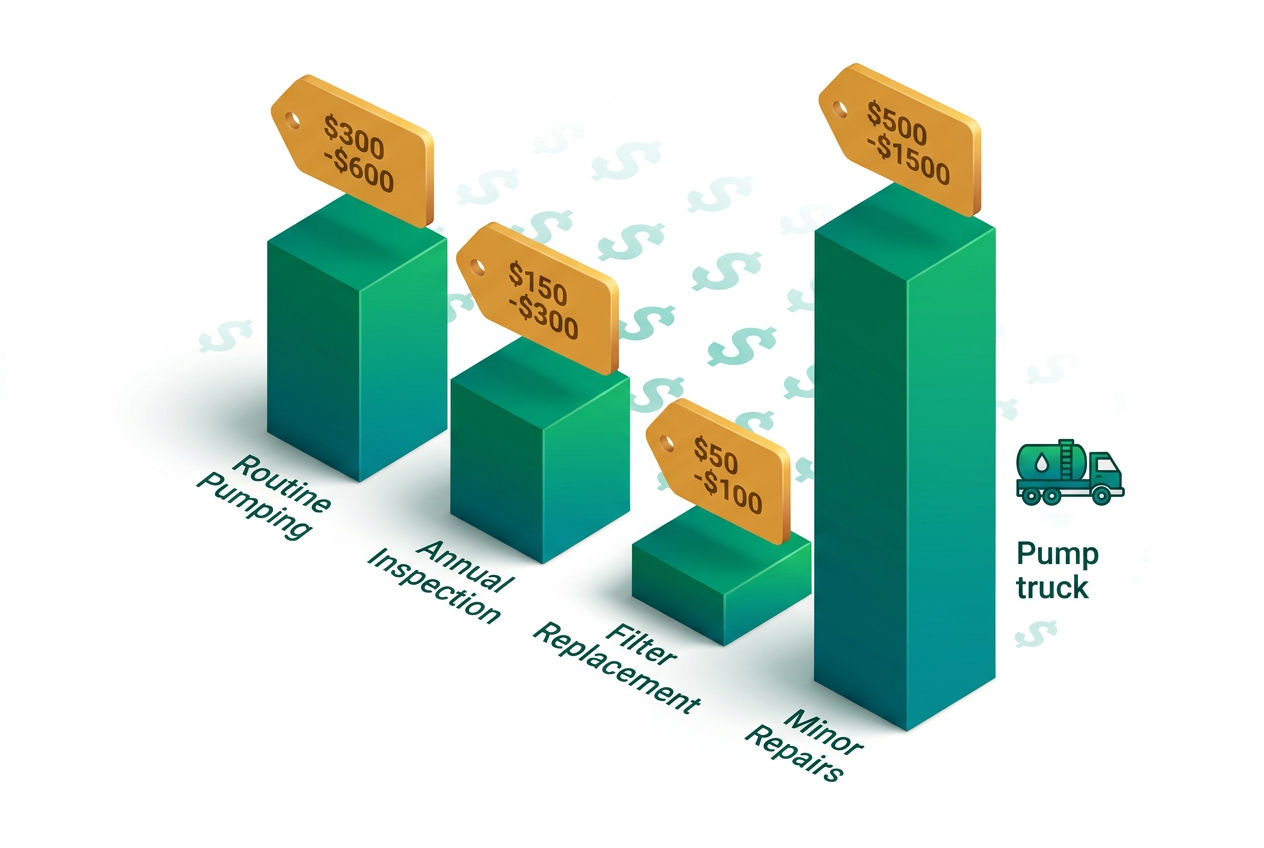
| Service | Typical Cost Range |
|---|---|
| Monthly visual inspection | $0 (DIY) |
| Effluent filter cleaning | $0 (DIY) or $75–$150 (pro) |
| Annual professional inspection | $100–$250 |
| Full inspection with pumping | $250–$500 |
| Tank pumping (1,000-gallon) | $300–$600 |
| Tank pumping (1,500-gallon) | $400–$800 |
| Distribution box repair | $500–$1,500 |
| Drainfield repair (partial) | $1,500–$5,000 |
| Full drainfield replacement | $3,000–$15,000 |
| Full system replacement | $15,000–$30,000+ |
Regional variation is significant. A 1,000-gallon tank pump-out in Central Florida typically runs $275–$375. The same service in rural Montana or northern Minnesota runs $400–$550, driven by longer travel distances and lower contractor density. Urban markets in the Northeast and Pacific Northwest often land in the $450–$650 range for basic pump-outs due to higher disposal and labor costs.
The contrast between a $400 pump-out and a $20,000 system replacement is the entire argument for keeping to a maintenance schedule.
For a complete regional cost breakdown, see our guide to septic tank maintenance costs.
What Do Local Regulations Require for Septic Maintenance?
Septic regulations are state and county-level, not federal. The EPA sets guidelines; enforcement and specific requirements vary enormously by jurisdiction.
State-level examples:
- Minnesota: The MPCA requires licensed pumpers to file disposal manifests with the county after every service. Many Minnesota counties also require inspections at point of sale.
- Texas: The OSSF (On-Site Sewage Facility) program is delegated to individual counties under TCEQ oversight. Roughly 200 Texas counties have adopted DR (Designated Representative) programs with their own inspection schedules and permit requirements.
- Florida: The RSTC (Registered Septic Tank Contractor) licensing is administered through DOH. Some counties — particularly in the Florida Keys — have mandatory upgrade and connection requirements tied to nutrient reduction goals.
- Washington State: Point-of-sale inspection requirements mean any home sold with a septic system must have a current inspection report. Some counties require inspections every 3 years regardless of sale.
If you're in a regulated jurisdiction, your county health department or environmental services office maintains the specific schedule your system must follow. Non-compliance can result in fines, mandatory upgrades, or orders to connect to municipal sewer at your expense.
For guidance on what to expect if you're purchasing a property with an existing system, see our resource on septic inspections for home buyers.
How Long Does a Septic System Last With Proper Maintenance?
A properly maintained septic system lasts 25–40 years. The wide range reflects differences in soil conditions, system type, construction quality, and — most significantly — how consistently the maintenance schedule was followed.
Concrete tanks installed before 1980 often used non-sulfate-resistant cement. These tanks are prone to hydrogen sulfide corrosion at the inlet baffle and can develop structural cracks as the concrete degrades. Even with perfect maintenance, some older concrete tanks begin showing structural failure between 20–30 years.
Modern precast concrete tanks using sulfate-resistant cement, and high-density polyethylene (HDPE) or fiberglass tanks, regularly exceed 40 years when properly maintained.
Drainfields are typically the limiting component. A drainfield that receives properly treated effluent from a well-maintained tank can last 30–50 years. A drainfield that receives partially treated effluent — because the tank was never pumped or the effluent filter was never cleaned — develops biomat clogging and may fail in 10–15 years. Once a drainfield fails, it generally cannot be restored; it requires replacement or installation of an alternative system.
For a detailed look at system lifespan variables and when full replacement becomes necessary, see our guide on how often to replace a septic system.
Frequently Asked Questions
What is a good septic tank maintenance schedule for a family of four?
A family of four with a standard 1,000-gallon tank should follow this residential septic maintenance schedule: monthly visual inspections of the yard and lid area, effluent filter cleaning every 6–12 months, a professional inspection every 1–2 years, and tank pumping every 3–4 years. If the household has a garbage disposal, reduce the pumping interval to every 2 years. At 1,500 gallons, a four-person household can extend pumping to every 4–5 years, but only after a licensed pumper confirms sludge depth with a sludge judge. Keep a written septic maintenance checklist with service dates, pumper names, and any findings. This record helps your pumper track accumulation trends over time and can be required documentation if you sell the home. Don't skip the effluent filter — it's a 15-minute DIY task that protects a drainfield worth $5,000–$15,000.
How do I know if my septic tank needs to be pumped?
Your septic tank likely needs pumping if you notice slow drains across multiple fixtures, gurgling sounds from toilets when running appliances, sewage odors inside the house, or wet soggy areas over the drainfield. These are active warning signs, not early indicators. The more reliable approach is proactive: follow a septic tank pumping schedule based on your household size and tank capacity rather than waiting for symptoms. A 1,000-gallon tank serving three to four people should be pumped every 3–4 years regardless of visible symptoms. During any pump-out, ask the pumper to measure sludge depth with a sludge judge — if sludge exceeds 12 inches, you've already been overdue. See our full guide on signs your septic tank needs pumping for photos and a complete symptom checklist.
What is the difference between a septic inspection and a septic pump-out?
A septic inspection and a pump-out are different services, sometimes performed together. A pump-out uses a vacuum truck to remove accumulated sludge and scum from the tank — it doesn't assess system function beyond what the pumper observes while working. A professional inspection involves measuring sludge depth with a sludge judge, examining inlet and outlet baffles for cracks or missing components, flow-testing the drainfield, checking the distribution box for level and cracks, and in some cases camera-inspecting the inlet pipe. A full inspection with pump-out typically costs $250–$500 and provides a written report of findings. A pump-out alone runs $300–$600. NAWT recommends inspections every 1–3 years. Some states require them at property transfer. Always request a written inspection report — verbal-only findings are not useful if problems emerge later.
Can I pump my own septic tank without hiring a professional?
No. Pumping a septic tank is not a DIY job. It requires a licensed vacuum truck to remove and transport septage, which is classified as a regulated waste in every U.S. state. Disposal requires an approved facility — you cannot legally dump septage on your property or into municipal sewer without authorization. Beyond the legal issue, opening a septic tank without proper safety equipment exposes you to hydrogen sulfide gas, which can reach lethal concentrations at low exposure times. The gas is detectable at low levels by smell, but at concentrations above 100 ppm it paralyzes the olfactory nerves — meaning you stop smelling it right before it becomes dangerous. Maintenance tasks that are genuinely DIY-appropriate include monthly visual inspections, effluent filter cleaning, and riser lid checks. Everything involving the tank interior stays in professional territory. Our septic pumping and cleaning service page explains what to expect from a licensed pump-out.
Does a septic tank maintenance schedule change for an aerobic system?
Yes — aerobic septic systems require a more frequent and more technical maintenance schedule than conventional gravity systems. In addition to the standard septic tank pumping schedule (typically every 3–5 years for the trash tank), aerobic systems require professional service every 6 months to inspect the aerator motor (commonly a Hiblow HP-80 or HP-120 linear air pump), check float switches in the pump chamber, test chlorine or UV disinfection components, verify spray head or drip emitter function, and confirm timer settings match the system's cycle requirements. Most states that permit aerobic systems — including Texas and Florida — require a licensed service contract as a condition of the system's operating permit. Skipping aerobic service visits doesn't just void the permit; it risks chlorine under-dosing that can allow pathogens to reach the dispersal area. See our complete guide to aerobic septic system maintenance for a full service checklist.
What household products are safe to use with a septic system?
Most standard household cleaners are safe in normal quantities, but a few categories require care. Antibacterial soaps and disinfectants — bleach, quaternary ammonium compounds, pine oil cleaners — kill the anaerobic bacteria that break down solids in your tank. Small amounts from routine cleaning are generally tolerable; pouring a full bottle of bleach down a drain is not. Laundry detergents marketed as "septic safe" typically contain lower surfactant concentrations and no phosphates that would disrupt bacterial activity. Toilet bowl cleaners with bleach tablets that dissolve with every flush are a common slow-dose problem — replace them with non-chlorine alternatives. For a product-by-product compatibility guide covering cleaners, detergents, medications, and personal care products, see our guide to septic-safe products. The short version: use normal quantities of standard products, avoid continuous-dose disinfectants, and never pour paint, solvents, or medications down any drain.
Sources & Methodology
-
U.S. Environmental Protection Agency — SepticSmart Program. EPA guidelines for residential septic system maintenance, pumping frequency, and homeowner responsibilities. epa.gov/septic
-
National Association of Wastewater Technicians (NAWT). Inspection standards and recommended service intervals for conventional and alternative septic systems. nawt.org
-
University of Arkansas Cooperative Extension. Research evaluation of commercial septic tank additives, including biological and chemical product categories. Publication FSA-6115.
-
Minnesota Pollution Control Agency (MPCA). Individual sewage treatment system rules, disposal manifest requirements, and licensed pumper obligations under Minnesota Statutes Chapter 115.
-
National Onsite Wastewater Recycling Association (NOWRA). Technical resources on drainfield biomat formation, distribution box function, and alternative system maintenance requirements. nowra.org
Was this article helpful?
Frequently Asked Questions
Recommended Resources
📖 Related Articles
- The Complete Septic Tank Maintenance Guide
- Can You Use a Garbage Disposal with a Septic System?
- How Often Should You Pump Your Septic Tank?
- Aerobic Septic System Maintenance: The Complete Guide
- What Happens During a Septic Inspection?
- Septic Inspection for Home Buyers: Complete Checklist
- Freezing Pipes and Septic: How to Prevent Winter Damage
- Can You Clean a Septic Tank Without Pumping It?
- 8 Signs Your Septic Tank Needs to Be Pumped
- Septic-Safe Products: What to Use (and What to Avoid)
- What Can You Flush with a Septic System? (Tampons, Wipes & More)
- Do Septic Tank Additives Actually Work? (The Science)
- Septic Tank Maintenance Cost: 2026 Price Guide
- How Often Do Septic Systems Need to Be Replaced?
💰 Cost Guides
🔧 Services
Find Septic Professionals Near You
Compare licensed, verified septic companies by area — top county markets and cities below, or browse all 50 states.
County markets
Popular cities
