
Quick Answer
Septic tank maintenance cost averages $300–$600 for a standard pump-out nationally in 2026, with most homeowners paying somewhere in the middle of that range for a 1,000-gallon conventional system. Aerobic treatment units run higher — expect $400–$600 per year just for the service contract. Skip maintenance entirely, and you're looking at repair bills starting at $1,500 and drain field replacements that can hit $20,000 or more.
Key Takeaways
- A standard septic pump-out costs $300–$600 nationally; rural areas run lower, metro areas run higher
- Most 1,000-gallon tanks serving a 3–4 person household need pumping every 3–5 years
- Aerobic septic systems cost $400–$600/year to maintain — significantly more than conventional systems
- Skipping maintenance risks drain field failure, which costs $5,000–$20,000+ to replace
- Annual maintenance contracts ($150–$500/year) often cost less than emergency service calls
About 21 million U.S. homes rely on septic systems, according to the EPA. Most homeowners never think about theirs — until something goes wrong. That's the most expensive way to own a septic system.
This guide breaks down every cost you'll realistically face: pumping, inspection, cleaning, additives, and what happens when maintenance gets skipped too long. For a deeper look at keeping your system running long-term, the septic tank maintenance guide covers everything from daily habits to annual checklists.
Septic Maintenance Cost Summary Table
| Service | Typical Cost Range | Frequency |
|---|---|---|
| Tank pumping (1,000-gal) | $300–$600 | Every 3–5 years |
| Full septic inspection | $100–$900 | Every 1–3 years |
| Effluent filter cleaning | $50–$150 | Annually |
| Baffle inspection/repair | $100–$300 | Every 3–5 years |
| Annual maintenance contract | $150–$500/yr | Yearly |
| Aerobic system contract | $400–$600/yr | Yearly |
| Septic riser installation | $200–$400 | One-time |

Sources: EPA Septic Systems guidance, NAWT industry pricing surveys, contractor market data 2025–2026
How Much Does Septic Tank Pumping Cost in 2026?
A standard septic pump-out for a 1,000-gallon tank runs $300–$600 nationally in 2026, with most companies charging $350–$450 for routine residential service. That's the number to use for budgeting. But where you live and how big your tank is will move that number considerably.
Tank size is the biggest variable pumpers use to set pricing:
- 750-gallon tank: $200–$400 (older homes, 1–2 occupants)
- 1,000-gallon tank: $300–$600 (most common residential size)
- 1,500-gallon tank: $400–$700
- 2,000-gallon tank or larger: $500–$900+
Geography matters just as much. A 1,000-gallon tank in suburban Central Florida runs $275–$375. That same tank in rural Montana or Minnesota can cost $350–$550 because the pumper is driving 45 minutes each way and factoring in fuel and time. In metro areas like New York or Los Angeles, labor costs and regulatory compliance push prices $50–$150 above the national average.
For a full state-by-state breakdown, see the septic pumping cost by state resource.
What Does Septic Tank Maintenance Actually Include?
Routine septic system maintenance goes beyond just pumping the tank. A thorough service visit covers several components that rarely get discussed upfront.
Pumping removes accumulated solids — the sludge layer on the bottom and the scum layer floating at the top. A vacuum truck extracts the entire contents, usually 800–1,500 gallons of material for a standard residential tank. This is the core of septic pumping and cleaning service.
Effluent filter cleaning is often an add-on, but it should be standard. The effluent filter (a common model is the Polylok PL-122) sits at the outlet baffle and catches solids before they reach the drain field. Cleaning it costs $50–$150 as a standalone service. Ignoring it means solids eventually blow past it into your leach laterals — a $5,000+ problem.
Baffle inspection checks the inlet and outlet baffle walls inside the tank. Baffles direct flow and prevent floating scum from short-circuiting into the drain field. Inspection runs $100–$200; replacement adds another $100–$200 in parts and labor, depending on material and access. For more detail on baffle issues, the septic tank baffle repair guide walks through what to expect.
Riser lid access is a one-time cost worth mentioning. If your tank lids are buried below grade, every service call includes a dig-up fee of $50–$200. Installing concrete or polyethylene risers (like those from Infiltrator Water Technologies) runs $200–$400 once and eliminates that charge forever.
How Often Does a Septic Tank Need to Be Pumped?
Pumping frequency depends on household size and tank capacity — and the math here is worth doing because it directly affects your total annual cost.
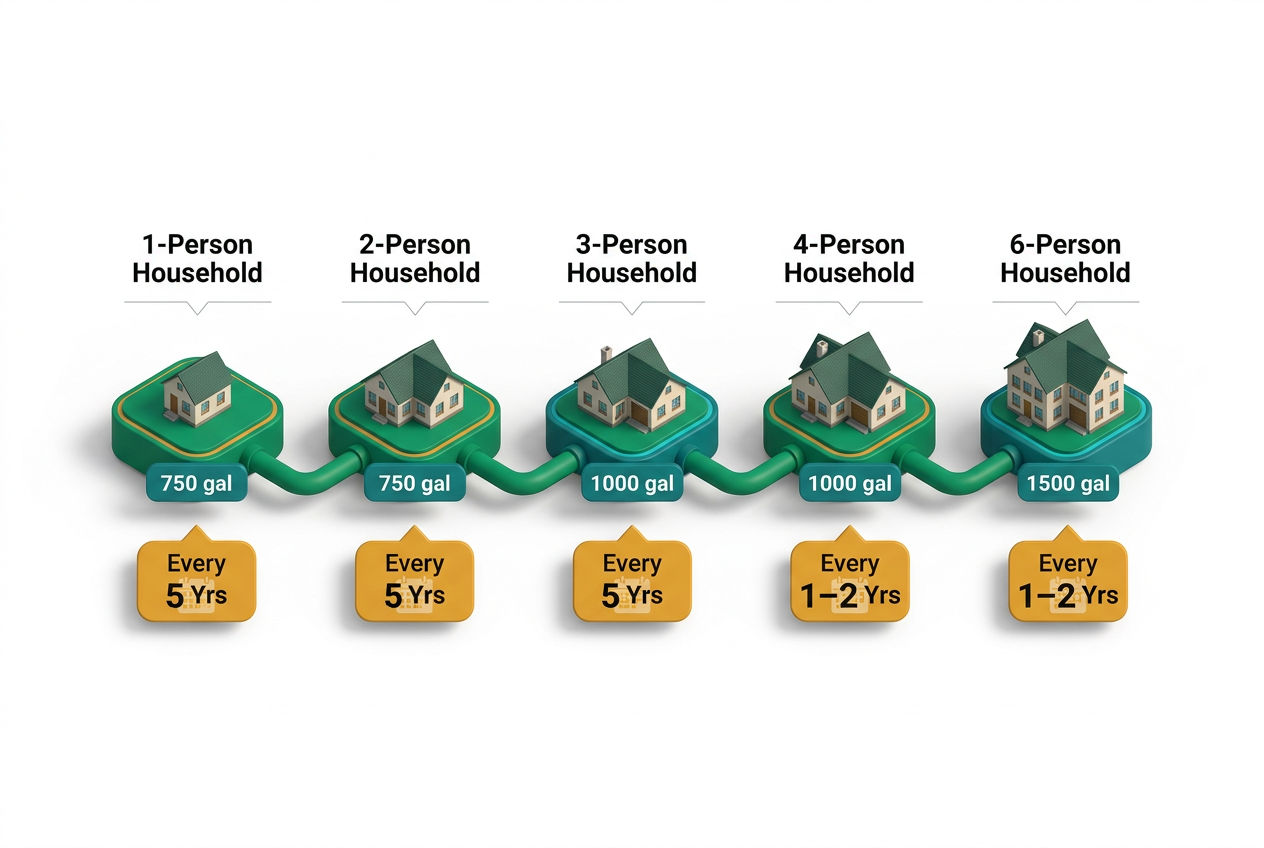
The EPA recommends pumping every 3–5 years for most households. But that's a wide range. Here's how it actually breaks down:
- 1–2 person household: Every 5–7 years
- 3–4 person household: Every 3–5 years
- 5+ person household: Every 1–3 years
Add a garbage disposal and subtract a year from each range. Garbage disposals push 30–50% more solids into the tank. For households that have one, pumping every 2–3 years is more realistic. See how garbage disposals affect septic systems for the full picture.
Want to check your own system's schedule? The how often to pump a septic tank guide has a household-size calculator and frequency chart.
Septic System Inspection Cost
A septic inspection costs $100–$900, depending on the type. That's a wide spread, so here's what you're actually paying for:
- Basic visual inspection: $100–$200. A technician checks accessible components, looks for surface signs of failure, checks tank levels. Common for routine annual checkups.
- Standard inspection with pumping: $300–$650. Most common combo. Includes pump-out plus a look at baffles, effluent filter, and inlet/outlet lines.
- Full camera inspection: $400–$900. A scope goes through the distribution box and into the leach laterals to check for root intrusion, pipe damage, or biomat buildup. Required in some states for real estate transactions.
Picture this: you're selling your home and the buyer's inspector flags your drain field as potentially compromised. A camera inspection at $500–$700 now is a lot cheaper than a failed sale or a price reduction of $15,000. California counties frequently require licensed inspection reports for property transfers. What to know about septic inspections for home buyers covers that scenario in detail.
For full pricing on inspections, the septic inspection cost guide breaks it down by inspection type and state.
Is a Septic Maintenance Contract Worth It?
Free download
Free: the Septic Fridge Card — what to flush, what never to.
The Do / Don’t card the whole family can see, plus the Survival Kit: emergency flowchart, warning-sign decoder and pump-schedule card. One printable PDF.
Annual septic maintenance contracts run $150–$500 per year for conventional systems and $400–$600 per year for aerobic treatment units (ATUs). Whether they're worth it depends on your system type.
For a conventional gravity-fed system, a contract typically includes one scheduled inspection per year, effluent filter cleaning, and a discounted rate on pumping. If your pumping cycle is every 4 years, the math might not pencil out purely on service cost — but many homeowners value the peace of mind and the reminder to actually schedule service.
For aerobic septic systems, a contract is almost always worth it — and in some states, it's legally required. Florida, for example, mandates annual maintenance contracts for aerobic systems through licensed contractors registered with the Department of Health. The Hiblow HP-80 air pump and sprayer heads on ATUs require quarterly checks, lubrication, and occasional replacement. Without a contract, a single neglected aerator can fail and create sewage backup within days. Learn more about aerobic septic system maintenance and what those contracts actually cover.
Septic Tank Cleaning Cost vs. Pumping: What's the Difference?
These terms get used interchangeably, but there's a practical distinction worth understanding.
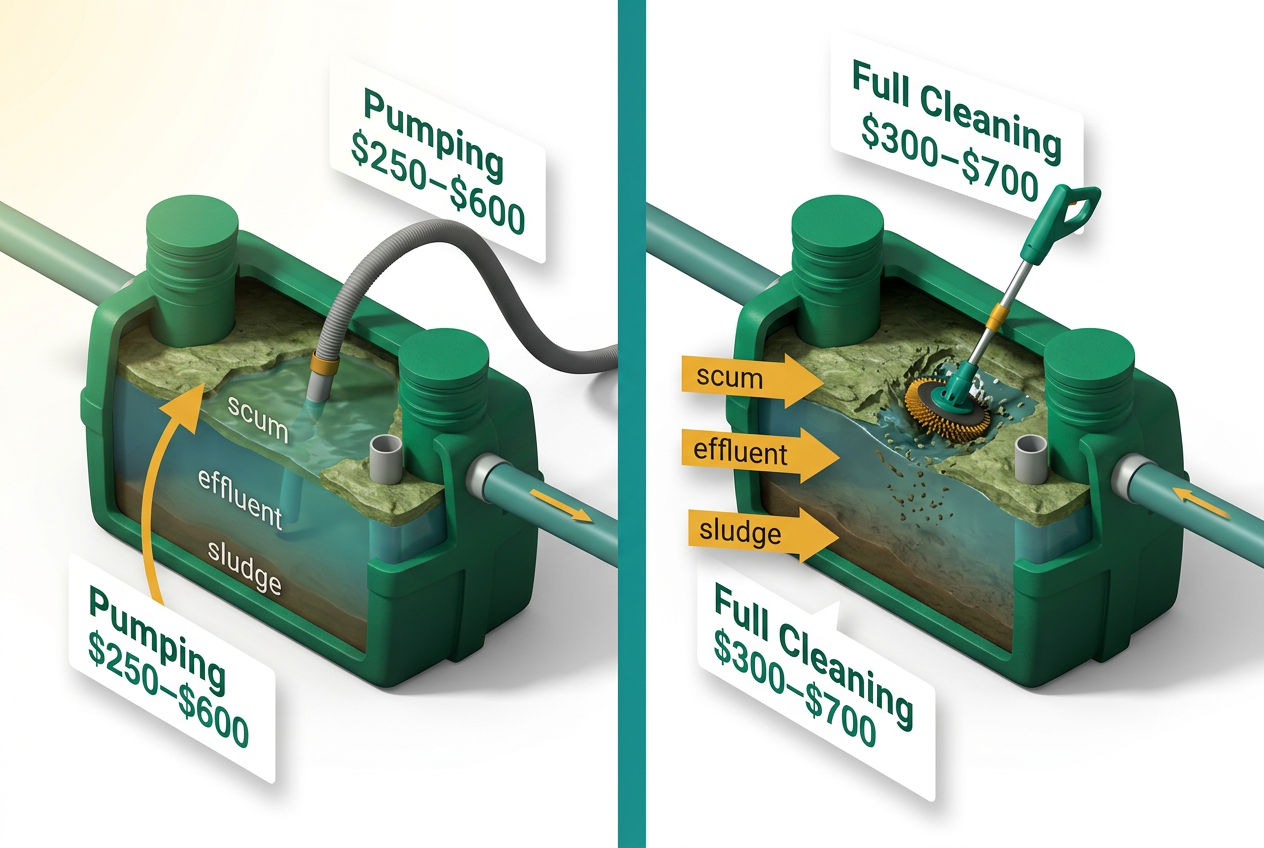
Pumping removes the liquid and solid contents of the tank in a single vacuum pass. It's fast — typically 20–45 minutes on site — and costs $300–$600 for a 1,000-gallon tank.
Cleaning goes further. After pumping, the technician may rinse the tank walls and floor with a hose to dislodge stuck solids, then vacuum out the rinse water. Full cleaning costs $400–$800. It's not necessary every service cycle, but it's recommended every other pump-out or when a tank hasn't been serviced in 8+ years.
Some companies advertise "cleaning" when they really mean pumping. Ask directly: "Will you rinse the tank walls after pumping?" If the answer is no, you're getting a pump-out regardless of what they call it.
How Does System Type Affect Maintenance Cost?
Not all septic systems cost the same to maintain. System type is one of the biggest drivers of long-term ownership cost.
Conventional gravity systems are the lowest-cost option to maintain. Pumping every 3–5 years, an occasional inspection, and effluent filter cleaning — most homeowners spend $75–$150 per year averaged across a full service cycle.
Aerobic treatment units (ATUs) cost significantly more. The mechanical components — aerator compressors, float switches, spray heads — need quarterly or semi-annual service. Annual contracts run $400–$600. For a detailed cost breakdown, the aerobic septic system cost guide is worth reading before you commit to this system type.
Mound systems add a pump chamber with a float switch and effluent pump (often an Orenco Systems pump). The pump chamber needs inspection annually and the pump itself runs $300–$800 to replace every 7–15 years.
Chamber/leach field systems using Infiltrator chambers have lower long-term drain field maintenance costs than traditional perforated pipe and gravel — but the tank itself costs the same to pump.
What Are the Real Costs of Skipping Septic Maintenance?
This is where the math gets uncomfortable. Routine maintenance costs roughly $300–$600 every few years. Skip it long enough, and here's what you're risking:
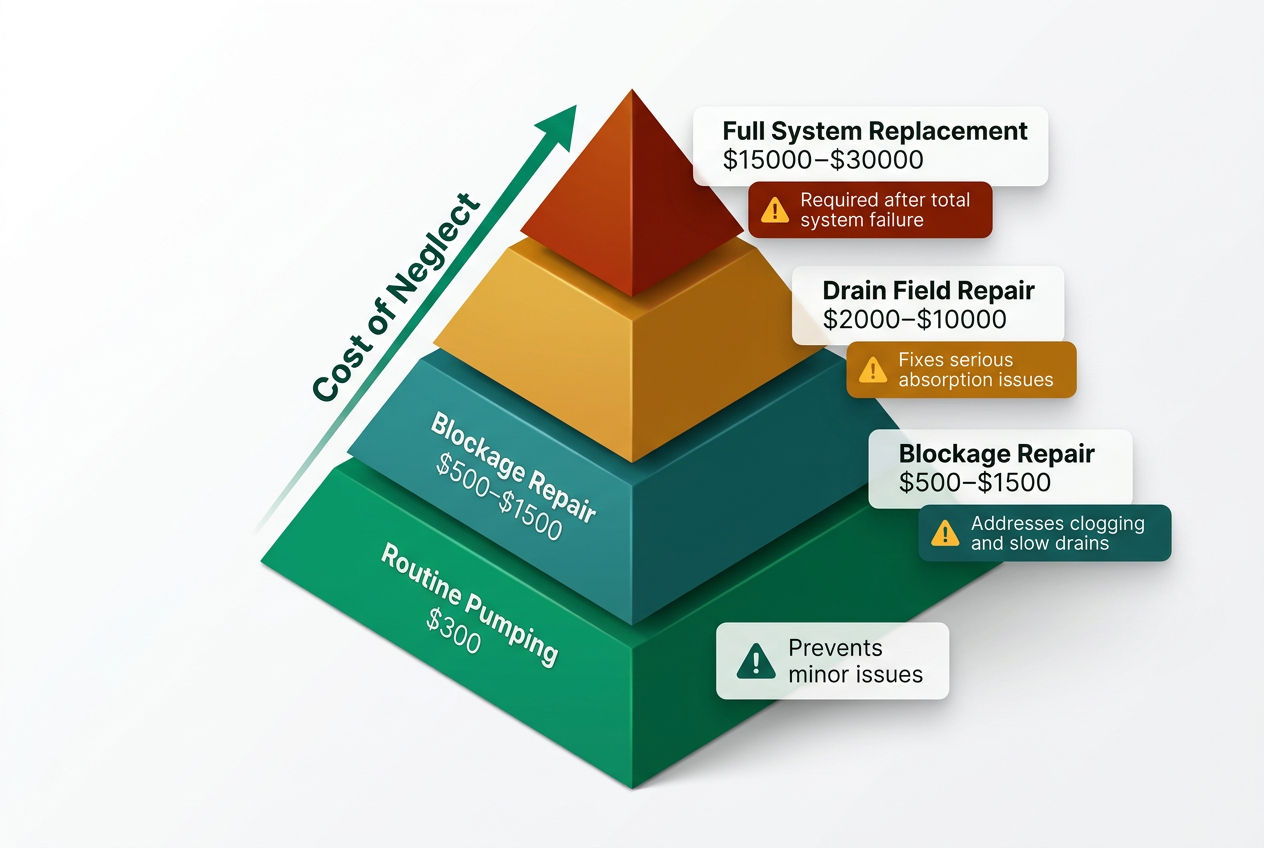
- Septic system repair: $1,500–$5,000 for component failures (pump, baffle, distribution box)
- Drain field replacement: $5,000–$20,000+ depending on system size and soil conditions
- Full system replacement: $10,000–$30,000+ installed
The drain field replacement cost guide has current pricing by region and system type.
The mechanism is straightforward: when sludge builds up past 30–40% of tank capacity, solids start flowing into the distribution box and out through the leach laterals. Those solids create a biological clog called a biomat — a black, anaerobic layer that seals the soil and prevents effluent from draining. Once biomat is established, the only reliable fix is excavating and replacing the drain field.
Regular maintenance can extend a septic system's lifespan by 25–50%, according to industry data from NAWT (National Association of Wastewater Technicians). A well-maintained system lasts 20–40 years. A neglected one might fail in 10–15.
How Can You Reduce Septic Tank Maintenance Costs?
There are legitimate ways to lower your total cost of ownership — and a few approaches that sound good but don't hold up.
Actually schedule service. Emergency pump-outs cost $200–$400 more than scheduled visits. A system that backs up into the house on a holiday weekend is a $600–$1,000 call before any repairs begin. Stay on your pump schedule using the septic tank maintenance schedule as a reference.
Install risers. If your tank lids are buried, a $200–$400 one-time riser installation (polyethylene or concrete) eliminates dig-up fees on every future service call. Over 20 years of service visits, that pays for itself several times over. See the septic tank risers guide for options and pricing.
Watch what goes down the drain. Flushing wipes, grease, or medication accelerates sludge accumulation and kills the bacterial populations that process waste. The what you can and can't flush with a septic system guide is a quick read that can extend time between pump-outs.
Septic additives — with honest expectations. Products like Rid-X and bacterial additives introduce beneficial microbes into the tank. However, peer-reviewed research from the University of Arkansas found that bacterial additives do not eliminate or reduce the need for pumping. They can support a healthy bacterial colony if you've just used heavy antibiotics or bleach — but if your tank is filling with solids, no additive will reverse that. The do septic additives work article covers this honestly.
Time your service for fall. Scheduling pump-outs in September or October — before the ground freezes — is optimal in cold-climate states. Some companies offer 10–15% discounts for off-peak scheduling. Spring brings peak demand and prices to match.
Regional Cost Variations: Where You Live Matters
Geography moves septic maintenance costs more than most homeowners realize.
In the Northeast (New York, Massachusetts, Connecticut), expect to pay 20–35% above the national average. Dense regulation, older systems that require more careful handling, and high labor costs all push prices up.
On the Pacific Coast, environmental compliance requirements in California add cost at every level. Many California counties require a licensed inspection report for home sales — an added expense buyers and sellers should budget for.
In the Midwest (Ohio, Indiana, Missouri), rural competition keeps prices lower. A standard pump-out in rural Ohio might run $250–$350 for the same 1,000-gallon tank that costs $450 in suburban Boston.
Texas and Oklahoma have a large septic market and competitive pricing — but aerobic systems are more prevalent in these states, which pulls average maintenance costs up despite lower base labor rates.
In any rural area, distance surcharges are common. Pumpers may charge $1–$2 per mile beyond a 20-mile service radius. If you're 40 miles from the nearest licensed contractor, that adds $40–$80 to every service call before the truck even arrives.
Sources & Methodology
This pricing guide was compiled using the following sources:
- U.S. Environmental Protection Agency — Septic Systems (epa.gov/septic): Used for recommended pumping frequency, household size guidance, and national septic system statistics.
- National Association of Wastewater Technicians (NAWT) (nawt.org): Industry pricing benchmarks and technician certification standards referenced for service cost ranges.
- National Onsite Wastewater Recycling Association (NOWRA) (nowra.org): System type maintenance standards and aerobic system service requirements.
- Contractor market pricing surveys (2024–2025): Regional cost data aggregated from licensed septic service companies across 15 states via SepticTankHub.com's contractor network.
- University of Arkansas Cooperative Extension: Cited for additive efficacy research referenced in the cost-reduction section.
Cost ranges reflect 2025–2026 market conditions. Prices vary by region, system type, and contractor. Always obtain at least two local quotes before scheduling service.
Find a licensed septic professional in your area through the SepticTankHub.com directory — compare quotes from local contractors and get your system serviced on schedule.
Was this article helpful?
Frequently Asked Questions
Recommended Resources
📖 Related Articles
- The Complete Septic Tank Maintenance Guide
- Septic Tank Pumping Cost by State: Regional Price Comparison
- Septic Tank Baffle Repair & Replacement: Costs, Signs of Failure, and DIY vs Pro
- Can You Use a Garbage Disposal with a Septic System?
- How Often Should You Pump Your Septic Tank?
- Septic Inspection for Home Buyers: Complete Checklist
- Aerobic Septic System Maintenance: The Complete Guide
- Aerobic Septic System (ATU) Cost: $10K–$20K Install (2026)
- Septic Tank Maintenance Schedule: The Complete Guide
- How to Install Septic Tank Risers (and Why You Should)
- What Can You Flush with a Septic System? (Tampons, Wipes & More)
- Do Septic Tank Additives Actually Work? (The Science)
💰 Cost Guides
Find Septic Professionals Near You
Compare licensed, verified septic companies by area — top county markets and cities below, or browse all 50 states.
County markets
Popular cities
