
Quick Answer
title: "Aerobic Septic System Maintenance: The Complete Guide" description: "Learn the exact aerobic septic system maintenance schedule — chlorine refills, professional service visits, pump-outs, and seasonal tasks — to keep your ATU running for 20–30 years." published: January 15, 2026 updated: January 15, 2026
Aerobic septic system maintenance involves a regular schedule of chlorine replenishment, component inspections, and professional service visits every 3–6 months. Unlike conventional septic systems, aerobic treatment units (ATUs) have mechanical and electrical components that require active upkeep — and in most states, a mandatory service contract.
Key Takeaways
- Add aerobic system chlorine tablets every 2–4 weeks; a single container ($20–$50) typically lasts 1–2 months for an average household.
- Professional service is required every 3–6 months — quarterly in Texas, Florida, and Oklahoma by law.
- Inspect aerobic septic system sprinkler heads monthly and before each irrigation season.
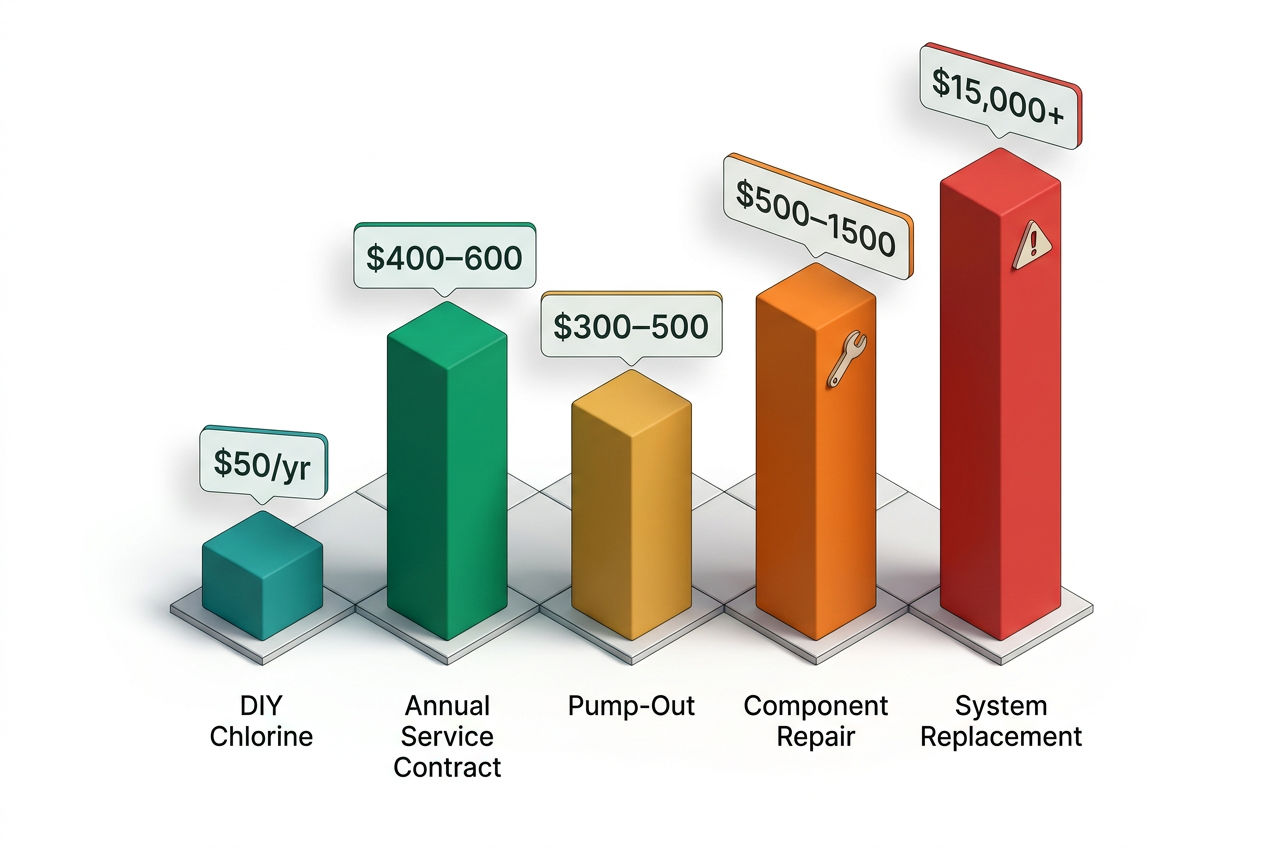
- A properly maintained aerobic system lasts 20–30 years; neglect leads to repair bills of $500–$1,500 for a single aerator, or $10,000–$20,000+ for full replacement.
- Annual maintenance costs run $300–$600 for a service contract — far cheaper than the alternative.
About 21% of U.S. homes use a septic system rather than municipal sewer, according to the EPA. Of those, an estimated 2–4 million rely on aerobic treatment units — with the heaviest concentration in Texas, Florida, and Oklahoma. If you own one of these systems, you already know it's not a "set it and forget it" situation. This guide covers the exact schedule, tasks, and cost benchmarks for aerobic septic system maintenance — everything you need to keep your system running cleanly for decades.
What Makes an Aerobic Septic System Different?
A conventional septic system is passive. Wastewater flows into a tank, solids settle, and liquid effluent drains into the soil through a drain field. No moving parts, no electricity, minimal oversight.
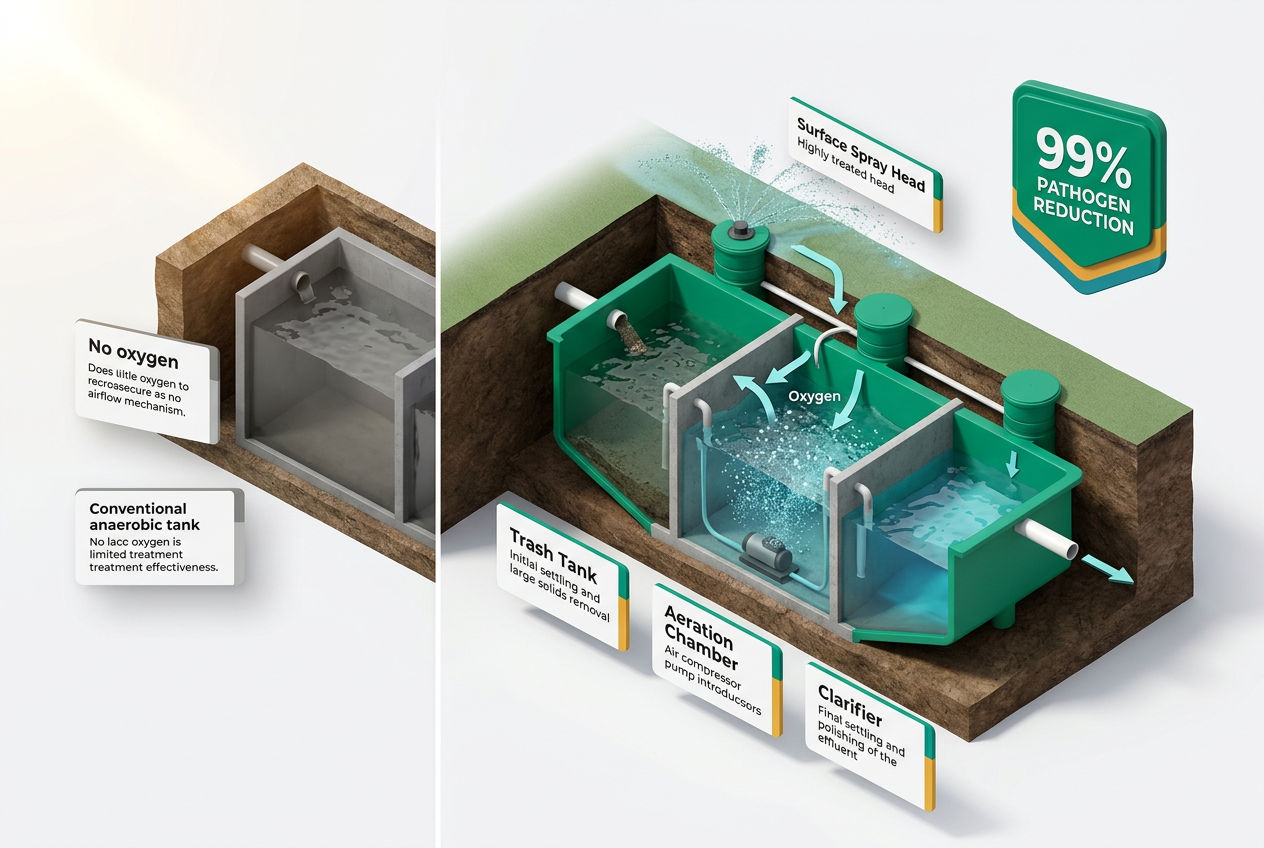
An aerobic treatment unit does something fundamentally different: it injects oxygen into the treatment chamber using an air pump (also called an aerator compressor). That oxygen supercharges bacterial activity, breaking down waste to 95%+ BOD (biochemical oxygen demand) reduction, compared to roughly 65% for a conventional system. The treated effluent then gets disinfected — usually with chlorine tablets — and distributed through a surface application system, typically via sprinkler heads across your yard.
The result is better treatment quality, but also more moving parts, more maintenance requirements, and more regulatory oversight. ATU maintenance isn't optional — it's built into state permitting.
If you're still researching whether an aerobic system makes sense for your property, our comparison of aerobic vs. anaerobic septic systems covers the tradeoffs in depth. For broader context on how all septic systems work, start with what is a septic system.
What Does Aerobic Septic System Maintenance Involve?
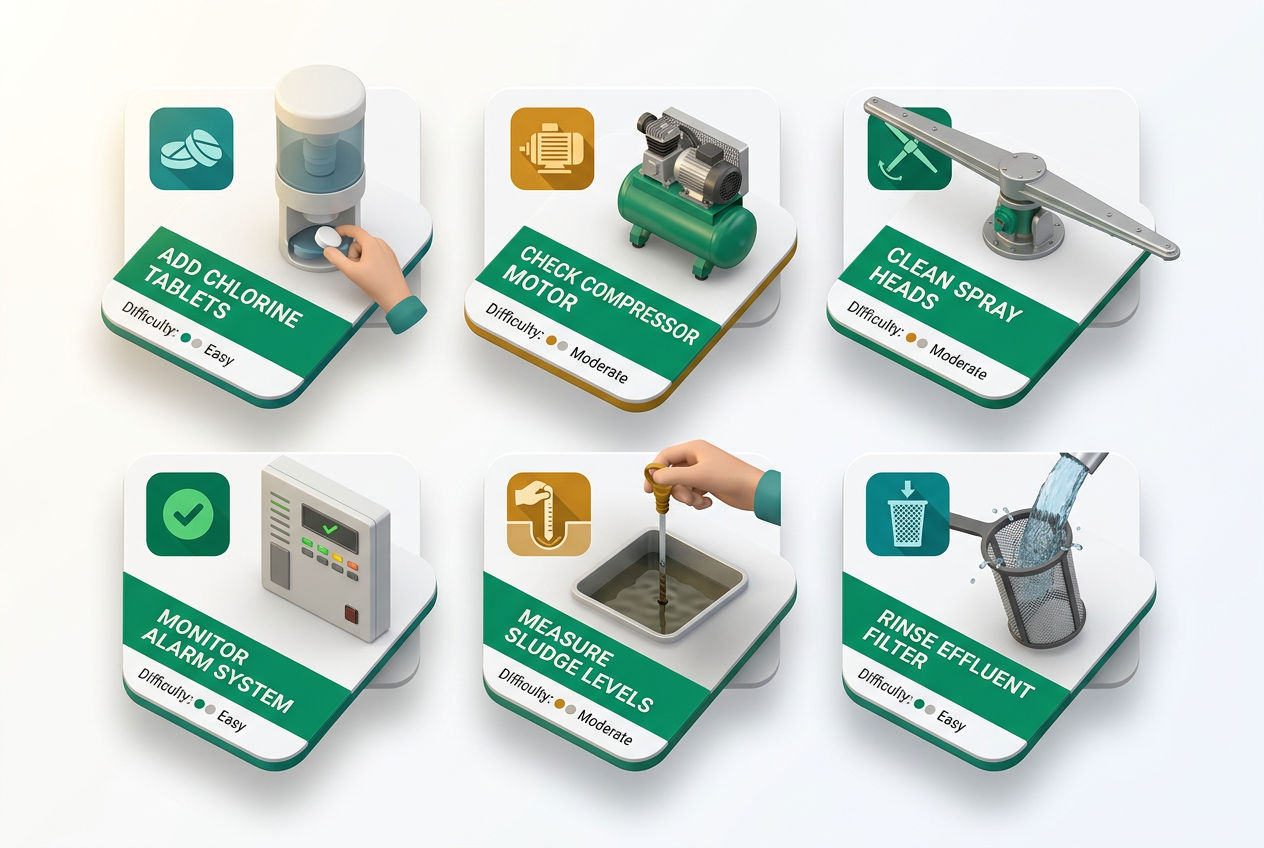
Aerobic septic system maintenance breaks down into three categories: tasks you handle yourself on a regular schedule, professional service visits, and periodic pump-outs.
Owner Tasks (Monthly)
Chlorine tablets. The disinfection chamber in your ATU holds a chlorinator tube — usually PVC, about 4 inches in diameter — that releases chlorine as effluent passes through. You need to check this tube every 2–4 weeks and refill it with calcium hypochlorite tablets (not pool chlorine — the concentration is different). A 25-pound bucket of the correct tablets runs $20–$50 and typically lasts one to two months for a 3–4 person household. Running out isn't just a maintenance failure; in most states, discharging non-disinfected effluent through your sprinkler heads is a regulatory violation.
Air pump inspection. Walk out and listen to your aerator compressor. You should hear a consistent, low hum. A Hiblow HP-80, one of the most common residential aerator compressors, runs at about 60–80 watts and produces a steady vibration you can feel on the cabinet. Silence, grinding, or irregular pulsing means trouble. Aerator lifespans average 3–5 years; replacement runs $500–$1,500 depending on the unit.
Sprinkler head check. If your system uses a surface application system, check each sprinkler head for clogs, damage, and proper spray pattern. Nozzles clog with mineral deposits, insect debris, and biofilm. A clogged head creates ponding — and ponding creates odor, health hazards, and code violations. Sprinkler heads last 2–5 years depending on water quality and UV exposure.
Alarm panel. Glance at your control panel. No lights should be flashing red. If your aerobic septic system alarm activates, don't ignore it — address it within 24 hours. (More on that below.)
Professional Service Visits (Every 3–6 Months)
Most states require a licensed technician to service your ATU on a set schedule. Texas, under Title 30 TAC Chapter 285 enforced by the TCEQ, mandates quarterly maintenance contracts — that's four visits per year, minimum. Florida's Department of Environmental Protection requires similar oversight for permitted systems. Oklahoma's DEQ follows comparable rules.
A professional aerobic septic system service visit typically includes:
- Checking aerator function and airflow output
- Testing chlorine residual in the effluent
- Inspecting all electrical components and float switches
- Examining the pump chamber and effluent pump
- Documenting the visit in a state-required maintenance log
Annual service contract costs run $300–$600 nationally. That cost varies by region — rural Oklahoma typically runs lower than suburban Houston or Tampa, where demand for certified technicians drives rates up.
Pump-Outs (Every 1–3 Years)
Even though aerobic systems treat waste more thoroughly than conventional systems, solids still accumulate in the trash tank (the primary settling chamber). A 1,000-gallon tank serving a four-person household typically needs pumping every 1–3 years. Add heavy use — frequent guests, a large household, or a garbage disposal — and you're looking at the shorter end of that range.
Pump-out costs for aerobic systems run slightly higher than conventional tanks because technicians need to navigate multiple chambers. Budget $300–$500 for a standard residential pump-out. See our full septic pumping cost guide for regional price breakdowns.
Aerobic Septic System Maintenance Schedule
| Task | Frequency | Who Does It | Typical Cost |
|---|---|---|---|
| Chlorine tablet refill | Every 2–4 weeks | Homeowner | $20–$50/container |
| Air pump / aerator check | Monthly | Homeowner | Free |
| Sprinkler head inspection | Monthly | Homeowner | Free |
| Alarm panel check | Monthly | Homeowner | Free |
| Professional service visit | Every 3–6 months | Licensed technician | $300–$600/year (contract) |
| Full system pump-out | Every 1–3 years | Licensed pumper | $300–$500 |

Sources: EPA SepticSmart guidelines; TCEQ Title 30 TAC Chapter 285; NAWT (National Association of Wastewater Technicians) recommended service intervals.
How Do I Add Chlorine to My Aerobic Septic System?
Adding chlorine to an aerobic septic system is straightforward, but the details matter. Use only calcium hypochlorite tablets rated for ATU use — typically 1-inch tablets at 65–70% available chlorine. Do not substitute swimming pool chlorine tablets (trichlor), which have a lower pH and can damage your system components over time.
Step-by-step:
- Locate your chlorinator tube. It's usually accessible via a green or gray access port near your control panel or final treatment chamber.
- Remove the cap or access lid. Wear gloves — residual chlorine is a skin irritant.
- Check how many tablets remain. If the tube is less than one-third full, it's time to refill.
- Drop in enough tablets to fill the tube to the manufacturer's recommended level (usually 3–5 tablets for a residential system).
- Replace the cap securely and rinse your gloves.
If you're seeing consistently low chlorine residuals during professional service checks despite regular refilling, the chlorinator tube itself may be scaled or cracked. Replacement tubes run $30–$80 at most septic supply houses.
Why Is My Aerobic Septic System Alarm Going Off?
Your aerobic septic system alarm is triggered by a float switch inside the pump chamber. When effluent levels rise above the normal operating range, the float rises and trips the alarm — usually a red light on the control panel and an audible buzzer.
Common causes:
High water table or heavy rainfall. After several inches of rain, groundwater can infiltrate the system, raising liquid levels faster than the effluent pump can discharge. This is especially common in Florida, where the water table can sit just 18–24 inches below the surface. If the alarm trips during or after a major rain event, give it 24–48 hours before calling for service — and reduce household water use in the meantime. For more on managing your system in wet conditions, see our guide on septic systems in heavy rain.
Effluent pump failure. The effluent pump moves treated water from the pump chamber to the sprinkler heads. If it fails, liquid backs up and triggers the alarm. Pump replacement runs $300–$700 for parts and labor.
Aerator failure. If the air pump stops working, treatment quality drops. Some systems trigger an alarm on aerator failure; others don't. Either way, a non-functioning aerator means untreated effluent is being discharged — a regulatory violation.
Electrical fault. Float switches, control boards, and wiring can fail independently of the pump or aerator. A licensed technician can diagnose this during a service call.
If you're uncertain what's triggering your alarm, check our dedicated septic tank alarm troubleshooting guide before calling for emergency service.
What Happens If You Don't Maintain an Aerobic Septic System?
A homeowner in suburban San Antonio skips their quarterly service contract to save $400 a year. Fourteen months later, they receive a TCEQ notice of violation — their aerator has failed, non-disinfected effluent is pooling in the yard, and neighbors have complained about odor. The fine is $500. Bringing the system back into compliance costs $1,200 in deferred repairs. The "savings" cost them more than three years of service contract fees.
That scenario is illustrative, but it isn't an edge case — it's a predictable outcome of deferred ATU maintenance, and it plays out across Texas, Florida, and Oklahoma every year.
System failure. Without oxygen injection, aerobic bacteria die off and the system reverts to anaerobic treatment — or worse, no effective treatment at all. Effluent quality drops, solids accumulate faster, and components wear out without the lubrication of regular inspection.
Regulatory consequences. Every state that permits ATUs requires documented maintenance. A lapsed service contract means you're operating an unpermitted system. In Texas, TCEQ can impose fines per day of non-compliance. In Florida, the DEP can require system abandonment for chronic violations.
Cost acceleration. Aerator replacement: $500–$1,500. Effluent pump replacement: $300–$700. Full system replacement: $10,000–$20,000+. Each of these is a foreseeable outcome of skipping the $300–$600 annual service contract.
Property impact. When you sell your home, buyers' inspectors check ATU maintenance records. A system with no service history or documented violations affects sale price and can delay closing. For more on what buyers look at, see our guide on selling a house with a septic system.
How Long Do Aerobic Septic Systems Last With Proper Maintenance?
Free download
Free: the Septic Fridge Card — what to flush, what never to.
The Do / Don’t card the whole family can see, plus the Survival Kit: emergency flowchart, warning-sign decoder and pump-schedule card. One printable PDF.
According to NAWT benchmarks and manufacturer specifications, a properly maintained aerobic treatment unit lasts 20–30 years. The mechanical components have shorter individual lifespans:
- Aerator compressor: 3–5 years average; replace proactively at first sign of performance drop
- Effluent pump: 7–10 years with regular inspection
- Sprinkler heads: 2–5 years depending on UV exposure and water quality
- Chlorinator tube: 5–10 years; inspect annually for scaling or cracking
- Control panel: 10–15 years; electrical components degrade faster in humid climates
The concrete or fiberglass tank itself typically outlasts all mechanical components — assuming no structural damage from root intrusion or ground shifting.
The single biggest variable in system lifespan isn't the equipment — it's the maintenance history. Systems with continuous service contracts and documented pump-outs routinely exceed 25 years. Systems with gaps in service rarely make it past 15 without a major repair or partial replacement.
For a full breakdown of what aerobic system repairs and replacement costs look like at each stage, see our aerobic septic system cost guide.
Can I Maintain My Aerobic Septic System Myself?
You can handle the monthly owner tasks — chlorine refills, visual inspections, and alarm checks — without any special license. What you cannot do, in most states, is substitute your own inspections for the licensed professional service visits that state permits require.
Here's the practical distinction: checking that your aerator is humming is a homeowner task. Verifying that your effluent chlorine residual meets state discharge standards requires calibrated test equipment and a licensed technician's signature on the maintenance log. Those two things are not interchangeable, and regulators know the difference.
In Texas, TCEQ requires service contracts with a licensed maintenance provider — a homeowner cannot self-certify compliance with Title 30 TAC Chapter 285. Florida and Oklahoma have similar requirements for permitted ATUs.
Where homeowners save money is in reducing service-call frequency. A homeowner who checks their chlorinator tube every two weeks, catches a failing aerator by sound before it stops completely, and keeps a written log of observations gives their service technician less emergency work to do — which means fewer emergency call fees on top of the contract rate.
You can find a licensed septic inspector in your area through our provider directory. For a full comparison of what homeowners can and can't do across different system types, the septic tank maintenance guide covers the complete spectrum.
Seasonal Aerobic System Maintenance: What to Do and When
Aerobic septic system upkeep isn't just a monthly checklist — some tasks are seasonal, tied to temperature shifts, irrigation schedules, and rainfall patterns.
Spring (March–May)
- Inspect all sprinkler heads after winter dormancy. Freeze-thaw cycles crack nozzles and shift head positions.
- Confirm the surface application zone is clear of new growth — shrubs and grass that overgrew during winter can block spray patterns.
- Check the air pump housing for moisture intrusion after wet-season rains.
- Schedule your first professional service visit of the year if your contract runs on a semi-annual cycle.
Summer (June–August)
- Chlorine consumption increases in hot weather as effluent volume rises with household activity. Check the chlorinator tube every two weeks minimum, not monthly.
- Inspect sprinkler heads for UV degradation — cracking and brittleness accelerate in direct sun exposure.
- Watch for dry-weather ponding near spray heads, which signals a clogged nozzle or shifting head, not a rainfall event.
Fall (September–November)
- In northern climates, this is the last window to address surface application components before ground freeze. Replace damaged sprinkler heads now, not in March.
- Schedule your pump-out if you're approaching the 18-month mark — avoid doing it in frozen ground conditions.
- Review your chlorine supply. Don't let the tube run empty over a holiday weekend when supply stores are closed.
Winter (December–February)
- In freeze-prone areas, the aerator compressor air intake can ice over. Check the housing vent after hard freezes. See our guide on preventing septic pipes from freezing for cold-weather protection steps.
- Reduce water use during extended cold snaps — thermal stress on the system increases when cold water enters the treatment chamber frequently.
- Keep your service contract active. Winter failures — particularly aerator failures — are harder to diagnose and repair in cold conditions, and delayed service compounds the damage.
What Does Aerobic Septic System Maintenance Cost?
The annual cost of maintaining an aerobic septic system runs $400–$900 for most households when you combine service contracts, chlorine supplies, and pump-outs amortized over the pump cycle.
Breakdown:
| Cost Category | Annual Cost Estimate |
|---|---|
| Service contract (2–4 visits/year) | $300–$600 |
| Chlorine tablets (26 refills/year avg.) | $80–$150 |
| Pump-out (amortized over 2-year cycle) | $150–$250 |
| Total estimated annual cost | $530–$1,000 |
That range widens significantly if you're replacing components. An aerator compressor replacement in year 4 ($500–$1,500) is a one-time spike, not an ongoing cost — but it needs to be budgeted for.
For regional cost comparisons and a full breakdown of repair vs. replacement thresholds, see our septic tank maintenance cost guide. The short version: a $600 annual service contract is insurance against a $15,000 system replacement. The math works decisively in favor of maintenance.
Frequently Asked Questions
How often does an aerobic septic system need to be serviced?
An aerobic septic system requires professional service every 3–6 months, depending on your state's regulations. In Texas, TCEQ mandates quarterly service visits under Title 30 TAC Chapter 285 — that's four licensed technician visits per year, minimum. Florida's DEP and Oklahoma's DEQ impose similar requirements for permitted ATUs. Beyond those mandatory visits, homeowners should perform monthly self-checks: verify the chlorinator tube has adequate tablets, listen to the aerator compressor for consistent operation, inspect sprinkler heads for clogs or damage, and confirm no alarm lights are active on the control panel. Annual pump-outs are required every 1–3 years depending on household size and usage. A service contract covering 2–4 annual visits typically costs $300–$600 per year nationally, with rural areas trending lower and high-demand suburban markets like Houston or Tampa trending higher.
What kind of chlorine do I use for an aerobic septic system?
Use calcium hypochlorite tablets specifically rated for aerobic treatment unit (ATU) use — typically 1-inch tablets at 65–70% available chlorine concentration. Do not substitute trichlor tablets sold for swimming pools. Trichlor has a significantly lower pH (around 2.8–3.5 versus calcium hypochlorite's 10–11), and repeated use acidifies the treatment chamber over time, degrading PVC components including the chlorinator tube itself and potentially affecting the concrete or fiberglass tank lining. ATU-rated calcium hypochlorite tablets are sold at most septic supply houses and some farm supply stores in 10–25 pound buckets, typically priced at $20–$50. A standard 3–4 person household goes through roughly one bucket every 1–2 months. If your chlorine residual readings remain low during service visits despite regular refills, inspect the chlorinator tube for scaling or cracking — replacement tubes cost $30–$80.
Why is my aerobic septic system alarm going off?
Your aerobic septic system alarm activates when a float switch in the pump chamber detects effluent levels above the normal operating range. The four most common causes are: heavy rainfall or a high water table pushing groundwater into the system (especially in Florida, where the water table can sit 18–24 inches below grade); effluent pump failure, which prevents the chamber from draining and causes liquid to back up; aerator compressor failure, which drops treatment quality and may trigger a separate alarm circuit on some systems; or an electrical fault in the float switch, control board, or wiring. If the alarm trips during a significant rain event, reduce household water use and wait 24–48 hours before calling for service — the system may normalize as ground conditions improve. For any other trigger, contact your service provider within 24 hours. Operating with a non-functioning aerator or failed effluent pump is a regulatory violation in most states.
What is an aerobic septic system service contract, and is it required?
An aerobic septic system service contract is a written agreement with a licensed maintenance provider to perform scheduled inspections, testing, and documentation of your ATU's performance. Most states that permit aerobic treatment units require homeowners to maintain an active service contract as a condition of the operating permit — this is not optional. In Texas, Title 30 TAC Chapter 285 requires a licensed maintenance provider to visit quarterly and file reports with the TCEQ. Florida and Oklahoma impose comparable requirements. A standard contract covers 2–4 visits per year and costs $300–$600 annually. During each visit, the technician checks aerator output, tests effluent chlorine residual, inspects electrical components and float switches, and logs results in a state-required maintenance record. That log becomes critical if you sell your home — buyers' inspectors and lenders increasingly request ATU maintenance documentation as part of real estate transactions.
How long does an aerobic septic system last with proper ATU maintenance?
A properly maintained aerobic treatment unit lasts 20–30 years, according to NAWT benchmarks and manufacturer design specifications. The tank structure — whether concrete or fiberglass — typically outlasts all mechanical components. Individual components have shorter service lives: aerator compressors average 3–5 years before replacement ($500–$1,500); effluent pumps typically last 7–10 years with regular inspection ($300–$700 to replace); sprinkler heads last 2–5 years depending on UV exposure and water quality; chlorinator tubes last 5–10 years with annual inspection. The most reliable predictor of system longevity isn't equipment brand or tank material — it's maintenance consistency. Systems with continuous service contracts and documented pump-outs routinely reach 25+ years. Systems with gaps in professional service rarely make it past 15 years without a major repair event. Proactive component replacement before failure is significantly cheaper than emergency repair or full system replacement.
Can I do aerobic septic system upkeep myself, or do I need a licensed technician?
Homeowners can and should handle monthly aerobic system upkeep tasks: checking and refilling the chlorinator tube, listening to the aerator compressor, inspecting sprinkler heads for clogs or damage, and monitoring the alarm panel. None of these require a license. What homeowners cannot do — in Texas, Florida, Oklahoma, and most other states with ATU permitting programs — is substitute self-inspection for the mandatory licensed technician visits required by state regulations. Verifying that effluent chlorine residual meets discharge standards requires calibrated testing equipment and a licensed provider's signature on the maintenance log. Regulators audit those records. Where homeowners reduce costs is by staying on top of monthly tasks so technicians spend less time on corrective work during service visits, reducing the chance of emergency call fees. A homeowner who catches a failing aerator early by sound saves significantly more than the cost of the service contract itself.
Sources & Methodology
Cost ranges cited throughout this article reflect national survey data and regional contractor pricing as of early 2026. Individual costs vary based on system size, location, component brand, and local labor rates.
Primary sources:
- U.S. Environmental Protection Agency, SepticSmart program guidelines and household septic system statistics (epa.gov/septic)
- Texas Commission on Environmental Quality (TCEQ), Title 30 Texas Administrative Code Chapter 285, On-Site Sewage Facilities (tceq.texas.gov)
- Florida Department of Environmental Protection, Onsite Sewage Treatment and Disposal Systems permitting requirements (floridadep.gov)
- National Association of Wastewater Technicians (NAWT), recommended service intervals and component lifespan benchmarks (nawt.org)
- Oklahoma Department of Environmental Quality (ODEQ), individual on-site sewage treatment system rules (deq.ok.gov)
Regulatory requirements change. Verify current service contract and inspection frequency requirements with your state environmental agency or licensed maintenance provider before making scheduling decisions.
Was this article helpful?
Frequently Asked Questions
Recommended Resources
📖 Related Articles
- Aerobic vs Anaerobic Septic Systems: How They Compare
- What Is a Septic System? How It Works (Visual Guide)
- Can You Use a Garbage Disposal with a Septic System?
- Heavy Rain and Septic Systems: What Happens and What to Do
- Septic Tank Alarm Going Off? What It Means and What to Do
- Selling a House With a Septic System: What Sellers Must Disclose
- Aerobic Septic System (ATU) Cost: $10K–$20K Install (2026)
- The Complete Septic Tank Maintenance Guide
- Freezing Pipes and Septic: How to Prevent Winter Damage
- Septic Tank Maintenance Cost: 2026 Price Guide
💰 Cost Guides
🔧 Services
Find Septic Professionals Near You
Compare licensed, verified septic companies by area — top county markets and cities below, or browse all 50 states.
County markets
Popular cities
