
Quick Answer
Choosing the right septic company isn't something most homeowners think about until something goes wrong. Sewage backing up into a bathtub. A soggy drain field that smells like a swamp. A home sale falling apart because the inspector flagged a failing system.
The stakes are real. A full septic system replacement costs $3,000–$10,000 or more. A well-maintained system can last 25–30 years. A neglected one - or one serviced by the wrong contractor - can fail in half that time.
According to the EPA, roughly 21 million U.S. homes (about 1 in 5) rely on a septic system. Most of those homeowners will need to hire a pumping company every 3–5 years for routine maintenance. Some will need repairs, inspections for a home sale, or emergency service in the middle of winter. Every one of those situations requires trusting someone with the infrastructure under your yard.
So how do you find a good septic company? You ask the right questions before anyone touches your tank.
💡 Key Takeaways
- Always verify your contractor holds a state-issued septic license - requirements vary significantly by state.
- Minimum general liability coverage should be $500,000; $1 million is the industry standard for larger jobs.
- Get an itemized written estimate before work begins. Verbal quotes aren't binding.
- Ask specifically about emergency availability - frozen lines and backups don't wait for business hours.
- A reputable company will explain the difference between pumping and cleaning without being asked.
Why Does Choosing the Right Septic Company Matter?
Hiring the wrong contractor doesn't just mean bad service. It can mean code violations, property damage, or a $10,000 drain field repair that a competent technician would have caught early during a routine inspection.
Picture this: you're selling your home and the buyer's inspector flags a saturated leach field. You hire the first company you find to pump the tank and "take a look." They pump it, hand you a receipt, and leave. Closing day arrives, and the buyer's lender requires a Title 5 inspection (mandatory in Massachusetts for all property transfers). Now you're scrambling to find a licensed inspector who understands state compliance - and the company you just paid didn't warn you that pumping wouldn't satisfy the inspection requirement.
⚠️ Warning: That scenario plays out constantly. It's preventable with the right preparation.

8 Essential Questions to Ask Before Hiring a Septic Company

Free download
Free: the Septic Fridge Card — what to flush, what never to.
The Do / Don’t card the whole family can see, plus the Survival Kit: emergency flowchart, warning-sign decoder and pump-schedule card. One printable PDF.
1. "Are You Licensed and Certified in My State?"
Licensing requirements for septic contractors vary widely by state, and the details matter. Florida requires a Registered Septic Tank Contractor (RSTC) license through the Department of Health. Texas delegates oversight to county-level Designated Representatives. Massachusetts enforces Title 5 regulations with its own inspector certification system. Some states operate under general contractor licensing with a septic endorsement.
Ask the company for their license number. Then verify it. Most state health departments and environmental agencies maintain online contractor lookup tools. A licensed septic contractor should hand over that number without hesitation.
Also ask whether anyone on the crew holds a NAWT (National Association of Wastewater Technicians) certification. NAWT-certified pumpers complete hands-on training and must recertify regularly - it's a meaningful signal of professional commitment beyond the minimum required by law.
✅ Pro Tip: If a company can't produce a license number, stop the conversation there.
2. "Do You Carry Insurance and Bonding?"
A licensed company without adequate insurance is a liability risk you're absorbing. If a technician accidentally collapses your tank riser, damages a utility line, or backs a pump truck through your fence, you need to know their policy will cover it - not your homeowner's policy.
Minimum Coverage Standards
- General Liability: $1 million is the industry standard
- Acceptable Minimum: $500,000 for routine residential pumping
- Major Projects: Contractor's pollution liability for drain field repairs or full installations
Ask to see the certificate of insurance. Any reputable company keeps a current COI on file and will email it to you before scheduling. If they hesitate, that's a red flag.
Bonding is a separate protection - it covers you if the contractor fails to complete work or causes financial harm. It's less critical for a routine pump-out but worth confirming for any project over $1,000.
Want to understand how septic work intersects with your homeowner's policy? Read our guide on homeowners insurance and septic systems.
3. "How Long Have You Been in Business Locally?"
Five years in business is a reasonable minimum threshold for a septic company you're trusting with a major system. Ten or more years in your specific region is better - it means they've worked through local soil conditions, dealt with your county's permit office, and built relationships with health department inspectors.
Why Local Tenure Matters
Local experience is critical because septic systems are highly regional. A company that's been pumping tanks in the Texas Hill Country for 15 years understands shallow caliche soil and arid climate aerobic treatment units (ATUs). That knowledge doesn't transfer from a franchise that relocated from the Pacific Northwest.
Check the company's track record across multiple platforms:
- BBB profile for complaint history
- Google reviews for recent feedback
- Yelp listings for service patterns
📊 Quick Fact: BrightLocal's annual consumer research consistently finds that 87%+ of consumers read online reviews before hiring a home services contractor.
Reviews from 3–5 years ago tell you more than the most recent handful - look for patterns, not outliers. Don't confuse years of a brand's existence with local operational experience. A national franchise new to your market is not the same as a family-owned company that has serviced your neighborhood for 20 years.
4. "Can You Provide Three to Five Recent Local References?"
Online reviews are useful, but personal references let you ask follow-up questions. A confident, experienced company will provide three to five recent customers without hesitation. Ask for references from jobs similar to yours - a routine pump-out, a drain field repair, or a system inspection for a home sale.
Three Critical Questions for References
When you call those references, ask:
- Did the crew explain what they found and what it meant?
- Was the final cost within 10% of the original estimate?
- Would you call them again for an emergency?
The answers to those three questions tell you almost everything.
5. "Will You Provide a Detailed Written Estimate?"
Verbal quotes are not contracts. A written, itemized estimate protects both parties and gives you a real basis for comparison when getting multiple bids.
What a Legitimate Estimate Should Include
A proper estimate for a standard pump-out breaks down:
- Tank size and expected gallons pumped
- Labor and per-gallon disposal fees
- Travel fees (common in rural areas)
- Additional charges for risers, filter cleaning, or minor repairs
Nationally, septic tank pumping costs run $250–$600 for a standard residential service. Regional examples:
| Region | Typical Cost | Why the Difference |
|---|---|---|
| Central Florida | $275–$375 | Competitive market, year-round access |
| Rural Northern Minnesota | $350–$500 | Longer drive times, limited seasonal access |
⚠️ Warning: If a quote falls significantly below the regional average, ask why - sometimes it's efficiency, sometimes it's a sign of cut corners.
Ask whether they charge separately for pumping versus full cleaning. There's a real difference: pumping removes liquid and floating scum; cleaning (also called hydrojetting) breaks up and removes the settled sludge layer at the tank bottom. A good company will explain this unprompted. If they can't, that's a concern.
6. "What Services Do You Offer Beyond Pumping?"
A full-service septic company can handle the entire system lifecycle:
- Pumping and cleaning
- Septic system inspections
- Drain field diagnosis
- Distribution box repairs
- Baffle wall replacement
- Effluent filter servicing (Polylok PL-122 is a common residential model)
- Full septic system installation
- Aerobic treatment unit (ATU) servicing, including compressors and float switches
Why Comprehensive Service Matters
The technician servicing your system is the most qualified person to catch early warning signs. If they can only pump and move on, they have no incentive to flag a deteriorating outlet baffle or a distribution box that's starting to shift. A company offering septic repair services has a direct reason to do a thorough assessment - and a thorough assessment protects your system.
Ask specifically:
- Do you service [your system type - conventional, mound, chamber, aerobic]?
- Can you perform a full septic inspection at the same visit?
- Do you handle drain field evaluation and repair?
Learn more about how your drain field works - and why repairs run $1,500–$20,000 - in our drain field guide.
7. "What Is Your Availability for Emergency Calls?"
Septic emergencies don't care about your schedule. A blocked outlet pipe or a failed pump chamber float switch at 11 p.m. on a Friday means sewage is backing into your house. You need a company that picks up the phone.
Emergency Service Essentials
Ask directly:
- Do you offer 24/7 emergency service?
- What's your average response time for an after-hours call?
- Is there a dispatch fee, and how much?
After-hours emergency calls typically run $150–$300 in dispatch fees on top of the service cost - that's normal. What's not acceptable is a company that advertises 24/7 service and has an answering machine with no callback guarantee.
✅ Pro Tip: This question becomes especially important based on where you live. In the Northeast and Upper Midwest, frozen inlet pipes are a winter reality. The frost line in Minnesota reaches 42–60 inches, and while tanks buried below 48 inches rarely freeze, the inlet pipe from the house is vulnerable during prolonged cold snaps. A $350 thaw-out call is far better than a $2,000 pipe replacement - but only if your company answers when you call.
8. "Do You Offer Any Warranties or Guarantees on Your Work?"
Workmanship warranties in the septic industry typically run 30–90 days. For major repairs - new distribution boxes, drain field repairs, or pump chamber installations - 12-month warranties on parts and labor are reasonable to request.
Warranty Questions to Ask
Ask specifically:
- What's covered if the problem recurs within 60 days?
- Are parts covered under manufacturer warranty, and will you handle the claim?
- Is there a warranty on new system components (pumps, risers, lids)?
A company that stands behind its work will answer these questions directly. One that hedges, says "it depends," or claims the industry doesn't offer warranties is either poorly organized or hoping you won't follow up.
What Are the Red Flags When Hiring a Septic Company?
Spotting a bad actor is just as important as finding a good one. Watch for these warning signs:
Critical Dealbreakers
-
No written estimate. Any company insisting on verbal-only quotes or refusing to itemize is hiding something - usually extra charges after the truck leaves.
-
Pressure to commit on the first call. "We have a truck in your area right now and this price is only good today" is a pressure tactic, not a business practice.
-
Can't produce a license number. This is a dealbreaker. There is no acceptable explanation for a contractor who cannot immediately provide their state license number.
-
No proof of insurance. A contractor working without a COI means any damage comes out of your pocket.
Serious Warning Signs
-
Recommending immediate full system replacement without an inspection. A legitimate technician doesn't recommend a $7,000–$10,000 replacement without documented evidence. If a company is pushing replacement after a 10-minute visit, get a second opinion. Signs of septic system failure are real, but they require proper diagnosis.
-
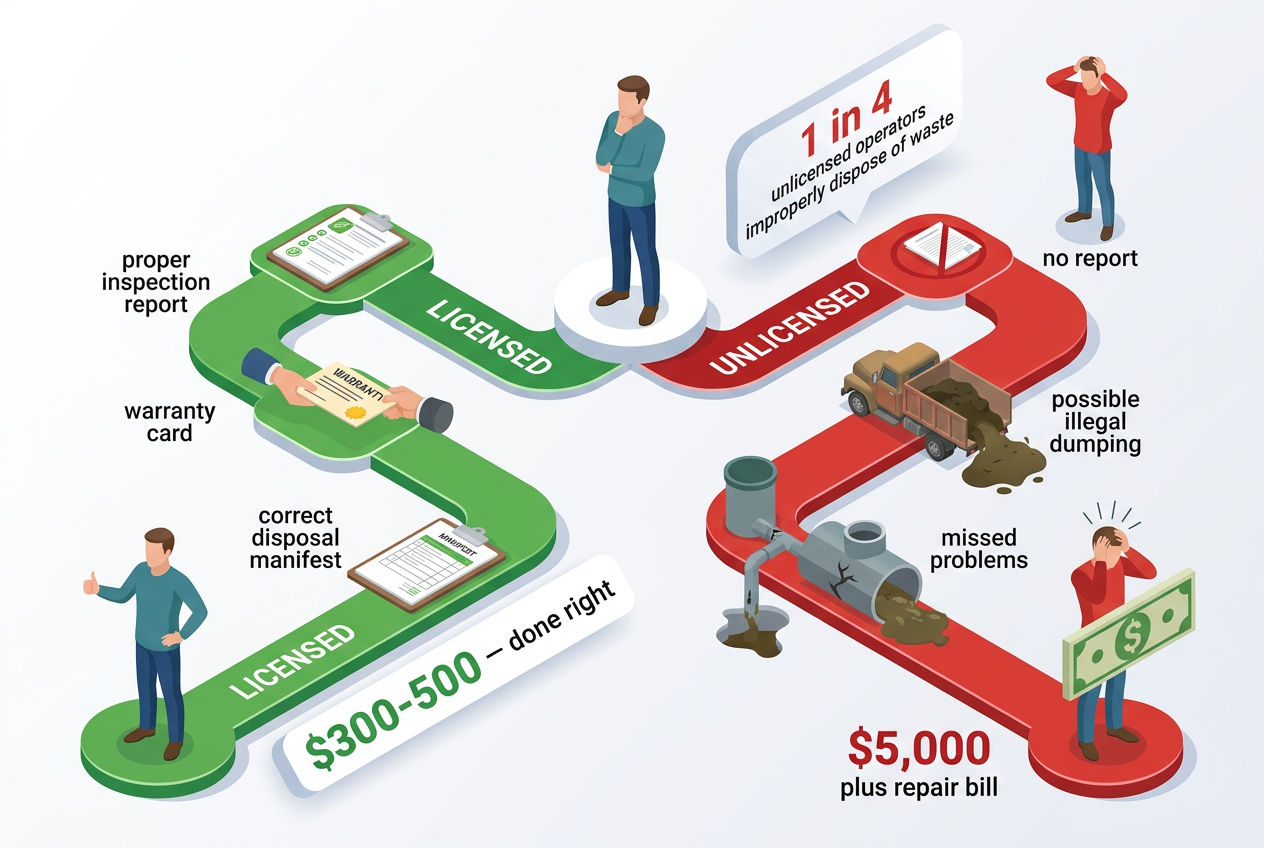
Dumping waste on-site or in unapproved locations. In many states, pumpers are required to file disposal manifests with the county after every service (Minnesota's MPCA enforces this requirement). Ask where your waste goes. A legit company has a licensed disposal site and will tell you.

How to Compare Septic Companies: A Quick Checklist
Use this when evaluating two or more companies side by side:
| Evaluation Factor | Company A | Company B | Company C |
|---|---|---|---|
| State license verified? | ☐ Yes ☐ No | ☐ Yes ☐ No | ☐ Yes ☐ No |
| $1M liability insurance? | ☐ Yes ☐ No | ☐ Yes ☐ No | ☐ Yes ☐ No |
| 5+ years in local market? | ☐ Yes ☐ No | ☐ Yes ☐ No | ☐ Yes ☐ No |
| Written itemized estimate? | ☐ Yes ☐ No | ☐ Yes ☐ No | ☐ Yes ☐ No |
| Full-service capabilities? | ☐ Yes ☐ No | ☐ Yes ☐ No | ☐ Yes ☐ No |
| 24/7 emergency service? | ☐ Yes ☐ No | ☐ Yes ☐ No | ☐ Yes ☐ No |
| Workmanship warranty? | ☐ Yes ☐ No | ☐ Yes ☐ No | ☐ Yes ☐ No |
| References provided? | ☐ Yes ☐ No | ☐ Yes ☐ No | ☐ Yes ☐ No |
Evaluation criteria based on industry standards from NAWT and NOWRA professional guidelines.
✅ Pro Tip: The company with the most checkmarks - and no dealbreakers - is your hire.
Find a Trusted Septic Service Company Near You
You've got the questions. Now you need companies worth asking them to.
SepticTankHub.com lists licensed septic professionals across the country. Search by ZIP code to find septic tank pumping companies near you, compare providers, and read verified reviews from real homeowners. Every listing includes service area, specialties, and contact information.
Regulations and licensing requirements vary significantly by state and county. If you're in a regulated state like Massachusetts, Maryland, or Washington - where compliance expertise is non-negotiable - use our state and city-level directory pages to find contractors who know your local codes.
Don't wait until there's an emergency to vet your options. Build the relationship now. The homeowners who have the best outcomes are the ones who scheduled routine septic maintenance with a trusted company before anything went wrong.

Comparing costs? Find septic professionals near you on SepticTankHub.
Related reading: septic inspection process.
Sources & Methodology
1. U.S. Environmental Protection Agency - Septic Systems Primary source for recommended pumping frequency (every 3–5 years), national statistics (21 million homes on septic), and system lifespan data. epa.gov/septic
2. National Association of Wastewater Technicians (NAWT) Industry standards for pumper certification, training requirements, and professional best practices. nawt.org
3. National Onsite Wastewater Recycling Association (NOWRA) Guidance on contractor credentials, licensing frameworks, and regional regulatory variation. nowra.org
4. BrightLocal Annual Local Consumer Review Survey Source for the statistic that 87%+ of consumers read online reviews before hiring a home services provider.
5. State Health Department Licensing Databases Florida Department of Health (RSTC licensing), Minnesota Pollution Control Agency (disposal manifests), and Massachusetts Title 5 inspection requirements referenced as illustrative examples of state-specific regulatory variation.
For more on how your system works before you hire anyone to touch it, read our complete guide to septic systems.
Need help with your septic system? Browse local septic companies in South Carolina or Missouri.
Was this article helpful?
Frequently Asked Questions
Recommended Resources
📖 Related Articles
💰 Cost Guides
Find Septic Professionals Near You
Compare licensed, verified septic companies by area — top county markets and cities below, or browse all 50 states.
County markets
Popular cities
