
Quick Answer
Septic tank excavation is digging and preparing the hole a septic tank sits in. A 1,000-gallon tank usually needs a hole about 8 by 12 feet and 6 to 7 feet deep, topped with 4 to 6 inches of level sand or stone. The dig alone typically costs $1,000 to $4,000.
Key Takeaways
- Size the hole at the tank's footprint plus 1 to 2 feet of working room on every side.
- Depth = tank height + 4 to 6 inches of bedding + the cover your county requires (often 6 to 24 inches over the lid).
- Set the tank on level, compacted sand or ¾-inch stone over undisturbed soil, never on loose fill.
- Leach field trenches commonly run 18 to 36 inches wide and 18 to 36 inches deep.
- Budget $1,000 to $4,000 for the tank hole and $2,500 to $10,000+ with the drain field.
Picture this: the excavator shows up Monday, the inspector is booked for Wednesday, and by Tuesday afternoon the tank hole is half full of groundwater. Nobody planned for a pump. Nobody asked who pays when the bucket hits ledge at 4 feet. That's how a $2,000 dig turns into a $5,000 one.
Septic tank excavation looks like the simple part of an install. It isn't. Get the hole too shallow and your inlet pipe can't keep its slope. Dig too deep and fill it back with loose dirt, and the tank settles and cracks. Smear the leach field trenches in wet clay and the system can fail years early. If you're weighing an owner-built system, start with our DIY septic system guide, then use the numbers below to check any plan or quote.
What Does Septic Tank Excavation Involve?
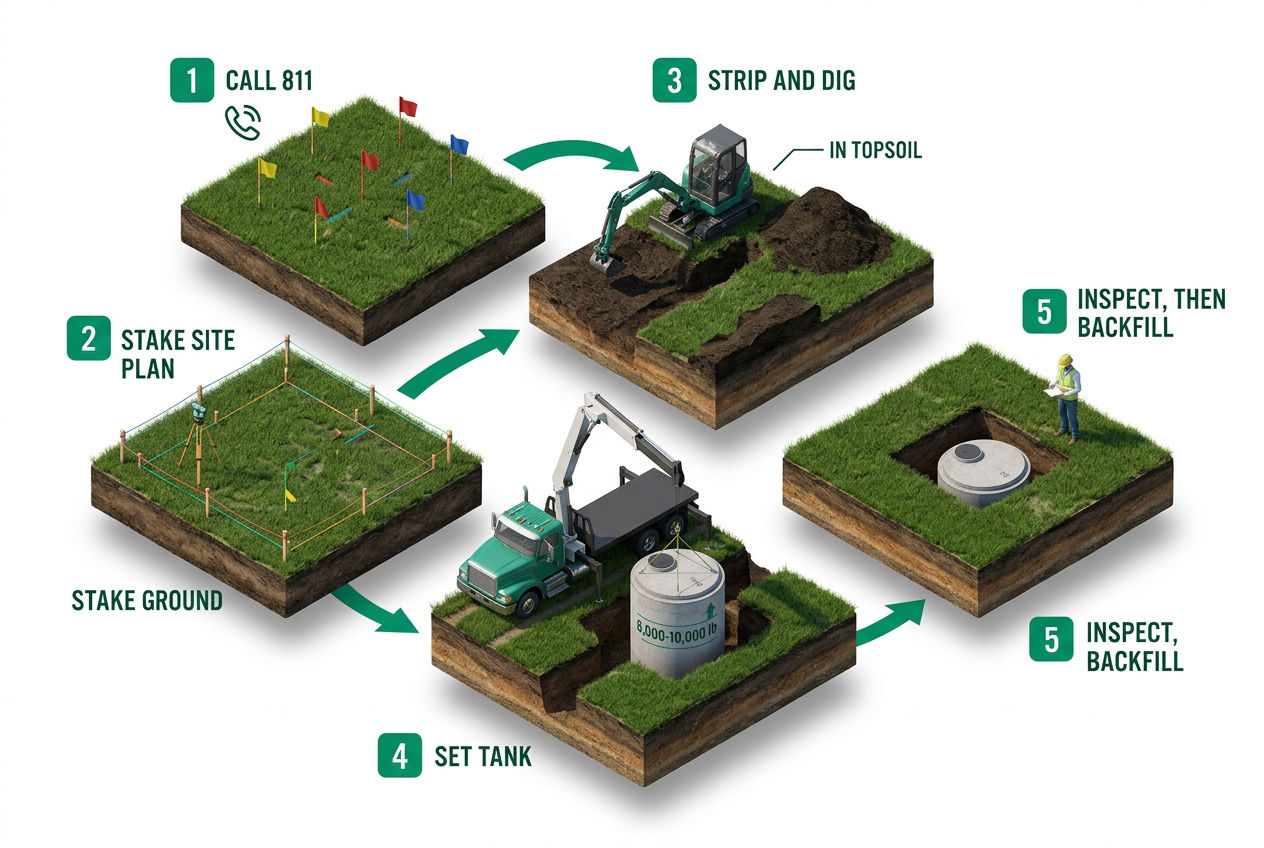
Septic tank excavation involves locating buried utilities, staking the approved tank and field locations, digging the tank hole and leach field trenches, preparing a level base, setting the tank, connecting pipes at the right slope, and backfilling in compacted layers. Most counties require an inspection before anything gets covered. The hole size and depth come straight from your septic system design. For the full sequence from permit to backfill, see how to install a septic tank.
Here's the usual order of work on a conventional gravity system:
- Call 811. Utility locating is free, and most states require 2 to 3 business days' notice before you dig. Private lines like a well pump feed or a shop's power cable won't be marked, so you'll need to find those yourself.
- Stake the site plan. The tank, distribution box, and trenches go exactly where your approved design puts them. Setbacks to wells, property lines, and foundations are written into the septic permit requirements for your county.
- Strip and dig. Topsoil gets set aside so it can go back on top. A 5- to 8-ton mini excavator handles most residential work.
- Prep the base, set the tank. A precast concrete 1,000-gallon tank weighs roughly 8,000 to 10,000 pounds, so the supplier's boom truck usually sets it. That truck needs firm ground within reach of the hole.
- Pipe, inspect, backfill. The inspector checks elevations, bedding, and pipe joints in the open hole. Then you backfill and grade.
How Big a Hole Do You Need for a Septic Tank?
A septic tank hole should be the tank's footprint plus 1 to 2 feet of working room on every side. A typical 1,000-gallon concrete tank measures about 5.5 feet wide by 9 feet long, so its hole runs roughly 8 to 9 feet wide and 12 to 13 feet long. Check the outside measurements on our septic tank diagram with dimensions before you dig.
That extra room isn't wasted. Crews need space to level the bedding, guide the tank down, and compact backfill along the walls. A hole cut tight to the tank leaves voids that settle later.
Approximate hole footprints for common concrete tank sizes:
- 750-gallon (about 5 × 7 ft tank): hole about 8 × 10 ft
- 1,000-gallon (about 5.5 × 9 ft tank): hole about 8.5 × 12 ft
- 1,250-gallon (about 5.5 × 10 ft tank): hole about 8.5 × 13 ft
- 1,500-gallon (about 6 × 11 ft tank): hole about 9 × 14 ft
Dimensions vary by manufacturer, and two-compartment tanks can run longer. Always size from the spec sheet. Our 1,000-gallon septic tank guide compares concrete, plastic, and fiberglass shapes.
Worked example: how much dirt comes out? Take a hole 8.5 feet wide, 12 feet long, and 6.5 feet deep. That's 8.5 × 12 × 6.5 = 663 cubic feet, or about 24.5 cubic yards of "bank" soil. Soil fluffs up 20 to 30% once it's dug, so you'll have a pile of about 30 loose yards. The tank itself takes up about 9 cubic yards. That leaves 9 to 12 yards of extra spoil to spread on site or haul away. A tandem dump truck carries 10 to 14 yards, so plan for about one load if you can't spread it.
How Deep Should a Septic Tank Excavation Be?
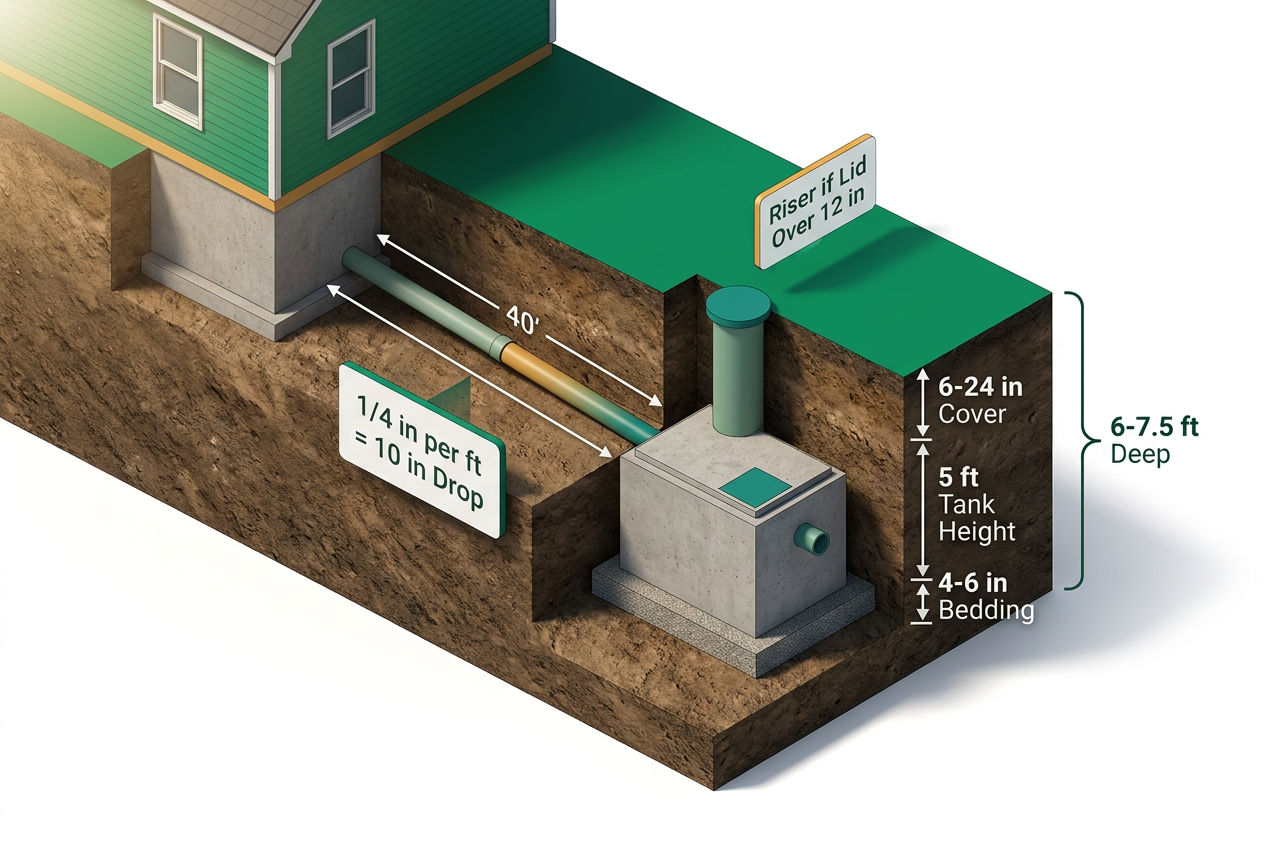
A septic tank excavation should equal the tank height, plus 4 to 6 inches of bedding, plus the soil cover your local code requires. Most tanks sit with the lid 6 to 24 inches below grade, so a 5-foot-tall tank usually needs a hole about 6 to 7.5 feet deep.
The real driver isn't the tank. It's the house sewer pipe. Wastewater flows by gravity, and most plumbing codes require 1/4 inch of fall per foot (some allow 1/8 inch for 4-inch pipe). The tank's inlet has to land below that line.
Worked example: Your sewer pipe leaves the foundation 24 inches below grade. The tank sits 40 feet away. At 1/4 inch per foot, the pipe drops 10 inches, so the inlet lands about 34 inches down. If the inlet sits about 12 inches below the tank top, the lid ends up roughly 22 inches below grade. Many counties require a riser to grade once the lid is deeper than about 12 inches, so budget for one.
Deeper isn't always safer. Concrete tanks are rated for a certain soil load, and plastic tanks list a maximum burial depth on the spec sheet. Bury past it and the walls can bow. In cold states the cover also insulates; the University of Minnesota Extension notes that frost can reach 4 to 5 feet in parts of Minnesota, which is why northern installers often add rigid foam over shallow tanks. See how deep a septic tank is buried for state-by-state examples.
What Goes Under a Septic Tank? Bedding and Base Prep
A septic tank should rest on 4 to 6 inches of compacted sand, pea gravel, or ¾-inch crushed stone, spread over undisturbed native soil and leveled in both directions. The bedding spreads the tank's weight evenly and keeps rocks from cracking concrete or deforming a plastic tank.
A few rules that separate a good base from a callback:
- Over-dug? Fix it with stone. If the hole goes 8 inches too deep, fill the extra with compacted crushed stone. Loose dirt settles, and one end of the tank drops.
- Level matters. The inlet is usually set 2 to 3 inches higher than the outlet. A tank that tips toward the outlet can let scum slip past the outlet baffle and into your drain field.
- Clear the floor. Pull roots, boulders, and standing water before the tank goes in.
- Backfill in lifts. Place and compact soil in layers of about 12 inches, working evenly around all sides. Keep rocks larger than about 3 inches away from plastic tanks.
- Plastic tanks get water. Most plastic tank makers say to fill the tank with water as you backfill, so outside soil pressure doesn't push the walls in.
Here's the honest limitation: bedding can't fix a bad subgrade. If the hole bottom is soft clay or old fill, 6 inches of sand won't stop settling. That site may need deeper stone, geotextile fabric, or an engineer's design. In wet areas, an empty tank can also float right out of the ground, so the base may need concrete deadmen or anchor straps. Our guide to septic systems in a high water table covers flotation fixes.
How to Dig a Leach Field: Trench Width, Depth, and Soil Rules
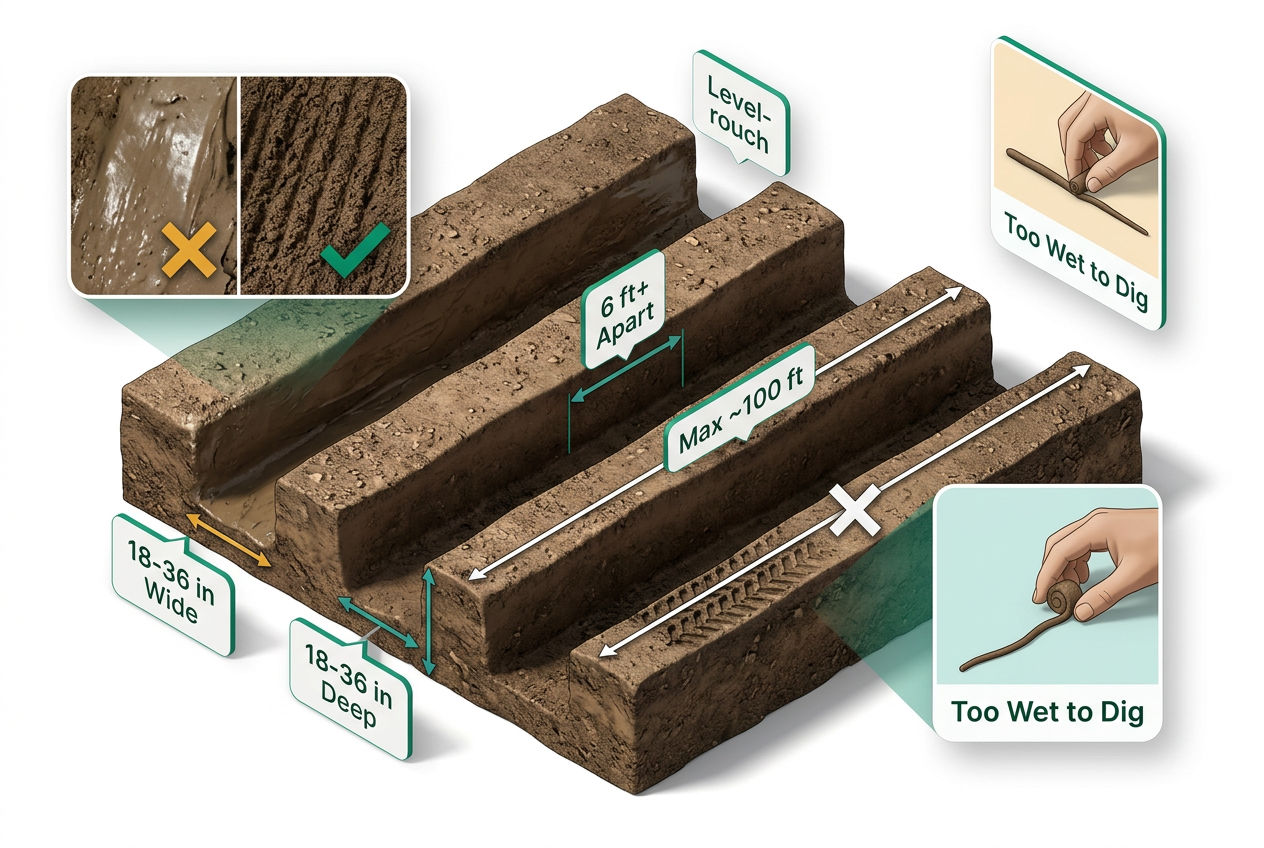
To dig a leach field, cut level-bottomed trenches to the dimensions in your approved design, typically 18 to 36 inches wide and 18 to 36 inches deep, spaced about 6 feet or more apart. Dig only when the soil is dry enough not to smear, and keep machine tracks off the trench bottoms.
Leach field trenching is where most DIY mistakes happen. The tank only has to hold water. The field has to soak it into the soil for decades.
Smearing is the silent killer. When you dig wet clay, the bucket polishes the trench walls into a slick, sealed surface. Effluent can't pass through it. Many extension programs suggest a simple roll test: if a handful of soil from trench depth rolls into a thin wire without crumbling, it's too wet to dig. If you do see shiny walls, rake them rough before placing stone. Homes on heavy soil should read our guide to septic systems for clay soil before scheduling the dig.
Other trench rules most codes share:
- Level bottoms. Each trench bottom should be level along its full length so effluent spreads evenly.
- Length limits. Many states cap a single lateral at about 100 feet.
- Aggregate layers. Most designs call for 6 to 12 inches of washed stone under the pipe and about 2 inches over it. Our leach field gravel guide shows how to calculate tons.
- Chambers change the dig. Plastic chamber systems from makers like Infiltrator Water Technologies skip the stone, which can shrink trench width in some states.
Separation to water and rock is set by state code, and it decides how deep you can go. Florida's Department of Health (Chapter 64E-6) requires at least 24 inches between the drain field bottom and the wet-season high water table. Massachusetts Title 5 requires 4 feet to high groundwater, and 5 feet in very fast-draining soils. Your perc test and soil log set the final drain field depth.
Worked example: A 3-bedroom design calls for three trenches, each 75 feet long, 3 feet wide, and 3 feet deep. That's 3 × 75 × 3 × 3 = 2,025 cubic feet, or 75 cubic yards of soil. That's three times the tank hole. A mini excavator usually needs a full day or more for that much trench.
How Much Does Septic Excavation Cost?

DIY Septic Blueprint
Thinking about building it yourself?
The complete, plain-English plan to size, permit and install your own septic system — designed for homeowners, not contractors. Skip the $15,000–$25,000 quotes and do it right the first time.
Get the DIY Blueprint — $67 →Instant download · 8 modules + 3 bonus guides · 60-day money-back guaranteeSeptic excavation cost typically runs $1,000 to $4,000 for the tank hole alone and $2,500 to $10,000 or more when leach field trenches are included. Excavator work with an operator usually costs $100 to $250 an hour, while rock, groundwater, and tight access can double a quote. Digging is only one stage of the full installation timeline.
| Excavation Item | Typical Cost | Main Cost Driver |
|---|---|---|
| Tank hole only | $1,000–$4,000 | Tank size, soil |
| Tank + leach field dig | $2,500–$10,000+ | Trench footage |
| Excavator + operator | $100–$250/hr | Machine size, region |
| Mini excavator rental | $300–$500/day | Delivery is extra |
| Rock breaking | $1,000–$5,000+ | Ledge, boulders |
Source: SepticTankHub estimates from published 2026 contractor and equipment-rental rate ranges. Prices vary by state and county; get local quotes.
Location swings these numbers hard. A 1,000-gallon tank hole in sandy Coastal Plain soil in the Carolinas can be opened in 3 or 4 machine hours, or roughly $400 to $1,000 of excavator time. The same hole in New Hampshire granite ledge might need a hydraulic hammer for a day or more, adding $1,500 to $5,000. Pumping out groundwater adds more: a trash pump rents for roughly $50 to $150 a day, and a wet spring job can run it for a week.
Most installers bundle excavation into the full install price. Our septic installation cost guide shows how digging fits into the total. When you compare bids, ask each one:
- Is haul-off of extra spoil included?
- Is there a rock clause, and what's the hourly rate if they hit ledge?
- Are backfill, final grading, topsoil, and seed included?
- Who pays for dewatering if the hole floods?
Replacing an old field costs more than a new one, because the old trenches and stone usually have to be dug out first. The drain field replacement cost guide breaks down that work.
What Makes Septic System Excavation Harder? Rock, Water, Frost, and Access
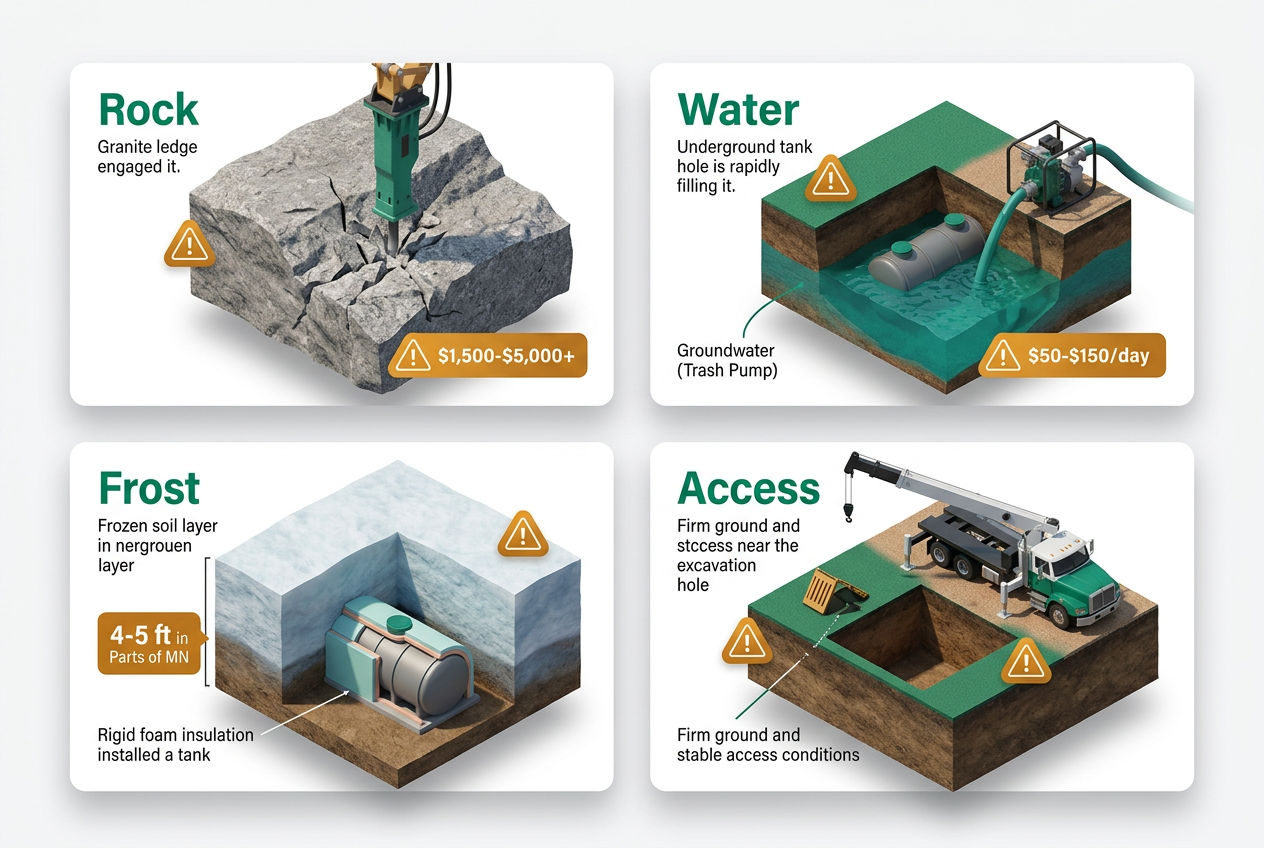
Septic system excavation gets harder and pricier when crews hit ledge rock, a high seasonal water table, frozen ground, or a site a tracked machine can't reach. Spring is usually the worst season because groundwater peaks and wet soil smears. Late summer and early fall are usually the easiest months to dig.
- Rock. New England and much of Appalachia sit on shallow ledge and glacial boulders. Central Texas limestone and Southwest caliche act much the same. A quote without a rock clause is a quote that will change.
- High groundwater. Florida, the Gulf Coast, and many river valleys have water tables a few feet down in the wet season. Holes flood, sidewalls cave, and some sites end up with mound or raised systems instead of conventional trenches.
- Clay. Midwest and Piedmont clays smear when wet and may need bigger fields. Crews sometimes wait a week of dry weather before trenching.
- Frost. In northern states, frozen ground can be 2 to 4 feet thick by midwinter. Some installers rip frost with a bigger machine at extra cost. Others simply wait for spring, and some counties won't inspect over frozen soil.
- Access. A mini excavator needs a path about 6 to 8 feet wide. The boom truck setting a concrete tank needs firm ground close to the hole. Fences, steep slopes, and mature trees all add hours.
Can You Dig a Septic Tank Hole Yourself?
Some states and counties let homeowners do their own septic tank excavation on owner-occupied property, but many require a licensed installer, and nearly all require a permit and an open-hole inspection. Even where DIY digging is legal, deep holes are dangerous: OSHA requires cave-in protection for trenches 5 feet deep or more. Whether you can do the rest of the install depends on your state: see septic installation rules by state.
OSHA's trenching standard (29 CFR 1926 Subpart P) applies to employers, not homeowners. The physics applies to everyone. OSHA notes that a single cubic yard of soil can weigh about as much as a car. A tank hole is usually 6 to 7 feet deep, so never step into it unless the walls are sloped back, benched, or shored. Keep the spoil pile at least 2 feet from the edge, and use a ladder for any hole 4 feet or deeper.
DIY digging can save money. A two-day mini excavator rental with delivery often runs $800 to $1,200, versus several thousand for a contractor. The catch is what happens when something goes wrong. A trench dug 6 inches too deep, a smeared field, or a tank set out of level can fail inspection, and reopening the work often costs more than hiring it out would have.
If your county requires a licensed installer, or you'd rather not stand next to a 7-foot hole, our septic installation service page explains what a full-service install covers. You can also compare licensed installers near you on the SepticTankHub directory.
Sources & Methodology
- U.S. Environmental Protection Agency (epa.gov/septic): homeowner guidance on septic design, siting, and drain field function.
- OSHA Trenching and Excavation Standard (osha.gov): 29 CFR 1926 Subpart P, the 5-foot protective-system rule, spoil setbacks, and ladder rules.
- Florida Department of Health, Chapter 64E-6, F.A.C.: separation between drain field bottom and wet-season high water table. floridahealth.gov
- Massachusetts DEP, Title 5 (310 CMR 15.000): groundwater separation rules for soil absorption systems. mass.gov/dep
- University of Minnesota Extension, Onsite Sewage Treatment Program: frost depth and cold-climate installation practices. extension.umn.edu
Cost ranges are SepticTankHub estimates compiled from published contractor and equipment-rental rates for 2026. Tank dimensions reflect typical precast concrete products; always confirm with your tank manufacturer and your county health department.
Primary sources to read: OSHA 29 CFR 1926 Subpart P (excavations) · Call 811 before you dig · Florida DEP: onsite sewage permitting FAQ · MassDEP: Title 5 new construction · University of Minnesota Onsite Sewage Treatment Program
More Septic Design & Install Guides
- Septic system design: the complete guide
- Septic pipe slope: the right fall per foot
- Gravel for a leach field
- How long a septic install takes
- Septic systems on a slope
- Leach field design and sizing
- Can you install your own septic system? Rules by state
Frequently Asked Questions
How much does septic tank excavation cost?
Septic tank excavation costs about $1,000 to $4,000 for the tank hole alone in most of the U.S., and $2,500 to $10,000 or more once leach field trenches are added. The low end applies to sandy or loamy soil, easy machine access, and a 1,000-gallon tank. Costs climb with tank size, ledge rock, high groundwater that needs pumping, frozen ground, and long haul-off distances for extra spoil. Rock breaking alone can add $1,000 to $5,000. Hourly excavator work with an operator usually runs $100 to $250 an hour. Most installers fold excavation into a full installation price, so ask each bidder to list digging, haul-off, backfill, and final grading separately, and check whether the quote has a rock clause that adds charges if the crew hits ledge.
How do you dig a leach field?
To dig a leach field, follow the trench layout in your approved permit design. Call 811 first and wait for utility marks. Stake the trenches, then cut them level along their length, usually 18 to 36 inches wide and 18 to 36 inches deep, with about 6 feet of undisturbed soil between trenches. Dig only when the soil is dry enough to crumble instead of rolling into a wire, because wet clay smears and seals. Rake any polished sidewalls, keep machine tracks off the trench bottoms, and keep the required separation from the seasonal high water table, often 2 to 4 feet. Then place aggregate or chambers and pipe as designed. Most counties inspect the open trenches before backfill, so don't cover anything until the inspector signs off.
How big of a hole do you need for a 1,000-gallon septic tank?
A 1,000-gallon septic tank usually needs a hole about 8 to 9 feet wide, 12 to 13 feet long, and 6 to 7.5 feet deep. That sizing comes from a typical concrete tank footprint of roughly 5.5 by 9 feet, plus about 1.5 feet of working room on each side. Depth equals the tank's height (about 5 feet), plus 4 to 6 inches of bedding, plus the 6 to 24 inches of cover most counties allow over the lid. Plastic and fiberglass 1,000-gallon tanks have different shapes, so measure from the manufacturer's spec sheet instead of using a generic number. Expect roughly 25 bank cubic yards of soil from the hole, which swells to about 30 loose yards once it's dug.
How long does septic system excavation take?
Septic system excavation for a standard conventional system usually takes one to three days of machine time. An experienced operator with a 5- to 8-ton mini excavator can open a 1,000-gallon tank hole in about 2 to 4 hours in sandy or loamy soil. Leach field trenches for a 3-bedroom home often take another full day. Rock, groundwater, clay that has to dry out, and tight access can stretch the dig to a week. The calendar time is usually longer than the dig time, because most counties require open-hole and pre-backfill inspections, and you may wait a few days for the inspector. Spring water tables and winter frost can also push the start date back by weeks in northern and coastal states.
What do you put in the bottom of a septic tank excavation?
The bottom of a septic tank excavation gets 4 to 6 inches of compacted sand, pea gravel, or ¾-inch crushed stone, laid over undisturbed native soil and leveled end to end and side to side. That bedding spreads several tons of concrete evenly and keeps rocks from point-loading a plastic or fiberglass tank. If the hole was dug too deep, fill the extra depth with compacted stone, never loose soil, or the tank will settle unevenly. Remove roots, boulders, and standing water before setting the tank. In high groundwater areas, the base may also include concrete deadmen or anchor straps to keep an empty tank from floating. Always follow the tank manufacturer's bedding instructions, because some plastic tanks require a specific material.
Free download
Not ready for the Blueprint? Start free.
Grab the free DIY Septic Planning Kit — the permit-first checklist, perc-test cheat sheet, and sizing tables that keep your build from getting red-tagged.
Was this article helpful?
Frequently Asked Questions
Recommended Resources
📖 Related Articles
- DIY Septic System: How to Build Your Own (Step-by-Step)
- Septic System Permit Cost & State Requirements (2026 Guide)
- 1000-Gallon Septic Tank: Dimensions, Cost & Concrete vs Plastic
- How Deep Is a Septic Tank Buried? (Tank, Lines & Field Depths)
- High Water Table and Septic Systems: What You Need to Know
- Gravel for a Leach Field: Size, Depth & How Much You Need
- How Deep Should a Drain Field Be?
💰 Cost Guides
🔧 Services
Find Septic Professionals Near You
Compare licensed, verified septic companies by area — top county markets and cities below, or browse all 50 states.
County markets
Popular cities
