
Quick Answer
Most septic tanks are buried with the top of the tank sitting 12 to 36 inches below ground, though anything from 4 inches to 4 feet is considered normal. The inlet and outlet pipes connecting your house to the tank typically run at the same depth range. Drain field trenches sit 18 to 36 inches deep. Your specific depth depends on frost line, soil conditions, water table, and local code — not a single national standard.
Key Takeaways
- The top of a septic tank is most commonly buried 12–36 inches below grade, with a permitted range of roughly 4 inches to 4 feet.
- Septic lines (inlet and outlet pipes) typically run 12–36 inches deep at a slope of ⅛ to ¼ inch per foot.
- Leach field trenches are usually 18–36 inches deep, with 6–12 inches of gravel beneath the distribution pipes.
- Frost line depth drives installation depth in northern states — Minnesota's frost line can reach 60 inches.
- High water table areas (coastal Florida, low-lying Gulf Coast) limit depth and often require mound systems instead.
How Deep Is a Septic Tank Usually Buried?
A standard septic tank is buried so the top of the tank sits 12 to 36 inches below ground surface. That's the most common range you'll find across state health department guidance nationwide. The absolute permitted range runs from as shallow as 4 inches (rare, usually in mild climates) to as deep as 4 feet to the top of the tank — though many jurisdictions cap allowable burial depth at 4 feet for practical access reasons.
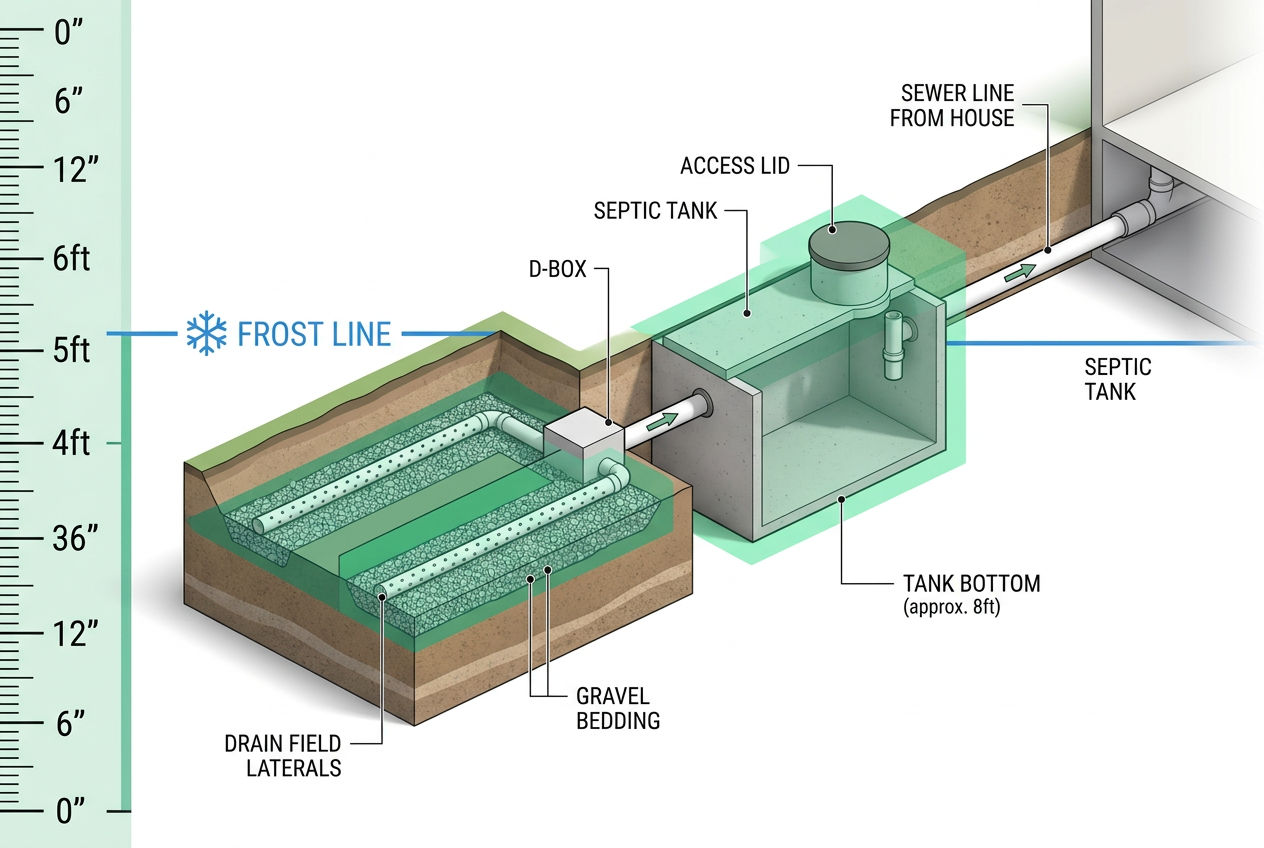
Here's what that means in practice. A standard 1,000-gallon precast concrete tank stands roughly 5 feet tall. If the top of that tank is 24 inches below grade, the bottom of the tank sits about 7 feet underground. A 1,500-gallon tank runs taller — often 5.5 to 6 feet — so the bottom could be 8 to 9 feet deep. The tank itself isn't moving, but knowing these numbers matters when you're planning an excavation, a pool, or a new outbuilding nearby. They matter even more if you're considering installing your own septic system, since burial depth dictates the entire excavation plan.
The lid — specifically the access port where a pumper inserts their hose — follows the same depth as the tank top. Without a septic tank riser installed, that lid can be 2 to 3 feet underground and require hand-digging before every pump-out. Risers extend the access port to just below grade or flush with the surface, eliminating that dig each time. Installing a riser typically runs $100 to $350 — money well spent if your tank lid is buried 30 inches down and you're paying a pump crew to dig to it every 3 years.
How Deep Are Septic Lines Buried?
Septic lines — the 4-inch PVC pipe running from your house to the tank's inlet baffle, and from the outlet baffle toward the drain field — are typically buried 12 to 36 inches deep. That range mirrors the tank depth because the pipe has to enter the tank at the right elevation.
Slope is the critical variable here, not depth alone. The EPA's guidelines for gravity-fed septic systems call for a minimum fall of ⅛ inch per foot of pipe run, with ¼ inch per foot being the more common installation standard. Too little slope and solids settle in the pipe. Too much and liquids race ahead, leaving solids stranded.
Walk through a real scenario: your house sits 60 feet from the tank inlet. At ¼ inch per foot, the pipe drops 15 inches over that run. If the pipe exits your foundation 18 inches below ground, it arrives at the tank inlet roughly 33 inches below grade. That's geometry — the slope determines the depth as much as any code requirement.
In cold climates, those lines need to stay below the frost line or be insulated. Frozen inlet pipes cause sewage backups fast. If you're in a northern state, read our guide on preventing septic pipes from freezing before winter sets in.
How Deep Is a Septic Drain Field?
Leach field trenches — also called leach laterals — are typically excavated to 18 to 36 inches deep. Inside each trench, the layout from bottom to top looks like this:
- 6 to 12 inches of washed drain rock (gravel) on the trench floor
- Perforated distribution pipe (usually 4-inch diameter) laid on top of the gravel
- Additional gravel covering the pipe to within 6 to 12 inches of the surface
- Geotextile fabric to prevent soil migration into the gravel
- 6 to 12 inches of backfill soil to the surface
So the distribution pipes themselves sit roughly 12 to 24 inches below grade in most installations, even though the trench is dug 18 to 36 inches deep.
One number that overrides all of the above: the separation distance between the trench bottom and the seasonal high water table. Most states require 2 to 4 feet of unsaturated soil between the bottom of the leach trench and the water table. In coastal Florida or Louisiana, where the water table can be 18 inches below grade, a conventional drain field simply can't be installed. That's why those areas rely heavily on mound systems, which build the field up rather than digging it down.
For a deeper look at leach field construction and layout, see our drain field installation guide.
Free download
Planning your own septic system?
Grab the free DIY Septic Planning Kit — the permit-first checklist, perc-test cheat sheet, and sizing tables that keep your build from getting red-tagged.
Septic System Depth Reference Table
| Component | Typical Depth (Top/Surface) | Typical Depth Range | Key Variable |
|---|---|---|---|
| Septic tank top | 12–36 in. below grade | 4 in. – 4 ft. | Frost line, grade elevation |
| Septic tank bottom | 6–9 ft. below grade | 5–10 ft. | Tank height + burial depth |
| Inlet/outlet pipes | 12–36 in. below grade | 12–48 in. | Pipe slope, distance from house |
| Distribution box | 12–36 in. below grade | 6 in. – 4 ft. | Field elevation, tank elevation |
| Drain field trench (top) | 18–36 in. total depth | 12–48 in. | Soil type, water table |
| Distribution pipe (in trench) | 12–24 in. below grade | 6–36 in. | Trench depth, gravel bed |
Sources: EPA Septic Systems guidance (epa.gov/septic); state health department installation standards; NOWRA (nowra.org)
Does the Depth of a Septic Tank Depend on Where You Live?
Yes — significantly. There is no single federal depth standard. Depth requirements are set at the state or county level, and two neighboring states can have meaningfully different rules.
Frost line is the biggest regional driver. In northern states, pipes and tanks must be installed deep enough to avoid freezing. The frost line in Minnesota reaches 42 to 60 inches in the northern counties. Wisconsin's Department of Natural Resources mandates that septic components be installed below the local frost depth or adequately insulated. By contrast, Georgia's frost line is roughly 6 to 12 inches, and Florida's is essentially zero — which is why you'll see septic lids nearly at the surface in South Florida.
Water table depth shapes the other end of the constraint. In high water table regions, you can't go deep even if you want to. Florida requires mound or advanced systems when seasonal high water tables are within 24 inches of the surface. Coastal Louisiana faces similar challenges. In these areas, the conventional buried tank remains feasible, but the drain field design changes completely.
Soil type also plays a role, though it affects field design more than tank burial depth. Dense clay soils fail percolation tests and may require engineered alternatives. Rocky New England ledge can make excavation below 3 feet physically impractical without blasting. Massachusetts's Title 5 regulations, for example, are among the most detailed in the country — specifying separation distances, soil classifications, and minimum depths for every component.
How Do I Find Out How Deep My Septic Tank Is?
Start with your property records. When a septic system is installed, the installer files an as-built drawing — sometimes called a septic plot plan or record drawing — with the local health department. That document shows the tank location, the outlet pipe direction, and typically the burial depth. Your county health department can usually provide a copy, sometimes for free, sometimes for a small fee.
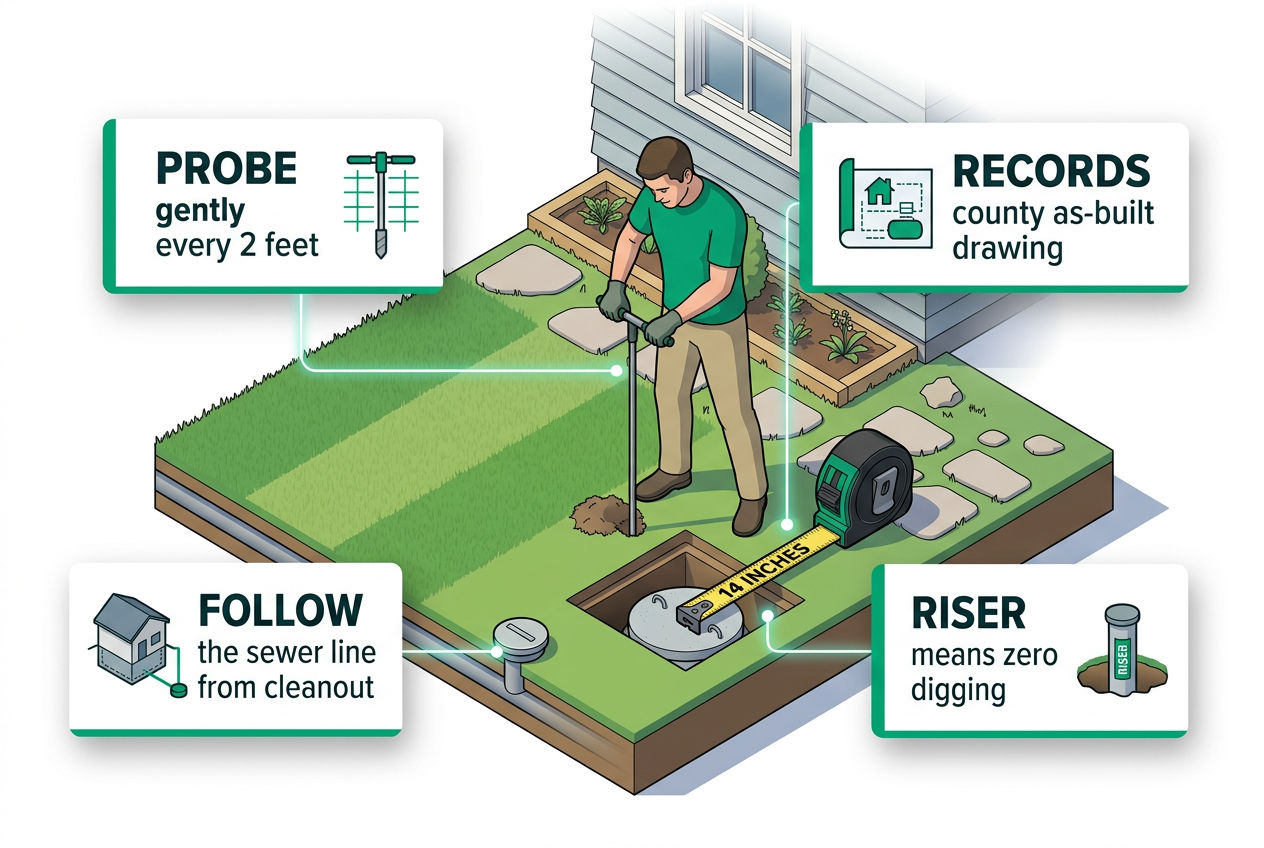
No records? Here's how professionals locate and measure depth in the field:
- Probe the yard — A thin metal rod (a septic probe or soil probe) is pushed into the ground in the area where the tank is expected. A hollow sound and firm resistance indicate the tank top.
- Use the cleanout — Your home's plumbing cleanout shows the pipe exit point and its depth. Tracing the pipe slope gives a close estimate of tank inlet depth.
- Electronic locator — A technician flushes a transmitting device down the toilet and uses a surface receiver to pinpoint the tank.
- Check your inspection report — If you had a septic inspection at purchase, the report likely includes the tank lid depth.
If the lid is buried more than 12 inches down, ask about installing a riser. You'll recover the cost in saved labor charges within two pump-out cycles. Finding the tank lid is half the battle — knowing the depth before the pump truck arrives saves everyone time.
Can a Septic Tank Be Too Deep?
Yes. Most jurisdictions cap the maximum burial depth at 4 feet to the top of the tank. Beyond that, access becomes dangerous and expensive. A pump truck's hose has practical length limits, and a technician working over a 4-foot-deep opening faces serious confined space risks.
When tanks are buried deeper than code allows — which sometimes happens with unlicensed work or major grade changes after original installation — pump-outs become difficult, costly, or impossible without extension hoses and specialized equipment. More importantly, very deep tanks make proper baffle inspection nearly impossible, and a deteriorated inlet or outlet baffle that goes unnoticed leads to drain field damage that can cost $5,000 to $20,000 to fix. See the drain field replacement cost guide for what that looks like.
If you suspect your tank is buried unusually deep, a septic inspection will confirm it and tell you whether a riser extension can solve the access problem without excavation.
Do You Need to Dig Up Your Yard to Pump Your Septic Tank?
Not if risers are installed. A septic tank riser extends the access port from the tank lid up to just below the surface — usually 2 to 4 inches underground. The pump truck can locate the lid, pull it off, and drop the hose in without any digging.
Without risers, if your tank lid sits 24 to 36 inches below grade, the pump crew will hand-dig to expose it. That adds 15 to 30 minutes of labor to the service call, plus the time to rebury and tamp the soil. Some companies charge extra for deep-lid access; others roll it into a flat rate. Either way, you're paying for the labor.
Risers are made from high-density polyethylene (HDPE) or concrete, come in 12-inch, 16-inch, and 24-inch diameter sizes to match your tank's access port, and stack in sections. For most homeowners, it's a one-time upgrade during a pump-out that eliminates the dig-up hassle forever. Compare that to the cost of septic pumping over a 20-year tank life and the math is obvious.
What Affects How Deep a Septic System Needs to Be?
Five factors drive the final installation depth for every component:
1. Frost line depth. Pipes above the frost line freeze and crack. In Duluth, Minnesota, that means burial to at least 48 to 60 inches. In Atlanta, Georgia, 12 inches is sufficient. The National Weather Service publishes frost depth data by region — your local health department will cite the applicable design depth for permits.
2. Water table elevation. The seasonal high water table determines the minimum separation distance below your drain field trenches. The EPA recommends at least 2 feet of unsaturated soil; many states require 3 to 4 feet. Where the water table is high, mound systems elevate the field rather than fight the physics.
3. Topography and existing grade. A house on a hillside has different pipe-run geometry than a flat lot. Installers work with natural slope to maintain proper gravity flow without burying pipes unnecessarily deep or mounting them too shallow.
4. Local code requirements. Your county or state health department sets the actual numbers. Check your state's regulations — for example, Washington State's WAC 246-272A specifies soil cover requirements, minimum depths, and separation distances in detail.
5. Tank and system type. A conventional gravity-fed system follows the depths discussed here. An aerobic treatment unit (ATU), a mound system, or a chamber system like those using Infiltrator Water Technologies chambers may have different depth profiles. If you're planning a new installation, understanding system design options before you pull the permit can save you from a costly redesign.
Not Sure How Deep Your System Is? A Pro Can Tell You in an Hour
About 21 million U.S. homes rely on septic systems, according to the EPA — and a significant percentage of those homeowners have no idea where their tank is, let alone how deep it's buried. That's not a criticism. It's just not the kind of thing anyone thinks about until there's a problem.
If you're planning a landscaping project, adding a pool, or selling your home, get the depth confirmed before you break ground. A licensed septic professional can locate your tank, probe for the lid, measure the burial depth, and assess whether a riser makes sense — often in under an hour.
Find septic installers in your area through the SepticTankHub directory, or schedule a pump-out and ask the technician to document your lid depth and riser status while they're on-site.
Sources & Methodology
-
U.S. Environmental Protection Agency — Septic Systems (epa.gov/septic): Primary reference for national guidance on septic system design, installation, and maintenance standards, including separation distance requirements and system component depth guidance.
-
National Onsite Wastewater Recycling Association (NOWRA) (nowra.org): Industry organization providing technical standards and best practices for onsite wastewater systems, referenced for component depth ranges and installation norms.
-
Minnesota Pollution Control Agency (MPCA): Referenced for frost line depths in northern climates (42–60 inches) and licensed pumper manifest requirements — a specific example of state-level regulatory rigor.
-
Massachusetts Title 5 Regulations (310 CMR 15.000): Cited as an example of detailed state-level septic code, including soil classification requirements, minimum separation distances, and component depth specifications.
-
Washington State Department of Health — WAC 246-272A: Referenced for state-level code variation, including specific soil cover requirements and installation depth minimums for septic system components in the Pacific Northwest.
Content reviewed for accuracy against state health department installation standards and EPA guidance. Depth ranges reflect typical permitted installations; always verify with your local authority having jurisdiction (AHJ) before planning excavation or construction near a septic system.
Was this article helpful?
Frequently Asked Questions
Recommended Resources
📖 Related Articles
- How to Install Septic Tank Risers (and Why You Should)
- Freezing Pipes and Septic: How to Prevent Winter Damage
- How to Install a Septic Drain Field
- Perc Test (Percolation Test): What It Is & How It Works
- What Happens During a Septic Inspection?
- How to Find Your Septic Tank Lid (And What to Do If It's Buried)
- Septic System Design: Layouts, Drawings & Requirements
💰 Cost Guides
Find Septic Professionals Near You
Compare licensed, verified septic companies by area — top county markets and cities below, or browse all 50 states.
County markets
Popular cities
