
Quick Answer
Plastic septic tank installation is the process of setting a polyethylene tank level on a prepared bed, connecting the inlet and outlet pipes, and backfilling in compacted lifts of about 12 inches. Norwesco, Valencia and Premier Tech (Rewatec) tell installers to fill their tanks with water during backfill so the walls don't collapse, while Infiltrator says its IM-series tanks don't need it. Cover limits and high-water-table rules differ by maker, so your tank's own manual is the rulebook.
Key Takeaways
- The manufacturer manuals reviewed here warn about two install failures above all: walls collapsing under backfill and tanks floating in high groundwater.
- Cover limits differ by maker: 6–30 inches for Norwesco's standard tanks and Valencia, up to 36 inches for Rewatec, and 6–48 inches for most Infiltrator IM-series tanks.
- Norwesco, Valencia and Infiltrator call for backfill in 12-inch lifts. Norwesco says to keep the water inside level with the backfill outside.
- Norwesco and Valencia say not to install any tank in a high water table or water-saturated clay. Infiltrator sets its own groundwater limit and buoyancy rules.
- Norwesco and Valencia both tell buyers to check local codes and approved installation procedures before installing.
Plastic tanks are light. Valencia's instructions say lowering one of its tanks into the hole is best done with two or three people, depending on the tank's size and weight. That low weight is also the weak spot. An empty poly tank in a flooded hole behaves like an empty cooler in a pool.
This guide walks you through how to install a plastic septic tank step by step. It also explains the two failures you're trying to avoid. If you're still deciding on materials, start with our breakdown of concrete vs. plastic septic tanks.
What Are the Steps to Install a Plastic Septic Tank?
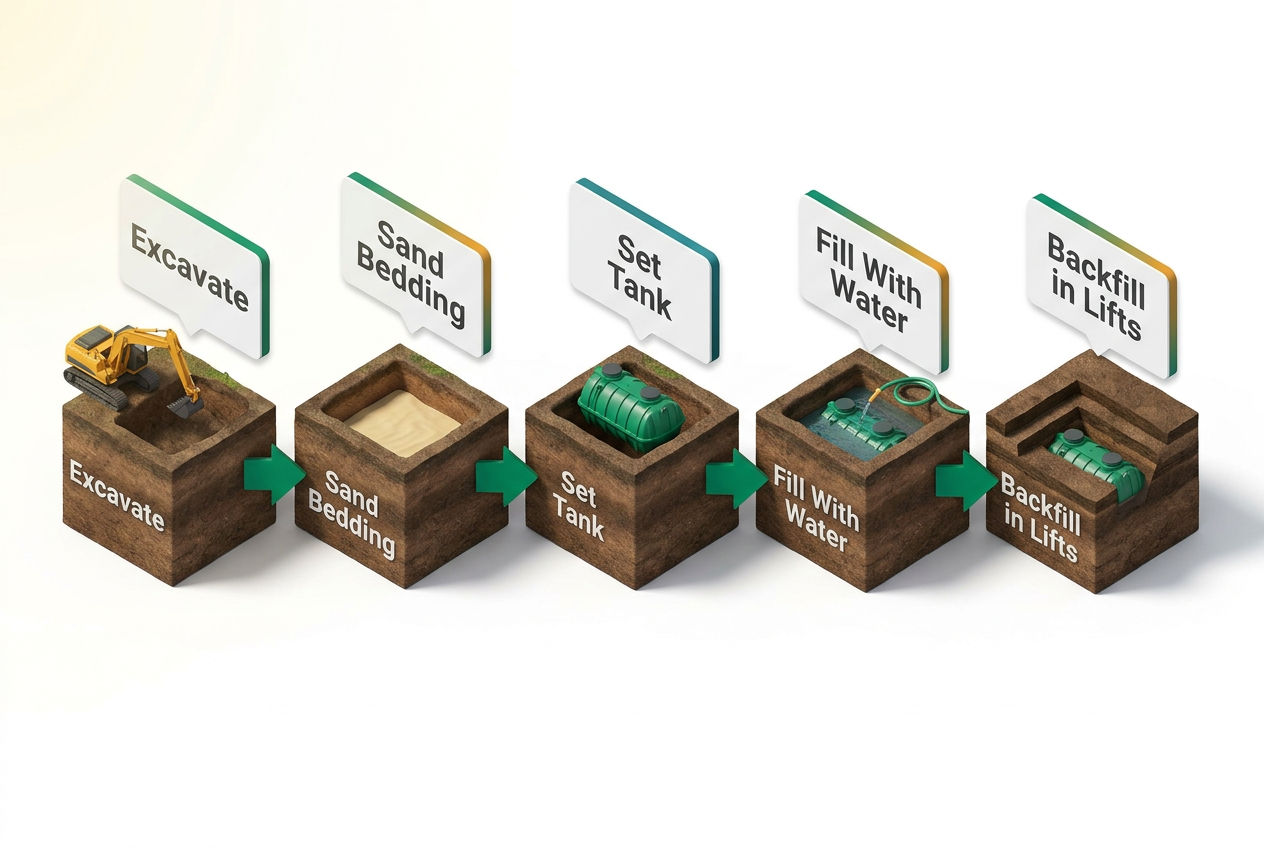
To install a plastic septic tank, you confirm the permit and design, check groundwater, dig a hole with room to compact around the tank, and lay a level bed. Then you set the tank, connect the pipes, and backfill in compacted lifts, adding water if your manual calls for it. Finally, you get any required inspection and bring the lids to grade.
Here are the plastic septic tank installation instructions in order. They're drawn from manufacturer manuals from Norwesco, Valencia Pipe Company, Premier Tech (Rewatec) and Infiltrator:
- Pull your permit and confirm the design. Norwesco tells septic buyers to contact their local or state sanitarian about approved installation procedures, and Valencia says to check local codes before you buy. Check our septic system permit requirements guide before you rent equipment.
- Find out how high groundwater gets. Valencia recommends a professional site survey by a qualified, certified geologist before purchase or installation. Infiltrator's buoyancy guidance needs two numbers: the maximum height of saturated soil above the tank bottom and the planned soil cover.
- Excavate with clearance. Norwesco and Valencia call for 18–24 inches on both sides and both ends of the tank. Rewatec calls for at least 12 inches on all sides, and Infiltrator for 18–36 inches on each side. You need that room to compact the backfill.
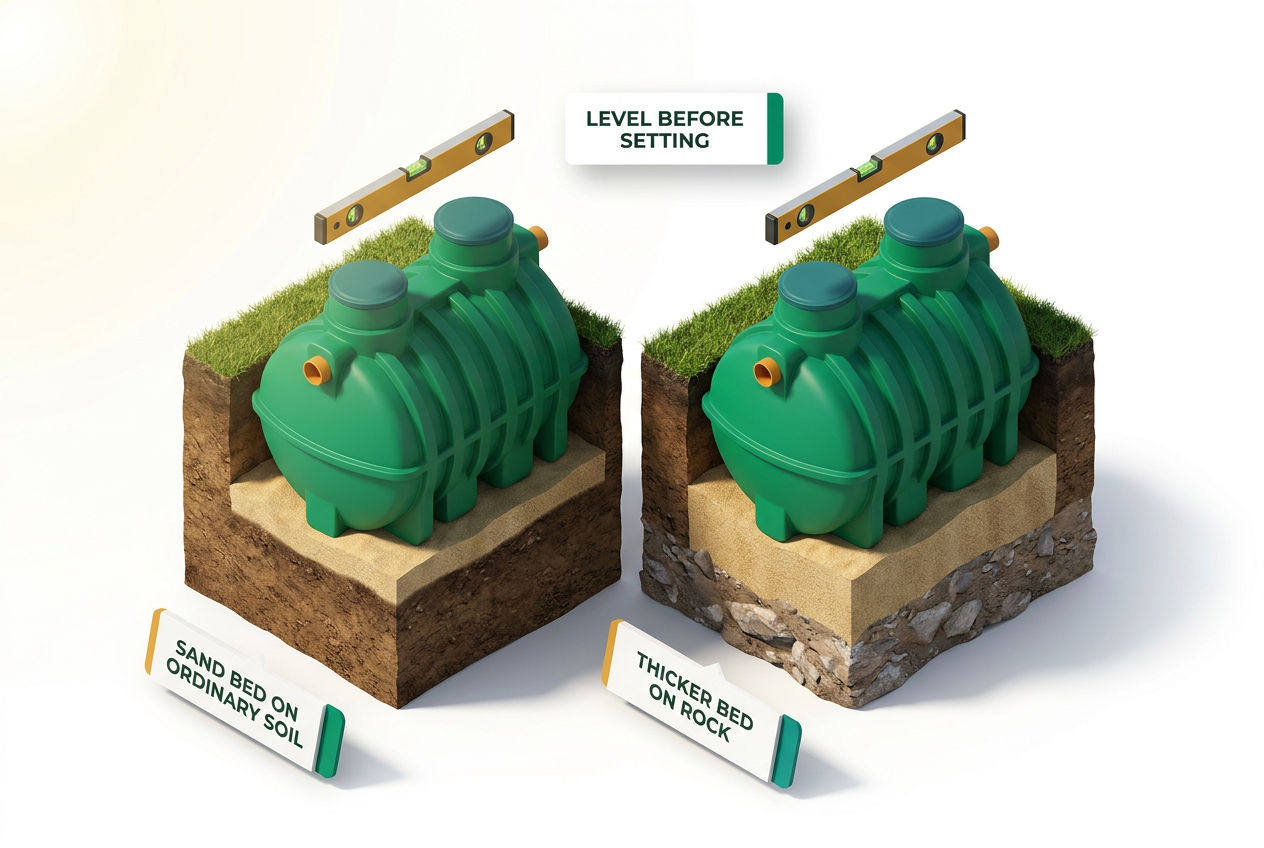
- Lay and level the bedding. Norwesco and Valencia prefer well-packed sand, at least 6 inches in soil and 12 inches in rocky terrain. Norwesco's Low Profile instructions set a level tolerance of plus or minus 1/2 inch from each end.
- Set the tank and connect the pipes. Norwesco, Valencia and Rewatec all note that the inlet sits higher than the outlet, so check the flow markings. Norwesco and Valencia call for solvent-welding the PVC piping to the supplied tees or adapters.
- Backfill in lifts, with water if your manual calls for it. Valencia alternates 12 inches of water in the tank with 12 inches of firmly compacted backfill around it, compacting the ends first. Infiltrator uses 12-inch lifts without water, unless the hole may fill with water from rain or other sources.
- Tamp under the pipes. Norwesco and Valencia both say to compact backfill under the inlet and outlet pipes. Loose soil there lets pipes sag at the fitting.
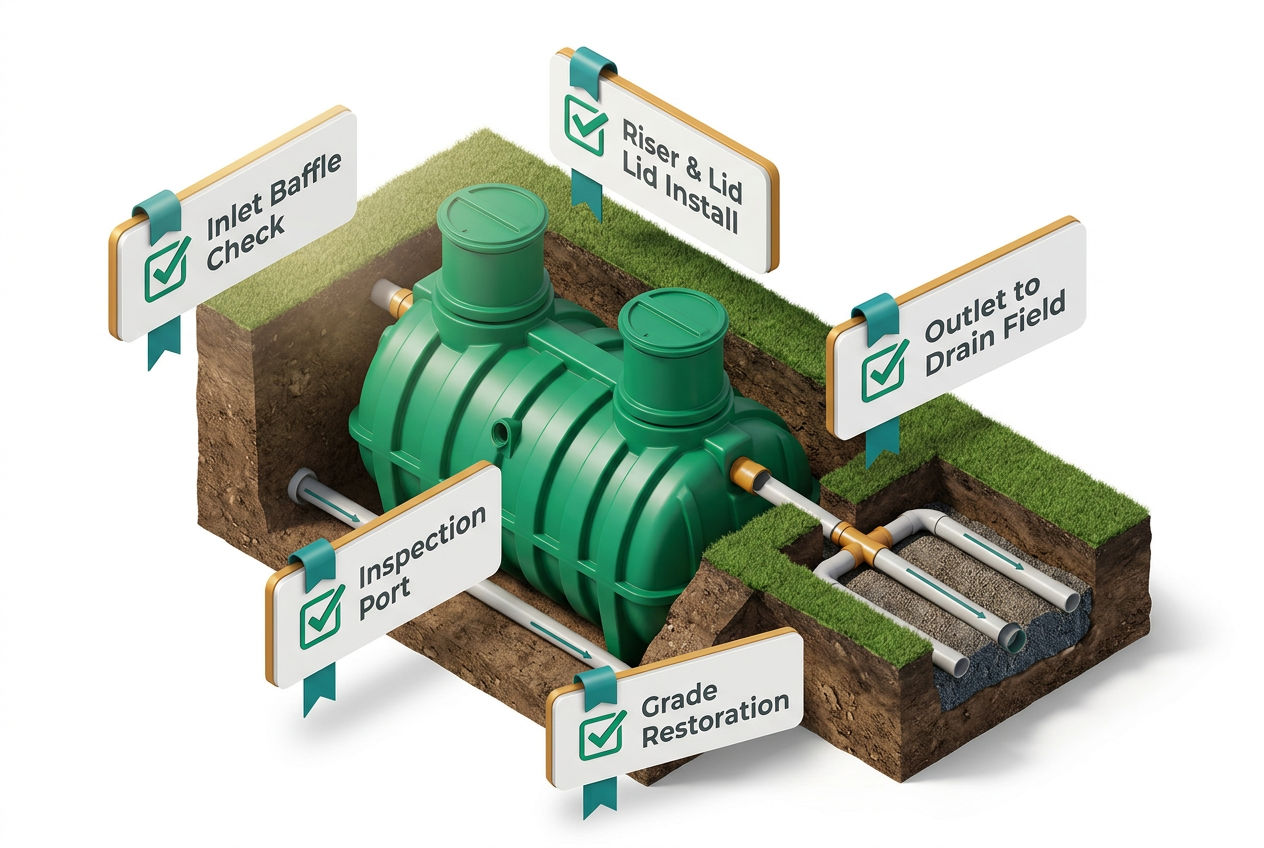
- Call for inspection before final cover. If your permit requires an inspection, schedule it while the tank and connections are still exposed.
- Install risers and finish grade. Norwesco says to install manhole extensions or lid risers before you backfill, and Rewatec says never to cover or bury the access lids.
Want the bigger picture beyond the tank itself? Our DIY septic system pillar covers the drain field, design, and approvals.
Plastic Septic Tank Installation Specs at a Glance
The specs below come from each maker's published installation instructions. They apply to the products named, not to every poly tank on the market, and they differ from brand to brand. Always follow the manual that ships with your tank.
| Spec | Norwesco (standard) | Valencia | Rewatec | Infiltrator IM-series |
|---|---|---|---|---|
| Soil cover | 6–30 in. (Low Profile: 6–36 in.) | 6–30 in. | 36 in. max | 6–48 in. (lower in some states) |
| Side/end clearance | 18–24 in. | 18–24 in. | 12 in. min | 18–36 in. |
| Water during backfill | Keep level with backfill | 12 in. water, then 12 in. backfill | Fill before backfill | Not required unless hole may flood |
| Backfill lifts | 12 in., compacted | 12 in., compacted | Deposited, not dumped | 12 in., compacted |
| Vehicle traffic | Not under vehicle paths | Not under vehicle paths | No motorized traffic | Non-traffic only |
Sources: Norwesco Underground Tank and Low Profile Underground Tank installation instructions; Valencia Pipe Company Underground Septic Tank Installation Instructions; Premier Tech Rewatec septic tank installation guide and owner's manual; Infiltrator Septic Tank General Installation Instructions (February 2024).
Why Do Plastic Septic Tanks Float?
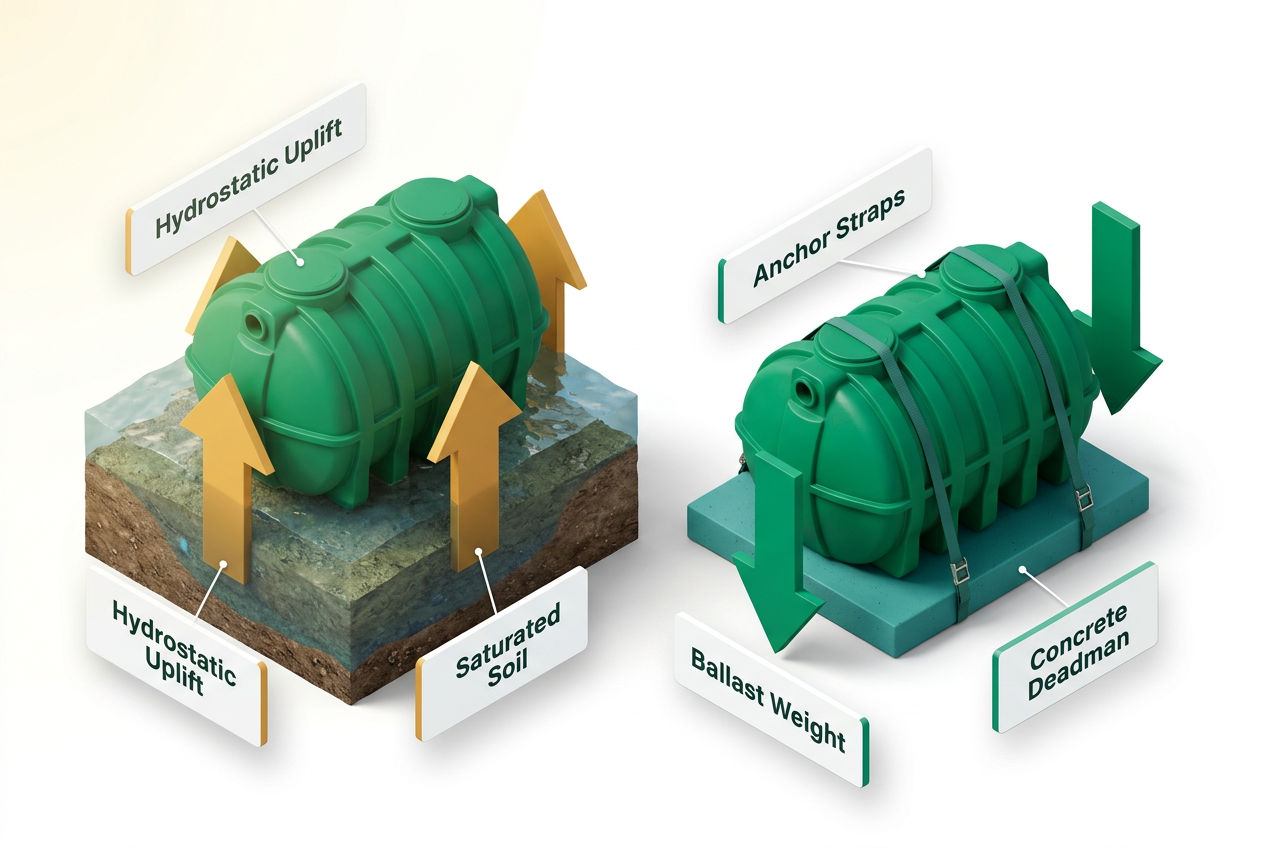
A plastic septic tank floats when groundwater pushes up on it with more force than the tank, its contents, and the soil on top can hold down. An empty or freshly pumped tank in wet ground is the classic case. Valencia's instructions warn that high water tables can cause a septic tank to float to the surface.
The lift is large. The USGS lists fresh water at about 62.4 pounds per cubic foot, which works out to roughly 8.34 pounds per gallon. A 1,000-gallon septic tank sitting empty in a flooded hole displaces at least 1,000 gallons of water, or roughly 8,340 pounds of upward force (SepticTankHub calculation). Water inside the tank and soil on top are what hold it down. Valencia's buoyancy table shows how fast the need grows: its 1,000-gallon tank under 6 inches of cover needs 4,860 pounds of added weight when groundwater stands 30 inches above the tank base, but no added weight at 30 inches of cover. Infiltrator lists 2,700 pounds of downward force for its IM-1060 under 6–12 inches of cover with saturated soil 36 inches or more above the tank bottom.
Picture this: you set the tank on Friday, plan to backfill Saturday, and it rains hard that night. On Saturday morning, the empty tank has lifted out of its bed and the pipe connections are strained or broken. You're starting over.
Three conditions raise the risk of a floating tank:
- Groundwater. Norwesco's Low Profile instructions send installers to separate supplemental instructions wherever saturated soil or seasonal high water tables show up between the tank bottom and the ground surface.
- An empty tank. Norwesco's Low Profile instructions say not to leave those tanks empty for extended periods. Infiltrator requires filling with water and backfilling to the tank's mid-height if the hole may fill with water.
- Pumping without refilling. Norwesco and Valencia say a pumped septic tank should be refilled immediately, and Rewatec's manual says to fill the tank with water after it's emptied.
What anchoring can and can't do: Makers treat buoyancy control differently. Norwesco's standard instructions and Valencia's notes both say not to install any tank in a high water table, though Valencia's sheet also includes buoyancy mitigation tables for places where codes require it, and Norwesco's Low Profile instructions refer installers to separate counter-buoyancy instructions. Rewatec says never to install where the groundwater table can reach the tank's base. Infiltrator allows IM-series tanks in saturated soil up to the outlet pipe saddle, 43 inches above the tank bottom, and lists methods such as concrete-filled half-pipe deadmen, concrete parking bumpers or traffic barriers, concrete collars and helical anchors when cover is under 12 inches. Use only the method your tank's manual approves. If you're on Florida's Gulf Coast or in low ground anywhere, read our guide to septic systems in a high water table and ask your designer which tank types your site allows.
Why Do Plastic Septic Tanks Crack or Collapse?
Plastic septic tanks crack or collapse when soil pressure on the walls or lid is uneven or too great. The manuals point to the same causes again and again: too much cover, sharp stones against the tank, poorly compacted backfill, and backfilling around an empty tank when the manual says to add water.
Here's how each cause plays out:
- Too much cover. Norwesco says its 6–30 inch cover range avoids collapse and over-expansion of the tank and possible leakage. Burying a tank deeper than its manual allows to beat frost works against you. Our article on how deep a septic tank is buried explains depth tradeoffs.
- Sharp stones. Norwesco says sharp objects must not come into contact with the tank. Infiltrator says soils with large, protruding or sharp stones are not suitable under the tank.
- Poorly compacted backfill. Infiltrator calls compacting soil beneath the haunches of the tank critical for structural integrity.
- Dumping soil. Rewatec's manual says backfill must be deposited, not dumped, does not recommend a bulldozer for that step, and says to backfill each side evenly.
- Dry backfilling. Norwesco's caution is to keep the water level even with the backfill level as you go, to prevent possible collapse.
Here's a worked example using Valencia's sequence. Say your tank is 60 inches tall. That's five rounds: add 12 inches of water, then 12 inches of compacted soil around the tank, and repeat. Then finish with Valencia's 6–30 inches of cover once the tank is full. Our how to backfill a septic tank guide covers compaction tools and soil choices in more detail.
What Do You Put Under a Plastic Septic Tank?

DIY Septic Blueprint
Thinking about building it yourself?
The complete, plain-English plan to size, permit and install your own septic system — designed for homeowners, not contractors. Skip the $15,000–$25,000 quotes and do it right the first time.
Get the DIY Blueprint — $67 →Instant download · 8 modules + 3 bonus guides · 60-day money-back guaranteeNorwesco and Valencia prefer well-packed sand under the tank: at least 6 inches in soil terrain and 12 inches in rocky terrain. Both accept native soil if it is flowable, compactable, rock free and gives uniform support in the recessed rib areas. Rewatec calls for gravel or sand up to 3/4 inch, well compacted and levelled, and Infiltrator for a uniform, compacted, level surface of suitable native soil or granular material.
Site conditions change the spec:
- Rocky ground. Norwesco, Valencia and Rewatec all double the bedding depth to 12 inches in rock or bedrock.
- Clay soils. Norwesco and Valencia warn against installing in water-saturated clay, and Rewatec says never to install its tanks in clayey soil. Infiltrator judges native soil against the USDA soil texture triangle and, in Arkansas, requires septic gravel or similar angular stone where native soil is more than 50% clay. See our guide to septic systems in clay soil.
Can You Install a Plastic Septic Tank Yourself?
You can physically install a plastic septic tank yourself if you have the equipment and a suitable site. Whether it's legal depends on your state and county, so call your health department before you buy a tank.
Rules vary by state. Florida's onsite sewage program moved from the Department of Health to the Department of Environmental Protection on July 1, 2021, so check the DEP's program pages for who handles permits in your county. In Texas, TCEQ lets local governments act as authorized agents that review septic permit applications and conduct inspections under their own approved orders, so the process can differ from county to county.
Where your permit includes an inspection before cover, the inspector needs to see the tank before it's buried. Read up on septic inspection before backfill so you know what they'll check. Covering the tank early can mean uncovering it again.
Not sure DIY pencils out? Equipment rental, bedding sand, and permit fees add up. Compare real-world numbers in our septic installation cost guide.
What Happens After the Tank Is in the Ground?
After a plastic septic tank is installed, you need access to the lids, a pumping schedule, and a plan for refilling after each pump-out. The EPA says the average household septic system should be inspected at least every three years and that household tanks are typically pumped every three to five years. Plastic tanks add one rule from their makers: refill with water right after pumping.
EPA guidance on septic care lists household size, total wastewater, volume of solids and tank size as the major factors in how often to pump. A 2-person home on a 1,000-gallon tank pumps less often than a 6-person home on the same tank. Our septic pumping schedule guide shows how to estimate yours.
Access matters on plastic tanks. Rewatec says never to cover or bury the access lids, and Valencia notes that its manhole extensions can be stacked to reach the burial depth you need. A septic tank riser brings the lid to grade, so the pumper never needs to dig.
Also, keep vehicles off the tank area. Norwesco, Valencia, Rewatec and Infiltrator all rule out vehicle traffic over their tanks.
Ready to hand the job off? Find a septic installer near you and get quotes from local installers.
Sources & Methodology
This article draws on published manufacturer instructions and government sources. Specs are attributed to the brand that publishes them because burial limits and backfill rules vary by product. The buoyancy figure for an empty 1,000-gallon tank is a SepticTankHub calculation from the USGS water weight.
- Norwesco, Underground Tank Installation Instructions (P/N 63380, distributor-hosted copy): 6–30 inch cover, 18–24 inch clearance, sand bedding, water level even with backfill, 12-inch lifts, tamping under pipes, high water table and saturated clay warning, no vehicles, refill after pumping.
- Norwesco/Snyder Industries, Low Profile Underground Tank Installation Instructions (distributor-hosted copy): 6–36 inch cover, ±1/2 inch level tolerance, backfill gradation, empty-tank, groundwater and counter-buoyancy notes.
- Valencia Pipe Company, Underground Septic Tank Installation Instructions: cover depth, clearance, bedding, lift sequence, high water table warning, buoyancy mitigation table, vehicles, refilling.
- Premier Tech Aqua, Rewatec Septic Tanks Installation Guide and Owner's Manual: 36-inch maximum backfill, 12-inch clearance, bedding, filling with water, "deposited, not dumped," groundwater, clay and traffic limits.
- Infiltrator Water Technologies, Septic Tank General Installation Instructions (February 2024) and IM-Series Tank Buoyancy Control Guidance (May 2019, county-hosted copy): cover limits by state, excavation, bedding, no water fill, 12-inch lifts, groundwater limit and buoyancy control.
- USGS Water Science School, Water Density: weight of water per cubic foot.
- U.S. EPA, How to Care for Your Septic System: inspection (at least every 3 years), pumping (every 3–5 years) and pumping-frequency factors.
- Florida DEP, Program Transfer and TCEQ, Becoming an Authorized Agent: state program structure.
Frequently Asked Questions
How do you install a plastic septic tank in a high water table?
Start with the manual for your exact tank, because makers disagree. Norwesco's standard underground instructions and Valencia's instructions both say not to install any tank in a high water table or in water-saturated clay, and Rewatec's manual says never to install where groundwater can reach the tank's base. Valencia's sheet still includes buoyancy tables for places where codes require mitigation, and Norwesco's Low Profile instructions point to separate supplemental and counter-buoyancy instructions. Infiltrator allows its IM-series tanks in saturated soil up to the outlet pipe saddle, 43 inches above the tank bottom, and its buoyancy guidance calls for control measures such as strapped concrete deadmen or helical anchors when cover is under 12 inches. For a 1,000-gallon tank under 6 inches of cover with groundwater 30 inches above its base, Valencia's table calls for 4,860 pounds of added weight. Ask your designer and health department which tank types your site allows.
Why do poly septic tank installation instructions say to fill the tank with water?
Water inside the tank pushes back against the backfill pressing on the walls. Norwesco's instructions say to fill the tank with water as you backfill, keeping the water level even with the backfill level, to prevent possible collapse. Valencia's instructions alternate 12 inches of water in the tank with 12 inches of firmly compacted backfill around it, all the way to the surface. Rewatec's manual has you fill the tank with water while connecting the pipes and place the final backfill only once the tank is full. Infiltrator is the exception: it says its tanks don't need water before backfill, unless the open or backfilled hole may fill with water from rain or other sources. Norwesco and Valencia also say a pumped tank should be refilled immediately.
How deep can you bury a plastic septic tank?
It depends on the tank. Norwesco's standard underground tanks and Valencia's tanks allow 6 to 30 inches of cover over the top. Norwesco's Low Profile tanks allow 6 to 36 inches, and Rewatec's manual caps backfill over the tank at 36 inches. Infiltrator allows 6 to 48 inches for most IM-series models, but its instructions lower that to 36 inches in Massachusetts, New Hampshire, North Carolina and Oregon, and to 18 inches for Category 3 tanks in Florida. Norwesco says staying within its range avoids collapse, over-expansion of the tank and possible leakage. If your frost depth or grade calls for more cover, check your tank's manual and your health department before you dig.
What do plastic septic tank installation instructions say about backfill material?
Norwesco prefers a sand and gravel mix that is 100% smaller than 1-1/2 inches and about 50% smaller than 1/4 inch, free of wood, masonry debris, silt or clay. Valencia says all backfill must be free of wood, masonry debris, silt and clay. Rewatec's manual bans organic matter, impermeable soil, rock, debris and particles larger than 3/4 inch, and says backfill must be deposited, not dumped, and placed evenly on each side. Infiltrator accepts suitable native soil with stones no larger than 3 inches, judged against the USDA soil texture triangle. Norwesco, Valencia and Infiltrator all call for 12-inch lifts, and Norwesco and Valencia say to compact under the inlet and outlet pipes.
Can you drive over a plastic septic tank after installation?
Not according to the manuals reviewed for this guide. Norwesco says not to install any tank under the path of vehicles or heavy equipment, and Valencia says not to bury its tanks under the path of vehicles or heavy equipment. Infiltrator says not to install its tanks in vehicular traffic areas because they are designed for non-traffic use. Rewatec's manual says to install its tanks where there is no motorized traffic and never to drive vehicles or place objects over 450 pounds within 10 feet of the lids. If a driveway or work area must cross the tank site, ask your designer about a different layout before installation, and keep delivery trucks, pumper trucks and heavy equipment off the area.
Free download
Not ready for the Blueprint? Start free.
Grab the free DIY Septic Planning Kit — the permit-first checklist, perc-test cheat sheet, and sizing tables that keep your build from getting red-tagged.
Was this article helpful?
Frequently Asked Questions
Recommended Resources
📖 Related Articles
- Concrete vs Plastic Septic Tanks: Which Is Better?
- Septic System Permit Cost & State Requirements (2026 Guide)
- DIY Septic System: How to Build Your Own (Step-by-Step)
- 1000-Gallon Septic Tank: Dimensions, Cost & Concrete vs Plastic
- High Water Table and Septic Systems: What You Need to Know
- How Deep Is a Septic Tank Buried? (Tank, Lines & Field Depths)
- How to Backfill a Septic Tank (Without Cracking It or Failing Inspection)
- Septic System for Clay Soil: The Options That Actually Pass
- Septic Inspection Before Backfill: What the Inspector Checks (Checklist)
- How Often Should You Pump Your Septic Tank?
- How to Install Septic Tank Risers: Riser Kit Guide
🔧 Services
Find Septic Professionals Near You
Compare licensed, verified septic companies by area — top county markets and cities below, or browse all 50 states.
County markets
Popular cities
