
Quick Answer
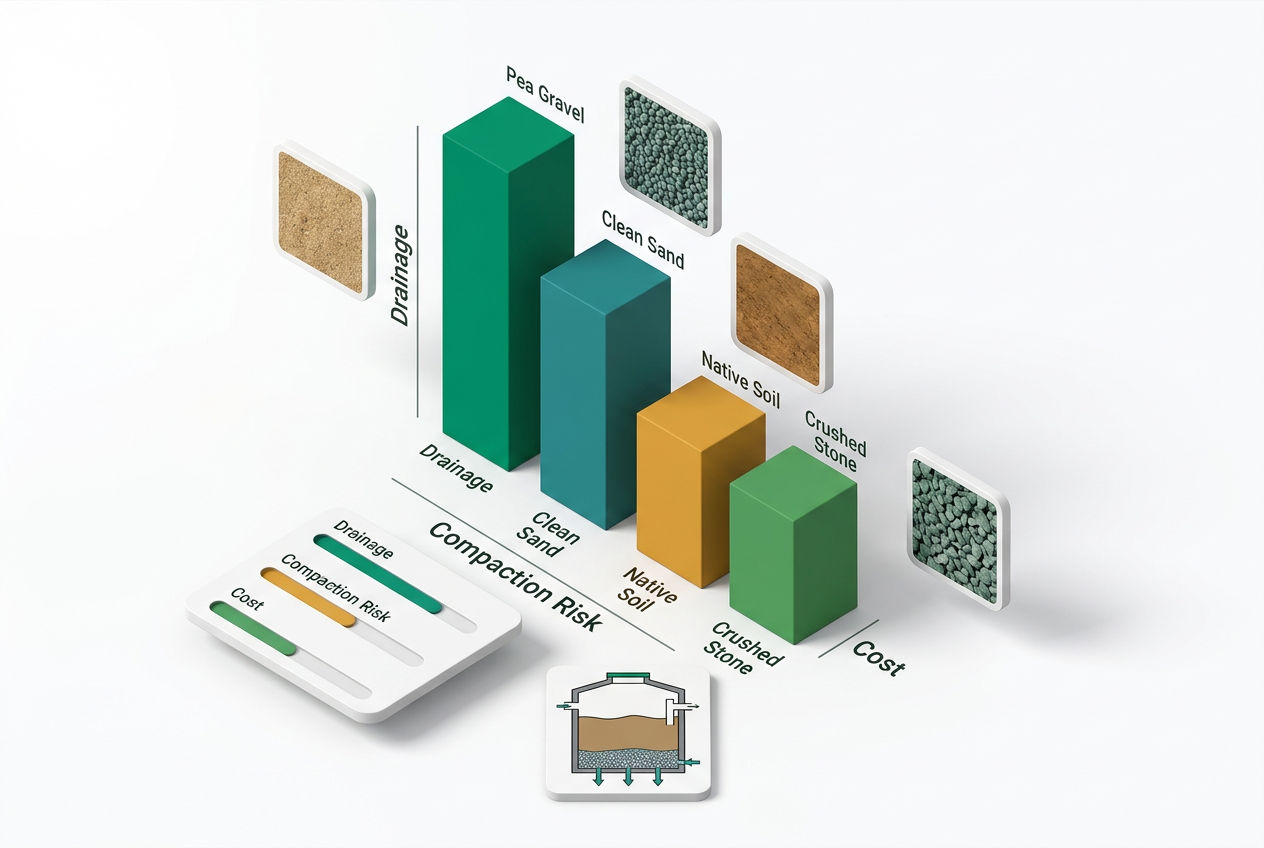
Learning how to backfill a septic tank comes down to refilling the excavation in thin, compacted layers of approved material. Common choices are ASTM C-33 sand or pea gravel. Fill plastic tanks with water as the soil rises. Keep out rocks over 3 inches, and wait for inspection before you cover anything.
Key Takeaways
- Bed the tank on 6–12 inches of sand or pea gravel. Use 12 inches if you're digging in rock.
- Backfill in 12-inch lifts. Do the ends first, then the sides, and keep all four sides within 12 inches of each other.
- Plastic tanks need water inside as backfill rises. Otherwise they can cave in or float.
- Maximum burial depth varies by model, from 30 inches to 36 inches in the sources we checked.
- Get the inspection before you cover. Uncovering a buried tank costs you time and money.
Here's the thing most people miss. Tanks rarely fail because of the tank. They fail because of the dirt around it. A poly tank set in wet clay with a few boulders mixed in can look fine on day one and be egg-shaped by spring. This guide covers both goals in the title: keeping the tank intact and getting it past your county inspector.
What Do You Need to Do Before You Backfill?
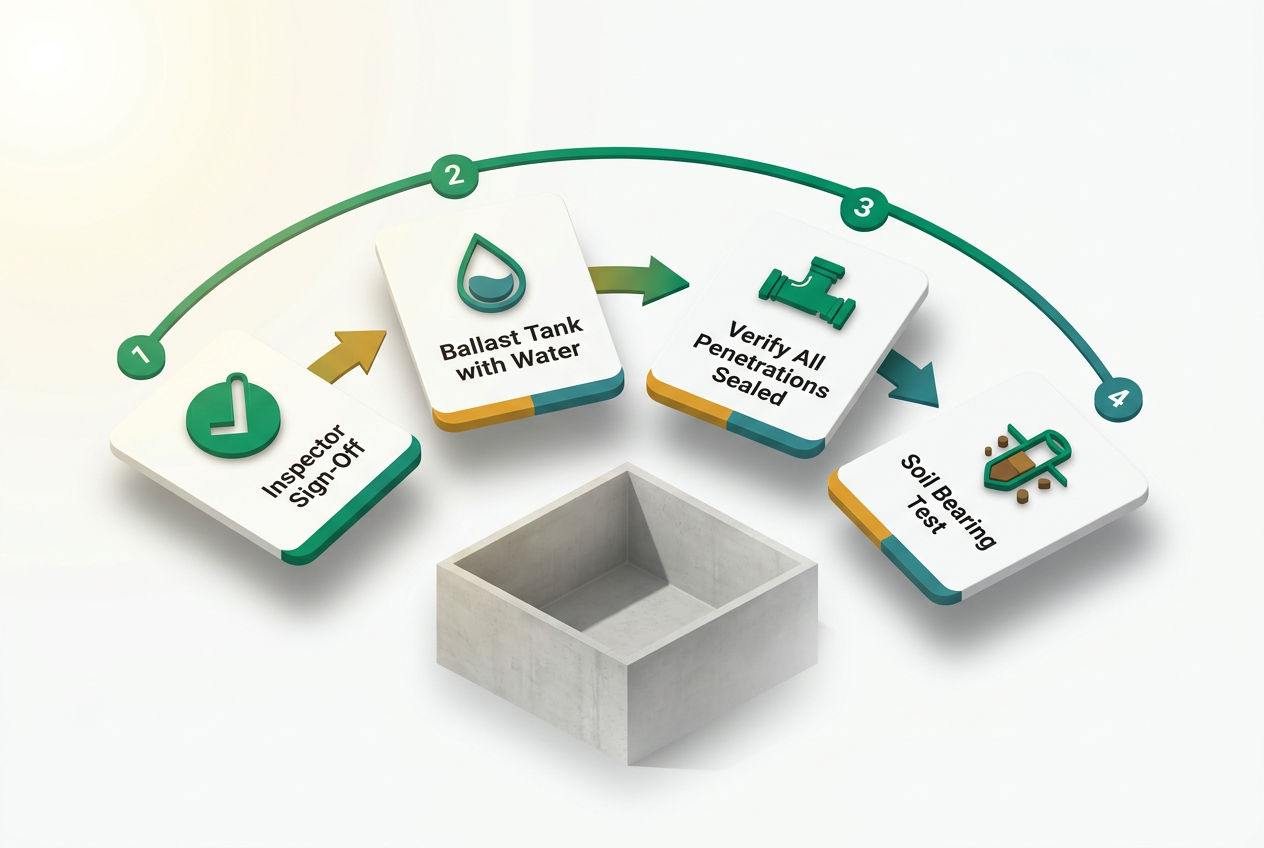
Before you backfill a septic tank, you need three things. First, a valid septic permit. Second, a pre-cover inspection, because most counties want to see the tank, pipes, and bedding while they're still exposed. Third, an 811 utility locate. The 811 call should happen before you dig at all, not just before you backfill.
The Valencia tank installation instructions make Call 811 the first step, and that's the right order. Hitting a gas line with a mini-excavator turns a weekend project into a news story.
Your inspection rules depend on where you live. Requirements vary by state and county, so read up on septic system permit requirements before you schedule anything. Picture this: you backfill on Friday, and on Monday the inspector asks to see the outlet connection. Now you're digging out 15 cubic yards by hand. Book the septic inspection first, and don't move dirt until it's done.
How Should the Tank Be Bedded?
A septic tank should sit on a level, firm bed of pea gravel or ASTM C-33 sand. Cowlitz County, Washington, calls these "self-compacting." Protank asks for at least 6 inches of well-packed sand in normal soil and 12 inches in rock. Never set a tank directly on ledge, roots, or loose spoil.
What if you dug too deep? Don't throw loose dirt back in the hole. New Jersey's septic code (N.J.A.C. 7:9A-8.2) says an over-dug hole has to be brought back to grade with sand, and the tank must rest on a firm, stable foundation. Loose native fill under a tank settles. When it does, the inlet and outlet pipes shear or lose their slope.
If you're still planning the hole, our septic tank excavation guide covers depth and over-dig. Use a laser level or a builder's level on the bedding. One inch of tilt across an 8-foot tank can throw off your baffles.
What Is the Best Septic Tank Backfill Material?
The best septic tank backfill material is clean, free-flowing sand or pea gravel with no stones larger than 3 inches. Cowlitz County sets that 3-inch limit. Valencia's instructions also ban wood, masonry debris, silt, and clay around their tanks. Concrete tanks often allow screened native soil, but plastic and fiberglass tanks are much pickier.
Here's what generally passes and what doesn't:
- Usually OK: ASTM C-33 concrete sand, pea gravel, or screened native sandy loam (if your manufacturer allows it).
- Usually banned: clay, silt, frozen clods, construction debris, roots, stumps, and rocks over 3 inches.
Protank puts it plainly: use only the backfill specified for your model. A spec sheet can be stricter than county code, and when it is, the stricter rule wins. Ignoring it can also void the warranty.
Clay deserves its own warning. In heavy-clay areas such as East Texas, the Gulf South, and much of the Midwest, native clay swells when wet and shrinks when dry. That cycle squeezes plastic walls. If you're building on clay, read our septic system for clay soil page and budget for imported sand.
How to Backfill a Septic Tank: Step by Step
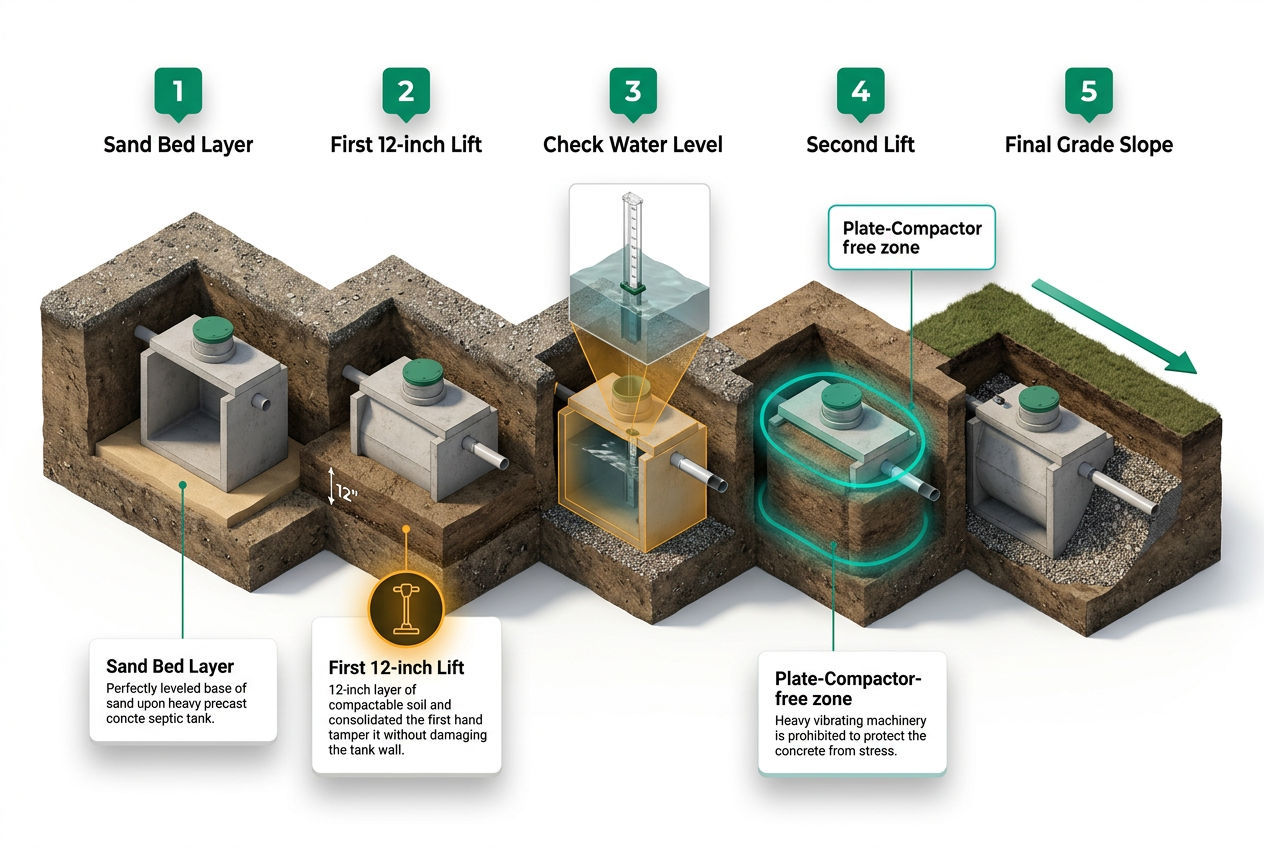
To backfill a septic tank, place 12-inch lifts of approved fill and compact each lift before adding the next. Do the ends first, then the sides. Keep all four sides within 12 inches of each other. On plastic tanks, add about 12 inches of water before each 12-inch lift so the pressure inside balances the soil outside.
Plastic (Poly) Tanks
Poly tanks are light, which is why they're popular with owner-builders. That same lightness makes them the easiest to crush or float. Valencia's sequence works like this:
- Leave 18–24 inches of clearance on all sides and ends.
- Add 12 inches of water to the tank.
- Add 12 inches of backfill. Compact the ends first, then the sides.
- Repeat, keeping water level with the backfill, until you reach grade.
- Compact under the inlet and outlet pipes so they don't sag.
Protank's ribbed tanks follow the same idea. Water should match the backfill level or sit 12 inches above it, and Protank suggests planning for a water truck. A garden hose filling a 1,000-gallon tank takes hours. Learn more about plastic septic tanks before you buy one.
Fiberglass Tanks
Fiberglass tanks are stiffer than poly but still rely on even side support. New Jersey's code says plastic and fiberglass tanks can't be buried deeper than the manufacturer's maximum. The rest of the method matches poly: thin lifts, even sides, water ballast if the manufacturer calls for it. Our fiberglass vs. concrete septic tank comparison explains the tradeoffs.
Concrete Tanks
Concrete tanks are heavy, and they resist crushing and flotation far better than plastic. They are not indestructible, though. Big boulders dropped against the walls can chip the tank or crack a seam. Uneven bedding can also crack a tank that's been set. Backfill in layers, as LSU AgCenter advises, so the tank isn't strained. Precasters' rules on native soil vary, so check your tank's spec sheet. See concrete vs. plastic septic tanks for more.
How Do You Compact Around a Septic Tank Without Damaging It?
You compact around a septic tank by walking in, hand tamping, or running a light plate compactor on 12-inch lifts. Never pound a single spot or drive heavy equipment against the walls. An Oregon DEQ-filed plastic tank drawing calls for "walking in" soil under the haunches, the curved lower sides where voids form most easily.
The haunches are where poly tanks fail. If fill doesn't get packed under those curves, the tank has nothing holding it from below. Load from above then pushes the walls out and down. Use a shovel handle or a 2x4 to work sand into that space before you tamp.
Even lifts matter too. The Oregon drawing keeps all four sides within 12 inches of each other. If you pile 3 feet on one side and nothing on the other, you're pushing the tank sideways.
Worked example: how much fill will you need? Say you're setting a 1,000-gallon poly tank that's about 8 feet long, 5 feet wide, and 5 feet tall. You leave 24 inches of clearance all around.
- Hole footprint: 12 ft × 9 ft = 108 sq ft
- Tank footprint: 8 ft × 5 ft = 40 sq ft
- Side fill: (108 − 40) × 5 ft = 340 cu ft, or about 12.6 cubic yards
- 12 inches of cover: 108 cu ft, or about 4 cubic yards
- Total: roughly 16–17 cubic yards, placed in about 5 side lifts plus cover
That's five rounds of adding water, placing fill, and compacting. Order about 10% extra, because sand settles as you compact it. Material and rental prices vary a lot by region, so get local quotes. Our septic installation cost guide shows how the project budget adds up.
How Deep Can a Septic Tank Be Buried?
A septic tank's maximum burial depth is set by the manufacturer, not by one national rule. Valencia allows 6 to 30 inches of cover over its tanks. The plastic tank in the Oregon DEQ drawings allows 36 inches. Exceed the rated depth and soil weight can deform a plastic or fiberglass tank, even with perfect backfill.
This creates a real problem in cold states. In Minnesota, Wisconsin, northern New England, and the Mountain West, local code may want more cover for frost protection than a poly tank can handle. The usual fixes are a different tank rated for deeper burial, or rigid foam insulation over a shallower tank. Ask your county which option it accepts. Our page on how deep septic tanks are buried covers typical ranges.
Risers solve the access side of this. They bring lids up to grade so the pumper doesn't have to dig. See our septic tank risers guide for options.
Finish with a slight mound over the tank so rain runs off instead of pooling. LSU AgCenter suggests leaving enough soil on top for grass to grow, and putting nothing on the tank that adds strain or blocks access. That means no sheds, no patios, and no parking.
Does Season or Region Change How You Backfill?

DIY Septic Blueprint
Thinking about building it yourself?
The complete, plain-English plan to size, permit and install your own septic system — designed for homeowners, not contractors. Skip the $15,000–$25,000 quotes and do it right the first time.
Get the DIY Blueprint — $67 →Instant download · 8 modules + 3 bonus guides · 60-day money-back guaranteeYes. Season and region change backfill timing and materials. Frozen clods can't be compacted, and they leave voids that settle after the thaw. A spring high water table can float an empty plastic tank right out of the hole. Saturated clay won't compact at all, and rocky till has to be screened or replaced with imported sand.
- Winter: Many counties limit or pause installs in deep cold. If you must work, never use frozen spoil as backfill.
- Wet season, coastal areas, and high water tables: In Florida, Louisiana, and the coastal Carolinas, flotation is a real risk, and some jurisdictions require anti-buoyancy measures. Keep water in the tank. Read more on high water table septic issues.
- Rocky soils: In the Northeast and Pacific Northwest, glacial till is full of cobbles. Screen out anything over 3 inches, or import sand. Protank calls for 12 inches of bedding in rock.
- Summer and fall: These are peak install season, and inspector calendars fill up. Book early.
What Are the Most Common Septic Tank Backfill Mistakes?
The most common septic tank backfill mistakes are using clay or rocky native soil, dumping all the fill at once, skipping water in plastic tanks, burying past the rated depth, and covering before inspection. Each one causes cracks, settling, floating, or a failed inspection.
| Mistake | What Happens | Fix |
|---|---|---|
| Rocks over 3 in | Punctures, point loads | Screen or import sand |
| One big dump | Voids, wall bulge | 12-in lifts |
| Empty poly tank | Collapse or floating | Add water each lift |
| Loose fill under pipes | Sagging, broken pipes | Compact under pipes |
| Covered too early | Failed inspection | Inspect first |
Sources: Cowlitz County (WA) Environmental Health; Valencia and Protank installation instructions; Oregon DEQ IM1530.

Should You Backfill It Yourself or Hire an Installer?
Many owner-builders can backfill a septic tank themselves if their county allows homeowner installs and they follow the spec sheet closely. Hire a licensed installer if your state requires one, if you have a high water table or rocky ground, or if you've never run a compactor. A crushed tank costs more than the labor you saved.
Not every state allows DIY work. If yours does, our DIY septic system guide walks through the whole project. If you'd rather hand it off, find a local septic installer who knows your county's inspectors and soil.
One honest limitation: careful backfill won't save a tank that's the wrong size, set on bad bedding, or placed in a spot that floods. Backfill protects a good install. It can't fix a bad one.
Sources & Methodology
We built this guide from county health department guidance, state code, and manufacturer installation instructions. Rules vary by jurisdiction, so treat the numbers here as examples and confirm them with your county and your tank's spec sheet.
- Cowlitz County (WA) Environmental Health, Homeowner's Guide to Septic Tank Replacement: bedding materials, the 3-inch stone limit, and lifts.
- Valencia Pipe, Underground Septic Tank Installation Instructions: the water/backfill sequence, clearances, and 6–30 inch cover range.
- Oregon DEQ, Dosing Septic Tank Plans (IM1530): lift balance, haunch compaction, and 36-inch maximum burial.
- N.J. Admin. Code § 7:9A-8.2 (Cornell LII): over-dig correction and burial limits.
- LSU AgCenter, Wastewater Installers: Conventional Septic System: thin-layer backfill and final cover.
- Protank, Underground Septic Holding Tanks: bedding depth and water-filling ribbed tanks.
- General homeowner background: U.S. EPA Septic Systems.
About the Author: The SepticTankHub editorial team covers septic installation, maintenance, and regulation. We review state codes, county health department guidance, and manufacturer specs for every article.
More Septic Design & Install Guides
- Septic Pump Tank: How a Septic System With a Pump Works, Costs & Installs
- Septic Holding Tank: Cost, Sizes, Rules & Holding Tank vs. Septic System
- Conventional Septic System: How It Works, What It Costs & When You Can Use One
- Drip Septic System: How Drip Dispersal Works, Cost & Design
- Septic System for a 2-Bedroom House: Tank Size, Drain Field & Cost
- Septic System for a 5-Bedroom House: Tank Size, Drain Field & Cost
- Concrete Septic Tank Price: 1,000-Gallon and Other Sizes in 2026
- How Long Is a Perc Test Good For? Expiration and Retesting Explained
- Septic Inspection Before Backfill: What the Inspector Checks
- Septic system design: the complete guide
- Can you install your own septic system? Rules by state
Frequently Asked Questions
What is the best septic tank backfill material?
The best septic tank backfill material is clean, free-flowing sand, such as ASTM C-33 concrete sand, or pea gravel. Cowlitz County, Washington, calls both "self-compacting" and bans stones over 3 inches in diameter. Manufacturer instructions, including Valencia's, also ban wood, masonry debris, silt, and clay around plastic tanks. Concrete tanks are more forgiving, and some precasters allow screened native soil. Plastic and fiberglass tanks almost always need imported sand or gravel. Always check your tank's spec sheet first. Protank says to use only the backfill specified for your model, and a manufacturer rule can be stricter than county code. Using the wrong fill can void your warranty and fail inspection. If your native soil is heavy clay or full of rocks, budget for trucking in clean sand. Clay swells and shrinks with moisture, which stresses tank walls, and rocks create point loads that can puncture plastic.
Can you backfill around a septic tank with native soil?
You can backfill around a septic tank with native soil only if the soil is sandy, rock-free, and allowed by your manufacturer and county. Clay, silt, and rocky glacial till usually aren't acceptable around plastic or fiberglass tanks. Valencia's instructions specifically ban clay and silt. Clay is common across Texas, the Gulf South, and the Midwest. It holds water, won't compact when wet, and expands and contracts with the seasons, which squeezes plastic walls. Rocky soils in New England and the Pacific Northwest can work if you screen out anything over 3 inches, which is Cowlitz County's limit. Concrete tanks tolerate native fill better, but large rocks dropped against them can still chip walls or crack seams. If in doubt, ask your county inspector before you start. Fixing bad backfill after inspection means digging it all back out.
Do you fill a plastic septic tank with water before backfilling?
Yes. Plastic septic tanks are filled with water in stages as you backfill, not all at once beforehand. Valencia's instructions call for adding 12 inches of water, then 12 inches of compacted backfill, and repeating to grade. Protank says water in ribbed tanks should match the backfill level or sit up to 12 inches above it. The water does two jobs. It pushes outward to balance soil pressure, which keeps the walls from caving in. It also adds weight, so an empty tank can't float up in a high water table. Flotation is a real risk in Florida, Louisiana, and the coastal Carolinas, and during wet spring months anywhere. Filling a 1,000-gallon tank with a garden hose is slow, so Protank suggests planning for a water truck. Never fill the tank completely before backfilling, because the walls can bulge outward with nothing holding them.
How deep can you bury a septic tank with backfill on top?
How deep you can bury a septic tank depends on the specific tank model. There's no single national number. Valencia allows 6 to 30 inches of cover over its tanks. A plastic tank model in Oregon DEQ records allows a maximum of 36 inches. New Jersey's code says plastic and fiberglass tanks can't be buried deeper than the manufacturer's maximum. Exceeding the rating can deform the tank even when the septic tank backfill is done perfectly. This becomes tricky in cold climates such as Minnesota, Wisconsin, and northern New England, where frost protection may call for more cover than a poly tank allows. Common fixes include choosing a tank rated for deeper burial or adding rigid foam insulation. Use risers to bring lids up to grade so pumping stays easy. Leave a slight mound over the tank so water drains away.
Does a septic tank need inspection before backfill?
Most counties require a septic tank inspection before backfill. The inspector wants to see the tank, bedding, and inlet and outlet connections while they're still exposed. Rules vary by state and county, so confirm the exact steps when you pull your permit. Covering too early is one of the most expensive mistakes you can make. If the inspector can't see the connections, they may make you dig them out, which can mean moving 15 or more cubic yards of fill by hand or machine. Schedule the inspection before backfill day, and leave pipes and joints exposed until you have sign-off. Summer and fall are peak installation season, and inspector calendars fill fast. Book early, and plan for weather delays. Some counties also check final grade and riser height afterward, so ask whether a second visit is needed.
Free download
Not ready for the Blueprint? Start free.
Grab the free DIY Septic Planning Kit — the permit-first checklist, perc-test cheat sheet, and sizing tables that keep your build from getting red-tagged.
Was this article helpful?
Frequently Asked Questions
Recommended Resources
📖 Related Articles
- Septic System Permit Cost & State Requirements (2026 Guide)
- Septic Tank Excavation: Hole Size, Depth, Bedding & Cost
- Septic System for Clay Soil: The Options That Actually Pass
- Plastic Septic Tanks: Sizes, Prices, Pros & Cons
- Fiberglass vs Concrete vs Poly Septic Tanks Compared
- Concrete vs Plastic Septic Tanks: Which Is Better?
- How Deep Is a Septic Tank Buried? (Tank, Lines & Field Depths)
- How to Install Septic Tank Risers: Riser Kit Guide
- High Water Table and Septic Systems: What You Need to Know
- DIY Septic System: How to Build Your Own (Step-by-Step)
🔧 Services
Find Septic Professionals Near You
Compare licensed, verified septic companies by area — top county markets and cities below, or browse all 50 states.
County markets
Popular cities
