
Quick Answer

A septic holding tank is a sealed, watertight tank that stores all household wastewater until a licensed hauler pumps it out. It has no drain field and does no treatment. Many states approve holding tanks only when a standard septic system won't work on the lot, such as after a failed perc test.
Key Takeaways
- A septic holding tank stores sewage and treats none of it. Every gallon you use leaves on a pump truck.
- Installation is cheap at about $500–$4,000, according to Fixr. Pumping is where the real money goes.
- State minimum sizes range from 1,000 gallons (Mississippi, Arkansas) to 1,500 gallons (Oregon).
- High water alarms are required in most codes, often at 75% full.
- Arkansas won't approve one if a standard system fits the site.
What Is a Septic Holding Tank?
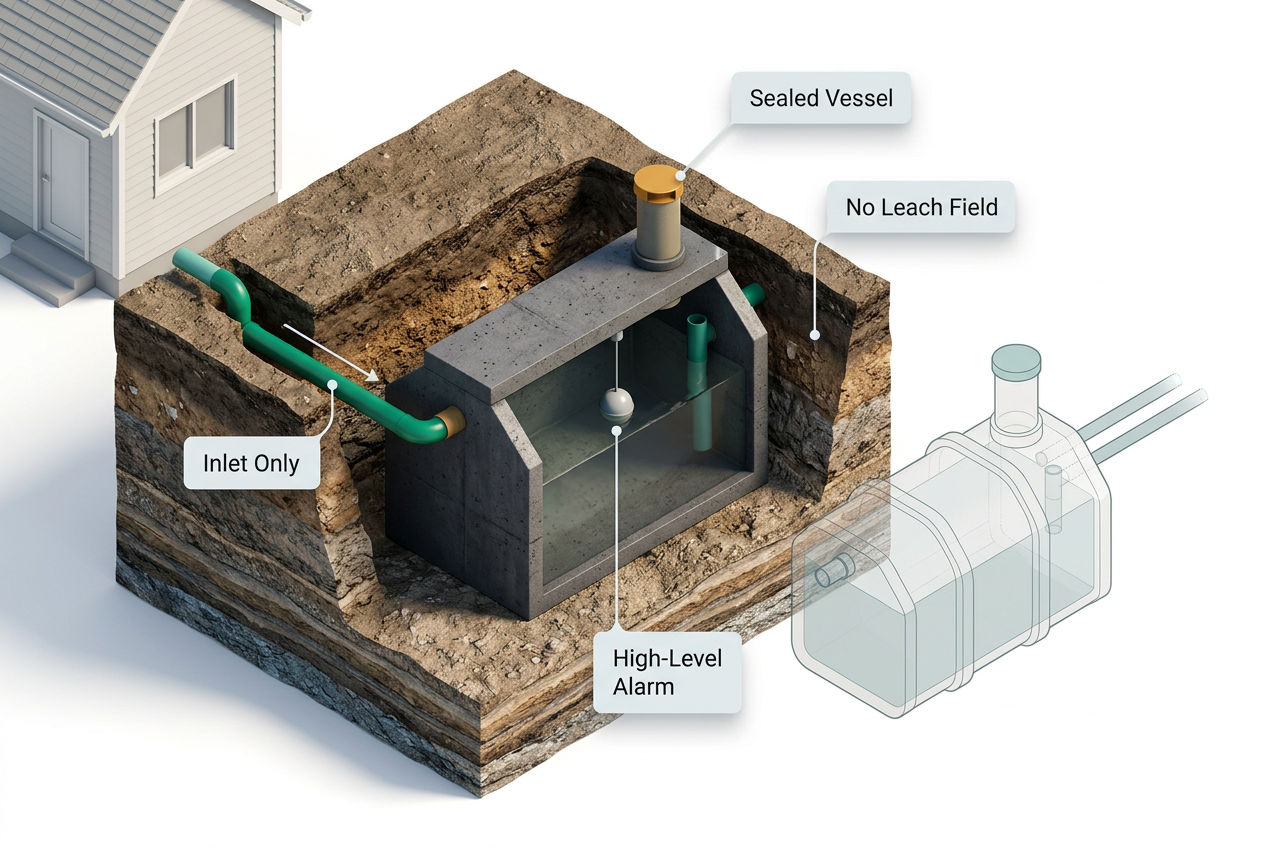
A septic holding tank, also called a tight tank or closed vault, is a buried or above-ground container with an inlet and no outlet. Wastewater from your toilets, sinks, shower and washer flows in and stays there. A septage hauler empties it on a schedule or when the high water alarm sounds.
A regular septic tank has an outlet baffle that sends effluent to a leach field, where the soil finishes treatment. A holding tank has no outlet baffle, no effluent filter and no distribution box. It's a storage vessel and nothing more.
That simplicity is the appeal. You don't need good soil, a perc test that passes, or room for a drain field. The tank still has to be fully watertight, though. A leaking holding tank lets groundwater in, so it fills faster and you pay more. Sewage can also leak out, which is a code violation.
You'll see holding tanks in these places:
- Seasonal cabins and lake lots in Wisconsin, Minnesota and Maine, where shoreline setbacks leave no space for a drain field.
- Sites with a high water table or bedrock close to the surface. See our guide to septic options for high water table lots.
- Temporary setups that bridge the gap until a permanent system is built.
- Commercial spots such as boat launches, campground bathhouses and rural shops.
Holding Tank vs. Septic Tank: What's the Difference?
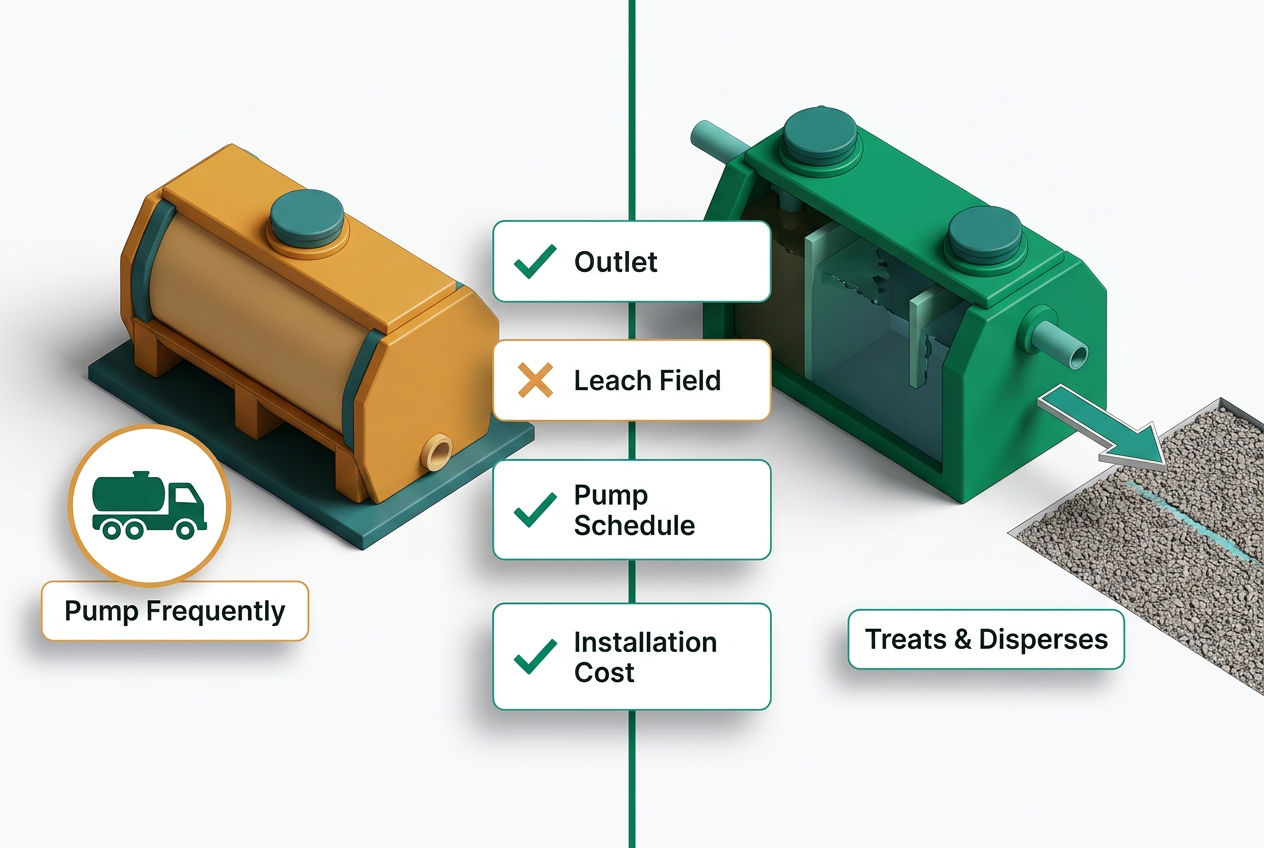
The main difference between a holding tank and a septic tank is treatment. A septic tank separates solids and sends liquid effluent to a drain field that treats it in the soil. A holding tank keeps everything until a truck hauls it away. So a holding tank costs less to install but far more to run each year.
Here's how the two compare side by side.
| Factor | Holding Tank | Septic System |
|---|---|---|
| Installed cost | $500–$4,000 | $3,100–$9,600 |
| Treats wastewater? | No | Yes, via drain field |
| Pumping frequency | Weeks | 3–5 years |
| Needs passing perc test? | No | Yes |
| Best fit | Seasonal or last resort | Full-time homes |
Source: Installed cost ranges from Fixr's septic installation cost guide (cost-guide estimates, not official figures). Pumping frequency for septic systems reflects general guidance from the EPA. Holding tank frequency depends on use. See the math below.
Look at that pumping row closely. A conventional system with a 1,000-gallon tank might see a pump truck twice in a decade. A full-time household on a holding tank might see one every week. If the lot can pass a perc test, even for a mound or chamber system, the higher upfront price usually pays for itself within a year or two. Our failed perc test options guide covers alternatives to try before you settle on a tight tank.
How Much Does a Holding Tank Septic System Cost?
A holding tank septic system costs about $500 to $4,000 to install, according to Fixr. InspectAPedia gives a rule of thumb of roughly $1 per gallon of capacity for tanks up to 5,000 gallons, plus about $400 for the alarm. Pumping adds a large recurring cost that most buyers underestimate.
Here's a rough breakdown for a 2,000-gallon installation:
- Tank and setting: about $2,000 at the $1-per-gallon rule. Older pricing data may run low today.
- High water alarm: about $400.
- Permit, excavation, risers and inspection: these vary by county. Many health departments also charge a plan review fee.
- Tank material: concrete costs less and resists floating. Polyethylene is lighter and easier to set on remote lots, but it needs anti-buoyancy anchoring where the water table is high. Our concrete vs. plastic septic tank comparison explains the tradeoffs.
For a full-system price comparison, see our septic installation cost guide.
The pumping math nobody shows you
Fixr lists holding tank pumping at $100–$150 per visit every 6–8 weeks. Treat that as a low-end figure, because emptying a full 1,500- to 2,000-gallon tank usually costs more. Premier Tech, a tank manufacturer, prices pumping at about 40 cents per gallon for a 500-gallon tank and about 28 cents per gallon for tanks of 2,000 gallons or more.
Here's a worked example. The figures below are our estimates. The water use number is a common planning assumption of about 60 gallons per person per day, which we couldn't confirm against a federal source.
Full-time family of 4:
- 4 people × 60 gal/day = 240 gallons per day
- 2,000-gallon tank, with the alarm set at 75% = about 1,500 usable gallons
- 1,500 ÷ 240 = a pump-out about every 6 days
- 1,500 gal × $0.28 = about $420 per visit
- 87,600 gal per year ÷ 1,500 = about 58 visits, or roughly $24,000 per year
Weekend cabin for 2 people over a 20-week season:
- 2 people × 60 gal × 2 days = 240 gallons per week
- 1,500 ÷ 240 = a pump-out about every 6 weeks
- About 3–4 visits × $420 = roughly $1,300–$1,700 per season
That second scenario lines up with Fixr's 6–8 week figure. That's why holding tanks make sense for seasonal use and are a tough financial fit for full-time homes. Low-flow toilets (1.28 gpf), a front-load washer and fixing every dripping faucet can cut visits by a third or more. Check local rates on our septic pumping cost page.
Rural location matters too. A hauler driving 45 minutes each way to a lake cabin in northern Wisconsin will charge more than one working within a suburban Ohio county.
What Size Septic Holding Tank Do I Need?
Most states require a septic holding tank of at least 1,000 to 1,500 gallons. Many also require capacity equal to several days of your projected flow. Mississippi requires 1,000 gallons and twice the daily flow. Arkansas requires ten times the daily use or 1,000 gallons, whichever is greater. Oregon requires 1,500 gallons.
Here's what the codes say, based on the rules we checked:
- Mississippi: At least 1,000 gallons and able to hold twice the projected daily wastewater flow, per the Mississippi State Department of Health's on-site wastewater regulations.
- Arkansas: At least ten times the estimated daily usage or 1,000 gallons, whichever is greater, under 14 CAR § 21-806.
- Oregon: At least 1,500 gallons of liquid capacity, under the Oregon DEQ's OAR 340-071.
- Wisconsin (Pierce County public facilities): At least 2,000 gallons or five times the estimated daily flow, whichever is greater.
Those Wisconsin and Arkansas multipliers add up fast. Take a family using 240 gallons per day in Arkansas: 240 × 10 = 2,400 gallons, so the 1,000-gallon minimum no longer applies. Don't treat any one state's number as a national rule. Call your county health department before you buy a tank. Our septic tank size chart covers sizing for conventional tanks.
Bigger is almost always cheaper per gallon to pump, at 28 cents versus 40 cents per gallon in the Premier Tech pricing above. A 2,500-gallon tank also means fewer truck visits, which matters at the end of a long gravel road.
Is a Holding Tank Allowed Where a Septic System Would Work?
Usually not. Many states treat a septic holding tank as a last resort. Arkansas rules say plainly that holding tanks "shall not be approved on sites acceptable for the installation of standard onsite wastewater systems." Other states limit them to seasonal use, temporary use or repairs on lots where nothing else fits.
Picture this: you buy a wooded lake lot, the perc test comes back slow, and a neighbor tells you to "just put in a tight tank." The county may say no if a mound or engineered system can be designed for the site. Approval often also depends on a long-term pumping plan. Pierce County, Wisconsin, for example, requires a signed and notarized servicing contract with a certified septage servicing operator before it will issue a permit.
Expect paperwork like this:
- A soil evaluation showing that a standard system can't work
- Plan approval and a holding tank permit
- A recorded servicing contract, and sometimes pumping reports filed with the county
- A deed notice in some counties, so future buyers know the property is on a holding tank
Our septic system permit requirements guide explains the approval steps state by state.
Does a Holding Tank Need an Alarm?

DIY Septic Blueprint
Thinking about building it yourself?
The complete, plain-English plan to size, permit and install your own septic system — designed for homeowners, not contractors. Skip the $15,000–$25,000 quotes and do it right the first time.
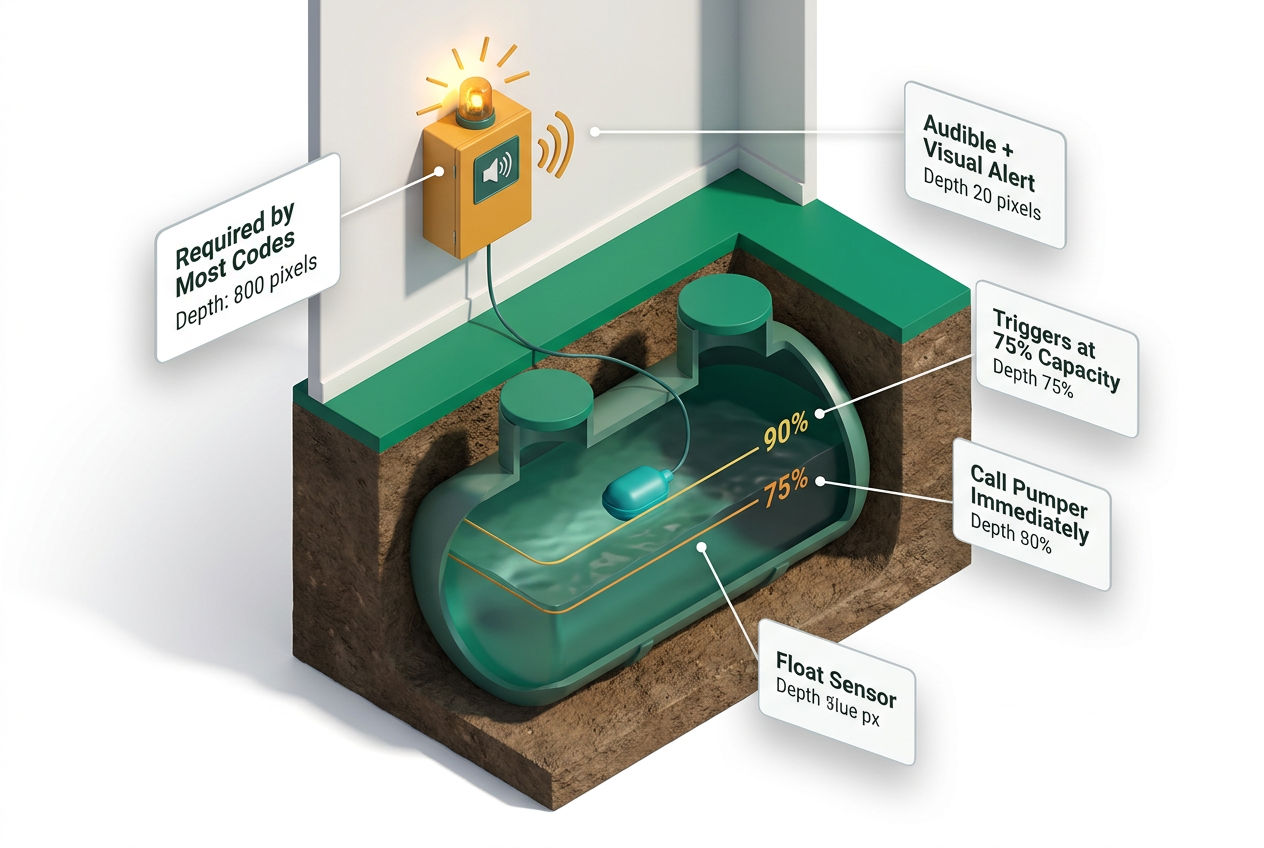
Get the DIY Blueprint — $67 →Instant download · 8 modules + 3 bonus guides · 60-day money-back guaranteeYes. Nearly every state code requires a high water alarm on a septic holding tank. Ohio's rule (OAC 3745-42-11) sets the alarm to sound at 75% of tank capacity. Mississippi requires an alarm that can sound at both ½ and ¾ capacity. That gives you time to schedule a pump-out before sewage backs up.
The setup is simple. A float switch hangs inside the tank and connects to an indoor panel with a horn and a light. Mount the panel somewhere you'll actually hear it, not in a crawlspace. Put it on its own circuit if your code allows, because a tripped breaker shouldn't be the reason your basement floods.
Here's what an alarm can't do. It won't stop you from using water. Once it sounds, you still have to cut back on showers and laundry until the truck arrives. On a holiday weekend that could be three days away. Learn more in our septic tank alarm guide.
How to Install a Septic Holding Tank
Installing a septic holding tank is a permitted job run by a licensed installer in most jurisdictions. It is not a weekend DIY project. The steps are permit and plan approval, excavation, bedding, setting the tank, a watertightness test, alarm wiring, inspection, and a signed servicing contract. Truck access matters as much as the tank itself.
- Permit and plan approval. The county reviews the site evaluation and tank size, and confirms that no standard system will fit.
- Plan truck access. A loaded pump truck can weigh 30,000+ pounds. Most haulers want the tank within about 100–150 feet of a solid driveway. Ask your hauler for their maximum hose reach before you choose a spot.
- Excavation and bedding. The installer digs to grade and lays a level bed of sand or gravel. Lots with a high water table may need dewatering. Plastic tanks need anchoring straps or concrete deadmen so they don't float.
- Set the tank and risers. Add risers to grade so pumpers don't have to dig every visit. Our septic tank risers guide covers lid options.
- Watertightness test. Many codes require a water-fill or vacuum test before backfill. A holding tank that leaks is worse than useless.
- Wire the alarm, then get the county inspection and file the servicing contract.
Some states let owners build their own systems, but holding tanks rarely qualify. Read our DIY septic system guide to see where owner-installs are allowed. If you're considering a tank that sits above grade, see our above-ground septic tank page.
How Do Seasons Affect a Septic Holding Tank?
Seasons hit holding tanks harder than conventional systems. Summer guests and laundry fill tanks faster, while frozen ground, snowbanks and spring weight limits on rural roads can keep pump trucks away. In northern states, you should pump before freeze-up and make sure the tank can be reached all year.
Here's what to do in each season:
- Before winter: Pump the tank nearly empty in late fall, especially at a cabin you'll close up. Mark the riser lid with a tall stake so the plow driver and the pumper can find it.
- Spring thaw: Many Upper Midwest counties post "frost laws" that limit truck weight on township roads. Your hauler might not be able to reach you for weeks. Plan for that.
- Summer peaks: A Fourth of July weekend with eight guests can use a month's worth of capacity. Book a pump-out right before big gatherings.
Our winter septic tank pumping article covers cold-weather access in more detail. If you're still choosing a system for a seasonal property, compare cabin septic system options first.
Ready to Price Your Project?
Get at least two pumping quotes before you commit to a septic holding tank, and ask each one for a per-gallon rate, not just a per-visit price. Find septic pumping companies near you on SepticTankHub to compare local haulers and installers.
Sources & Methodology
- Fixr: installed cost ranges for holding tanks versus septic systems, and holding tank pumping frequency and price. These are cost-guide estimates.
- Mississippi State Department of Health, Title 15: 1,000-gallon minimum size, 2× daily flow, and alarms at ½ and ¾ capacity.
- Code of Arkansas Rules, 14 CAR § 21-806: last-resort approval rule and 10× daily use sizing.
- Ohio Administrative Code 3745-42-11: high water alarm at 75% of capacity.
- Oregon DEQ, OAR 340-071: 1,500-gallon minimum liquid capacity. oregon.gov/deq
Per-gallon pumping rates come from Premier Tech (a manufacturer), and the $1-per-gallon install rule comes from InspectAPedia. Water use of 60 gallons per person per day is a planning assumption we could not confirm with a federal source. All annual pumping figures are our own estimates.
About the author: The SepticTankHub editorial team writes homeowner guides on septic installation, maintenance and regulations, and checks state codes against primary sources.
More Septic Design & Install Guides
- Septic Pump Tank: How a Septic System With a Pump Works, Costs & Installs
- Conventional Septic System: How It Works, What It Costs & When You Can Use One
- Drip Septic System: How Drip Dispersal Works, Cost & Design
- Septic System for a 2-Bedroom House: Tank Size, Drain Field & Cost
- Septic System for a 5-Bedroom House: Tank Size, Drain Field & Cost
- Concrete Septic Tank Price: 1,000-Gallon and Other Sizes in 2026
- How Long Is a Perc Test Good For? Expiration and Retesting Explained
- How to Backfill a Septic Tank
- Septic Inspection Before Backfill: What the Inspector Checks
- Septic system design: the complete guide
- Can you install your own septic system? Rules by state
Frequently Asked Questions
What is the difference between a holding tank vs septic tank?
A holding tank stores all wastewater until it's pumped. A septic tank treats wastewater by separating solids and sending liquid effluent to a drain field, where the soil filters it. That one difference drives everything else. A septic system needs suitable soil and a passing perc test, and it typically needs pumping only every 3–5 years. A holding tank needs no soil treatment area, so it works on lots with high water tables, bedrock or tight shoreline setbacks. But it fills in days or weeks instead of years. Fixr puts holding tank installs at $500–$4,000 versus $3,100–$9,600 for septic systems. For a full-time household, the holding tank's pumping bills usually erase that upfront savings within the first year. Many states, including Arkansas, won't approve a holding tank if a standard system can work on the site.
How much does a holding tank septic system cost?
A holding tank septic system costs about $500 to $4,000 to install, according to Fixr. InspectAPedia's rule of thumb is roughly $1 per gallon of tank capacity plus about $400 for the high water alarm. A 2,000-gallon setup therefore runs around $2,400 before permits and excavation. Ongoing pumping is the bigger expense. Premier Tech estimates about 28 cents per gallon for tanks of 2,000 gallons or more, so emptying 1,500 gallons costs roughly $420. A weekend cabin might need 3–4 pump-outs per season, or about $1,300–$1,700. A full-time family of four could need nearly weekly service, which by our estimate comes to around $24,000 a year. Rural properties far from a hauler pay more. Always ask for per-gallon pricing.
How do you install a septic holding tank?
You install a septic holding tank through a permitted process, usually led by a licensed installer. First, the county health department approves your site evaluation and plan, often only after confirming that a standard system won't fit. Next, choose a location a pump truck can reach year-round, usually within 100–150 feet of a firm driveway. The installer excavates, lays a level sand or gravel bed, and sets the tank. Plastic tanks get anchored against flotation. Risers bring the lids to grade. Many codes require a watertightness test before backfill. The installer then wires a float-switch high water alarm to an indoor panel. Finally, the county inspects the work, and you file a servicing contract with a certified hauler. Most jurisdictions don't allow homeowner DIY installs for holding tanks.
How often does a septic holding tank need to be pumped?
A septic holding tank needs pumping whenever it reaches its alarm level. That can be every week or every couple of months, depending on water use. Fixr cites every 6–8 weeks, which fits light or seasonal use. Here's the math. Assume about 60 gallons per person per day (a planning estimate). A 2,000-gallon tank with a 75% alarm gives about 1,500 usable gallons. A full-time family of four using 240 gallons per day fills that in about 6 days. A couple using a cabin two days a week fills it in about 6 weeks. Low-flow toilets, a front-load washer and fixing leaks can stretch the time between pump-outs. In northern states, pump before freeze-up, since snow and spring road limits can block truck access.
Does a septic holding tank need a high water alarm?
Yes. Almost every state requires a high water alarm on a septic holding tank. Ohio's rule, OAC 3745-42-11, requires the alarm to sound at 75% of tank capacity. Mississippi's regulations require an alarm that can sound at both ½ and ¾ capacity. Rules like these give you time to call a hauler before sewage backs up into the house. A typical setup uses a float switch inside the tank wired to an indoor panel with a horn and a light, and it costs about $400 according to InspectAPedia. Mount the panel where you'll hear it, and test it every few months by lifting the float. Remember that the alarm only warns you. You still need to cut water use until the truck arrives, which could take several days.
Free download
Not ready for the Blueprint? Start free.
Grab the free DIY Septic Planning Kit — the permit-first checklist, perc-test cheat sheet, and sizing tables that keep your build from getting red-tagged.
Was this article helpful?
Frequently Asked Questions
Recommended Resources
📖 Related Articles
- High Water Table and Septic Systems: What You Need to Know
- Land Failed the Perc Test? Here Are Your Options
- Concrete vs Plastic Septic Tanks: Which Is Better?
- Septic Tank Sizes & Dimensions Chart (by Bedrooms)
- Septic System Permit Cost & State Requirements (2026 Guide)
- Septic Tank Alarm Going Off? What It Means and What to Do
- How to Install Septic Tank Risers: Riser Kit Guide
- DIY Septic System: How to Build Your Own (Step-by-Step)
- Above-Ground Septic Systems & Tanks: Options, Costs & Rules
- Should You Pump Your Septic Tank Before Winter?
- Off Grid Cabin: The Complete Guide
💰 Cost Guides
🔧 Services
Find Septic Professionals Near You
Compare licensed, verified septic companies by area — top county markets and cities below, or browse all 50 states.
County markets
Popular cities
