
Quick Answer
A drip septic system is an alternative wastewater system that pumps filtered effluent through small, pressure-dosed tubing buried 4-10 inches deep. Emitters release about a gallon per hour or less into the topsoil and root zone. According to Angi, installed costs run $8,000-$18,000. Drip systems suit shallow soils, clay, slopes, and odd-shaped lots.
What do you do when the soil report says 14 inches of dirt over limestone, and a gravel trench needs three feet? On many lots like that, the answer is drip dispersal. This guide covers how it works, what it costs, how designers size the field, and where it falls short.
Key Takeaways
- A drip septic system spreads effluent through ½-inch tubing buried just 4-10 inches deep (Ohio EPA).
- Drip septic system cost typically runs $8,000-$18,000 installed, plus $450-$2,300 for permits.
- Every system needs a septic tank, a dosing pump, 100-150 micron filters, and a control panel.
- Drip fields need regular flushing. Idaho DEQ calls for flushing every 2 weeks on non-continuous designs.
- Drip works on shallow, clay, and sloped sites, but it depends on electricity and ongoing service.
What Is a Drip Septic System?
A drip septic system is a pressurized drain field. You may also see it called subsurface drip dispersal (SDD), a drip distribution septic system, a drip line septic system, or a drip irrigation septic system. Instead of gravel trenches, it uses rows of thin polyethylene tubing with built-in emitters. A pump sends small, timed doses of effluent through the tubing. The shallow soil and plant roots then treat it.
It's one of several alternative septic systems designed for lots where a conventional drain field won't pass. A standard gravel trench needs deep, permeable soil. Drip needs only a few inches of decent topsoil. That topsoil is often the most biologically active layer on your property.
Missouri's Department of Health and Senior Services explains the advantage in its subsurface drip dispersal owner's manual. According to the manual, drip systems use "the better soil properties six to eight inches below the surface," which is also where plant roots live. Those roots pull water and nutrients out of the effluent. A gravel trench 3 feet down gets almost none of that help.
Common commercial dripline products include Geoflow's WASTEFLOW and Netafim's Bioline. Both are pressure-compensating tubing built for wastewater, with emitters treated to resist root intrusion.
Septic drip irrigation vs. a lawn sprinkler. People sometimes call this "septic drip irrigation," and the tubing does look like landscape drip line. The difference is that wastewater dripline is buried, never sprays, and is designed and permitted as a treatment system. Effluent should never surface.
Most states require an engineer or certified designer to plan the system. Texas, for example, regulates drip under TCEQ's on-site sewage rules (30 TAC Chapter 285), which also require a maintenance contract for systems that use aerobic pretreatment. Check your state's rules in our septic permit guide.
How Does a Drip Septic System Work?
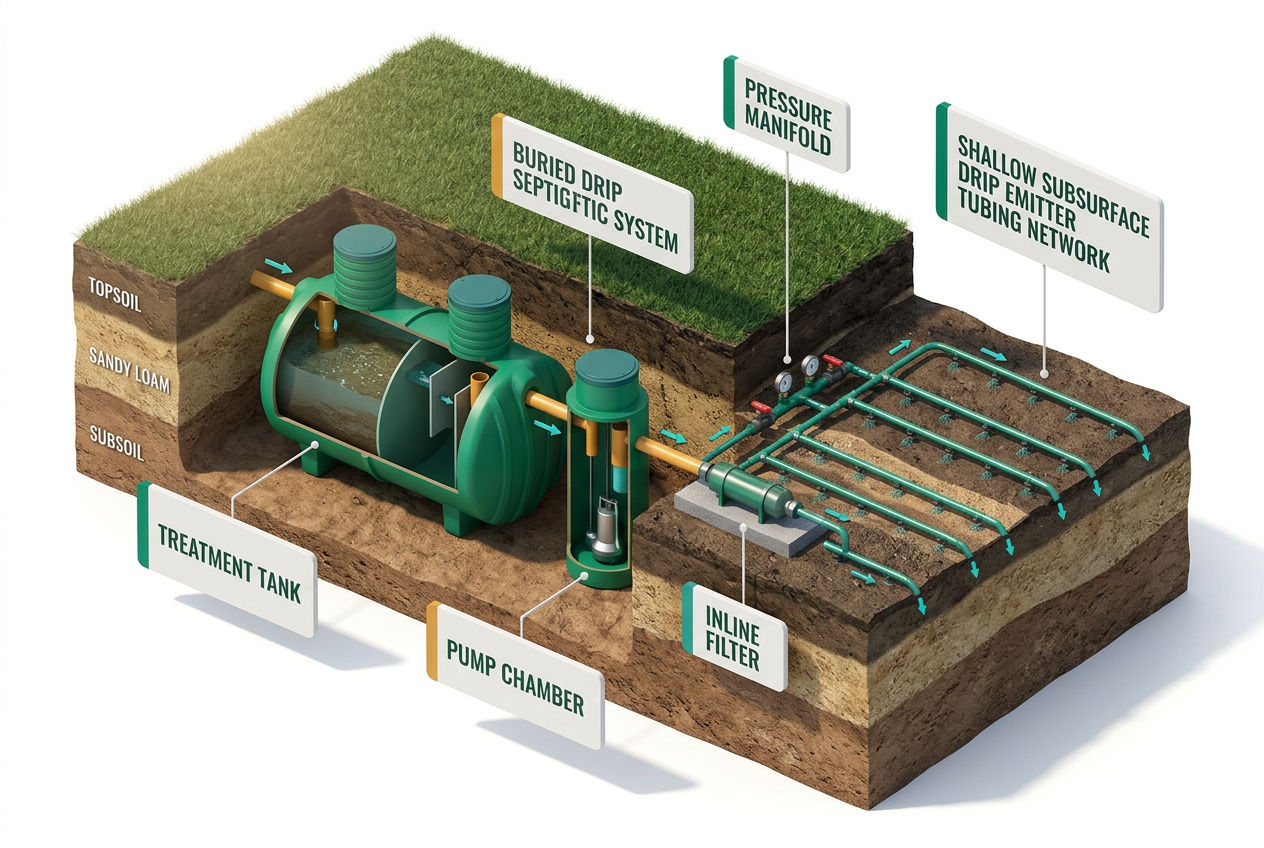
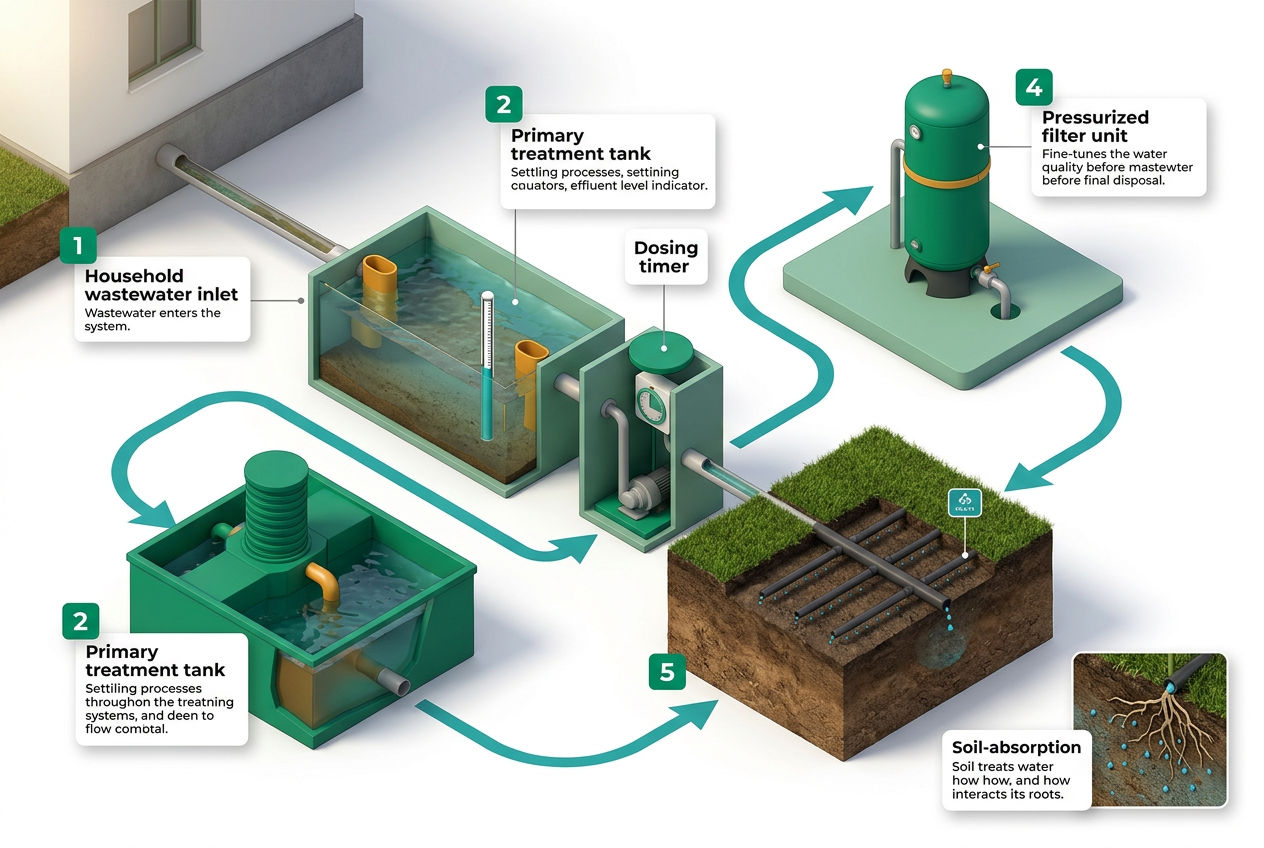
A drip septic system works in six steps. Wastewater settles in a septic tank and may get extra treatment. It collects in a dosing tank, passes through a filter at the headworks, and is pumped in small, timed batches into dripline. Emitters spaced about 2 feet apart release it into shallow soil. A return line handles periodic flushing.
Here's the path a flush takes:
- Septic tank (primary settling). Solids sink and grease floats, just like any system. According to Ohio EPA's drip guidance, all drip distribution systems should use septic tanks for primary settling. Regular pumping still matters; see how often to pump a septic tank.
- Optional pretreatment. Many designs add an aerobic treatment unit (ATU) or media filter to clean the effluent further before it reaches the tubing. Some states require it, and others allow plain septic tank effluent. ATUs sold in most states must be certified to NSF/ANSI Standard 40. Our aerobic septic system cost guide covers what that adds.
- Dosing tank and pump. Effluent collects in a pump tank. A float switch and timer tell the pump when to run.
- Headworks. This box near the field holds a disk or spin filter, zone valves, and pressure gauges. According to the University of Tennessee's onsite curriculum, typical filtration is 100-150 microns, about the width of a human hair. Emitter passages are small enough that anything coarser would clog them.
- Drip field. Half-inch polyethylene dripline runs in parallel rows. Each drip emitter releases effluent at about a gallon per hour or less, according to Missouri DHSS.
- Return line and flushing. A return line carries flush water back to the tank. Flushing clears out the slime and fine particles that build up inside the tubing.
What makes drip different is timed dosing. Instead of dumping 300 gallons into the field after a busy laundry morning, the controller spreads it out over the day. The soil never gets waterlogged. That's why drip can work in clay that would drown a gravel trench. See our guide to septic systems for clay soil for more on tight soils.
How Much Does a Septic Drip System Cost?
A septic drip system typically costs $8,000-$18,000 installed, according to Angi's 2026 cost data. Fixr quotes a lower $4,000-$10,000, but that figure is materials only. Add $450-$2,300 for permits. Pretreatment units, long pipe runs, and engineered design can push totals higher.
Why do the two ranges differ so much? Fixr's number covers the tubing, filters, pump, and panel. Angi's number includes excavation, labor, and setup. When a contractor hands you a $15,000 quote, compare it to Angi's range.
For context, Angi reports that septic installation overall runs $3,590-$12,463 depending on tank size and system type. So drip usually lands above a conventional gravel system. Our septic installation cost guide breaks down the full project, and our mound septic system cost guide covers the most common alternative.
Worked example: a 3-bedroom on a shallow-soil lot
Here's an illustrative example. Your own designer's numbers will differ.
- Tank and drip system, installed: $13,000 (midpoint of Angi's range)
- County permit: $1,200 (within the $450-$2,300 range)
- ATU pretreatment, if your state requires it: added on top
- Total before pretreatment: about $14,200
Spread over a 20-year service life, that's roughly $710 a year in capital cost before maintenance. Treat that as a rough planning figure; real lifespan depends on care.
Worked example: annual operating cost
Pump electricity is easy to estimate yourself. Suppose a ½-horsepower effluent pump draws about 0.5 kW and runs a combined 1 hour per day across all doses and flushes:
- 0.5 kW × 1 hour × 365 days = 182.5 kWh per year
- At the U.S. average residential rate of about 17 cents per kWh (U.S. Energy Information Administration, 2025), that's about $31 a year
Electricity is the small line item. The service contract is the big one, so get it quoted before you sign.
What drives your price up or down?
- Field size. More square footage means more dripline, more trenching, and sometimes more zones and valves.
- Pretreatment. An ATU adds equipment and a service contract.
- Distance. Long pipe runs from the tank to a usable field add up fast.
- Region. Labor and permit fees vary. Texas Hill Country installers see drip often and may price it more competitively than a region where few contractors install it.
Ongoing costs to budget for: a maintenance contract (required in many counties), electricity for the pump, filter cleaning, and an eventual pump replacement. We couldn't find a reliable national figure for service contracts, so ask each installer to quote annual service in writing. Our septic pump guide explains what pump replacement involves.

What Are the Standard Drip Septic System Design Specs?
Drip septic system design follows a few standard specs. Tubing sits 4-10 inches deep. Emitters are spaced about 2 feet apart, and each one covers no more than 4 square feet. Flow stays at 1 gallon per hour or less. Filters screen particles to 100-150 microns before effluent reaches the field.
| Design Spec | Typical Value | Source |
|---|---|---|
| Burial depth | 4-10 inches | Ohio EPA |
| Emitter grid | ~2 ft × 2 ft | Missouri DHSS |
| Area per emitter | Max 4 sq ft | Missouri DHSS |
| Emitter flow | ≤1 gal/hour | Missouri DHSS |
| Filtration | 100-150 microns | Univ. of Tennessee |
| Emitter spacing options | 12, 18, or 24 in. | Washington DOH |
Sources: Ohio EPA Permit to Install Guidance 5; Missouri DHSS Owner's Manual, Ch. 10; University of Tennessee Drip Dispersal Text; Washington State Department of Health, Recommended Standards and Guidance for Subsurface Drip Systems.
According to Washington's Department of Health, dripline comes with 12-, 18-, or 24-inch emitter spacing. The 2-foot spacing is the common sizing basis.
How the septic drip field is sized
Your designer starts with daily flow and your soil's loading rate, measured in gallons per day per square foot (gpd/sq ft). Here's a simplified example:
- Design flow for a 3-bedroom home: 360 gpd (a common figure, but your state sets the real number)
- Loading rate for a tight clay soil: 0.2 gpd/sq ft (example only)
- Field area: 360 ÷ 0.2 = 1,800 sq ft
- Emitters needed at 4 sq ft each: 450 emitters
- Dripline at 2-foot row spacing: about 900 feet of tubing
That field is then split into zones so the pump doses one section at a time. A 1,800 sq ft field is bigger than many homeowners expect, even though it's only inches deep. Sizing basics are covered in our septic system design guide.
Is Your Lot a Good Candidate for Drip Dispersal?

DIY Septic Blueprint
Thinking about building it yourself?
The complete, plain-English plan to size, permit and install your own septic system — designed for homeowners, not contractors. Skip the $15,000–$25,000 quotes and do it right the first time.
Get the DIY Blueprint — $67 →Instant download · 8 modules + 3 bonus guides · 60-day money-back guaranteeDrip dispersal is a strong fit for lots with shallow soil over rock, a high water table, heavy clay, steep slopes, or irregular shapes. According to Ohio EPA, drip works in severe soil conditions where conventional systems can't. It's a poor fit if you can't guarantee steady power or regular service.
Common situations that lead to drip:
- You failed a perc test. Our failed perc test guide explains the options, and drip is often near the top of the list.
- Bedrock or a seasonal water table is close to the surface. Drip needs far less vertical separation than a gravel trench.
- The lot is steep. Dripline follows the contour, so you don't need large terraces. See septic systems on a slope for how designers handle grade.
- The usable area is oddly shaped. Tubing can bend around trees, driveways, and setbacks.
- You want to keep the landscape. Drip installs with narrow trenches or a vibratory plow, so less of the yard is torn up.
Drip is a weaker choice when:
- Power outages are frequent and you don't plan to add a backup generator or a high-water alarm with reserve tank capacity.
- No local contractor services drip systems. A system nobody can maintain will fail.
- The field area will see vehicles, livestock, or heavy equipment.
Drip Septic System vs. Mound System: Which Fits Your Lot?
Both drip and mound systems solve shallow-soil problems. A mound builds the treatment zone above grade with imported sand. Drip uses the existing topsoil instead. Drip is usually less visible and fits tighter spaces, while a mound has fewer small parts to clog.
| Factor | Drip System | Mound System |
|---|---|---|
| Installed cost | $8,000-$18,000 (Angi) | Often $10,000-$20,000+ |
| Visibility | Flat, nearly invisible | Raised mound, often 2-3 ft |
| Imported fill | Little or none | Large volume of sand |
| Maintenance | Filter cleaning, line flushing | Pump service, less frequent |
| Slope tolerance | High | Limited on steep grades |
A mound may win if your site is flat, roomy, and has no installer experienced with drip. Drip may win on steep, wooded, or tight lots. Compare details in our mound septic system guide.
How Do You Maintain a Drip Septic System?
A drip septic system needs scheduled service: tank pumping, filter cleaning, field flushing, and control panel checks. According to Idaho DEQ's technical guidance, non-continuous flush designs should be flushed every 2 weeks. Automatic-flush systems still need periodic inspection of filters, valves, and pressure readings.
A typical maintenance checklist:
- Clean or backflush the headworks filter on the schedule your designer sets.
- Flush the dripline. Automatic systems handle this on a timer. Manual systems rely on you or your service provider.
- Check pressure gauges. A rising pressure reading can mean clogged emitters. A falling one can mean a leak or broken line.
- Pump the septic tank every 3-5 years, or as your inspector advises.
- Test the alarms so you know a pump failure will get noticed.
In the yard:
- Keep cars, trucks, and livestock off the field.
- Leave snow on the field in winter. It insulates the shallow lines.
- Plant grass or shallow-rooted ground cover, not trees.
- Don't till, aerate deeply, or install fence posts over the tubing.
Many counties require a maintenance contract for drip systems, especially those with an ATU. Ask your health department before you assume it's optional. Our septic maintenance schedule lays out a year-round plan, and our guide to signs of septic system failure explains what to watch for.
What Are the Pros and Cons of Drip Dispersal?
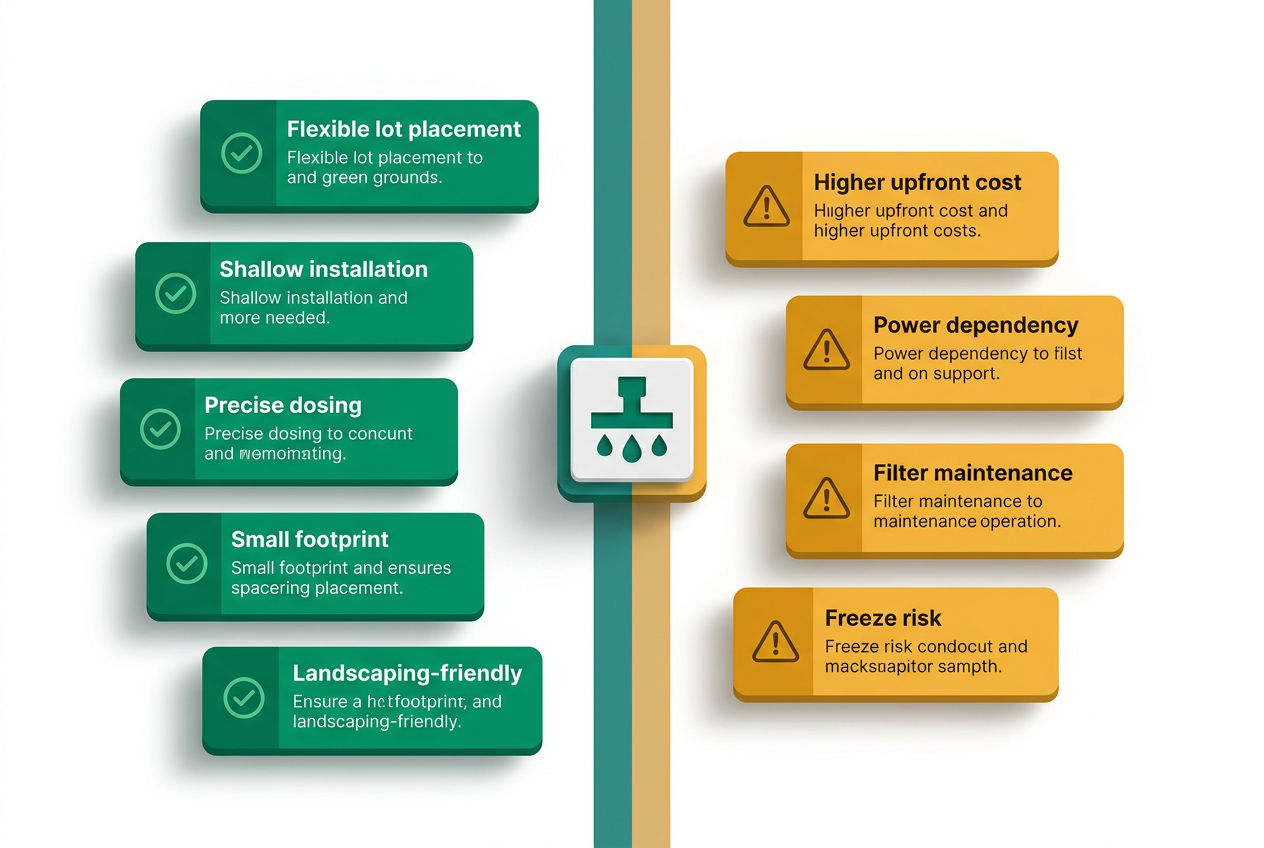
Drip dispersal's biggest advantage is that it works where conventional systems can't. Its biggest drawback is dependence on electricity, pumps, and regular service. The tradeoffs are clear once you list them side by side.
Pros
- Works in shallow, clay, rocky, or sloped soils
- Uses the most active treatment layer of soil
- Fits irregular lots and preserves landscaping
- Timed doses prevent field saturation
Cons
- Higher upfront cost than a gravel system
- Requires power; outages stop dispersal
- Needs routine filter cleaning and flushing
- Fewer contractors know how to install and service it
- Shallow lines can be damaged by digging or vehicles
How to Choose a Drip System Installer
Choose a drip installer who is licensed in your state, has completed manufacturer training for the dripline brand they use, and can show you drip systems they maintain today. Get at least three quotes with the same scope so you can compare them line by line.
Questions to ask:
- How many drip systems have you installed in this county?
- Which dripline and filter brands do you use, and why?
- Does the quote include design, permits, pretreatment, and startup?
- What does annual service cost, and is it required here?
- Who do I call when the alarm goes off?
You can find vetted local contractors through our septic installer directory.
More Septic Design & Install Guides
- Septic Pump Tank: How a Septic System With a Pump Works, Costs & Installs
- Septic Holding Tank: Cost, Sizes, Rules & Holding Tank vs. Septic System
- Conventional Septic System: How It Works, What It Costs & When You Can Use One
- Septic System for a 2-Bedroom House: Tank Size, Drain Field & Cost
- Septic System for a 5-Bedroom House: Tank Size, Drain Field & Cost
- Concrete Septic Tank Price: 1,000-Gallon and Other Sizes in 2026
- How Long Is a Perc Test Good For? Expiration and Retesting Explained
- How to Backfill a Septic Tank
- Septic Inspection Before Backfill: What the Inspector Checks
- Septic system design: the complete guide
- Can you install your own septic system? Rules by state
Frequently Asked Questions
How deep is drip septic tubing buried?
Drip septic tubing is typically buried 4-10 inches deep, according to Ohio EPA's drip distribution guidance. Missouri DHSS describes the target zone as six to eight inches below the surface, where soil is most biologically active and plant roots can take up water and nutrients. Shallow placement is the main reason drip works on lots with limited soil over bedrock or a high water table. The tradeoff is that shallow lines are easier to damage. Avoid driving on the field, tilling, or installing posts over the tubing. In cold climates, designers may bury lines toward the deeper end of the range or rely on snow cover and frequent small doses to keep lines from freezing. Your state's code sets the exact allowed depth.
How long does a drip septic system last?
A well-maintained drip septic system can last 20 years or more, though there is no reliable national data on average lifespan. The tubing itself is durable polyethylene. Mechanical parts wear out sooner. Pumps commonly need replacement during the system's life, and filters, valves, and control components may need repair. The biggest threats to longevity are skipped maintenance, clogged emitters, root intrusion, and physical damage from vehicles or digging. Systems that get regular filter cleaning, flushing, and tank pumping tend to perform far longer than neglected ones. Ask your installer what warranty covers the dripline and the pump, and keep service records. Good records also help when you sell the home.
Does a drip septic system need electricity?
Yes, a drip septic system needs electricity. A pump pushes effluent through the filter and dripline under pressure, and a control panel times each dose and flush. If the power goes out, the pump tank fills but nothing is dispersed. Most pump tanks have some reserve capacity, and a high-water alarm warns you before it overflows. During an outage, cut back on water use: skip laundry, take short showers, and avoid running the dishwasher. If outages are common where you live, ask your designer about a larger reserve volume or a backup generator connection. Pump electricity itself is inexpensive, often around $30-$50 a year for a typical home, but reliability matters more than the bill.
Can I plant over a drip septic field?
You can plant grass and shallow-rooted ground covers over a drip septic field, and plants actually help by taking up water and nutrients. Avoid trees and large shrubs, because their roots can invade tubing and their removal can damage lines. Don't plant vegetable gardens over the field; it's not recommended for food crops, and tilling can cut the tubing. Mow normally, but keep heavy riding equipment off when the soil is wet. Avoid adding thick layers of fill or mulch, which change the depth your designer planned for. If you want landscaping over the area, review the plan with your installer or health department first. Many state manuals, including Missouri DHSS, give plant guidance.
Is a drip septic system better than a mound?
A drip septic system isn't automatically better than a mound; each suits different sites. Drip is usually better on steep, wooded, or oddly shaped lots, and it stays nearly invisible because it needs little or no imported fill. A mound can be the better pick on flat, open lots where no local contractor services drip, since mounds have fewer small parts that can clog. Costs often overlap, so get quotes for both if your site allows it. Ask each installer about long-term service costs, not just installation price. A designer who works with both system types can give you the most objective comparison for your specific soil report.
Sources & Methodology
This guide was built from state regulatory manuals, university extension curricula, and published cost data. Cost figures come from Angi and Fixr 2026 data; we note where ranges include materials only. Electricity rates come from the U.S. Energy Information Administration.
Sources consulted:
- Ohio EPA, Permit to Install Guidance 5: Drip Distribution Systems
- Missouri Department of Health and Senior Services, Onsite Wastewater Treatment System Owner's Manual, Chapter 10: Subsurface Drip
- Idaho Department of Environmental Quality, Technical Guidance Manual: Drip Distribution Systems
- University of Tennessee, Drip Dispersal Curriculum (Consortium of Institutes for Decentralized Wastewater Treatment)
- Washington State Department of Health, Recommended Standards and Guidance for Subsurface Drip Systems
- Texas Commission on Environmental Quality, 30 TAC Chapter 285: On-Site Sewage Facilities
- NSF International, NSF/ANSI Standard 40: Residential Wastewater Treatment Systems
- U.S. Energy Information Administration, Electric Power Monthly (2025 residential rates)
- Angi and Fixr, drip and septic installation cost guides (2026)
Limitations: We did not inspect or install systems for this article. It summarizes published guidance, which varies by state. Lifespan and service contract costs lack reliable national data, and our worked examples use illustrative inputs, not engineering values. Your state code, your soil report, and a licensed designer should always decide your system's final design.
Primary sources to read: EPA: Types of Septic Systems · EPA: How Your Septic System Works · University of Minnesota Onsite Sewage Treatment Program · NOWRA, National Onsite Wastewater Recycling Association
Free download
Not ready for the Blueprint? Start free.
Grab the free DIY Septic Planning Kit — the permit-first checklist, perc-test cheat sheet, and sizing tables that keep your build from getting red-tagged.
Was this article helpful?
Frequently Asked Questions
Recommended Resources
📖 Related Articles
Find Septic Professionals Near You
Compare licensed, verified septic companies by area — top county markets and cities below, or browse all 50 states.
County markets
Popular cities
