
Quick Answer
An aerobic septic system diagram maps four treatment stages — pretreatment, aeration, clarification, and disinfection — that work together to process wastewater far more thoroughly than a conventional tank. Understanding this labeled ATU diagram helps you identify every aerobic system component, know what each part does, and recognize when something's failing. Most residential aerobic treatment units (ATUs) process wastewater through these four distinct stages before releasing effluent that's clean enough to spray on your lawn — legally, with a permit.
Key Takeaways
- Aerobic treatment units (ATUs) operate in 4 stages: pretreatment, aeration, clarification, and disinfection
- ATUs remove 85–98% of organic matter versus 60–70% for conventional anaerobic systems
- Most states require a licensed maintenance contract every 4–6 months — not optional
- Installation costs run $10,000–$20,000 nationally; annual operating costs add $300–$700/year
- Systems certified to NSF/ANSI Standard 40 must meet ≤30 mg/L BOD and ≤30 mg/L TSS thresholds
If you want to understand what's buried in your yard — or what a contractor is proposing you spend $15,000 on — this walkthrough covers every component, what it does, and what happens when it fails. For a broader look at how all septic system types compare, see our guide to types of septic systems.
What Are the Main Parts of an Aerobic Septic System?
A standard residential aerobic treatment unit contains four core stages housed in a multi-compartment concrete or fiberglass tank, typically holding 500 to 1,500 gallons total. Some manufacturers build these as separate tanks plumbed in series. Others integrate everything into one molded unit. Either way, the treatment process is the same.
Here's the full aerobic septic system diagram broken down stage by stage, with every aerobic system component explained.
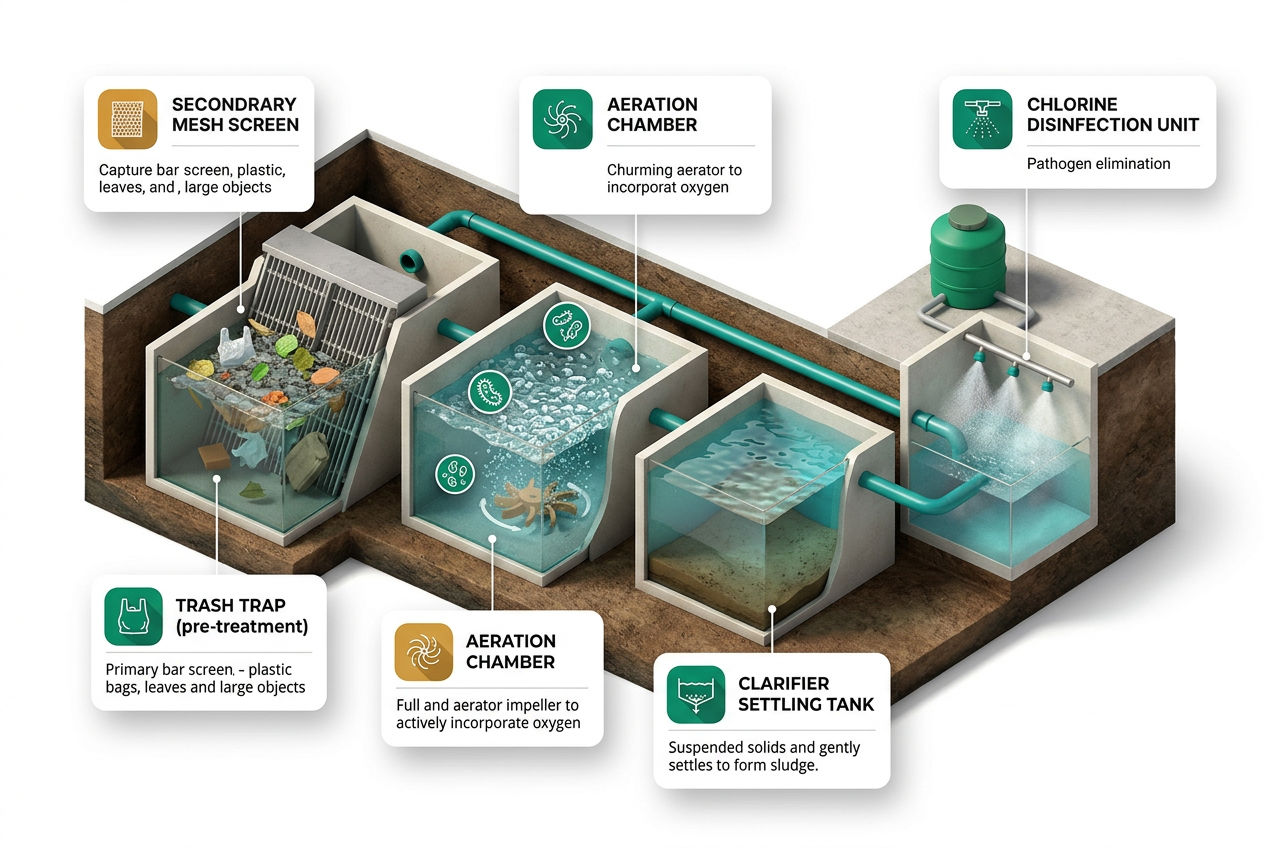
Stage 1: The Trash Tank (Pretreatment Chamber)
Raw sewage enters the system here first. This chamber functions similarly to a conventional septic tank — solids sink to the bottom as sludge, grease floats to the top as scum, and partially clarified liquid (called "gray water" at this stage) passes through to the next compartment.
This stage is sometimes called the pretreatment tank or trash tank. Its job is mechanical separation, not biological treatment. Keeping large solids out of the aeration chamber protects the aerator from clogging.
The trash tank in most residential ATUs holds 250–500 gallons and needs pumping every 3–5 years, depending on household size and usage. A 4-person household producing typical waste loads usually hits that 3-year mark. Add a garbage disposal and you're looking at every 2 years. The EPA recommends against garbage disposals with any septic system — aerobic or otherwise — for exactly this reason.
Stage 2: The Aeration Chamber (Where the Real Work Happens)
This is what separates an aerobic system from everything else underground. An aerator pump — often called an air compressor — pushes a continuous stream of air into the wastewater. That oxygen feeds aerobic bacteria, the same microscopic organisms that treat wastewater in municipal plants.
Aerobic bacteria are dramatically more efficient than the anaerobic bacteria in a conventional tank. They consume organic waste 2–3 times faster and produce a much cleaner effluent. That's why ATUs can achieve 85–98% removal of organic matter compared to the 60–70% you get from a standard anaerobic system.
The most common aerator compressors used in residential ATUs are linear diaphragm units. The Hiblow HP-80 is one of the most widely specified models — it draws roughly 80 watts continuously, adding about $5–$12/month to your electric bill. Aerator motor lifespan is typically 2–5 years before the diaphragm wears out and needs replacement ($300–$800 for parts and labor).
When the aerator fails, your alarm goes off. More on that below.
Stage 3: The Settling Chamber (Clarifier)
After aeration, wastewater moves into a settling chamber, also called the clarifier. Here, the turbulence of the aeration zone calms down. Biological floc — clumps of bacteria and digested organic material — settles out of the water column and sinks. Clarified liquid rises to the top and flows forward to the final stage.
Some ATU designs recirculate settled solids back into the aeration chamber to improve treatment efficiency. Others use a separate clarifier cone or baffle wall to force clean separation. Either way, the goal is the same: get the treated liquid as clear as possible before disinfection.
If the clarifier isn't functioning correctly — usually because solids are escaping from the aeration zone — you'll see turbid, cloudy effluent downstream. That's a maintenance flag, not a DIY fix.
Stage 4: The Disinfection Chamber
Clarified effluent enters the chlorine disinfection chamber last. A tube or basket holds chlorine tablets (typically calcium hypochlorite, the same chemistry as pool shock). As water flows past the tablets, it picks up enough residual chlorine to kill pathogens — coliform bacteria, viruses, and protozoa — before the water leaves the tank.
Chlorine tablet replenishment is a monthly check item. Tablets cost roughly $50–$150/year depending on system size and brand. Running out of tablets means untreated effluent hits your yard — which is both a health hazard and a permit violation.
Some newer ATUs use UV disinfection instead of chlorine, particularly in states that restrict chlorine discharge to ground surface. Your local regulations dictate which method is allowed.
The Control Panel and Alarm System
Mounted near the tank or on your home's exterior, the control panel is the nerve center of an aerobic system. It powers the aerator, controls the effluent pump timer, and monitors the system for abnormal conditions.
The alarm — usually a loud buzzer and a red or amber light — activates when:
- The aerator motor fails or trips a breaker
- The effluent level rises above the float switch threshold (indicating a pump failure)
- The system loses power and switches to alarm mode
Many modern control panels are equipped with cellular or Wi-Fi monitoring that alerts your maintenance provider automatically. If your alarm keeps going off repeatedly, don't silence it and walk away. A failed aerator that runs dry can burn out within hours. Call your maintenance provider — most ATU service contracts include alarm response.
For more detail on alarm causes and fixes, see our guide on septic tank alarms.
Effluent Distribution: Spray Heads and Drip Irrigation
Treated effluent leaving the disinfection chamber gets pumped to one of two distribution systems:
Spray heads — Pop-up sprinkler heads mounted around the yard distribute effluent over a defined irrigation area. This is the most common setup in Texas and the South. Spray heads require a surface discharge permit in most jurisdictions, and there are strict setback rules — typically 50–100 feet from property lines, wells, and water features.
Drip irrigation — Low-pressure tubing buried 6–12 inches below the surface delivers effluent directly to the root zone. Drip systems are preferred where surface spraying isn't permitted (near slopes, in subdivisions, or in states with stricter discharge rules). Drip systems need periodic flushing to prevent line clogging from biofilm.
Both systems require a pump chamber with a submersible effluent pump, a float switch, and a timer. The pump activates on a timed dose cycle, pushing a precise volume of effluent out to the distribution field during each cycle.
How Does an Aerobic Septic System Work Step by Step?
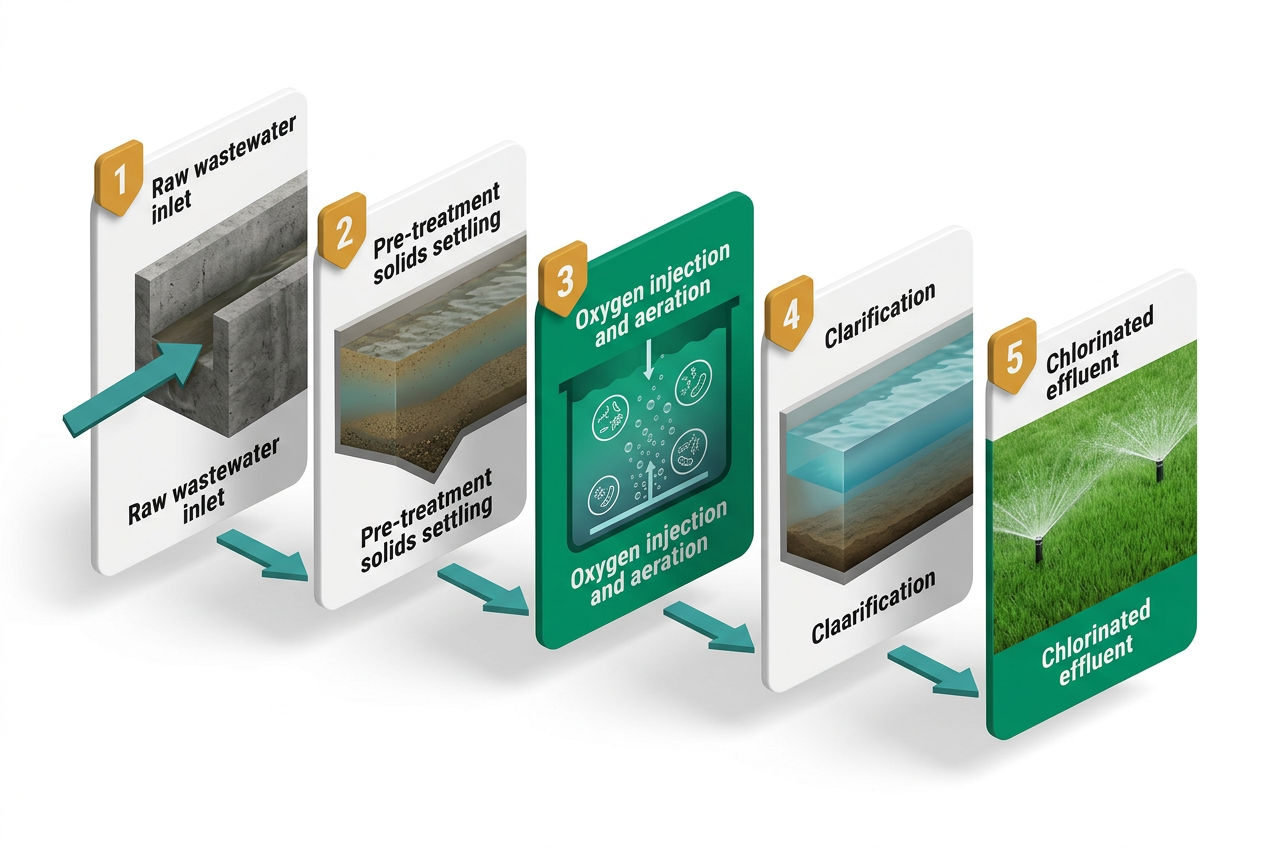
Here's the full treatment sequence, from flush to field:
- Wastewater enters the trash tank — Solids separate by gravity
- Clarified liquid flows to the aeration chamber — Aerator pumps oxygen in continuously
- Aerobic bacteria consume organic waste — BOD drops to ≤30 mg/L (NSF/ANSI Standard 40)
- Mixed liquid enters the settling/clarification chamber — Biological solids settle out
- Clear effluent flows through the chlorine disinfection chamber — Pathogens are killed
- Pump timer activates — Effluent pump doses treated water to spray heads or drip lines
- Treated water disperses across the yard — Either surface-sprayed or subsurface-dripped
The entire cycle runs continuously, 24 hours a day. That's why aerators use small but always-on motors — they're designed for continuous duty, not intermittent use.
Aerobic vs. Anaerobic Septic System: What's the Difference?
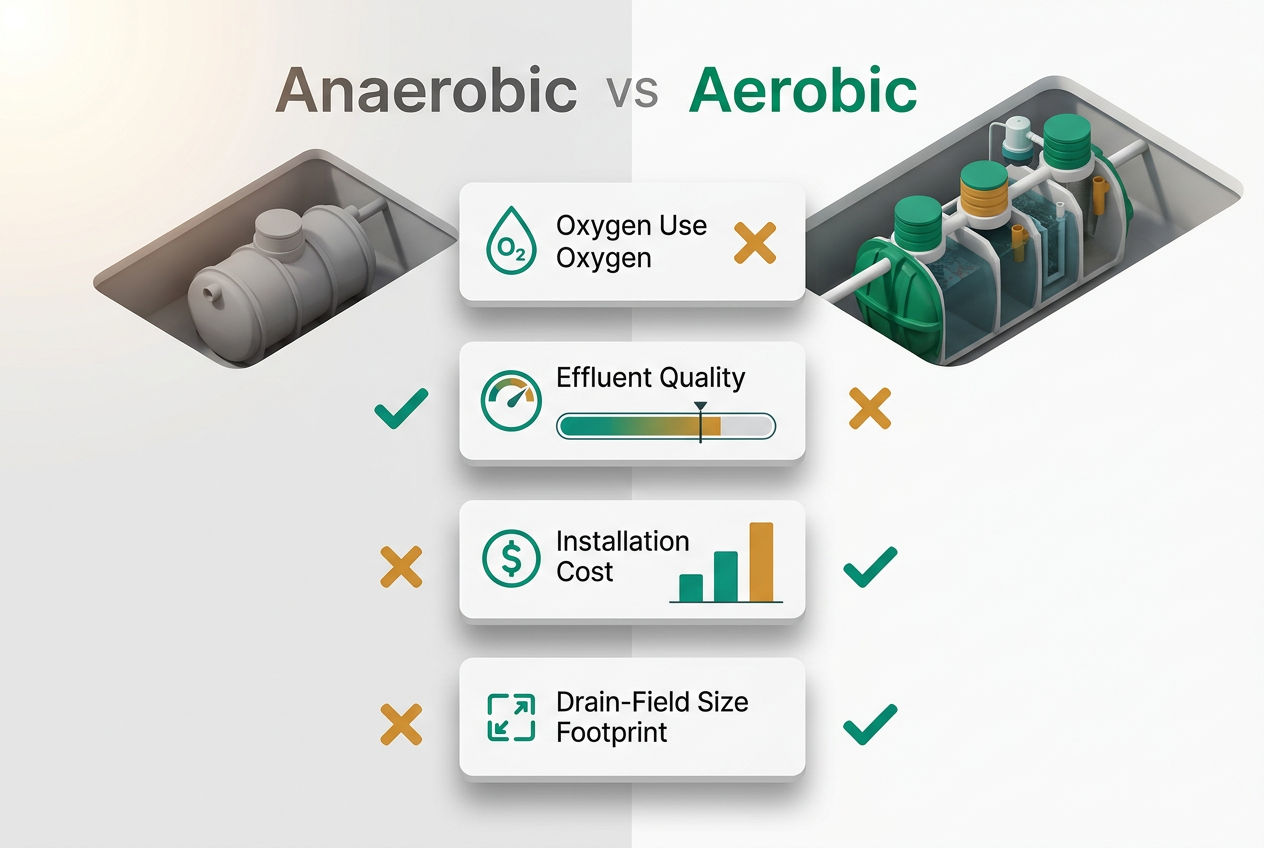
| Feature | Aerobic System (ATU) | Anaerobic (Conventional) System |
|---|---|---|
| Treatment level | Secondary (advanced) | Primary only |
| Bacteria type | Aerobic (oxygen-dependent) | Anaerobic (no oxygen) |
| BOD removal rate | 85–98% | 60–70% |
| Requires electricity | Yes (continuous) | No |
| Maintenance contract | Required (most states) | Optional |
| Installation cost | $10,000–$20,000+ | $3,000–$8,000 |
| Drain field needed | No (spray/drip) | Yes |
| Best for | Poor soil, high water table | Adequate soil percolation |
Data sources: EPA SepticSmart Program; NSF/ANSI Standard 40; national installer surveys
For a deeper look at these tradeoffs, check out our aerobic vs. anaerobic septic comparison.
How Often Does an Aerobic Septic System Need Maintenance?
Most jurisdictions that permit aerobic systems require a licensed maintenance contract — this isn't a suggestion. In Texas, the TCEQ (Texas Commission on Environmental Quality) mandates inspections every 4 months by a licensed maintenance provider. Other states set the interval at every 6 months. Check your permit documents — the required frequency is usually listed there.
A standard service visit covers:
- Aerator inspection — Check motor amp draw, listen for unusual noise, verify airflow
- Chlorine tablet check — Refill the disinfection chamber as needed
- Effluent quality test — Visual clarity check; some providers do on-site turbidity or chlorine residual testing
- Float switch and pump check — Verify the effluent pump activates correctly on timer
- Alarm system test — Confirm the panel responds to simulated fault conditions
- Trash tank sludge level — Determine if pump-out is approaching
Maintenance contracts typically run $200–$600/year depending on your region and what's included. In Texas and other high-ATU-density states, competition keeps prices lower. In rural areas with fewer licensed providers, prices run higher.
Skipping maintenance accelerates every one of these failure timelines. A burned-out aerator that goes undetected for weeks will turn your aeration chamber anaerobic — and undo weeks of biological treatment progress.
For a detailed maintenance checklist, see our aerobic septic system maintenance guide.
What Does an Aerobic Septic System Cost to Install and Operate?
Installation runs $10,000–$20,000 for a standard residential ATU, including the tank, aerator, control panel, disinfection system, and effluent distribution field. Higher-end systems with drip irrigation, advanced controls, or difficult site conditions push toward the top of that range or beyond.
Cost breakdown by component:
| Component | Typical Cost |
|---|---|
| ATU tank (concrete or fiberglass) | $3,000–$6,000 |
| Aerator/air compressor | $500–$1,500 |
| Control panel | $800–$2,000 |
| Disinfection system (chlorine or UV) | $300–$800 |
| Spray heads or drip field | $2,000–$5,000 |
| Labor and site prep | $2,000–$5,000 |
Ongoing annual costs:
- Electricity (aerator): $60–$144/year
- Chlorine tablets: $50–$150/year
- Maintenance contract: $200–$600/year
- Aerator replacement (amortized): $60–$160/year
- Trash tank pump-out (amortized): $50–$150/year
Total annual operating cost: $420–$1,200/year
Compare that to a conventional system's near-zero operating cost (pump-outs aside) and you understand why aerobic systems are usually installed because site conditions leave no other viable option — not because they're cheaper.
For a full cost breakdown with regional price data, see our aerobic septic system cost guide and our septic pumping cost guide.

NSF/ANSI Standard 40: What Does Certification Mean for Your System?
Free download
Free: the Septic Fridge Card — what to flush, what never to.
The Do / Don’t card the whole family can see, plus the Survival Kit: emergency flowchart, warning-sign decoder and pump-schedule card. One printable PDF.
Any ATU sold in the U.S. should carry NSF/ANSI Standard 40 certification. According to NSF International, this standard requires that certified systems achieve ≤30 mg/L BOD (biochemical oxygen demand) and ≤30 mg/L TSS (total suspended solids) in their treated effluent — measured over a standardized test period under variable loading conditions.
Standard 40 has two performance tiers:
- Class I (premium): ≤10 mg/L BOD and ≤10 mg/L TSS — substantially cleaner output, required in some sensitive watershed areas
- Class II (standard): ≤30 mg/L BOD and ≤30 mg/L TSS — the baseline for most residential permits
When comparing ATU brands, always ask for the NSF certificate of conformance. Don't take a contractor's word for it. The NSF product listing database is publicly searchable at nsf.org — you can verify any claimed certification in under two minutes.
Some states have adopted additional standards beyond NSF/ANSI 40. According to the EPA's Onsite Wastewater Treatment Systems Manual, state regulators may impose stricter effluent quality thresholds in areas with sensitive groundwater or proximity to surface water. Local regulations vary — always verify permit and maintenance requirements with your county health department before installation.
Where Are Aerobic Septic Systems Most Commonly Used?
Aerobic systems dominate in states where conventional drain fields simply won't work:
- Texas — The single largest ATU market in the U.S. Poor soil permeability across much of central and east Texas, combined with TCEQ's well-developed ATU permitting framework, makes aerobic systems the default solution for rural properties without sewer access.
- Florida — High water tables throughout the peninsula make conventional drain fields impractical in many counties. ATUs are widely permitted as an alternative.
- Oklahoma, Arkansas, Missouri — Rocky or clay-heavy soils with poor percolation rates push many rural homeowners toward ATUs.
- Coastal and waterfront properties nationwide — Proximity to surface water triggers nutrient and pathogen restrictions that conventional systems can't meet. The higher treatment quality of ATUs makes them the only permitted option near lakes, rivers, and estuaries.
In northern states like Minnesota and Wisconsin, ATUs must be buried deep enough — or thermally insulated — to prevent freezing. According to the University of Minnesota Extension, reduced winter soil temperatures also slow aerobic bacterial activity, something your maintenance provider should account for during cold-weather inspections.
How Long Does an Aerobic Septic System Last?
A well-maintained ATU should last 20–30 years or more. The concrete or fiberglass tank itself is the longest-lived component — it can outlast the house.
Component lifespans:
| Component | Expected Lifespan |
|---|---|
| Concrete or fiberglass tank | 30–50 years |
| Aerator/air compressor | 2–5 years |
| Effluent pump | 5–10 years |
| Control panel | 10–15 years |
| Spray heads or drip lines | 10–20 years |
| Float switches | 3–7 years |
The aerator is your most frequent replacement item. Budget for it. A linear diaphragm aerator like the Hiblow HP-80 costs $150–$400 for the unit alone; with labor, replacement runs $300–$800.
Signs a system is approaching end of life:
- Repeated aerator failures despite correct replacement units
- Cracked or settling tank structure
- Persistent effluent quality failures during maintenance inspections
- Control panel that can no longer be serviced (discontinued model)
If you want to support the bacterial population between scheduled service visits, Septifix is the treatment we recommend for aerobic systems. Each tablet releases oxygen alongside 14 strains of live aerobic bacteria — roughly 10 billion CFU — which aligns well with the oxygen-rich environment an ATU is already designed to maintain. Dosing is straightforward: one tablet flushed down the toilet, at around $3–$4 per treatment. It carries a 60-day money-back guarantee and is non-toxic and septic-safe. That said, no additive replaces routine pumping or aerator maintenance — the EPA is clear that additives are not required for a healthy system, and Septifix should be viewed as a complement to proper service, not a substitute for it.
For a septic inspection before purchasing a property with an existing ATU, hire a licensed inspector who can pull the maintenance history and test effluent quality directly.
Related Rid-X & Septic Treatment Guides
- The Best Rid-X Alternatives
- The Best Septic Tank Smell Removers
- Septic Smell When It Rains? Why It Happens & How to Fix It
- Can You Use Rid-X in an RV Black Tank? What to Know First
- Is Rid-X Safe for Septic Tanks, Toilets & Pipes?
- How Often Should You Use Rid-X? Directions, Dosing & Timing
- What's Actually in Rid-X? Ingredients Explained
- Does Rid-X Unclog Drains or Toilets?
- Rid-X vs. Green Gobbler: Which Septic Treatment Wins?
- Green Gobbler Septic Treatment Review: Pods, Packets & Results
- Where to Buy SeptiFix
- Bio-Clean Septic Treatment Review: Does It Work?
- Cabin Obsession Septic Tank Treatment Review
- Camco Septic Tank Treatment Review
- Septic Tank Treatments at Walmart vs. Home Depot vs. Online
- Septic Smell Coming From Toilet? Causes & How to Fix It
- Septic Smell From Shower Drain? Causes & How to Fix It
- Septic Tank Smell After Pumping? Causes & How to Fix It
- Septic Smell From Roof Vent? Causes & How to Fix It
- Is Septic Tank Smell Dangerous? Gases, Risks & When to Worry
- Septic Tank Diagram With Dimensions
- Septic Tank Cross-Section Diagram: Every Part Labeled
- Septic System Diagram With a Pump
- Septic Tank Plumbing Diagram: From House to Drain Field
- Are Septic Tank Treatments Necessary?
- How to Handle How Often to Use Septic Tank Treatment: Step by Step
- Septic Treatment Tablets vs. Powder vs. Liquid: Which Is Best?
- Best Septic Tank Treatment for Slow Drains
- Yeast, Baking Soda & Milk in Your Septic Tank: Myths Tested
Frequently Asked Questions About Aerobic Septic System Diagrams and Parts
What are the labeled parts of an aerobic septic system diagram?
A complete aerobic septic system diagram labels four primary treatment zones and several mechanical components. The four zones are: (1) the trash tank or pretreatment chamber, where raw sewage separates by gravity; (2) the aeration chamber, where an aerator pump feeds oxygen to aerobic bacteria that consume organic waste; (3) the settling or clarification chamber, where biological solids drop out of the treated water; and (4) the disinfection chamber, where chlorine tablets or UV light kill remaining pathogens. Supporting components shown on a labeled ATU diagram include the aerator compressor, control panel and alarm system, effluent pump, float switches, pump timer, and the surface distribution system — either spray heads or subsurface drip irrigation lines. Every component on the diagram serves a specific function; if any one fails, effluent quality or system safety is compromised. Your maintenance provider should be able to walk you through the diagram during any service visit.
How does an aerobic septic system work differently from a conventional system?
An aerobic septic system works by injecting continuous airflow into the treatment chamber, which sustains a population of aerobic bacteria far more efficient than the anaerobic bacteria found in conventional systems. Conventional systems rely on oxygen-free bacterial digestion, which removes roughly 60–70% of organic matter and produces effluent that must be filtered further through a drain field. An ATU achieves 85–98% organic removal within the tank itself, producing treated effluent clean enough — after disinfection — to discharge to a yard surface or subsurface drip field without a traditional drain field. According to the EPA SepticSmart Program, this advanced treatment level is why aerobic systems are permitted in locations where conventional systems would fail environmental or public health standards: high water tables, poor soil percolation, proximity to surface water, and small lot sizes. The tradeoff is ongoing electricity use and mandatory maintenance contracts.
Why is my aerobic septic system alarm going off?
An aerobic septic system alarm activates when the control panel detects one of three main fault conditions: aerator motor failure, high effluent water level in the pump chamber, or loss of power to the system. The most common cause is aerator failure — the diaphragm in linear aerator pumps like the Hiblow HP-80 wears out every two to five years, and when it does, airflow stops and the alarm triggers. The second most common cause is effluent pump failure, which causes liquid to rise above the float switch threshold. Do not silence the alarm and ignore it. A failed aerator left running without airflow can burn out the motor entirely within hours. A failed effluent pump can cause untreated wastewater to back up toward the house. Call your licensed maintenance provider immediately — most ATU service contracts include emergency alarm response. Keep your provider's number posted near the control panel.
How often should you add chlorine tablets to an aerobic septic system?
Chlorine tablet levels should be checked monthly and refilled whenever the tablet basket or tube is less than half full. Most residential ATUs use calcium hypochlorite tablets — the same base chemistry as pool shock — loaded into a plastic basket or tube through which clarified effluent flows before leaving the tank. Consumption rate depends on household water usage and system flow rate, but a typical home goes through one to three tablets per month. Running out of tablets means the disinfection chamber produces no residual chlorine, allowing pathogens including coliform bacteria and viruses to reach your yard in the discharged effluent — a health hazard and a permit violation in every jurisdiction that licenses ATU operation. Annual tablet cost runs $50–$150 depending on system size and brand. Your licensed maintenance provider will check and refill tablets during scheduled service visits, but monthly visual checks by the homeowner are strongly recommended between professional visits.
What is the life expectancy of an aerobic septic system?
A properly maintained aerobic treatment unit has an expected system life of 20–30 years, though the concrete or fiberglass tank itself can last 30–50 years and often outlasts the home it serves. The limiting factor is not the tank but the mechanical components. The aerator compressor — the highest-wear component — typically needs replacement every 2–5 years at a cost of $300–$800 including labor. The effluent pump lasts 5–10 years; the control panel 10–15 years; float switches 3–7 years. Spray heads and drip irrigation lines last 10–20 years depending on water quality and maintenance. Systems that receive mandatory licensed maintenance on schedule consistently reach or exceed the 25-year mark. Systems where maintenance contracts lapse, alarm responses are ignored, or chlorine tablets are routinely neglected often fail structurally or biologically within 10–15 years. Keeping a maintenance log with service dates, parts replaced, and effluent test results is the single best way to extend system life and support resale disclosure requirements.
What do aerobic septic system parts cost to replace?
Replacement costs for individual aerobic system components vary by part and region. The aerator compressor — the most frequently replaced part — runs $300–$800 installed, depending on the model specified and local labor rates. Effluent pump replacement costs $400–$900 installed. Float switch replacement is $150–$350 per switch. Control panel replacement is the most expensive single repair at $1,000–$2,500 installed, particularly for newer panels with cellular monitoring capability. Spray head replacement runs $20–$80 per head for parts, with labor adding $50–$150 per service call. Drip line repair costs vary widely based on how much line needs to be excavated and replaced. Trash tank pump-out — required every 3–5 years — costs $250–$500 depending on tank size and access. To estimate total long-term ownership costs accurately, budget approximately $600–$1,200 per year in combined maintenance contract fees, consumables, and amortized component replacements. See our septic pumping cost guide and aerobic septic system cost guide for regional pricing data.
Sources & Methodology
-
U.S. Environmental Protection Agency — Onsite Wastewater Treatment Systems Manual (EPA/625/R-00/008); SepticSmart Program educational materials. Used for treatment performance benchmarks, component function descriptions, and garbage disposal guidance.
-
NSF International — NSF/ANSI Standard 40: Residential Wastewater Treatment Systems. Used for BOD and TSS performance thresholds, Class I and Class II certification definitions, and conformance verification guidance. Public product listings at nsf.org.
-
Texas Commission on Environmental Quality (TCEQ) — Chapter 285: On-Site Sewage Facilities regulations. Used for Texas-specific inspection frequency requirements (every 4 months) and maintenance contract mandate details.
-
University of Minnesota Extension — Cold Climate Septic System Guidance. Used for northern-state freezing concerns and winter bacterial activity notes.
-
National installer and maintenance provider surveys — Cost ranges for installation ($10,000–$20,000), maintenance contracts ($200–$600/year), and component replacement costs reflect aggregated data from licensed ATU installers and service providers across Texas, Florida, Oklahoma, and the upper Midwest, collected 2023–2025.
Methodology note: Component lifespan estimates reflect manufacturer specifications and installer field experience. Individual results vary based on household size, water usage, soil conditions, and maintenance compliance. All cost figures are national ranges; regional pricing can fall outside these ranges in either direction.
For a septic inspection or help finding a licensed ATU maintenance provider in your area, use the SepticTankHub service directory to locate certified professionals near you.
Was this article helpful?
Frequently Asked Questions
Recommended Resources
📖 Related Articles
💰 Cost Guides
🔧 Services
Find Septic Professionals Near You
Compare licensed, verified septic companies by area — top county markets and cities below, or browse all 50 states.
County markets
Popular cities
