
Quick Answer
title: "Green Gobbler Septic Treatment Review: Pods, Packets & Results" description: "Green Gobbler septic treatment review: do the pods and packets actually work? We compare CFU counts, formats, and real results vs. RID-X — plus honest limitations." published: "June 12, 2025" updated: "July 2, 2025"
Green Gobbler septic treatment review summary: Green Gobbler is a bacterial enzyme additive that delivers roughly 2 billion CFUs of anaerobic waste-digesting bacteria into your septic tank each month. It supports healthy solid breakdown in conventional gravity-fed systems and works best as part of a regular maintenance routine — not as a fix for a failing tank. It will not replace pumping, reverse drain field damage, or rescue a system that's already backed up.
Key Takeaways
- Green Gobbler pods drop into the toilet and dissolve, sending billions of bacteria directly into your tank
- Four enzyme types — lipase, protease, amylase, and cellulase — target fats, proteins, starches, and paper fiber
- Monthly use works best on healthy, regularly pumped conventional anaerobic systems
- Green Gobbler pods and packets differ in delivery format; bacterial strains and enzyme profiles are essentially identical
- No septic additive eliminates the need for pumping every 3–5 years, per EPA guidance
Does Green Gobbler Septic Treatment Actually Work?
Green Gobbler septic treatment works — with conditions. It delivers a concentrated dose of anaerobic bacteria into your tank, which helps maintain the microbial population that breaks down solids between pump-outs. What it cannot do is work miracles on a neglected system.
A homeowner in rural Tennessee hadn't pumped their 1,000-gallon tank in eight years. Slow drains started backing up into the laundry room. They bought a box of Green Gobbler pods. Two weeks later, nothing changed. That's not a product failure — that's using the wrong tool for the job. The tank needed a pump-out. Once solids have accumulated past the outlet baffle and are pushing into the drain field, no additive will undo that damage.
According to University of Arkansas Cooperative Extension Service research on septic system management, bacterial additives support an already-functional system but do not rehabilitate a failing one. The microbial colony in a healthy 1,000-gallon tank already numbers in the hundreds of billions — you're supplementing, not rescuing.
For a healthy 1,000-gallon tank serving a typical 3–4 person household, a monthly Green Gobbler treatment makes reasonable sense as part of a broader septic tank maintenance routine.
What's Inside a Green Gobbler Septic Pod?
Green Gobbler's septic line is built around four enzyme strains: lipase (breaks down fats and grease), protease (proteins), amylase (starches), and cellulase (paper and plant fiber). These enzymes work alongside the bacteria themselves, which are the actual workhorses doing the digesting.
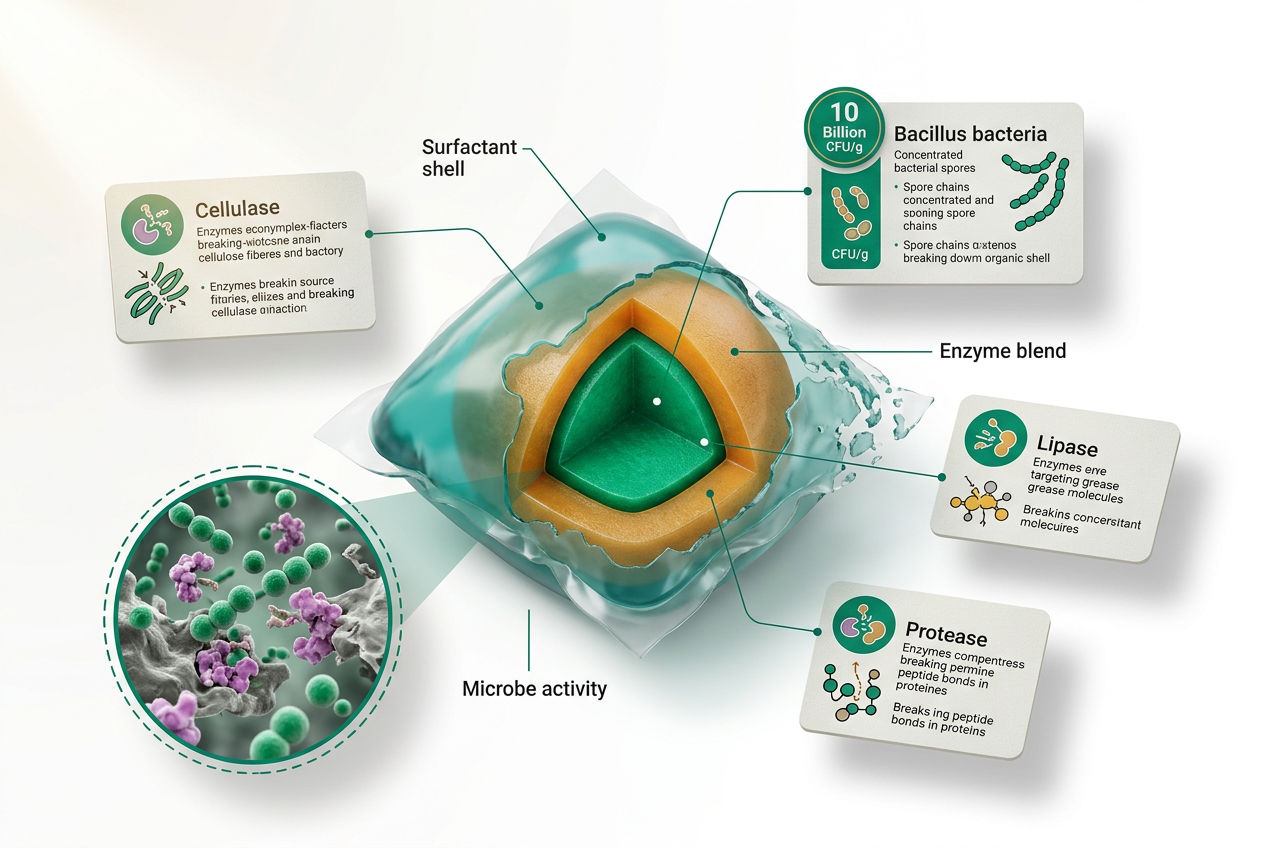
The pods contain approximately 2 billion CFUs (colony-forming units) of active bacteria per dose, according to the current product label we verified in June 2025. The packets (powder format) are similarly dosed per serving. CFU count matters because your tank already houses hundreds of billions of bacteria — you're supplementing, not replacing.
The water-soluble pod casing dissolves within minutes of contact with water in a toilet bowl. You don't need to open them, measure anything, or touch the contents. For most homeowners, that's the real selling point: simplicity.
One thing worth knowing — bacterial additive formulations get reformulated periodically. Always verify the CFU count on the packaging you're buying, not what you read in a review from three years ago.
Green Gobbler Pods vs. Packets: What's the Difference?
The pods and packets contain the same bacterial strains and enzyme profile. The difference is purely delivery format.
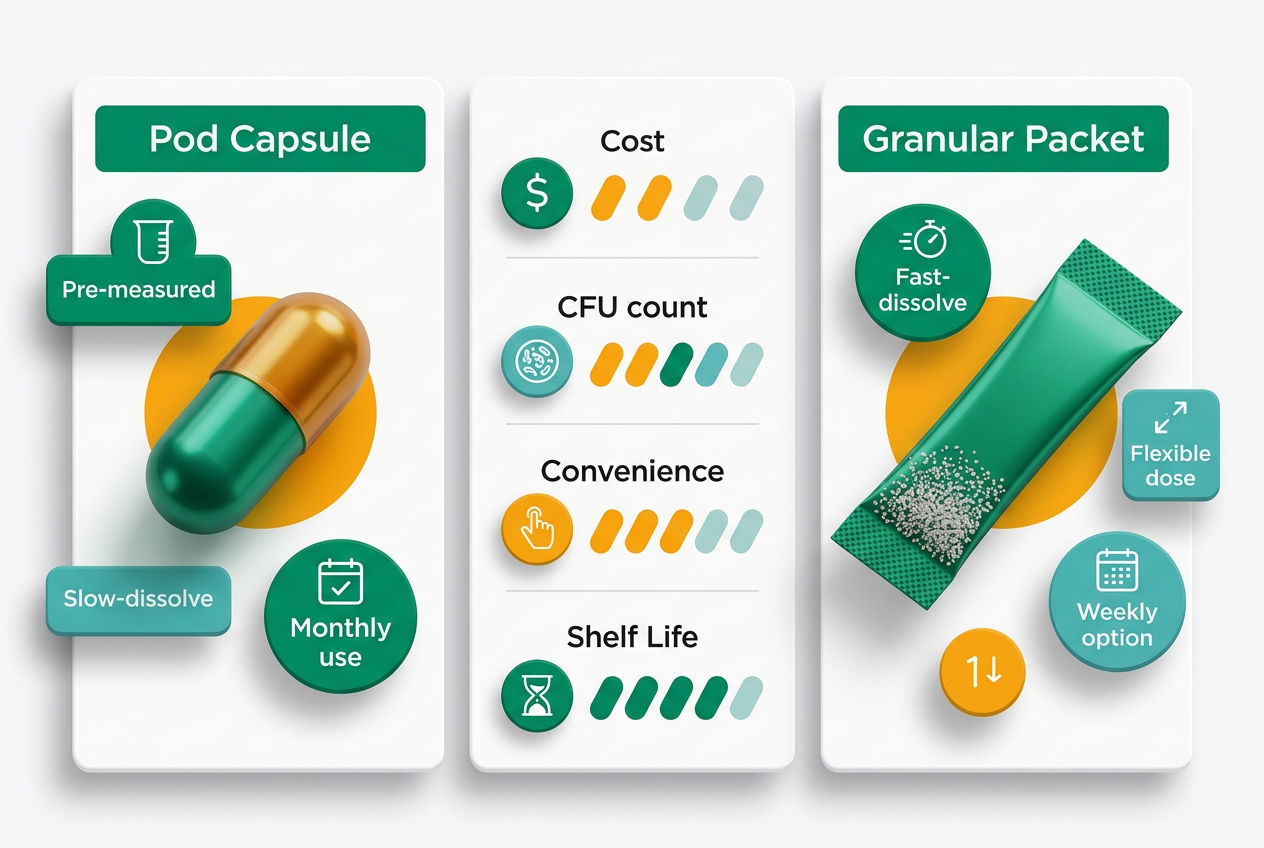
Septic Saver Pods are pre-measured, water-soluble capsules. Drop one in the toilet, flush, done. Each pod is a single monthly dose for a standard 1,000–1,500 gallon tank. They're sold in 3-month and 6-month supply packs.
Septic Treatment Packets are powder-filled sachets, also pre-measured. The powder format dissolves slightly faster than the pod shell, which some users prefer. Both formats target the same four enzyme classes with equivalent bacterial loads.
Both formats are designed for conventional anaerobic septic systems. If you have an aerobic treatment unit (ATU) — common in Florida, coastal Texas, and parts of the Gulf Coast — ATUs use oxygen injection to process waste, and adding anaerobic bacteria to an aerobic system can disrupt the treatment balance. Check your system type before buying.
How Do You Use Green Gobbler Septic Pods?
Using the pods correctly takes about 30 seconds once a month. Here's the process:
- Choose the right toilet. Pick the one closest to your main drain line — usually the lowest-level bathroom in your home.
- Drop one pod into the bowl. Don't break it open. Let it sit for 30–60 seconds to start dissolving.
- Flush with a full flush. Skip the half-flush setting — you want full water volume to carry the bacteria through the drain pipe.
- Avoid harsh chemicals for 24–48 hours. Bleach-based toilet cleaners or heavy disinfectants used right after treatment will kill the bacteria before they reach the tank.
- Repeat monthly. Consistency matters more than any single dose.
Timing matters seasonally. Bacterial activity slows in cold water. If you're in Minnesota or Vermont and your tank sits close to the frost line, the bacteria in your tank are already sluggish from November through March. A monthly treatment year-round still makes sense — the bacteria survive in the pod dormantly and reactivate once inside the warmer tank environment.
How Often Should You Use Green Gobbler in Your Septic Tank?
Once per month is the manufacturer's recommended frequency for a standard residential system. That aligns with general guidance from most bacterial additive manufacturers for tanks serving 2–6 person households.
If your household runs unusually heavy loads — hosting guests frequently, running a home daycare, or doing extra laundry — treating every 3 weeks during peak periods is reasonable. The number of laundry loads you run weekly has a real impact on how hard your system works.
If you're already committed to a monthly treatment routine, the product we'd steer you toward is Septifix. Rather than relying on enzymes alone, each tablet releases oxygen alongside 14 strains of aerobic bacteria — roughly 10 billion CFU — which is a more targeted approach to odor and sludge than most pod-style treatments. Dosing is a single tablet flushed down the toilet, and it runs about $3–$4 per treatment with a 60-day money-back guarantee. That said, no additive, including this one, replaces scheduled pumping — the EPA is clear on that point, and we won't pretend otherwise.
For seasonal cabin owners in the Mountain West or New England, some users treat before closing the cabin for winter and again when reopening in spring. That's reasonable, but not a substitute for annual inspection.
Green Gobbler vs. RID-X: How Do They Compare?
| Feature | Green Gobbler Pods | RID-X Powder | RID-X Gel Packs |
|---|---|---|---|
| Format | Water-soluble pod | Loose powder | Pre-measured gel |
| CFU Count (per dose) | ~2 billion | ~5.67 billion | ~5.67 billion |
| Enzyme Types | 4 (L, P, Am, Ce) | 4 (L, P, Am, Ce) | 4 (L, P, Am, Ce) |
| Ease of Use | Very easy | Moderate | Easy |
| Amazon Rating | ~4.3/5 | ~4.4/5 | ~4.3/5 |
| Approx. Cost/Month | $5–8 | $4–7 | $6–9 |
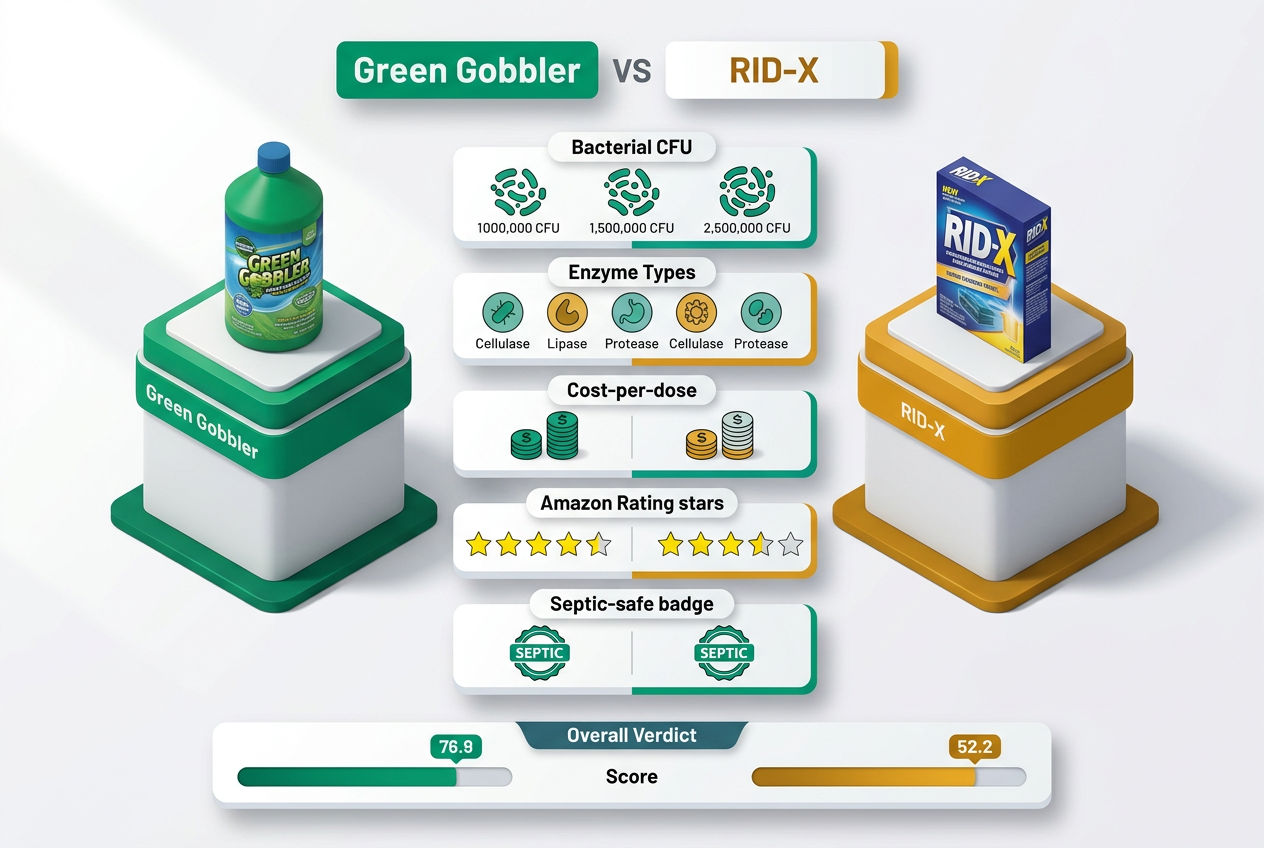
Sources: Amazon product listings, manufacturer labels (verified June 2025). Ratings based on review aggregates with 10,000+ reviews each.
RID-X carries a higher CFU count per dose — roughly 5.67 billion versus Green Gobbler's ~2 billion. Whether that translates to meaningfully better performance in a 1,000-gallon tank that already contains trillions of existing bacteria is debatable. Both products use the same four enzyme classes.
A worked example: if your 1,000-gallon tank already contains an estimated 500 billion resident bacteria (a conservative figure for a healthy system, per typical extension service estimates), adding 2 billion CFUs represents a 0.4% population boost. Adding 5.67 billion represents a 1.1% boost. Both are supplemental, not transformative. The difference in real-world outcome is unlikely to be detectable.
You can read a full side-by-side breakdown in our RID-X vs. Green Gobbler comparison. For most homeowners, the difference in outcome between these two products will be undetectable. The pod format is Green Gobbler's actual competitive advantage — it's genuinely more convenient than measuring powder.
Is Green Gobbler Safe for All Septic Systems?
For conventional anaerobic systems — concrete or fiberglass tanks with gravity-fed drain fields — Green Gobbler is safe. The bacterial strains are non-pathogenic and the enzyme profile is standard for the industry.
For aerobic treatment units (ATUs), common in high-water-table areas like coastal Florida and Louisiana, use caution. ATUs rely on aerobic bacteria that need oxygen. Flooding the system with anaerobic bacteria can create competition that temporarily disrupts treatment efficiency. If you're unsure which system you have, check your tank lid: ATUs typically have a visible aerator compressor (like a Hiblow HP-80) and an alarm panel near the tank.
For older cesspool systems in the Northeast — still found throughout rural New England — Green Gobbler won't cause harm, but it also won't compensate for the structural limitations of a cesspool. Those systems need different solutions, often replacement.
For mound systems or drip irrigation systems, compatibility depends on the treatment stages involved. When in doubt, call your installer or county health department.
Green Gobbler is not EPA Safer Choice certified as of this writing, though it is marketed as biodegradable and safe for pipes and tanks. The lack of formal EPA certification isn't a red flag — most septic additives don't carry it — but Pacific Northwest buyers who prioritize environmental credentialing should note the absence. The EPA's Safer Choice program (epa.gov/saferchoice) is the benchmark to check.
An honest limitation: This green gobbler septic treatment review cannot assess long-term microbial population dynamics in your specific tank. Soil composition, water usage patterns, household chemistry (antibacterial soaps, medications excreted in urine), and tank age all affect how well any bacterial additive performs. Green Gobbler improves baseline conditions; it doesn't guarantee a specific outcome.
Can Green Gobbler Replace Septic Tank Pumping?
No — and this is the most important myth to address.
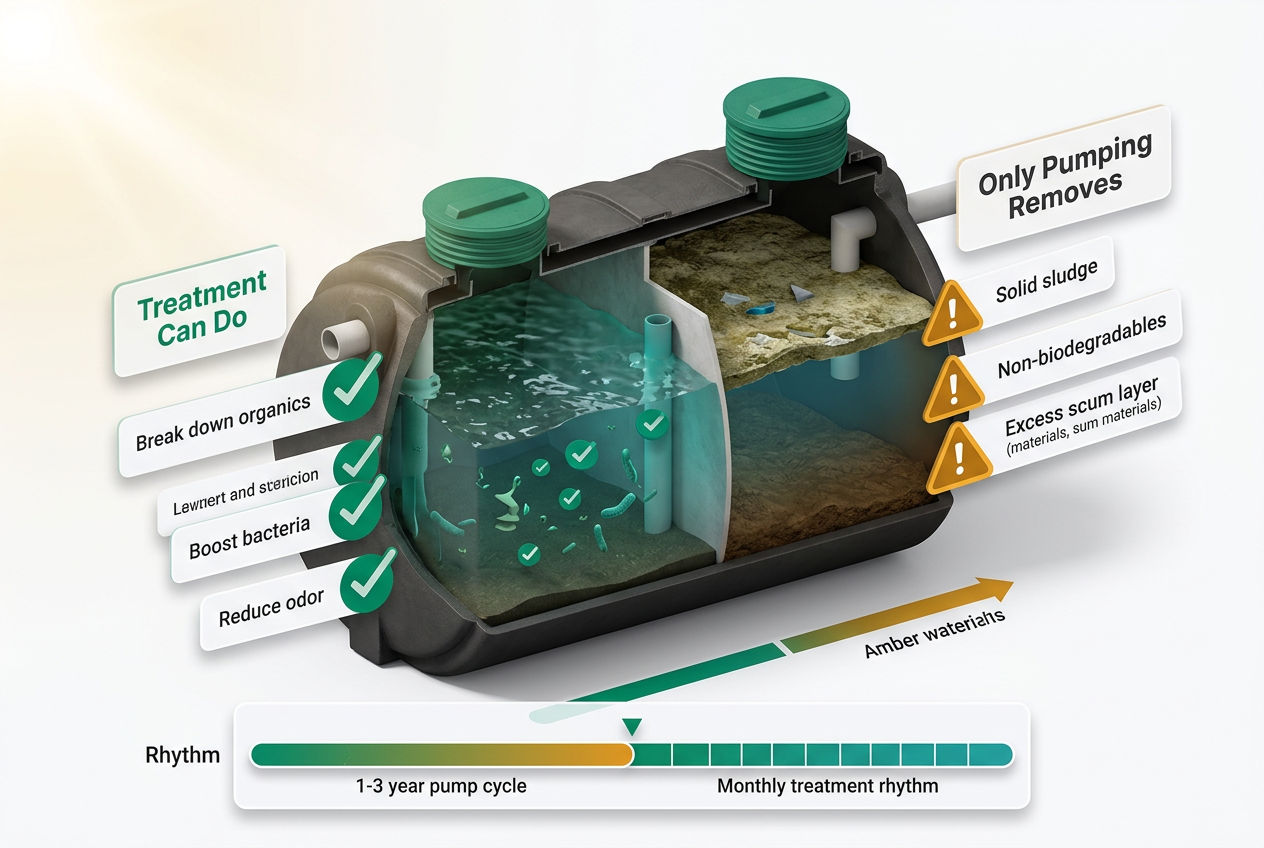
According to EPA guidelines, residential septic tanks should be pumped every 3–5 years depending on household size and tank volume. A 1,000-gallon tank serving four people accumulates roughly 250–300 gallons of sludge annually, based on figures from the EPA's "Septic Smart" public education program. At that rate, the tank reaches its sludge threshold in approximately 3–4 years regardless of any additive used.
Bacteria break down the liquid and semi-liquid fraction of waste. They do not eliminate sludge — the dense, inorganic-heavy layer that settles at the bottom. That layer can only be removed mechanically, by a septic pumping service.
Skipping pumping while using an additive is how homeowners end up with a $350–450 pump-out bill escalating to an $8,000–25,000 drain field repair or replacement. Check our septic pumping cost guide for regional pricing benchmarks, and use our pumping frequency guide to schedule correctly for your household size.
When Should You Stop Using Green Gobbler and Call a Pro?
Stop adding any bacterial treatment and contact a licensed septic professional if you notice:
- Sewage odors inside the home or near the tank/drain field
- Slow drains in multiple fixtures simultaneously — not just one toilet or sink (slow drains guide)
- Wet spots or unusually green grass over the drain field (wet yard septic guide)
- Gurgling sounds from drains after flushing
- Sewage backup into tubs, floor drains, or laundry lines
- Tank alarm activation on ATU systems
These symptoms indicate the system has moved past the point where any additive helps. You need a septic inspection and likely a pump-out or repair. Review signs your drain field is failing to understand how to read the warning signals before they become emergencies.
What Do Real Users Say About Green Gobbler?
Across Amazon, Home Depot, and Walmart product pages — aggregating reviews from pools of 5,000–15,000 verified purchasers as of June 2025 — Green Gobbler septic pods hold a 4.2–4.4/5 average rating.
Positive patterns in the reviews:
- Ease of use cited repeatedly — "drop and flush" format appeals to users who previously struggled with powder measurement
- Odor reduction reported within 2–4 weeks of starting monthly treatment
- Homeowners who use it preventatively (healthy systems, regular pumping schedule) report no drain issues over multi-year use periods
Negative patterns:
- Users who bought it hoping to solve an existing problem (slow drains, sewage odor, wet yard) consistently report no improvement — which is expected, not a product defect
- A subset of reviewers report the pod shell not fully dissolving in low-flow toilets; the fix is to let the pod sit in the bowl for 60 seconds before flushing on a full-flush setting
- Price sensitivity: some reviewers note RID-X offers higher CFU counts at lower per-dose cost, though without the convenience advantage
The negative reviews almost universally describe a use-case mismatch rather than a product failure. That pattern is consistent with how bacterial additives work — or don't — and it reinforces the core guidance in this review.
The Verdict: Is Green Gobbler Worth Buying?
Buy it if: You have a healthy conventional anaerobic septic system, you pump on schedule every 3–5 years, and you want a simple monthly maintenance routine that takes 30 seconds. The pod format is genuinely more convenient than powder alternatives, and the product is reasonably priced at $5–8 per month.
Skip it if: You're buying it to fix an existing problem. Slow drains, sewage odors, or wet spots over the drain field require a professional inspection and likely a pump-out — not bacteria. Using Green Gobbler as a substitute for addressing active symptoms will cost you time and money while the underlying problem worsens.
Use caution if: You have an ATU, a cesspool, a mound system, or any non-conventional treatment setup. Verify compatibility with your installer or county health department before using any bacterial additive.
If you're evaluating Green Gobbler against other products, read our best septic tank treatment roundup and our do septic additives work analysis for broader context on the additive category.
Related Rid-X & Septic Treatment Guides
- Aerobic Septic System Diagram: How Each Part Works
- Are Septic Tank Treatments Necessary?
- Best Septic Tank Treatment for Slow Drains
- Bio-Clean Septic Treatment Review: Does It Work?
- Cabin Obsession Septic Tank Treatment Review
- Camco Septic Tank Treatment Review
- How Often Should You Use Rid-X? Directions, Dosing & Timing
- How to Handle How Often to Use Septic Tank Treatment: Step by Step
- Is Rid-X Safe for Septic Tanks, Toilets & Pipes?
- Is Septic Tank Smell Dangerous? Gases, Risks & When to Worry
- The Best Rid-X Alternatives
- Does Rid-X Unclog Drains or Toilets?
- Can You Use Rid-X in an RV Black Tank? What to Know First
- What's Actually in Rid-X? Ingredients Explained
- Rid-X vs. Green Gobbler: Which Septic Treatment Wins?
- Septic Tank Smell After Pumping? Causes & How to Fix It
- Septic Smell From Roof Vent? Causes & How to Fix It
- Septic Smell From Shower Drain? Causes & How to Fix It
- Septic Smell Coming From Toilet? Causes & How to Fix It
- Septic Smell When It Rains? Why It Happens & How to Fix It
- Septic System Diagram With a Pump
- Septic Tank Cross-Section Diagram: Every Part Labeled
- Septic Tank Diagram With Dimensions
- Yeast, Baking Soda & Milk in Your Septic Tank: Myths Tested
- Septic Tank Plumbing Diagram: From House to Drain Field
- The Best Septic Tank Smell Removers
- Septic Tank Treatments at Walmart vs. Home Depot vs. Online
- Septic Treatment Tablets vs. Powder vs. Liquid: Which Is Best?
- Where to Buy SeptiFix
- Rid-X Platinum Review: Is the Upgrade Worth It?
- Zep Septic Defense Review: Does It Beat Rid-X?
- The Best Septic Tank Sludge Dissolvers
- The Best Septic Treatment for Toilet Paper Breakdown
- Instant Power Septic Shock Review: Does It Work?
Frequently Asked Questions
Does Green Gobbler septic treatment actually work for maintenance?
Yes — Green Gobbler septic treatment works as a monthly maintenance additive for conventional anaerobic septic systems that are already healthy and pumped on schedule. Each pod delivers approximately 2 billion CFUs of anaerobic bacteria alongside four enzyme types: lipase, protease, amylase, and cellulase. These support the microbial population that breaks down organic solids between pump-outs. According to University of Arkansas Cooperative Extension Service research, bacterial additives like this one maintain function in a working system but do not rehabilitate a failing one. If your system is backing up, producing sewage odors, or showing wet spots over the drain field, no additive will fix those problems — you need a professional pump-out and inspection first. For a healthy system with a regular pumping schedule, monthly Green Gobbler use is a reasonable, low-effort maintenance step. Expect gradual improvement in odor and solid breakdown over 4–8 weeks, not overnight results.
How long does Green Gobbler take to work in a septic tank?
Green Gobbler typically takes 2–4 weeks of consistent monthly use before most homeowners notice any change in system odor or drain behavior. The bacteria delivered in each pod need time to establish themselves in the existing microbial environment of the tank. A 1,000-gallon tank already contains hundreds of billions of resident bacteria — the 2 billion CFUs in a single pod represent a supplement, not a replacement population. Initial doses support the existing colony; over several months of consistent treatment, the overall microbial balance improves. Seasonal timing affects results: in cold-weather states like Minnesota or Vermont, bacterial activity in tanks near the frost line slows during winter months, which can delay noticeable improvement until spring. If you've used Green Gobbler for two full months without any improvement and your system had pre-existing symptoms like slow drains or odors, the issue is mechanical — not microbial — and requires professional service rather than continued additive use.
Are Green Gobbler septic pods safe for older pipes and tank materials?
Yes. Green Gobbler septic pods are safe for standard pipe materials including PVC, ABS, cast iron, and older clay or concrete sewer lines. The bacterial strains used are non-pathogenic, and the enzyme profile — lipase, protease, amylase, and cellulase — breaks down organic waste without corroding pipe walls or degrading tank materials. The water-soluble pod casing is also non-reactive and dissolves completely on contact with water. For concrete septic tanks, which represent the majority of residential installations in the U.S., the product poses no compatibility issues. For conventional fiberglass tanks, the same applies. The main compatibility caveat is system type, not pipe material: aerobic treatment units (ATUs) common in coastal Florida and Louisiana rely on aerobic bacterial populations, and introducing anaerobic bacteria from Green Gobbler can temporarily disrupt their balance. If you have an ATU — identifiable by an aerator compressor like a Hiblow HP-80 near the tank — consult your installer before using this or any anaerobic additive.
How many Green Gobbler pods per month do you need?
One pod per month is the correct dose for a standard residential septic tank in the 1,000–1,500 gallon range serving 2–4 people, per the manufacturer's current label. For larger tanks (above 1,500 gallons) or households with 5 or more occupants generating higher-than-average waste loads, some users increase frequency to one pod every three weeks during peak-use periods. Running a home daycare, hosting frequent guests, or doing more than 8–10 laundry loads per week all increase the biological load on your tank and may justify slightly more frequent treatment. For seasonal cabin systems that sit unused for months, treat once before winterizing and once when reopening in spring. More is not necessarily better — overdosing won't harm your system, but it wastes money without proportional benefit, since your tank's existing bacterial population handles the vast majority of digestion. Stick to the monthly schedule for typical households and adjust only for documented heavy-use situations.
Can you use Green Gobbler in an aerobic septic system?
No — using Green Gobbler in a true aerobic treatment unit (ATU) is not recommended. ATUs process waste using oxygen-dependent aerobic bacteria, typically delivered by an electric aerator compressor. Green Gobbler's bacteria are anaerobic — they thrive in oxygen-free environments. Introducing a large anaerobic bacterial load into an ATU can create bacterial competition that disrupts the aerobic treatment process and temporarily reduces treatment efficiency, which matters especially in systems regulated under state health codes (common in Texas, Florida, and other states with mandatory ATU maintenance contracts). ATUs are identifiable by a visible aerator compressor near the tank (such as a Hiblow HP-80 model), an alarm panel, and often a spray head or drip irrigation effluent dispersal system. If you have a conventional anaerobic septic system — a buried concrete or fiberglass tank with a gravity-fed drain field — Green Gobbler is fully compatible. When in doubt about your system type, check your original installation permit or call your county health department.
What is the difference between Green Gobbler pods and Green Gobbler packets?
Green Gobbler septic pods and packets deliver the same bacterial strains and enzyme profile — lipase, protease, amylase, and cellulase — at equivalent doses per serving. The difference is entirely in delivery format. Pods are pre-measured, water-soluble capsules that you drop directly into the toilet bowl; the casing dissolves in 30–60 seconds of water contact. Packets are powder-filled sachets that dissolve slightly faster since there's no outer shell to break down first. Both formats are pre-dosed for a standard 1,000–1,500 gallon residential tank, so there's no measuring involved with either. The pods are slightly more popular in customer reviews due to the no-touch, no-mess handling — you never contact the bacterial powder directly. If you prefer faster dissolution or have a very low-flow toilet that occasionally leaves the pod shell partially intact, the packet format is the practical alternative. Neither format is more potent than the other; choose based on which handling format you prefer.
Is Green Gobbler EPA certified or environmentally safe?
Green Gobbler markets its septic treatment products as biodegradable and safe for pipes, tanks, and groundwater — but as of this writing, the product is not EPA Safer Choice certified. The EPA's Safer Choice program (epa.gov/saferchoice) evaluates cleaning and maintenance products for environmental and human health safety across all ingredients. The absence of that certification doesn't mean the product is unsafe — the majority of septic additives on the market, including RID-X, also lack EPA Safer Choice certification — but it does mean no independent federal agency has formally reviewed the full ingredient profile against Safer Choice standards. For homeowners in environmentally sensitive areas — the Pacific Northwest, near protected waterways, or in states with stricter groundwater regulations — this distinction matters. The bacterial strains in Green Gobbler are non-pathogenic and widely used in wastewater treatment contexts. If EPA Safer Choice certification is a purchasing requirement for you, verify current certification status directly at epa.gov/saferchoice before buying, as product certifications can change after publication.
Sources & Methodology
- U.S. Environmental Protection Agency — "How Your Septic System Works" and "Septic Smart" public education program. epa.gov/septic. Used for pumping frequency guidance and additive position statements.
- University of Arkansas Cooperative Extension Service — Research publications on bacterial additives and septic system management. Used for the finding that additives support functional systems but do not rehabilitate failing ones.
- Green Gobbler product labels — Septic Saver Pods and Septic Treatment Packets, verified June 2025. Used for CFU counts, enzyme types, and dosing instructions.
- RID-X product labels — Powder and Gel Pack formats, verified June 2025. Used for comparative CFU data in the comparison table.
- Amazon, Home Depot, and Walmart product review aggregates — Green Gobbler and RID-X listings with 5,000–15,000+ verified reviews each. Accessed June 2025. Used for rating data and user pattern analysis.
This green gobbler septic treatment review is based on the manufacturer's published label and product information, published extension service research, and consumer review analysis. We did not purchase or hands-on test the product, and no product was provided by the manufacturer. Some links in this article are affiliate links; we may earn a commission at no additional cost to you. This does not affect our editorial assessment.
For related guidance, see our do septic additives work analysis and our best septic tank treatment roundup.
Free download
Not ready for the Handbook? Start with the free Fridge Card.
The Do / Don’t card the whole family can see, plus the Survival Kit: emergency flowchart, warning-sign decoder and pump-schedule card. One printable PDF.
Was this article helpful?
Frequently Asked Questions
Recommended Resources
📖 Related Articles
- The Complete Septic Tank Maintenance Guide
- Aerobic vs Anaerobic Septic Systems: How They Compare
- How Many Loads of Laundry Can You Do With a Septic System?
- Rid-X vs. Green Gobbler: Which Septic Treatment Wins?
- How Often Should You Pump Your Septic Tank?
- Slow Drains With Septic: Is It the Plumbing or the Tank?
- Wet Spot in Yard Over Septic: What It Means & How to Fix It
- Signs Your Drain Field Is Failing (And What to Do)
- Do Septic Tank Treatments Actually Work?
- Do Septic Tank Additives Actually Work? (The Science)
💰 Cost Guides
Find Septic Professionals Near You
Compare licensed, verified septic companies by area — top county markets and cities below, or browse all 50 states.
County markets
Popular cities
