
Quick Answer
A septic system diagram with pump shows the complete path wastewater travels from your home's plumbing through a primary tank, into a dedicated pump chamber, and out to a drainfield or mound system — often dozens of feet uphill or hundreds of feet away. The pump replaces gravity where gravity can't do the job alone.
Key Takeaways
- Not every septic system has a pump. Pumped systems are required when terrain, soil type, or distance prevents gravity flow to the drainfield.
- A typical pumped system has two main tanks: a 1,000–1,500-gallon primary septic tank and a 300–500-gallon pump chamber (dosing chamber).
- The effluent pump doses wastewater in controlled batches — usually 50–150 gallons per cycle — several times per day.
- Float switches control the pump's on/off cycles and trigger an alarm when liquid rises too high.
- Pumps last 7–15 years. Replacement costs run $1,000–$3,000 installed for an effluent pump, more for a grinder pump.
Do All Septic Systems Have a Pump?
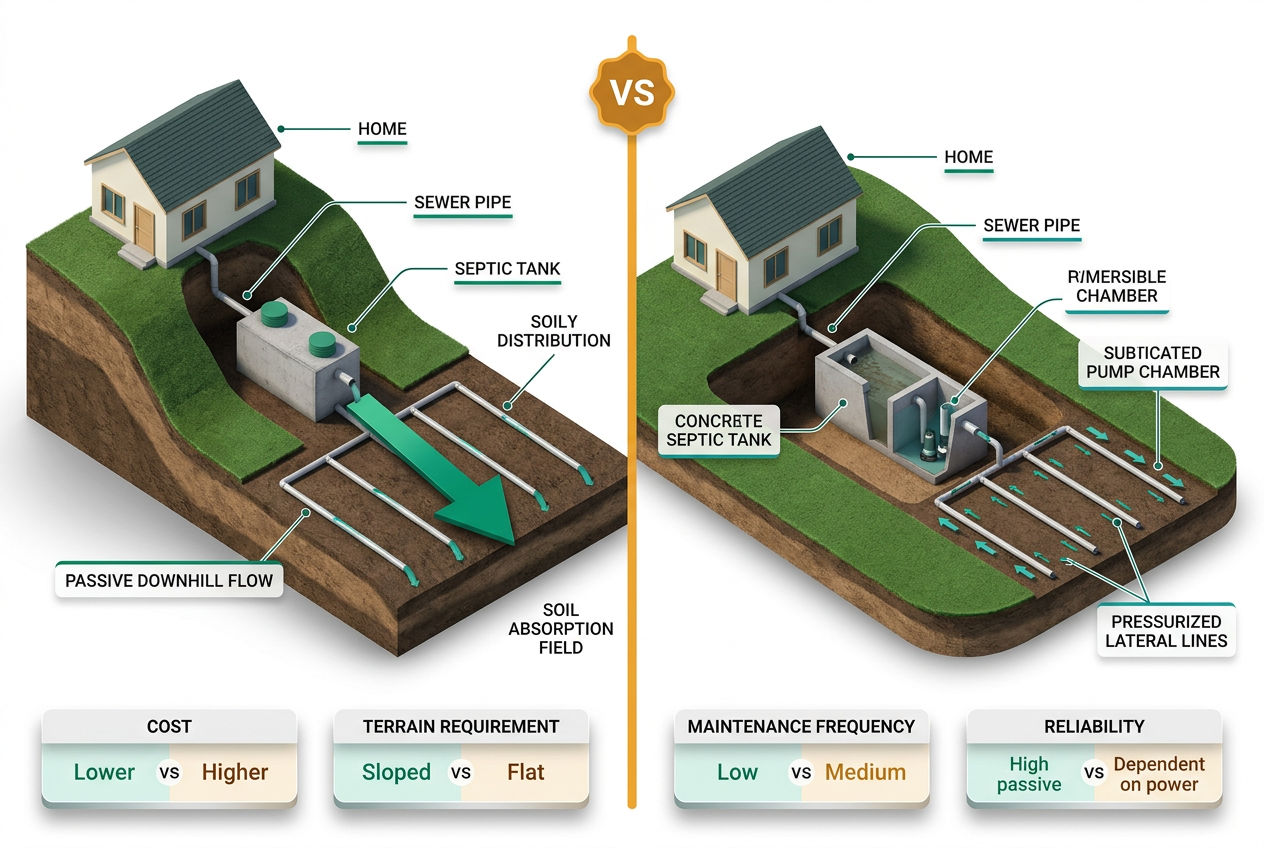
No. A conventional gravity septic system relies entirely on slope. Wastewater flows downhill from the house to the tank, and clarified effluent flows downhill again from the tank outlet to the drainfield. No electricity required.
A pumped system enters the picture when that gravity flow isn't possible. There are three common scenarios:
- The drainfield sits uphill from the tank — common on hilly terrain in Appalachia, the Pacific Northwest, or the Ozarks.
- The drainfield is too far away — gravity systems typically work over short distances; pumped systems can push effluent 200+ feet horizontally or 20–50 feet vertically.
- Soil or site conditions require a special drainfield type — mound septic systems and pressure distribution systems are built above grade or use pressurized laterals, both of which require a pump.
If you're on a flat lot with good sandy loam and a nearby drainfield, you likely don't have a pump. If you're in coastal Florida with a high water table, or on a hillside in Tennessee, there's a real chance you do.
Learn more about the different septic system configurations to see where pumped systems fit in the spectrum.
What Does a Septic Pump Diagram Show? (Component-by-Component Walkthrough)
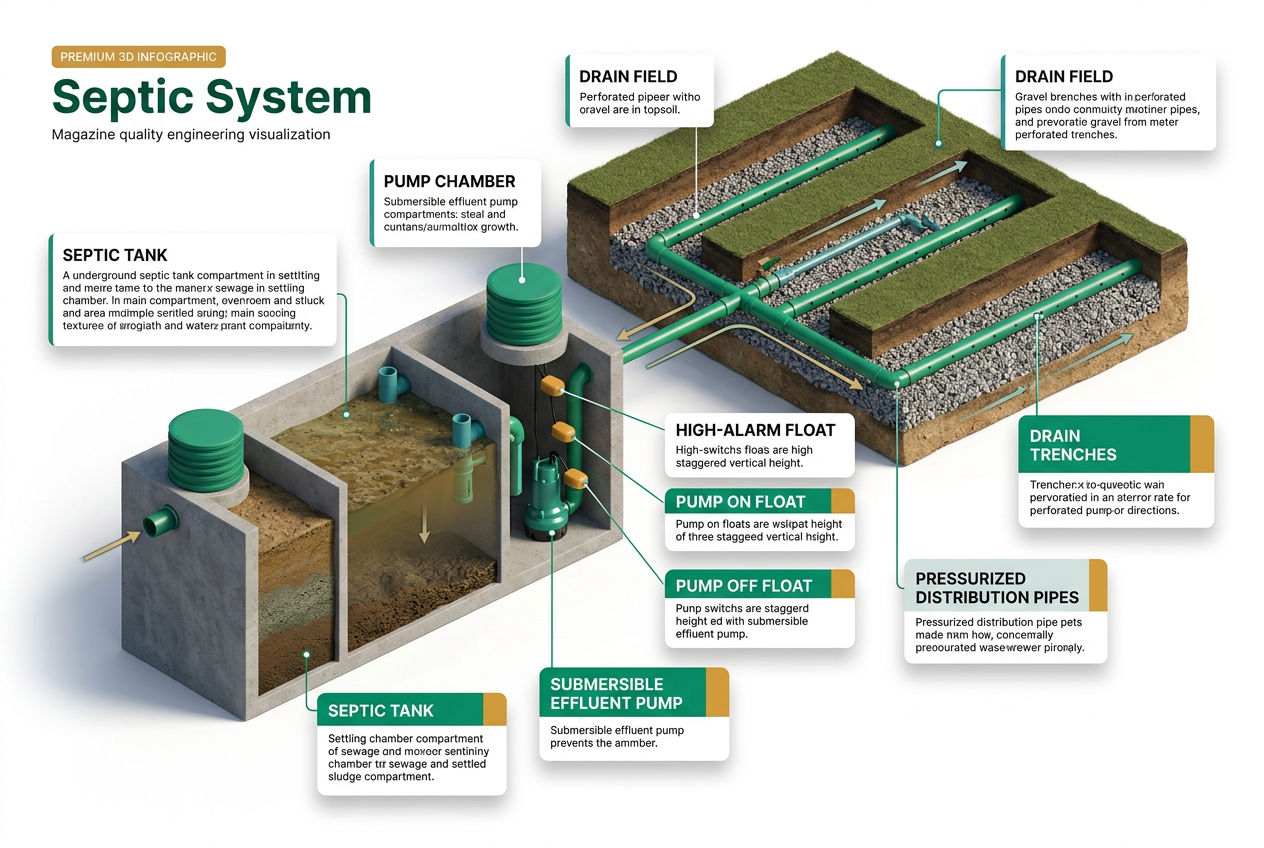
A septic pump diagram traces the flow path through seven distinct components — from your home's drain lines to the drainfield. Read this left to right, house to drainfield, and each piece snaps into place.
Component 1: Your Home's Plumbing
Every toilet flush, shower drain, and dishwasher cycle sends wastewater through your home's drain lines to a single main sewer pipe. That pipe exits through the foundation (typically 4" PVC or cast iron) and runs to the septic tank. In a pumped system, this inlet pipe works exactly the same as in a gravity system.
Component 2: The Primary Septic Tank (1,000–1,500 Gallons)
The primary tank is where the heavy lifting happens biologically. A 1,000-gallon concrete or fiberglass tank is standard for a 3-bedroom home; a 4-bedroom home typically requires 1,250–1,500 gallons.
Inside, solids sink to form a sludge layer. Fats and grease float to form a scum layer. The clarified liquid in the middle — called effluent — exits through the outlet baffle. That outlet baffle (often a Polylok PL-122 effluent filter on modern systems) prevents floating scum and suspended solids from moving downstream.
This tank needs pumping every 3–5 years regardless of whether you have a pump downstream. Don't skip it just because the pump is working fine.
Component 3: The Pump Chamber (Dosing Chamber) — 300–500 Gallons
After the primary tank, effluent flows by gravity into a separate pump chamber — sometimes called a dosing chamber or wet well. On some older systems, this is a compartment at the far end of the primary tank. On most modern installations, it's a separate 300–500-gallon tank buried a few feet from the primary tank.
This is where the real difference from a gravity system becomes visible. The pump chamber holds a reserve of clarified effluent, ready to be dosed out in measured batches.
Component 4: The Effluent Pump (or Grinder Pump)
Sitting at the bottom of the pump chamber is the pump itself. Most residential systems use a submersible effluent pump rated at 1/3 to 1 HP. Common manufacturers include Goulds Water Technology, Zoeller, and Liberty Pumps.
These pumps handle clarified effluent — liquid that has already been separated from solids in the primary tank. A grinder pump is a different animal. It handles raw sewage (solids included), grinds it to a slurry, and pumps it under pressure. Grinder pumps are common in low-pressure sewer systems and some steep-terrain installations. They're more powerful, cost more to replace ($1,500–$4,000 installed versus $1,000–$3,000 for an effluent pump), and wear out faster — typically 5–10 years versus 7–15 years for an effluent pump.
See our detailed comparison of effluent pump vs. grinder pump if you're not sure which type you have.
Component 5: The Float Switches and Alarm Panel
Float switches are the brain of the pump chamber. Most systems use three floats hung at different depths:
- Off-float (lower): When liquid drops to this level, the pump shuts off.
- On-float (upper operating level): When liquid rises here, the pump kicks on and doses effluent to the drainfield.
- Alarm float (highest point): If liquid rises above the on-float without being pumped down — pump failure, power outage, clogged line — this float triggers the septic pump alarm panel, usually a buzzer and red light mounted inside or near the home.
The alarm float is typically set 6–12 inches above the on-float, giving you a buffer of 50–100 gallons before effluent is at risk of backing up. If your alarm goes off, you likely have 24–48 hours before a real emergency — call a pro.
The alarm panel itself typically costs $100–$300 to replace if the panel fails rather than the pump. Many states, including Minnesota and Wisconsin, have specific code requirements mandating audible-and-visual alarms on all pump systems.
Component 6: The Check Valve and Discharge Line
Between the pump and the drainfield sits a check valve — a one-way valve (typically a swing-check or ball-check style) that prevents effluent from draining back into the pump chamber when the pump shuts off. Without it, the pump would have to re-pump the same effluent sitting in the line every cycle, dramatically shortening its life.
The discharge line itself is usually 1.25"–2" Schedule 40 PVC. In cold climates — think Minnesota, where frost penetrates 42–60 inches — this line needs to be buried below the frost line or insulated where it transitions above grade. A frozen discharge line is a common winter emergency that can cost $500–$1,500 to thaw and repair. Preventing frozen septic pipes before the season starts is far cheaper.
Component 7: The Drainfield (Pressure Distribution or Mound)
In a standard pumped system, the discharge line feeds into either a pressure distribution drainfield or a mound system.
In a pressure distribution system, the pump sends effluent through a network of small-diameter PVC laterals perforated with 1/8"–3/16" holes, spreading it evenly across the drainfield rather than letting it pool at the inlet end. This dramatically extends drainfield life.
In a mound septic system diagram, the drainfield is built above the native soil on a sand fill mound — necessary where the water table is too shallow or the soil won't perc. The pump chamber pushes effluent uphill to the mound, where it trickles down through sand and into the native soil below. If you've failed a perc test, this is often the path forward — see our guide on failed perc test options.
Either way, the drainfield is where final treatment happens. Soil microbes break down remaining pathogens before the water reaches groundwater.
How Does a Septic System With a Pump Actually Work? (Step-by-Step)
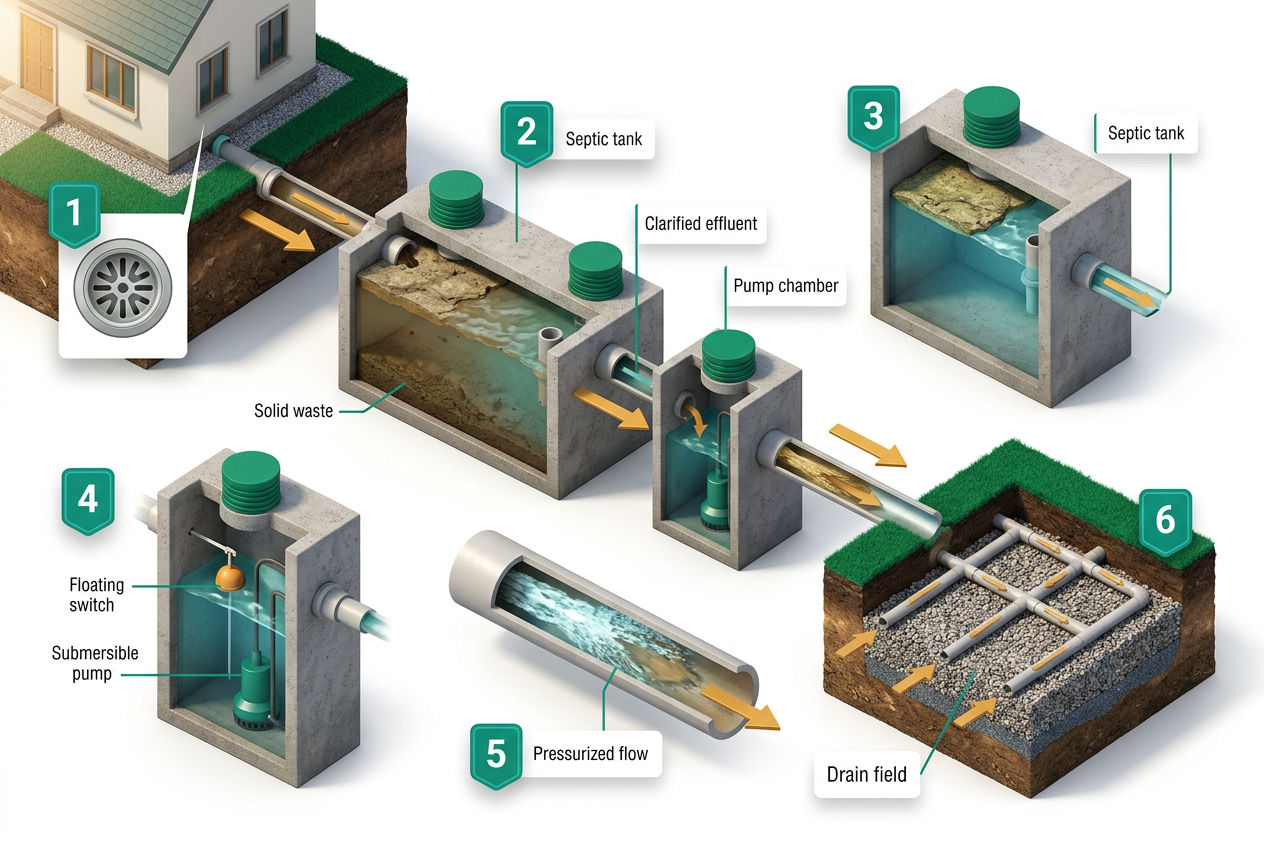
Here's the full cycle, start to finish:
- Wastewater leaves your home and enters the primary septic tank.
- Solids settle, scum floats, effluent clarifies over 24–48 hours.
- Clarified effluent exits through the outlet baffle and flows by gravity into the pump chamber.
- The on-float rises with the liquid level and triggers the pump.
- The pump sends 50–150 gallons of effluent through the check valve and discharge line in one timed dose — typically over 2–5 minutes.
- The pump shuts off when the off-float is reached.
- This cycle repeats several times per day based on household water use.
- Effluent is distributed evenly across the drainfield and treated by soil.
According to the EPA, approximately 20% of U.S. households — around 21 million homes — rely on septic systems. Among those, systems requiring pumps are increasingly common as development pushes into hillier terrain and areas with challenging soils.
A worked example: Take a 4-person household in rural North Carolina generating roughly 240 gallons of wastewater per day (60 gallons per person, per EPA household estimates). With a pump dosed at 100 gallons per cycle, the system fires 2–3 times daily. Over a year, that's roughly 800–1,000 pump cycles. A Zoeller M267 effluent pump rated for 150,000+ cycles will handle this load for a decade or more — but only if the primary tank is pumped every 3–5 years to keep solids from reaching the pump chamber. Skip that pumping service ($350–$500), and solids reaching the pump can cause a $2,500+ pump replacement within a few years.
Gravity vs. Pump Septic System: What's the Real Difference?
| Feature | Gravity System | Pumped System |
|---|---|---|
| Power required | None | Yes (pump runs on 120V household current) |
| Terrain flexibility | Flat lots only | Uphill, downhill, long distances |
| Operating cost | Minimal | $30–$80/year in electricity |
| Maintenance complexity | Lower | Higher (pump, floats, alarm panel) |
| Failure modes | Drain clogs, root intrusion | All gravity failures + pump failure, frozen lines |
| Average system life | 25–40 years | 25–40 years (pump replaced every 7–15 years) |
| Typical installation cost | $5,000–$12,000 | $8,000–$20,000+ |
The pump adds complexity and operating cost — but it makes septic viable on terrain and soil types where gravity systems simply won't work. According to the National Onsite Wastewater Recycling Association (NOWRA), pressure-dosed and pumped systems now represent a significant share of new installations in states with varied topography.
Honest limitation: These cost figures are national averages. Your actual numbers depend heavily on local labor rates, soil conditions, and permitting requirements. Always get at least two local quotes before budgeting. See our septic installation cost guide for regional breakdowns.
What Does It Mean When My Septic Pump Alarm Goes Off?
Your alarm panel is beeping. Here's what's actually happening and what to do next.
The alarm float — the highest of the three floats in your pump chamber — has risen above its set point. That means liquid in the chamber is higher than it should be. Three things typically cause this:
1. The pump lost power. Check your breaker panel first. A tripped breaker is the most common cause and costs nothing to fix. Reset it and watch whether the alarm clears within 30–60 minutes.
2. The pump failed. If the breaker is fine but the alarm stays on, the pump motor may have burned out. This is more likely if you've heard the pump cycling unusually or if it's more than 10 years old. You'll need a pro to pull and test the pump.
3. A float switch failed. Sometimes the pump is fine but the on-float is stuck — either stuck up (pump running constantly) or stuck down (pump not triggering). A stuck float can usually be identified by a technician in under an hour.
What not to do: Don't run extra water. Don't do laundry, run the dishwasher, or shower more than necessary until the alarm clears. Every gallon you send to the tank is a gallon closer to a backup.
You likely have 24–48 hours of buffer from the time the alarm trips to a genuine emergency. Use that window to schedule service, not ignore it. See our full septic tank alarm troubleshooting guide for a step-by-step diagnostic.
How Long Does a Septic Pump Last — and How Do You Know It's Failing?
Effluent pumps last 7–15 years under normal residential use. Grinder pumps run shorter — typically 5–10 years — because they handle raw sewage with solids. Pushing beyond these windows without inspection is how a $400 service call becomes a $2,500 emergency.
Signs your pump is near the end:
- Alarm trips more frequently, even after the panel resets
- The pump runs longer than usual to dose the same volume
- Grinding or rattling sounds from the pump chamber (especially in grinder pump systems)
- Sluggish drains throughout the house when the pump should be running
- Visible rust or corrosion on the pump body when inspected
What shortens pump life:
- Flushing wipes, rags, or feminine hygiene products — even "flushable" wipes don't break down before reaching the pump chamber
- Running the pump without adequate liquid in the chamber (dry-running)
- Power surges without a surge protector on the pump circuit
- Neglecting the primary tank so solids carry over into the pump chamber
A Zoeller M267 or comparable effluent pump run under normal conditions, with primary tank pumped every 3–5 years, will routinely hit the 12–15 year mark. Run it hard with poor tank maintenance and you'll see failure at 5–7 years.
See our complete septic pump guide and septic pump troubleshooting guide for diagnostic steps before you call a technician.
How Much Does It Cost to Replace a Septic Pump?
Free download
Free: the Septic Fridge Card — what to flush, what never to.
The Do / Don’t card the whole family can see, plus the Survival Kit: emergency flowchart, warning-sign decoder and pump-schedule card. One printable PDF.
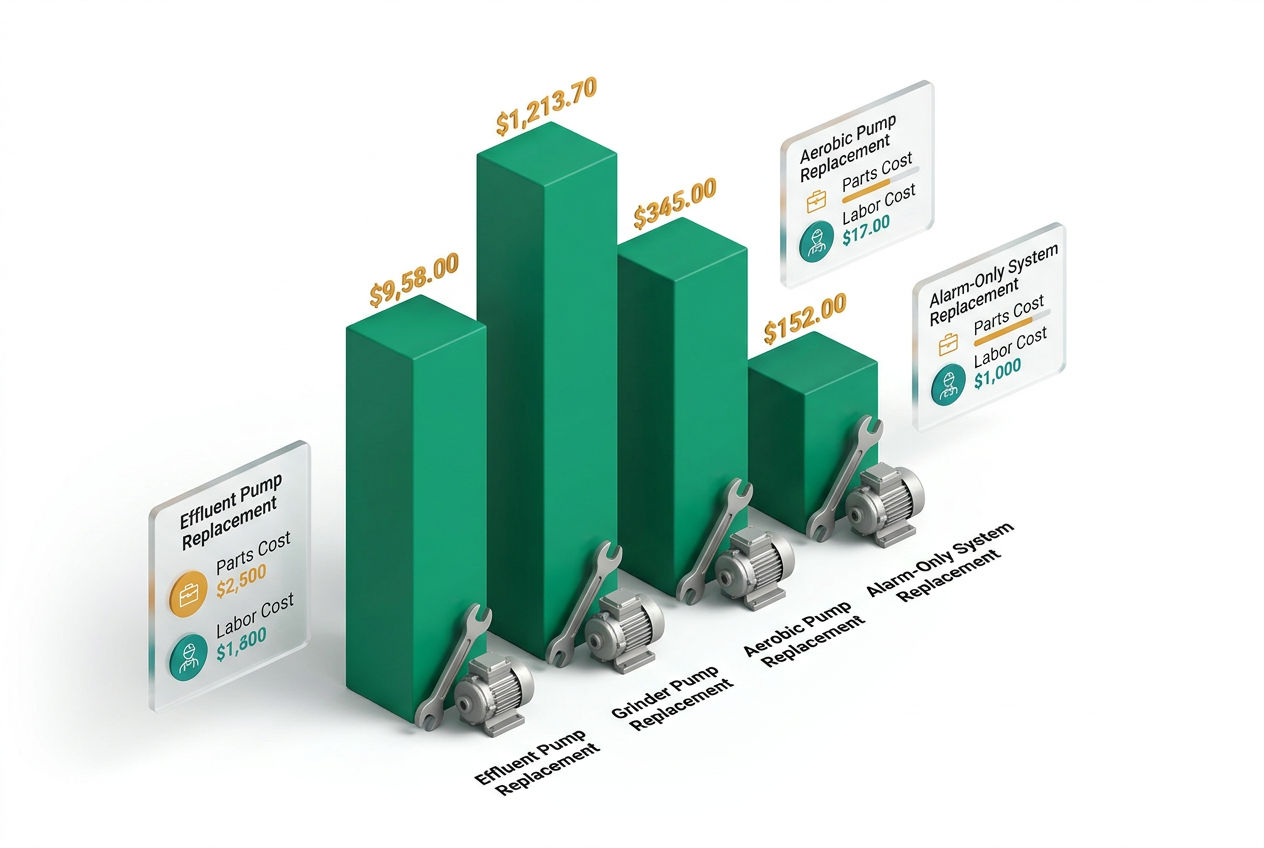
Pump replacement costs depend on pump type, depth of burial, and your location. Here's what to expect:
| Pump Type | Parts Cost | Installed Cost | Lifespan |
|---|---|---|---|
| Effluent pump (1/3–1 HP) | $200–$600 | $1,000–$3,000 | 7–15 years |
| Grinder pump | $400–$1,200 | $1,500–$4,000 | 5–10 years |
| Alarm panel replacement | $100–$300 | $200–$500 | 10–20 years |
| Float switch replacement | $20–$80 | $150–$400 | 5–10 years |
Regional cost differences are significant. In Charlotte, NC, effluent pump replacement typically runs $900–$1,600 installed. The same job in rural Montana or interior Alaska runs $2,000–$3,500 because of longer technician drive times and limited competition. Parts costs are similar; labor and mobilization drive the regional gap.
Budget rule of thumb: Set aside $150–$200 per year in a home maintenance fund specifically for septic pump replacement. Over 10–12 years, that covers most installed replacement costs without a financial shock.
For a full cost breakdown with regional data, see our septic pump replacement cost guide and septic repair cost guide.
If your system needs repair beyond just the pump, our septic repair service page can help you find licensed professionals in your area.
Annual Maintenance Schedule for a Pumped Septic System
Pumped systems require more attention than gravity systems. Here's the schedule practitioners actually follow:
Every year:
- Test the alarm panel by pressing the test button on the control box — confirm the buzzer and light both activate
- Visually inspect the pump chamber access lid for cracks, settlement, or insect intrusion
- Check the electrical connections at the junction box for corrosion or moisture intrusion
- Note any changes in how frequently you hear the pump cycling
Every 1–3 years:
- Have a septic professional inspect the float switches and pump performance
- Check the check valve for proper seating — a leaking check valve wastes pump cycles and shortens motor life
- Inspect the discharge line for root intrusion, especially near mature trees
Every 3–5 years:
- Pump the primary septic tank — this is non-negotiable regardless of pump performance
- Inspect the outlet baffle and effluent filter (Polylok PL-122 or equivalent) — clean or replace the filter cartridge
- Camera-inspect the discharge line if you've had any alarm events
Before winter (cold climates):
- Confirm the discharge line is buried below local frost depth or properly insulated
- Check that the pump chamber lid is secure and sealed — warm effluent vapor escaping through a cracked lid can freeze and create ice blockages
The septic pumping and cleaning service directory can help you schedule routine maintenance with licensed providers.
Where Are Pumped Septic Systems Most Common?
Geography determines pump necessity more than most homeowners realize before they buy. Here's where you're most likely to encounter a pumped system:
High-probability pump regions:
- Appalachian states (West Virginia, eastern Tennessee, western North Carolina): Steep terrain with limited flat buildable area forces uphill pumping routinely
- Pacific Northwest (western Oregon, Washington Cascades): Hilly terrain combined with clay soils that perc poorly
- Florida coastal areas: Shallow water tables — sometimes 12–18 inches below grade — require mound systems that need pumps
- Minnesota and Wisconsin lake country: Shoreline lots with high water tables and set-back requirements push drainfields far from the home
Lower-probability pump regions:
- Kansas, Iowa, and Nebraska plains — flat terrain with deep water tables favors conventional gravity systems
- Parts of the Southeast with well-draining sandy soils at moderate elevation
The Florida Department of Health Onsite Sewage Program (FDOH-OSP) and its Registered Septic Tank Contractor (RSTC) designation specifically address the prevalence of pump-required systems in that state's coastal environment. Minnesota's MPCA (Pollution Control Agency) similarly mandates pump system compliance standards given the state's lake-dense geography and frost depth requirements.
If you own a pumped system in any of these high-probability regions, keeping the tank itself in good biological shape matters even more than it does with a conventional gravity setup — because pump failures and odor problems tend to compound quickly when sludge accumulates faster than expected. That's the situation where we recommend Septifix: each tablet releases oxygen and 14 strains of live aerobic bacteria (roughly 10 billion CFU) directly into the tank, targeting odor and sludge buildup without any measuring or mess. To be clear, no additive replaces scheduled pumping — the EPA's position on that hasn't changed — but if you're going to use a monthly treatment alongside your maintenance routine, Septifix is the one we point readers toward.
Sources & Methodology
This article draws on the following sources:
- U.S. Environmental Protection Agency (EPA) — Septic Systems Overview (epa.gov/septic): Household septic prevalence statistics (21 million homes, approximately 20% of U.S. households)
- Minnesota Pollution Control Agency (MPCA) — Individual Sewage Treatment Systems Standards (Minnesota Rules Chapter 7080): Frost penetration depth requirements (42–60 inches), mandatory alarm standards for pump systems
- Florida Department of Health, Environmental Health — Onsite Sewage Program: RSTC contractor designation requirements, mound and pump system prevalence in coastal counties
- National Onsite Wastewater Recycling Association (NOWRA) — Industry statistics on pressure-dosed system installation trends
- Manufacturer technical specifications: Zoeller Company (Model M267 effluent pump), Goulds Water Technology (effluent pump product line), Liberty Pumps (residential effluent pump series), Polylok (PL-122 effluent filter installation guide)
Cost ranges reflect contractor quotes and regional service data compiled by SepticTankHub from licensed professionals across multiple states. Costs are estimates; get local quotes before budgeting.
Related Rid-X & Septic Treatment Guides
- The Best Rid-X Alternatives
- The Best Septic Tank Smell Removers
- Septic Smell When It Rains? Why It Happens & How to Fix It
- Can You Use Rid-X in an RV Black Tank? What to Know First
- Is Rid-X Safe for Septic Tanks, Toilets & Pipes?
- How Often Should You Use Rid-X? Directions, Dosing & Timing
- What's Actually in Rid-X? Ingredients Explained
- Does Rid-X Unclog Drains or Toilets?
- Rid-X vs. Green Gobbler: Which Septic Treatment Wins?
- Green Gobbler Septic Treatment Review: Pods, Packets & Results
- Where to Buy SeptiFix
- Bio-Clean Septic Treatment Review: Does It Work?
- Cabin Obsession Septic Tank Treatment Review
- Camco Septic Tank Treatment Review
- Septic Tank Treatments at Walmart vs. Home Depot vs. Online
- Septic Smell Coming From Toilet? Causes & How to Fix It
- Septic Smell From Shower Drain? Causes & How to Fix It
- Septic Tank Smell After Pumping? Causes & How to Fix It
- Septic Smell From Roof Vent? Causes & How to Fix It
- Is Septic Tank Smell Dangerous? Gases, Risks & When to Worry
- Septic Tank Diagram With Dimensions
- Septic Tank Cross-Section Diagram: Every Part Labeled
- Septic Tank Plumbing Diagram: From House to Drain Field
- Aerobic Septic System Diagram: How Each Part Works
- Are Septic Tank Treatments Necessary?
- How to Handle How Often to Use Septic Tank Treatment: Step by Step
- Septic Treatment Tablets vs. Powder vs. Liquid: Which Is Best?
- Best Septic Tank Treatment for Slow Drains
- Yeast, Baking Soda & Milk in Your Septic Tank: Myths Tested
Frequently Asked Questions
What is a septic pump diagram used for?
A septic pump diagram is a visual reference that maps the complete flow path of wastewater in a pumped septic system — from the home's drain lines through the primary tank, into the pump chamber, and out to the drainfield or mound. Homeowners use it to understand how their system works before a service call, to locate components during an alarm event, and to communicate with contractors about repairs. A clear septic pump diagram typically labels the primary tank, the dosing chamber, the effluent pump, float switch positions, the check valve, the discharge line, and the drainfield distribution network. Installers and inspectors use more detailed engineering diagrams that include pipe diameters, burial depths, and elevation changes. If you're buying a home with a pumped system, ask the seller for the as-built diagram — most state health departments require one be filed at permit close.
How does a mound septic system diagram differ from a standard pumped system diagram?
A mound septic system diagram includes all the components of a standard pumped system — primary tank, pump chamber, effluent pump, discharge line — plus the engineered sand mound structure built above grade. The key visual difference is elevation: in a mound system diagram, the discharge line rises from the pump chamber up to the mound platform, typically 2–4 feet above the original ground surface. The mound itself shows layers — native soil at the base, a sand fill layer (usually 12–24 inches), the drainfield laterals embedded in gravel or aggregate, and a topsoil cap. Mound system diagrams also typically note the set-back distances required from property lines, wells, and surface water — often 50–100 feet depending on state regulations. Understanding the mound septic system diagram helps homeowners recognize why the pump is critical: without it, no effluent reaches the elevated drainfield at all.
What's the difference between an effluent pump and a grinder pump in a septic system?
An effluent pump handles clarified liquid that has already been separated from solids in the primary septic tank. It pulls from the pump chamber — a holding vessel that receives pre-treated effluent — and doses it to the drainfield in controlled batches. Effluent pumps are typically rated at 1/3 to 1 HP and last 7–15 years under normal use. Common models include the Zoeller M267 and Goulds WS series. A grinder pump, by contrast, handles raw sewage — solids, paper, and all — by grinding everything into a fine slurry before pumping it under pressure. Grinder pumps are larger, more powerful, and typically cost $1,500–$4,000 installed versus $1,000–$3,000 for an effluent pump. They also wear out faster (5–10 years) because of the mechanical stress of grinding. Grinder pumps are common in low-pressure community sewer systems and steep-terrain properties where a primary tank isn't feasible upstream of the pump.
How does a dosing chamber work in a pumped septic system?
A dosing chamber — also called a pump chamber or wet well — is a separate holding tank, typically 300–500 gallons, that receives clarified effluent from the primary septic tank. Its job is to accumulate enough liquid to justify a full pump dose, then release that volume to the drainfield in one controlled batch rather than a constant trickle. Inside the dosing chamber, three float switches set the operating parameters: the off-float defines the minimum liquid level, the on-float triggers the pump when liquid rises to the dosing threshold, and the alarm float activates a warning buzzer if liquid rises above the on-float — indicating the pump isn't keeping up. A typical dose is 50–150 gallons delivered over 2–5 minutes. This batch-dosing approach distributes effluent more evenly across the drainfield and gives the soil resting time between doses, extending drainfield life significantly compared to continuous-flow systems.
How long do septic pump systems last before needing replacement?
The pump itself — the mechanical heart of a pumped septic system — typically lasts 7–15 years for an effluent pump and 5–10 years for a grinder pump under normal residential use. The surrounding infrastructure (tanks, pipes, drainfield) can last 25–40 years with proper maintenance. Pump lifespan depends heavily on three factors: how well the primary tank is maintained (solids reaching the pump dramatically accelerate wear), what gets flushed (wipes and fibrous materials clog pump intakes), and whether the system is protected from power surges. According to manufacturer specifications from Zoeller and Liberty Pumps, pumps operating in properly maintained systems with primary tanks pumped every 3–5 years routinely reach the upper end of lifespan estimates. Budget approximately $150–$200 per year into a home maintenance reserve for eventual pump replacement. Plan for a professional inspection every 1–3 years to catch failing floats or early pump wear before they become emergencies.
What causes a septic pump alarm to go off, and what should I do?
A septic pump alarm activates when the liquid level in your pump chamber rises above the alarm float — the highest of three floats in the chamber. This means the pump isn't moving liquid out as fast as it's coming in. The three most common causes are a tripped circuit breaker (check your electrical panel first — this is free to fix), a failed pump motor, or a stuck float switch. When the alarm sounds, reduce household water use immediately: skip laundry, showers, and dishwasher cycles until the alarm clears. You typically have a 24–48 hour buffer before liquid backs up into the home. Reset the breaker if it's tripped and watch whether the alarm clears within an hour. If it trips again, or if the breaker was fine, call a licensed septic technician. Per Minnesota and Wisconsin code requirements, all pump systems must have audible-and-visual alarm panels — if yours is silent during a high-water event, the panel itself may need replacement ($200–$500 installed).
Need a licensed septic professional for a pumped system inspection, pump replacement, or routine maintenance? Use the SepticTankHub contractor directory to find vetted providers in your area.
Was this article helpful?
Frequently Asked Questions
Recommended Resources
📖 Related Articles
- What Is a Septic System? How It Works (Visual Guide)
- Mound Septic System: $10K–$25K Cost & How It Works (2026)
- Types of Septic Systems: Complete Comparison Guide
- Septic Grinder Pump: The Complete Guide
- Effluent Pump: A Side-by-Side Comparison
- Freezing Pipes and Septic: How to Prevent Winter Damage
- Land Failed the Perc Test? Here Are Your Options
- What Is a Drain Field? (And How Does It Work?)
- Septic Tank Alarm Going Off? What It Means and What to Do
- Septic Pumps Explained: Types, Costs & When You Need One
- Septic Pump Replacement? Causes & How to Fix It
- Septic Pump Replacement Cost: 2026 Price Guide
💰 Cost Guides
🔧 Services
Find Septic Professionals Near You
Compare licensed, verified septic companies by area — top county markets and cities below, or browse all 50 states.
County markets
Popular cities
