
Quick Answer
Most homeowners should use septic tank treatment once per month. For enzyme- and bacteria-based products, a single monthly dose — flushed down the toilet after your heaviest water-use day — is the standard manufacturer recommendation and aligns with the biology of how bacterial colonies cycle inside the tank. Some households need to adjust their septic tank treatment frequency based on tank size, household size, antibiotic use, or season.
Key Takeaways
- Monthly treatment is the baseline for most homes with enzyme or bacteria-based additives
- A 1,000-gallon tank serving a 4-person household still needs pumping every 3–4 years — no treatment replaces that
- Bacterial additives cost $10–$25/month; skipping maintenance risks a $15,000–$30,000 system replacement
- Cold climates slow bacterial activity — winter dosing may need adjustment or a winter-specific formula
- Over-treating can introduce imbalance; more is not always better
Why Does Treatment Frequency Matter?
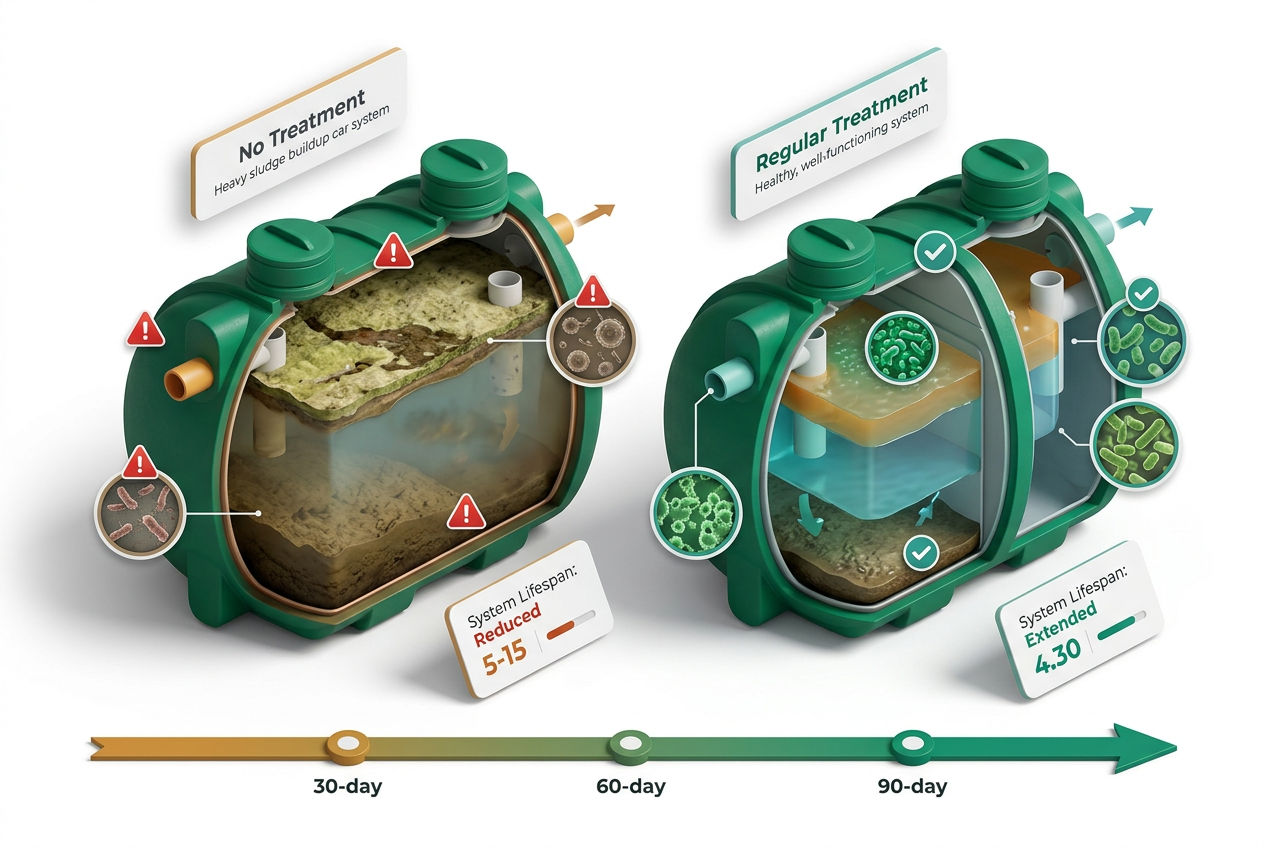
Treatment frequency matters because the bacterial population inside your tank gets disrupted regularly — and if you don't replenish it on a consistent schedule, solids accumulate faster than your system was designed to handle.
Billions of bacteria — both aerobic and anaerobic — break down the solid waste, grease, and organic matter that enters your system daily. According to the EPA's Septic System guidance, the average American uses 80–100 gallons of water per day. Multiply that by a family of four and you're pushing 300–400 gallons through your system every single day.
Bleach, antibacterial soaps, harsh drain cleaners, and even prescription antibiotics pass through your plumbing and kill off the microbes doing the heavy lifting. When that bacterial population drops, solids accumulate faster, effluent quality falls, and your drain field starts absorbing partially treated waste instead of the clean-ish liquid it was designed to handle.
Think about it this way: if you've run three back-to-back bleach loads of laundry and used antibacterial bathroom cleaner the same week, you've essentially fumigated your tank's workforce. A monthly septic treatment schedule rebuilds that workforce before the damage compounds.
Septic tank treatments — specifically biological and enzyme-based products — are designed to replenish that microbial population. But timing matters. Dose too infrequently and you're not making a dent. Dose too often and you risk upsetting the chemical balance inside the tank.
How Often Should You Use Septic Tank Treatment?
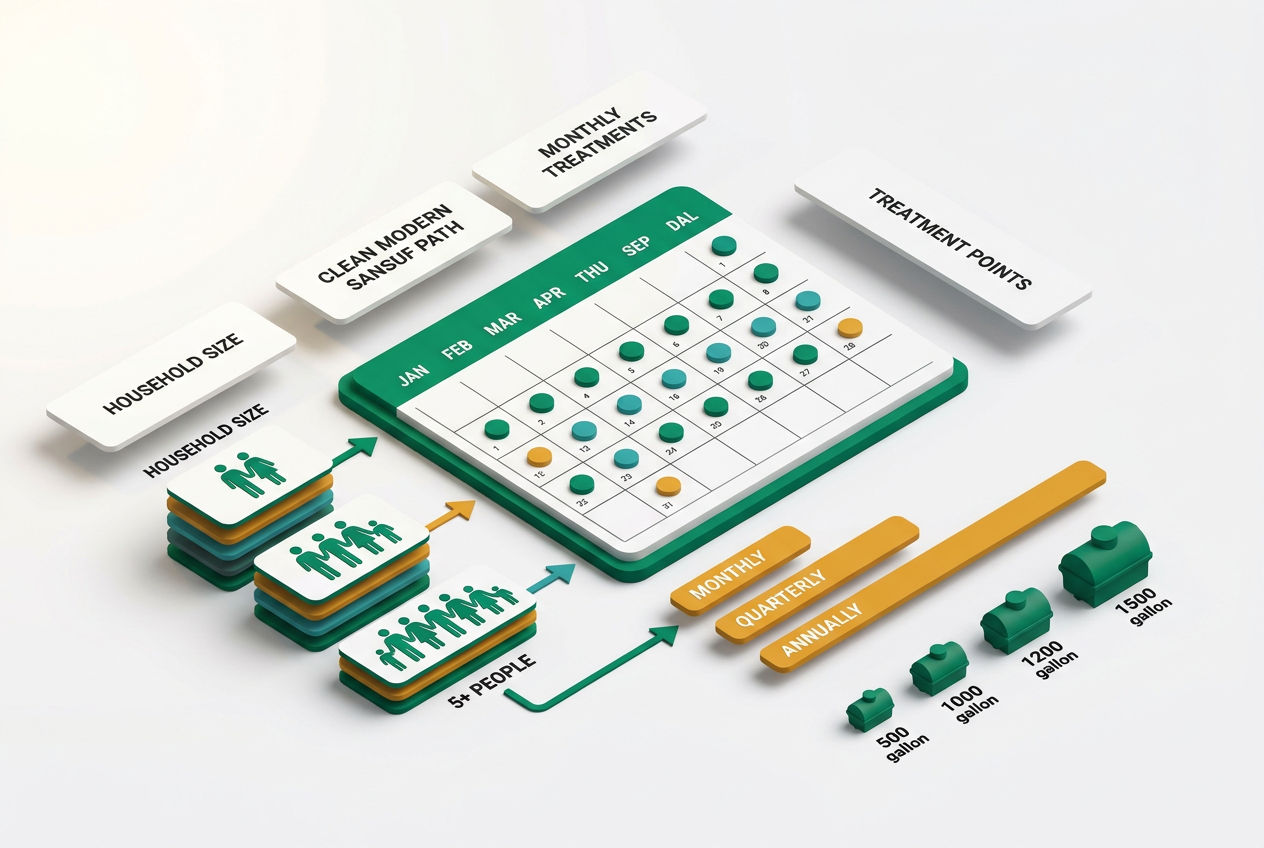
For most households, once per month is the correct answer to how often to use septic tank treatment. That's the consensus recommendation from major manufacturers and aligns with the biology of the tank: bacterial colonies cycle roughly every 4–6 weeks, and a monthly dose keeps populations stable without flooding the system.
Here's how tank size, household size, and usage affect the math:
| Tank Size | Household Size | Pumping Interval | Recommended Treatment Frequency |
|---|---|---|---|
| 750 gallons | 1–2 people | Every 4–5 years | Monthly |
| 1,000 gallons | 3–4 people | Every 3–4 years | Monthly |
| 1,250 gallons | 4–5 people | Every 2–3 years | Monthly |
| 1,500 gallons | 5–6 people | Every 2–3 years | Monthly + after disruptions |
| 1,500+ gallons (aerobic) | 4–6 people | Per manufacturer | Per aerobic system specs |
Source: EPA Homeowner's Guide to Septic Systems; manufacturer dosing guidelines (Rid-X, Septifix)
Notice that septic tank treatment frequency stays monthly across the board. What changes is how urgently you should respond to warning signs, and how closely you should track your pumping interval.
Worked example: A family of four using a 1,000-gallon tank adds 350 gallons per day on average (4 people × ~87.5 gallons). Over 30 days, that's 10,500 gallons processed. At that throughput, the active bacterial layer needs replenishment roughly every 28–35 days — which is exactly why every major biological additive manufacturer settled on a monthly septic additive schedule. Add a garbage disposal to that same household, and the solids load increases enough to push the pumping interval from 3–4 years down to closer to 2 years.
If you're going to follow a monthly treatment schedule, the product we recommend is Septifix. Each tablet releases oxygen alongside 14 strains of live aerobic bacteria — roughly 10 billion CFU — directly into the tank after a simple flush down the toilet. The oxygen-driven approach targets odor and sludge more directly than enzyme-only products, and at $3–$4 per treatment it fits easily into a monthly maintenance budget. That said, no additive substitutes for regular pumping: the EPA is clear that a properly used septic system doesn't require treatments to function, so pair any product with the pumping schedule your tank size and household demand. You can compare options side by side in our Rid-X vs. Septifix breakdown.
You can read more about how often to pump a septic tank to pair your treatment schedule with your pumping calendar.
How to Set Up a Monthly Treatment Routine
Getting consistent with septic tank treatment is straightforward once you lock in a few habits. Here's the process.
Step 1: Pick your treatment day. Choose the same day each month — the first Saturday, the day after you do your biggest laundry load, whatever you'll remember. Consistency matters more than the specific day.
Step 2: Identify your tank size. Check your county permit records, your home inspection report, or call the company that last pumped your system. This determines your dosage. A 1,000-gallon tank gets a different dose than a 1,500-gallon tank — always follow the manufacturer's label. To search county permit records online, go to your county's official website and look for "environmental health permits" or "on-site sewage" in the public records section.
Step 3: Choose your product format. Powder, liquid, and pod/tablet formats all work. Pods and tablets are the easiest — no measuring, no mess. Liquids work fast but require accurate measuring. Powder is economical but has to be dissolved. We cover the liquid vs. powder question in more detail below.
Step 4: Apply at the right time. Flush your treatment down the toilet at night, before bed, when water usage in your home will be lowest for the next 8–12 hours. This gives the bacteria time to establish before the next flush cycle stirs things up. Don't follow it with bleach-based cleaners the same evening.
Step 5: Log it. Keep a simple note on your phone or a sticky on the water heater. Date of last treatment, next due date, product used. When you sell the house or hire a pumper, this record is worth something.
Step 6: Adjust after disruptions. Had a round of antibiotics? Hosted 15 people for Thanksgiving? Used a heavy bleach cleaner on a bathroom mold problem? Add an extra dose within 48–72 hours. After significant chemical exposure, beneficial bacteria can take 48–72 hours just to begin recovering — that's the window where a booster dose makes the biggest difference.
Can You Use Too Much Septic Tank Treatment?
Yes — though the risks are more nuanced than "it breaks everything immediately."
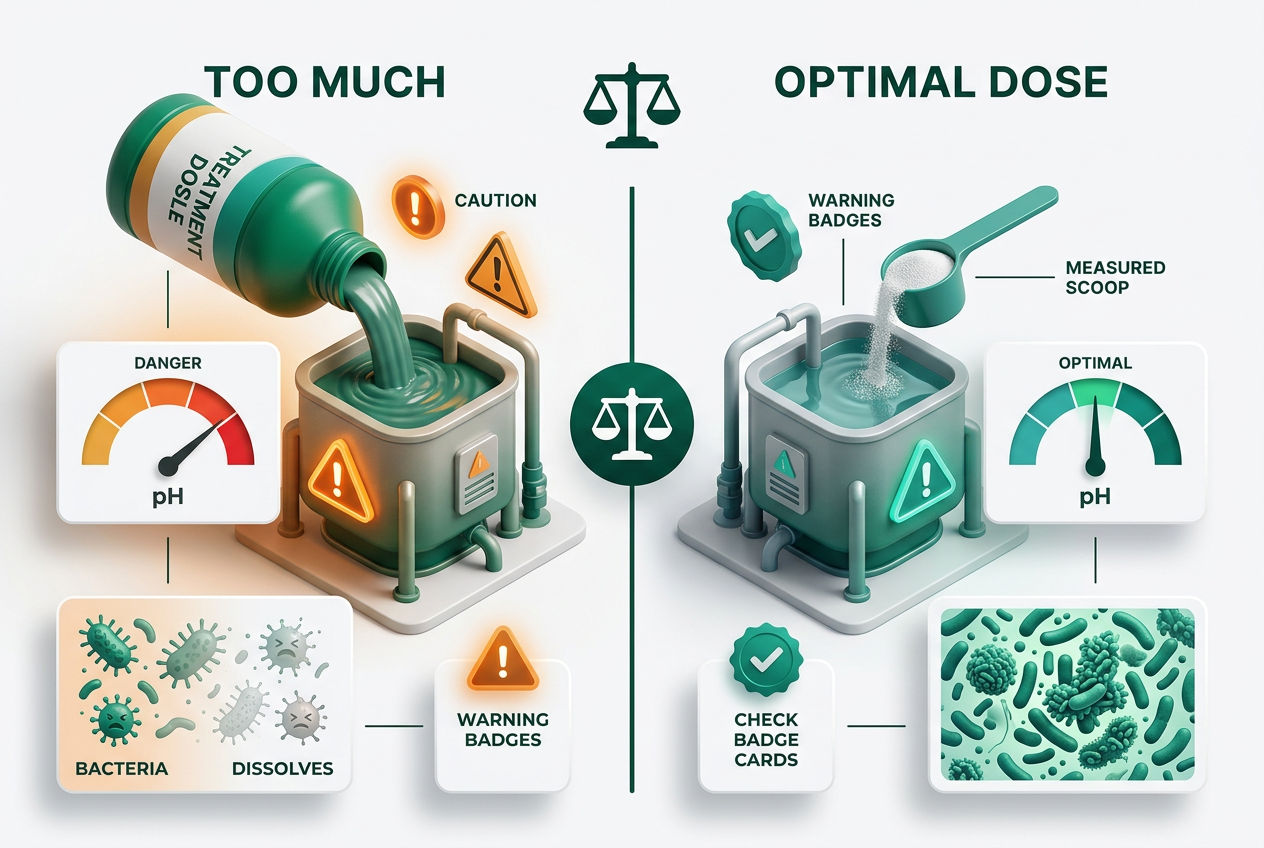
Over-treating your septic tank with biological products isn't catastrophic the way dumping drain cleaner in is, but it's not harmless either. Here's what can happen:
Bacterial overgrowth without adequate waste to process. If you're dosing weekly in a lightly used tank (a seasonal cabin, for example), you may be adding more bacteria than the system can support, leading to die-off and the byproducts that come with it.
Enzyme overload disrupting solids stratification. Your septic tank relies on a three-layer structure: floating scum on top, liquid effluent in the middle, and settled sludge at the bottom. Aggressive enzyme treatments can break down solids too quickly, pushing particulate matter into the effluent zone and — in the worst case — into the leach laterals of your drain field.
Wasted money. If you're dosing every two weeks when once a month is sufficient, you're spending $200–$400 annually on something the biology of the tank handles with half that.
Stick to a monthly septic treatment schedule unless a specific event — antibiotics, heavy cleaning, large gatherings — justifies a booster dose.
Do Septic Tank Treatments Really Work?
Honest answer: it depends on the product type and what you expect them to do.
Biological additives — products containing live bacteria and enzymes — do add beneficial microbes to your tank. The bacterial strains in quality products (Bacillus subtilis, Bacillus licheniformis, and others) actively break down organic waste, reduce sludge buildup, and help maintain a healthy septic tank bacterial balance.
Peer-reviewed research has consistently shown that additives don't eliminate the need for pumping. The University of Arkansas Cooperative Extension Service reviewed multiple studies on septic additives and found that while biological products can support tank health, none eliminated sludge accumulation to the point that pumping could be skipped. The EPA's position aligns: pumping every 3–5 years remains the foundation of proper maintenance. No tablet, powder, or liquid changes that math.
Honest limitation: Treatments are a maintenance support tool, not a rescue tool. If your system is already showing signs of failure — sewage odors, wet spots over the drain field, slow drains throughout the house — a monthly treatment isn't going to save it. That's a call to a licensed septic professional.
What treatments genuinely help with:
- Restoring bacterial populations after chemical disruption
- Reducing odor from hydrogen sulfide production
- Slowing sludge accumulation between pump-outs
- Supporting drain field health by improving effluent quality
What they cannot do:
- Reverse a failing drain field clogged with biomat
- Replace a full pump-out on an overdue tank
- Fix structural damage to inlet/outlet baffles or distribution boxes
- Compensate for a household flushing non-biodegradable wipes, grease, or medications
You can find a licensed septic professional in your area through our septic pumping and cleaning service directory.
What Are the Signs Your Septic Tank Needs Treatment?
Watch for these specific signals that your bacterial colony has taken a hit:
- Sulfur or rotten-egg smell from drains, toilets, or your yard near the tank or drain field
- Slow drains throughout the house (not just one fixture — that's likely a clog, not a septic issue)
- Gurgling sounds from toilets or drains after flushing
- Unusually green or spongy grass over the drain field, especially after dry weather
- Recent heavy antibiotic use in the household
- Back-to-back weeks of heavy cleaning with bleach-based products
The first four signs could indicate a tank that's full or close to full, in which case treatment needs to follow — not replace — a pump-out. The last two are triggers for a booster dose within 24–48 hours of the event.
Is It Better to Use Liquid or Powder Septic Treatment?
Both liquid and powder formats deliver bacteria and enzymes to your tank effectively — the format is largely a matter of convenience and measuring accuracy.
Liquid treatments activate quickly because the bacteria are already in suspension. They're well-suited for emergency booster doses when you need fast action — after a large gathering or heavy chemical use. The downside: they require measuring, and the bottles are bulky to store.
Powder treatments are typically more economical per dose and have a longer shelf life. They dissolve in warm water before flushing, which adds a step but keeps cost-per-treatment low for households managing a tight budget.
Pod and tablet formats are the format we most often recommend for the monthly septic additive schedule because there's no measuring involved — one tablet, one flush, done. Septifix uses this format: each tablet contains approximately 10 billion CFU of 14 strains of live aerobic bacteria. The tablets also release oxygen directly into the tank, which actively targets hydrogen sulfide — the compound responsible for that rotten-egg odor. For detailed product comparison, see the Rid-X vs. Septifix breakdown.
How Long Does It Take for Septic Tank Treatment to Work?
Biological treatments begin working within 24–48 hours, but meaningful results — reduced odor, slower sludge buildup — typically take 2–4 weeks of consistent monthly use.
Here's the general timeline:
- 24–48 hours: Live bacteria introduced by the treatment begin colonizing the tank. Oxygen-releasing tablet formulas like Septifix start targeting hydrogen sulfide almost immediately.
- 1–2 weeks: Bacterial populations establish more fully. Households that were experiencing odor issues often notice improvement within this window.
- 4–8 weeks (1–2 monthly treatments): The full effect of consistent dosing becomes measurable. Sludge accumulation slows, effluent quality improves, and the drain field receives better-treated liquid.
- 3–6 months: If you started treatment after a long gap, this is when a licensed septic professional doing an inspection would likely see a difference in sludge depth compared to a similar untreated system.
Important caveat: if your system is already overloaded or showing failure signs, no timeline applies — you need a pump-out and a professional inspection first. Treatment works as a maintenance tool on a functioning system, not a recovery tool on a failing one. For a full picture of what drain field failure costs when maintenance is skipped, see our drain field replacement cost guide.
How Do Seasonal Changes Affect Your Septic Treatment Schedule?
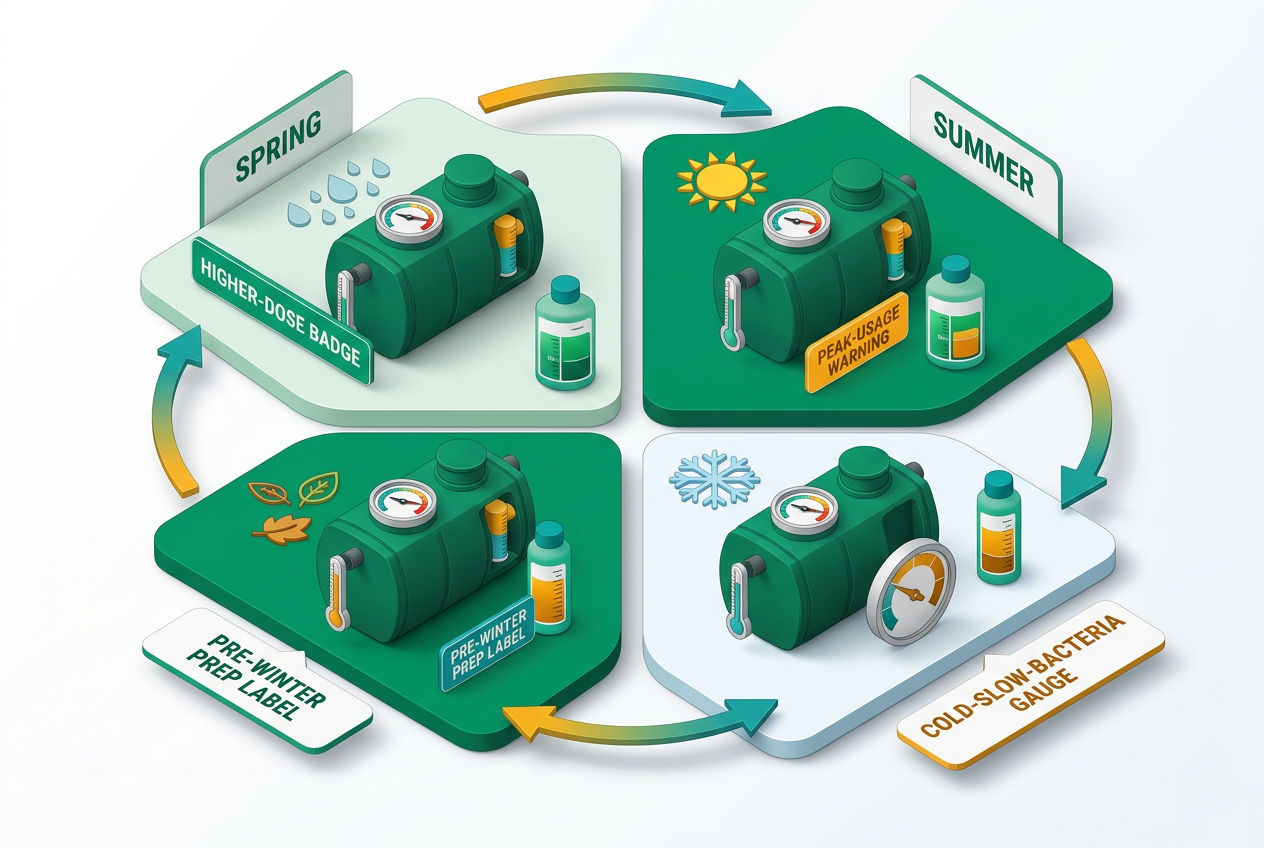
Yes — cold weather, heavy rainfall seasons, and summer vacation patterns all change how often to use septic tank treatment and what formula works best.
Winter: Bacterial activity slows significantly in cold temperatures. Minnesota's MPCA guidelines reference frost lines of 42–60 inches — at those depths, tank temperatures drop enough to reduce microbial metabolism substantially. In northern climates, some homeowners skip the January–February dose if their tank is deep and they're using low water volumes. A better approach: switch to a cold-weather formula rated for low-temperature activity, and make sure your bacterial population is strong going into freeze season by dosing in late October before the ground hardens.
Spring: After a cold winter, do a double dose in March or early April to rebuild populations that may have declined. This is also when groundwater levels rise, increasing hydraulic load on the drain field — a healthy bacterial population buffers that stress better than a depleted one.
Summer: Higher water use from guests, irrigation backflow contamination, and frequent outdoor cleaning products going down drains all increase the disruption rate. Stick strictly to monthly dosing and add a booster after any large gathering.
Rainy seasons (Southeast/Gulf Coast): Coastal areas often have environmental regulations restricting chemical treatments near waterways. In Florida, Georgia, and the Carolinas, biological-only treatments may be required by local health departments — ask your county environmental health office specifically whether chemical additives are permitted in your zone, and whether your system requires inspection under state onsite sewage rules (Florida's Chapter 64E-6, for example, governs system maintenance requirements).
For cold-climate households dealing with freezing risk at the pipe level, see our guide on preventing septic pipes from freezing.
What Septic Treatment Should You Use Each Month?
Our pick for monthly maintenance is Septifix — here's specifically why.
Most biological treatments add bacteria. Septifix adds bacteria and oxygen. Each tablet delivers approximately 10 billion CFU of 14 strains of live aerobic bacteria, and the tablet's oxygen-release mechanism does something most treatments skip: it actively targets hydrogen sulfide production, which is the direct cause of the rotten-egg odor that signals bacterial imbalance. That dual action — bacterial replenishment plus odor-targeting oxygen — is what separates it from standard powder or liquid additives.
Practical details that matter for a monthly septic additive schedule:
- One tablet per dose, flushed down the toilet — no measuring
- Made in the USA, non-toxic, safe for all conventional septic systems
- 60-day money-back guarantee
- Approximately $3–$4 per monthly treatment
The honest caveat, which applies to every biological product including this one: Septifix does not replace pumping. The EPA's position is clear — pumping every 3–5 years is the non-negotiable foundation of septic maintenance. No treatment changes that math. What Septifix does is make the intervals between pump-outs more productive, keep your bacterial population stable, and reduce the odor and drain field stress that comes from a depleted tank.
For a side-by-side look at how it compares to the most widely available alternative, the Rid-X vs. Septifix comparison covers both products honestly.
If you want to understand what the full maintenance picture looks like — treatment schedule, pumping intervals, drain field care — the complete septic tank maintenance guide covers every component in one place.
Related Rid-X & Septic Treatment Guides
- The Best Rid-X Alternatives
- The Best Septic Tank Smell Removers
- Septic Smell When It Rains? Why It Happens & How to Fix It
- Can You Use Rid-X in an RV Black Tank? What to Know First
- Is Rid-X Safe for Septic Tanks, Toilets & Pipes?
- How Often Should You Use Rid-X? Directions, Dosing & Timing
- What's Actually in Rid-X? Ingredients Explained
- Does Rid-X Unclog Drains or Toilets?
- Rid-X vs. Green Gobbler: Which Septic Treatment Wins?
- Green Gobbler Septic Treatment Review: Pods, Packets & Results
- Where to Buy SeptiFix
- Bio-Clean Septic Treatment Review: Does It Work?
- Cabin Obsession Septic Tank Treatment Review
- Camco Septic Tank Treatment Review
- Septic Tank Treatments at Walmart vs. Home Depot vs. Online
- Septic Smell Coming From Toilet? Causes & How to Fix It
- Septic Smell From Shower Drain? Causes & How to Fix It
- Septic Tank Smell After Pumping? Causes & How to Fix It
- Septic Smell From Roof Vent? Causes & How to Fix It
- Is Septic Tank Smell Dangerous? Gases, Risks & When to Worry
- Septic Tank Diagram With Dimensions
- Septic Tank Cross-Section Diagram: Every Part Labeled
- Septic System Diagram With a Pump
- Septic Tank Plumbing Diagram: From House to Drain Field
- Aerobic Septic System Diagram: How Each Part Works
- Are Septic Tank Treatments Necessary?
- Septic Treatment Tablets vs. Powder vs. Liquid: Which Is Best?
- Best Septic Tank Treatment for Slow Drains
- Yeast, Baking Soda & Milk in Your Septic Tank: Myths Tested
Frequently Asked Questions
How often to put treatment in a septic tank?
For the vast majority of households, you should put treatment in your septic tank once per month. This monthly cadence aligns with how bacterial colonies cycle — roughly every 28–35 days — and is the standard recommendation from manufacturers of enzyme- and bacteria-based products including Rid-X and Septifix. The dose goes down the toilet at night, when water usage will be low for the next 8–12 hours, giving bacteria time to establish before the next flush cycle.
The monthly frequency holds whether your tank is 750 gallons or 1,500 gallons. What changes with tank size and household size is how urgently you need to respond to warning signs and how tightly you should track your pumping interval. You should add a booster dose outside the monthly schedule after specific disruptions: a round of antibiotics in the household, heavy bleach cleaning, or a large gathering of 10 or more guests. After those events, dose within 48–72 hours regardless of where you are in your monthly septic treatment schedule.
What is the recommended septic tank treatment frequency for a large family?
For a household of five or six people using a 1,500-gallon tank, the baseline septic tank treatment frequency is still monthly — but you should treat it as a firm minimum rather than a ceiling. Larger households push more water and waste through the system daily, which means the bacterial population faces more frequent disruption from antibacterial products, cleaning chemicals, and sheer volume.
In practical terms: stick to your monthly septic additive schedule, but be more aggressive about booster doses after disruptions. Where a two-person household might skip a booster after one bleach-cleaning session, a six-person household should add one within 48 hours. Additionally, a 1,500-gallon tank serving five or six people typically needs pumping every 2–3 years rather than the 3–4 years typical for smaller households. Pairing a consistent septic treatment schedule with a tighter pumping interval is the right approach for high-occupancy homes.
Does a septic tank additive schedule really prevent system failure?
A consistent septic tank additive schedule reduces the risk of certain failure modes — particularly drain field stress from poor effluent quality and accelerated sludge buildup — but it does not prevent all forms of system failure. The University of Arkansas Cooperative Extension Service reviewed multiple studies and found biological additives support tank health but do not eliminate sludge accumulation or remove the need for pumping.
What a monthly schedule genuinely prevents: bacterial population crashes after chemical disruption, excessive hydrogen sulfide odor, and the gradual drain field degradation that comes from chronically undertreated effluent. What it cannot prevent: structural failures in baffles or distribution boxes, biomat clogging from years of deferred pump-outs, or hydraulic overload from a household using far more water than the system was designed to handle. If your system is already showing failure signs — odor, wet spots, slow drains — treatment alone will not reverse it. A licensed septic professional and likely a pump-out are the starting point.
How often should I use Rid-X or a similar brand?
The manufacturer recommendation for Rid-X — and for most comparable septic tank treatment products — is once per month. Rid-X is available in powder, liquid, and pod formats; regardless of format, the monthly dose is the standard septic treatment schedule the label specifies.
One honest note on Rid-X specifically: the powder and liquid formats deliver bacteria and enzymes effectively, but they require measuring and offer no secondary mechanism beyond microbial replenishment. Products like Septifix use an oxygen-release tablet format that adds an active odor-targeting mechanism alongside bacterial delivery, which makes the monthly dose more functional for households dealing with hydrogen sulfide odor issues. For a direct comparison of how Rid-X and Septifix differ in formulation, format, and cost per treatment, the Rid-X vs. Septifix breakdown covers both without bias. Either product used on a consistent monthly basis outperforms sporadic or reactive dosing.
What's the best septic treatment schedule for a seasonal or vacation home?
For a seasonal or vacation home, the septic treatment schedule is different from a full-time residence — and over-treating is a real risk. If the home sits empty for weeks at a time, adding a full monthly dose every 30 days means you're potentially adding more bacteria than the available waste can support, leading to die-off and byproducts that negate the benefit.
The practical approach: dose once when the home is opened for the season, dose again after any extended period of heavy use (a holiday week, a large family gathering), and dose once more when closing the home for the off-season. That's typically three to four treatments per year rather than twelve. Use a tablet format like Septifix for seasonal homes — tablets have a longer shelf life than liquids and don't require measuring, which matters when the home sits unused between visits. Before closing for winter, confirm the tank is within its pumping interval, since an overfull tank sitting through cold months is a failure risk no treatment addresses.
Is monthly septic treatment worth the cost?
Monthly septic treatment costs approximately $10–$25 per month depending on the product and format — or as low as $3–$4 per treatment with tablet formats like Septifix. Against that, consider the cost of what you're protecting: a conventional drain field replacement runs $5,000–$20,000 depending on size and soil conditions, and a full system replacement can reach $15,000–$30,000 in difficult site conditions.
The math isn't complicated. At $4 per month, you spend $48 per year on maintenance that demonstrably reduces sludge accumulation and supports drain field health. Skipping treatment doesn't guarantee failure, but it removes a buffer that costs less per year than a single restaurant dinner. The honest framing: biological treatments are insurance for the intervals between pump-outs, not a substitute for pumping. Used consistently on a monthly septic treatment schedule alongside regular pump-outs every 3–5 years, they represent a low-cost way to extend the functional life of a system that would cost tens of thousands of dollars to replace.
Sources & Methodology
-
U.S. Environmental Protection Agency — "Septic Systems Overview" and "Homeowner's Guide to Septic Systems." Used for daily water use figures (80–100 gallons/person/day), pumping interval recommendations (3–5 years), and the EPA's position on additives not replacing pumping.
-
University of Arkansas Cooperative Extension Service — Review of peer-reviewed studies on biological septic additives. Used to support the finding that no biological treatment eliminates sludge accumulation to the point of replacing pump-outs.
-
Minnesota Pollution Control Agency (MPCA) — Frost line depth guidelines (42–60 inches) used in the seasonal adjustment section for northern climate dosing recommendations.
-
Florida Department of Health, Chapter 64E-6, Florida Administrative Code — "Standards for Onsite Sewage Treatment and Disposal Systems." Referenced for Southeast regulatory requirements around septic system maintenance and permitted treatment types near waterways.
-
Manufacturer product specifications — Septifix tablet formulation (14 bacterial strains, ~10 billion CFU per tablet, oxygen-release mechanism); Rid-X dosing guidelines. Used for product-specific claims in the recommendation and comparison sections. CFU and strain count sourced from manufacturer documentation; independent third-party verification of CFU counts was not conducted for this article.
Free download
Not ready for the Handbook? Start with the free Fridge Card.
The Do / Don’t card the whole family can see, plus the Survival Kit: emergency flowchart, warning-sign decoder and pump-schedule card. One printable PDF.
Was this article helpful?
Frequently Asked Questions
Recommended Resources
📖 Related Articles
- What Is a Drain Field? (And How Does It Work?)
- How Often Should You Pump Your Septic Tank?
- Do Septic Tank Additives Actually Work? (The Science)
- How Septic Tank Bacteria Work (And Why They Matter)
- 8 Signs Your Septic Tank Needs to Be Pumped
- Freezing Pipes and Septic: How to Prevent Winter Damage
- The Complete Septic Tank Maintenance Guide
💰 Cost Guides
🔧 Services
Find Septic Professionals Near You
Compare licensed, verified septic companies by area — top county markets and cities below, or browse all 50 states.
County markets
Popular cities
