
Quick Answer
Is septic tank smell dangerous? Yes — but the degree of danger depends on which gas is present, its concentration, and where you're smelling it. The rotten egg odor most people recognize is hydrogen sulfide — a gas detectable at less than 1 part per million that can cause rapid unconsciousness and death at higher concentrations. Methane is a secondary threat: odorless but explosive. Brief whiffs near your tank lid outdoors are usually nothing to panic over. A persistent smell indoors is a different story entirely.
Key Takeaways
- Hydrogen sulfide (H₂S) — the "rotten egg" gas — is detectable at 0.5–1 ppm but becomes immediately dangerous to life at 50 ppm (NIOSH IDLH threshold)
- At 100–150 ppm, your nose stops detecting it — you can no longer smell the gas that's killing you
- Methane from septic systems is non-toxic but explosive between 5% and 15% concentration in air
- Septic smell indoors almost always indicates a specific fixable problem: a dry P-trap, a cracked vent pipe, or a failing baffle
- Persistent indoor odors require professional evaluation — not just an air freshener
What Gases Does a Septic Tank Produce?
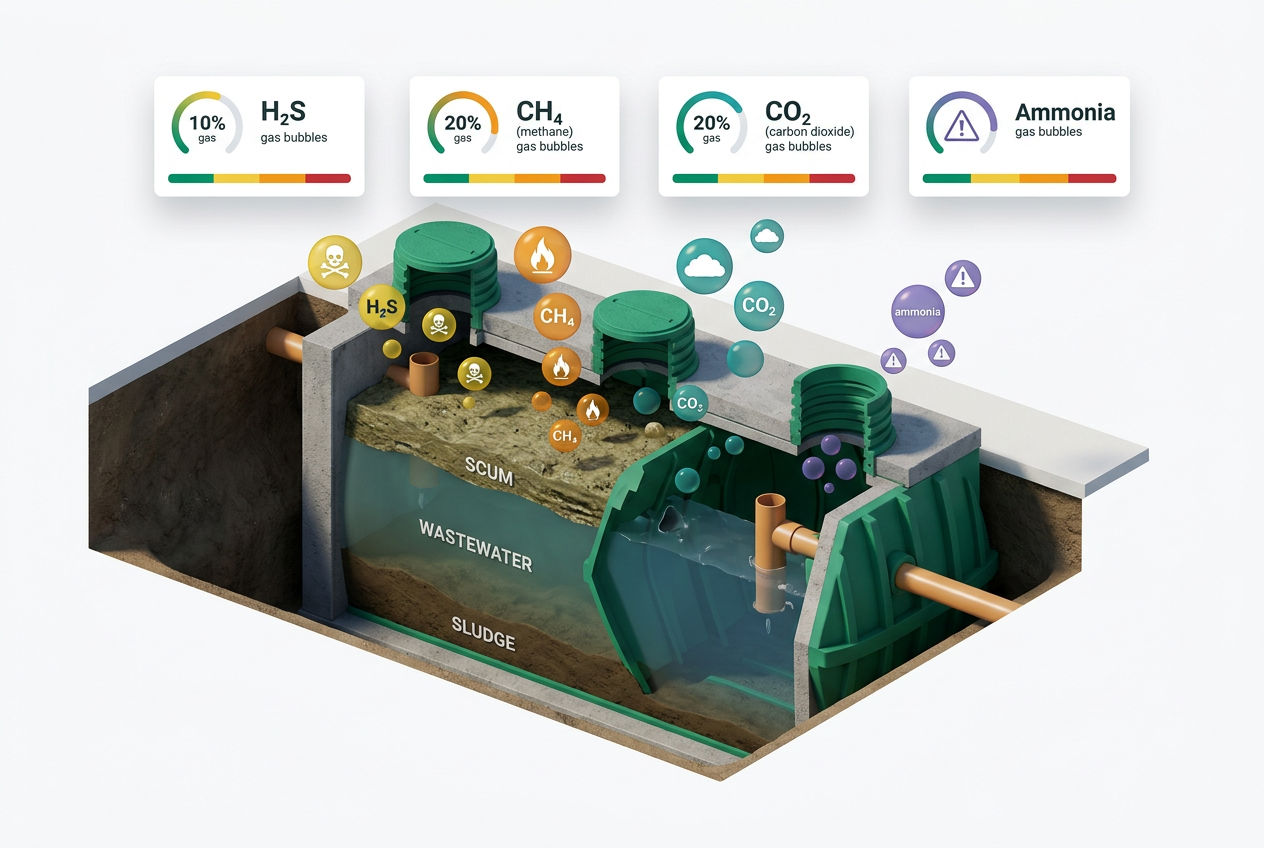
A healthy septic tank produces hydrogen sulfide, methane, carbon dioxide, and ammonia as natural byproducts of anaerobic bacterial decomposition. Each one carries different risks.
Hydrogen sulfide (H₂S) is the dominant concern. It's the gas responsible for that unmistakable rotten egg smell. At low concentrations — 0.5 to 1 ppm — your nose picks it up easily. That's actually a protection mechanism. The problem is what happens as concentrations rise.
Methane gas from septic tanks (CH₄) is the second major hazard. It's colorless and odorless, so you'll never smell it directly. Methane becomes explosive at concentrations between 5% and 15% in air — known as the Lower Explosive Limit (LEL) and Upper Explosive Limit (UEL). It also displaces oxygen in enclosed spaces, which creates an asphyxiation risk separate from its flammability. A properly functioning septic vent pipe routes methane safely to atmosphere before it can accumulate anywhere near those thresholds.
Carbon dioxide (CO₂) is the third gas component. The atmosphere contains about 0.04% CO₂ normally. OSHA's Permissible Exposure Limit is 5,000 ppm (0.5%). Inside a confined septic space, CO₂ can accumulate well above that — which is one reason you should never enter a septic tank without proper confined-space entry equipment and training.
Ammonia is a lesser-known but relevant gas in septic systems, particularly in tanks receiving heavy nitrogen loads from garbage disposals or large households. It contributes to overall odor and, at high concentrations, causes respiratory irritation.
Can Septic Tank Fumes Make You Sick?
Yes — and the severity ranges from mild headache to death, depending on gas type and exposure level.
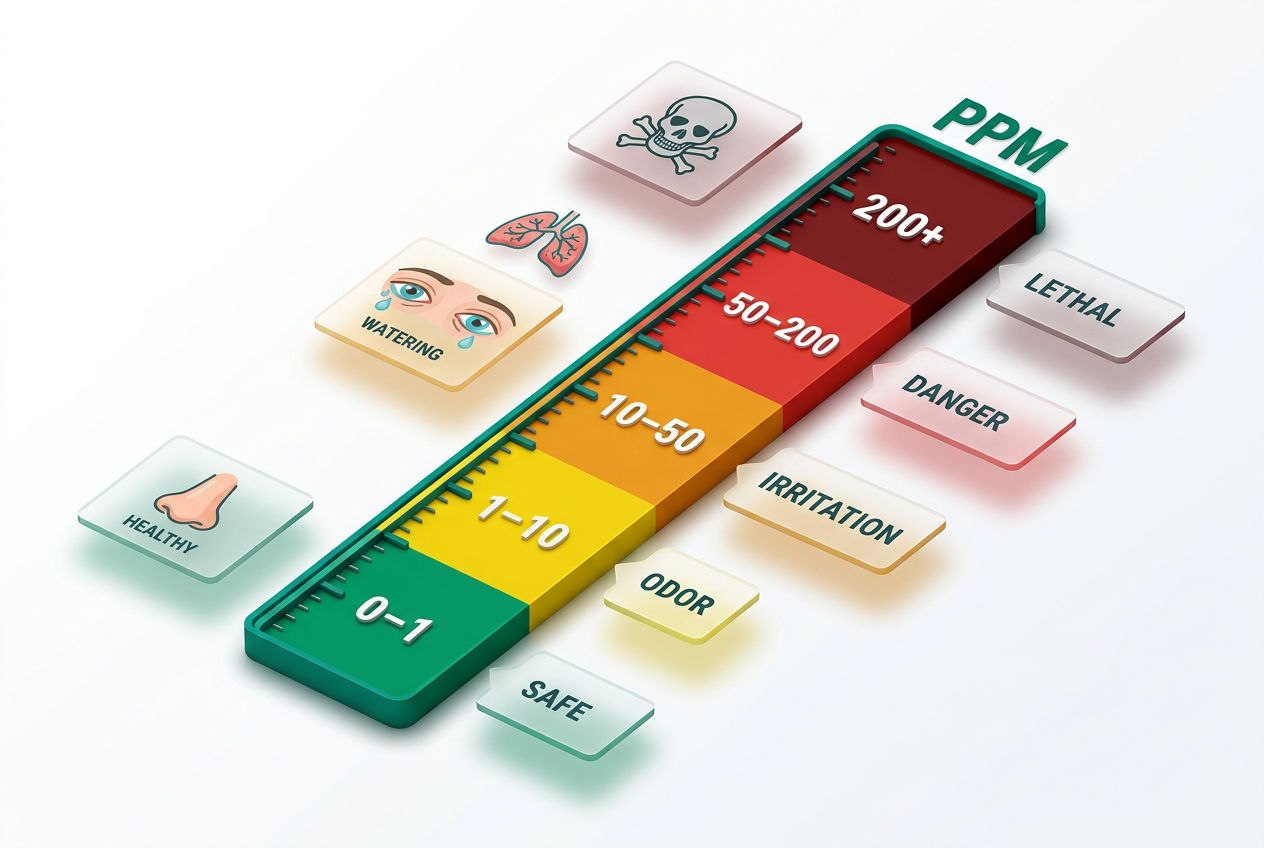
At low concentrations (under 10 ppm), hydrogen sulfide exposure typically causes eye irritation, headache, and nausea. Workers in sewer systems report these symptoms regularly. At 20 ppm, OSHA sets its Permissible Exposure Limit ceiling — meaning no unprotected worker should be exposed above this level even briefly.
Here's the exposure data:
| H₂S Level (ppm) | Effect |
|---|---|
| 0.5–1 ppm | Detectable by smell |
| 10–20 ppm | Eye/throat irritation, headache |
| 20 ppm | OSHA PEL ceiling (workplace limit) |
| 50 ppm | NIOSH IDLH — immediately dangerous to life or health |
| 100–150 ppm | Olfactory fatigue — you can no longer smell it |
| 500–1,000 ppm | Rapid unconsciousness; potentially fatal |
Source: OSHA, NIOSH hydrogen sulfide exposure guidelines
That row at 100–150 ppm is the critical one. Your nose stops working as a warning system at the exact point where the danger becomes severe. This is why "I don't smell it anymore" is never reassuring when H₂S is a possibility.
For a residential homeowner standing briefly near an open septic tank lid or drain field, the concentration is almost never high enough to cause acute harm. The real danger is in confined spaces — inside the tank itself, inside a pump chamber, or in a basement where gases have accumulated over time. According to OSHA and the CDC, septic and sewer gas is a consistent cause of confined-space fatalities. These incidents typically involve a worker entering a tank to investigate a problem and being overcome within seconds.
If you're experiencing symptoms like headache, nausea, or dizziness and you can smell rotten egg odor in your home, get outside immediately and call a professional. Don't investigate the source yourself.
What Does It Mean When You Can Smell Your Septic Tank?
A noticeable septic odor usually points to one of five specific problems. Knowing which one saves you a service call — or tells you exactly when to make one.
1. The tank is due for pumping. When sludge accumulates past roughly one-third of tank capacity, anaerobic decomposition accelerates and gas production increases. A 1,000-gallon tank serving a 4-person household typically needs pumping every 3–4 years according to EPA guidance. When odors suddenly get worse on a system that's been odor-free, this is the first thing to check. See our septic tank maintenance guide for a full service schedule.
2. The vent pipe is blocked or undersized. Your septic system routes gases up through a vent stack — typically a 3- or 4-inch PVC pipe that exits through your roof. Local codes generally require the vent to extend 6–12 inches above the roofline, though this varies by jurisdiction. If that pipe is blocked by leaves, ice, a bird nest, or was never installed to proper height, gases that should vent skyward instead push back into your plumbing or out through the drain field. Septic smell from a roof vent is a common and fixable problem.
3. A baffle is damaged. Inlet and outlet baffles inside the tank direct flow and help contain gases. A collapsed or rotted baffle — common in older concrete tanks — can allow gases to migrate backward through your inlet pipe toward the house. This is a job for a licensed inspector.
4. The drain field is saturated. When the drain field can't absorb effluent fast enough, gases back up through the soil and emerge at the surface. You may smell this near soggy ground or notice wet spots in your yard. This is a sign your drain field may be failing and needs prompt attention.
5. Bacterial imbalance. Overuse of antibacterial cleaners, bleach, or other harsh chemicals kills the anaerobic bacteria that break down waste efficiently. When the bacterial population crashes, decomposition becomes inefficient and odors increase. See our guide on what kills septic bacteria for a rundown of common household offenders.
Is It Normal to Smell Septic Outside Near the Tank?
A brief, faint odor near the tank lid immediately after heavy water use — multiple loads of laundry, a large gathering — is generally within normal range. The tank is pressurized by fresh waste entering and pushing gases out.
What's not normal: a persistent, strong odor that doesn't dissipate within an hour, a smell you can detect 20–30 feet away from the tank, or any odor near the drain field combined with soggy ground. Those are warning signs.
Septic smell after rain is particularly common in spring. Saturated soil compresses air pockets in the drain field, pushing accumulated gases to the surface. If the smell appears only after heavy rain and resolves within a day, your system may be functioning normally under stress. If it persists or worsens, a saturated drain field or high water table situation needs professional evaluation.
Homes in Florida, the Gulf Coast, and the Pacific Northwest — where water tables run high — deal with this more frequently than drier climates. Our high water table septic system guide walks through the specifics of managing a system in those conditions.
Why Does My House Smell Like Septic Tank Inside?
Indoor septic smell is more urgent than outdoor odor. Gases concentrated inside a home — especially in basements or crawl spaces — can reach dangerous levels faster than most homeowners realize.
The most common indoor causes:
Dry P-trap. Every drain in your home has a curved pipe section (the P-trap) that holds water, creating a seal against sewer gases. In a bathroom you rarely use, that water can evaporate in as little as 2–3 weeks. The fix: run the water for 30 seconds. If the smell resolves within an hour, that was it.
Cracked or disconnected vent pipe. A vent pipe running through your attic or wall that has cracked at a joint will release sewer gas into your living space. This is invisible from the outside and requires a smoke test by a plumber to locate.
Wax ring failure on a toilet. The wax seal between your toilet base and the floor flange degrades over time or if the toilet rocks. Gases escape directly into the bathroom. A septic smell from the toilet that worsens when you flush is a classic symptom.
Sewage backup. If waste is backing up into a floor drain or tub, the odor source is obvious — and so is the urgency. See our guide on septic smell in the house for a full indoor diagnostic sequence.
Any indoor septic odor that doesn't resolve within an hour of the P-trap test warrants a call to a licensed septic inspector. The cost of a septic inspection typically runs $100–$300 — a reasonable price to rule out a gas accumulation issue inside your home.

How Much Hydrogen Sulfide Is Dangerous?
According to NIOSH, hydrogen sulfide becomes immediately dangerous to life and health at 50 ppm. That's the IDLH threshold — the concentration at which a healthy adult could sustain life-threatening injury within 30 minutes of unprotected exposure.
But the more dangerous threshold is lower than that. At 20 ppm, OSHA prohibits unprotected workplace exposure. At 10 ppm, most people experience eye and respiratory irritation. The insidious part: at 100–150 ppm, your olfactory nerves are paralyzed. You stop smelling the gas entirely. People have died in septic systems because they assumed the absence of smell meant the danger had passed.
For residential exposure outdoors, the concentrations near an open tank lid rarely approach OSHA limits. The risk shifts dramatically in enclosed or partially enclosed spaces: basements with floor drains connected to the septic system, crawl spaces, and especially inside the tank itself. Never enter a septic tank without confined-space entry training, a gas monitor, and a trained attendant outside.
Can a Septic Tank Explode From Gas Buildup?
Technically yes — though the conditions required are specific and rare in a properly functioning system.
Methane becomes explosive at concentrations between 5% and 15% in air. Reaching that concentration requires methane to accumulate in an enclosed space without adequate ventilation. In a sealed tank or a pump chamber with a blocked vent, this is plausible. In open air above a drain field, it's not.
The realistic explosion risks are:
- Open flames near a septic tank access lid — lighting a match or cigarette while leaning over an open tank is genuinely dangerous
- Pump chamber ignition — an electric pump sparking in a methane-rich chamber is a documented cause of septic explosions
- DIY tank entry with power tools — using a gas-powered tool near an open tank or inside a chamber
This is why septic professionals use intrinsically safe equipment rated for explosive atmospheres when working in confined spaces. It's also why building codes prohibit open flames and non-rated electrical equipment near septic access points.
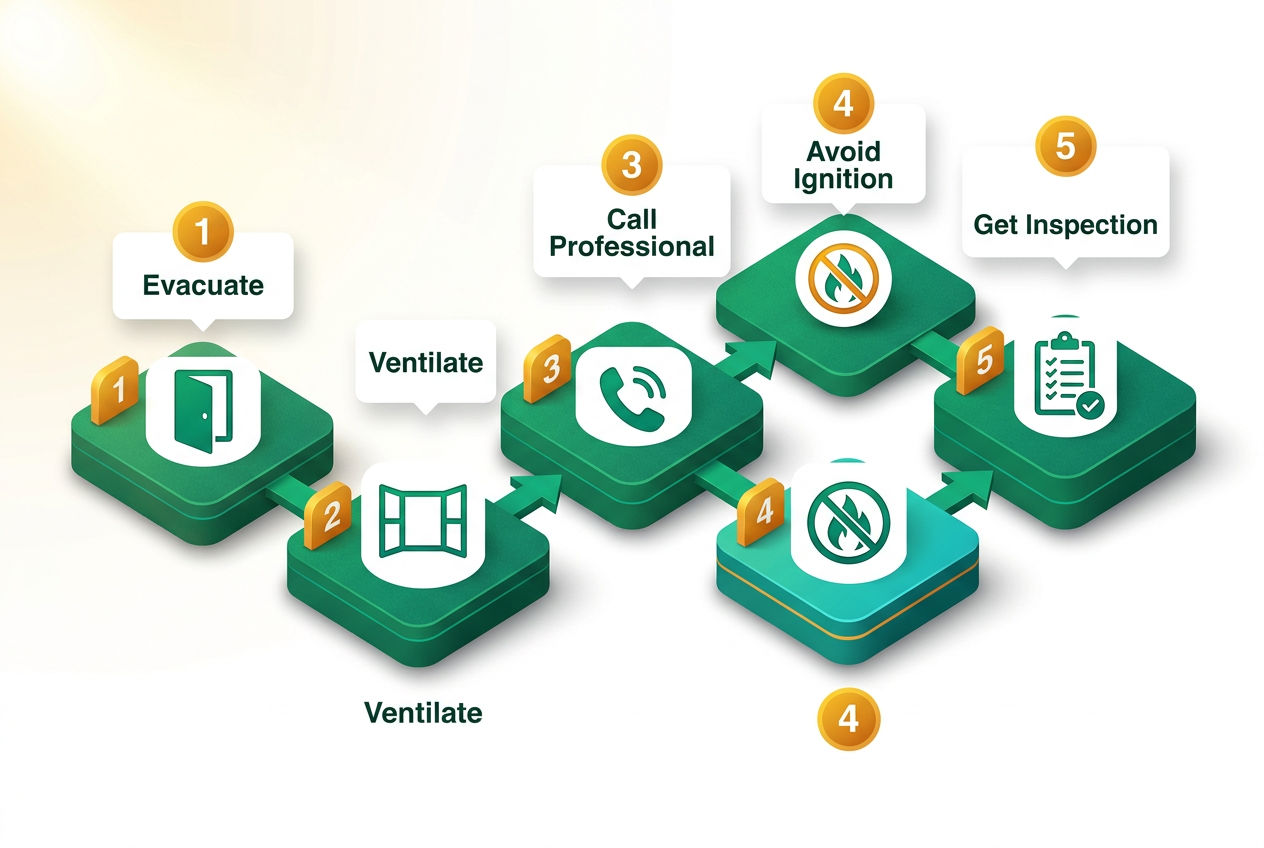
For a homeowner, the practical rule is simple: never use a lighter, match, or any ignition source near an open septic lid, access riser, or pump chamber.
What Should I Do If I Smell Strong Septic Gas Indoors?
The answer depends on whether the smell is gradual and persistent or sudden and strong.
Gradual persistent smell: Work through the diagnostic checklist. Run each drain for 30 seconds to recharge P-traps. Check toilets for rocking (wax ring failure). Look for any floor drains that may have dried out. If the smell persists after those checks, schedule a septic inspection — don't wait it out.
Sudden and strong smell: Treat this as an emergency. Get everyone out of the house. Don't operate light switches, appliances, or anything that could create a spark (methane is odorless — a strong H₂S smell can accompany elevated methane). Call 911 from outside. Call your gas utility to rule out a natural gas co-occurrence. Then call a septic professional.
The cost of septic repair varies widely by cause, but the cost of inaction when gases are accumulating indoors is categorically higher. A cracked vent pipe costs a few hundred dollars to fix. Delayed treatment of a serious gas accumulation scenario is a life-safety issue.
What Are Seasonal Factors That Make Septic Smell Worse?
Septic odor isn't constant — it follows predictable seasonal patterns that can help you diagnose whether you have a real problem or a temporary condition.
Winter: Frozen vent pipes. In Minnesota, Wisconsin, and throughout the Mountain West, the vent cap at the top of your stack can ice over. When that happens, gases that normally escape through the roof get pushed back down into the house. The fix is a vent cap designed to resist ice formation — typically a $20–$50 part that a homeowner can install. If you're in a cold climate and indoor odors appear in January or February and disappear in March, a frozen vent is the likely cause.
Summer: Attic heat reversing airflow. In Phoenix or Houston, attic temperatures can exceed 150°F in summer. That heat can actually reverse airflow in a vent pipe — pulling air (and gas) upward from the drain rather than exhausting it out. If you notice indoor odors peak in afternoon heat and resolve in the evening, this is worth investigating with a plumber who can assess your vent configuration.
Spring: Rain saturation. According to EPA guidance on drain field management, saturated soil is the most common cause of seasonal septic odor complaints. When the drain field is waterlogged after snowmelt or heavy spring rain, gases have nowhere to go but up through the soil surface. This typically self-resolves as soil drains — but if it persists beyond a week, the drain field itself may be compromised.
Fall: Leaf blockage. Before leaf season, check that your vent stack cap is clear. A single season of leaf accumulation can partially block a vent, creating a back-pressure situation that builds through winter.
Should You Use a Septic Treatment for Odor Control?
Septic treatments won't fix a blocked vent, a dry P-trap, or a failing drain field. The EPA is direct about this: no additive substitutes for proper maintenance, including regular pumping. If you have a structural or mechanical problem, a tablet won't solve it.
That said, bacterial imbalance is a legitimate and common cause of increased septic odor — particularly in households that use antibacterial soaps, bleach-based cleaners, or run a garbage disposal regularly. When the bacterial population in your tank is depleted, decomposition slows and H₂S production increases. Restoring that bacterial population can measurably reduce odor.
If you're going to use a treatment, the one we recommend is Septifix. Each tablet carries 14 strains of live aerobic bacteria at approximately 10 billion CFU per tablet, plus an oxygen-release compound. That oxygen component is what sets it apart: it directly targets the anaerobic conditions in which H₂S-producing bacteria thrive. Dosing is simple — one tablet per flush, once a month. It's made in the USA, non-toxic, and backed by a 60-day money-back guarantee, at roughly $3–$4 per treatment.
If the odor problem you're dealing with traces back to a depleted bacterial population — common after a course of antibiotics in the household, a stretch of heavy bleach use, or simply an older system running lean — Septifix is the treatment we'd point you toward first. The aerobic bacteria it delivers address the specific chemistry behind H₂S odor rather than just supplementing general decomposition. That said, no tablet corrects a tank that is overdue for pumping; if your system hasn't been serviced in three or more years, schedule that inspection before adding any treatment product.
For a direct comparison of how it stacks up against the market leader, see our Rid-X vs. Septifix breakdown. The short version: Rid-X uses anaerobic bacteria, which makes sense for a typical tank environment but does nothing to address the anaerobic conditions that generate hydrogen sulfide. Septifix's aerobic approach targets those conditions directly.
Neither product replaces pumping. Use a treatment to support your system's bacterial population between service visits — not as a substitute for them.
Related Rid-X & Septic Treatment Guides
- The Best Rid-X Alternatives
- The Best Septic Tank Smell Removers
- Septic Smell When It Rains? Why It Happens & How to Fix It
- Can You Use Rid-X in an RV Black Tank? What to Know First
- Is Rid-X Safe for Septic Tanks, Toilets & Pipes?
- How Often Should You Use Rid-X? Directions, Dosing & Timing
- What's Actually in Rid-X? Ingredients Explained
- Does Rid-X Unclog Drains or Toilets?
- Rid-X vs. Green Gobbler: Which Septic Treatment Wins?
- Green Gobbler Septic Treatment Review: Pods, Packets & Results
- Where to Buy SeptiFix
- Bio-Clean Septic Treatment Review: Does It Work?
- Cabin Obsession Septic Tank Treatment Review
- Camco Septic Tank Treatment Review
- Septic Tank Treatments at Walmart vs. Home Depot vs. Online
- Septic Smell Coming From Toilet? Causes & How to Fix It
- Septic Smell From Shower Drain? Causes & How to Fix It
- Septic Tank Smell After Pumping? Causes & How to Fix It
- Septic Smell From Roof Vent? Causes & How to Fix It
- Septic Tank Diagram With Dimensions
- Septic Tank Cross-Section Diagram: Every Part Labeled
- Septic System Diagram With a Pump
- Septic Tank Plumbing Diagram: From House to Drain Field
- Aerobic Septic System Diagram: How Each Part Works
- Are Septic Tank Treatments Necessary?
- How to Handle How Often to Use Septic Tank Treatment: Step by Step
- Septic Treatment Tablets vs. Powder vs. Liquid: Which Is Best?
- Best Septic Tank Treatment for Slow Drains
- Yeast, Baking Soda & Milk in Your Septic Tank: Myths Tested
Frequently Asked Questions
Is septic tank smell dangerous to breathe indoors?
Yes — septic tank smell indoors can be genuinely dangerous, not just unpleasant. The primary concern is hydrogen sulfide (H₂S), the gas responsible for the rotten egg odor. At concentrations above 20 ppm, OSHA prohibits unprotected worker exposure. At 50 ppm — the NIOSH IDLH threshold — you're in territory where a healthy adult can sustain serious injury within 30 minutes. Indoors, where gases can accumulate in basements, crawl spaces, and bathrooms, those concentrations are more achievable than most homeowners assume. The secondary concern is methane: odorless and explosive between 5–15% concentration in air. If you smell strong septic gas inside your home suddenly, evacuate immediately and don't operate switches or appliances. If the smell is gradual and persistent, run your drains to recharge P-traps, then schedule a septic inspection if it doesn't resolve within an hour. Don't treat indoor septic odor as a nuisance — treat it as a diagnostic signal.
What does septic tank gas smell like, and is it always detectable?
Septic tank gas primarily smells like rotten eggs — that's the hydrogen sulfide component, detectable by most people at concentrations as low as 0.5 parts per million. Methane, the second major gas, has no smell whatsoever. Carbon dioxide is also odorless. This means the rotten egg smell is actually your early warning system: if you can smell it, H₂S is present. The critical problem is that at concentrations between 100 and 150 ppm — well above the OSHA safety limit but not yet at instantly fatal levels — your olfactory nerves become paralyzed. You stop smelling the gas entirely. At that point, the warning system shuts off while the danger continues to increase. This is called olfactory fatigue, and it's the reason septic fatalities often involve people who reported that "the smell went away." Never interpret the absence of smell near an open tank or in an enclosed space as confirmation that the gas is gone. A gas monitor is the only reliable detection method in those conditions.
Can sewer gas from a septic system make you sick?
Yes, sewer gas from a septic system can make you sick, and the symptoms follow a predictable concentration-dependent pattern. At low H₂S levels (under 10 ppm), expect eye irritation, headache, and nausea — symptoms that sewer workers report regularly even with protective equipment. At 20 ppm, OSHA's ceiling exposure limit, throat and lung irritation become significant. Prolonged exposure at levels approaching 50 ppm can cause pulmonary edema (fluid in the lungs), cardiovascular stress, and disorientation. The practical implication for homeowners: if you're experiencing recurring headaches or nausea in a specific room — particularly a basement bathroom, laundry room, or any room near a drain you rarely use — septic gas exposure is a plausible cause worth investigating. Run the drains to recharge P-traps, check for rocking toilets, and if symptoms continue, call a plumber for a smoke test to locate any cracked vent connections inside your walls. Don't self-diagnose by sniffing around — get outside and get a professional assessment.
Is hydrogen sulfide from a septic tank dangerous at low levels?
At low levels — below 1 ppm — hydrogen sulfide from a septic system is not acutely dangerous, but it is worth taking seriously as a warning signal. The smell itself at those concentrations is unpleasant but not harmful to a healthy adult in brief exposure. The reason low-level H₂S still demands attention is what it signals: if you're detecting it inside your home, gas is escaping from your septic system somewhere it shouldn't be. That pathway — whether it's a dry P-trap, a cracked vent pipe, or a failed wax ring — can allow concentrations to build over time, especially in enclosed or poorly ventilated areas. A basement with a floor drain connected to the septic system can accumulate H₂S to dangerous levels overnight if a seal fails. Low-level detection outdoors near the tank or drain field is less concerning, but indoors it should trigger a diagnostic response, not an air freshener. See the full indoor diagnostic process for a step-by-step checklist.
How do I know if my septic tank smell is a health emergency?
The distinction between a manageable odor problem and a health emergency comes down to two factors: location and onset speed. Outdoor odors near the tank or drain field that are faint and intermittent are rarely emergencies. Indoor odors that appeared suddenly and are strong are a different situation entirely. Treat indoor septic gas as an emergency if: the smell came on quickly rather than building gradually; you or anyone in the household has symptoms (dizziness, nausea, headache, shortness of breath); the smell is strong enough to be noticeable throughout multiple rooms; or you can't identify and resolve an obvious cause like a dry drain. In any of those cases, evacuate everyone from the home, avoid operating light switches or appliances on the way out, call 911 from outside, and contact a licensed septic professional. The cost of a septic inspection runs $100–$300 — a small number compared to the alternative. Don't wait to "see if it improves."
Sources & Methodology
This article draws on the following sources:
- OSHA Hydrogen Sulfide Safety Data — osha.gov: PEL ceiling of 20 ppm, confined-space hazard classifications, and general industry standards for H₂S exposure
- NIOSH Pocket Guide to Chemical Hazards — cdc.gov/niosh: IDLH threshold of 50 ppm for H₂S, olfactory fatigue documentation at 100–150 ppm
- U.S. EPA Septic Systems Overview — epa.gov: Pumping frequency recommendations, drain field management, additive position statement
- OSHA Confined Spaces Standard (29 CFR 1910.146) — governing entry requirements for permit-required confined spaces including septic tanks and pump chambers
- CDC — Preventing Occupational Fatalities in Confined Spaces — cdc.gov: Documentation of sewer/septic gas as a leading cause of confined-space worker fatalities
Exposure thresholds cited in this article are derived from regulatory sources, not manufacturer claims. Cost ranges reflect national averages from contractor surveys and are provided for planning purposes only — local rates vary.
Free download
Not ready for the Handbook? Start with the free Fridge Card.
The Do / Don’t card the whole family can see, plus the Survival Kit: emergency flowchart, warning-sign decoder and pump-schedule card. One printable PDF.
Was this article helpful?
Frequently Asked Questions
Recommended Resources
📖 Related Articles
- The Complete Septic Tank Maintenance Guide
- Wet Spot in Yard Over Septic: What It Means & How to Fix It
- Signs Your Drain Field Is Failing (And What to Do)
- What Kills Septic Tank Bacteria? (14 Things to Avoid)
- Septic Smell When It Rains? Why It Happens & How to Fix It
- High Water Table and Septic Systems: What You Need to Know
- Septic Smell in House? Causes & How to Fix It
💰 Cost Guides
🔧 Services
Find Septic Professionals Near You
Compare licensed, verified septic companies by area — top county markets and cities below, or browse all 50 states.
County markets
Popular cities
