
Quick Answer
Published: June 12, 2025 · Updated: July 14, 2025
Written by the SepticTankHub editorial team. This article contains affiliate links — if you purchase through them, we may earn a commission at no extra cost to you.
A septic smell from your shower drain is most commonly caused by a dry P-trap, biofilm buildup on drain walls, a blocked plumbing vent stack, or a full septic tank. Roughly 60–70% of cases can be resolved without calling a professional by refilling the P-trap or cleaning the drain. If your shower drain smells like sewer gas, rotten eggs, or sulfur, the fix depends entirely on which of these four causes applies — and this guide walks you through diagnosing each one.
Key Takeaways
- A dry P-trap is the #1 cause — it can evaporate in as little as 3–4 weeks in an unused shower
- Biofilm (a slimy layer of bacteria) forms inside drains within 24–48 hours of organic contact and produces hydrogen sulfide gas
- A blocked vent stack can pull water out of your P-trap through negative pressure — in as few as a few hours
- A full or failing septic tank pushes sewer gas back through your plumbing; this requires a pro
- Approximately 1 in 5 U.S. homes (about 21 million households) rely on a septic system, according to the EPA, so this problem is more common than most people think
Why Does My Shower Drain Smell Like Rotten Eggs?
That rotten egg smell from your shower drain is hydrogen sulfide gas — detectable by the human nose at concentrations as low as 0.5 parts per billion. At concentrations above 50 ppm, OSHA classifies it as a genuine health hazard. A persistent, strong sulfur smell coming up from the shower drain isn't a cosmetic problem — it's a ventilation or plumbing failure that needs a specific fix.
The gas can originate inside your drain or from deeper in your septic system. Start with the simplest explanation — a dry P-trap — and work outward. For context on how your drain connects to the rest of the system, see our septic system plumbing overview.
What Causes a Septic Smell From Your Shower Drain?
There are five primary causes, ordered from most to least common. Work through them in sequence — the first two are free DIY fixes that resolve the majority of cases.
Cause #1: Dry P-Trap — Why Your Shower Smells Like Sewer Gas Even When Clean
The P-trap is the curved section of pipe directly under your shower drain. That curve holds 2–4 inches of standing water at all times. That water seal is the only thing blocking sewer gas from traveling up into your bathroom.
When a shower goes unused — a guest bath, a vacation cabin, a basement shower — that water evaporates. In a dry Southwest climate or an air-conditioned home in July, it can be gone in three to four weeks. Once the seal is broken, you get a direct pipeline for hydrogen sulfide to rise straight up through the drain.
How to fix it: Run the shower for 30–60 seconds. That refills the trap. Do this once a week for any shower that isn't used regularly. If the smell disappears within 10–15 minutes of running the water, a dry P-trap was almost certainly your problem.
This is your first test — it costs nothing and takes less than a minute.
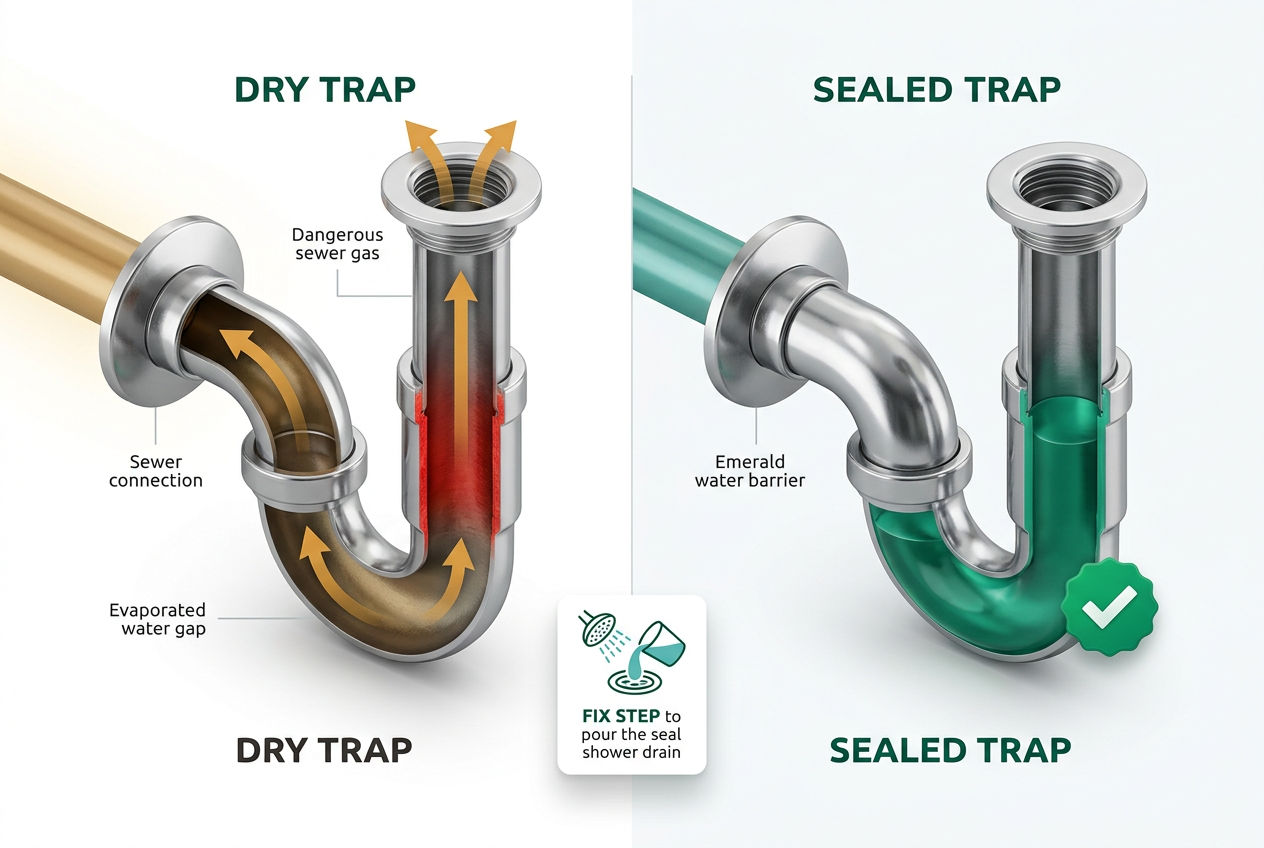
Cause #2: Biofilm Buildup — When Your Shower Drain Smells Like Sewage Despite Regular Use
Even a shower you use every day can develop a sulfur smell. Hair, soap scum, body oils, and skin cells collect in the drain pipe and on the underside of the drain cover. Bacteria colonize that organic material almost immediately — biofilm can start forming within 24–48 hours of organic contact. As those bacteria break down waste, they produce hydrogen sulfide. The biofilm itself looks like a dark, slimy coating on the inside of the drainpipe. If you've ever pulled a drain cover and caught a whiff of something foul before the water even runs, that's it.
How to fix it:
- Remove the drain cover (usually one screw or a simple lift-and-twist)
- Use a drain snake or a Zip-It tool to pull out accumulated hair and gunk
- Pour 1 cup of baking soda down the drain, followed by 1 cup of white vinegar — the fizzing reaction breaks up organic buildup
- Wait 15 minutes, then flush with boiling water (not if you have PVC pipe — use very hot tap water instead)
- Scrub the drain cover with a stiff brush and dish soap
For stubborn biofilm, an enzyme-based septic-safe drain cleaner works without harming the bacterial balance inside your septic tank. Avoid bleach — it kills the beneficial bacteria your system depends on.
Repeat this cleaning every 4–6 weeks to prevent the buildup from returning.
Cause #3: Blocked Plumbing Vent Stack — Why Sulfur Smell in the Bathroom Drain Gets Worse Seasonally
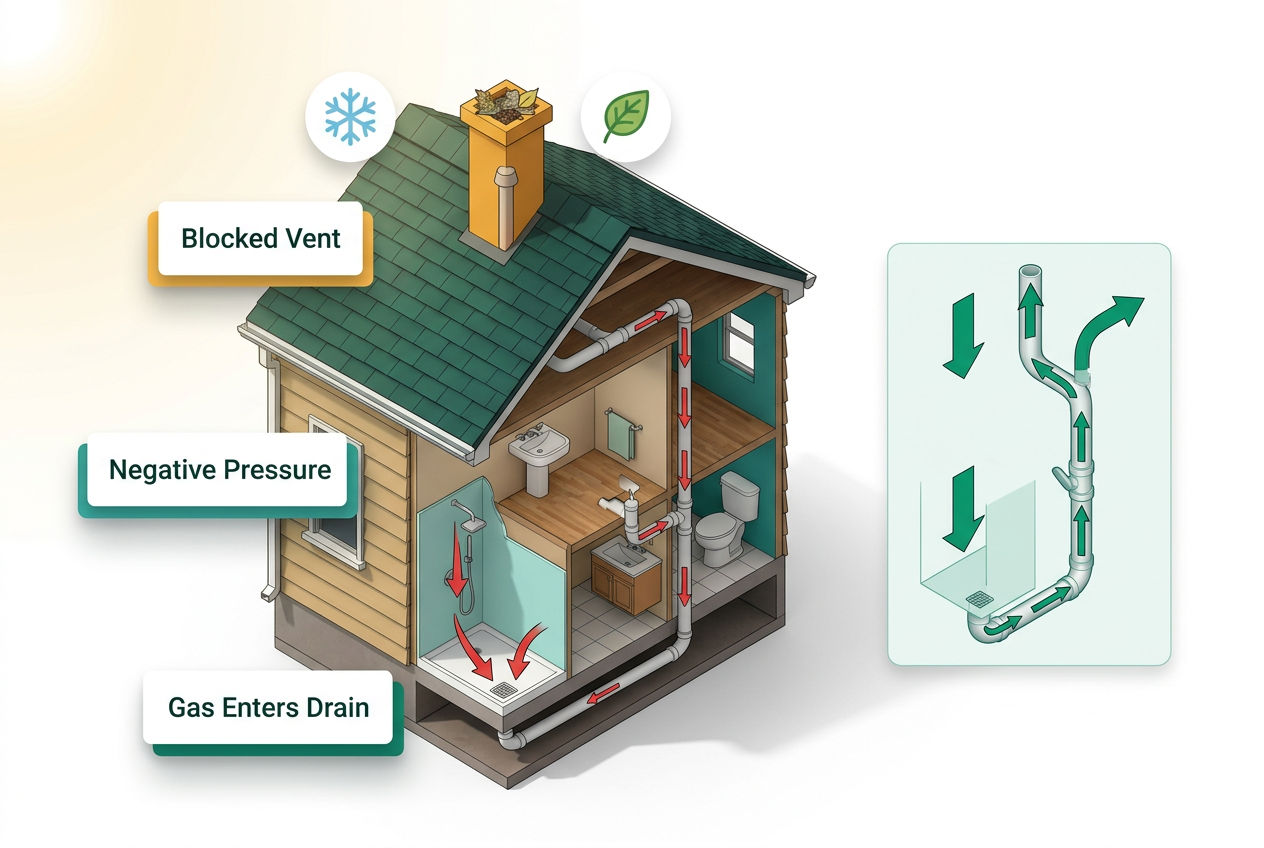
Your home's plumbing system breathes. A vertical pipe runs from your drain system up through the roof, allowing air to enter so wastewater flows freely. It also vents sewer gases safely above the roofline — away from your living space.
When that vent pipe gets blocked — by leaves, a dead bird, a wasp nest, or ice in colder climates — two things happen. First, sewer gases have nowhere to escape upward, so they push back down into your drains. Second, the negative pressure created by flowing water can actually siphon water out of your P-trap. A strong blockage can empty a P-trap in just a few hours.
This explains why some homeowners notice the bathroom drain smelling like sulfur worse in fall (leaves clog the vent cap) or in winter (ice forms inside the pipe, especially in climates where frost penetrates above 12 inches). If you're in Minnesota or upstate New York and the smell started in December, a frozen vent stack is a reasonable suspect. According to the University of Minnesota Extension, vent stack icing is among the most underdiagnosed causes of recurring sewer gas odor in cold-climate homes.
How to fix it: A clogged vent stack is a roof-level job. You can carefully clear debris from the top of the vent with a garden hose if you're comfortable on a roof and the pitch is 4:12 or less — steeper roofs should be left to a professional. Vent pipe clearing typically runs $150–$500 depending on access difficulty and your region.
Cause #4: Your Septic Tank Is Full or Failing
If you've ruled out the simpler causes above, the smell may be coming from the septic system itself. A tank that hasn't been pumped in years builds up solid sludge at the bottom and a floating scum layer at the top. When there's no room left for effluent to flow properly, gas pressure backs up through the inlet baffle and into your home's drain lines.
The EPA recommends pumping every 3–5 years for most households. A 1,000-gallon tank serving a family of four realistically needs service every 3–4 years. Add a garbage disposal and that shortens to every 2 years. Push it to 7 or 8 years and you're not just dealing with odors — you're risking drain field damage.
Worked example: A family of four with a 1,000-gallon tank generates roughly 240–300 gallons of wastewater per day. At that rate, the tank accumulates approximately 2–3 inches of sludge per year. By year 6 without pumping, sludge and scum layers can occupy 30–40% of the tank's working volume — enough to push gas pressure back through the inlet baffle and into drain lines. This is the mechanical reason the EPA's 3–5 year guideline exists; it's not conservative caution, it's math.
A full or stressed tank typically produces odors from multiple fixtures, not just the shower. If your toilet, sink, and shower all smell — and especially if any drains are running slow — the tank is the most likely culprit. Check out our article on signs your septic tank needs pumping to confirm before you call.
What to do: Schedule a professional pump-out. National average cost is $300–$600 for a standard residential tank. See our septic pumping cost guide for regional breakdowns. You can find a local septic pumping professional through our directory.
Also worth noting: if your tank has an effluent filter (like a Polylok PL-122 or Zabel A1800 series), it may need cleaning. A clogged effluent filter restricts flow and causes the same backup-pressure symptoms as a full tank. Most licensed pumpers clean the filter during a routine pump-out — ask them to confirm before they leave.
Cause #5: Drain Field Problems
This is the least common cause of shower drain odor, but it's the most serious. If your drain field (also called a leach field) is saturated or failing, effluent has nowhere to go — and sewer gases migrate back through the system into your home.
A few situations where this becomes more likely:
- Heavy rainfall saturating the soil for extended periods (common in the Pacific Northwest and Gulf Coast)
- High water table preventing proper effluent absorption (coastal Florida is a frequent example)
- Compacted soil from vehicles parked over the drain field
- A drain field that has simply reached end of life after 20–30 years of use
Drain field odor is typically persistent and often accompanied by wet, spongy ground above the field, unusually green grass in patches, or slow drains across the entire house — not just the shower.
If you recognize those signs, read our guide on signs your drain field is failing before calling anyone, and be aware that drain field replacement costs can run $5,000–$20,000 depending on soil conditions and system size. You can schedule a septic inspection to get a professional assessment of whether repair or replacement is necessary.
For more on how weather and system conditions interact with drain odor, see our related article on septic smell when it rains.
How Do You Diagnose Which Cause Is Making Your Shower Drain Smell?
Use this quick triage table:
| Symptom | Most Likely Cause | First Step |
|---|---|---|
| Smell disappears after running water for 1 minute | Dry P-trap | Run shower weekly |
| Smell is worst right after pulling the drain cover | Biofilm buildup | Clean drain with Zip-It + baking soda |
| Smell worsens in fall or after heavy rain | Blocked vent stack | Inspect/clear vent cap |
| Multiple fixtures smell; drains running slow | Full septic tank | Schedule pump-out |
| Smell plus wet ground above drain field | Failing drain field | Professional inspection immediately |
If you're still unsure after working through the table, the safest assumption is to clean the drain first (free), run the shower to test the P-trap (free), and then call a plumber if the smell persists after 48 hours.
If your triage points toward the septic tank itself — sluggish drains across multiple fixtures, odors that follow heavy water use, or a tank that hasn't been serviced in a while — a bacterial treatment can help restore the microbial balance between pump-outs. Septifix is the one we recommend here: each tablet releases oxygen along with 14 strains of aerobic bacteria (around 10 billion CFU) that work on odor and sludge buildup, and dosing is as simple as flushing one tablet down the toilet. It's non-toxic, made in the USA, and costs roughly $3–$4 per treatment. That said, no additive replaces a scheduled pump-out — the EPA is clear on that — so treat it as maintenance support, not a fix for a tank that's already overdue.

Should You Use a Septic Treatment Product for Shower Drain Odor?
This question comes up a lot — and the honest answer is: sometimes, but only as a maintenance tool, not a fix.
Bacterial additives work by introducing live microorganisms into your tank to help break down organic solids. They don't repair a dry P-trap, unclog a vent stack, or pump out a full tank. If one of those is your actual problem, no additive will solve it.
That said, if your system is functioning normally and you want to reduce odor long-term and support bacterial activity in your tank, a quality additive used on schedule makes sense — particularly after a pump-out, after heavy antibiotic use, or after a period when the house was unoccupied.
The one we recommend: Septifix. Each tablet releases oxygen directly into the tank and carries 14 strains of live aerobic bacteria at roughly 10 billion CFU per tablet. The oxygen component is what makes it different — aerobic conditions suppress the anaerobic sulfur-reducing bacteria that produce hydrogen sulfide. The dosing is simple: one tablet flushed down the toilet monthly, no measuring. It's made in the USA, non-toxic, and comes with a 60-day money-back guarantee. At roughly $3–$4 per treatment, it's one of the lower-cost options on the market.
One honest limitation: No bacterial additive replaces regular pumping. The EPA's position is clear — mechanical pump-outs are required regardless of what you add to the tank. Think of Septifix as maintenance between pump-outs, not a substitute for them.
If you're comparing options, our Rid-X vs. Septifix breakdown covers the key differences in bacterial strains, oxygen delivery, and cost per treatment in detail.
Is Sewer Gas From a Shower Drain Dangerous?
At the concentrations produced by a residential plumbing issue, hydrogen sulfide from a shower drain is unlikely to cause acute poisoning — but it shouldn't be ignored.
According to OSHA's hydrogen sulfide standard (29 CFR 1910.1000), the permissible exposure limit is 20 ppm as a ceiling concentration. At 50 ppm, the agency identifies it as an immediate hazard. At 100 ppm, the olfactory nerve becomes temporarily paralyzed — meaning you stop smelling the gas even as concentrations continue rising.
In a bathroom with a blocked vent stack and a dry P-trap simultaneously, concentrations can rise faster than most homeowners expect — especially in a small, poorly ventilated space with the door closed. If you or anyone in your household experiences headaches, nausea, or eye irritation that resolves immediately after leaving the bathroom, treat that as a ventilation emergency and open windows before diagnosing the cause.
For ongoing low-level odor without those symptoms: diagnose and fix, but it's not an emergency. For sudden strong smell plus physical symptoms: ventilate first, diagnose second.
Prevention: How to Stop Shower Drain Odor From Coming Back
Once you've fixed the immediate problem, a simple maintenance schedule keeps it from returning:
Weekly: Run any unused shower for 30–60 seconds to keep the P-trap filled.
Every 4–6 weeks: Clean the drain with a Zip-It tool and baking soda + vinegar flush.
Monthly: Use a septic-safe bacterial additive (Septifix is our pick at ~$3–$4 per treatment) to maintain bacterial balance in the tank.
Annually: Inspect the vent stack cap for debris. Late fall — before leaves fully drop — is the best time.
Every 3–5 years: Pump the septic tank on schedule. A septic tank maintenance guide can help you build a full service calendar if you've lost track of when the last pump-out occurred.

When Should You Call a Septic Professional?
DIY fixes are appropriate for the first three causes. Call a licensed plumber or septic technician when:
- The smell persists after cleaning the drain and refilling the P-trap
- Multiple fixtures smell simultaneously
- Drains are running slow throughout the house
- You see wet or unusually green patches above the drain field
- The smell appeared suddenly and is strong
- Your tank hasn't been pumped in more than 5 years
Call script: "I have a sulfur/sewer gas smell from my shower drain. I've ruled out a dry P-trap and biofilm — I cleaned the drain two days ago and ran the water, but the smell came back within 24 hours. I'm on a septic system. Can you assess the vent stack and tank condition?"
That gives a technician enough information to bring the right equipment on the first visit.
Related Rid-X & Septic Treatment Guides
- The Best Rid-X Alternatives
- The Best Septic Tank Smell Removers
- Septic Smell When It Rains? Why It Happens & How to Fix It
- Can You Use Rid-X in an RV Black Tank? What to Know First
- Is Rid-X Safe for Septic Tanks, Toilets & Pipes?
- How Often Should You Use Rid-X? Directions, Dosing & Timing
- What's Actually in Rid-X? Ingredients Explained
- Does Rid-X Unclog Drains or Toilets?
- Rid-X vs. Green Gobbler: Which Septic Treatment Wins?
- Green Gobbler Septic Treatment Review: Pods, Packets & Results
- Where to Buy SeptiFix
- Bio-Clean Septic Treatment Review: Does It Work?
- Cabin Obsession Septic Tank Treatment Review
- Camco Septic Tank Treatment Review
- Septic Tank Treatments at Walmart vs. Home Depot vs. Online
- Septic Smell Coming From Toilet? Causes & How to Fix It
- Septic Tank Smell After Pumping? Causes & How to Fix It
- Septic Smell From Roof Vent? Causes & How to Fix It
- Is Septic Tank Smell Dangerous? Gases, Risks & When to Worry
- Septic Tank Diagram With Dimensions
- Septic Tank Cross-Section Diagram: Every Part Labeled
- Septic System Diagram With a Pump
- Septic Tank Plumbing Diagram: From House to Drain Field
- Aerobic Septic System Diagram: How Each Part Works
- Are Septic Tank Treatments Necessary?
- How to Handle How Often to Use Septic Tank Treatment: Step by Step
- Septic Treatment Tablets vs. Powder vs. Liquid: Which Is Best?
- Best Septic Tank Treatment for Slow Drains
- Yeast, Baking Soda & Milk in Your Septic Tank: Myths Tested
Frequently Asked Questions
Why does my shower drain smell like rotten eggs even though I just cleaned it?
A freshly cleaned drain that still smells like rotten eggs almost always means the source is deeper than the drain itself — either the P-trap, the vent stack, or the septic tank. Start by running the shower for 60 seconds and waiting 15 minutes. If the smell clears, you had a dry P-trap, not a biofilm problem. If it returns within 24 hours of cleaning, the drain itself isn't the issue.
A blocked vent stack is the next most likely culprit. When the vent pipe is obstructed, sewer gas has no upward exit and pushes back through the drain instead. This is common in fall (leaves over the vent cap) and winter (ice formation inside the pipe in climates like Minnesota or upstate New York). Vent clearing typically runs $150–$500 through a licensed plumber.
If neither fixes it, schedule a septic pump-out. A tank overdue for service — especially one last pumped more than five years ago — builds gas pressure that bypasses your drain cleaning entirely. See our septic pumping cost guide for what to expect.
What does it mean when my shower drain smells like sewage but the toilet flushes fine?
When the toilet flushes normally but the shower drain smells like sewage, the problem is almost certainly local to the shower drain — not the septic tank. A working toilet flush confirms that the main drain line has adequate flow and the tank isn't completely backed up.
The most likely causes in this scenario are: a dry P-trap in the shower (especially if it's a guest bath or basement shower used infrequently), biofilm accumulated on the shower drain walls and cover, or a partial blockage in the shower's individual drain branch rather than the main line.
Run the shower for 60 seconds. If the smell fades within 15 minutes, it was a dry P-trap. If not, remove the drain cover and clean it thoroughly with a Zip-It tool, followed by a baking soda and vinegar flush. In the vast majority of cases where the toilet is unaffected, this two-step process resolves the odor completely — at zero cost. If it doesn't, the shower's individual drain branch may have a partial blockage worth snaking professionally.
How do I fix a sulfur smell coming from the bathroom drain?
A sulfur smell from the bathroom drain follows a clear fix sequence. First, run the shower for 60 seconds and wait 15 minutes — if the smell clears, you've fixed a dry P-trap. If not, clean the drain: remove the cover, use a Zip-It tool to pull out accumulated hair and biofilm, pour one cup of baking soda followed by one cup of white vinegar, wait 15 minutes, then flush with very hot tap water. (Skip boiling water if you have PVC pipe — use the hottest setting from the tap instead.) Scrub the drain cover separately with a stiff brush.
If cleaning doesn't resolve it within 48 hours, move to the vent stack. A blocked vent pipe creates negative pressure that siphons water from the P-trap, allowing gas back in even after you've refilled it. Vent clearing runs $150–$500 through a plumber. Still persisting? The issue is likely your septic tank. Check our signs your septic tank needs pumping and schedule a pump-out if you're overdue.
Can a full septic tank really cause my shower to smell like sewer gas?
Yes — and the mechanism is straightforward. A septic tank that hasn't been pumped accumulates sludge at the bottom and a floating scum layer at the top. As these layers grow, the working volume of the tank shrinks, effluent backs up, and gas pressure increases inside the tank.
Consider the math: a family of four with a 1,000-gallon tank generates roughly 240–300 gallons of wastewater per day and accumulates approximately 2–3 inches of sludge per year. By year 6 without pumping, sludge and scum can occupy 30–40% of the tank's working volume. At that point, gas pressure backs up through the inlet baffle and travels through the drain lines into the house — your shower drain being one of the first exit points.
The telltale sign that the tank is the source: odor comes from multiple fixtures, not just the shower. Slow drains throughout the house confirm it. The EPA recommends pumping every 3–5 years for this exact reason. If you're overdue, see our septic pumping cost guide before calling — $300–$600 is the typical range for a standard residential pump-out.
Is a shower drain that smells like hydrogen sulfide dangerous?
The direct answer is: at low concentrations typical of residential plumbing problems, it's a nuisance and a warning signal — not an acute emergency. But at higher concentrations, hydrogen sulfide is genuinely hazardous.
According to OSHA (29 CFR 1910.1000), the permissible ceiling exposure is 20 ppm. At 50 ppm, it's classified as an immediate danger to health. At 100 ppm, the olfactory nerve temporarily shuts down — meaning you stop smelling the gas even as levels continue rising. A small, poorly ventilated bathroom with a dry P-trap and a blocked vent stack simultaneously can approach problematic concentrations faster than most people realize.
The practical rule: if the smell is mild and appeared gradually, diagnose and fix it at a normal pace. If the smell is sudden and strong, or if anyone in the household experiences headaches, nausea, or eye irritation that clears immediately on leaving the room, ventilate first — open the window, run the exhaust fan, open the door — before investigating the source. Physical symptoms mean treat it as a ventilation emergency, not a weekend project.
What's the best way to get rid of a sewer smell from a shower drain permanently?
Permanently eliminating a sewer smell from a shower drain requires addressing the root cause, not masking the symptom. There is no single product or one-time fix that works across all causes — the right answer depends on which cause you have.
For a dry P-trap: the permanent fix is running any unused shower for 30–60 seconds once a week. For biofilm: clean the drain every 4–6 weeks with a Zip-It tool and a baking soda-vinegar flush. For a blocked vent: clear or cap the vent stack and inspect annually before fall. For a full septic tank: pump on schedule — every 3–5 years for most households — and use a monthly bacterial additive like Septifix between pump-outs to maintain tank health. Each tablet carries 14 strains of live aerobic bacteria at roughly 10 billion CFU and releases oxygen that suppresses the hydrogen sulfide-producing bacteria responsible for the rotten egg smell.
One honest caveat: no additive replaces mechanical pumping. Use Septifix as a maintenance tool on an already-functioning system, not as a cure for a tank that's overdue for service. See our septic tank maintenance guide for a full prevention schedule.
Sources & Methodology
This article draws on the following primary sources:
- U.S. Environmental Protection Agency — A Homeowner's Guide to Septic Systems (epa.gov/septic). Source for the 21 million household statistic and 3–5 year pumping recommendation.
- Occupational Safety and Health Administration — Hydrogen Sulfide (osha.gov/hydrogen-sulfide). Source for 50 ppm action level, 100 ppm olfactory paralysis threshold, and 29 CFR 1910.1000 permissible exposure limits.
- University of Minnesota Extension — Septic System Care and Maintenance (extension.umn.edu). Source for cold-climate vent stack icing guidance.
- National Onsite Wastewater Recycling Association (NOWRA) — Technical guidance on effluent filter maintenance schedules.
- National Association of Wastewater Technicians (NAWT) — Inspection and pumping frequency standards for residential systems.
- Polylok, Inc. — Product documentation for PL-122 effluent filter specifications.
- Zabel Environmental Technology — Product documentation for A1800 series effluent filter specifications.
Cost figures are based on aggregated contractor estimates current as of the article's update date and will vary by region. Always obtain at least two local quotes before scheduling service.
Free download
Not ready for the Handbook? Start with the free Fridge Card.
The Do / Don’t card the whole family can see, plus the Survival Kit: emergency flowchart, warning-sign decoder and pump-schedule card. One printable PDF.
Was this article helpful?
Frequently Asked Questions
Recommended Resources
📖 Related Articles
💰 Cost Guides
Find Septic Professionals Near You
Compare licensed, verified septic companies by area — top county markets and cities below, or browse all 50 states.
County markets
Popular cities
