
Quick Answer
How often to use Rid-X: once per month. One dose — whether you choose the 9.8 oz powder, 9.8 fl oz liquid, or a single gel pac — treats any standard residential tank from 750 to 1,500 gallons. Flush it at night, let the bacteria work while water use is low, and repeat every 30 days. That's the short version. The rest of this article covers why, exactly how, and when it's not enough.
Key Takeaways
- Use Rid-X once per month for tanks up to 1,500 gallons — one box, one bottle, or one gel pac per dose
- Flush your dose at night through a toilet closest to your tank for maximum contact time
- Rid-X contains four active enzyme types — cellulase, lipase, protease, and amylase — plus billions of beneficial bacteria per dose
- Rid-X does not replace pumping; the EPA recommends pumping every 3–5 years regardless of additive use
- If your drains are slow, your yard smells, or you haven't pumped in five years, call a professional — no additive fixes a failing system
What Is Rid-X and How Does It Work?
Rid-X is a septic tank bacteria additive that delivers a concentrated blend of enzymes and live bacterial cultures into your tank each month. Specifically, it contains four enzyme types: cellulase (breaks down toilet paper and plant fibers), lipase (attacks fats and grease), protease (digests proteins), and amylase (handles starches). Each dose delivers billions of bacteria to reinforce the microbial colony already living in your tank.

Your septic tank is a living bioreactor. Wastewater enters through your inlet baffle, solids settle to the bottom as sludge, lighter materials like grease float to the top as a scum layer, and clarified effluent passes through the outlet baffle into your drain field. The bacteria in that tank — both the ones already there and those you add with Rid-X — work continuously to digest organic solids before they accumulate.
According to the Rid-X manufacturer (Reckitt Benckiser), bacteria from a dose begin working within 2–4 hours of being flushed. Cold groundwater can slow that activation. If your tank sits in soil that stays below 50°F — common in Minnesota, Wisconsin, or Michigan from November through March — bacterial activity drops noticeably. More on seasonal timing below.
The septic tank bacteria guide on this site covers the full microbiology if you want to go deeper on how different bacterial strains divide labor inside your tank.
Rid-X Dosing by Tank Size
Rid-X dosing is straightforward for most homes. The standard package covers the most common residential tank sizes with no math required.

| Tank Size | Powder | Liquid | Gel Pacs |
|---|---|---|---|
| 700–1,000 gal | 9.8 oz (1 box) | 9.8 fl oz | 1 pac |
| 1,001–1,250 gal | 9.8 oz (1 box) | 9.8 fl oz | 1 pac |
| 1,251–1,500 gal | 9.8 oz (1 box) | 9.8 fl oz | 1 pac |
| 1,501–2,000 gal | 19.6 oz (2 boxes) | 19.6 fl oz | 2 pacs |
| 2,001–2,500 gal | 29.4 oz (3 boxes) | 29.4 fl oz | 3 pacs |
Source: Rid-X manufacturer label directions (Reckitt Benckiser, 2024). Dose scales proportionally above 1,500 gallons.
One standard-size package of any Rid-X format equals one monthly dose for tanks up to 1,500 gallons. If you're not sure what size tank you have, your county health department permit records, your home's original inspection report, or a septic tank size chart can help you figure it out. Most single-family homes built after 1980 have a 1,000- or 1,250-gallon concrete or fiberglass tank.
Worked example: A household of four in suburban Ohio has a 1,250-gallon tank installed in 1994. They use the powder format. Each month, they pour one 9.8 oz box into the toilet before bed — total annual cost around $72 at $6 per box. If they upgraded to a 2,000-gallon tank after an addition, they'd need two boxes per dose, bringing annual cost to roughly $144. No other calculation is needed.
How Often Should Rid-X Be Used?
Once a month, every month. That's the manufacturer's recommendation, and it aligns with how septic additives work — you're replenishing a bacterial population that gets depleted by antibacterial soaps, cleaning products, bleach, and normal fluctuations in household water use.
Picture a busy holiday weekend. You've got eight people in the house, someone runs four loads of laundry, and the dishwasher runs twice a day. That surge of water and waste dilutes your tank's bacterial colony fast. A monthly septic tank treatment schedule helps you stay ahead of those natural peaks.
Do you need to use it more than once a month? No. More product doesn't mean a healthier tank — your tank's environment can only support so many bacteria at once. Can you skip months and double up later? The manufacturer says no to that, too. Consistency matters more than occasional heavy doses. Think of it like taking a daily vitamin, not cramming a week's worth on Sunday.
Step-by-Step Rid-X Directions by Product Type

Powder (9.8 oz box)
- Measure out the full 9.8 oz package — one box equals one dose
- Pour directly into the toilet bowl
- Flush immediately with one full flush of water
- Do this at night before bed so wastewater flow is minimal for 6–8 hours
- Avoid using heavy amounts of water (laundry, dishwasher, long showers) for the next several hours
Powder dissolves quickly in water and travels through your drain pipes directly to the tank. Don't add it to a sink drain — the toilet provides the most direct, clean path to the tank.
Liquid (9.8 fl oz bottle)
- Shake the bottle gently before use
- Pour the entire 9.8 fl oz bottle into the toilet bowl
- Flush once
- Same timing rules apply — nighttime use is best
- The liquid format activates slightly faster than powder, which can be an advantage in cold climates
The liquid vs. powder comparison comes down to personal preference and storage — liquid is easier to pour, powder has a longer shelf life at room temperature.
Gel Pacs
- Drop one gel pac directly into the toilet bowl — do not unwrap or puncture it
- Flush immediately with one full flush
- The dissolvable pac releases its contents as it travels through the drain
- Use at night for best results
Gel pacs are the most convenient format and generate the least mess. They're single-use by design, so there's no measuring or risk of spilling powder on your bathroom floor.
When Is the Best Time to Use Rid-X?
Night. Every time. Your household water use naturally drops to near zero between 10 PM and 6 AM. That gives the bacteria an uninterrupted 6–8 hours to activate, multiply, and get to work on your tank's sludge layer without getting flushed out by incoming wastewater.
If you flush Rid-X before your morning shower routine, half the bacteria may get pushed through the tank before they've established. Nighttime use maximizes dwell time.
Should you use Rid-X before or after pumping? After. Once your tank is pumped, the bacterial colony gets partially reset. Adding Rid-X within a few days of a pump-out helps re-establish that microbial population faster. Using it before a scheduled pump-out isn't harmful, but the timing is less efficient — you're adding bacteria right before they get vacuumed out.
Learn more about what to expect during a pump-out so you can time your Rid-X use accordingly.
Seasonal Timing: Does It Matter Where You Live?
Yes, and this is something the product box doesn't explain well enough.
Spring (March–May): Peak time to restart a monthly routine. Frost thaw raises water tables across the Northeast and Upper Midwest, which can temporarily saturate drain fields. Starting or resuming Rid-X in spring gives your bacterial colony time to build up before the ground warms.
Summer (June–August): High household water use — guests, vacation laundry loads, kids home all day — dilutes tank contents faster. Monthly dosing is especially important. In Florida, Georgia, and the Carolinas, where soil temps stay warm year-round, bacterial activity is naturally high. Rid-X works well here consistently.
Fall (September–November): Use this as your "button-up" dose. Adding Rid-X in late October or early November ensures a strong bacterial colony is established before cold slows microbial activity. Homeowners in Maine, Vermont, and New Hampshire benefit most from this timing.
Winter (December–February): Bacterial activity slows in cold soils, but don't skip months. Maintain your monthly schedule. Some homeowners in cold climates ask about doubling up in winter — the research doesn't support it as beneficial, and it won't hurt but it's not necessary. Keep the dose standard; just be consistent.
Regional note: Washington State has studied septic additives more rigorously than most states. While Rid-X is EPA-accepted and contains no harmful chemicals, a few states have explored or implemented additive regulations. Check with your local county health department if you're unsure whether additive use requires any disclosure in your area.
What Does Rid-X Actually Cost?
Roughly $5–$8 per month, depending on the format and where you buy it. Powder is typically the cheapest per dose. Gel pacs cost slightly more for the convenience.
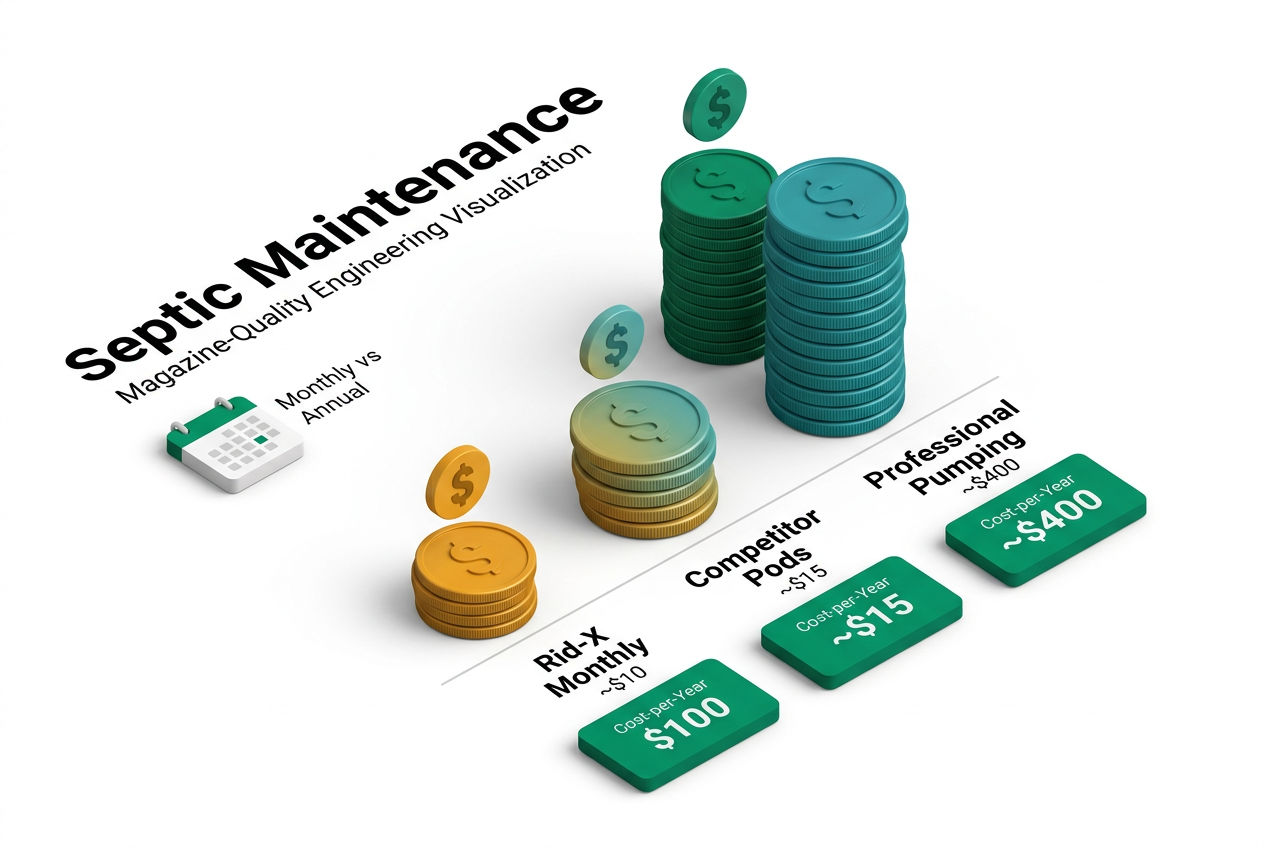
At $6/month average, a full year of Rid-X treatment runs about $72. Compare that to the average septic pumping cost of $300–$600 every three to five years, and monthly additive use looks like reasonable insurance — even if the science on additives is mixed (more on that below).
If you have a larger tank that requires two or three doses per month, annual costs scale to $144–$216. Still far less than a drain field replacement, which averages $3,500–$10,000 depending on system type and soil conditions.
Does Rid-X Really Work — And What Can't It Do?
For standard conventional septic systems, yes — with important caveats. According to the National Onsite Wastewater Recycling Association (NOWRA), biological additives like Rid-X can support existing bacterial populations, but they have not been proven to reduce pump-out frequency or prevent system failures on their own.
What Rid-X can do:
- Replenish bacteria depleted by cleaning products, antibiotics, or heavy water use
- Help break down organic solids in the sludge layer more efficiently
- Support faster recovery after a system disruption (pump-out, heavy use period)
What Rid-X cannot do:
- Eliminate the need for periodic pumping — sludge and scum accumulate regardless of bacterial activity
- Fix a drain field that is already failing due to biomat buildup or soil saturation
- Replace a damaged baffle, cracked tank wall, or failing distribution box
Research from the University of Arkansas (referenced in NOWRA's technical literature) found no statistically significant difference in sludge accumulation rates between tanks using biological additives and those that did not. This doesn't mean Rid-X is useless — it means it works best as a supplement to proper maintenance, not a substitute.
The honest limitation: if your system is already struggling — slow drains, wet spots in the yard, sewage odors — Rid-X won't fix it. Read the do septic additives work breakdown for a full evidence review, and check our signs your drain field is failing guide if you're seeing any of those symptoms.
Can You Use Too Much Rid-X?
No — but it won't help either. Overshooting the recommended dose doesn't accelerate bacterial activity. Your tank's environment — oxygen levels, temperature, available organic material — sets a ceiling on how many bacteria can survive at once. Adding more product than the label recommends just wastes money.
Doubling up after a missed month is also unnecessary. The bacteria already in your tank will persist. Just resume your normal monthly dose.
One scenario where extra caution applies: if you're on a very small lot with a shallow water table and you're already treating for a septic biomat, adding more biological product isn't the fix. The biomat is a physical clogging problem, not a bacterial deficiency problem. Over-adding product to a struggling system can give false confidence that something is being done when professional intervention is actually needed.
Is Rid-X Safe for All Septic Systems?
For conventional gravity-fed systems, yes. Rid-X's four enzyme types and bacterial cultures are non-toxic, non-corrosive, and safe for standard concrete, fiberglass, and plastic tanks.
ATU / aerobic systems: If you have an aerobic treatment unit — common in Texas, Oklahoma, and rural areas without access to municipal sewer — check with your system's manufacturer or your local health department before using Rid-X. ATUs use mechanical aeration and may have different bacterial balance requirements. The aerobic vs. anaerobic septic systems breakdown explains why these systems operate differently.
Mound systems and drip systems: Generally safe, but the same principle applies — confirm with your licensed installer or county health department if you're unsure.
What kills septic bacteria more than any additive can help: bleach flushed directly into the toilet, antibacterial cleaning products used in large quantities, and non-biodegradable wipes. Review what kills septic bacteria to understand what to avoid between doses.
When Should You Call a Professional Instead?
Rid-X is maintenance support — not emergency response. Call a licensed septic professional if you notice any of the following:
- Drains backing up or gurgling in multiple fixtures simultaneously
- Wet or spongy ground above your drain field, especially with an odor
- Sewage smell inside the house or near the tank lid
- You haven't had the tank pumped in more than five years
- Your tank is over 15 years old and has never been inspected
A licensed pumper can insert a sludge judge — a clear acrylic tube — into your tank to measure your sludge and scum layers directly. If sludge depth exceeds one-third of the tank's liquid depth, it's time to pump regardless of how consistently you've used Rid-X.
If your inspection confirms you're not yet due for a pump-out but you still want to support bacterial activity between service visits, Septifix is the treatment we recommend. Each tablet releases oxygen along with 14 strains of aerobic bacteria — roughly 10 billion CFU — directly into the tank, targeting odor and sludge buildup through a mechanism that goes beyond enzymes alone. Dosing is straightforward: one tablet flushed down the toilet, with no measuring required. That said, no additive substitutes for professional pumping, and the EPA's position that additives aren't required for a healthy system remains sound.
How often should you pump? For a family of four with a 1,000-gallon tank, the EPA recommends every 3–5 years. Add a garbage disposal and that drops to every 2 years. The septic pumping service page can connect you with licensed professionals in your area.
Rid-X Alternatives Worth Knowing
Rid-X isn't the only biological additive on the market. If you want to compare before committing to a monthly product, these are the most commonly evaluated alternatives:
Green Gobbler Septic Saver — enzyme-forward formula, often compared directly to Rid-X. The Rid-X vs. Green Gobbler comparison covers dosing, cost, and performance differences side by side.
Bio-Clean — a professional-grade bacterial additive used by plumbers and septic technicians. Higher bacterial concentration per dose, higher price point. See the Bio-Clean septic review for a detailed breakdown.
Septic tank treatment pods — pre-measured dissolvable pods similar to gel pacs but from competing brands. Septic tank treatment pods covers the top options.
Natural septic tank treatments — yeast, baking soda, and other home remedies circulate online. The natural septic tank treatment article evaluates what actually works and what doesn't.
All of these products share the same core limitation: they support bacterial populations but don't replace physical maintenance.
Related Rid-X & Septic Treatment Guides
- Aerobic Septic System Diagram: How Each Part Works
- Are Septic Tank Treatments Necessary?
- Best Septic Tank Treatment for Slow Drains
- Bio-Clean Septic Treatment Review: Does It Work?
- Cabin Obsession Septic Tank Treatment Review
- Camco Septic Tank Treatment Review
- Green Gobbler Septic Treatment Review: Pods, Packets & Results
- How to Handle How Often to Use Septic Tank Treatment: Step by Step
- Is Rid-X Safe for Septic Tanks, Toilets & Pipes?
- Is Septic Tank Smell Dangerous? Gases, Risks & When to Worry
- The Best Rid-X Alternatives
- Does Rid-X Unclog Drains or Toilets?
- Can You Use Rid-X in an RV Black Tank? What to Know First
- What's Actually in Rid-X? Ingredients Explained
- Rid-X vs. Green Gobbler: Which Septic Treatment Wins?
- Septic Tank Smell After Pumping? Causes & How to Fix It
- Septic Smell From Roof Vent? Causes & How to Fix It
- Septic Smell From Shower Drain? Causes & How to Fix It
- Septic Smell Coming From Toilet? Causes & How to Fix It
- Septic Smell When It Rains? Why It Happens & How to Fix It
- Septic System Diagram With a Pump
- Septic Tank Cross-Section Diagram: Every Part Labeled
- Septic Tank Diagram With Dimensions
- Yeast, Baking Soda & Milk in Your Septic Tank: Myths Tested
- Septic Tank Plumbing Diagram: From House to Drain Field
- The Best Septic Tank Smell Removers
- Septic Tank Treatments at Walmart vs. Home Depot vs. Online
- Septic Treatment Tablets vs. Powder vs. Liquid: Which Is Best?
- Where to Buy SeptiFix
- Rid-X Platinum Review: Is the Upgrade Worth It?
- Zep Septic Defense Review: Does It Beat Rid-X?
- The Best Septic Tank Sludge Dissolvers
- The Best Septic Treatment for Toilet Paper Breakdown
- Instant Power Septic Shock Review: Does It Work?
Frequently Asked Questions
How often should you use Rid-X in a septic tank?
You should use Rid-X once per month, every month, without skipping. One standard dose — a 9.8 oz powder box, a 9.8 fl oz liquid bottle, or a single gel pac — treats any residential tank up to 1,500 gallons. The monthly schedule works because septic bacteria get continuously depleted by antibacterial soaps, bleach-based cleaners, and high-volume water use events like holiday gatherings or vacation laundry. Skipping a month and doubling up the next month doesn't compensate — you can't bank bacterial activity. Consistency matters more than intensity. Mark a recurring calendar reminder for the same date each month, flush the dose at night through the toilet closest to your tank, and avoid running the dishwasher or laundry for 6–8 hours afterward. According to the manufacturer, this routine keeps your tank's microbial population at optimal working levels year-round.
What is the correct Rid-X dosing for my tank size?
Rid-X dosing is based on tank volume: one standard package — 9.8 oz powder, 9.8 fl oz liquid, or one gel pac — covers tanks from 700 to 1,500 gallons. For tanks between 1,501 and 2,000 gallons, you need two packages per dose. Tanks between 2,001 and 2,500 gallons require three packages. The dose scales proportionally above that threshold. Most single-family homes built after 1980 have a 1,000- or 1,250-gallon tank, so one standard package per month is correct for the majority of homeowners. If you don't know your tank size, check your county health department permit records, your original home inspection report, or look up your property's septic permit online. Your tank's size is almost always recorded there. When in doubt, use one package — undershooting the dose slightly is far less wasteful than overbuying.
Do Rid-X directions differ by product format — powder, liquid, or gel pac?
The application method differs slightly by format, but the core Rid-X directions are the same: flush a full dose into the toilet at night, then minimize water use for 6–8 hours. For powder, pour the entire 9.8 oz box directly into the toilet bowl and flush once. For liquid, shake the bottle gently, pour all 9.8 fl oz into the bowl, and flush once. For gel pacs, drop one pac — do not unwrap it — into the bowl and flush; the outer shell dissolves in water. All three formats should be flushed through a toilet, not poured down a sink or floor drain. The toilet provides the most direct path to the tank. Liquid activates slightly faster than powder in cold conditions, which is a minor advantage in northern climates during winter months. Otherwise, the choice between formats comes down to storage preference and cost.
Is Rid-X safe for all types of septic systems?
Rid-X is safe for conventional gravity-fed septic systems — the most common type in the U.S. — including those with concrete, fiberglass, or plastic tanks. Its enzyme and bacterial formula is non-toxic and non-corrosive. However, if you have an aerobic treatment unit (ATU), common in Texas, Oklahoma, and rural areas, check with your system manufacturer or county health department before using any biological additive. ATUs use mechanical aeration and operate under different biological conditions than anaerobic systems, and some manufacturers have specific guidance about additives. Mound systems and drip irrigation systems are generally safe for Rid-X use, but the same verification step applies if you're uncertain. Rid-X does not interact negatively with plastic or PVC drain pipes. The product contains no harsh chemicals — the same bacterial cultures and enzyme types are used in commercial wastewater treatment facilities, just at a much smaller scale.
Can Rid-X replace regular septic pumping?
No — Rid-X cannot replace regular septic pumping, and the manufacturer does not claim it can. According to the EPA, residential septic tanks should be pumped every 3–5 years regardless of whether any additive is used. Biological additives like Rid-X help break down organic solids in the liquid zone of your tank, but they cannot eliminate the physical accumulation of inorganic solids, grit, and non-digestible materials that build up in the sludge layer over time. Research cited by the National Onsite Wastewater Recycling Association (NOWRA) found no statistically significant reduction in sludge accumulation rates in tanks using biological additives compared to those that did not. For a family of four with a 1,000-gallon tank, plan to pump every 3–5 years; add a garbage disposal and that shortens to roughly every 2 years. Rid-X is maintenance support — not a substitute for professional service.
What are the best Rid-X alternatives for septic tank treatment?
The most commonly evaluated Rid-X alternatives include Green Gobbler Septic Saver, Bio-Clean, and various septic treatment pod brands. Green Gobbler uses a similar enzyme-and-bacteria formula at a comparable monthly cost and is the most direct competitor. Bio-Clean is a professional-grade product with a higher bacterial concentration per dose — often used by plumbers and septic technicians — and carries a higher price point. Septic treatment pods from brands like Cabin Obsession and Walex offer pre-measured convenience similar to Rid-X gel pacs. Natural alternatives like active dry yeast are sometimes recommended online, but evidence for their effectiveness is limited compared to commercial bacterial products. All biological additives share the same core limitation: they support microbial populations but cannot prevent sludge accumulation or fix a failing drain field. If your system is symptomatic, no alternative product replaces professional inspection and pumping.
Sources & Methodology
- Reckitt Benckiser (Rid-X manufacturer) — Product label directions and dosing specifications, 2024 packaging
- U.S. Environmental Protection Agency — "Septic Systems Overview," EPA.gov; pumping frequency recommendation of every 3–5 years
- National Onsite Wastewater Recycling Association (NOWRA) — Technical literature on biological additive efficacy and sludge accumulation research
- University of Arkansas Cooperative Extension — Research on biological septic additives and wastewater treatment performance
- Washington State Department of Health — Regulatory review of septic system additives; state-level assessment of additive safety and disclosure requirements
Free download
Not ready for the Handbook? Start with the free Fridge Card.
The Do / Don’t card the whole family can see, plus the Survival Kit: emergency flowchart, warning-sign decoder and pump-schedule card. One printable PDF.
Was this article helpful?
Frequently Asked Questions
Recommended Resources
📖 Related Articles
- What Is a Drain Field? (And How Does It Work?)
- How Septic Tank Bacteria Work (And Why They Matter)
- Septic Tank Sizes & Dimensions Chart (by Bedrooms)
- How to Handle How Often to Use Septic Tank Treatment: Step by Step
- Rid X Liquid: A Side-by-Side Comparison
- What to Expect When Getting Your Septic Tank Pumped
- Do Septic Tank Additives Actually Work? (The Science)
- Signs Your Drain Field Is Failing (And What to Do)
- Septic Tank Biomat: What It Is and When It's a Problem
- Aerobic vs Anaerobic Septic Systems: How They Compare
- What Kills Septic Tank Bacteria? (14 Things to Avoid)
- Rid-X vs. Green Gobbler: Which Septic Treatment Wins?
- Bio-Clean Septic Treatment Review: Does It Work?
- The Best Septic Tank Treatment Pods (Top Picks)
- The Best Natural Septic Tank Treatment (Top Picks)
💰 Cost Guides
🔧 Services
Find Septic Professionals Near You
Compare licensed, verified septic companies by area — top county markets and cities below, or browse all 50 states.
County markets
Popular cities
