
Quick Answer
Rid-X does not unclog drains or toilets. It is a septic tank maintenance additive — not a drain cleaner. Pouring it into a slow or blocked drain won't clear the clog, and in some cases it may delay you from finding the real fix. If you have a clogged drain right now, skip the Rid-X and read on.
Key Takeaways
- Rid-X is formulated exclusively for septic tank maintenance, not drain clearing
- Its enzymes (cellulase, lipase, protease, amylase) need 2–4 weeks to establish bacterial colonies — useless in an emergency
- Reckitt Benckiser, the manufacturer, does not claim Rid-X unclogs drains anywhere on the product label
- A mechanical drain snake ($150–$250 service call) or hydrojetting ($300–$600) actually removes clogs
- If all drains in your home are slow, the problem may be a full septic tank, not a pipe clog
What Is Rid-X Actually Designed to Do?
Rid-X is a septic tank treatment additive manufactured by Reckitt Benckiser. The product contains four types of enzymes — cellulase (breaks down paper and plant fiber), lipase (breaks down fats and grease), protease (breaks down proteins), and amylase (breaks down starches) — plus live bacterial cultures that reproduce and colonize your septic tank over time.
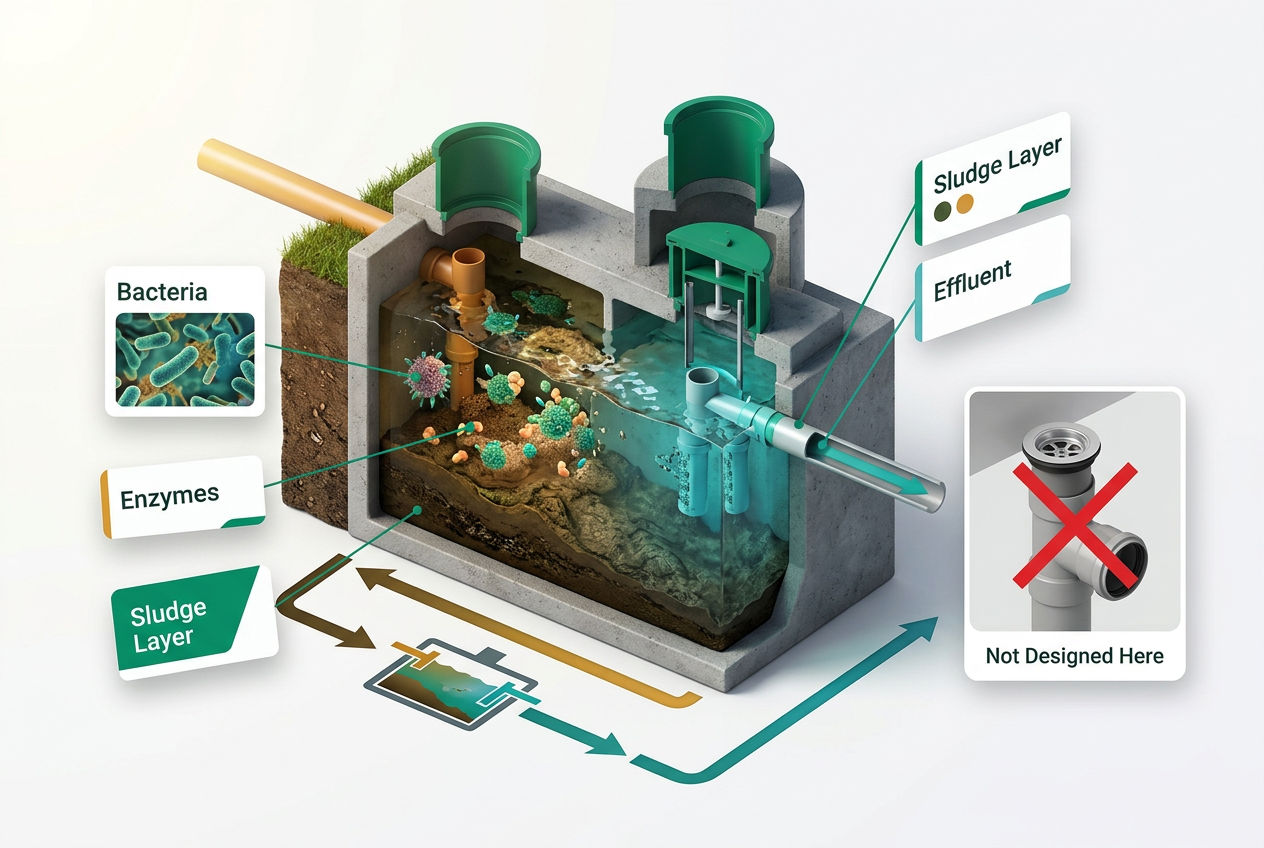
The manufacturer recommends one dose per month: either a 9.8-oz powder packet or a single liquid pouch, flushed down the toilet so it reaches the tank directly. That's the key phrase: reaches the tank. Rid-X is designed to work inside a 750- to 1,500-gallon concrete or fiberglass tank, where it has weeks to establish a thriving bacterial ecosystem. It's a solid product for what it's built to do. If you want the full breakdown, our Rid-X septic review covers the science in detail.
But clearing a clogged pipe? That's not in its job description — and Reckitt Benckiser never claims it is on any product label or marketing material.
Why Can't Rid-X Unclog a Drain? (And Can Rid-X Unclog a Drain at All?)
Short answer: no, Rid-X cannot unclog a drain. Three reasons explain why, and they stack on each other.
First, the timing is completely wrong. Bacterial colonies take 2–4 weeks to establish meaningful activity in a septic tank. A kitchen drain blocked by a grease clog or a toilet stopped up by a wad of paper isn't going to wait a month for microbes to multiply. You need a fix measured in minutes, not weeks.
Second, the mechanism doesn't match the problem. A clog in your sink drain or toilet trap is a physical obstruction — a compressed mass of grease, hair, soap scum, or waste jammed inside a 3- or 4-inch pipe. Rid-X's enzymes can gradually break down organic matter floating freely in liquid, but they're not powerful enough or fast-acting enough to penetrate and dissolve a dense, compacted blockage wedged inside a pipe.
Picture this: you've got standing water in your kitchen sink at 7 p.m., guests arriving at 8, and someone suggests pouring in Rid-X. That dose needs weeks of bacterial colonization before it does anything useful. By contrast, a $35 drum auger rental from the hardware store down the street solves the problem before your guests arrive. That gap — weeks vs. minutes — is the whole story.
Third, Rid-X never reaches the clog site in useful concentrations. If the drain is fully blocked, your Rid-X dose just sits on top of standing water — diluted, dispersed, and mostly wasted. If the drain is partially flowing, the product washes past the clog and ends up in the septic tank where it was supposed to go in the first place.
According to the University of Arkansas Cooperative Extension Service's review of biological septic additives, bacterial products contribute microbial populations to septic tanks but show no evidence of accelerating the breakdown of solid blockages in drain pipes. The EPA's septic system guidance similarly classifies these additives as tank maintenance products, not drain-clearing solutions.
For more on whether septic additives actually do what they claim, see our deep-dive: do septic additives work?
Can Rid-X Make a Clog Worse?
No — Rid-X won't physically worsen a clog. It's not corrosive and it won't damage your pipes or plumbing fixtures. Rid-X is pH-neutral and septic-safe, so physical harm to PVC, ABS, or cast-iron pipe isn't the concern.
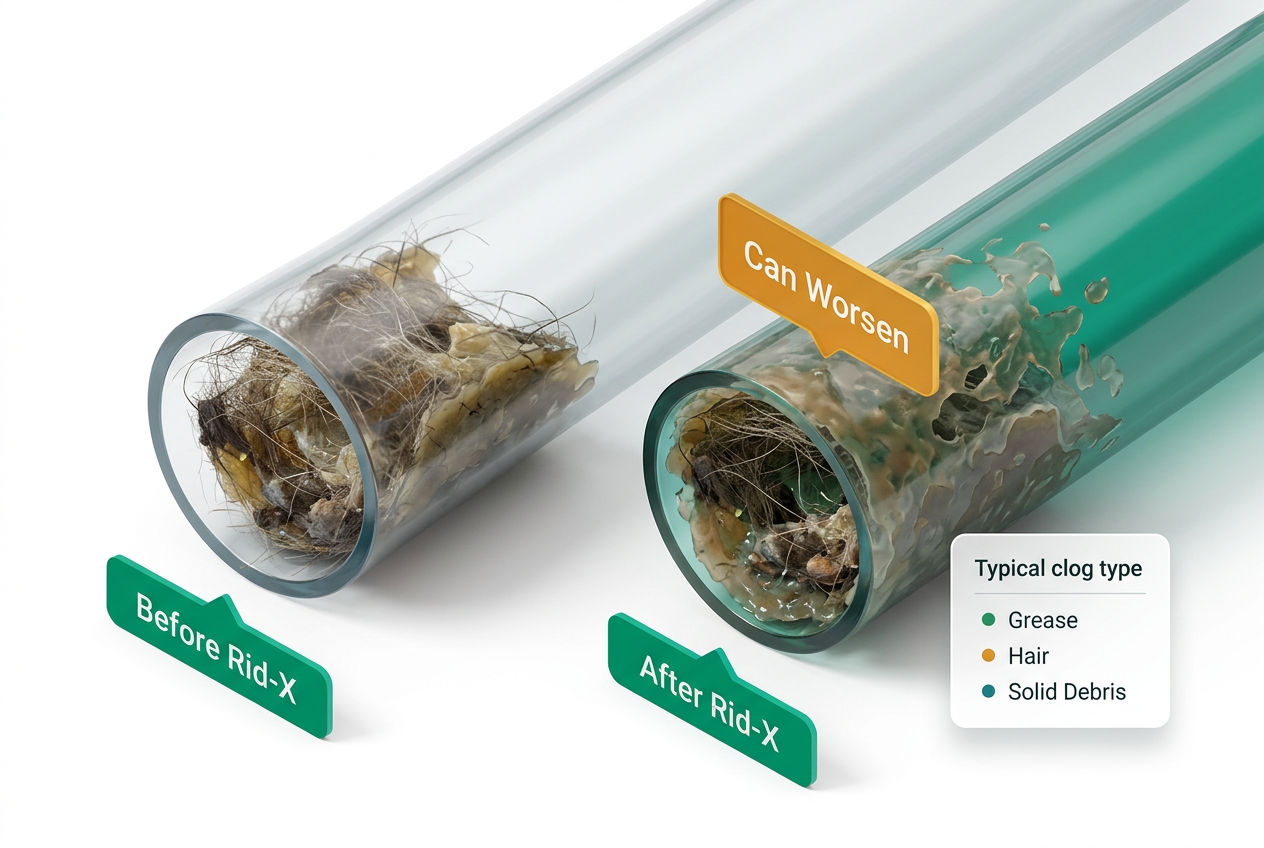
The real risk is delay. Every hour you spend hoping Rid-X will clear a backed-up toilet is an hour the clog sits, potentially getting worse as more water and waste back up behind it. If the root cause is a full septic tank or a failing drain field, that delay gives the system more time to overflow.
There's also a misdiagnosis problem. If you pour Rid-X into a drain, see minor improvement (because the drain was only partially blocked), and assume the product is working — you might not call a plumber until the clog is completely solid. That partial improvement is almost always coincidental; gravity and water pressure do more clearing work than the enzymes.
What Actually Unclogs Drains and Toilets?
A plunger, a drain snake, or a professional with a hydrojetter — those are your actual options. Here's the breakdown of what works, and when to use each approach.
| Solution | Best For | Typical Cost | Time to Work |
|---|---|---|---|
| Plunger | Toilet / simple sink clogs | $0 (you own one) | Minutes |
| Drain snake (DIY) | Hair, soft clogs in sink/tub | $30–$60 tool rental | 15–30 min |
| Professional snaking | Stubborn clogs, deep in line | $150–$250 service call | Same day |
| Hydrojetting | Grease buildup, tree roots | $300–$600 | Same day |
| Septic tank pumping | Full tank causing backups | $300–$600 nationally | Same day |
| Rid-X / bacterial additive | Septic tank maintenance | $10–$15/month | 2–4 weeks |
Cost data based on national averages from service provider surveys. Regional rates vary — Southeast markets average 10–15% below national figures while Northeast metro areas run 20–30% higher. See our septic pumping cost guide for location-specific pricing.
Worked example: A homeowner with a grease-clogged kitchen drain calls a plumber. The tech runs a 50-foot drum auger ($175 service call), breaks up the grease blockage, and restores full flow in 25 minutes. Total cost: $175. If instead that homeowner had purchased Rid-X monthly for the next three months while the clog worsened ($45 in product), they'd eventually pay the same service call — plus potentially a hydrojetting charge ($400) if the grease had hardened further into the line. The auger-first approach saves $270 and three months of frustration.
A standard mechanical snake physically grabs or breaks apart whatever is blocking the pipe. Hydrojetting uses pressurized water at 3,000–4,000 PSI to scour the inside of drain lines clean. Neither approach requires the clog to dissolve over weeks. They remove the obstruction now.
For toilets specifically, a flange plunger (the kind with the rubber flap that extends downward) creates a proper seal and generates the pressure needed to dislodge most clogs in 30 seconds. A regular cup plunger won't seal properly against a toilet bowl.
Is Rid-X Safe to Put Down a Kitchen Sink or Toilet?
Yes — it's physically safe. Rid-X won't corrode your pipes, won't kill your septic bacteria (it adds bacteria), and won't create a dangerous chemical reaction with anything in your drain. So if you've already poured some down the sink, don't panic.
"Safe to use" and "useful for this problem" are two different things. Pouring Rid-X into your kitchen sink when you have a grease clog does nothing for the actual blockage — it's the wrong tool for the job, even if it causes no harm.
One nuance worth knowing: if you're on municipal sewer (not a septic system), Rid-X provides zero benefit at all, not even the maintenance benefit it's designed for. Roughly 80% of U.S. homes connect to public sewer systems. If that's you and you've been buying Rid-X monthly, you've been spending money on a product that does nothing for your plumbing setup.
According to the EPA's Onsite Wastewater Treatment Systems Manual, approximately 21 million U.S. households — about 20% of the country — rely on septic systems. Everyone else is on municipal sewer, and Rid-X is irrelevant to their drains entirely.
Is Rid-X a Drain Cleaner? (Rid-X vs. Enzyme Drain Cleaners)
No — Rid-X is not a drain cleaner, and calling it a "rid x drain cleaner" is a category error that costs homeowners real money and time.
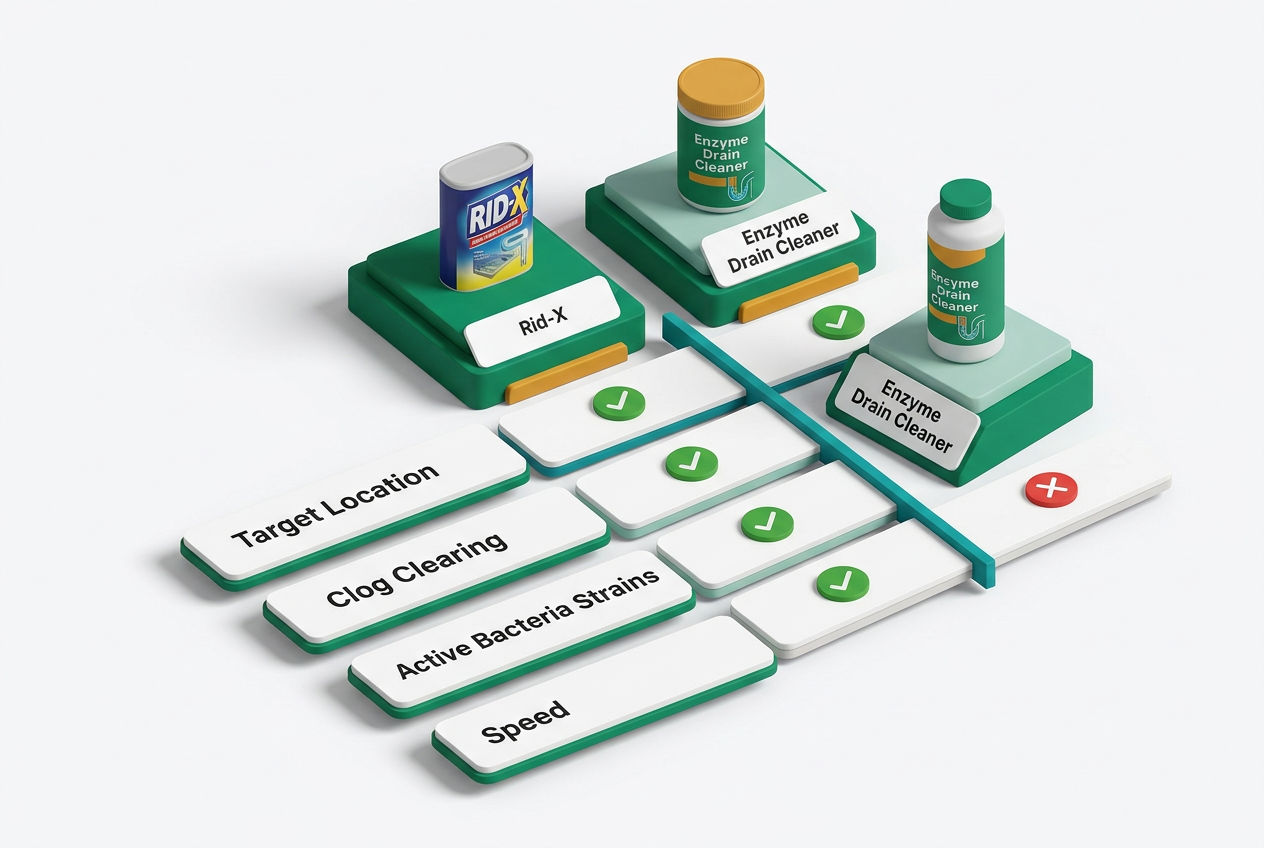
The confusion is understandable because Rid-X does contain enzymes, and there are products marketed as enzyme drain cleaners (like Bio-Clean, Green Gobbler Enzyme Drain Cleaner, or RootX) that are specifically formulated to work inside pipes. The difference is concentration, formulation, and delivery mechanism.
Products designed to clear drains contain enzyme concentrations optimized for contact with a localized clog, often in gel or foam form that clings to pipe walls. They're also tested and marketed for that specific purpose. Rid-X is formulated for a much larger volume — a 1,000-gallon septic tank — where its bacteria and enzymes spread throughout the entire tank environment. The dilution factor alone makes it ineffective for the concentrated, targeted action needed to break down a pipe clog.
For a comparison of products that are actually designed for drain clearing, our bio-clean septic review covers the differences in detail. If you want something enzyme-based that actually works on drains, look for products specifically labeled as enzyme drain cleaners — and check the label for the word "drain" in the intended use section. Better yet, pair an enzyme product with a drain snake for tough clogs.
When Slow Drains Signal a Septic Problem, Not a Pipe Clog
If multiple drains in your home are slow at the same time — say, the kitchen sink, a bathroom sink, and a toilet all draining poorly within the same week — you probably don't have three simultaneous pipe clogs. You likely have a septic system problem.
A full septic tank stops accepting new wastewater efficiently, which causes backpressure that slows every drain in the house simultaneously. A saturated drain field (common in Florida, coastal Georgia, and other high water table regions, especially after spring snowmelt or heavy rainfall) produces the same symptom. In both cases, snaking individual drains won't solve anything — the blockage is systemic, not localized.
This is where Rid-X is occasionally misused most harmfully. A homeowner notices multiple slow drains, reads that Rid-X "helps your septic system," and doses the tank — then waits. But if the tank is full or the field is failing, a bacterial additive cannot fix either problem. The tank needs pumping; the field may need evaluation by a licensed septic engineer.
Honest limitation worth stating plainly: no bacterial additive, including Rid-X, eliminates the need for periodic septic tank pumping. According to the EPA's septic guidance, tanks serving a family of four should be pumped every 3–5 years regardless of additive use. Rid-X can help maintain bacterial populations between pumpings — that's a real and legitimate benefit — but it cannot substitute for mechanical removal of accumulated solids.
For related reading, see our guides on signs your septic tank needs pumping and what to do when heavy rain affects your septic system.
What to Do Right Now If Your Drain Is Clogged
Stop adding product to the drain. Here's the decision sequence that actually resolves the problem:
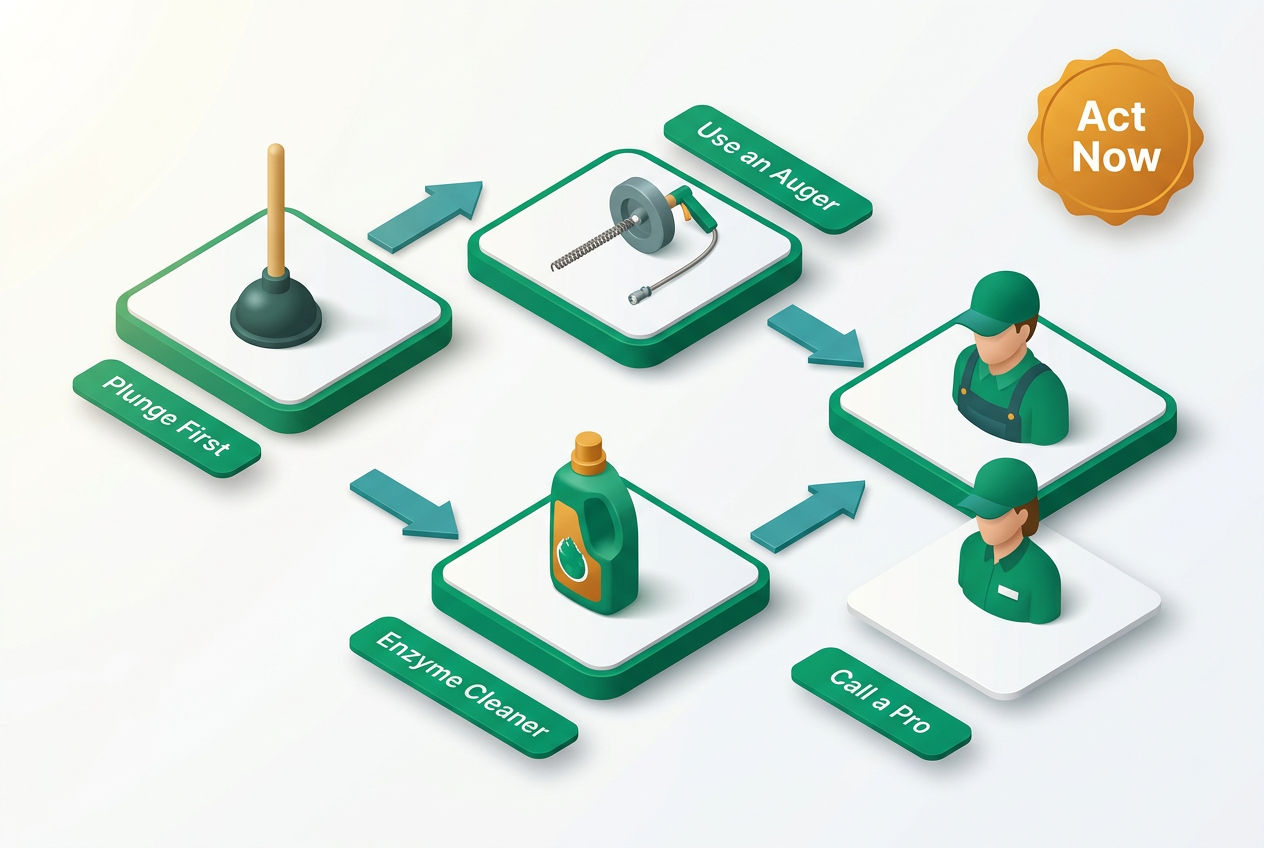
Step 1 — One drain slow or blocked? Start with a flange plunger (for toilets) or a cup plunger (for sinks). Apply 10–15 firm plunges. If the clog doesn't clear in two attempts, move to Step 2.
Step 2 — Snake it. Rent a drum auger ($30–$60) from any hardware store for sink and tub clogs. For toilets, use a closet auger specifically — it's shaped to navigate the toilet trap without scratching the bowl. A zip-it tool handles hair clogs near the drain surface in seconds.
Step 3 — Multiple drains slow? Stop using water in the house. Do not run laundry, dishwasher, or additional flushing. Call a licensed septic service — this is a system-level problem, not a pipe clog.
Step 4 — Sewage odors indoors? Treat this as an emergency. Sewage gases including hydrogen sulfide are a health hazard. Evacuate the affected area and call a plumber or septic service immediately.
Step 5 — Can't identify the cause? A professional septic inspection and pumping service will camera-inspect the line and identify whether the problem is in the pipe, the tank inlet baffle, or the drain field. This costs $150–$300 for the diagnostic component and is almost always worth it over repeated guessing.
Once your system has been inspected and pumped as needed, many homeowners ask whether a maintenance treatment makes sense going forward. If you decide to use one, the product we recommend is Septifix. Each tablet releases oxygen and 14 strains of live aerobic bacteria — around 10 billion CFU — directly into the tank, targeting odor and sludge buildup through a mechanism that goes beyond enzymes alone. One tablet flushed monthly runs roughly $3–$4 per treatment, and it comes with a 60-day money-back guarantee. That said, no additive replaces regular pumping, and the EPA's position is that a well-maintained system doesn't require them — the honest case for Septifix is maintenance support, not a fix for an active problem.
For more detail on septic biomat buildup or backing-up septic systems, those guides cover the next steps if your field is involved.
The Correct Use Case for Rid-X: Monthly Septic Maintenance
Rid-X does what it's supposed to do when used correctly — and what it's supposed to do is genuinely useful, just not for clogs.
Flush one dose down the toilet on the same day each month so it flows directly into the septic tank. The 9.8-oz powder packet is easiest for this. Don't pour it into a sink or floor drain; those routes may not deliver the product to the tank efficiently depending on your plumbing layout.
Used this way, Rid-X helps maintain the bacterial population inside the tank between professional pumpings. That means faster breakdown of organic solids, less sludge accumulation, and reduced odor. It's a reasonable maintenance supplement for the 21 million U.S. households on septic — just not a substitute for pumping, and absolutely not a drain-clearing product.
For guidance on timing and frequency, see how often to use Rid-X and our roundup of best septic tank treatments for comparisons with competing products.
If your system has backed up severely, emergency septic tank treatment covers what to do when you can't wait for a standard service appointment.
Related Rid-X & Septic Treatment Guides
- Aerobic Septic System Diagram: How Each Part Works
- Are Septic Tank Treatments Necessary?
- Best Septic Tank Treatment for Slow Drains
- Bio-Clean Septic Treatment Review: Does It Work?
- Cabin Obsession Septic Tank Treatment Review
- Camco Septic Tank Treatment Review
- Green Gobbler Septic Treatment Review: Pods, Packets & Results
- How Often Should You Use Rid-X? Directions, Dosing & Timing
- How to Handle How Often to Use Septic Tank Treatment: Step by Step
- Is Rid-X Safe for Septic Tanks, Toilets & Pipes?
- Is Septic Tank Smell Dangerous? Gases, Risks & When to Worry
- The Best Rid-X Alternatives
- Can You Use Rid-X in an RV Black Tank? What to Know First
- What's Actually in Rid-X? Ingredients Explained
- Rid-X vs. Green Gobbler: Which Septic Treatment Wins?
- Septic Tank Smell After Pumping? Causes & How to Fix It
- Septic Smell From Roof Vent? Causes & How to Fix It
- Septic Smell From Shower Drain? Causes & How to Fix It
- Septic Smell Coming From Toilet? Causes & How to Fix It
- Septic Smell When It Rains? Why It Happens & How to Fix It
- Septic System Diagram With a Pump
- Septic Tank Cross-Section Diagram: Every Part Labeled
- Septic Tank Diagram With Dimensions
- Yeast, Baking Soda & Milk in Your Septic Tank: Myths Tested
- Septic Tank Plumbing Diagram: From House to Drain Field
- The Best Septic Tank Smell Removers
- Septic Tank Treatments at Walmart vs. Home Depot vs. Online
- Septic Treatment Tablets vs. Powder vs. Liquid: Which Is Best?
- Where to Buy SeptiFix
- Rid-X Platinum Review: Is the Upgrade Worth It?
- Zep Septic Defense Review: Does It Beat Rid-X?
- The Best Septic Tank Sludge Dissolvers
- The Best Septic Treatment for Toilet Paper Breakdown
- Instant Power Septic Shock Review: Does It Work?
FAQ: Does Rid-X Unclog Drains?
Does Rid-X work for clogged drains?
No — Rid-X does not work for clogged drains, and it was never designed to. The product contains four enzymes (cellulase, lipase, protease, amylase) plus live bacterial cultures, but these require 2–4 weeks to establish meaningful activity inside a septic tank. A clogged drain is a physical obstruction — a compressed mass of grease, hair, or waste — that needs to be mechanically removed, not slowly digested by microbes. When you pour Rid-X into a blocked drain, it either sits on top of standing water doing nothing, or it washes past a partial clog and ends up in the septic tank where it was supposed to go anyway. For an actual clog, use a plunger, a drain snake (rentable for $30–$60), or call a plumber for a professional snaking service. Rid-X has a legitimate use — monthly septic tank maintenance — but drain clearing is not it.
Can Rid-X unclog a toilet?
No — Rid-X cannot unclog a toilet. The product is a septic tank additive manufactured by Reckitt Benckiser, and the company makes no claim on its label or in any marketing material that it clears toilet clogs. A toilet blockage is typically caused by a physical obstruction in the toilet trap or drain line — paper, waste, or a foreign object — that requires mechanical force to dislodge. A flange plunger (the style with the extended rubber flap) is the correct first tool; it creates a seal against the toilet bowl and generates the pressure needed to move most clogs within 30 seconds. If plunging fails, a closet auger — a toilet-specific drain snake with a protective sleeve — physically breaks apart or retrieves the blockage. Rid-X poured into a clogged toilet will simply sit in the standing water, dilute, and accomplish nothing. Use it only for monthly maintenance on a working septic system.
Is Rid-X the same as a drain cleaner?
No — Rid-X is not a drain cleaner, and the two product categories work in completely different ways. Rid-X is a biological septic tank additive: its enzymes and bacteria are formulated to spread throughout a 750–1,500 gallon tank over weeks and maintain the microbial ecosystem that processes waste. Enzyme drain cleaners — products like Bio-Clean or Green Gobbler Enzyme Drain Cleaner — are specifically formulated for pipe contact, with higher enzyme concentrations in gel or foam formats that cling to a localized clog inside a 3- or 4-inch drain line. The dilution math alone disqualifies Rid-X as a drain cleaner: a dose designed for 1,000 gallons of tank volume can't deliver concentrated enzymatic action to a 4-inch pipe. If you want an enzyme-based option for drains, look for products that specifically list "drain" in their intended use. Rid-X won't fill that role.
Will Rid-X help with a slow drain?
Rid-X will not fix a slow drain caused by a pipe clog. If your drain is running slowly, the cause is almost always a partial physical blockage — accumulated hair near the drain opening, grease buildup along the pipe walls, or soap scum narrowing the line. A zip-it tool (for hair near the surface), a drain snake, or a short burst of a real enzyme drain cleaner addresses the actual problem. Where Rid-X becomes relevant is a specific scenario: if multiple drains throughout your home are slow simultaneously, that can indicate a full septic tank backing up pressure into the system. In that case, Rid-X still isn't the answer — the tank needs to be pumped, typically every 3–5 years for a family of four according to EPA guidance. Rid-X is appropriate after pumping, as a monthly maintenance dose to rebuild the bacterial population in a now-empty tank.
Can you use Rid-X for clogged drains if you're on a septic system?
No — being on a septic system doesn't change the fact that Rid-X cannot clear a clogged drain. The clog lives in the drain pipe, not in the septic tank, and Rid-X's bacterial cultures need to reach and colonize the tank to be effective. Even if a small amount of Rid-X contacted the clog, it would take weeks to have any biological effect — far too slow for an active blockage. Homeowners on septic systems sometimes assume Rid-X has broad plumbing benefits because it's marketed as a septic product, but the product's action is tank-specific. What changes when you're on septic is your choice of drain cleaning products: avoid chemical drain cleaners like Drano or Liquid-Plumr that contain sodium hydroxide or sulfuric acid, as these can kill the beneficial bacteria in your tank. Instead, use a drain snake or a septic-safe enzyme drain cleaner specifically labeled for drain use, followed by your normal monthly Rid-X maintenance dose once the clog is cleared.
Sources & Methodology
-
U.S. Environmental Protection Agency — Septic Systems Overview, including the Onsite Wastewater Treatment Systems Manual. Used for septic system household count (21 million), recommended pumping frequency, and classification of bacterial additives as maintenance products.
-
University of Arkansas Cooperative Extension Service — Review of biological septic additives and their efficacy in drain pipe versus tank environments. Cited for conclusion that bacterial additives show no evidence of clearing solid drain blockages.
-
Reckitt Benckiser — Rid-X product label, dosing instructions, and manufacturer claims. Source for enzyme types, packet weight (9.8 oz), and recommended use (monthly tank maintenance via toilet flush).
-
Service provider cost data — National average figures for drain snaking ($150–$250), hydrojetting ($300–$600), and septic pumping ($300–$600) aggregated from licensed plumbing and septic service providers across U.S. regions. Regional adjustment ranges (Southeast 10–15% below average; Northeast metro 20–30% above) based on Bureau of Labor Statistics regional labor cost indices.
Free download
Not ready for the Handbook? Start with the free Fridge Card.
The Do / Don’t card the whole family can see, plus the Survival Kit: emergency flowchart, warning-sign decoder and pump-schedule card. One printable PDF.
Was this article helpful?
Frequently Asked Questions
Recommended Resources
📖 Related Articles
- Rid-X for Septic Tanks: Does It Help or Hurt?
- Do Septic Tank Additives Actually Work? (The Science)
- The Best Septic-Safe Drain Cleaners (and What to Never Pour In)
- Bio-Clean Septic Treatment Review: Does It Work?
- 8 Signs Your Septic Tank Needs to Be Pumped
- Heavy Rain and Septic Systems: What Happens and What to Do
- Septic Tank Biomat: What It Is and When It's a Problem
- Septic System Backing Up? Causes & Emergency Steps
- How Often Should You Use Rid-X? Directions, Dosing & Timing
- Do Septic Tank Treatments Actually Work?
- Emergency Septic Tank Treatment? Causes & How to Fix It
💰 Cost Guides
🔧 Services
Find Septic Professionals Near You
Compare licensed, verified septic companies by area — top county markets and cities below, or browse all 50 states.
County markets
Popular cities
