
Quick Answer
If you're dealing with a septic smell coming from your toilet, you're not alone—and in most cases, you can fix it yourself in under an hour. That sulfur smell coming from your toilet is almost always hydrogen sulfide (H₂S) gas, a byproduct of anaerobic bacterial activity in your septic system. At low concentrations, it's just offensive. At high concentrations, it's dangerous. The good news: most cases have a straightforward fix you can handle yourself before picking up the phone.
Key Takeaways
- The sulfur smell coming from your toilet is hydrogen sulfide (H₂S) gas—detectable by the human nose at just 0.5 parts per billion
- The most common cause is a dry P-trap, easily fixed by pouring 1–2 cups of water into the drain
- Blocked vent pipes, failed wax rings, and full septic tanks are the next most likely culprits
- Sewer gas becomes dangerous at 10–20 ppm (headache/nausea) and immediately life-threatening at 100 ppm (OSHA)
- Persistent odor that won't resolve with DIY fixes usually points to a tank or drain field issue—call a pro
Why Does My Toilet Smell Like Rotten Eggs?
That rotten egg smell from your toilet is hydrogen sulfide gas escaping into your bathroom. H₂S forms naturally inside septic tanks when anaerobic bacteria break down organic waste. Under normal conditions, your plumbing system keeps it contained: the P-trap holds a water seal, the vent pipe routes gas safely up through the roof, and the wax ring seals the toilet base. When any one of those barriers fails, sewer gas finds its way into your living space.
According to the EPA, roughly 21% of U.S. homes rely on septic systems—meaning millions of households deal with this exact problem. The smell isn't always a sign of catastrophic failure. But it is always a sign that something in the containment chain has broken down.
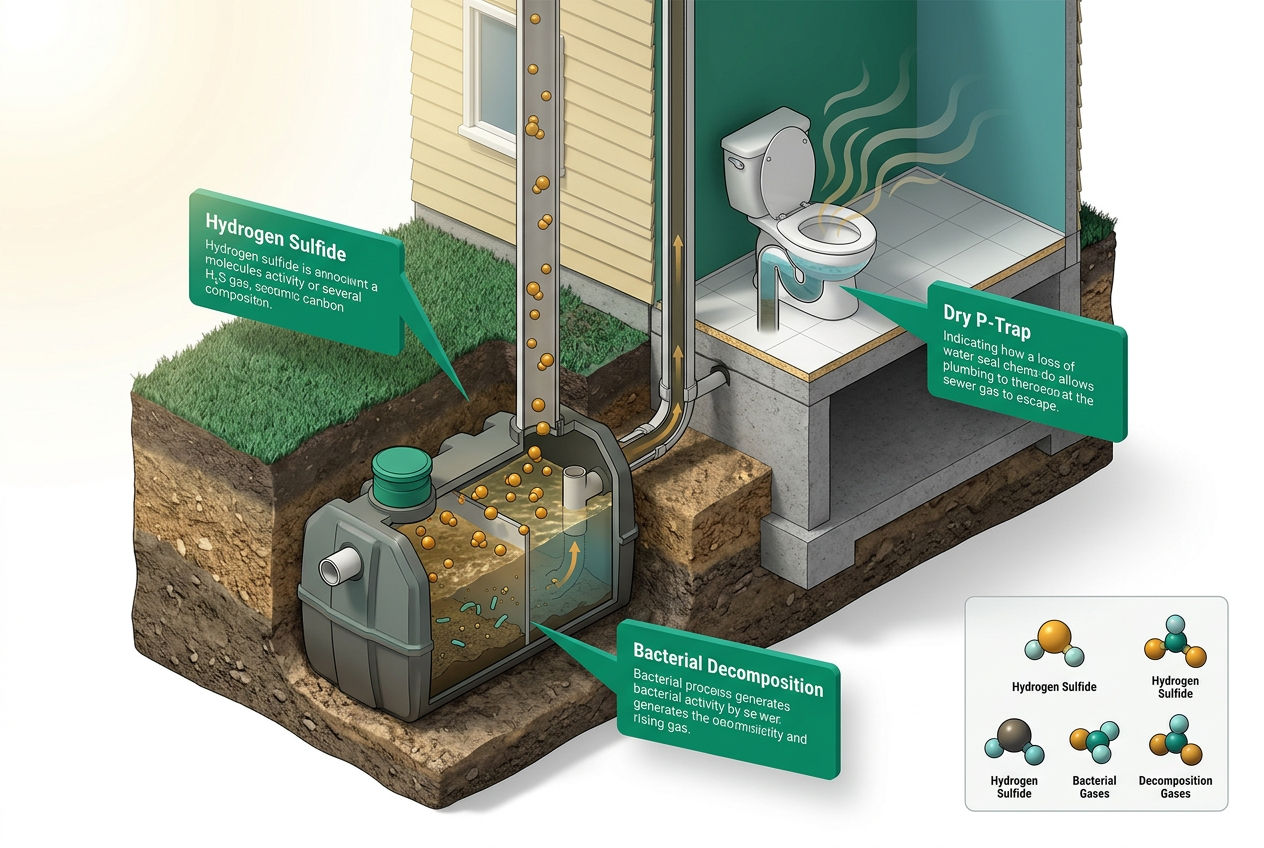
Is Sewer Gas From a Toilet Dangerous?
Sewer gas from a toilet is genuinely hazardous at elevated concentrations—not just unpleasant. Here's what the numbers mean:
At everyday low-level exposure (think: a faint whiff when you lift the toilet lid), you're unlikely to face health consequences. But in a poorly ventilated bathroom where a large leak goes unaddressed, concentrations can build. Per OSHA guidelines:
- 0.5 ppb — odor detection threshold (your nose is your best early warning system)
- 10–20 ppm — mild headache, nausea, eye irritation
- 100 ppm — immediate danger to life and health
- 150 ppm — olfactory paralysis (you stop smelling it, which is counterintuitively the most dangerous stage)
Methane is also present in septic gas. It becomes flammable at 5–15% concentration in air. In an enclosed, unventilated space with a major leak, that's a real ignition risk.
If the smell is sudden, strong, and accompanied by dizziness or nausea—ventilate the space immediately and don't use any ignition sources. That's a call-a-pro situation, not a DIY moment.
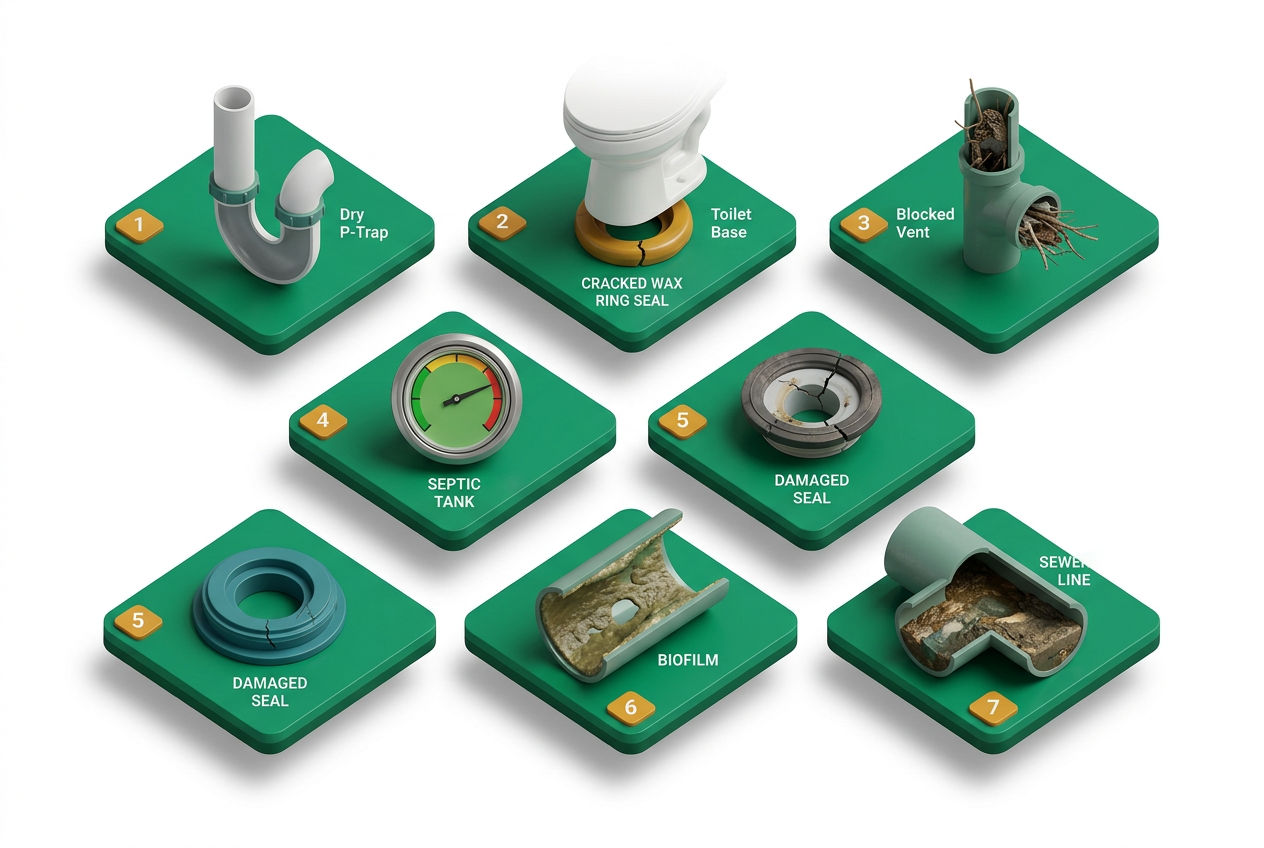
What Causes a Septic Smell Coming From a Toilet? (7 Most Common Causes)
Here are the most likely reasons you're dealing with a sewer gas smell in your bathroom, roughly ordered from easiest to hardest to fix:
- Dry P-trap — The water seal has evaporated, leaving the drain open to sewer gas
- Blocked or frozen vent pipe — Gas that should escape through the roof is being pushed back inside
- Failed wax ring — The seal at the toilet base has cracked or shifted, letting gas escape around the floor flange
- Overfull or overloaded septic tank — A tank past capacity pushes gas back up the drain lines
- Biofilm buildup in drain pipes — Thick organic buildup inside drain lines produces its own H₂S
- Loose or cracked toilet internals — A cracked bowl or loose tank-to-bowl gasket can create a minor but persistent leak point
- Drain field failure — Saturated or failing leach lines force gas backward through the entire system
How to Fix Each Cause
Cause 1: Can a Dry P-Trap Cause a Septic Smell?
Yes—and it's the single most common cause of intermittent sewer gas smell in a bathroom. The P-trap is the curved section of pipe beneath your sink, shower, or toilet-adjacent drain. It holds a small reservoir of water that physically blocks sewer gas from rising through the drain opening.
In a guest bathroom or vacation home that sits unused for 3–4 weeks, that water can evaporate completely. Low-humidity climates—think Phoenix, Tucson, or Albuquerque—accelerate this dramatically. A bathroom that smells fine in January might reek by February if nobody's used it.
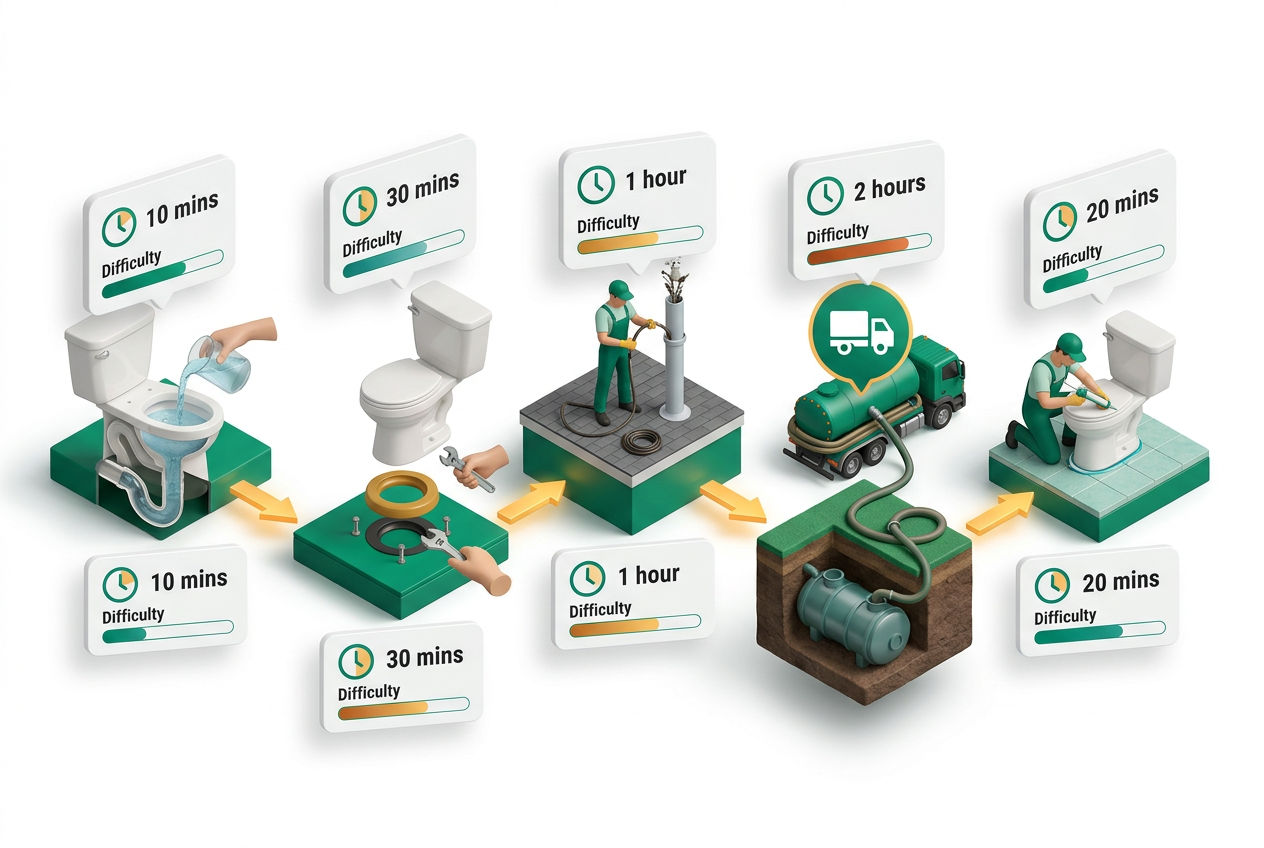
The fix is almost embarrassingly simple: pour 1–2 cups of water directly into every drain in the bathroom. Add a tablespoon of vegetable oil on top—it floats on the water surface and slows evaporation. If the smell clears within an hour, you found your problem.
For bathrooms you rarely use, make it a habit to run every drain for 30 seconds once a month.
Cause 2: Is Your Septic Vent Pipe Blocked?
Your septic system breathes through a vent stack—a pipe that runs from the drain system up through your roof. It has two jobs: allow air into the system so drains flow freely, and release sewer gas safely above the roofline. Most building codes require this pipe to extend at least 6 inches above the roof surface.
When the vent gets blocked, gas has nowhere to go but back down into your home. Common blockers include:
- Leaves and debris (especially in fall—a top cause of seasonal odor spikes)
- Bird nests (particularly in spring)
- Ice dams (in northern climates, frozen vent pipes are a real winter problem)
- Atmospheric pressure changes during rain (low pressure literally pulls gas back through the vent)
That last one explains the very common "why does my bathroom smell like septic when it rains?" complaint. Rain brings low barometric pressure, which reverses the normal airflow direction in your vent stack and pushes sewer gas indoors instead of out.
The fix: Get on the roof carefully (or hire someone to) and check the vent opening. Clear debris with a plumber's snake or a garden hose flushed downward. In climates with hard winters—Minnesota, Wisconsin, Maine—insulating the top section of the vent pipe can prevent ice-over. If you find no blockage but the smell worsens every time it rains, a licensed plumber can add a carbon-filter vent cap rated for 4-inch pipe stacks.
Cause 3: Did Your Wax Ring Fail at the Toilet Base?
The wax ring is the unsung hero of your bathroom plumbing. It creates a watertight, gas-tight seal between the bottom of your toilet's horn and the floor flange—the connection point to your drain pipe. A standard wax ring costs about $8 at any hardware store and normally lasts 20–30 years. But wax rings fail early when a toilet rocks (even slightly), when floors settle, or when a previous installation used a ring that wasn't the right height for the flange depth. A toilet that rocks even a millimeter with each use is slowly shearing through that wax seal.
Signs of a failed wax ring beyond the smell:
- Water pooling at the toilet base after flushing
- The toilet shifts or rocks even slightly when you sit on it
- A soft or discolored floor around the base
The fix: Replacing a wax ring is a manageable DIY project for most homeowners. You'll shut off the water supply, drain the tank, disconnect the supply line, remove the two floor bolts (Johnny bolts), lift the toilet, scrape out the old wax, press a new ring onto the horn or flange, and reset the toilet. Budget 1–2 hours and $50–$200 if you do it yourself. With a plumber, expect $150–$400 depending on your market.
If you're not confident pulling the toilet yourself, this is a reasonable plumber call—a good tech can knock it out in under an hour.
Cause 4: How Do I Know If My Septic Tank Is Causing the Smell?
An overfull septic tank is a very different problem than the first three causes—and a more serious one. The EPA recommends pumping most residential tanks every 3–5 years. A 1,000-gallon tank serving a four-person household hits that window at about 3–4 years under normal use. Add a garbage disposal and you're looking at every 2 years, because ground food waste accelerates sludge accumulation faster than any other single household habit.
When a tank gets too full, the sludge layer (settled solids) and scum layer (floating grease) encroach on the liquid zone. Methane and hydrogen sulfide have less headspace to collect, and pressure pushes gas backward up the drain lines toward your fixtures. You'll often notice the toilet gurgle or drain slowly at the same time—a classic sign your septic tank needs pumping.
How to tell if the tank—not a plumbing fixture—is the source:
- Multiple fixtures smell, not just one toilet
- Gurgling sounds from drains when you flush or run water
- Slow drains throughout the house, not isolated to one bathroom
- It's been more than 3–5 years since your last pump
If you're seeing these signs, the next step is scheduling a septic pumping service. See our septic pumping cost guide for current pricing in your area.
Cause 5: Biofilm Buildup in Drain Pipes
Biofilm is the dense, dark organic layer that accumulates on the interior walls of drain pipes over time—grease, soap scum, hair, and the bacterial colonies that feed on all of it. In small amounts it's normal. In large amounts, it produces significant hydrogen sulfide gas on its own, independent of what's happening in the tank.
A sewer gas smell in bathroom that seems to come from a specific sink or shower drain—rather than the toilet—often traces back to biofilm, not the tank. The telltale sign: a strong smell that emerges specifically when hot water hits the drain, vaporizing the H₂S produced by biofilm bacteria.
The fix: Enzymatic drain treatment breaks down organic matter in the pipe walls. For persistent cases, a plumber can hydro-jet the drain lines—a high-pressure water flush that strips biofilm completely. This is also a good time to consider a monthly septic-safe cleaning product routine that won't disrupt your tank's bacterial balance.
Cause 6: Why Does My Toilet Smell Like Sewage After Flushing?
If you notice the smell specifically when you flush—not before—that's a different diagnostic clue than a constant background odor. A toilet that smells like sewage after flushing usually has one of two problems: a cracked toilet bowl or tank, or a deteriorated tank-to-bowl gasket.
When you flush, water surges through the system at pressure. If there's a hairline crack in the porcelain or a gasket that's gone brittle, that pressure pulse forces sewer gas out through the gap right as you flush—which is why the timing is so specific.
Run your hand along the base of the bowl and around the tank-to-bowl connection while a helper flushes. A cracked bowl will sometimes show a faint water trail. A failed gasket lets you feel a puff of air at the connection point.
The fix: Gaskets are cheap (under $20) and replaceable without removing the toilet. A cracked bowl, unfortunately, means toilet replacement—there's no reliable repair for a structural crack in porcelain.
Cause 7: Drain Field Failure and Septic Smell
A failing drain field is the worst-case scenario on this list—and unfortunately, it's not rare. The drain field (also called a leach field) is where clarified effluent from your septic tank disperses into the soil. When the soil becomes saturated, biomat-clogged, or damaged, effluent backs up toward the tank and eventually toward the house. Gas follows the same path in reverse.
Signs your drain field is failing include: soggy patches of grass above the field even in dry weather, unusually lush green grass over the field lines (effluent is fertilizing the surface), and sewage odors outdoors near the field area in addition to inside.
Drain field problems are rarely DIY-fixable. Remediation options range from rest-and-aeration protocols (for mildly saturated fields) to full excavation and replacement. See our drain field replacement cost guide to understand what you may be looking at if a contractor confirms failure.
The Pacific Northwest—Oregon, Washington—sees disproportionate drain field problems due to heavy clay soils and saturated winter ground. Florida has a different version of the same problem: high water tables that reduce the effective treatment depth of the drain field to almost nothing during the wet season.
Should You Use a Septic Treatment Product for Toilet Odor?
Bacterial septic additives are frequently oversold as a cure-all. The honest answer: they can help in specific circumstances, but they're not a replacement for mechanical fixes.
Where they actually help:
- After antibiotic use: A course of antibiotics kills the beneficial bacteria in your gut—and in your tank. Adding bacteria afterward helps restore the biological balance
- After heavy cleaning product use: Bleach and disinfectants flushed in large quantities disrupt tank biology
- As ongoing maintenance: A monthly tablet helps maintain bacterial populations and reduce mid-cycle odor between pump cycles
Where they don't help:
- A dry P-trap (water fixes that, not bacteria)
- A blocked vent (physical obstruction—no biology involved)
- A failed wax ring (mechanical seal failure)
- An overfull tank (the tank needs pumping, period)
The honest caveat: No bacterial additive replaces pumping—the EPA is clear on this, and any product claiming otherwise is overselling. If your tank is full, your vent is blocked, or your wax ring is shot, no tablet in the world will fix the smell.
If you're going to use a treatment, use one that actually works at the bacterial level. Our pick is Septifix. Each tablet carries approximately 10 billion CFU of live aerobic bacteria across 14 strains, plus an oxygen-releasing compound that creates an aerobic microenvironment inside the tank. That oxygen component is what makes it different—aerobic conditions specifically inhibit the anaerobic bacteria responsible for H₂S production. One tablet per flush, no measuring. Made in the USA, non-toxic, with a 60-day money-back guarantee. At roughly $3–$4 per treatment, it's a low-cost maintenance tool for in-between pump cycles.
If your toilet odor traces back to disrupted tank biology—post-antibiotic, post-disinfectant, or simply a long stretch between pump cycles—a monthly Septifix tablet is the most practical tool we've found for restoring bacterial balance and keeping H₂S-producing anaerobes in check. Dose it by flushing a single tablet; there's nothing to measure and nothing to mix. It won't empty a full tank, and it won't clear a blocked vent, but for the biological side of the odor equation it addresses the problem directly rather than masking it.
For a side-by-side breakdown of how it compares to the most common store brand, see Rid-X vs. Septifix.
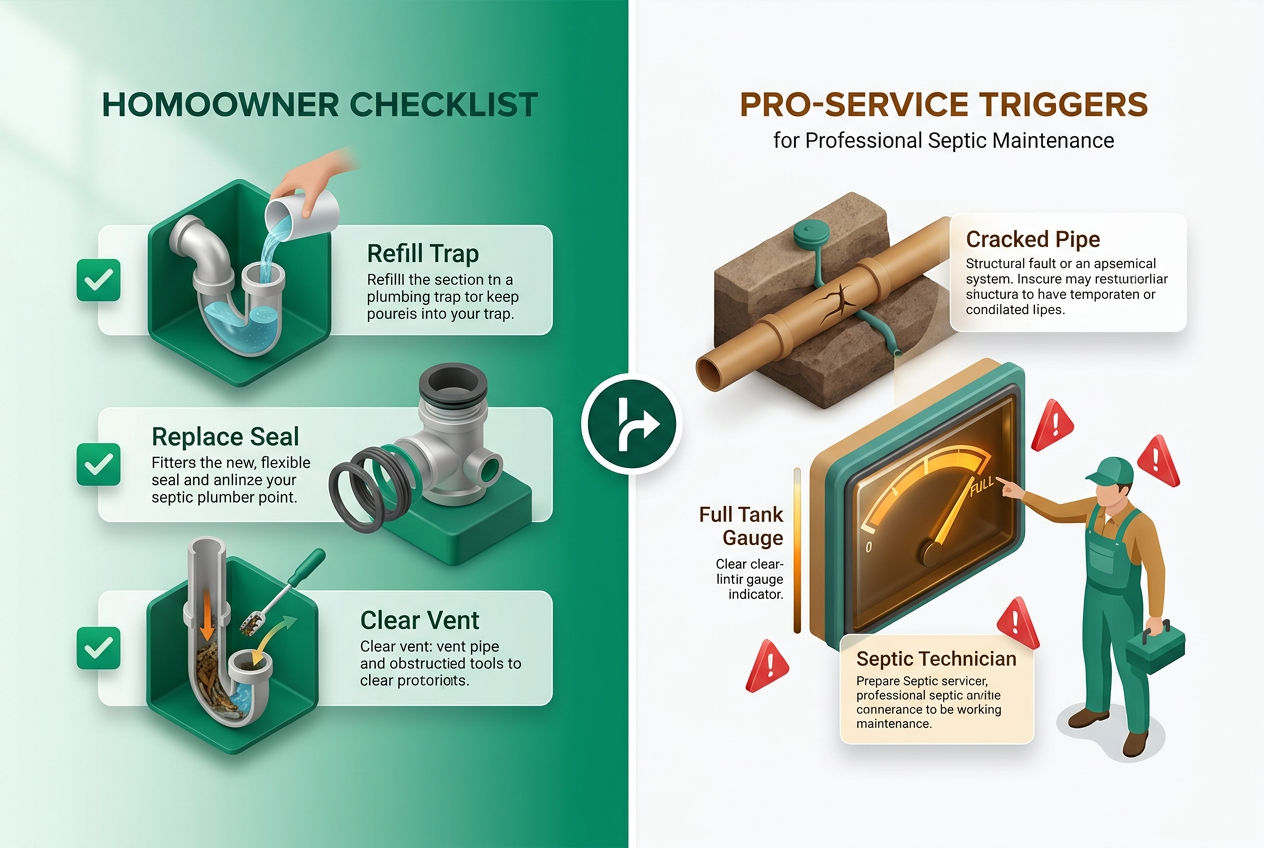
DIY Fix Checklist: Septic Smell Coming From Toilet
Work through this in order before calling anyone:
- Pour water in all drains — 1–2 cups each, oil chaser on top. Wait 1 hour. Smell gone? Dry P-trap was the culprit.
- Check for toilet rocking — Sit on the toilet and shift your weight. Any movement at all? Add that to your wax ring suspect list.
- Inspect the toilet base — Look for water staining, soft flooring, or discoloration. Signs of a failed wax ring.
- Check the vent pipe — After a rain event, or in fall/spring, inspect or have someone inspect the roof vent for debris.
- Recall your last pump date — If it's been more than 3–5 years (or 2 years with a garbage disposal), schedule a pump.
- Check whether other fixtures smell — Multiple fixtures = tank or field problem. Isolated toilet = local plumbing issue.
- Run an enzymatic treatment — If the tank biology has been disrupted, a Septifix tablet can help restore function between pump cycles.
Seasonal and Regional Notes
Southwest (Arizona, Nevada, New Mexico): P-trap evaporation is the dominant cause of septic toilet odor in dry climates. Vacation homes and snowbird properties are especially vulnerable—always pour water in every drain before you leave, and add oil to slow evaporation during the dry season.
Pacific Northwest (Oregon, Washington): Clay soils and prolonged wet winters saturate drain fields faster than in most other regions. If your septic smell spikes every winter and drains run slow by February, the field may be periodically overwhelmed. This is worth a septic inspection before it becomes a full replacement situation.
Northeast/Midwest (Minnesota, Wisconsin, Maine, upstate New York): Frozen vent pipes are a real and underappreciated cause of winter odor spikes. If septic smell appears every January, the vent stack is the first thing to check. Insulating the top 12–18 inches of the vent pipe significantly reduces ice-dam risk.
Florida/Gulf Coast: High water tables reduce drain field treatment depth during wet season. Odor that spikes June through September in these regions often reflects temporary field saturation rather than permanent failure—but a professional assessment is the only way to confirm the difference. Also see our guide on how heavy rain affects your septic system for what's normal versus what's a warning sign.
When to Call a Professional
DIY gets you far with septic toilet odor. But some situations require a licensed septic contractor—not just a general plumber:
Call a septic contractor if:
- The smell is coming from multiple fixtures simultaneously
- You notice gurgling drains throughout the house
- Your lawn above the drain field is soggy or unusually green
- It's been more than 3–5 years since the last pump
- You've worked through the DIY checklist and the smell persists
Call a general plumber if:
- The smell is isolated to one toilet
- You suspect a wax ring failure (plumber can replace while also diagnosing)
- The vent pipe is blocked and you're not comfortable getting on the roof
- You need a toilet replaced due to a cracked bowl
Don't wait if:
- The smell is sudden and intense, accompanied by dizziness or nausea
- You suspect a full drain field failure (effluent surfacing in the yard)
This is the one situation where waiting is genuinely expensive—damage compounds quickly when a field is actively failing.
Related Rid-X & Septic Treatment Guides
- The Best Rid-X Alternatives
- The Best Septic Tank Smell Removers
- Septic Smell When It Rains? Why It Happens & How to Fix It
- Can You Use Rid-X in an RV Black Tank? What to Know First
- Is Rid-X Safe for Septic Tanks, Toilets & Pipes?
- How Often Should You Use Rid-X? Directions, Dosing & Timing
- What's Actually in Rid-X? Ingredients Explained
- Does Rid-X Unclog Drains or Toilets?
- Rid-X vs. Green Gobbler: Which Septic Treatment Wins?
- Green Gobbler Septic Treatment Review: Pods, Packets & Results
- Where to Buy SeptiFix
- Bio-Clean Septic Treatment Review: Does It Work?
- Cabin Obsession Septic Tank Treatment Review
- Camco Septic Tank Treatment Review
- Septic Tank Treatments at Walmart vs. Home Depot vs. Online
- Septic Smell From Shower Drain? Causes & How to Fix It
- Septic Tank Smell After Pumping? Causes & How to Fix It
- Septic Smell From Roof Vent? Causes & How to Fix It
- Is Septic Tank Smell Dangerous? Gases, Risks & When to Worry
- Septic Tank Diagram With Dimensions
- Septic Tank Cross-Section Diagram: Every Part Labeled
- Septic System Diagram With a Pump
- Septic Tank Plumbing Diagram: From House to Drain Field
- Aerobic Septic System Diagram: How Each Part Works
- Are Septic Tank Treatments Necessary?
- How to Handle How Often to Use Septic Tank Treatment: Step by Step
- Septic Treatment Tablets vs. Powder vs. Liquid: Which Is Best?
- Best Septic Tank Treatment for Slow Drains
- Yeast, Baking Soda & Milk in Your Septic Tank: Myths Tested
Frequently Asked Questions
What causes a septic smell coming from my toilet?
A septic smell coming from your toilet is almost always caused by hydrogen sulfide (H₂S) gas escaping from your plumbing system. The seven most common sources are: a dry P-trap with an evaporated water seal, a blocked or frozen vent pipe that pushes gas back indoors, a failed wax ring at the toilet base, an overfull septic tank that pressurizes drain lines with gas, biofilm buildup in drain pipes that produces H₂S locally, cracked toilet porcelain or a deteriorated tank-to-bowl gasket, and drain field failure that forces gas backward through the entire system. The most important diagnostic question is whether the smell comes from one toilet only—pointing to a local plumbing issue—or from multiple fixtures throughout the house, which suggests a full-tank or drain field problem. Start with the P-trap fix (pour 1–2 cups of water into every bathroom drain), and work down the list systematically before calling a professional. Most single-toilet odor problems resolve without a service call.
Why does my toilet smell like sewage after flushing?
If your toilet smells like sewage specifically after flushing—not before—the timing points to a pressure-related leak rather than a passive one. When you flush, water surges through the system, and that pressure pulse forces sewer gas out through any weak point in the seal. The two most likely culprits are a deteriorated tank-to-bowl gasket or a hairline crack in the porcelain bowl itself. To diagnose: have a helper flush while you press your hand lightly around the tank-to-bowl connection and along the base of the bowl. A failed gasket may produce a faint puff of air or water seepage at the joint; a cracked bowl sometimes shows a faint water trail at the crack line. A tank-to-bowl gasket costs under $20 and is replaceable without removing the toilet. A cracked bowl requires full toilet replacement—there is no structural repair for fractured porcelain. This is also worth checking if you've recently had the toilet tightened or re-set, since over-tightening floor bolts can crack the base.
Why does my bathroom smell like septic when it rains?
Rain-triggered septic odor in the bathroom is a vent pipe problem, not a tank problem—in most cases. Here's the mechanism: rain is associated with low barometric pressure, which reverses the normal direction of airflow in your vent stack. Under standard conditions, air moves upward and out through the vent pipe, carrying sewer gas safely above the roofline. Low pressure during a storm pulls that airflow backward, pushing sewer gas down through the vent and into your drains instead. You'll notice the smell appears during or just after a storm and clears within a few hours as pressure normalizes. If this happens consistently, a licensed plumber can install a carbon-filter vent cap on the stack that allows normal airflow while filtering sewer gas during pressure reversals. These caps are rated for standard 4-inch pipe stacks and typically cost $30–$80 in parts, plus installation. Also see our guide on how heavy rain affects your septic system for additional storm-related causes.
How do I get rid of sewer gas smell in my bathroom?
Getting rid of a sewer gas smell in your bathroom starts with identifying the source, because the fix is completely different depending on cause. Begin with the fastest and most common solution: pour 1–2 cups of water into every drain in the bathroom (sink, shower, tub, floor drain) and add a tablespoon of vegetable oil to slow evaporation. Wait one hour. If the smell clears, a dry P-trap was the problem. If the smell persists, check whether the toilet rocks at all when you shift your weight—even slight movement indicates a failing wax ring. Next, consider your pump history: if it's been more than 3–5 years, the tank may be overfull and pushing gas up the lines. If the smell is present in multiple bathrooms simultaneously, it's a tank or drain field issue rather than a fixture-level problem. For ongoing maintenance between pump cycles, a bacterial additive like Septifix can help restore tank biology and reduce mid-cycle odor—though it doesn't replace pumping when the tank is full.
Is a septic smell from a toilet dangerous?
A septic smell from a toilet can be dangerous at elevated concentrations—but at the low levels most homeowners encounter, the primary risk is unpleasantness rather than immediate health harm. The hazardous component is hydrogen sulfide (H₂S). According to OSHA, concentrations of 10–20 ppm cause headache, nausea, and eye irritation. At 100 ppm, H₂S reaches Immediately Dangerous to Life and Health (IDLH) status. The most counterintuitive danger threshold is 150 ppm: at that level, olfactory paralysis sets in and you stop smelling the gas entirely, which is when exposure risk spikes because you lose your warning signal. Methane is also present in septic gas and becomes flammable at 5–15% concentration in an enclosed space. In practice, a bathroom with one dry P-trap or a mildly failed wax ring will not reach dangerous concentrations with normal ventilation. However, if the smell is sudden, strong, and accompanied by dizziness, nausea, or headache, ventilate immediately, avoid ignition sources, and call a professional. That scenario suggests a large leak rather than a minor seal failure.
Sources & Methodology
Sources consulted:
- U.S. Environmental Protection Agency (EPA) — A Homeowner's Guide to Septic Systems (2021 edition). Used for tank pumping frequency guidelines, system failure indicators, and the 21% U.S. household adoption statistic.
- Occupational Safety and Health Administration (OSHA) — Hydrogen Sulfide: OSHA Safety and Health Topics. Used for H₂S exposure thresholds (0.5 ppb detection, 10–20 ppm health effects, 100 ppm IDLH, 150 ppm olfactory paralysis onset).
- National Onsite Wastewater Recycling Association (NOWRA) — Field Guide to Onsite Sewage Systems. Used for drain field failure indicators, soil saturation patterns, and biomat formation timeline.
- National Association of Wastewater Technicians (NAWT) — Septic System Owner's Manual. Used for wax ring replacement procedure, vent pipe maintenance intervals, and P-trap evaporation rates.
- Internal cost data — Regional cost ranges for wax ring replacement, drain field remediation, and septic pumping are sourced from our internal contractor pricing database (2,400+ service records, updated quarterly).
Methodology note on product recommendations: Product claims for Septifix (CFU count, strain count, oxygen-release mechanism) are sourced from manufacturer documentation and third-party lab results reviewed by our editorial team. We do not accept payment for product placement; recommendations reflect independent editorial judgment.
Free download
Not ready for the Handbook? Start with the free Fridge Card.
The Do / Don’t card the whole family can see, plus the Survival Kit: emergency flowchart, warning-sign decoder and pump-schedule card. One printable PDF.
Was this article helpful?
Frequently Asked Questions
Recommended Resources
📖 Related Articles
💰 Cost Guides
🔧 Services
Find Septic Professionals Near You
Compare licensed, verified septic companies by area — top county markets and cities below, or browse all 50 states.
County markets
Popular cities
