
Quick Answer
Can you put yeast in a septic tank to help break down waste? No — and the same goes for baking soda treatments and milk. A standard yeast packet introduces fermentation organisms that produce the wrong enzymes for septic digestion, get outcompeted by existing bacteria, and die off within days. Baking soda is safe in tiny amounts but ineffective as a treatment. Milk's biochemical oxygen demand is roughly 500 times higher than normal wastewater and can stress your drain field. None of these pantry remedies replace pumping every 3–5 years.
Key Takeaways
- A packet of active dry yeast contains ~69 billion yeast cells but produces the wrong enzymes for septic waste breakdown
- Baking soda is safe in small amounts (1–2 tablespoons per week) but large doses can throw off the 6.5–7.5 pH range your tank needs
- Whole milk has a BOD of ~100,000 mg/L — roughly 500 times higher than normal wastewater — and can overwhelm your drain field
- The EPA states that additives are unnecessary for a properly maintained system
- Regular pumping every 3–5 years is the only proven maintenance method; no pantry remedy replaces it
How Does a Septic Tank Actually Work?
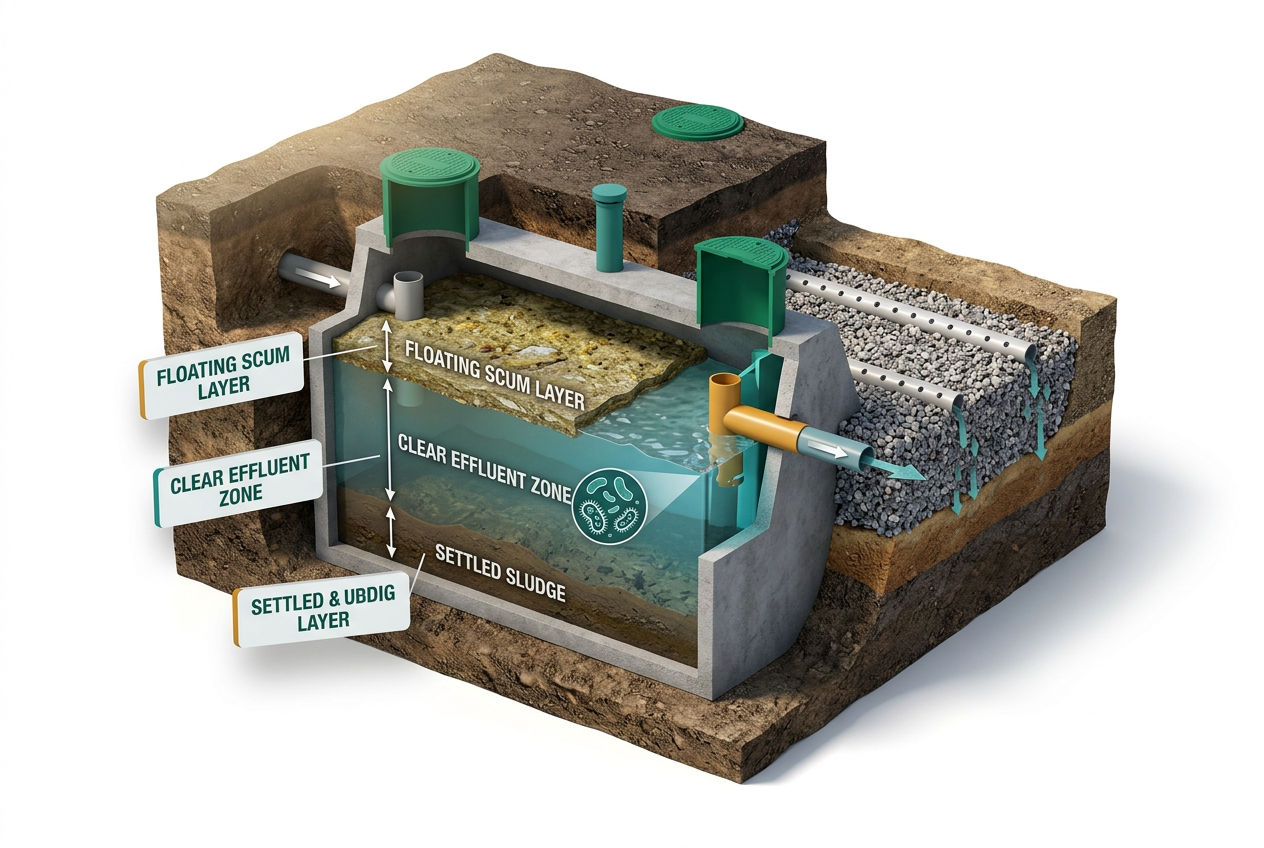
A conventional septic tank is a sealed underground chamber — typically 1,000 to 1,500 gallons for a 3–4 bedroom home — where wastewater separates into three layers. Solids sink to form a sludge layer at the bottom. Grease floats to form a scum layer at the top. The liquid in the middle, called effluent, flows out through the baffle wall into your drain field.
The real work happens through anaerobic digestion: billions of anaerobic bacteria break down organic solids without oxygen. A healthy 1,000-gallon tank holds roughly 3.8 million milliliters of liquid. At typical bacterial concentrations, that's trillions of bacteria already on the job. These microbes produce proteases (to break down proteins), lipases (to break down fats), and cellulases (to break down plant matter).
Every home remedy we're about to test is an attempt to influence that biological process. Some have surface-level logic. None of them work the way people think.
For a deeper look at the full process, see our guide on what a septic system is and how it works.
Can You Put Yeast in a Septic Tank to Boost Bacteria?
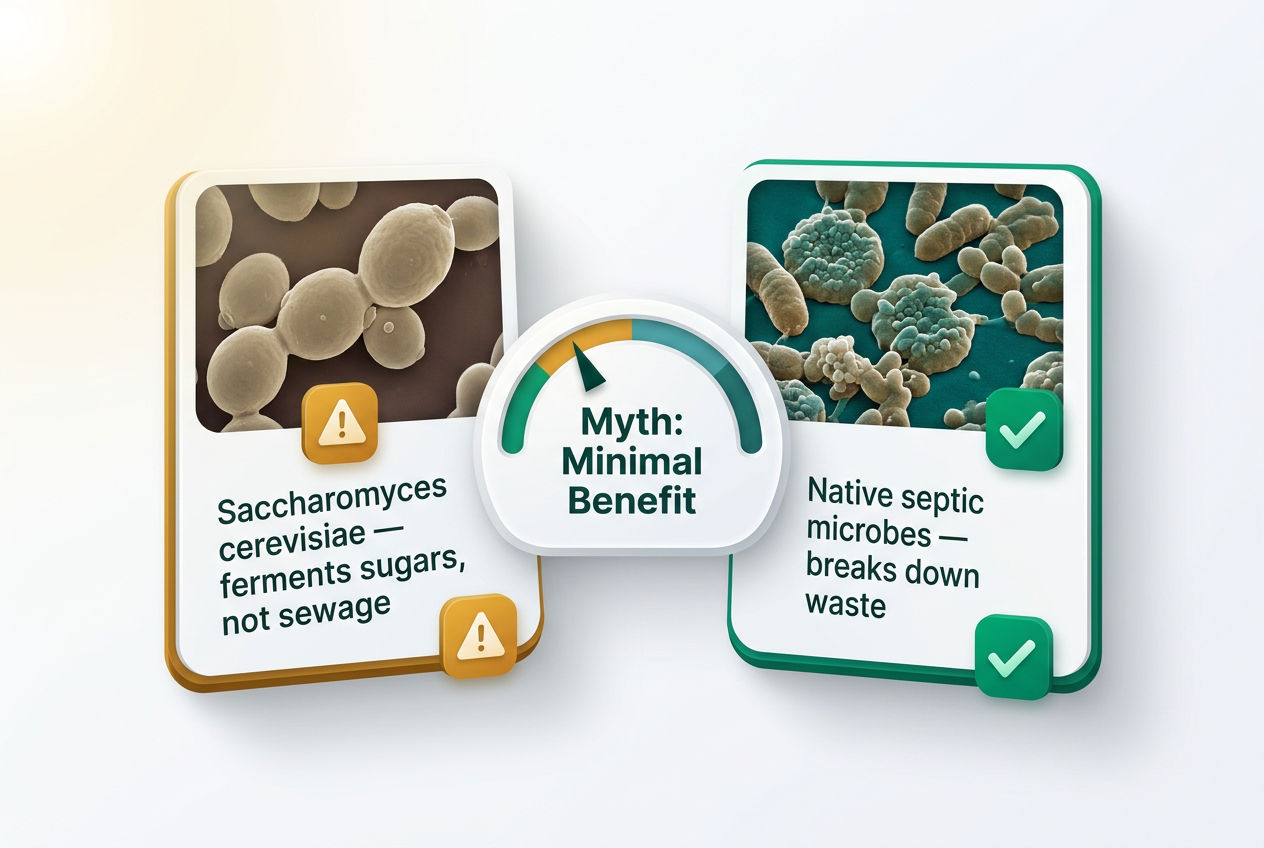
No. Putting yeast in a septic tank introduces living microorganisms, but not the right kind for septic waste digestion. A standard 7-gram packet of active dry yeast contains approximately 69 billion yeast cells (Saccharomyces cerevisiae). That sounds impressive until you realize your septic tank already contains far more microbes — and those microbes are far better suited to the job.
Here's the core problem: yeast is a fermentation organism. It produces enzymes optimized for breaking down simple sugars into alcohol and carbon dioxide — great for bread and beer, useless for the proteins, fats, and complex organic solids sitting in your tank's sludge layer. The enzymes your septic system needs are proteases and lipases. Yeast produces neither in meaningful quantities.
There's also a survival issue. The anaerobic environment inside your tank is hostile to most yeast strains. The lack of oxygen, combined with the existing bacterial ecosystem, means most of those 69 billion yeast cells die off before they accomplish anything. The bacteria already in your tank will simply outcompete them.
Worked example: Say you flush one yeast packet per month. That's ~69 billion Saccharomyces cerevisiae cells entering a tank that already holds an estimated 10 trillion anaerobic bacteria per liter of sludge. In a 1,000-gallon tank with roughly 200 liters of active sludge, the resident bacterial population outnumbers the yeast introduction by a factor of more than 28,000-to-1 — before accounting for the hostile anaerobic conditions that kill most yeast within 24–48 hours.
According to the EPA's Septic Systems Program, a properly functioning septic system does not need biological additives of any kind, including yeast-based products.
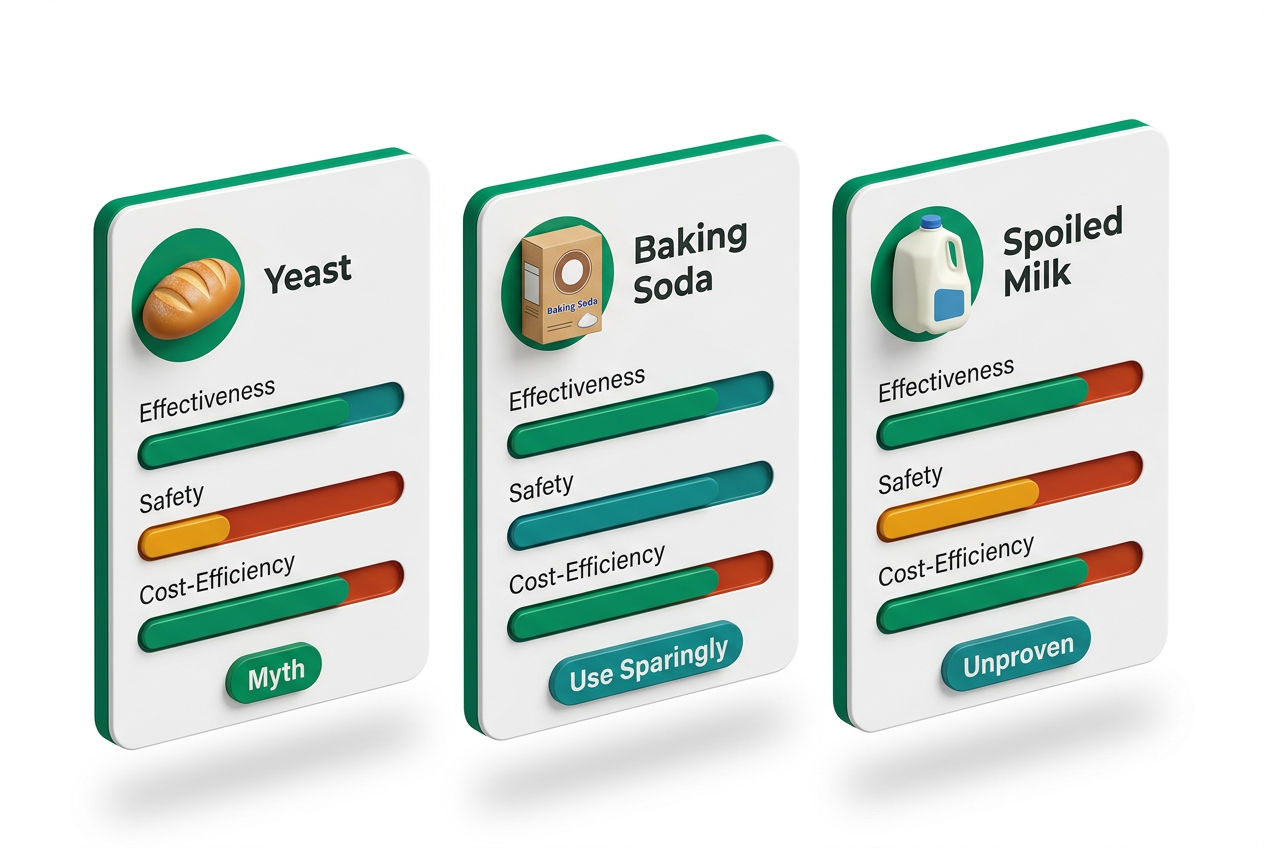
Verdict: ❌ Busted. Small amounts won't damage your system — yeast in a septic tank isn't toxic. But it won't help either. Flushing a $0.75 yeast packet every few months gives you the feeling of doing maintenance without the reality of it. If you want to actually support beneficial bacteria in your septic system, you need products specifically formulated with the right microbial strains for anaerobic digestion.
How Much Baking Soda Is Safe to Put in a Septic Tank?
A small amount — 1 to 2 tablespoons per week — is safe and can help with drain odors. Anything beyond that starts working against your system.
Baking soda (sodium bicarbonate) is mildly alkaline. Your septic tank needs to maintain a pH between 6.5 and 7.5 for anaerobic bacteria to thrive. Pour in a tablespoon and you're not moving that needle. Pour in the cup or more that some home remedy sites recommend, and you're potentially pushing pH high enough to slow bacterial activity.
Here's the math. A 1,000-gallon tank holds about 3,785 liters of water. Meaningfully shifting the pH of that volume requires far more baking soda than any home remedy suggests — which means the small doses are harmless but pointless, and the large doses people sometimes use can actually disrupt the septic system's biological balance.
There's a second issue: sodium. Every teaspoon of baking soda adds about 1,260 mg of sodium. High sodium concentrations can affect the soil structure around your drain field over time, reducing its ability to absorb effluent. This is especially relevant in clay-heavy soils common in the Southeast and Midwest.
The baking soda myth likely started because people noticed it neutralizes odors in a drain. That's true — it works in the pipe itself. The problem is people extrapolate that to the tank, where the chemistry and scale are completely different.
Verdict: ⚠️ Partially True. Tiny, infrequent doses near a drain are fine. Using baking soda as a septic treatment strategy is ineffective and potentially counterproductive at larger doses.
Can Spoiled Milk Help Restart Bacteria in a Septic System?
No — and dumping milk in any significant quantity can actively harm your drain field. Milk does contain proteins and nutrients that bacteria can digest, but the organic load it introduces is the problem.
The issue is biochemical oxygen demand (BOD). BOD measures how much oxygen microbes need to break down organic material in water. Normal household wastewater runs about 200–300 mg/L. Whole milk has a BOD of approximately 100,000 mg/L. That's 400 to 500 times the organic load of normal sewage.
Pour a gallon of milk down the drain and you've introduced the equivalent organic load of hundreds of gallons of normal wastewater. Your tank can handle it once. Do it regularly — or dump larger quantities — and you're accelerating sludge buildup, pushing more solids through to your drain field, and potentially clogging the leach laterals that let liquid percolate into the soil. This is particularly risky if you're already seeing signs that your drain field is stressed.
A failing drain field costs between $5,000 and $20,000 to replace. That's not a risk worth taking over a social media tip.
The "milk restarts bacteria" idea has some surface appeal — bacteria do consume the proteins and sugars in milk. But your system isn't short on food. It's processing thousands of gallons of organic-rich wastewater every year. It doesn't need a nutritional supplement.
Verdict: ❌ Busted. Don't do this intentionally. If you accidentally pour a small amount down the drain, it's fine. Making it a maintenance habit risks your drain field.
Home Remedy Verdict: At a Glance
| Remedy | Safe in Small Doses? | Effective? | Risk Level | Verdict |
|---|---|---|---|---|
| Active dry yeast | ✅ Yes | ❌ No | Low | ❌ Busted |
| Baking soda (1–2 tbsp) | ✅ Yes | ❌ No | Low | ⚠️ Harmless but useless |
| Baking soda (large amounts) | ⚠️ Risky | ❌ No | Medium | ❌ Avoid |
| Milk (occasional/small) | ✅ Yes | ❌ No | Low–Medium | ❌ Busted |
| Milk (regular/large amounts) | ❌ No | ❌ No | High | ❌ Dangerous |
Sources: EPA Septic Systems Program; University of Minnesota Extension; NC State University Extension; Washington State University Extension
If the remedies above left you wondering what you should use instead, we recommend Septifix. Unlike yeast or baking soda, it delivers 14 strains of live aerobic bacteria — roughly 10 billion CFU per tablet — alongside an oxygen-release mechanism that actively works against odor and sludge buildup. Dosing is straightforward: one tablet flushed down the toilet, at around $3–$4 per treatment. It's non-toxic, made in the USA, and backed by a 60-day money-back guarantee. That said, no additive replaces a scheduled pump-out — the EPA is clear on that point — but if you're going to use a treatment, this is the one we feel comfortable recommending.
Are Septic Tank Additives Worth It, or Are They All a Waste of Money?
No additive is necessary — but some are less pointless than others. The EPA's official position, published through its septic systems program, is clear: a properly maintained septic system does not need biological or chemical additives. The agency has reviewed the available research and found no evidence that commercial additives eliminate the need for pumping or improve long-term system performance.
"Not necessary" doesn't mean every product is equivalent, though. Several university extension programs, including University of Minnesota Extension and NC State Extension, have tested commercial bacterial additives and found that while they don't replace pumping, high-quality products containing live anaerobic bacterial strains may help sustain biological activity — particularly after events that kill off tank bacteria, like a course of antibiotics, a major bleach cleaning, or an extended period of low use (think: a vacation cabin that sits empty for months).
If you're going to use a septic tank treatment product, choose one that's actually formulated for the biology of the job. Our pick is Septifix. Each tablet contains 14 strains of live aerobic bacteria at approximately 10 billion CFU per tablet, plus an oxygen-release compound. The oxygen is important — it targets odor-causing anaerobic bacteria near the surface of the tank and helps oxidize sludge. One tablet per flush, no measuring, no mixing. Made in the USA, non-toxic, with a 60-day money-back guarantee, and it runs about $3–$4 per treatment.
If you're weighing your options, see our head-to-head Rid-X vs. Septifix comparison for how they differ on bacterial strains, delivery format, and value per dose.
The honest limitation: No additive — Septifix, Rid-X, or any other — reverses drain field clogging or eliminates the need for pumping. The EPA's position stands. Think of a quality additive as a maintenance supplement after a specific disruption event, not a cure and not a replacement for professional service.
What Actually Keeps a Septic System Healthy?
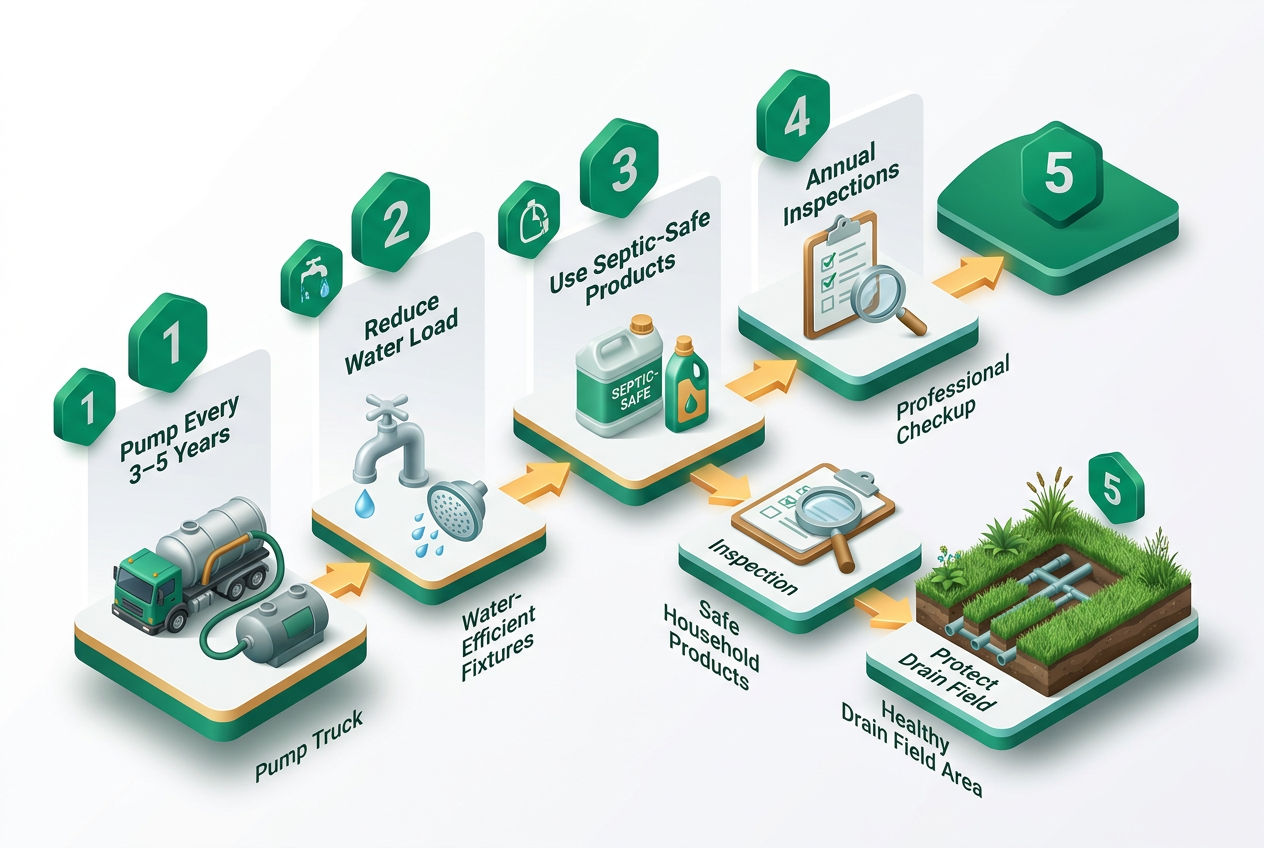
Three things keep a septic system functioning: regular pumping, mindful water use, and protecting the drain field.
Pumping schedule. Pump every 3–5 years for a typical household. A 3-bedroom home with a 1,000-gallon tank and 4 residents should generally pump every 3 years. Fewer residents, larger tank, or lower water use? You can stretch to 5 years. Use a sludge judge measurement to check: if the sludge layer has reached one-third of tank capacity, pump now regardless of schedule.
Water load management. Space out laundry loads. Fix dripping faucets. A single failing toilet flapper can waste 200 gallons per day — enough to hydraulically overload a drain field. See our full septic tank maintenance guide for a complete checklist.
Drain field protection. Never park vehicles on the drain field. Don't plant trees within 30 feet of leach lines — roots from willows and maples are the most common mechanical failure cause. Direct roof runoff away from the drain field area to prevent hydraulic saturation.
What you flush matters. Flushable wipes, feminine hygiene products, paper towels, and grease are the four most common causes of premature tank failure. None of them belong in a septic system. For a full list, see our guide to septic-safe products.
What Should You Do If Your System Is Already Struggling?
If you're seeing slow drains, gurgling pipes, wet spots over the drain field, or sewage odors in the yard, these are warning signs that need professional evaluation — not a home remedy.
Start with a professional inspection. A licensed septic inspector will measure sludge and scum depths, check baffle condition, and camera-inspect the distribution lines if needed. The septic inspection cost typically runs $100–$900 depending on your region and system type. If pumping is overdue, schedule septic pumping and cleaning immediately — the septic pumping cost averages $300–$600 nationally.
For systems showing early signs of drain field stress, an effluent filter like the Polylok PL-122 installed on the outlet baffle can extend drain field life by preventing fine solids from reaching the leach lines. This is a legitimate hardware intervention, not a remedy.
If the inspection confirms the system is biologically compromised — after a confirmed chemical disruption, antibiotic course, or extended vacancy — Septifix is the additive we'd use to support bacterial recolonization. One tablet per week for four weeks post-disruption, then monthly maintenance. It won't fix a failing drain field, but it does give the biology a genuine head start on recovery.
For ongoing monitoring, check your signs your septic tank needs pumping and review drain field maintenance best practices annually.
Related Rid-X & Septic Treatment Guides
- The Best Rid-X Alternatives
- The Best Septic Tank Smell Removers
- Septic Smell When It Rains? Why It Happens & How to Fix It
- Can You Use Rid-X in an RV Black Tank? What to Know First
- Is Rid-X Safe for Septic Tanks, Toilets & Pipes?
- How Often Should You Use Rid-X? Directions, Dosing & Timing
- What's Actually in Rid-X? Ingredients Explained
- Does Rid-X Unclog Drains or Toilets?
- Rid-X vs. Green Gobbler: Which Septic Treatment Wins?
- Green Gobbler Septic Treatment Review: Pods, Packets & Results
- Where to Buy SeptiFix
- Bio-Clean Septic Treatment Review: Does It Work?
- Cabin Obsession Septic Tank Treatment Review
- Camco Septic Tank Treatment Review
- Septic Tank Treatments at Walmart vs. Home Depot vs. Online
- Septic Smell Coming From Toilet? Causes & How to Fix It
- Septic Smell From Shower Drain? Causes & How to Fix It
- Septic Tank Smell After Pumping? Causes & How to Fix It
- Septic Smell From Roof Vent? Causes & How to Fix It
- Is Septic Tank Smell Dangerous? Gases, Risks & When to Worry
- Septic Tank Diagram With Dimensions
- Septic Tank Cross-Section Diagram: Every Part Labeled
- Septic System Diagram With a Pump
- Septic Tank Plumbing Diagram: From House to Drain Field
- Aerobic Septic System Diagram: How Each Part Works
- Are Septic Tank Treatments Necessary?
- How to Handle How Often to Use Septic Tank Treatment: Step by Step
- Septic Treatment Tablets vs. Powder vs. Liquid: Which Is Best?
- Best Septic Tank Treatment for Slow Drains
Frequently Asked Questions
Can you put yeast in a septic tank to help it work better?
No. Putting yeast in a septic tank does not improve how the system functions. Yeast (Saccharomyces cerevisiae) is a fermentation organism engineered by nature to convert simple sugars into alcohol and CO₂ — not to break down the proteins, fats, and complex organic solids that accumulate in septic sludge. The enzymes your tank actually needs are proteases and lipases, and yeast produces neither in meaningful quantities. Beyond the enzyme mismatch, yeast faces a survival problem: the anaerobic conditions inside a working septic tank are hostile to most yeast strains, and the existing bacterial population — numbering in the trillions — will simply outcompete the ~69 billion cells in a standard packet within 24 to 48 hours. According to the EPA Septic Systems Program, a properly maintained system requires no biological additives of any kind. Flushing yeast is harmless in small amounts, but it is not maintenance. It provides no measurable benefit to bacterial populations, sludge breakdown rates, or drain field longevity.
How much yeast should you put in a septic tank?
The correct amount of yeast to add to a functioning septic tank is zero — not because yeast is toxic, but because it does nothing useful. No research-backed dosing recommendation exists because no credible study has demonstrated that yeast improves septic system performance at any dose. Home remedy sources typically suggest one packet (7 grams) flushed monthly, but this figure has no scientific basis. A 7-gram packet contains roughly 69 billion yeast cells, which sounds substantial until you compare it to the trillions of anaerobic bacteria already present in a healthy tank. Those resident bacteria outcompete yeast for space and resources, and the anaerobic environment kills most yeast cells before they can act. If your system is underperforming due to bacterial die-off — caused by antibiotics, heavy bleach use, or extended vacancy — the right response is a properly formulated bacterial additive containing live anaerobic strains, not yeast. Our pick is Septifix, which delivers 14 bacterial strains at 10 billion CFU per tablet.
Is baking soda safe for septic tanks?
Yes, in very small amounts — but it is not effective as a septic treatment and can cause harm at larger doses. One to two tablespoons per week flushed near a drain will not meaningfully shift the pH of a 1,000-gallon tank, which holds approximately 3,785 liters of liquid. At that scale, a tablespoon of sodium bicarbonate is chemically insignificant. The problem arises when homeowners follow advice recommending a cup or more of baking soda as a monthly septic treatment. At those quantities, you risk pushing tank pH above the 6.5–7.5 range that anaerobic bacteria need to thrive, slowing biological activity. There is also a cumulative sodium concern: each teaspoon of baking soda contains approximately 1,260 mg of sodium, and chronic sodium loading can degrade soil structure around drain fields — particularly in clay-heavy soils common in the Southeast and Midwest — reducing the field's ability to absorb effluent over time. Baking soda genuinely neutralizes odors in drain pipes, but that benefit does not extend to the tank itself.
Can you put milk in a septic tank to add bacteria?
No. Milk does not meaningfully boost septic bacteria, and adding it in quantity poses a real risk to your drain field. The problem is biochemical oxygen demand (BOD): whole milk has a BOD of approximately 100,000 mg/L, compared to 200–300 mg/L for normal household wastewater. That means a single gallon of milk introduces the equivalent organic load of 300–500 gallons of normal sewage into your system. A healthy tank can absorb an occasional small spill without issue. But treating milk as a regular bacterial supplement accelerates sludge accumulation, forces more suspended solids into the distribution lines, and can clog the leach laterals that allow effluent to percolate into the soil. Drain field replacement costs between $5,000 and $20,000. Your septic system is not nutrient-starved — it processes thousands of gallons of organic-rich wastewater annually. It does not need a dairy supplement. If you want to support bacterial activity after a genuine disruption event, use a purpose-formulated product like Septifix rather than a food ingredient.
What is the best thing to put in a septic tank to break down waste?
The single most effective thing you can do for your septic tank is pump it every 3–5 years. No additive replaces that. If you are looking for a supplement to support biological activity after a specific disruption — a course of antibiotics, heavy use of antibacterial cleaners, or a system that sat idle for months — the best option is a properly formulated bacterial product containing live anaerobic strains at a high CFU count. Our pick is Septifix: each tablet delivers 14 strains of live aerobic bacteria at approximately 10 billion CFU, plus an oxygen-release compound that targets odor-causing bacteria and helps oxidize surface sludge. Dosing is one tablet per flush — no measuring, no mixing. It runs about $3–$4 per treatment and carries a 60-day money-back guarantee. For a comparison of leading products, see our Rid-X vs. Septifix breakdown. The EPA's position remains that additives are unnecessary for a healthy, properly maintained system — so treat any product as a targeted supplement, not a maintenance shortcut.
How often should you put yeast in a septic tank?
Never — there is no recommended frequency because yeast provides no documented benefit to a septic system at any interval. The folk remedy typically suggests one yeast packet flushed monthly, but this schedule has no research backing. Yeast (Saccharomyces cerevisiae) is outcompeted by existing septic bacteria within hours and cannot survive the anaerobic environment long enough to influence waste breakdown. Monthly yeast flushing costs roughly $9 per year and accomplishes nothing measurable. If you feel the need to do something monthly for your system, the most useful habits are: spacing out laundry loads to avoid hydraulic overload, avoiding antibacterial soaps and bleach cleaners that kill beneficial bacteria, and keeping a pump-scheduling log so you don't miss the 3–5 year service window. For a full maintenance checklist, see our septic tank bacteria guide and septic tank maintenance guide.
Sources & Methodology
This article draws on publicly available research and guidance from the following sources:
- U.S. Environmental Protection Agency — Septic Systems Program: official position on additives and maintenance requirements
- University of Minnesota Extension — research on commercial septic additive effectiveness
- NC State University Extension — guidance on septic system biology and additive testing
- Washington State University Extension — drain field protection and hydraulic loading guidance
- Wastewater Engineering: Treatment and Resource Recovery (Metcalf & Eddy, 5th ed.) — BOD values for household wastewater and dairy waste streams
Claims about yeast cell counts, BOD figures, sodium content, and bacterial populations are drawn from peer-reviewed wastewater engineering references. Cost ranges reflect national averages aggregated from contractor data and HomeAdvisor/Angi survey reports as of 2024–2025.
Free download
Not ready for the Handbook? Start with the free Fridge Card.
The Do / Don’t card the whole family can see, plus the Survival Kit: emergency flowchart, warning-sign decoder and pump-schedule card. One printable PDF.
Was this article helpful?
Frequently Asked Questions
Recommended Resources
📖 Related Articles
- Aerobic vs Anaerobic Septic Systems: How They Compare
- What Is a Septic System? How It Works (Visual Guide)
- What Kills Septic Tank Bacteria? (14 Things to Avoid)
- Signs Your Drain Field Is Failing (And What to Do)
- Do Septic Tank Treatments Actually Work?
- The Complete Septic Tank Maintenance Guide
- Septic-Safe Products: What to Use (and What to Avoid)
- 8 Signs Your Septic Tank Needs to Be Pumped
- How to Handle Septic Drain Field Maintenance: Step by Step
- How Septic Tank Bacteria Work (And Why They Matter)
💰 Cost Guides
🔧 Services
Find Septic Professionals Near You
Compare licensed, verified septic companies by area — top county markets and cities below, or browse all 50 states.
County markets
Popular cities
