
Quick Answer
The best septic tank treatment for slow drains uses live bacteria and enzymes to break down the organic buildup that's choking your system. A monthly biological treatment — dosed correctly and matched to your tank size — can restore normal drain speed in 2–4 weeks for mild cases. But a treatment won't fix a full tank, a failed drain field, or a clogged outlet baffle. Diagnosis first. Treatment second.
Key Takeaways
- Slow drains in a septic home usually trace back to four causes: sludge and scum buildup, a full tank, a clogged outlet baffle, or a saturated drain field.
- Biological treatments (live bacteria + enzymes) work. Chemical drain cleaners like Drano kill the bacteria your system depends on — avoid them entirely.
- Our top pick is Septifix: 14 bacterial strains, ~10 billion CFU per tablet, oxygen-release formula, simple one-tablet-per-flush dosing.
- Most OTC treatments cost $10–$40/month. A pump-out costs $300–$600. A new drain field costs $5,000–$20,000+.
- If slow drains persist more than 2 weeks after treatment, call a professional — do not keep adding product hoping it'll fix a structural problem.
Why Is Your Septic System Draining Slowly?
Slow drains in a septic-served home aren't always the same problem. They look identical from where you're standing at the sink, but the cause matters enormously — because the wrong fix wastes money, and the right fix saves your drain field.
Here are the four most common culprits:
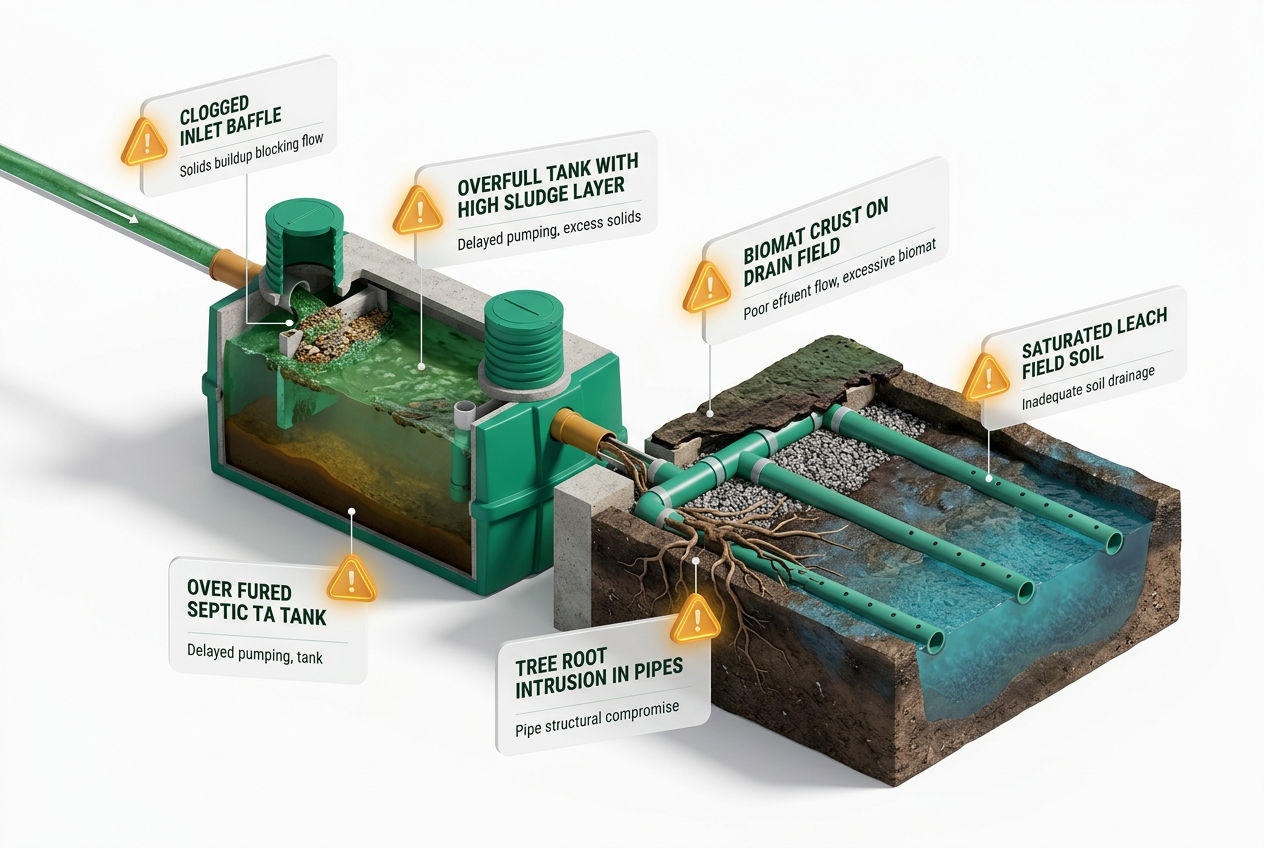
1. Sludge and scum overload. Every septic tank has three layers: a floating scum layer on top (grease, oils, soap residue), a liquid middle layer called effluent, and a sludge layer on the bottom (solids that have settled). A healthy tank manages these layers between pump-outs. But if grease buildup in the septic tank has been building for years, or if non-biodegradable material — wet wipes, paper towels, feminine products — has accelerated sludge accumulation, the working liquid zone shrinks. Less liquid volume means slower processing and slower drains. This is the scenario where a bacterial septic tank treatment can genuinely help.
2. A full tank. A 1,000-gallon tank serving a four-person household typically needs pumping every 3–4 years. Add a garbage disposal and that interval drops to roughly every 2 years. When a tank reaches 80–90% capacity, the effluent outlet gets obstructed — and drains slow noticeably. No treatment product fixes this. Only a pump truck does. The EPA recommends pumping every 3–5 years for most households, but your actual schedule depends on tank size and usage.
3. A blocked outlet baffle or effluent filter. The outlet baffle (or an effluent filter like a Polylok PL-122) sits at the exit point of your tank and prevents solids from reaching the drain field. If it's clogged with debris, effluent backs up into the tank, then into your pipes. A professional can inspect and clean this in 30 minutes. It's cheap. It's often overlooked.
4. A saturated or failing drain field. This is the expensive problem. A clogged septic drain field — often caused by a biomat (a layer of anaerobic bacteria and organic material that seals the soil interface) — cannot accept effluent at normal rates. When the drain field is saturated, sewage backs up through the tank into your pipes. No biological additive will reverse a failed drain field. Drain field restoration or replacement runs $5,000–$20,000+.
Knowing which problem you have changes everything. If you're not sure, read our guide on slow drains in septic systems before purchasing any product.
Can a Full Septic Tank Cause Slow Drains?
Yes — absolutely. A tank that's 80–90% full is one of the most common causes of slow draining septic systems. When the tank fills beyond its operational capacity, the outlet baffle becomes partially blocked by floating scum or rising sludge. Effluent can't exit at the normal rate, so it backs up into your household plumbing. Multiple drains slowing at once — not just one sink — is a strong indicator the issue is tank-level, not pipe-level. Check out our guide on signs your septic tank needs pumping to confirm.
A normal drain should move roughly 1 gallon every 30 seconds. If your bathroom sink takes 2–3 minutes to empty, you're looking at a system problem, not a partial clog in one branch line.
Can You Use Drano or Chemical Drain Cleaners With a Septic System?
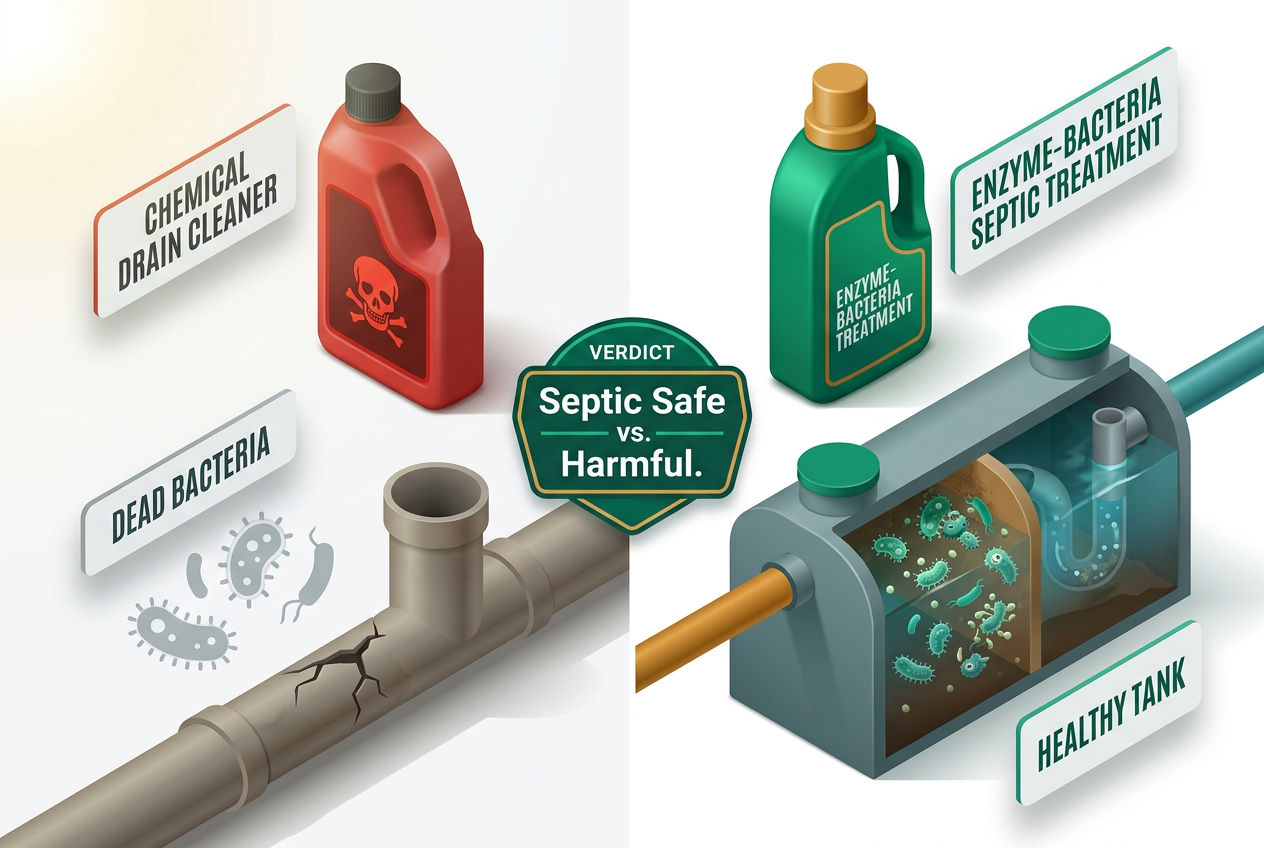
No. Don't do it. Chemical drain cleaners and septic systems are a bad combination. Drano and similar lye-based or bleach-heavy products work by chemically scorching organic material. That sounds helpful until you realize the organic material they're killing includes the billions of bacteria that process waste in your tank. One bottle of Drano can disrupt your tank's biological balance for weeks. It can also corrode older PVC pipe connections and accelerate baffle deterioration.
A septic-safe drain cleaner uses enzyme action, not caustic chemistry. For a localized clog in a single drain, a drain snake is your best first move. For a system-wide slowdown, a biological treatment is the appropriate product category.
How Septic Tank Treatments Actually Work
The best products in this category use two mechanisms:
Enzymes break down specific molecules. Lipase targets fats and grease. Protease breaks down proteins. Amylase handles starches. Cellulase works on paper and plant fiber. These aren't living organisms — they're biochemical tools that split complex molecules into simpler compounds that bacteria can consume.
Bacteria do the actual digestion. Aerobic bacteria (oxygen-dependent) are more efficient and produce less odor. Anaerobic bacteria (oxygen-free) dominate most conventional septic tanks naturally. The best treatments introduce concentrated, targeted strains of bacteria that can colonize your tank and outcompete less efficient native populations.
The combination of enzymes plus live bacterial cultures is more effective than either alone. Products that contain only enzymes provide short-term relief without establishing long-term bacterial colonies.
For a deeper look at how each mechanism works, our septic tank enzymes guide covers the science in detail.
Septic Tank Treatment Comparison
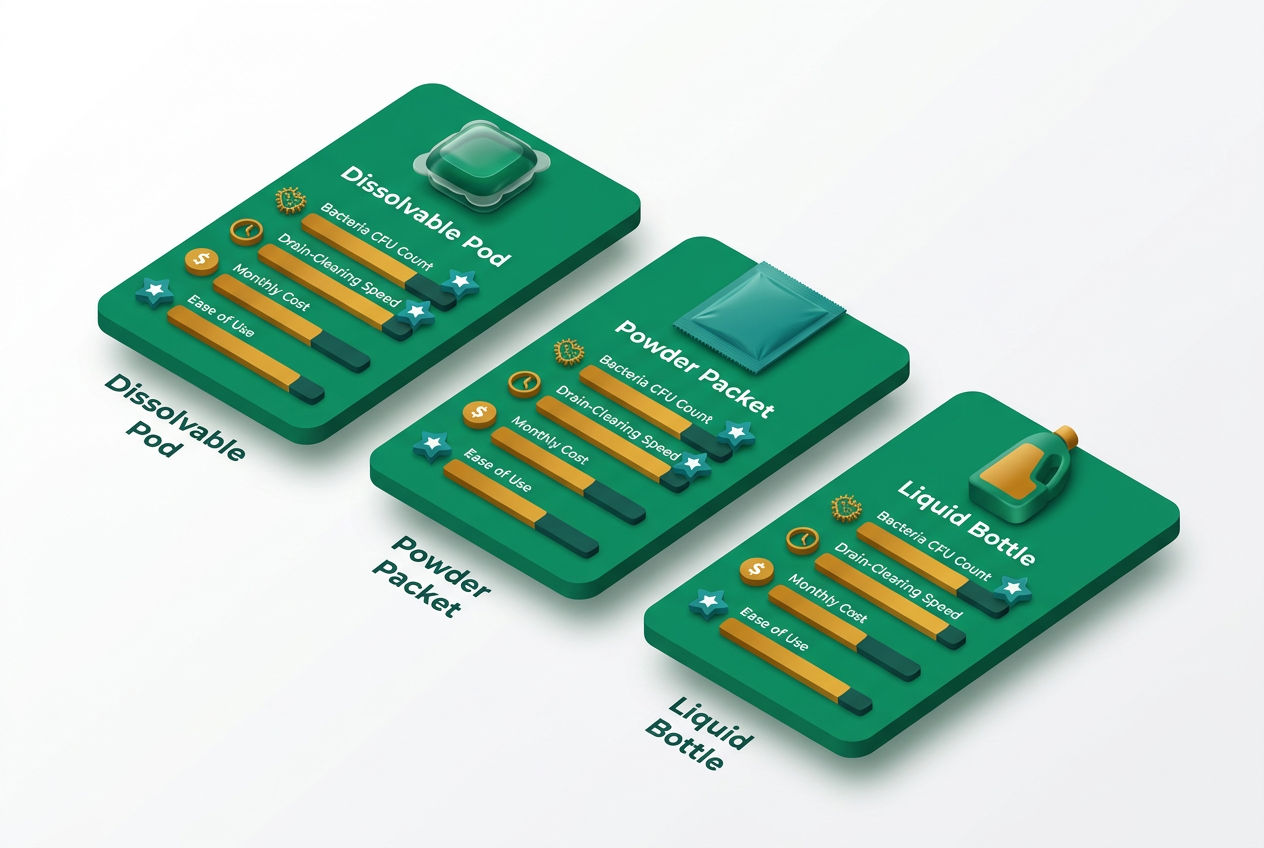
| Product | Active Agents | Dosing | Monthly Cost | Best For |
|---|---|---|---|---|
| Septifix | 14 bacterial strains, ~10B CFU, oxygen-release | 1 tablet/month via toilet | ~$3–$4/treatment | Overall maintenance + odor |
| Rid-X | Bacteria + 4 enzyme types | Monthly packet/powder | ~$8–$12/month | Budget maintenance |
| Bio-Clean | Bacteria + enzymes | Weekly initial, monthly after | ~$15–$25/month | Active buildup treatment |
| Green Gobbler | Enzyme-heavy formula | Monthly | ~$10–$15/month | Grease-heavy households |
| Cabin Obsession | Concentrated bacteria | Monthly | ~$10–$18/month | Seasonal/infrequent use |
Sources: Product manufacturer specifications; retail pricing from Amazon and Home Depot as of Q2 2026. CFU = colony-forming units.
What's the Best Septic Tank Treatment for Slow Drains?
For most homeowners dealing with slow drains from organic buildup and sludge accumulation, Septifix is the treatment we recommend.
Here's why it earns the top spot specifically for slow drain situations:
Septifix tablets are formulated with 14 strains of live aerobic bacteria at approximately 10 billion CFU per tablet. That's a meaningful bacterial load — enough to establish a viable colony in most 1,000–1,500 gallon residential tanks. What makes it different from most competitors is the oxygen-release chemistry built into the tablet. As the tablet dissolves, it releases oxygen directly into the anaerobic tank environment. That oxygen burst stimulates aerobic bacterial activity, which processes waste faster and more completely than the anaerobic breakdown happening in an untreated tank. The result is faster digestion of the grease, sludge, and organic solids that slow your drains.
Dosing is simple: one tablet, flushed down the toilet, once a month. No measuring, no mixing, no pouring product down each drain individually. Made in the USA, non-toxic, and backed by a 60-day money-back guarantee. At roughly $3–$4 per treatment, it's one of the lowest-cost-per-dose options in the biological treatment category.
Honest caveat: Septifix — like every biological treatment — does not replace pumping. The EPA's position is that no additive eliminates the need for periodic pump-outs. If your tank is already at capacity or your drain field is failing, a tablet isn't going to reverse that. But if your system is fundamentally sound and slow drains are being caused by biological underperformance and sludge accumulation, this is the product to reach for.
If slow drains are your primary concern and you've already ruled out a full tank or a drain field problem, Septifix is the specific product we'd point you toward. The oxygen-release mechanism addresses the root cause of biologically driven slowdowns more directly than enzyme-only or standard bacterial treatments do. That said, the same honest caveat applies here as it does throughout this guide: no tablet substitutes for a pump-out, and the EPA is clear that additives are not required for a healthy, well-maintained system. Think of Septifix as a tool to keep a sound system performing well — not a repair for one that's already in trouble.
Curious how it compares to the market leader? See our Rid-X vs. Septifix breakdown for a head-to-head comparison.
Are Septic Tank Treatments Really Worth It?
Biological treatments are worth it as a maintenance tool. They're not worth it as a substitute for pumping or a fix for structural problems.
Research is nuanced here. A frequently cited University of Arkansas study found that septic tank additives — including bacterial treatments — do not eliminate the need for regular pumping, and some products showed no statistically significant benefit over untreated control tanks. That's an honest finding worth knowing. But most researchers also note that high-quality biological additives can help maintain a healthy bacterial population, particularly after the system has been stressed by antibiotic use, heavy cleaning product use, or a period of low water usage (like a vacation home that sat empty).
Think of a monthly biological treatment like a probiotic supplement. It won't cure a broken arm, but it supports baseline function. For a household spending $300–$600 on a pump-out every 3–5 years, spending $3–$4/month on a maintenance treatment is reasonable insurance — especially if it helps extend interval slightly and keeps drain speeds normal between service visits.
Our full do septic additives work article covers the research in detail.
What's the Best Homemade Septic Tank Treatment for Slow Drains?
There's genuine interest in DIY options — and some reasonable ones exist, alongside a lot of bad advice online.
Baking soda and vinegar: Creates a satisfying fizz in the drain but does essentially nothing for a septic tank. The chemical reaction neutralizes both compounds before they reach the tank. Not harmful, just ineffective at scale.
Active dry yeast: Yeast introduces Saccharomyces cerevisiae, which does produce some enzymatic activity. It's not harmful to your system and may provide a minor boost. But a tablespoon of bread yeast contains far fewer viable organisms than a properly formulated biological treatment product.
Raw meat scraps: Sometimes suggested as a bacterial inoculant. This introduces pathogens into your system and is genuinely a bad idea. Skip it.
The honest answer: homemade treatments can supplement a biological product routine, but they won't replace a quality concentrated product with high CFU counts and targeted enzyme formulations. Our homemade septic tank treatment guide covers the realistic options with appropriate expectations.
How Long Does It Take for Septic Treatment to Work on Slow Drains?
For mild cases of organic buildup, you may notice improvement in 3–5 days as the initial enzyme activity starts breaking down accumulated grease and soft solids near the outlet. Full bacterial colonization — where a new population has established itself and is consistently processing waste — typically takes 2–4 weeks.
Realistic expectations matter here. If your drains are slightly slower than normal and the problem is accumulation-based, a biological treatment cycle should show clear improvement within one month. If you're still seeing the same slow drain speed after 4–6 weeks of consistent treatment, something else is wrong. At that point, stop adding product and schedule a professional inspection.
One thing that affects this timeline significantly: temperature. Bacterial treatments work fastest when water and soil temperatures are above 60°F. In cold climates — parts of Minnesota, Maine, Vermont — winter soil temperatures below 40°F can nearly halt microbial activity in the tank and extend the effective treatment timeline considerably. If you're treating a system in a cold-weather region during winter months, don't expect normal results until spring.
How Often Should You Add Bacteria to a Septic Tank?
For maintenance: monthly is the standard recommendation across most product lines and is supported by general industry guidance from NOWRA (National Onsite Wastewater Recycling Association). Monthly dosing keeps a consistent bacterial population in the tank and replaces microbes lost to household cleaning products, antibacterial soaps, and natural die-off.
For active slow drain treatment: some professionals recommend a "shock treatment" protocol — higher initial doses for the first 2–4 weeks to establish a dense bacterial colony quickly, then dropping to a monthly maintenance dose. Check the specific product instructions, since CFU concentrations and recommended shock-treatment protocols vary by brand.
There are circumstances that warrant more frequent treatment: after antibiotic use (antibiotics pass through your body and can disrupt tank bacteria), after heavy bleach or disinfectant cleaning, after a septic backup or pump-out, or after a period of very low system use. Our guide on how often to use septic tank treatment covers these scenarios in detail.
How Do I Know if My Slow Drain Is a Plumbing Issue or a Septic Issue?
One slow drain = likely a localized plumbing clog. One sink, one shower, one toilet — and everything else drains fine. Try a drain snake before purchasing any septic product.
Multiple slow drains at once = likely a septic issue. When the bathroom sink, the kitchen drain, and the washing machine are all draining slowly, the bottleneck is downstream — in the tank, at the outlet baffle, or in the drain field.
Gurgling sounds from drains you're not using is another septic-side indicator. So is the toilet flushing slowly while the shower also drains sluggishly. If you're hearing gurgling from a floor drain or a rarely-used bathroom when you run the washing machine, your tank is almost certainly the issue.
Outdoor signs matter too. A soggy or unusually green patch of grass over the drain field area suggests the field is saturated and effluent is surfacing. That's a drain field problem — not a drain cleaner problem.
Seasonal and Regional Factors That Affect Treatment Results
Treatment effectiveness isn't uniform. Where you live and what time of year it is matters.
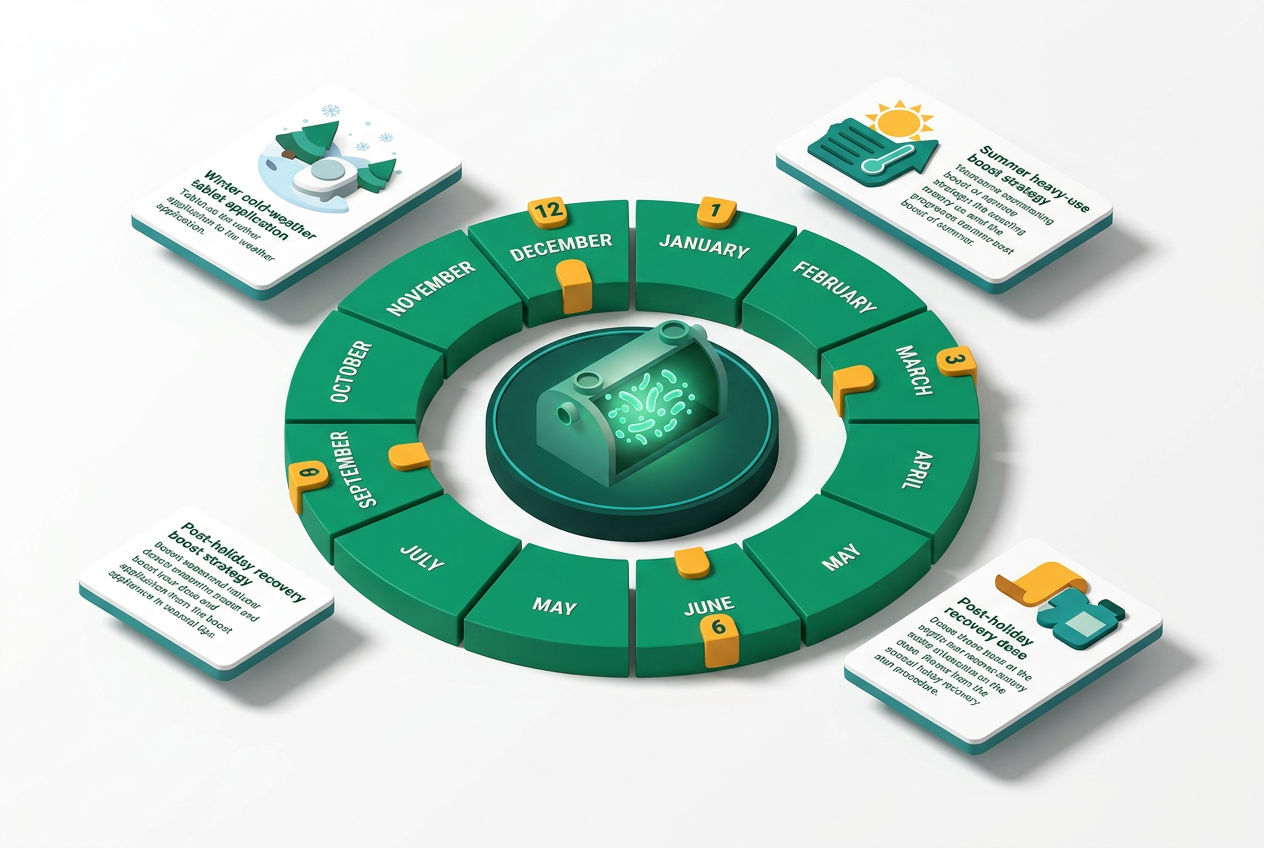
Spring (March–May): This is the highest-risk window for slow drains caused by drain field saturation. Heavy snowmelt and spring rains raise water tables, and a heavy rain event can temporarily overwhelm a septic system. In the Pacific Northwest (Washington, Oregon) and rural Northeast, this is the most common time homeowners call for emergency service.
Summer: Bacterial treatments work best now. Warm soil temperatures (above 70°F) accelerate microbial activity dramatically. If you're going to do a shock treatment to address slow drains, summer is the optimal time.
Fall (October–November): Schedule a professional inspection and pump-out before winter. Bacterial activity slows significantly once tank and soil temperatures drop. In Minnesota, where frost lines reach 42–60 inches, systems can struggle from November through March.
Arid Southwest (Arizona, New Mexico, Texas): Less drain field saturation from rainfall, but hard water and mineral scale can affect pipe flow and confuse the diagnosis. A slow drain in Phoenix is more likely a localized pipe issue than a saturated drain field.
Southeast (Florida, Georgia, South Carolina): High water tables, clay soils, and warm year-round temperatures create a mixed picture — bacterial treatments work well here year-round, but drain field saturation from heavy seasonal rain is also common. Florida homeowners should check local regulations; the Florida Department of Health requires septic system inspections at property transfer and has specific contractor licensing requirements.
Because treatment effectiveness varies this much by climate and soil type, consulting a local septic professional is always the smart call when you're unsure. They know your soil.
When a Treatment Product Isn't Enough — Call a Pro
Treatment products handle one scenario well: biological underperformance in a fundamentally sound system. They don't handle these situations:
- Tank at or near capacity. A 1,500-gallon tank with sludge and scum layers occupying 80%+ of volume needs a pump truck. Period. Check our septic pumping cost guide — most homeowners pay $300–$600 nationally for a standard pump-out.
- Failed outlet baffle or effluent filter. A cracked or collapsed baffle lets solids flow toward the drain field. Adding bacteria to a tank with a missing baffle is like taking vitamins when you have a broken bone.
- Saturated drain field. If the field can't accept effluent, no biological treatment will restore it. Drain field repair or replacement runs $5,000–$20,000+ depending on system type and site conditions. The sooner you diagnose it, the more options you have.
- Persistent backup. If wastewater is backing up into the lowest fixtures in your home — floor drains, basement toilets — stop using water immediately and call a professional. This is a septic system backup situation that needs immediate attention.
If you're not sure what you're dealing with, a septic inspection typically costs $100–$300 and gives you a definitive answer before you spend money on either products or guesswork.
Find a licensed septic professional in your area through the SepticTankHub directory — every listed company is searchable by state and service type.
Prevention: Keep Slow Drains From Coming Back
Once you've addressed the immediate problem, a simple ongoing routine prevents recurrence:
- Monthly biological treatment: One Septifix tablet flushed monthly maintains bacterial populations between pump-outs.
- Watch what goes down the drain: Grease, wet wipes, and harsh chemical cleaners are the leading causes of premature tank failure. Our septic-safe products guide covers what's safe and what isn't.
- Spread water use throughout the week: Running five loads of laundry in one day floods the tank with more water than it can process efficiently. Two loads a day, several days a week, is easier on the system.
- Know your pump-out schedule: Use the EPA's general guideline — every 3–5 years for most households — as a starting point, then adjust for your actual tank size and occupancy. Our how often to pump a septic tank guide has a size-based schedule you can follow directly.
- Annual visual inspection: Check the area above your drain field for wet spots, odors, or unusually lush grass. Catching a problem early is always cheaper than catching it late.
Related Rid-X & Septic Treatment Guides
- The Best Rid-X Alternatives
- The Best Septic Tank Smell Removers
- Septic Smell When It Rains? Why It Happens & How to Fix It
- Can You Use Rid-X in an RV Black Tank? What to Know First
- Is Rid-X Safe for Septic Tanks, Toilets & Pipes?
- How Often Should You Use Rid-X? Directions, Dosing & Timing
- What's Actually in Rid-X? Ingredients Explained
- Does Rid-X Unclog Drains or Toilets?
- Rid-X vs. Green Gobbler: Which Septic Treatment Wins?
- Green Gobbler Septic Treatment Review: Pods, Packets & Results
- Where to Buy SeptiFix
- Bio-Clean Septic Treatment Review: Does It Work?
- Cabin Obsession Septic Tank Treatment Review
- Camco Septic Tank Treatment Review
- Septic Tank Treatments at Walmart vs. Home Depot vs. Online
- Septic Smell Coming From Toilet? Causes & How to Fix It
- Septic Smell From Shower Drain? Causes & How to Fix It
- Septic Tank Smell After Pumping? Causes & How to Fix It
- Septic Smell From Roof Vent? Causes & How to Fix It
- Is Septic Tank Smell Dangerous? Gases, Risks & When to Worry
- Septic Tank Diagram With Dimensions
- Septic Tank Cross-Section Diagram: Every Part Labeled
- Septic System Diagram With a Pump
- Septic Tank Plumbing Diagram: From House to Drain Field
- Aerobic Septic System Diagram: How Each Part Works
- Are Septic Tank Treatments Necessary?
- How to Handle How Often to Use Septic Tank Treatment: Step by Step
- Septic Treatment Tablets vs. Powder vs. Liquid: Which Is Best?
- Yeast, Baking Soda & Milk in Your Septic Tank: Myths Tested
Sources & Methodology
U.S. Environmental Protection Agency — Septic Systems Overview EPA guidelines on pumping frequency, system maintenance, and additive use. Referenced for recommended pump-out intervals and additive efficacy position. epa.gov/septic
National Onsite Wastewater Recycling Association (NOWRA) Industry guidance on bacterial treatment frequency and biological additive best practices. nowra.org
University of Arkansas Cooperative Extension Service Peer-reviewed research on septic tank additive effectiveness, including bacterial and enzyme products. Referenced for product efficacy limitations.
Product manufacturer specifications Septifix, Rid-X, Bio-Clean, Green Gobbler, and Cabin Obsession — CFU counts, ingredient lists, and dosing recommendations sourced from current product labeling and official manufacturer documentation.
Retail pricing data Amazon and Home Depot product listings, Q2 2026. Pump-out and drain field cost ranges based on national contractor survey data.
Free download
Not ready for the Handbook? Start with the free Fridge Card.
The Do / Don’t card the whole family can see, plus the Survival Kit: emergency flowchart, warning-sign decoder and pump-schedule card. One printable PDF.
Was this article helpful?
Frequently Asked Questions
Recommended Resources
📖 Related Articles
- How Septic Tank Bacteria Work (And Why They Matter)
- Septic Effluent Filters: Do You Need One?
- Signs Your Drain Field Is Failing (And What to Do)
- Leach Field Rejuvenation: The Complete Guide
- Slow Drains With Septic: Is It the Plumbing or the Tank?
- 8 Signs Your Septic Tank Needs to Be Pumped
- Can You Use Drano with a Septic System?
- The Best Septic-Safe Drain Cleaners (and What to Never Pour In)
- Septic Tank Enzymes: What You Need to Know
- Do Septic Tank Additives Actually Work? (The Science)
- Homemade Septic Tank Treatment: What You Need to Know
- What Is a Drain Field? (And How Does It Work?)
- Heavy Rain and Septic Systems: What Happens and What to Do
- Septic System Backing Up? Causes & Emergency Steps
- Septic-Safe Products: What to Use (and What to Avoid)
- How Often Should You Pump Your Septic Tank?
💰 Cost Guides
Find Septic Professionals Near You
Compare licensed, verified septic companies by area — top county markets and cities below, or browse all 50 states.
County markets
Popular cities
