
Quick Answer
Septic tank enzymes are biological catalysts that accelerate the breakdown of organic waste inside your tank. They are not living organisms — that's a key distinction from bacteria-based products. A healthy septic system already produces its own enzymes naturally, and the EPA does not recommend additives as necessary for a properly maintained system.
Key Takeaways
- Enzymes are not living — they're biological catalysts that speed up waste breakdown
- Healthy septic systems produce natural enzymes; additives may help after chemical disruptions
- The EPA does not endorse septic additives as necessary for functioning systems
- Enzymes cannot fix a failing drain field or replace regular pumping
- Temperature matters: enzyme activity drops sharply below 50°F
About 21 million U.S. households rely on septic systems, according to the EPA. Walk into any hardware store and you'll find a shelf full of products promising to protect those systems — enzyme treatments, bacteria pods, "shock" doses. The marketing is convincing. But before you spend $15–$40 on a monthly additive, it's worth knowing exactly what you're buying and what it can — and can't — do.
What Are Septic Tank Enzymes, and How Do They Work?
Septic tank enzymes are proteins that act as biological catalysts. They speed up the chemical reactions that break down fats, oils, proteins, and carbohydrates inside your tank. Each enzyme type is specific to a target molecule: lipases attack grease, proteases break down proteins, amylases go after starches, and cellulases target paper and plant fiber.
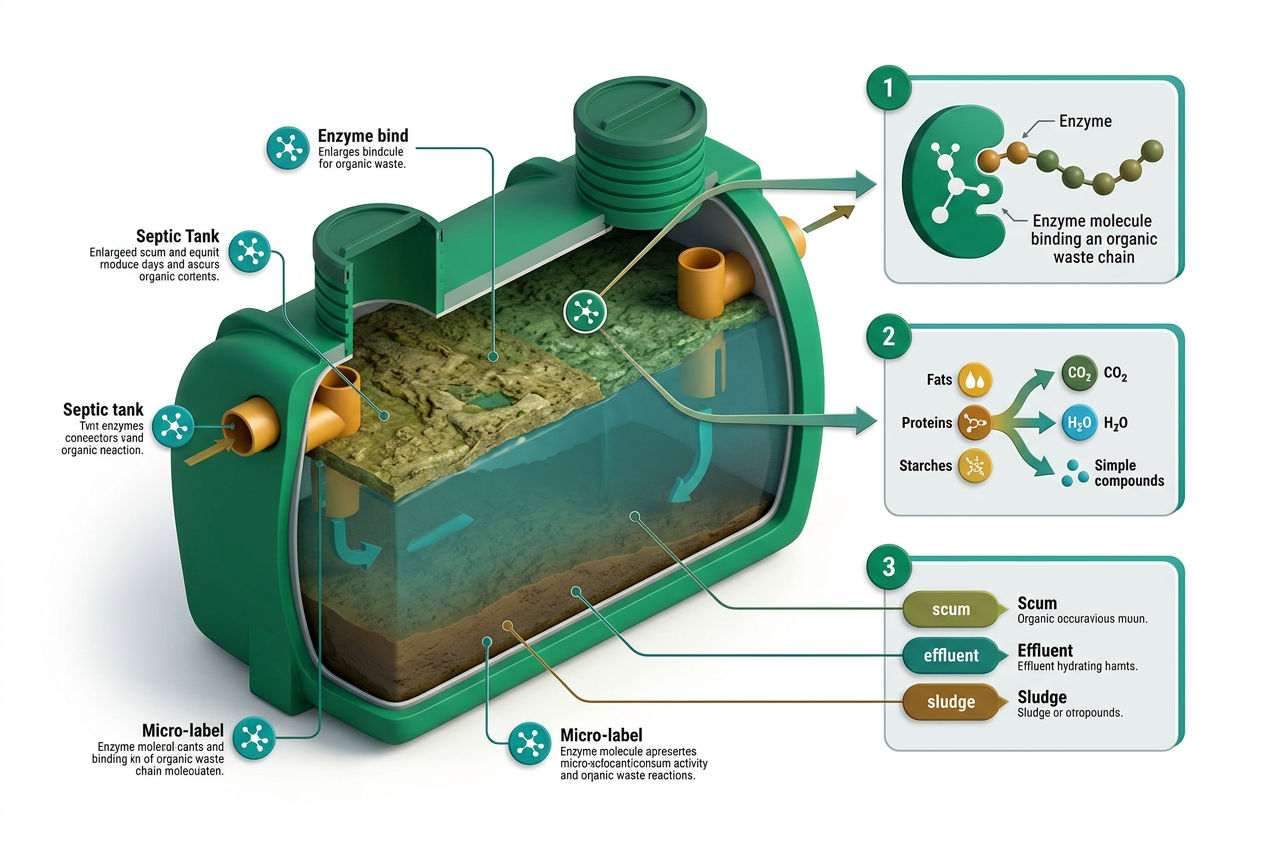
Here's the critical distinction that most product labels blur: enzymes are not alive. They don't reproduce. They don't colonize your tank. They perform a reaction, and they're done.
Bacteria, on the other hand, are living microorganisms. The anaerobic bacteria living in your tank actually produce enzymes as part of their metabolic process. So when you add a bacterial additive, you're seeding the tank with organisms that will then generate enzymes naturally. When you add an enzyme-only product, you're adding the catalyst directly — with no self-sustaining colony behind it.
A healthy 1,000-gallon septic tank contains billions of bacteria per milliliter of active sludge. Those bacteria are already producing the enzymes your system needs. That's why the EPA's guidance on septic systems states that a properly functioning system does not require additives.
Do Septic Tank Enzymes Actually Work?
The honest answer: it depends on what you're asking them to do.
For a healthy, well-maintained system? Peer-reviewed research suggests limited measurable benefit. Multiple studies from University of Wisconsin Extension and University of Nebraska researchers found that enzyme and bacteria additives provided no statistically significant improvement in effluent quality or solid waste breakdown in systems that were already functioning normally.
For a stressed or disrupted system? There's a more reasonable case. If you've just run a round of antibiotics through your household (those drugs reach your tank), poured bleach-based cleaners down the drain, or had a plumber use a strong chemical clog remover, your natural bacterial colonies may be temporarily diminished. In those scenarios, adding an enzyme or bacteria product can help re-establish biological activity faster than waiting for the system to recover on its own.
Natural bacterial colonies can begin regenerating within 24–72 hours after a chemical disruption — but that recovery time is temperature-dependent and varies by the severity of the chemical exposure. A modest bacterial additive during that window makes more sense than pouring one into a thriving tank every single month.
What enzymes cannot do:
- Reverse drain field clogging caused by biomat buildup
- Eliminate the need for pumping
- Fix a failed effluent filter (Polylok PL-122 or similar)
- Repair cracked baffles or damaged distribution boxes
- Substitute for a professional inspection
If your drain field is showing signs of failure, no amount of enzyme treatment will fix it. That's a call to a licensed septic contractor, not a trip to the hardware store.
Enzymes vs. Bacteria: What's the Difference?
This is the question that trips up most homeowners — and a lot of product marketing deliberately keeps it vague.
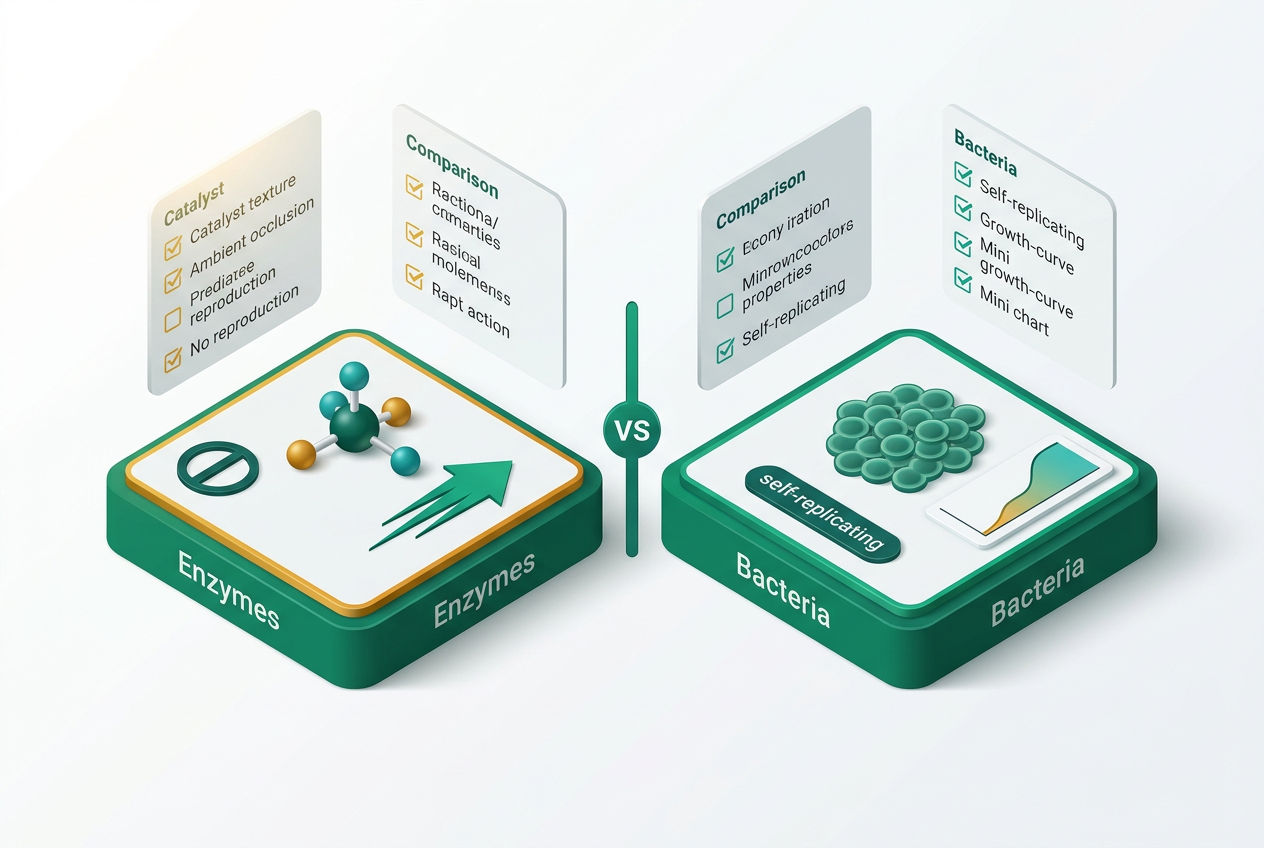
| Product Type | Contains | Reproduces? | Best Use Case | Notes |
|---|---|---|---|---|
| Enzyme-only | Lipases, proteases, amylases | No | Grease/paper breakdown | Short-lived effect |
| Bacteria-only | Live microbial cultures | Yes | Restoring disrupted systems | Self-sustaining colony |
| Enzyme + bacteria | Both | Yes (bacteria) | General maintenance | Most common retail product |
| Chemical additives | Acids/solvents | No | Not recommended | Can damage system |
Source: EPA Septic Systems Guidance; NOWRA Technical Bulletin on Septic Additives
Products like Rid-X and Septifix contain a blend of enzymes and bacterial cultures — they're not enzyme-only products, despite how they're often categorized. If you're evaluating specific brands, our Rid-X septic review and Septifix review break down exactly what each contains and what independent testing has found.
The bottom line: if you're going to add anything to your tank, a combined enzyme-plus-bacteria product gives you more biological "runway" than enzymes alone. But neither replaces the fundamentals.
How Often Should You Add Enzymes to a Septic Tank?
Most product labels recommend monthly use — which conveniently matches a monthly purchase cycle. The science doesn't clearly support that frequency for healthy systems.
Here's a more practical framework:
Use enzymes or bacterial additives:
- After confirmed antibiotic use in your household
- After a plumber treats a clog with chemical drain cleaner
- When reactivating a seasonal or vacation property after months of dormancy
- After your system has been pumped (pumping removes the sludge layer where most bacteria live)
- In early spring if you're in Minnesota, Vermont, or another state where ground temperatures drop your tank below 50°F for extended periods
Skip the monthly dose if:
- Your system has no symptoms and was pumped on schedule
- You already use septic-safe cleaning products consistently
- You've had a professional inspection confirming healthy effluent quality
Typical enzyme product dosing runs 2–4 oz per treatment for a standard 1,000–1,500 gallon tank, but follow the manufacturer's label — formulations vary.
Can You Put Too Many Enzymes in a Septic Tank?
You won't "burn out" your system with enzyme overdose the way you might with chemical additives. Enzymes are proteins — they break down over time and don't accumulate indefinitely.
That said, there's a practical concern with over-dosing: excessive enzyme activity can liquefy the solids in your tank faster than your drain field can safely handle them. A properly functioning drain field relies on effluent being relatively clarified before it reaches the distribution box and leach laterals. If your tank is churning out semi-liquefied solids because you've been adding high-dose enzyme products weekly, those particles can migrate into the leach field pipes and contribute to biomat formation.
This isn't common with standard monthly use. But if you're using "shock treatment" doses — some products advertise 4–8 oz treatments for "system restoration" — don't do it more frequently than the label specifies.
What Kills the Good Bacteria in Your Septic Tank?
This matters more than any additive you can buy. You can pour the best bacterial culture in the world into your tank and undo it in 24 hours with the wrong household products.
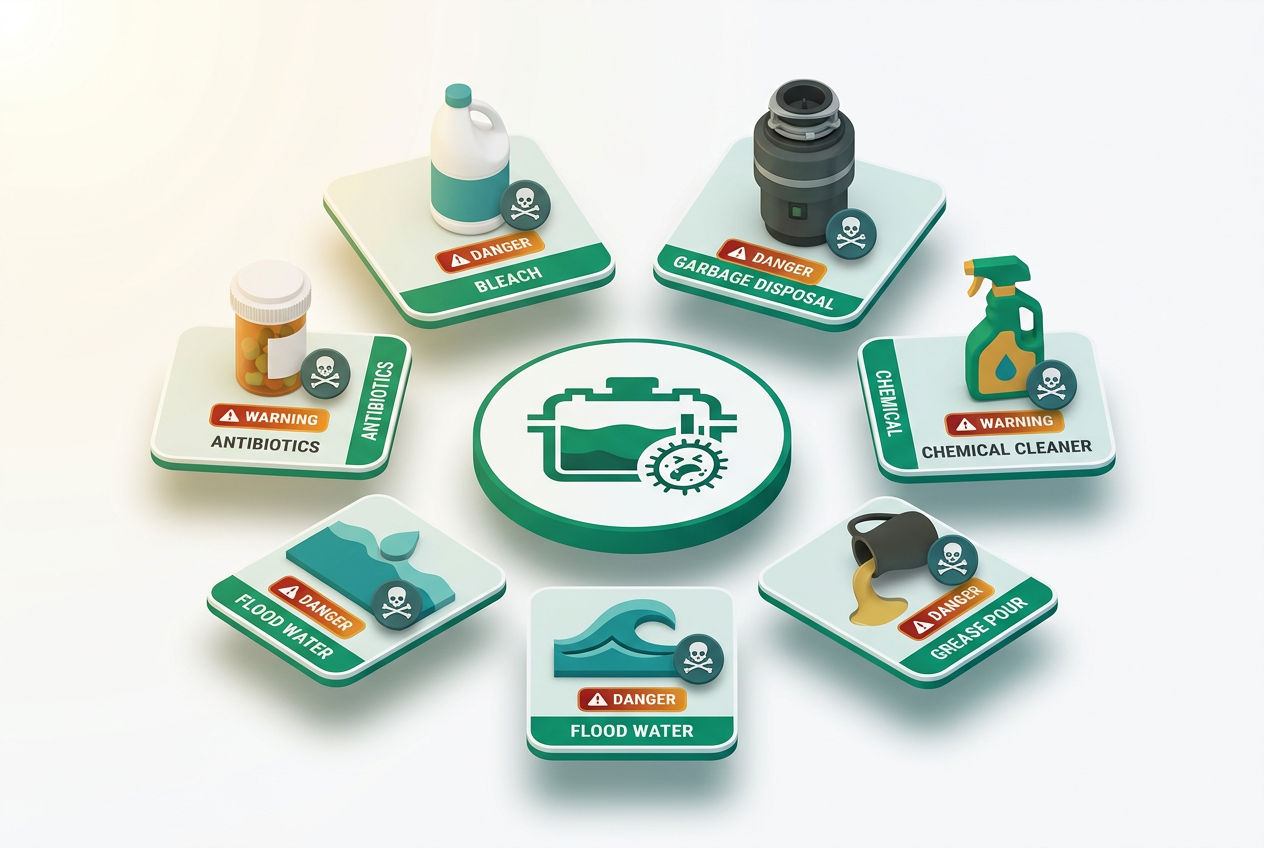
The main culprits:
- Bleach and antibacterial cleaners — Even diluted bleach reaching your tank regularly disrupts bacterial colonies. One toilet bowl cleaner used daily adds up. Our guide to safe cleaning products for septic systems lists specific product names that won't cause harm.
- Prescription antibiotics — A full course of antibiotics passes through your body and straight into your tank. It's unavoidable, but knowing it happened is a reasonable trigger for adding a bacterial supplement afterward.
- Chemical drain cleaners — Products containing sulfuric acid or lye (sodium hydroxide) are harsh enough to kill bacteria even at the dilutions that reach your tank. If you've got a slow drain and a septic system, reach for a septic-safe drain cleaner instead.
- Excess water volume — Not a chemical kill, but flushing your tank with large volumes of water (think a hot tub drain, a full water softener backwash cycle, or a huge laundry day) can physically flush the bacterial sludge layer out of the tank before it's had time to establish.
- Garbage disposals — Adding a garbage disposal to a home with a septic system increases the organic load significantly. A 1,000-gallon tank serving a 4-person household normally needs pumping every 3–4 years. Add a garbage disposal and that interval drops to roughly every 2 years. Our garbage disposal and septic guide covers this in detail.
Are Septic Tank Additives Required — Or Recommended by the EPA?
No. The EPA does not recommend or endorse septic additives as necessary for a properly functioning system. This has been the agency's consistent position. You can find current guidance at epa.gov/septic.
Several states have gone further and conducted independent evaluations. Washington State's Department of Health has studied biological additives and found insufficient evidence to support routine use in functioning systems. Florida's Department of Health regulates what additives can be marketed as "septic safe" within the state. Wisconsin's study, conducted through their Extension program, is one of the most-cited peer-reviewed evaluations of enzyme and bacteria additives — and it found no statistically meaningful benefit in healthy systems.
NOWRA (the National Onsite Wastewater Recycling Association) maintains a similar position: additives are not a substitute for proper maintenance, and their benefit in healthy systems is not supported by current research.
That doesn't mean they're completely worthless. It means they're a supplemental tool for specific situations — not a monthly necessity.
What Are the Signs That Your Septic Tank May Need Enzymes or Bacteria?
These symptoms suggest your biological balance may be off:

- Slow drains throughout the house — not just one fixture (one fixture is usually a clog, not a system issue)
- Gurgling sounds from toilets or drains after flushing
- Sewage odors inside the home or near the tank or drain field
- Unusually green or wet grass over the drain field when it hasn't rained
- Recent chemical disruption — antibiotics, heavy bleach use, drain cleaner
If you're seeing multiple symptoms at once, an enzyme or bacteria product is probably not your solution. That's a septic system backing up, and it needs professional eyes. A licensed technician can use a sludge judge to measure the scum and sludge layers in your tank — if the combined layers are within 12 inches of the outlet baffle, it's time to pump, not dose.
The average cost to pump a septic tank runs $300–$600 nationally for a standard 1,000–1,500 gallon tank. That's real maintenance. A $20 enzyme product is not a substitute for it.
Seasonal Considerations for Enzyme and Bacteria Use
Temperature directly affects how well enzymes and bacteria function. Enzyme activity drops sharply below 50°F, and bacterial metabolism slows significantly below 40°F.
Winter: In cold-climate states — think Maine, Vermont, Minnesota, Montana — your septic tank's biological activity slows considerably from November through March. Adding a bacterial supplement in late fall before ground temperatures drop can help maintain a healthy colony through the slow period. Our guide to septic tank maintenance in winter covers freeze protection too.
Spring: After a cold winter, spring is the best time to re-seed your system with a bacterial additive if you haven't done so recently. Tanks buried below 48 inches typically avoid freezing, but the biological activity has still been suppressed for months.
Holiday periods: Thanksgiving through New Year's is a high-stress period for septic systems. More people in the house, more cooking grease, more toilet use. This is the worst time to skip maintenance — and a reasonable time to add a bacterial product proactively if your system is older.
Vacation/seasonal properties: If you're reopening a cabin in Colorado or a beach house in South Carolina after months of vacancy, the bacterial colonies in that tank are depleted. A septic system shock treatment — a high-dose enzyme and bacteria product — is genuinely useful here. Emergency septic tank treatment options are worth reviewing before you reopen a property that's been sitting idle.
The Bottom Line on Septic Tank Enzymes
Enzymes aren't a scam — but they're also not magic. A healthy system with a healthy bacterial colony, no chemical disruptions, and a regular pumping schedule doesn't need monthly enzyme products. The science is clear on that.
Where they earn their place: after chemical disruptions, after pumping, during seasonal system reactivation, and in cold climates where biological activity stalls.
Your real maintenance priorities are:
- Pump your tank on schedule — every 3–5 years per EPA guidelines, or every 2–3 years for heavy-use households
- Protect your bacteria by using septic-safe products
- Inspect your effluent filter (Polylok PL-122 or equivalent) annually
- Keep your drain field healthy by controlling water load and keeping vehicles and roots off it
If you're unsure whether your system needs professional attention — not a $20 bottle — a septic inspection will tell you exactly what you're dealing with. The cost of a septic inspection runs $100–$300 and is well worth it before you spend months wondering if your additive routine is actually working.
For a deeper look at how the biological side of your system works, our septic tank bacteria guide covers the full picture — from anaerobic digestion in the tank to aerobic bacteria in the drain field.
Sources & Methodology
This article drew on the following primary sources:
- U.S. Environmental Protection Agency — Septic Systems (epa.gov/septic): Used for EPA guidance on pumping frequency, additive recommendations, and general system function.
- NOWRA (National Onsite Wastewater Recycling Association) (nowra.org): Referenced for industry position on biological additives and maintenance standards.
- University of Wisconsin Extension — Septic System Research: Peer-reviewed studies evaluating the measurable impact of enzyme and bacteria additives on effluent quality and solid waste breakdown in functioning septic systems.
- Washington State Department of Health: Referenced for state-level evaluation of septic additive marketing claims and biological additive research.
- University of Nebraska Extension: Cited for independent study findings on septic additive effectiveness in conventional residential systems.
Free download
Not ready for the Handbook? Start with the free Fridge Card.
The Do / Don’t card the whole family can see, plus the Survival Kit: emergency flowchart, warning-sign decoder and pump-schedule card. One printable PDF.
Was this article helpful?
Frequently Asked Questions
Recommended Resources
📖 Related Articles
- How Septic Tank Bacteria Work (And Why They Matter)
- Signs Your Drain Field Is Failing (And What to Do)
- Rid-X for Septic Tanks: Does It Help or Hurt?
- Septic-Safe Cleaning Products: The Complete List (Safe vs. Avoid)
- What Is a Drain Field? (And How Does It Work?)
- The Best Septic-Safe Drain Cleaners (and What to Never Pour In)
- Can You Use a Garbage Disposal with a Septic System?
- Septic System Backing Up? Causes & Emergency Steps
- Should You Pump Your Septic Tank Before Winter?
- Emergency Septic Tank Treatment? Causes & How to Fix It
- How to Handle Septic Drain Field Maintenance: Step by Step
💰 Cost Guides
🔧 Services
Find Septic Professionals Near You
Compare licensed, verified septic companies by area — top county markets and cities below, or browse all 50 states.
County markets
Popular cities
