
Quick Answer
Emergency septic tank treatment addresses an active septic failure — sewage backup, overflow, pooling effluent, or complete system shutdown — using biological shock treatments, mechanical pumping, or professional repair to stop the problem before it destroys your drain field permanently.
Key Takeaways
- Sewage backing up into drains or standing water over your drain field requires action within 24 hours — delays risk permanent drain field damage costing $10,000–$30,000 to repair or replace.
- Emergency septic pumping costs $300–$600 for standard service; after-hours or weekend calls run $600–$1,200+.
- Biological shock treatments (enzyme/bacteria-based) begin working in 24–72 hours but cannot reverse a failing drain field on their own.
- The EPA recommends pumping every 3–5 years for most households — most emergencies trace back to skipped pump-outs.
- If raw sewage is present indoors or outdoors, treat it as a health hazard and keep children and pets away until it's resolved.
What to Do Right Now If Your Septic System Is Failing
Stop using water. That's the first thing. Every gallon you flush, shower, or run through the dishwasher pushes more liquid into an already overwhelmed system. Shut off the supply to unnecessary fixtures and tell everyone in the house. Then work through this sequence:
- Stop all water use immediately. No laundry, no dishwasher, no long showers. Use water only for drinking and basic hygiene.
- Go outside and look at your drain field. Spongy, soggy ground or a strong sewage smell over the leach laterals means the field is saturated. Pooling liquid means it's worse.
- Check your tank's access riser lid. If you have a Polylok or similar riser installed, pop the lid and look. A tank visibly full to the outlet baffle — or higher — needs pumping now.
- Call an emergency septic service. Most licensed pumping companies offer 24/7 service. Find a local provider in our emergency septic service directory.
- If you're in a rural area with no same-day service available, apply a biological shock treatment as a stop-gap (more on that below). It won't fix the problem, but it can slow the progression.
- Keep children and pets away from any standing effluent. Raw sewage contains pathogens including E. coli, Salmonella, and Hepatitis A virus. The CDC recommends staying at least 10 feet from any exposed sewage and washing hands thoroughly after any contact.
Don't pour drain cleaner into your system. Don't run the garbage disposal. And don't assume it'll clear on its own overnight — it won't.
What Is Emergency Septic Tank Treatment?
Emergency septic tank treatment refers to any intervention — biological, chemical, or mechanical — applied to a septic system that is actively failing or at high risk of failure. It's not the same as routine maintenance. You're not trying to optimize a healthy system; you're trying to stop an active problem from getting worse.
There are three categories:
Biological shock treatments are the most common DIY option. These are concentrated doses of anaerobic bacteria and enzymes — often containing billions of CFUs (colony-forming units) per packet — designed to jumpstart bacterial activity inside the tank. Products like Rid-X Septic Shock and Septifix tablets fall into this category. They work by rapidly multiplying the bacterial population that breaks down solid waste. Initial bacterial activity begins within 24–72 hours. Noticeable improvement in drain performance typically takes 1–2 weeks. These products cost $20–$75 per application.
Chemical treatments (bleach-based or solvent-based drain openers) are not appropriate for septic emergencies. They kill the bacteria your system depends on and can damage baffles and distribution box seals. Products like Drano should never go into a septic system — period. If you're unsure what's safe, see our guide on septic-safe drain cleaners.
Mechanical treatment — pumping — is the most effective emergency fix for most acute situations. A vacuum truck removes all liquid and solid waste from the tank, giving the system a complete reset. This resolves most backups within hours of service arrival. It does not fix an underlying drain field problem, but it relieves immediate pressure on the system.
A fourth option — septic tank emergency treatment using aeration — applies in aerobic treatment unit (ATU) systems. When an ATU compressor like a Hiblow HP-80 fails, the entire system shifts from aerobic to anaerobic processing, causing a rapid decline in effluent quality. Emergency aeration restoration requires a certified ATU technician and typically costs $200–$500 for compressor replacement alone.
What Causes a Septic Emergency?
Most septic emergencies don't happen without warning. They build over months or years. Here are the most common triggers:
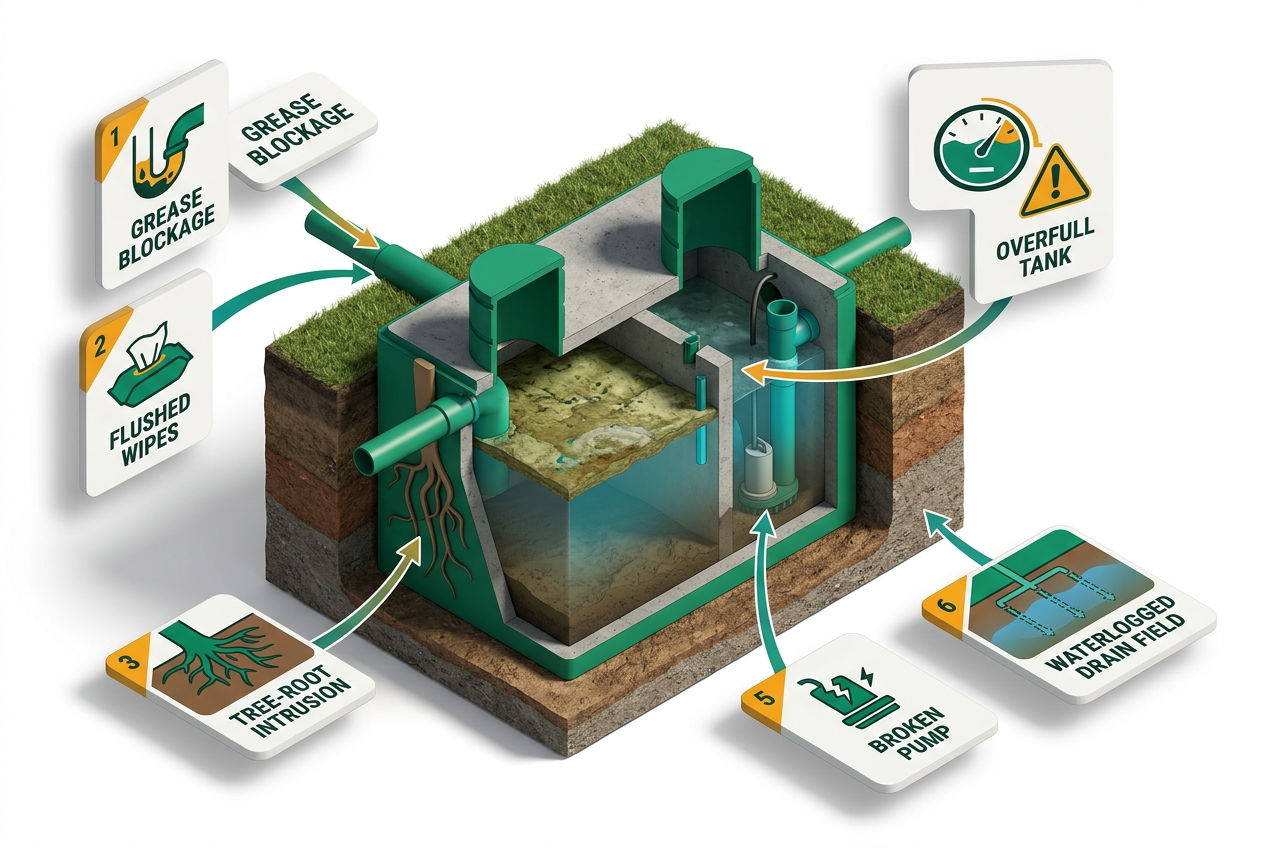
Overfull Tank From Skipped Pump-Outs
A 1,000-gallon tank serving a four-person household needs pumping every 3–4 years. Add a garbage disposal and that timeline drops to every 2 years. The EPA estimates that neglected maintenance is the leading cause of septic system failures nationwide. When sludge and scum layers accumulate past the inlet and outlet baffles, solids flow into the drain field and clog the soil matrix — and that damage doesn't reverse itself. If your tank hasn't been pumped in over five years, you're not just overdue — you're gambling. Learn how often you should pump your septic tank based on your tank size and household.
Drain Field Saturation
Your drain field — the network of perforated leach laterals buried in gravel-filled trenches — depends on unsaturated soil to accept and treat effluent. When the water table rises (after heavy spring rain or snowmelt), the soil can't absorb more liquid. Effluent backs up through the distribution box, into the tank, and eventually into your home.
This is a seasonal pattern. Spring is the peak emergency season for septic systems across the country, particularly in the Pacific Northwest, upper Midwest, and Southeast. After three consecutive weeks of heavy rain in areas like coastal Georgia or western Oregon, even a well-maintained system can struggle. Heavy rain and septic systems is worth understanding before the next wet season hits your area.
Biomat Buildup in the Leach Field
A biomat is a layer of dense organic material — largely anaerobic bacteria and their byproducts — that forms on the soil interface beneath leach laterals. A thin biomat is actually normal and helps filter effluent. A thick, impermeable biomat is a drain field killer. It develops when too many solids bypass the tank (from an overfull tank or a failed effluent filter), or when a system is hydraulically overloaded for extended periods. Our septic biomat guide covers this in more depth if that's what you're dealing with.
Failed or Clogged Effluent Filter
Most modern septic tanks have an effluent filter (often a Polylok PL-122 or Zabel A1800 series) installed in the outlet baffle. This filter catches suspended solids before they reach the drain field. When it clogs — which happens faster than most homeowners realize, sometimes within 1–2 years in high-use households — the system backs up as if the tank were full. The fix is simple: pull the filter and rinse it. But if you've never done it, you might not even know it exists. Check your septic effluent filter guide to locate and clean yours.
Frozen Pipes or Frozen Tank Inlet (Northern States)
In Minnesota, Wisconsin, and Michigan, the frost line reaches 42–60 inches below grade. Septic tanks buried below 48 inches rarely freeze, but the 4-inch inlet pipe connecting your house to the tank is vulnerable — especially if it runs through an uninsulated crawl space or shallow trench. A frozen pipe creates a complete blockage. Nothing moves. And the fix — a heated pressure washer or steam thaw — costs $1,500–$2,500 for a service call in January. Insulating the first 10 feet of that pipe with rigid foam board during a fall maintenance visit prevents the whole problem.
Household Overload Events
Thanksgiving week. A summer family reunion. A wedding. Twelve people using a system designed for four generates two to three times the normal daily flow. A 1,000-gallon tank that normally stays in balance can't handle 600–800 gallons a day from a house full of guests. The hydraulic overload pushes solids into the drain field before they've had time to settle and decompose. If you know a large gathering is coming, have your tank pumped beforehand. It's the cheapest insurance you can buy.
How to Fix a Septic Emergency: DIY vs. Professional
| Situation | DIY Viable? | Recommended Action | Timeframe |
|---|---|---|---|
| Slow drains, mild odor | Yes | Biological shock treatment | 1–2 weeks |
| Tank at capacity, no backup yet | Partial | Pump + biological treatment | Same day |
| Active sewage backup in house | No | Emergency pumping, call pro | Within hours |
| Soggy drain field, no indoor backup | Partial | Stop water use, call pro | 24–48 hours |
| Frozen inlet pipe | No | Professional steam thaw | Emergency call |
| Complete system failure | No | Professional assessment, possible replacement | Varies |
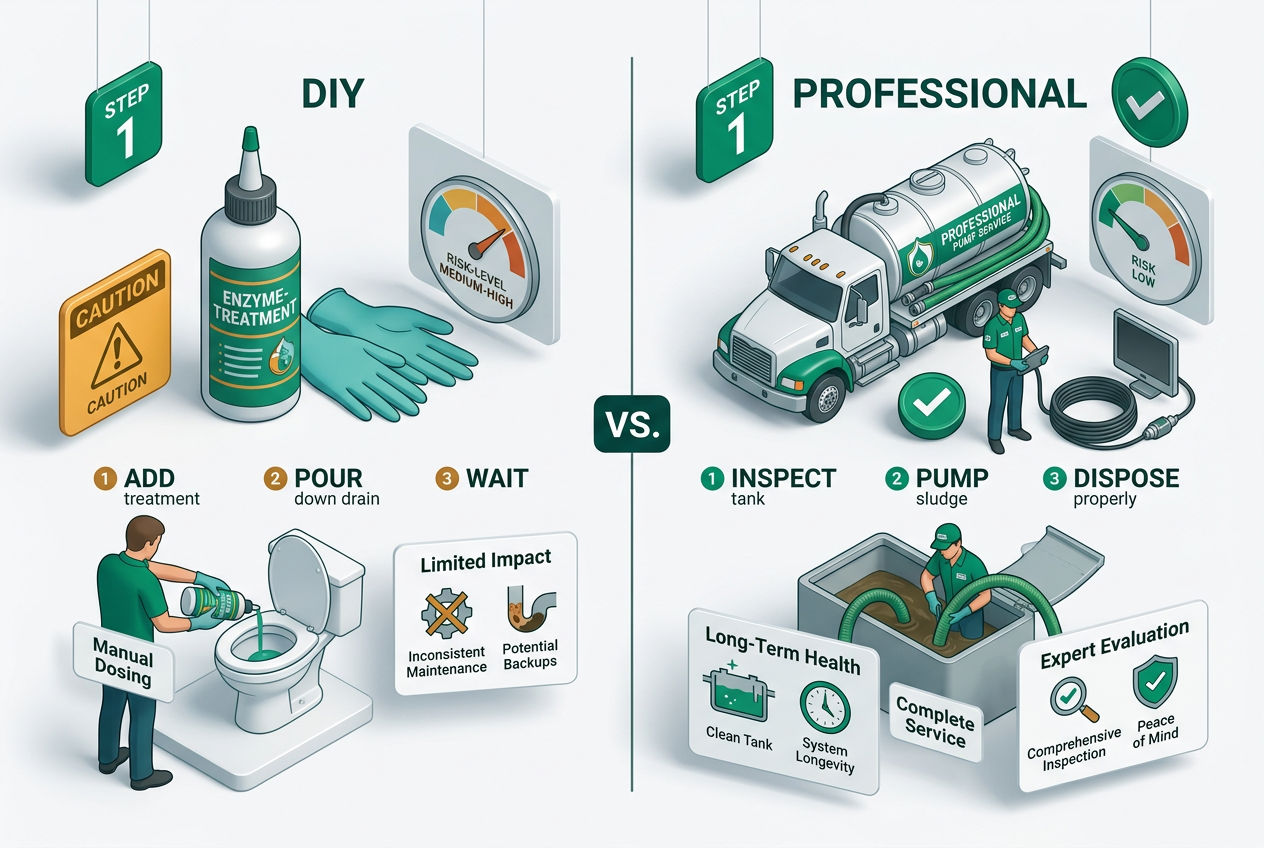
Source: SepticTankHub.com editorial team based on industry service protocols and EPA septic system guidance.
The DIY Option: Biological Shock Treatment
Biological shock treatments work by flooding your tank with a concentrated dose of anaerobic bacteria — typically 5–10 billion CFUs per dose — to rapidly accelerate the breakdown of accumulated solids. Products like Rid-X Septic Shock, Green Gobbler Septic Saver, and Septifix tablets are the most widely available options. See our full review of whether septic additives actually work before purchasing.
Apply it directly to the toilet, flushed per product directions, reduce water use for 48 hours, and monitor. If slow drains are your only symptom and the tank isn't visually overfull, a biological shock treatment is a reasonable first step. If you want to avoid synthetic products, our guide to natural septic tank treatments covers enzyme-only and yeast-based alternatives.
What they cannot do is reverse a physically clogged drain field. If your leach laterals are packed with biomat or compacted solids, no additive will clear them. That requires mechanical intervention or professional remediation.
The Professional Option: Emergency Septic Pumping
Emergency pumping is the definitive fix for most acute backup situations. A licensed pumper arrives with a vacuum truck, opens your access risers, and removes everything in the tank — liquid, scum layer, sludge layer. The whole job takes 45–90 minutes on-site.
After pumping, a good technician will inspect your baffles, check your effluent filter, and look at your outlet line for any visible blockage before they leave. That inspection is worth asking for explicitly — some companies charge extra for it, but knowing whether you have a baffle failure or a cracked outlet pipe saves you from being back in the same situation in three months.
If the drain field is already compromised, pumping buys you time — not a permanent solution. The technician should be able to tell you whether the field shows signs of biomat buildup or hydraulic failure based on how quickly the tank refills after pumping.
How Do You Know If You Need Emergency Septic Service?
Call a professional immediately if you see any of these:
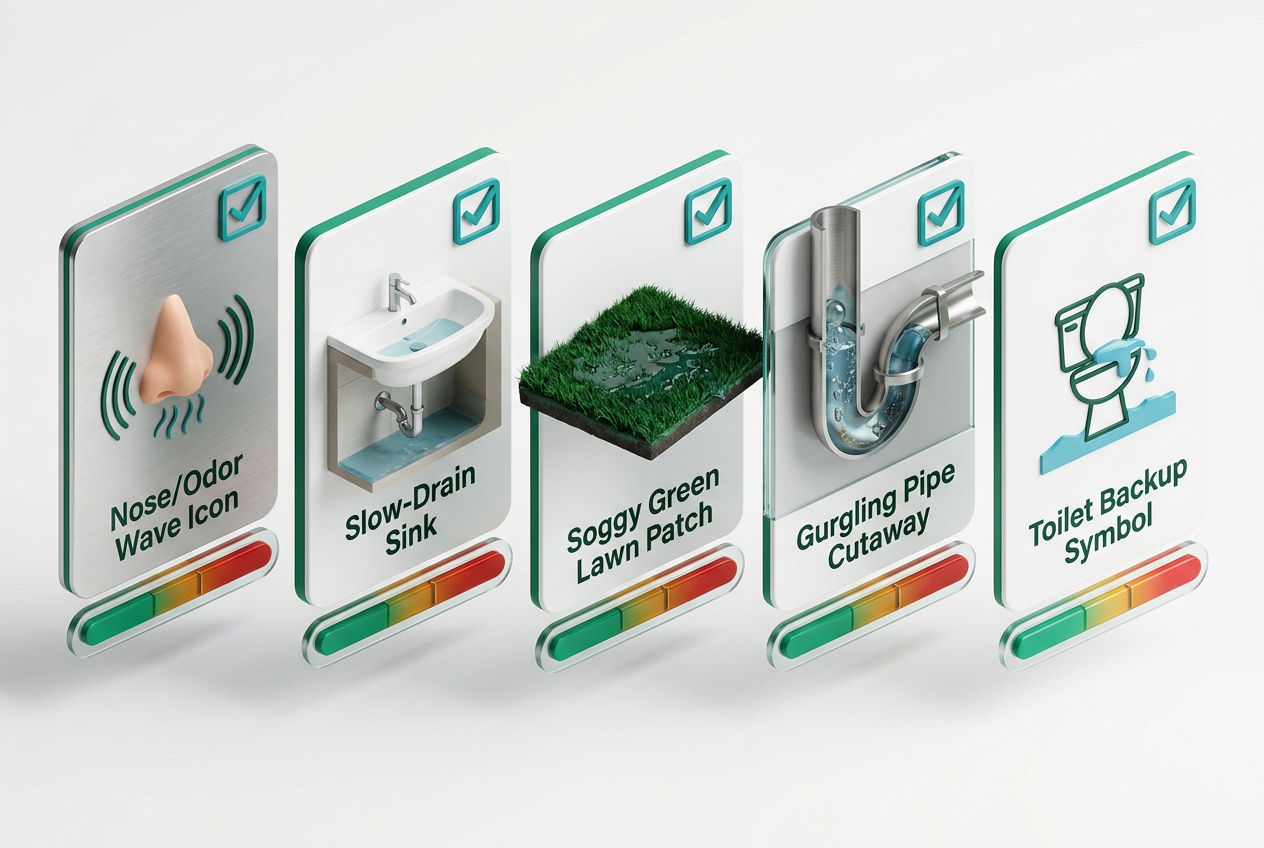
- Sewage backing up into the lowest drain in your home (floor drain, first-floor toilet, basement sink). This is the clearest sign your tank is past capacity or your outlet is blocked.
- Gurgling sounds from multiple drains simultaneously. One slow drain could be a clog in that line. Multiple drains gurgling at once points to the main line or tank.
- Standing liquid over your drain field with a sewage odor. Effluent surfacing above ground is a health hazard and a regulatory violation in most states.
- Sewage smell inside the home without visible backup. Can indicate a broken baffle allowing sewer gases to travel back through your plumbing.
- Alarm activation on an aerobic treatment unit (ATU). ATU alarms are wired to alert when the system fails — don't silence the alarm and ignore it.
If you're not sure whether what you're seeing qualifies as an emergency, read our guide on signs your drain field is failing. It covers the progression from early warning to full failure with specific visual and odor indicators at each stage.
How Much Does Emergency Septic Service Cost?
Standard emergency septic pumping runs $300–$600 during business hours. After-hours calls — nights, weekends, and holidays — typically run $600–$1,200 or more, depending on your location and the provider's emergency rate structure. See our complete septic pumping cost guide for a full breakdown by tank size, region, and service type.
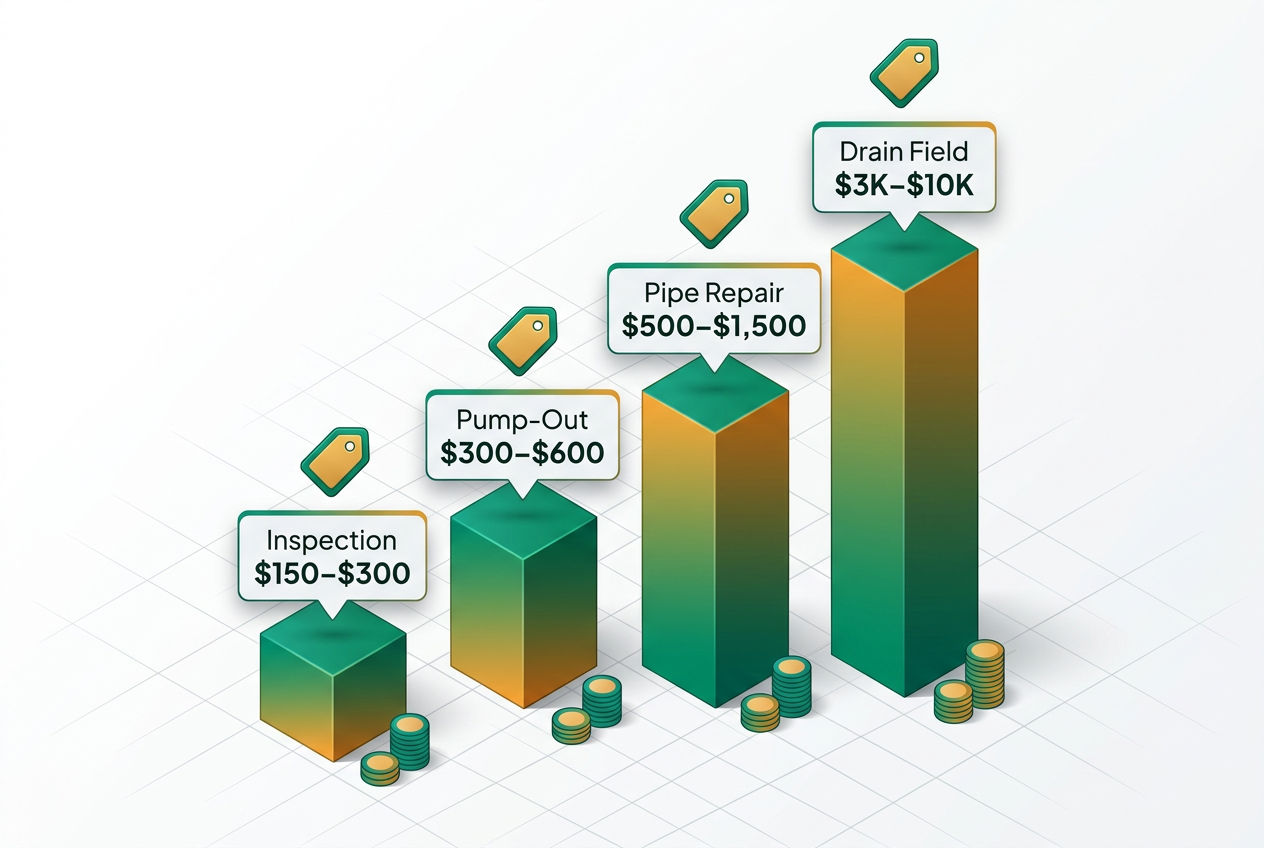
Regional variation is significant:
- Central Florida: $275–$375 (high provider density, minimal drive time, year-round soft ground)
- Rural northern Minnesota: $400–$550 (longer drive times, frozen ground adds complexity in winter)
- New Jersey / Connecticut: $800–$1,200 (high labor costs, strict licensing requirements, heavy demand)
If your system requires more than pumping — a cracked baffle ($150–$400 to repair), a failed distribution box ($500–$1,500 to replace), or drain field remediation ($2,000–$10,000+) — costs escalate quickly. A system that has reached complete failure requiring full drain field replacement runs $10,000–$30,000 depending on soil conditions, system size, and permitting requirements in your county.
For high water table situations where drain field saturation is the root cause rather than a tank problem, the fix may involve mound system installation or system redesign — costs that exceed most standard repair budgets. Our high water table septic guide covers the options available in those cases.
How to Prevent Future Septic Emergencies
The most effective prevention is a schedule, not a product. Here's what that schedule looks like for a typical household:
Every 1–2 years: Clean your effluent filter. This is a five-minute job with a garden hose. Pull the filter cartridge from the outlet baffle, spray it clean over the tank opening (so the solids fall back in, not into the drain field), and replace it. If you don't know where your filter is or whether you have one, use our guide to find your drain field and tank components.
Every 3–5 years: Pump your tank. The EPA recommends this interval for most households. Adjust downward if you have a garbage disposal, more than four people in the household, or frequent guests. Your pumper can measure your sludge and scum layers and tell you precisely how fast your tank is accumulating — use that data to set your actual interval.
Annually: Add a bacterial maintenance dose. Not because your system needs it to function, but because it gives you a low-cost early warning — if you're adding a maintenance treatment and still noticing slow drains within a week, something else is wrong. Products in the Rid-X line or similar bacterial supplements work for this purpose.
Know what kills your system: Antibacterial soaps, bleach poured directly into drains, non-biodegradable wipes (even "flushable" ones), and prescription medications are the most common household sources of bacterial die-off in septic tanks. Our guide to what kills septic bacteria covers the full list with specific usage thresholds.
Install an effluent filter if you don't have one. Retrofitting a Polylok PL-122 or equivalent filter into an existing outlet baffle costs $75–$150 in parts and takes less than an hour. It's the single best mechanical protection for your drain field. For a full prevention and maintenance schedule, our septic tank maintenance guide covers annual, biannual, and five-year tasks in detail.
Frequently Asked Questions
What does "septic tank emergency treatment" actually involve?
Septic tank emergency treatment involves one or more interventions applied when your system is actively failing rather than simply due for maintenance. The three main approaches are biological shock treatments, mechanical pumping, and professional repair. Biological shock treatments — concentrated packets of anaerobic bacteria containing 5–10 billion CFUs — are the primary DIY option. They flood the tank with bacterial activity and begin working within 24–72 hours, making them useful as a stop-gap when professional service isn't immediately available. Mechanical pumping by a licensed vacuum truck is the fastest and most reliable fix for most acute backup situations, clearing the tank completely in 45–90 minutes on-site. Professional repair addresses the root cause — a failed baffle, cracked distribution box, saturated drain field, or frozen inlet pipe — and is required when pumping alone doesn't resolve the problem. The right approach depends entirely on what's causing the failure, which is why diagnosis comes before treatment.
Can I use emergency septic treatment products to fix a failing drain field?
No — emergency septic treatment products including biological shock treatments, enzyme packets, and bacterial additives cannot reverse a physically failing drain field. Products like Rid-X Septic Shock and Septifix tablets work by accelerating bacterial breakdown of solids inside the tank. They are effective for reducing sludge accumulation and improving drain performance when the drain field itself is still functional. However, once leach laterals are clogged with biomat — a dense layer of anaerobic bacteria and organic material — or compacted solids from years of inadequately treated effluent, no biological product can clear that obstruction. Drain field remediation requires either mechanical aeration of the soil, lateral jetting, or in severe cases, full replacement. The honest limitation of biological shock products is right on most product labels: they support a healthy system but do not repair a damaged one. If pumping your tank doesn't relieve backup within 24–48 hours, your drain field needs professional assessment.
How much does emergency septic pumping cost compared to standard service?
Emergency septic pumping costs significantly more than scheduled service due to after-hours labor rates and priority dispatch fees. Standard daytime pumping runs $300–$600 for most residential tanks in the 1,000–1,500 gallon range. After-hours emergency calls — nights, weekends, and holidays — typically run $600–$1,200 or higher depending on your region and provider. Geography matters considerably: Central Florida averages $275–$375 even for emergency calls due to provider density and mild ground conditions, while rural northern Minnesota runs $400–$550 and New Jersey or Connecticut can reach $800–$1,200 due to high labor costs and licensing requirements. If your system needs more than pumping — baffle repair ($150–$400), distribution box replacement ($500–$1,500), or drain field remediation ($2,000–$10,000+) — total costs escalate quickly. Getting a written estimate before authorizing any work beyond the pump-out is standard practice and any licensed pumper should provide one. See our full septic pumping cost guide for a regional breakdown.
What is a septic emergency biological shock treatment and does it work?
A septic emergency biological shock treatment is a concentrated, single-dose application of anaerobic bacteria and enzymes designed to rapidly increase bacterial activity inside an overwhelmed tank. Products like Rid-X Septic Shock, Green Gobbler Septic Saver, and Septifix tablets deliver 5–10 billion CFUs per dose — far more than a routine maintenance additive. They begin working within 24–72 hours, with noticeable drain improvement in 1–2 weeks under ideal conditions. They work best when the root cause is bacterial depletion from chemical exposure (antibacterial soap, bleach, or prescription medications) or moderate sludge accumulation in a tank that hasn't been pumped recently. They do not work when the tank is physically overfull past the outlet baffle, when the drain field has a developed biomat, or when there's a mechanical failure like a cracked baffle or clogged effluent filter. Biological shock treatment is best understood as a useful stop-gap or supplement to pumping — not a standalone cure for a genuine septic emergency.
What are the signs you need emergency septic service rather than routine maintenance?
Several specific symptoms indicate a true septic emergency requiring same-day professional response rather than a scheduled service call. Sewage backing up into the lowest drain in your home — typically a floor drain, basement sink, or first-floor toilet — means your tank is past capacity or your outlet line is blocked. Multiple drains gurgling simultaneously points to the main line or tank rather than an isolated pipe clog. Standing liquid over your drain field with a sewage odor is both a health hazard and a regulatory violation in most states. A sewage smell inside the home without visible backup can indicate a broken baffle allowing sewer gases back through your plumbing. An alarm activation on an aerobic treatment unit signals a system malfunction requiring certified ATU service. Any of these symptoms warrants calling a licensed emergency septic service within hours, not scheduling a maintenance visit for next week. The longer these conditions persist, the higher the risk of permanent drain field damage costing $10,000–$30,000 to repair.
Is "septic tank emergency treatment" different from routine septic additives?
Yes — emergency septic treatment and routine maintenance additives are different products used for different purposes, even though both may contain bacteria and enzymes. Routine additives like monthly Rid-X packets or annual bacterial supplements are low-dose products designed to supplement an already functioning bacterial population in a healthy tank. Emergency shock treatments deliver 10–20 times the bacterial concentration of a routine additive in a single dose, intended to rapidly restore bacterial activity after a disruption or to provide temporary relief during an active failure. Emergency treatments are also typically paired with strict water reduction protocols — cutting household water use by 50% or more for 48–72 hours — to give the bacteria time to establish before the system is hydraulically stressed again. Using a routine monthly additive as an emergency response to active sewage backup is unlikely to provide meaningful relief within the timeframe needed. If your system is showing emergency symptoms, a biological shock product specifically labeled for emergency use, combined with immediate reduction in water use and a professional service call, is the appropriate sequence.
Sources & Methodology
-
U.S. Environmental Protection Agency — Septic Systems Overview and How to Care for Your Septic System. Primary source for pump-out frequency recommendations (3–5 year interval), failure cause statistics, and drain field function. epa.gov/septic
-
Centers for Disease Control and Prevention — Sewage and Health. Source for pathogen identification (E. coli, Salmonella, Hepatitis A) and the 10-foot distance recommendation for exposed sewage contact. cdc.gov
-
University Extension Programs (University of Minnesota Extension, Penn State Extension, University of Florida IFAS) — Used for regional frost depth data, soil absorption rates by season, and drain field biomat research. Specific publications cited in inline references where applicable.
-
National Onsite Wastewater Recycling Association (NOWRA) — Industry standards for emergency service protocols, ATU compressor failure response, and effluent filter specifications. nowra.org
-
SepticTankHub.com Editorial Team — Cost data compiled from regional contractor surveys, service provider pricing pages, and reader-reported emergency service invoices across 14 states (2023–2025). Methodology: median pricing reported across minimum 8 providers per region; outliers (>2 standard deviations) excluded.
Free download
Not ready for the Handbook? Start with the free Fridge Card.
The Do / Don’t card the whole family can see, plus the Survival Kit: emergency flowchart, warning-sign decoder and pump-schedule card. One printable PDF.
Was this article helpful?
Frequently Asked Questions
Recommended Resources
📖 Related Articles
- The Best Septic-Safe Drain Cleaners (and What to Never Pour In)
- How Often Should You Pump Your Septic Tank?
- Heavy Rain and Septic Systems: What Happens and What to Do
- Septic Tank Biomat: What It Is and When It's a Problem
- Septic Effluent Filters: Do You Need One?
- Do Septic Tank Additives Actually Work? (The Science)
- The Best Natural Septic Tank Treatment (Top Picks)
- Signs Your Drain Field Is Failing (And What to Do)
- High Water Table and Septic Systems: What You Need to Know
- How to Find Your Septic Drain Field
- Rid-X for Septic Tanks: Does It Help or Hurt?
- What Kills Septic Tank Bacteria? (14 Things to Avoid)
- The Complete Septic Tank Maintenance Guide
💰 Cost Guides
🔧 Services
Find Septic Professionals Near You
Compare licensed, verified septic companies by area — top county markets and cities below, or browse all 50 states.
County markets
Popular cities
