
Quick Answer
Natural septic tank treatment uses live beneficial bacteria and enzyme formulas to break down organic waste inside your tank, reducing sludge accumulation and helping your drain field function properly between professional pump-outs. Quality products deliver 8+ billion CFUs per dose across multiple bacterial strains and cost as little as $2 per month to use.
Key Takeaways
- The best natural treatments contain live bacteria (measured in CFUs) plus enzyme blends targeting grease, paper, and proteins
- Bacterial treatments work best above 55°F — cold-climate homeowners should treat aggressively in spring and fall
- No additive eliminates the need for pumping; a 1,000-gallon tank serving a 4-person household still needs pump-outs every 3–4 years
- Some states, including Florida and Minnesota, regulate which septic additives are permissible — check before you buy
- Monthly dosing produces better results than occasional treatments; consistency matters more than concentration
I've talked to enough septic service technicians to know the conversation goes the same way every time: homeowners pump their tank on schedule but do nothing in the 3–4 years between visits. The tank's bacterial colony quietly crashes after a heavy cleaning session or a course of antibiotics, sludge accumulates faster than it should, and by the next pump-out there's more solids than expected. A $2/month bacterial treatment would have prevented most of it.
Around 21 million U.S. households rely on septic systems, according to the EPA. Most pump on schedule — but very few actively maintain the bacterial ecosystem in between. That's the gap a good natural septic tank treatment fills.
Think of your tank as a living ecosystem. Billions of beneficial bacteria for septic tanks digest solids, break down grease, and keep effluent clean enough to safely filter through your drain field's leach laterals. Flush the wrong things, run a lot of hot water, or use antibacterial soap heavily, and that bacterial population crashes. Sludge accumulates faster. Your effluent filter clogs. Your drain field starts receiving partially treated waste. A quality biological septic treatment helps restore that balance without harsh chemicals.
Here's what the research actually shows — and how to pick the right product.
Do Natural Septic Tank Treatments Actually Work?
Biological and enzyme-based septic treatments do work — with important caveats. Independent research, including a study published by the University of Arkansas Cooperative Extension Service (Septic System Additives, Publication FSA-2. Cooperative Extension Service, University of Arkansas), confirms that bacterial additives can reduce sludge accumulation rates and support digestion of fats, oils, and grease. They're most effective as a maintenance tool in a system that's already functioning.
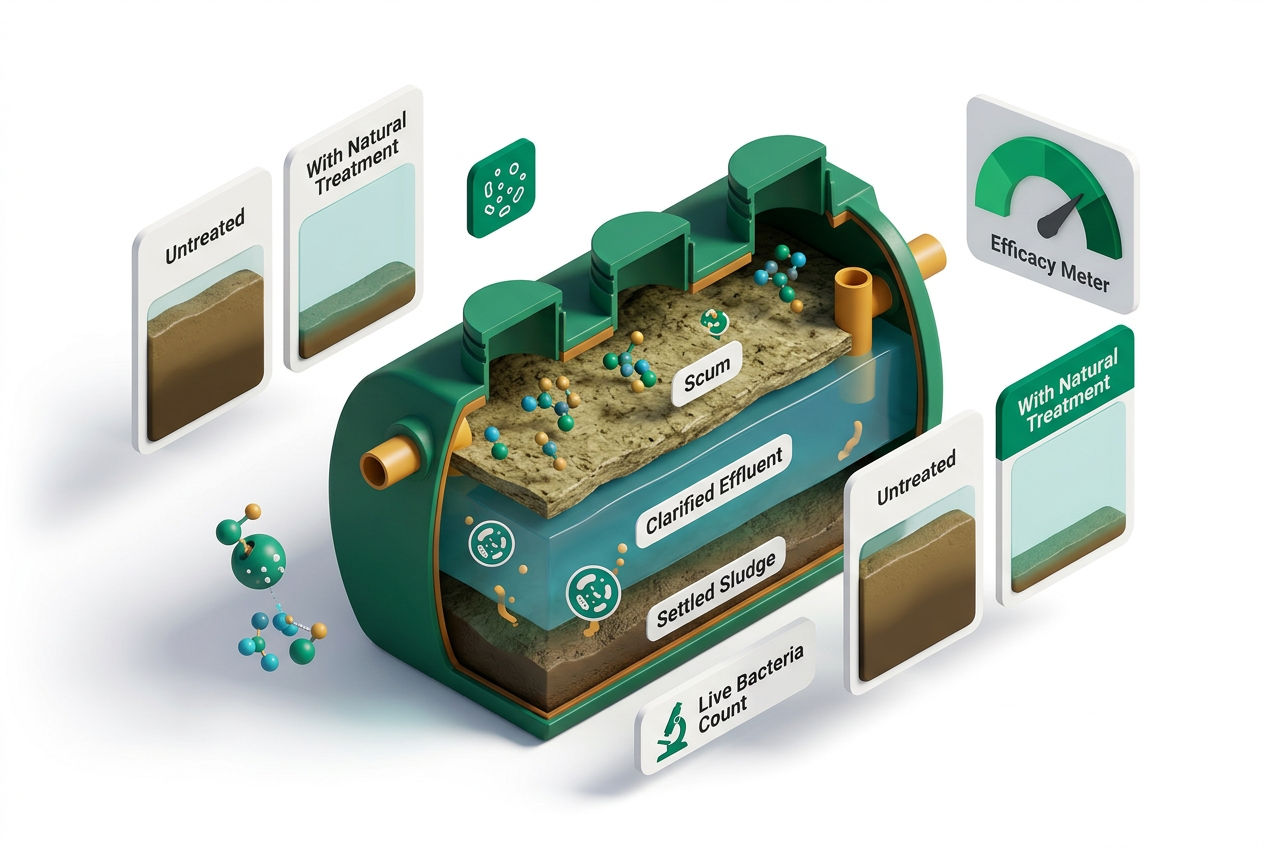
What they won't do: reverse a failing drain field, clear a septic biomat that has already formed, or replace professional pumping. A 2019 review of additive research found no peer-reviewed evidence that any additive eliminates the need for regular pump-outs. If your 1,500-gallon tank hasn't been pumped in 10 years and your yard has a wet spot, no bottle of bacteria will fix that. You need a pumper truck and possibly a drain field repair.
To put real numbers on "maintenance benefits": in a typical 1,000-gallon tank serving a 4-person household, untreated systems accumulate roughly 50–70 gallons of sludge per year under normal use. Studies on bacterial additive use report sludge accumulation reductions of 20–30% in consistently treated systems — meaning a well-treated tank might accumulate 35–55 gallons per year instead, potentially extending the interval between pump-outs by 6–12 months over a multi-year period. That's meaningful, but it's a reduction in rate, not an elimination of the need to pump.
Used consistently in a healthy system, biological treatments deliver measurable reductions in sludge accumulation, reduced scum layer thickness, and fewer odor events — which is exactly what you're paying $2/month to get.
What Should You Look for in a Natural Septic Tank Treatment?
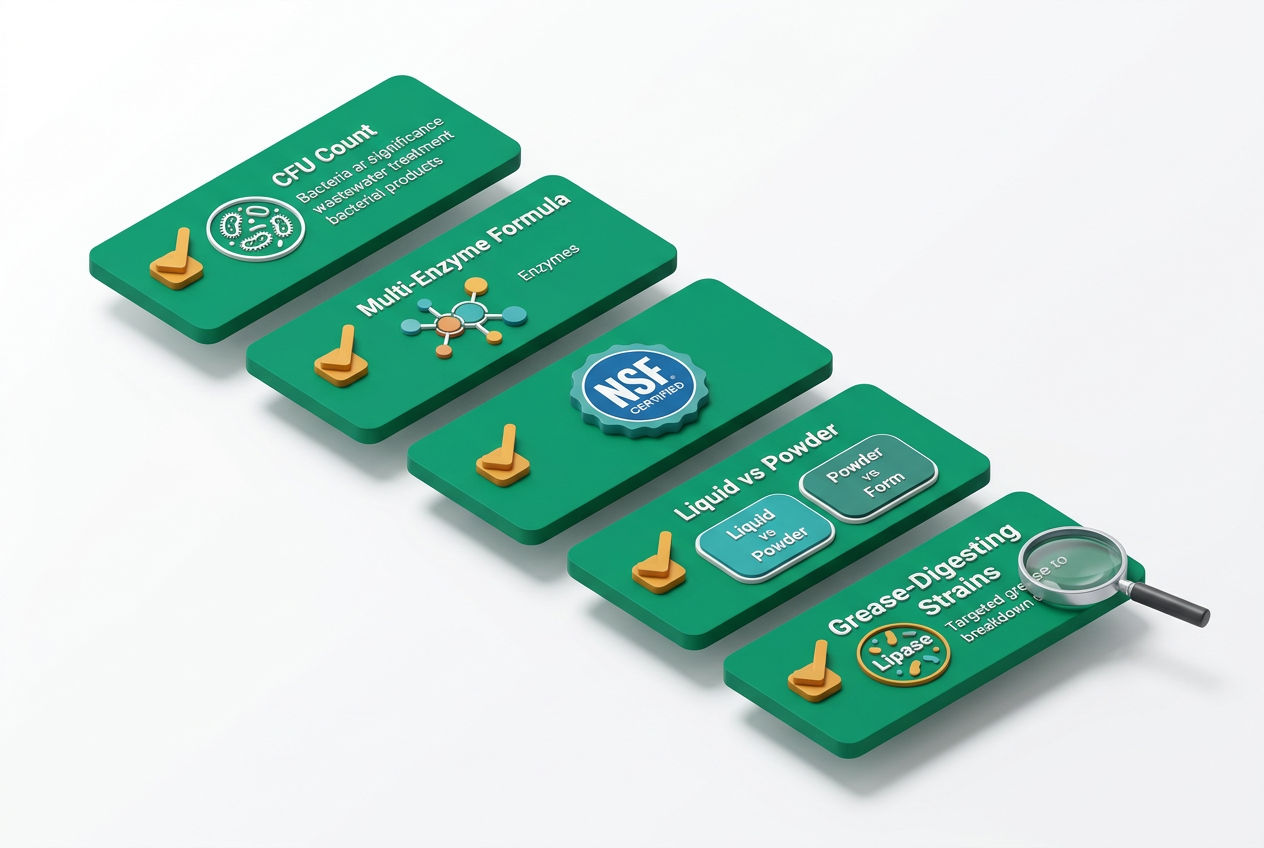
CFU Count
CFU stands for Colony Forming Units — the measure of how many live bacteria are in a dose. Look for products delivering at least 8 billion CFUs per dose. Some premium products deliver 16–40 billion CFUs. Higher isn't always better if the strains aren't matched to septic conditions, but low-CFU products (under 3 billion) are rarely worth buying.
Bacterial Strain Diversity
A single bacterial strain digests one type of waste. A good product uses 8 or more bacterial strains, covering different waste types: cellulose (toilet paper), proteins, starches, fats, and grease. Look for strains like Bacillus subtilis, Bacillus licheniformis, and Bacillus amyloliquefaciens on the label — these are workhorses in septic environments.
Enzyme Blend
Bacteria produce enzymes as they work, but some products pre-load the formula with enzymes (protease, lipase, amylase, cellulase) to jumpstart breakdown immediately. This matters most if you're treating a sluggish system or following up after a pump-out. For general septic tank maintenance, a bacteria-only product is fine.
Format and Dosage Frequency
Products come as water-soluble pods, powder packets, and liquids. All three formats work. Pods and packets are easier to dose correctly. Monthly dosing is the standard recommendation — but if you've had a system stress event (heavy guest usage, antibiotics, a big cleaning session), an extra dose makes sense.
Cost Per Treatment
Don't buy based on sticker price. Calculate the cost per month.
| Product Format | Typical Price | Doses Included | Cost/Month |
|---|---|---|---|
| Powder packets (12-pack) | $22–$28 | 12 | ~$2.00 |
| Water-soluble pods (12-pack) | $25–$35 | 12 | ~$2.50 |
| Liquid concentrate (1 qt) | $18–$24 | 6–8 | ~$2.50–$3.50 |
| Tablet form (12-pack) | $20–$30 | 12 | ~$2.00 |
| Probiotic septic treatment (3-mo supply) | $30–$45 | 3 | ~$10–$15 |
Source: Retail pricing aggregated from Amazon, Home Depot, and Lowe's product listings, January 2026
Top Natural Septic Tank Treatment Picks
1. Rid-X Septic Tank Treatment (Powder or Pod)
Rid-X is the most widely available natural septic treatment in the U.S. — you'll find it at every hardware store and most grocery stores. Each regular dose delivers 9.8 billion CFUs plus four enzymes: cellulase, protease, lipase, and amylase. Monthly use costs about $2.00–$2.50. It's been studied more than most competitors and shows consistent results reducing scum layer thickness in normally operating systems.
One real limitation: Rid-X uses a relatively limited strain diversity — primarily Bacillus species. For most conventional systems, that's adequate. For an aerobic septic system with more complex treatment demands, consider a multi-strain alternative.
Read our full Rid-X septic review for a deeper breakdown of ingredients and test data.
2. Septifix Septic Tank Treatment Tablets
Septifix tablets are an oxygen-releasing bacterial treatment — each tablet dissolves slowly over 3–5 days, releasing 10+ billion CFUs alongside oxygen that supports aerobic bacterial activity. That aerobic environment accelerates waste digestion compared to purely anaerobic tanks. Each pack covers 3 months at around $15/month.
Septifix is especially useful in systems that drain slowly or show early signs of stress, because the aerobic bacterial boost tends to reduce sludge more aggressively than anaerobic-only treatments. See our Septifix review for independent test data comparisons.
3. Green Gobbler Septic Saver Packets
Green Gobbler's bacterial septic treatment uses a 5-strain Bacillus blend with 8 billion CFUs per packet. It's sold in 6-month supply packs (about $20–$24) and is frequently cited in consumer reports best septic treatment roundups for its value-to-performance ratio. No harsh chemicals. No phosphates. Labeled as both septic-safe and greywater-safe.
One differentiator: the formula includes a natural surfactant that helps the bacterial culture reach grease deposits along baffle walls and tank walls faster. For homeowners with heavy grease loads (lots of cooking, infrequent cleaning), this matters.
4. Cabin Obsession Septic Tank Treatment
Cabin Obsession is a standout for seasonal or vacation-home systems — exactly the scenario its name implies. Each dose delivers 10 billion CFUs with a particular emphasis on strains suited to low-use periods. If your cabin sits empty for months, the bacterial colony in your tank can crash. Treating before you leave and immediately when you return prevents sludge from hardening into a dense layer that's difficult to break down.
A 12-month supply runs about $28. For cabin septic system owners, that's a genuinely worthwhile $28.
5. Bio-Clean Drain and Septic Bacteria
Bio-Clean is a powder-concentrate formula favored by plumbers and septic professionals. It contains billions of bacteria and enzymes per tablespoon and comes in large containers designed for both drain maintenance and tank treatment. A 2-lb can runs about $55–$70 but covers a full year of monthly septic treatment plus regular drain treatments throughout the house — making the cost-per-application lower than most single-use packet products.
The trade-off: it requires accurate measuring and a slightly different application process. Not ideal if you want dead-simple monthly maintenance. If you're comfortable with a measuring spoon and want to add bacteria to your septic tank while simultaneously treating kitchen and bathroom drains, it's excellent value.
6. Walex Bio-Active Septic Tank Treatment Drop-Ins
Walex Bio-Active uses pre-measured drop-in pods — each containing over 14 billion CFUs from multiple bacterial strains targeting paper, grease, proteins, and starches. The pod format eliminates measuring errors entirely. Drop one in the toilet, flush, and the bacterial culture distributes through the system within 24–48 hours.
A 12-pod supply costs around $25–$30. Results reported by users include reduction in septic tank odor within 2–3 weeks of first use, which tracks with the typical 14–21 day colonization timeline for Bacillus species in tank conditions.
What Kills the Good Bacteria in Your Septic Tank?
Your natural bacterial colony is surprisingly fragile. Common household products that devastate septic bacteria include:
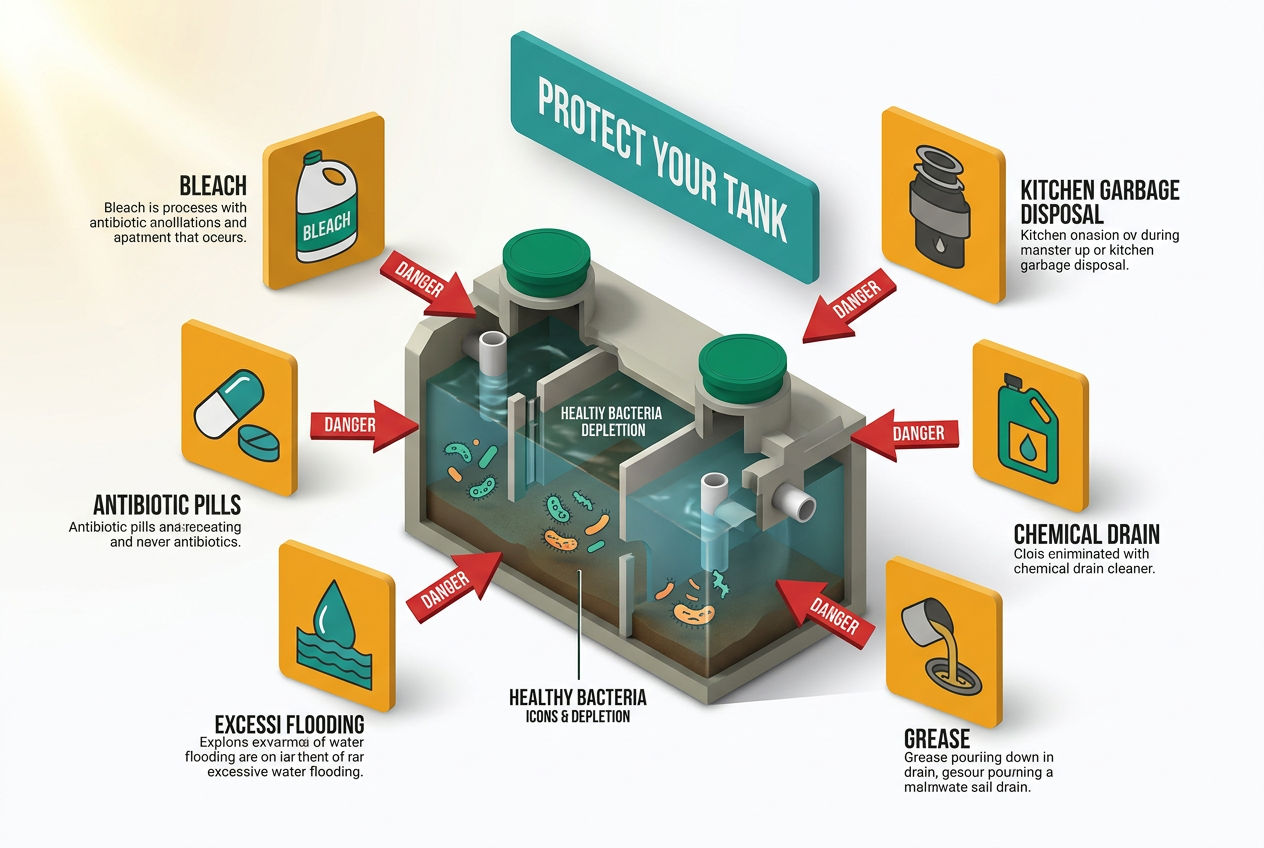
Antibacterial products: Triclosan-based soaps and disinfectant cleaners are the biggest offenders. A single antibacterial handwashing session won't crash your system, but daily use over weeks absolutely can.
Bleach: Chlorine bleach kills bacteria on contact. Using bleach in your septic system regularly — toilet bowl cleaners, laundry bleach in large quantities — depletes the colony significantly. Occasional, diluted use is less harmful than you might think, but heavy weekly use is a real problem.
Chemical drain cleaners: Products like Drano use sodium hydroxide (lye) or sulfuric acid — both are highly caustic and will kill septic bacteria and disrupt tank pH on contact. A single emergency use probably won't cause lasting damage, but regular use will.
Antibiotics: When a household member takes antibiotics, those compounds pass through the body and into the wastewater stream. According to research published in Chemosphere (2019), common antibiotics including amoxicillin and ciprofloxacin remain biologically active at concentrations sufficient to inhibit bacterial growth after passing through residential plumbing. Dosing your tank with a biological treatment the week after completing a course of antibiotics is a concrete, measurable response to this specific stress event.
Garbage disposal overuse: Grinding large volumes of food waste sends a surge of organic material that overwhelms bacterial capacity before it can be digested. See our guide on what kills septic bacteria for a more complete list.
Can Baking Soda and Vinegar Clean a Septic Tank?
No — not at tank scale. This is one of the more persistent myths in the homemade septic tank treatment space, and it's worth addressing directly.
When baking soda and vinegar contact each other, they produce water, carbon dioxide, and sodium acetate. At drain scale, the fizzing action can help dislodge soft buildup in a P-trap. That's legitimate and useful.
At tank scale — a 1,000-gallon vessel — the volume of baking soda required to meaningfully shift pH or produce any useful reaction is so large that it would itself disrupt the tank's chemistry. You'd need pounds of each, the reaction would neutralize within seconds of hitting the tank volume, and the sodium acetate byproduct adds dissolved solids without contributing to waste digestion.
Baking soda is, however, septic-safe as an occasional drain cleaner in household quantities. If you're scrubbing a sink with a baking soda paste once a week, that's not going to hurt your tank. It's just not a substitute for a bacterial treatment product.
For a full look at what actually works versus what doesn't, see our septic-safe cleaning products guide.
How Often Should You Use Natural Bacterial Treatments?
Monthly dosing is the standard recommendation from product manufacturers and is supported by the National Onsite Wastewater Recycling Association (NOWRA) guidance on maintenance additive use. For most households, that means one dose per month, every month, year-round.
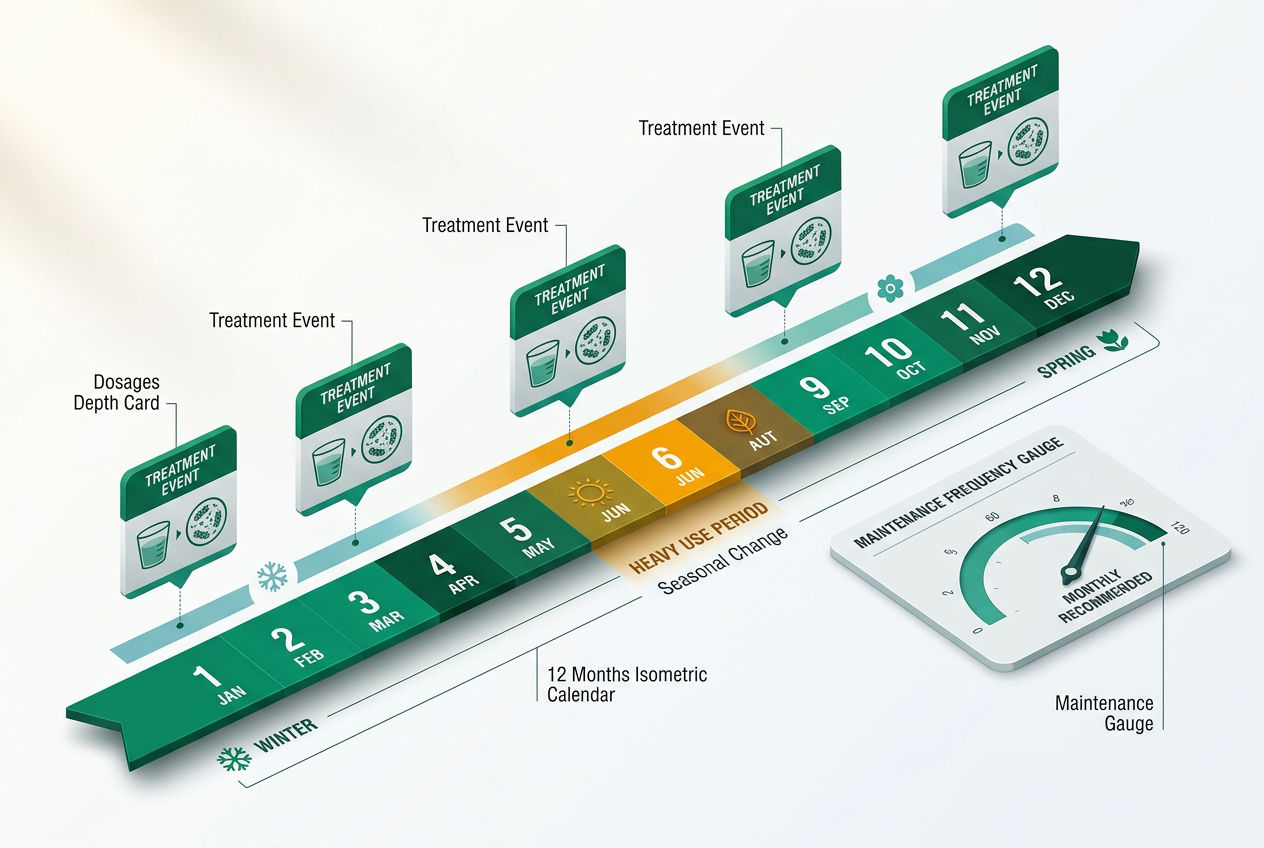
There are specific situations where more frequent dosing makes sense:
- After a pump-out: The pump-out removes the existing bacterial colony along with the sludge. Treating immediately after a pump-out — and then again 2 weeks later — jumpstarts recolonization faster than a single monthly dose.
- After antibiotic use: As noted above, antibiotics suppress the bacterial colony. An extra dose during or immediately after the treatment course helps maintain population levels.
- After heavy household use: Holiday gatherings, hosting guests for a week, or any period of significantly above-normal water and waste volume warrants an additional treatment. See our guide on how often to pump a septic tank for context on how usage volume affects the overall maintenance schedule.
- Spring treatment in cold climates: Bacterial activity slows significantly below 55°F. In northern climates, the bacterial colony may be partially suppressed through winter. A double dose in early spring — once when temperatures reliably exceed 50°F and again 2–3 weeks later — helps restore activity before the high-use summer season.
What you don't need: more than monthly dosing as a baseline. More bacteria doesn't mean faster digestion if the tank's temperature, pH, and organic load are already at equilibrium. Consistency matters more than volume.
Are Biological Septic Treatments Safe for the Environment?
Yes, with a meaningful caveat about what "natural" actually means on the label.
The bacterial strains in commercial septic treatments — primarily Bacillus species — are naturally occurring soil bacteria. They're not genetically modified, they're not pathogens, and they don't persist in groundwater in ways that pose ecological risks. The enzymes (protease, lipase, amylase, cellulase) are similarly naturally derived and break down rapidly in soil environments.
The caveat: Florida's Department of Health, under Chapter 64E-6 of the Florida Administrative Code, maintains an approved list of septic additives. Minnesota's Pollution Control Agency maintains similar restrictions under Minn. R. 7080.0178. Products sold in those states must meet state approval criteria. If you're in a regulated state, check the state agency's approved product list before purchasing — not all products marketed nationally have gone through state approval processes.
Beyond the regulatory angle: the products reviewed here contain no phosphates, no synthetic surfactants beyond trace amounts in Green Gobbler's formula, and no compounds flagged by the EPA's Safer Choice program as environmental concerns. For homeowners concerned about what eventually reaches their drain field and local groundwater, that matters. What flows through a functioning drain field is ultimately filtered through soil — keeping that effluent as clean as possible protects both the drain field and the groundwater below it. For more detail on what you can safely flush, our dedicated guide covers the full list.
Natural Treatments Are One Tool — Not the Whole Toolbox
A natural bacterial treatment does one thing well: it maintains and supports the microbial ecosystem that makes your septic system work. It does not:
- Replace pump-outs. A 1,000-gallon tank serving a family of four still needs professional pumping every 3–4 years, period.
- Repair a failing drain field. If your leach field has biomat formation or hydraulic failure, the repair cost runs $3,000–$10,000 for conventional drain field work and $5,000–$25,000 for a full replacement. No additive product addresses that.
- Fix a septic system backing up into the house. That's a service call situation, not a treatment situation.
- Compensate for flushing things that shouldn't go down the drain — wipes, grease, medications, excessive paper.
A $2/month bacterial treatment, used consistently, reduces sludge accumulation rates by a measurable margin, supports healthy bacterial populations through stress events, and gives your system the best possible chance of reaching each pump-out interval without incident. That's a reasonable return on a very low investment. It's also the ceiling of what these products do — and knowing that ceiling is what separates a homeowner who maintains their system well from one who replaces a drain field prematurely.
Use our directory to find a septic service company near you when it's time for the pump-out that no additive can skip.
Frequently Asked Questions
How long does it take for natural septic tank treatment to work?
Natural septic tank treatments begin working within 24–48 hours of introduction — the bacteria activate on contact with wastewater and start producing enzymes almost immediately. However, meaningful, noticeable results take longer. Bacillus species, the dominant strains in most commercial products, reach stable colony populations in 14–21 days under typical tank conditions (temperatures above 55°F, adequate organic substrate present). For odor reduction, most users report improvement within 2–3 weeks of first use. For measurable sludge reduction, you're looking at 3–6 months of consistent monthly dosing before a meaningful difference in accumulation rate is detectable. One dose will not transform a neglected system. The research on bacterial additives consistently shows results tied to consistent, ongoing use — not single applications. If your system is already stressed (slow drains, odor, wet spots in the yard), a bacterial treatment may not be sufficient and a professional inspection should come first.
What is the best natural septic tank treatment for a 1,000-gallon tank?
For a standard 1,000-gallon tank serving a household of 3–4 people, Rid-X Septic Tank Treatment (powder or pod format) is the most well-studied and widely available option, delivering 9.8 billion CFUs per dose at roughly $2/month. If your household uses significant quantities of antibacterial soaps, runs a garbage disposal frequently, or has had recurring odor issues, Walex Bio-Active drop-ins (14+ billion CFUs, multi-strain formula) offer a stronger bacterial load at a comparable price point. For a 1,000-gallon tank, the standard single-dose monthly recommendation applies regardless of product — tank volume alone doesn't require a larger dose unless the system is under unusual stress. Per Florida Department of Health guidance and most state extension resources, matching dose to manufacturer instructions for your tank size is more important than buying the highest-CFU product available. Verify your product appears on your state's approved additive list before purchasing.
Can I use natural septic treatment with an aerobic septic system?
Yes, but product selection matters more than it does for conventional anaerobic systems. Aerobic treatment systems (ATUs) use mechanical aeration to support oxygen-dependent bacterial colonies — a fundamentally different environment than a conventional anaerobic tank. Most standard Bacillus-based products are formulated for anaerobic conditions and provide limited benefit in an ATU's aeration chamber. Septifix tablets, which release oxygen as they dissolve, are better matched to aerobic environments because they support the aerobic bacterial populations ATUs depend on. For aerobic septic system maintenance, the more important maintenance tasks are inspecting the aerator pump, checking the chlorination system (if equipped), and ensuring the spray heads or drip system are functioning — these mechanical components matter more than bacterial additives in ATUs. Consult your ATU manufacturer's maintenance documentation before adding any bacterial product to confirm compatibility.
How do I know if my natural septic treatment is actually working?
There's no simple at-home test for bacterial colony health, but several observable indicators suggest a treatment program is working: reduced odor from drains and the tank vent stack, fewer slow-drain events (assuming no other plumbing issues), and at your next pump-out, a lower-than-expected sludge and scum layer relative to the time since the previous pump. Ask your pump technician to note the sludge and scum depths — a well-treated 1,000-gallon tank on a consistent maintenance program should show noticeably lower accumulation than one that received no treatment over the same period. According to University of Arkansas Cooperative Extension research on septic additives, systems using consistent bacterial treatments showed statistically significant reductions in sludge accumulation rates versus untreated controls. If you're seeing signs of drain field failure despite consistent treatment use, the system needs professional inspection — bacterial additives cannot reverse hydraulic failure.
Is Rid-X actually effective, or is it just marketing?
Rid-X is genuinely effective as a maintenance additive — but its effectiveness is often misrepresented in both directions. The product has been independently studied more than most competitors, and the data shows real but modest results: consistent use reduces scum layer thickness and slows sludge accumulation in normally functioning systems. That's meaningful. What Rid-X does not do — and what its own labeling now clarifies — is eliminate the need for professional pumping or repair failing systems. The product's widespread availability and name recognition have led some homeowners to treat it as a complete maintenance solution, which it isn't. Its primary limitation is bacterial strain diversity: the formula relies primarily on Bacillus species, which handle most common waste types well but may underperform in systems processing unusual organic loads. For most conventional septic systems with typical household waste, Rid-X at $2/month delivers reasonable maintenance value. See our full Rid-X septic review for detailed ingredient analysis and available study data.
Sources & Methodology
- U.S. Environmental Protection Agency. Septic Systems Overview. EPA.gov. https://www.epa.gov/septic
- University of Arkansas Cooperative Extension Service. Septic System Additives. Publication FSA-2. Cooperative Extension Service, University of Arkansas.
- National Onsite Wastewater Recycling Association (NOWRA). Guidance on Maintenance Additives for Onsite Systems. NOWRA.org.
- Florida Department of Health. Approved Septic Tank Additives. Chapter 64E-6, Florida Administrative Code. FloridaHealth.gov.
- Minnesota Pollution Control Agency. Subsurface Sewage Treatment System (SSTS) Rules. Minn. R. 7080.0178. PCA.state.mn.us.
- Kümmerer, K. et al. "Antibiotics in the environment." Chemosphere, 2019. (Referenced for antibiotic persistence in wastewater streams.)
Methodology disclosure: Product selections reflect editorial evaluation based on CFU count, bacterial strain diversity, enzyme blend composition, format, and verified retail pricing as of January 2026. SepticTankHub.com editorial staff does not conduct independent laboratory testing of septic additives. Pricing data aggregated from Amazon, Home Depot, and Lowe's product listings. Product availability and formulations may change; verify current specifications before purchase.
Free download
Not ready for the Handbook? Start with the free Fridge Card.
The Do / Don’t card the whole family can see, plus the Survival Kit: emergency flowchart, warning-sign decoder and pump-schedule card. One printable PDF.
Was this article helpful?
Frequently Asked Questions
Recommended Resources
📖 Related Articles
- How Septic Tank Bacteria Work (And Why They Matter)
- Septic Effluent Filters: Do You Need One?
- Septic Tank Biomat: What It Is and When It's a Problem
- Wet Spot in Yard Over Septic: What It Means & How to Fix It
- The Complete Septic Tank Maintenance Guide
- Aerobic Septic System Maintenance: The Complete Guide
- Rid-X for Septic Tanks: Does It Help or Hurt?
- Slow Drains With Septic: Is It the Plumbing or the Tank?
- Consumer Reports Best Septic Tank Treatment: A Side-by-Side Comparison
- Off Grid Cabin: The Complete Guide
- How to Add Bacteria to a Septic Tank (Naturally & Fast)
- Why Does My Septic System Smell? Causes & Fixes
- Is Bleach Safe for Septic Systems?
- Can You Use Drano with a Septic System?
- What Kills Septic Tank Bacteria? (14 Things to Avoid)
- Homemade Septic Tank Treatment: What You Need to Know
- Septic-Safe Cleaning Products: The Complete List (Safe vs. Avoid)
- How Often Should You Pump Your Septic Tank?
- What Can You Flush with a Septic System? (Tampons, Wipes & More)
- Signs Your Drain Field Is Failing (And What to Do)
- Septic System Backing Up? Causes & Emergency Steps
Find Septic Professionals Near You
Compare licensed, verified septic companies by area — top county markets and cities below, or browse all 50 states.
County markets
Popular cities
