
Quick Answer
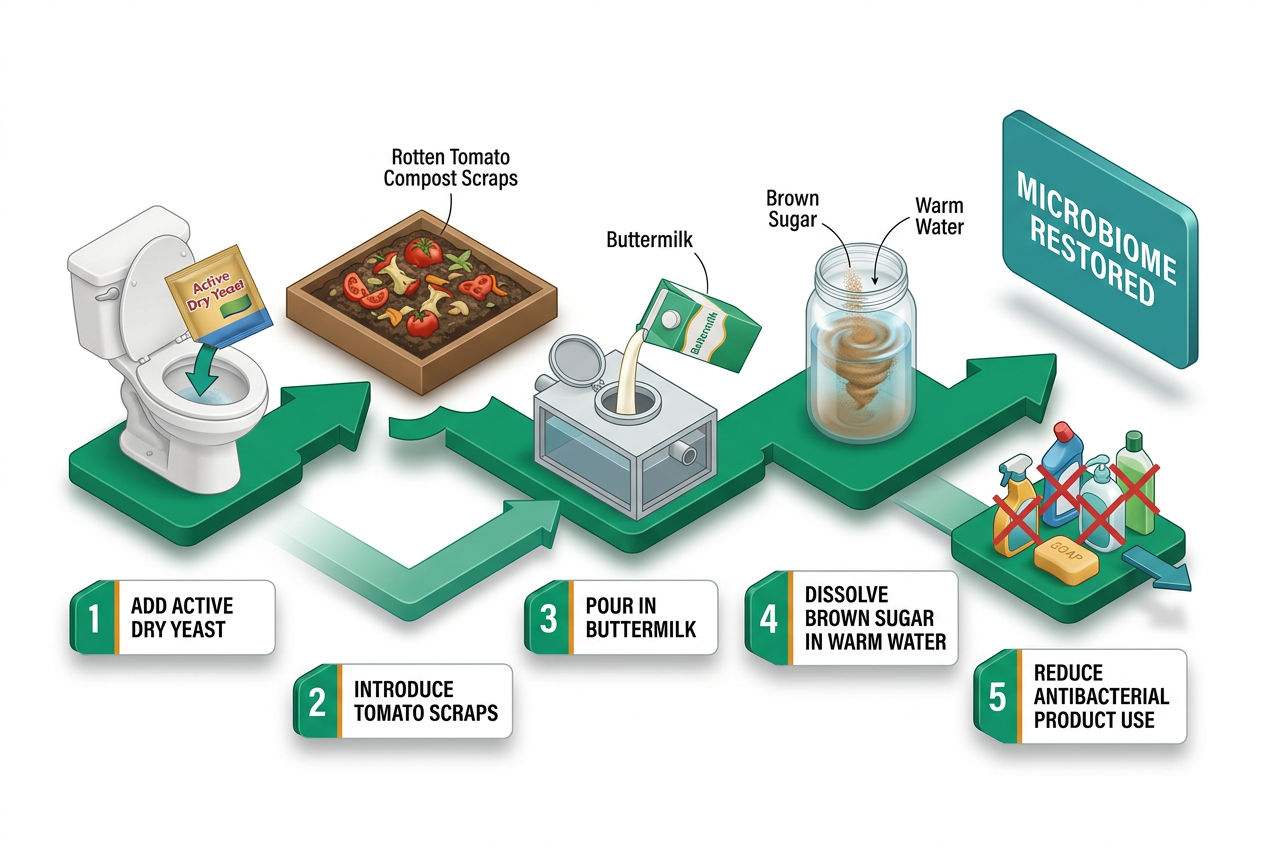
How to increase bacteria in a septic tank naturally: Stop using antibacterial soaps and chemical drain cleaners, then flush one packet of active dry yeast or 1–2 cups of live-culture yogurt monthly. For faster recovery after a disruption event, add a Bacillus-based commercial treatment. Most bacterial colonies rebuild within 2–4 weeks when harmful inputs are removed.
Key Takeaways
- A healthy septic tank contains billions of bacteria per milliliter of sludge — disruption can take 2–4 weeks to reverse
- Bleach, antibacterial soaps, and antibiotic medications are the three most common bacterial killers
- Active dry yeast (1 packet monthly) is a popular folk remedy — evidence is anecdotal but risk is low
- Spring and fall are the best times to proactively boost your bacterial population
- If symptoms persist beyond 4 weeks, stop DIY-ing and call a professional
What Do Septic Tank Bacteria Actually Do?
Septic bacteria break down every scrap of solid waste your household flushes underground. Without a functioning bacterial colony, solids accumulate, effluent clogs the drain field, and the system backs up into your home.
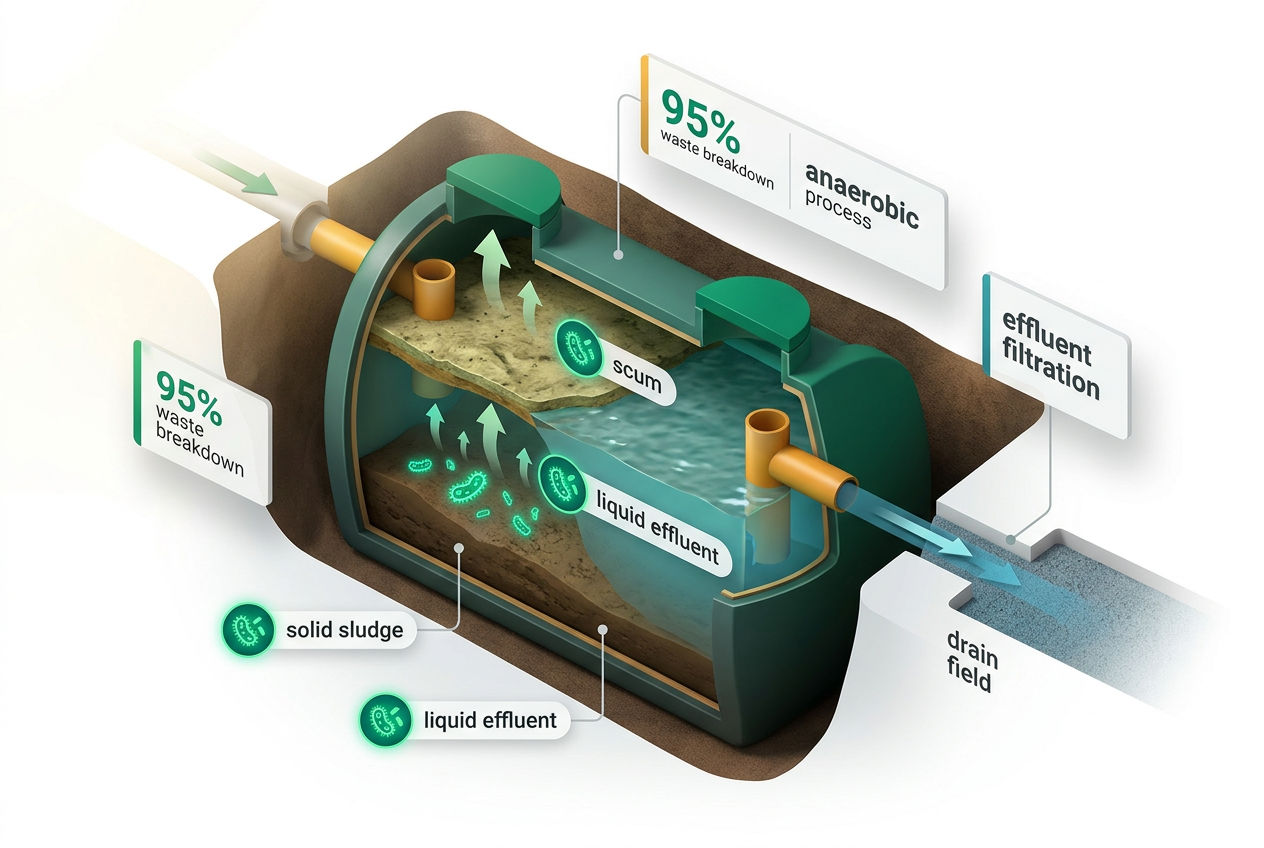
Inside your tank, two types of bacteria handle the heavy lifting. Anaerobic bacteria work in the oxygen-free lower zone, breaking down solid waste into sludge and releasing gases. Aerobic bacteria operate in the more oxygen-rich effluent layer and in the drain field itself, further treating wastewater before it percolates into the soil.
Together, they're what allows a 1,000–1,500 gallon concrete tank to serve a four-person household for years between pump-outs. According to the EPA's septic systems program, roughly 21 million U.S. households rely on septic systems — and the overwhelming majority of failures trace back to neglect of this biology, not mechanical breakdown.
One more thing worth knowing: bacteria are temperature-sensitive. They thrive between 68°F and 95°C (20°C–35°C). Below 50°F (10°C), bacterial metabolism slows dramatically. That's why homeowners in Minnesota or upstate New York see more system problems in late winter — the biology is essentially hibernating. More on the seasonal angle in a moment.
How Do You Know If Your Septic Tank Needs More Bacteria?
A depleted bacterial population shows up fast. Here are the warning signs — none of them are subtle.
- Slow drains throughout the house — not just one fixture, but all of them
- Gurgling sounds from toilets or drains after flushing
- Sewage odors inside or outside the home, particularly near the tank or drain field
- Wet or unusually green patches over the tank or leach lines
- Sewage backing up into the lowest drains in the house
- Tank not breaking down solids — confirmed during a pump-out when the pumper finds excessive floating scum or sludge beyond normal accumulation
Any single symptom could have a mechanical cause — a clogged baffle wall, a failing effluent filter, or a saturated drain field. But if you've recently run a round of antibiotics, switched to a heavy bleach cleaning routine, or had your tank pumped and didn't re-inoculate, depleted bacteria is a strong suspect.
A couple returns from six months in Florida, having left their Vermont cabin vacant all winter. The tank sat near-frozen, bacterial activity nearly zero. They flush the toilet and within two days the drains are slow. That's a classic bacterial depletion scenario — and it's fixable with a few targeted steps.
What Kills Septic Tank Bacteria? (The Avoidance List)
Before adding anything to your tank, stop the bleeding. Here's what's actively killing your bacterial colony:
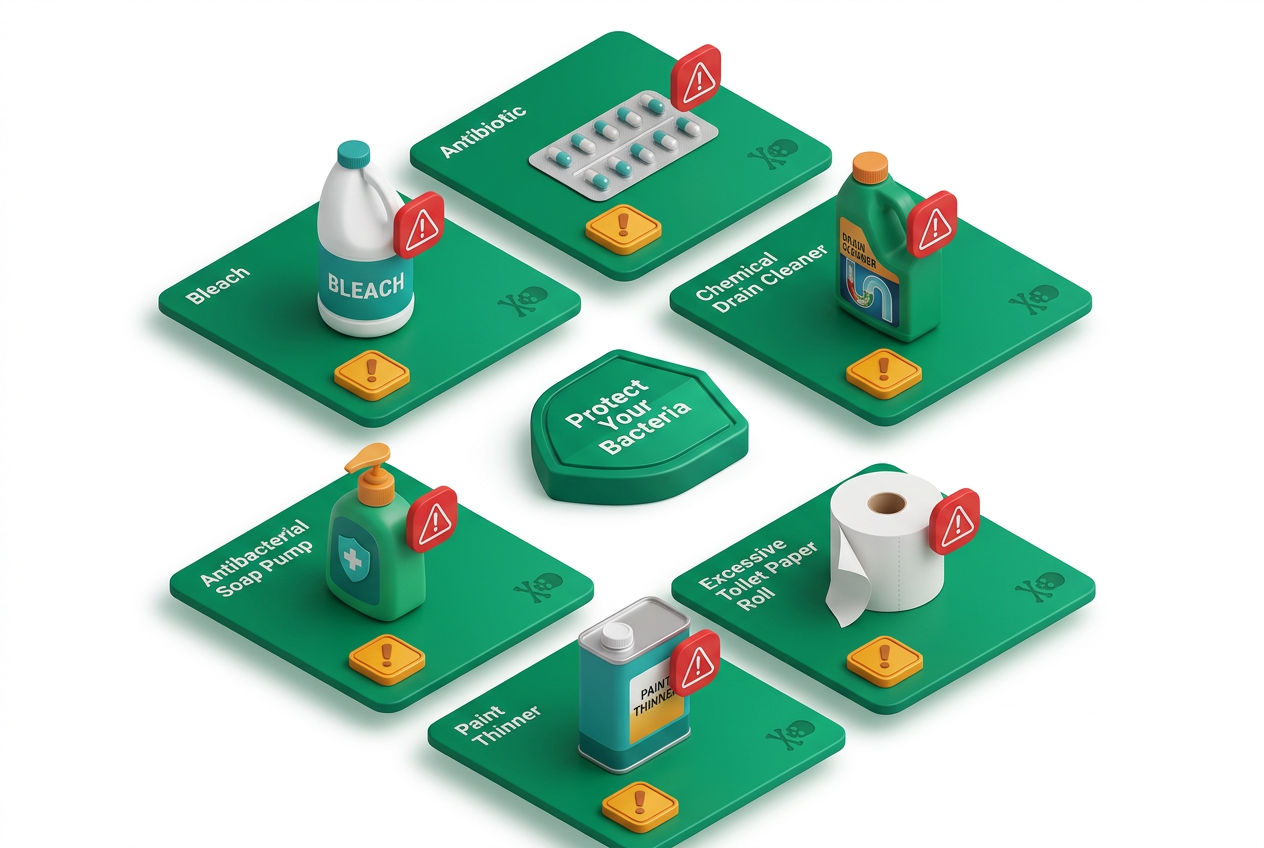
| Threat | Why It's Harmful | Threshold |
|---|---|---|
| Household bleach | Disinfectant kills bacteria on contact | Even 1 cup disrupts colonies |
| Antibacterial soaps (triclosan) | Targets bacterial cell membranes | Daily use, cumulative effect |
| Antibiotic medications | Excreted through urine, reaches tank | Effects last 2–4 weeks post-treatment |
| Chemical drain cleaners | Caustic chemicals sterilize tank environment | One use can cause significant damage |
| Excessive garbage disposal use | Floods tank with hard-to-digest solids | Ongoing overload stress |
| High-volume water events | Hydraulically flushes bacteria out | Single large events (e.g., hot tub drain) |
Sources: EPA Septic Systems Program; University of Minnesota Extension; product safety data
Antibacterial soaps containing triclosan deserve special attention. These are particularly destructive to the septic ecosystem. Switching to plain soap — not antibacterial — is one of the highest-impact free changes you can make. See our guide to septic-safe cleaning products for specific brand recommendations.
Can you use bleach at all? Yes, in moderation. One load of bleach laundry per week, in a tank serving a normal household, is unlikely to crash the system. Running six bleach loads in a day is a different story. For more detail on this, our article on whether bleach is safe for septic systems breaks down the exact thresholds.
How to Increase Bacteria in a Septic Tank Naturally
The methods below are ranked from most to least evidence-based. Every one of them is low-risk. None of them replace proper maintenance — but together they give your bacterial colony the best possible conditions to recover.
1. Stop the Killers First
If you add bacteria while still pouring bleach-based cleaners down the drain daily, you're filling a leaky bucket. Eliminate the harmful inputs before spending a dollar on any additive. Switch to plain soap, pause antibacterial cleaning products, and let any antibiotic courses clear your system over 2–4 weeks before expecting bacterial recovery.
2. Use Active Dry Yeast
Flush one packet (¼ oz) of active dry yeast down the toilet monthly. Dissolve it in warm — not hot — water first, then flush. Yeast introduces Saccharomyces cerevisiae, a microorganism that some practitioners believe jumpstarts bacterial activity and enzyme production.
Honest caveat: the evidence here is anecdotal. According to a review of septic additive literature by the University of Minnesota Extension, no peer-reviewed study has confirmed yeast measurably boosts septic performance. But the risk is essentially zero, the cost is pennies, and it's one of the most consistently searched natural septic tank bacteria remedies for a reason — a lot of homeowners swear by it.
3. Use Plain Yogurt or Buttermilk
Some septic professionals suggest flushing 1–2 cups of plain, live-culture yogurt or buttermilk monthly. The lactobacillus cultures in these dairy products can introduce live microorganisms into the tank. Again, direct evidence is thin. Like yeast, the downside risk is negligible. If it costs $1.50 at the grocery store and does no harm, it's not a bad habit.
4. Consider a Bacillus-Based Commercial Treatment
If you want something with more scientific backing than folk remedies, look for commercial products containing Bacillus strains — the most researched bacteria genus for septic applications. Products like Rid-X contain these organisms, though the EPA and most state health departments maintain a neutral-to-skeptical stance on whether additives provide measurable long-term benefit.
Our detailed Rid-X septic review covers the research honestly. The short version: these products add live bacteria, which isn't harmful, but they don't eliminate pumping needs or reverse drain field damage. Commercial treatments run $10–$50 per month depending on the product format (liquid, powder, pods).
For a broader look at whether additives actually move the needle, read do septic additives work? — we go deep on the research there.
5. The Rotten Tomato Method
Three to four overripe tomatoes, chopped and flushed down the toilet. This is perhaps the most colorful folk remedy in the septic world. The theory is that the tomato's acidity and organic matter stimulates bacterial growth. Evidence level: extremely anecdotal.
The pH of your tank should sit between 6.5 and 7.5 for healthy bacterial activity — adding acidic material in large quantities could theoretically shift that balance in the wrong direction. Mention it to your septic pumper and note their reaction. Most will shrug or steer you toward a Bacillus-based product instead.
How Often Should You Add Bacteria to Your Septic Tank?
For maintenance purposes — when your system is healthy — a monthly bacterial treatment (yeast or commercial product) is a reasonable habit.
After a disruption event — a course of antibiotics, a major bleach cleaning session, or a tank pump-out — bacterial colonies typically re-establish within 2–4 weeks under normal conditions. During that window, treat monthly and be extra conservative with your chemical inputs.
Here's a worked example to put the timeline in perspective: A household of four flushes a single round of amoxicillin through their 1,000-gallon tank. Antibiotic residue in the tank peaks around days 3–5, then dissipates. Bacterial counts, which may drop 40–60% during peak antibiotic exposure, typically return to functional levels by week 3–4 — assuming no additional disruptors are introduced. One yeast packet at day 7 and another at day 30 supports that recovery without any risk of harm.
After a pump-out specifically, your tank is essentially starting from scratch. This is the moment when a bacterial inoculant makes the most logical sense. Some pumping companies will add a starter culture at the time of service. If yours doesn't offer it, ask. Our post on what to expect from septic tank pumping covers the full pump-out process.
Seasonal timing matters too. Spring and fall are the two best windows for a proactive bacterial boost:
- Spring: After a cold winter, bacterial populations may be suppressed. A spring treatment helps colonies recover before heavy summer use.
- Fall: Before temperatures drop below 50°F and bacterial metabolism slows, a fall treatment ensures a robust colony heading into winter.
In the Southeast and Gulf Coast states, where temperatures stay warm year-round, this seasonal rhythm matters less — but homeowners in Florida and Louisiana face a different challenge: stormwater infiltration into older tanks during summer flooding events and high water table conditions can hydraulically flush bacteria out of the system just as effectively as cold weather suppresses them in the North.
Enzymes vs. Bacteria: What's the Difference?
Many septic products market themselves as "enzyme treatments" rather than bacterial treatments. Understanding the distinction helps you choose the right product.
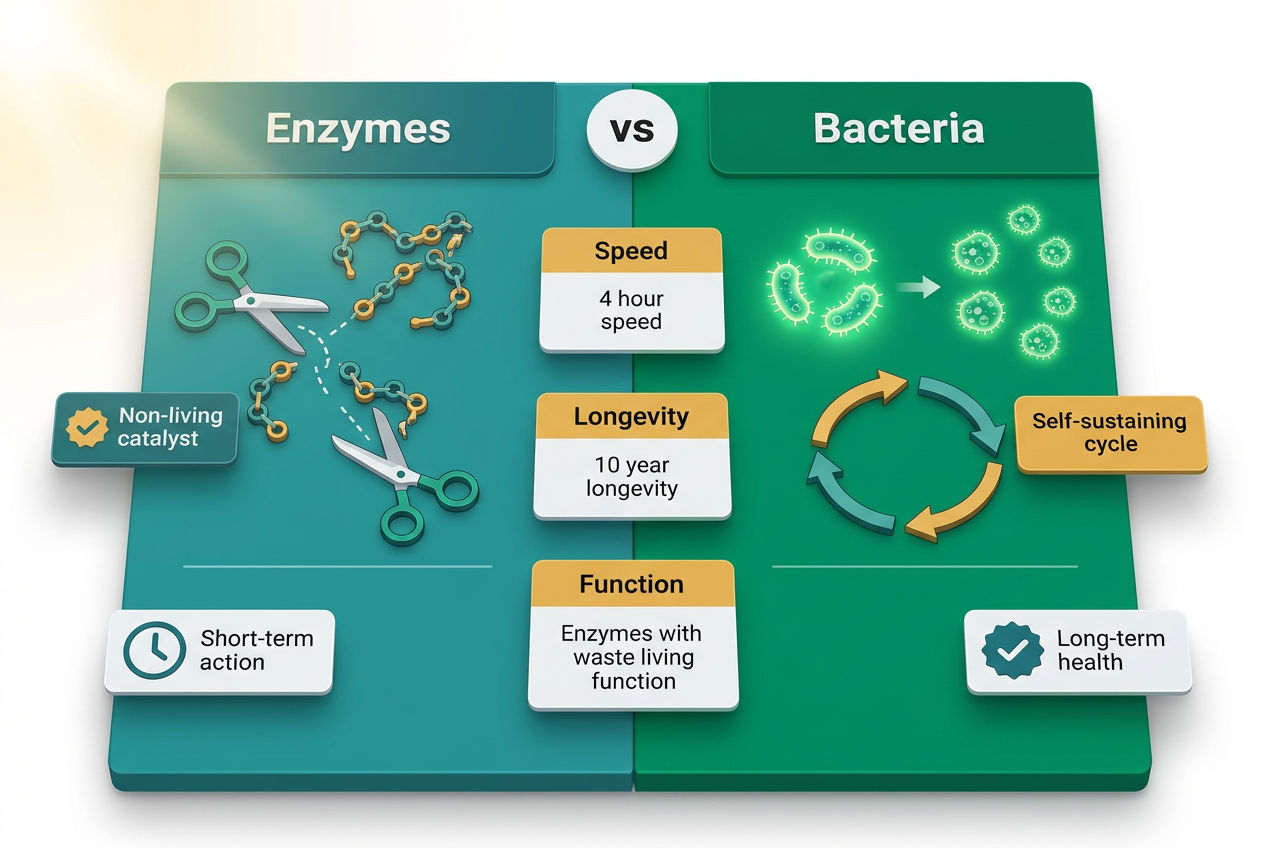
Bacteria are living organisms. They reproduce inside your tank, colonize the sludge layer, and continuously produce enzymes as a byproduct of their metabolism. A healthy bacterial population is self-sustaining given the right conditions.
Enzymes are proteins — not living organisms. They catalyze specific chemical reactions (breaking down fats, proteins, or starches) but do not reproduce. Once they're consumed in a reaction or flushed out with effluent, they're gone.
According to the National Association of Wastewater Technicians (NAWT), enzyme-only products provide a temporary boost to breakdown activity but cannot establish the sustained biological activity that bacteria can. NAWT's position is consistent with the EPA's: additives may help in the short term but should not substitute for proper pumping intervals or system maintenance.
For a deeper look at how these two product categories compare, our article on septic tank enzymes walks through the research side by side.
The practical takeaway: if you're choosing between an enzyme product and a Bacillus-based bacterial product, the bacterial product has a longer-lasting mechanism. Products that combine both are common and reasonable — just read the label to confirm live bacterial counts are included.
Can Too Much Bacteria Hurt a Septic Tank?
No — you cannot overdose your septic tank with naturally occurring bacteria. The tank self-regulates.
Bacterial populations in a septic tank are constrained by the food supply (incoming waste), available space, and the oxygen environment. Add more bacteria than the ecosystem can support, and the excess simply die off or wash out with effluent. There's no scenario where adding a packet of yeast or a cup of yogurt tips a healthy tank into dysfunction.
The concern some homeowners have about "too much bacteria" usually stems from marketing language around powerful commercial products — the implication being that a supercharged bacterial colony might somehow overcorrect. That's not how septic biology works. The limiting factor is always the food and environment, not the number of bacteria you introduce.
What you can do wrong is use the wrong type of product. Some septic additives contain solvents, surfactants, or other chemical agents marketed alongside bacterial claims — and those chemical components can harm your system even when the bacteria content is benign. Stick to products with clearly labeled Bacillus strain counts and no chemical disinfectant components.
When Should You Call a Professional Instead?
DIY bacterial treatments are appropriate for maintenance and mild disruption recovery. They are not a substitute for professional diagnosis when your system is showing serious symptoms.
Call a licensed septic professional — look for NAWT-certified technicians in your area — if any of the following are true:
- Sewage is backing up into your home — this is an emergency, not a DIY situation
- Odors or wet patches persist beyond 3–4 weeks after you've eliminated bacterial killers and added treatments
- Your tank was last pumped more than 3–5 years ago (varies by household size and tank volume)
- You're seeing drain field saturation — soggy ground, dead grass patterns, or effluent surfacing above ground
- A pump-out reveals excessive sludge or scum beyond what normal accumulation would explain
A septic inspection typically costs $100–$300, while a full pump-out runs $300–$500 nationally — with rural Midwest pricing often hitting $450–$600 due to drive time and winter access. That's far cheaper than a drain field replacement, which starts at $5,000 and frequently exceeds $15,000 depending on soil conditions and system size.
Learn more about what a professional visit involves at our septic pumping and cleaning service page, and see our full cost breakdown at our septic inspection cost guide.
Limitation worth stating plainly: nothing in this article constitutes a professional septic assessment. Bacterial depletion symptoms overlap with drain field failure, baffle damage, and effluent filter clogs — all of which require hands-on diagnosis. If you're unsure, the $150 inspection is money well spent.
Frequently Asked Questions
What is the best natural bacteria for a septic tank?
The best natural bacteria for a septic tank are the anaerobic and aerobic microorganisms your system already produces from normal household waste. You don't need to import exotic strains — you need to stop killing the ones already there. That said, if you want to actively supplement, Bacillus-based organisms are the most researched option and appear in products like Rid-X and similar treatments. For a completely free approach, active dry yeast (Saccharomyces cerevisiae) is the most consistently recommended folk remedy among septic professionals and homeowners alike. Flush one packet monthly dissolved in warm water. Plain live-culture yogurt or buttermilk (1–2 cups monthly) is a close second. Both introduce living microorganisms at essentially zero cost and zero risk. The University of Minnesota Extension notes that evidence for these remedies remains anecdotal — but neither poses any documented harm to a functioning system.
How do I add good bacteria to my septic tank after using antibiotics?
After a round of antibiotics, wait until you've finished the full course before starting any bacterial reintroduction — adding bacteria while antibiotics are still present in your waste stream is counterproductive. Antibiotic residue typically clears the tank within 5–10 days after your last dose. At that point, flush one packet of active dry yeast dissolved in warm water, and repeat at the 30-day mark. Avoid antibacterial soaps, bleach-based cleaners, and chemical drain treatments for at least 4 weeks. According to the EPA's septic systems guidance, bacterial populations disrupted by antibiotic exposure typically recover within 2–4 weeks under normal conditions. If you want faster recovery, a Bacillus-based commercial product — applied at the 10-day mark — provides a more targeted inoculation than yeast alone. Monitor for slow drains or odors; if symptoms persist past week 4, call a licensed septic professional.
Does flushing yeast help a septic tank?
Flushing active dry yeast helps a septic tank in a limited but real way. Yeast introduces Saccharomyces cerevisiae, a living microorganism that produces enzymes capable of supporting organic breakdown in the tank environment. The University of Minnesota Extension and similar agricultural extension programs acknowledge this as a longstanding folk remedy with a plausible mechanism, even though no peer-reviewed study has confirmed measurable system-level improvement. The honest answer is that yeast probably helps at the margins — and definitely doesn't hurt. The standard recommendation is one standard packet (¼ oz) of active dry yeast dissolved in warm (not hot) water, flushed down the toilet monthly. Do not use rapid-rise or bread machine yeast, which are different strains processed differently. Cost per treatment: roughly $0.30. Risk: none documented. If you're managing a healthy system, it's a reasonable monthly habit alongside eliminating bacterial killers from your cleaning routine.
What household products increase bacteria in a septic tank naturally?
Several common household products can support natural septic tank bacteria without any purchase of specialty additives. Active dry yeast (standard baking yeast, not rapid-rise) is the most widely recommended — one packet monthly dissolved in warm water and flushed. Plain live-culture yogurt or buttermilk provides lactobacillus organisms; use 1–2 cups monthly. Switching from antibacterial soap containing triclosan to plain soap is free and arguably the single highest-impact change a homeowner can make — triclosan targets bacterial cell membranes directly and accumulates with daily use. Beyond that, reducing bleach loads to no more than one per week, avoiding chemical drain cleaners entirely, and spacing out high-water-volume activities (laundry, dishwasher, long showers) all reduce hydraulic stress on the bacterial colony. None of these require spending money on specialty products. Combined, they create conditions where your system's existing bacterial population can thrive and self-replenish.
How long does it take to restore bacteria in a septic tank?
Restoring bacteria in a septic tank typically takes 2–4 weeks after the source of disruption is removed. The timeline depends on what caused the depletion, the current bacterial count, and whether new disruptors are being introduced. Here's a realistic example: a household that ran a 10-day antibiotic course and switched to antibacterial cleaning products during that period may see bacterial counts drop 40–60%. Once antibiotics clear the system (roughly 5–10 days post-last dose) and antibacterial products are replaced with plain soap, bacterial populations begin recovering. Adding a yeast treatment at day 10 and a Bacillus-based commercial product at day 14 can support — though not dramatically accelerate — that timeline. Full functional recovery, meaning normal drain speed and no odors, typically lands in the 3–4 week window. Cold temperatures slow this significantly; a tank operating below 50°F may take 6–8 weeks to reach normal bacterial activity. If recovery hasn't occurred by week 6, schedule a professional inspection.
Is there a difference between septic tank bacteria treatments and enzyme treatments?
Yes — the difference is significant and affects which product you should buy. Bacteria are living organisms that reproduce inside your tank, colonize the sludge layer, and continuously generate enzymes as a metabolic byproduct. A well-established bacterial colony is self-sustaining. Enzyme treatments contain proteins — not living organisms — that catalyze specific chemical reactions breaking down fats, starches, or proteins. Enzymes don't reproduce; once they're consumed in a reaction or flushed out with effluent, the effect ends. According to the National Association of Wastewater Technicians (NAWT), enzyme-only products provide a temporary boost but cannot establish sustained biological activity. For long-term bacterial population support, Bacillus-based bacterial products outperform enzyme-only treatments. Many commercial products combine both — which is reasonable — but confirm the label lists live bacterial colony counts (typically expressed in CFUs, or colony-forming units per gram) before purchasing. Products listing only enzyme content and no live bacteria are the lower-value option for bacterial restoration.
Sources & Methodology
- EPA Septic Systems Program — epa.gov/septic — cited for U.S. household count, failure cause data, and bacterial recovery timelines
- University of Minnesota Extension, "Septic System Owner's Guide" — cited for yeast/additive evidence assessment and temperature thresholds
- National Association of Wastewater Technicians (NAWT) — cited for enzyme vs. bacteria product position statement
- National Onsite Wastewater Recycling Association (NOWRA) — referenced for professional certification standards
- Product safety data — reviewed for triclosan mechanism and chemical drain cleaner impacts
This article was reviewed for accuracy in June 2025. It is intended for general informational purposes only and does not constitute professional septic system advice. Consult a licensed septic professional — ideally NAWT-certified — for diagnosis and treatment of specific system problems.
Free download
Not ready for the Handbook? Start with the free Fridge Card.
The Do / Don’t card the whole family can see, plus the Survival Kit: emergency flowchart, warning-sign decoder and pump-schedule card. One printable PDF.
Was this article helpful?
Frequently Asked Questions
Recommended Resources
📖 Related Articles
- What Is a Drain Field? (And How Does It Work?)
- Septic-Safe Cleaning Products: The Complete List (Safe vs. Avoid)
- Is Bleach Safe for Septic Systems?
- Rid-X for Septic Tanks: Does It Help or Hurt?
- Do Septic Tank Additives Actually Work? (The Science)
- What to Expect When Getting Your Septic Tank Pumped
- Septic Tank Enzymes: What You Need to Know
🔧 Services
Find Septic Professionals Near You
Compare licensed, verified septic companies by area — top county markets and cities below, or browse all 50 states.
County markets
Popular cities
