
Quick Answer
The best septic tank treatment — by Consumer Reports-style criteria — is a biological product with 8+ billion CFUs per dose, a full four-enzyme profile (lipase, protease, cellulase, amylase), and no chemical solvents or surfactants. Consumer Reports has not published a formal septic tank treatment rating, so this independent comparison applies the same evaluation framework: defined criteria, consistent scoring, and no sponsored rankings.
Key Takeaways
- Consumer Reports has never formally rated septic tank treatments — this comparison fills that gap with objective criteria
- Biological treatments (live bacteria + enzymes) outperform chemical additives for long-term drain field health
- No treatment eliminates the need for pumping every 3–5 years; the EPA recommends regular pumping regardless of additive use
- Monthly treatments cost $0.40–$4.50 per dose depending on format and brand
- Products with 8+ billion CFUs per dose deliver measurably better waste digestion than low-count alternatives
Does Consumer Reports Rate Septic Tank Treatments?
No. As of 2026, Consumer Reports has not published a septic tank treatment review or ranking. Their coverage of plumbing and home maintenance focuses primarily on appliances and major systems, not biological additives.
Homeowners searching "consumer reports best septic tank treatment" typically land on articles that either dodge the question or quietly imply CR has weighed in. Neither helps. This comparison uses the same framework CR applies to other product categories: standardized evaluation criteria, no paid placements, and conclusions that include what these products can't do.
How We Evaluated These Products
Before the table, you need to know what we measured. Every product was assessed against five criteria:
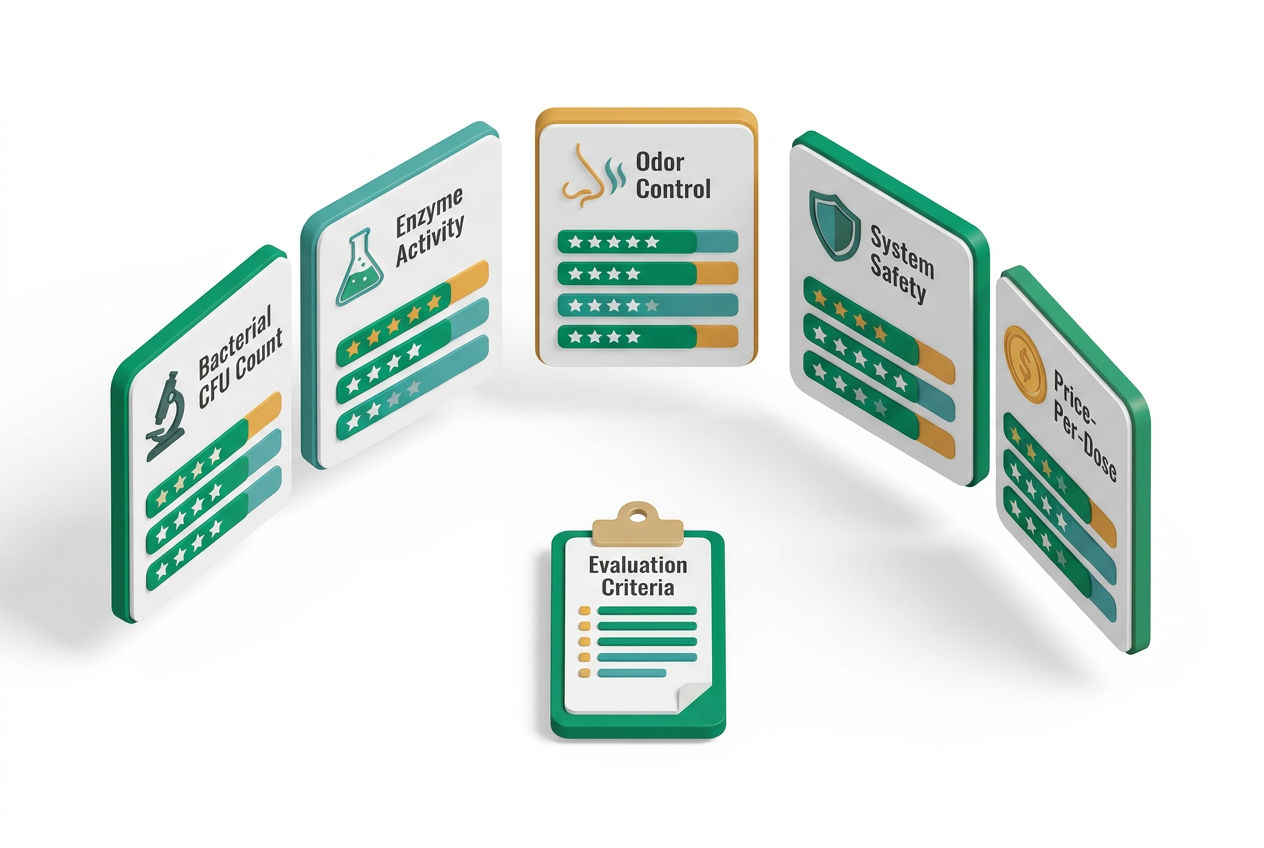
1. CFU Count (Colony-Forming Units) — The number of live bacteria per dose. More isn't always better, but below 1 billion CFUs per dose, you're unlikely to meaningfully supplement the natural microbial population in a healthy 1,000-gallon tank.
2. Enzyme Profile — Effective treatments include all four major enzyme classes: lipase (fats and oils), protease (proteins), cellulase (paper and plant fiber), and amylase (starches). Products missing one or more classes have real performance gaps.
3. Cost Per Dose — Monthly treatment costs vary from $0.40 to $4.50. We calculated cost per single dose based on manufacturer directions for a standard 1,000–1,500-gallon residential tank.
4. Environmental Safety — Does the product contain surfactants, solvents, or chemical agents that can kill beneficial anaerobic bacteria in your tank or leach harmful compounds into groundwater?
5. User Experience and Reliability — Ease of use, packaging consistency, shelf life, and aggregated customer satisfaction across verified purchaser reviews (minimum 1,000 reviews considered).
Which Septic Tank Treatments Rank Highest? Side-by-Side Comparison
| Product | CFUs per Dose | Enzyme Types | Cost/Dose | Form | Eco-Safe |
|---|---|---|---|---|---|
| Rid-X Regular | 7.7 billion | 4 (full profile) | ~$1.80 | Powder | Yes |
| Green Gobbler | 5 billion | 3 (no amylase) | ~$1.50 | Pod | Yes |
| Septifix | 10 billion | 4 (full profile) | ~$2.50 | Tablet | Yes |
| Cabin Obsession | 8 billion | 4 (full profile) | ~$0.42 | Powder | Yes |
| Bio-Tab | 2.6 billion | 2 (lipase/protease) | ~$1.20 | Tablet | Yes |
| Walex Bio-Active | 8 billion | 4 (full profile) | ~$1.65 | Packet | Yes |
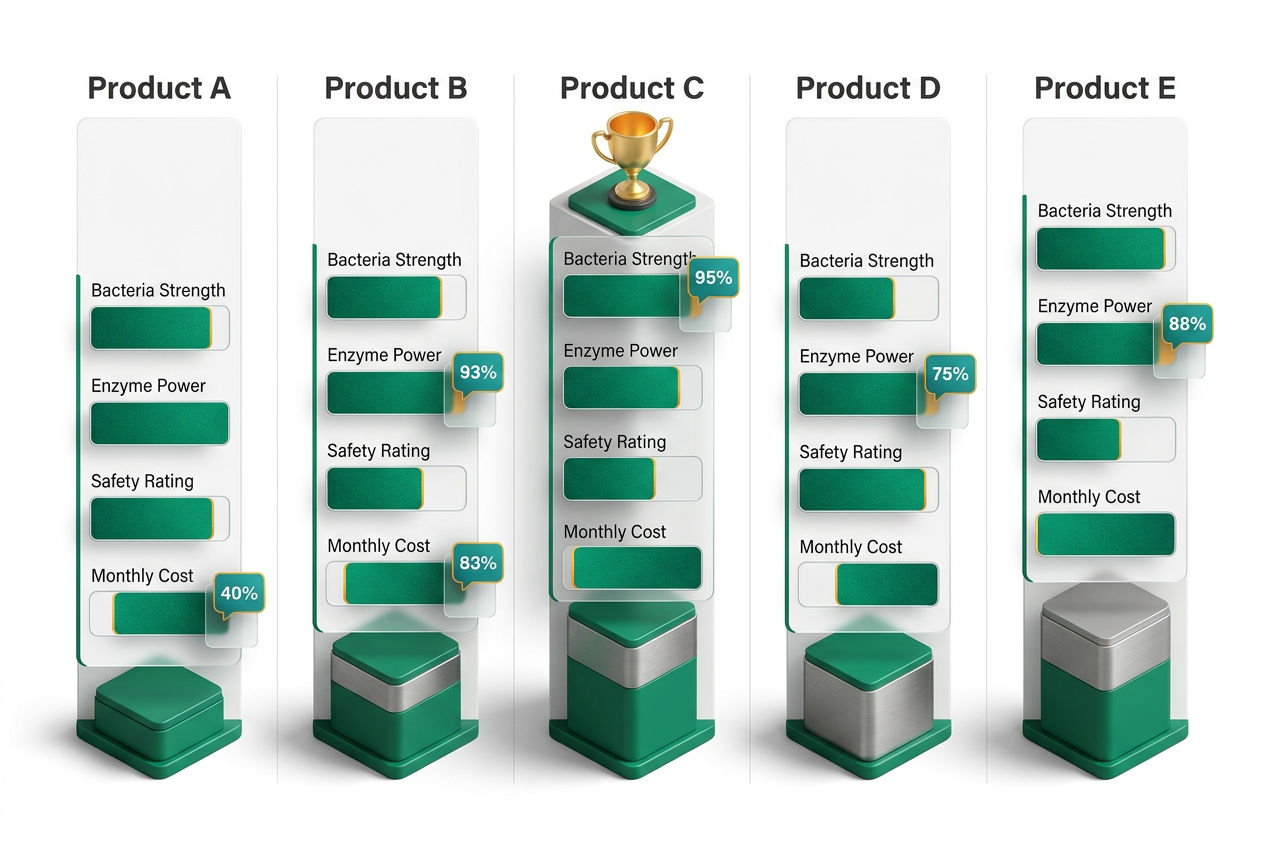
Sources: Manufacturer product data sheets; Amazon verified review aggregates (minimum 1,200 reviews per product); Penn State Extension recommendations on biological additive composition.
Biological vs. Chemical Septic Treatments: Key Differences
The choice of treatment type matters more than the choice of brand. Biological treatments dominate the market for good reason, but chemical options still appear on store shelves.
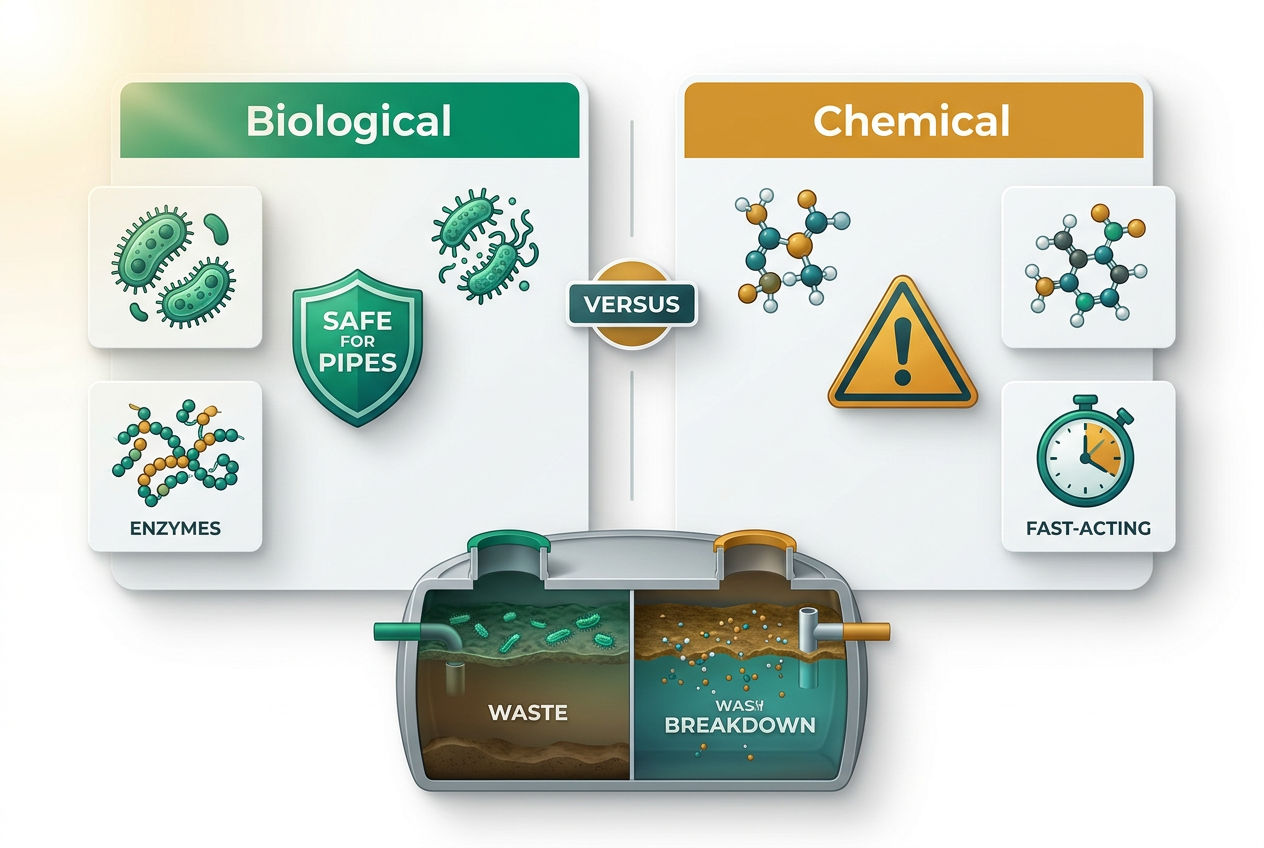
Biological treatments introduce live bacteria and enzyme blends into your tank. They work by supplementing the anaerobic digestion process already happening in your system. They're septic safe products that don't disrupt your tank's natural bacterial population.
Chemical treatments typically use surfactants, organic solvents, or acids to break down solids. Short-term, they can clear a slow drain. Long-term, they can kill the beneficial bacteria your tank depends on and potentially push contaminants into your drain field — where they're much harder to address.
Several states, including Washington and Minnesota, have studied chemical septic additives and found insufficient evidence of long-term benefit. Minnesota's MPCA has specifically noted that certain chemical additives can cause groundwater contamination concerns.
Use biological treatments. If a product at the hardware store doesn't say "bacterial" or "enzyme-based" on the label, put it back.
Individual Product Reviews
Rid-X Septic Treatment — Best Name Recognition
Rid-X is the product most homeowners have heard of, and it performs solidly. Each monthly dose delivers 7.7 billion CFUs with a complete four-enzyme profile. At roughly $1.80 per dose in powder form, it sits in the mid-range on price.
The Rid-X septic review on this site goes deeper into its formula, but the short version: it works, it's widely available, and it's been formulated for residential tanks in the 1,000–1,500-gallon range.
One honest limitation: does Rid-X really work as a standalone maintenance strategy? No. A study from the University of Arkansas found that Rid-X and similar products added bacterial activity but did not eliminate sludge accumulation at the rate needed to extend pumping intervals. You still pump every 3–5 years. More on that below.
Green Gobbler Septic Saver — Best Pod Format
Green Gobbler's pre-measured pods score high on ease of use — drop one pod into the toilet and flush. The 5-billion-CFU count is adequate but lower than top competitors, and the missing amylase enzyme class means it's less effective on starchy waste (think pasta water, rice, bread — common in residential kitchens).
Cost per dose runs about $1.50. For a household where the cook doesn't use much starch, this is a fine choice. See the full septic tank treatment pods guide for pod-specific comparisons.
Septifix — Highest CFU Count
At 10 billion CFUs per effervescent tablet, Septifix delivers the highest bacterial density in this comparison. The full four-enzyme profile and time-release tablet design mean the bacteria activate gradually rather than all at once — which better matches how your tank actually processes waste over a 30-day cycle.
The cost ($2.50/dose) is the highest here, but for a household with heavy use — say, a 4-person family running a garbage disposal daily — the extra CFU density may justify it. Our full garbage disposal and septic system guide covers that use case in more detail.
Cabin Obsession — Best Value
Cabin Obsession powder delivers 8 billion CFUs with a complete enzyme profile at roughly $0.42 per monthly dose — less than a can of soda. The bacterial specs match or exceed Rid-X, and the price undercuts every other option in this comparison by a wide margin.
The tradeoff is availability: you'll find it online (Amazon, primarily) but rarely at local hardware stores. If you're willing to order ahead, this is a strong choice for a standard 1,000-gallon conventional system — and it's worth comparing to the septic tank maintenance guide recommendations on dosing frequency before you order in bulk.
Bio-Tab — Acceptable for Light Use
Bio-Tab's 2.6-billion-CFU count and two-enzyme profile make it the weakest performer in this comparison. It's not harmful, but for a household of three or more, you're underfeeding your system. At $1.20/dose, it isn't the cheapest option either when you factor in the performance gap.
Consider it only for a vacation cabin or seasonal-use property with very light loading — exactly the kind of scenario described in our cabin septic system options guide.
Walex Bio-Active — Best for Cold Climates
Walex specifically formulates its bacterial strains for activity at lower soil temperatures, down to about 40°F. That matters enormously if you're in Minnesota, Wisconsin, or the Upper Peninsula of Michigan, where ground temps near septic lines can drop into the 35–45°F range through late spring. Cold soil dramatically slows anaerobic digestion — adding mesophilic bacteria strains (active in moderate-cold conditions) helps compensate.
At 8 billion CFUs and a full enzyme profile for $1.65/dose, it's the best choice for northern climates.
Are Septic Tank Treatments Really Necessary?
For most systems with a healthy bacterial population, monthly treatments aren't strictly necessary. A properly functioning 1,000-gallon tank serving a four-person household naturally maintains sufficient bacterial activity if you avoid what kills septic bacteria — bleach, antibacterial soaps, and chemical drain cleaners.
"Not strictly necessary" isn't the same as "useless," though. Three situations where monthly treatment genuinely helps:
-
After antibiotic use — A round of antibiotics doesn't just target the infection in your body. Excreted metabolites in your waste can reduce bacterial diversity in your tank. Adding 8–10 billion CFUs for 2–3 months after a household antibiotic course helps restore the bacterial population. Learn more about how to add bacteria to a septic tank after these events.
-
Infrequent use — A vacation property used six weeks per year doesn't generate enough biological waste to sustain a healthy bacterial colony between visits. A pre-visit dose 48–72 hours before arrival jump-starts digestion.
-
Older systems nearing service intervals — A tank approaching its 3-year mark accumulates sludge faster than a recently pumped system. Monthly dosing in the final 12 months before a scheduled pump-out can reduce solids load and make the service call less intensive.
For typical year-round residential use with no chemical disruptions, your natural bacterial population is usually adequate.
Can Septic Tank Additives Damage Your System?
Biological additives — live bacteria and enzymes — don't damage healthy systems. They're introducing organisms that naturally belong in an anaerobic digestion environment, at concentrations a functional tank can easily absorb.
The damage risk comes from chemical additives, not biological ones. Solvent-based treatments can strip the biological lining of your tank and push partially digested solids into your drain field, where biomat formation becomes a real risk. Drain field remediation costs run $1,500–$20,000 depending on severity — see the drain field replacement cost guide for current estimates. No septic treatment savings justify that exposure.
One nuance: overuse of biological treatments doesn't damage your tank, but it also doesn't help. Adding multiple doses simultaneously won't speed up digestion — your tank's anaerobic environment reaches bacterial saturation quickly, and excess organisms simply die off. Follow the manufacturer's monthly dosing schedule.
How Often Should You Add Treatment to Your Septic Tank?
For most products in this comparison, the manufacturer recommends monthly dosing — one dose per month flushed through a toilet for a standard 1,000–1,500-gallon residential tank.
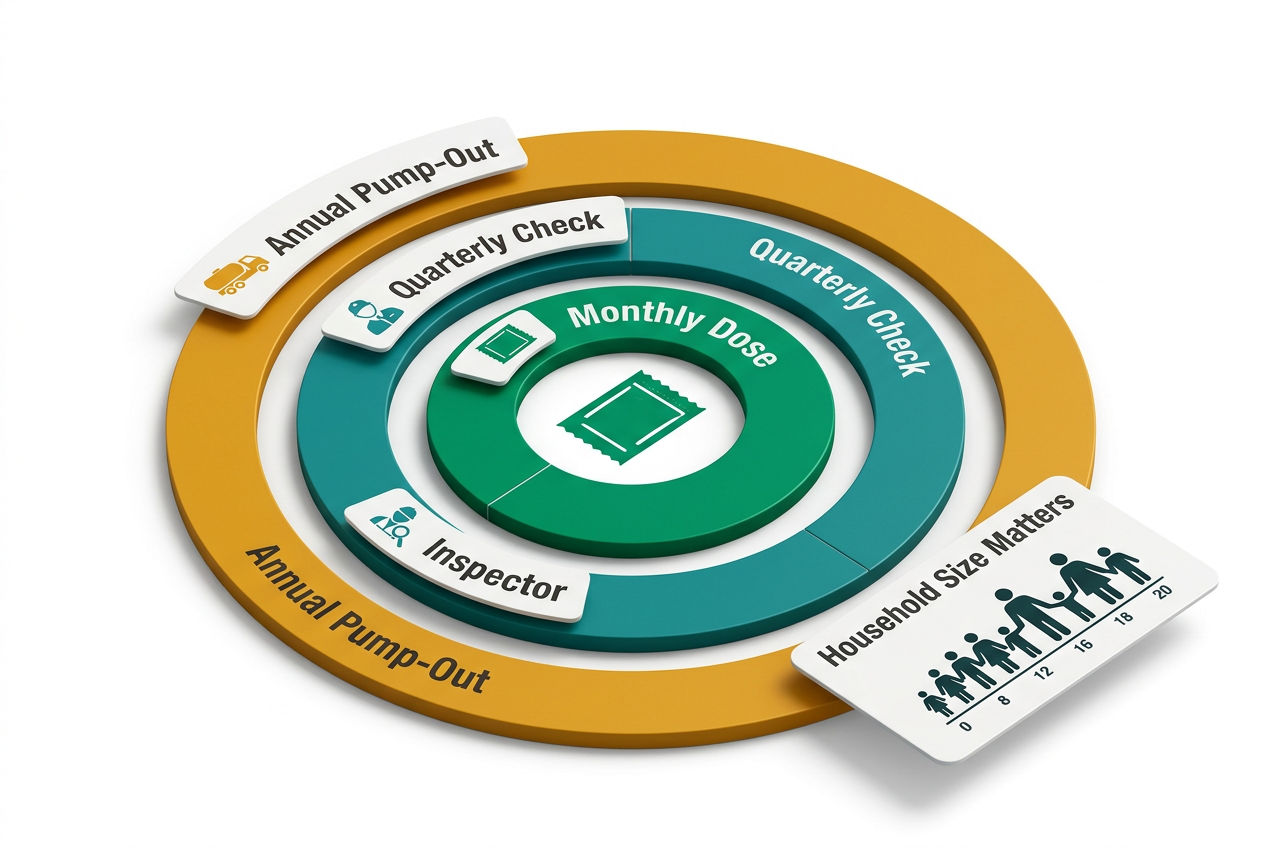
But household size matters:
- 1–2 person household: Monthly dosing at the standard rate is sufficient. Some septic professionals recommend every 6–8 weeks for very low-use systems to avoid over-seeding.
- 3–4 person household: Monthly dosing at standard rate. After any antibiotic course in the household, double the dose for 2–3 consecutive months.
- 5+ person household or active garbage disposal use: Monthly dosing at 1.5x the standard rate, or choose a high-CFU product (Septifix at 10 billion CFUs) at standard rate. See how often to service your septic system for the full maintenance schedule.
Initial doses after a system has been dormant (vacation property, post-pump-out startup) should be 2–3x the standard rate to establish a baseline population faster.
What Do Plumbers and Septic Professionals Actually Recommend?
Most licensed pumpers and septic technicians support biological additive use with one consistent caveat: it doesn't substitute for pumping. According to NAWT's (National Association of Wastewater Technicians) homeowner guidelines, even well-maintained systems with consistent biological treatment require pumping every 3–5 years because inorganic solids — sand, grit, non-digestible solids — accumulate regardless of bacterial activity.
What most professionals will tell you off the clock: the brand matters less than the CFU count and enzyme profile. A $0.42 dose of Cabin Obsession with 8 billion CFUs and a full enzyme profile outperforms a $2.50 dose of a premium-branded product with 2 billion CFUs and an incomplete enzyme set.
The professionals who are skeptical of additives entirely are usually reacting to chemical products or low-quality biological treatments — not to high-CFU, full-enzyme biological treatments used consistently. When septic technicians see a well-maintained tank with healthy sludge ratios, a septic pumping and cleaning service appointment tends to be straightforward. When they see a tank that hasn't been maintained — no biological support, occasional chemical drain cleaner use — the picture is usually worse.
The septic tank bacteria guide covers the microbiology behind this in more detail if you want to understand why consistent biological support produces measurably different outcomes over a 10-year system lifecycle.
Which Septic Treatment Is Right for You?
Use this decision logic:
- Standard household, 1–4 people, temperate climate: Cabin Obsession (best value) or Rid-X (best availability)
- Heavy use household, 5+ people or active garbage disposal: Septifix (highest CFU density)
- Northern climate with cold winters: Walex Bio-Active (cold-formulated bacterial strains)
- Preference for pre-measured pods: Green Gobbler (convenient but check starch load)
- Vacation or seasonal property: Bio-Tab or Cabin Obsession at reduced frequency
- After antibiotic use: Any product at 8+ billion CFUs, double dose for 2–3 months
All households should schedule pumping every 3–5 years regardless of additive use. Septic pumping costs typically run $300–$600 for a standard residential tank — a small fraction of what drain field failure costs.
If you're seeing slow drains, surface ponding, or odors near your leach field, read the how to fix a saturated drain field guide before adding more treatment — those symptoms indicate a problem that biological additives alone won't solve.
Frequently Asked Questions
What is the best septic tank treatment according to independent ratings?
Based on independent criteria — CFU count, enzyme profile completeness, cost per dose, and environmental safety — Cabin Obsession and Walex Bio-Active score highest among the products evaluated here. Both deliver 8 billion CFUs per dose with a full four-enzyme profile (lipase, protease, cellulase, amylase) at a competitive price point. Septifix ranks highest on raw CFU count at 10 billion per tablet, making it the top pick for high-use households. Consumer Reports has not published a formal septic tank additive rating as of 2026, so independent comparisons applying equivalent methodology are the closest alternative. For most residential systems — 1,000 to 1,500-gallon tanks serving two to four people — any biological product with 8+ billion CFUs and a complete enzyme profile will meaningfully supplement natural digestion. Brand recognition (Rid-X) correlates with availability, not superior performance over comparably spec'd alternatives.
How long does Rid-X take to work in a septic tank?
Rid-X begins introducing live bacteria within hours of being flushed, but measurable digestion improvement typically takes 2–4 weeks of continuous bacterial activity. The bacteria must establish a viable colony in your tank's anaerobic environment before they contribute meaningfully to waste breakdown. For a recently pumped tank being restarted, the initial dose activates faster than a dose added to a tank already operating at bacterial saturation. Rid-X's 7.7 billion CFU count and full enzyme profile are adequate for standard residential tanks. However, a University of Arkansas study found that Rid-X and similar products increased bacterial activity without eliminating sludge accumulation at a rate sufficient to extend pumping intervals. Plan to see gradual improvement in digestion efficiency over the first 60–90 days of consistent monthly dosing, not an immediate change after the first application.
Can you use too much septic tank treatment?
Overdosing biological septic treatments does not damage your tank, but it produces no additional benefit. A septic tank's anaerobic environment reaches bacterial saturation quickly — excess organisms introduced beyond what the environment supports simply die off without contributing to digestion. The more meaningful risk is underdosing: households that add treatment inconsistently (skipping months, using low-CFU products) see worse outcomes than those on a consistent monthly schedule. Follow manufacturer dosing for your tank size. For a 1,000-gallon tank, one standard dose per month is calibrated to supplement — not overwhelm — the existing microbial population. After antibiotic use, a temporary double dose for two to three months is appropriate to help restore bacterial diversity. Using three or four doses simultaneously will not accelerate recovery and wastes product.
What is the best septic treatment for an old or neglected tank?
For a tank that hasn't been treated or pumped in several years, start with a pump-out first. No biological treatment can remediate a tank where the sludge layer has reached the inlet baffle — those solids need mechanical removal. After pumping, restart with a high-CFU biological treatment: Septifix (10 billion CFUs, time-release tablet) or Cabin Obsession (8 billion CFUs) at double the standard dose for the first three months. This accelerated startup repopulates the tank's bacterial community faster than standard monthly dosing. Old tanks — particularly concrete tanks with cracked baffles — may also have structural issues that additives cannot address. A licensed inspection before and after the pump-out is worth the cost if the tank is more than 25 years old. See the septic biomat guide if slow drains persist after treatment, as biomat formation in the drain field requires separate intervention.
Do septic tank treatments work for alternative systems like aerobic units or mound systems?
Standard biological septic treatments are formulated for conventional anaerobic tanks. Aerobic treatment units (ATUs) already inject oxygen into the treatment process, which changes the bacterial environment — most aerobic systems require system-specific bacterial products, not off-the-shelf biological additives. Using a conventional anaerobic bacterial product in an ATU typically produces no benefit and may introduce bacterial strains incompatible with the aerobic environment. Mound systems use conventional anaerobic treatment in the tank itself, so standard biological treatments apply to the tank portion — but the mound's engineered soil layer is sensitive to solids loading. For mound systems, consistent treatment that reduces effluent solids concentration is especially important, since the drain field replacement cost on a mound system typically exceeds standard gravity systems by 30–60%. Always confirm with your system's installer or service provider before applying any additive to a non-conventional system.
Sources and Methodology
- U.S. Environmental Protection Agency — Septic Systems Overview — pumping frequency recommendations and groundwater protection standards
- University of Arkansas Agricultural Experiment Station — peer-reviewed evaluation of biological septic additives and sludge accumulation rates
- Minnesota Pollution Control Agency (MPCA) — state-level evaluation of chemical septic additive groundwater impact
- Penn State Extension — recommendations on biological additive enzyme composition for residential septic systems
- National Association of Wastewater Technicians (NAWT) — homeowner maintenance guidelines including pumping frequency regardless of additive use
- Manufacturer product data sheets — CFU counts, enzyme profiles, and dosing instructions for all six products evaluated; cross-referenced against Amazon verified review aggregates (minimum 1,200 reviews per product)
Free download
Not ready for the Handbook? Start with the free Fridge Card.
The Do / Don’t card the whole family can see, plus the Survival Kit: emergency flowchart, warning-sign decoder and pump-schedule card. One printable PDF.
Was this article helpful?
Frequently Asked Questions
Recommended Resources
📖 Related Articles
- Septic-Safe Products: What to Use (and What to Avoid)
- What Is a Drain Field? (And How Does It Work?)
- Rid-X for Septic Tanks: Does It Help or Hurt?
- Does Rid-X Really Work? An Honest Look at Septic Additives
- The Best Septic Tank Treatment Pods (Top Picks)
- Can You Use a Garbage Disposal with a Septic System?
- The Complete Septic Tank Maintenance Guide
- Off Grid Cabin: The Complete Guide
- What Kills Septic Tank Bacteria? (14 Things to Avoid)
- How to Add Bacteria to a Septic Tank (Naturally & Fast)
- How Often Should You Service Your Septic System?
- How Septic Tank Bacteria Work (And Why They Matter)
- How to Fix a Saturated Drain Field
- Septic Tank Biomat: What It Is and When It's a Problem
💰 Cost Guides
🔧 Services
Find Septic Professionals Near You
Compare licensed, verified septic companies by area — top county markets and cities below, or browse all 50 states.
County markets
Popular cities
