
Quick Answer
Does Rid-X work? The short answer: it adds live bacteria and enzymes to your tank, but peer-reviewed research finds no statistically significant benefit for a properly functioning septic system. It isn't a scam — but it isn't the monthly insurance policy the box implies, either. For most households with a healthy system, you're spending $96–$180 per year for an outcome the EPA officially classifies as "not necessary." The scenarios where it genuinely helps — post-pump-out recovery, antibiotic disruption, seasonal startup — are real but narrow.
Key Takeaways
- Rid-X contains four active enzymes and approximately 10 billion CFUs of bacteria per dose, but peer-reviewed research shows no statistically significant benefit for a properly functioning septic system.
- The EPA officially states that septic additives are "not necessary" for a system in good working order.
- Rid-X costs $8–$15 per month ($96–$180/year) — roughly the annual equivalent of a professional pump-out on a 3-year cycle.
- No additive can reverse drain field failure or eliminate the need for regular pumping every 3–5 years.
- A healthy septic system already produces billions of anaerobic bacteria naturally — the bigger threat is killing them with bleach, antibiotics, and harsh cleaners.
Does Rid-X Actually Work?
Here's the direct answer: Rid-X works in the narrow sense that its bacteria activate and its enzymes begin breaking down organic waste. But for the vast majority of households with a functioning conventional septic system, it produces no measurable improvement in system performance. The science is consistent on this point. The scenarios where it provides genuine value — post-pump-out recovery, antibiotic disruption, seasonal start-up — are real but limited. For everything else, it's an optional expense.
How Does Rid-X Work Inside Your Septic Tank?
Rid-X is a bacterial and enzymatic septic tank additive designed to supplement the microbial population inside your tank. Each standard packet contains approximately 10 billion colony-forming units (CFUs) of naturally occurring bacteria, along with four active enzyme types: cellulase (breaks down paper and plant fibers), lipase (targets fats, oils, and grease), protease (digests proteins), and amylase (handles starches and carbohydrates).
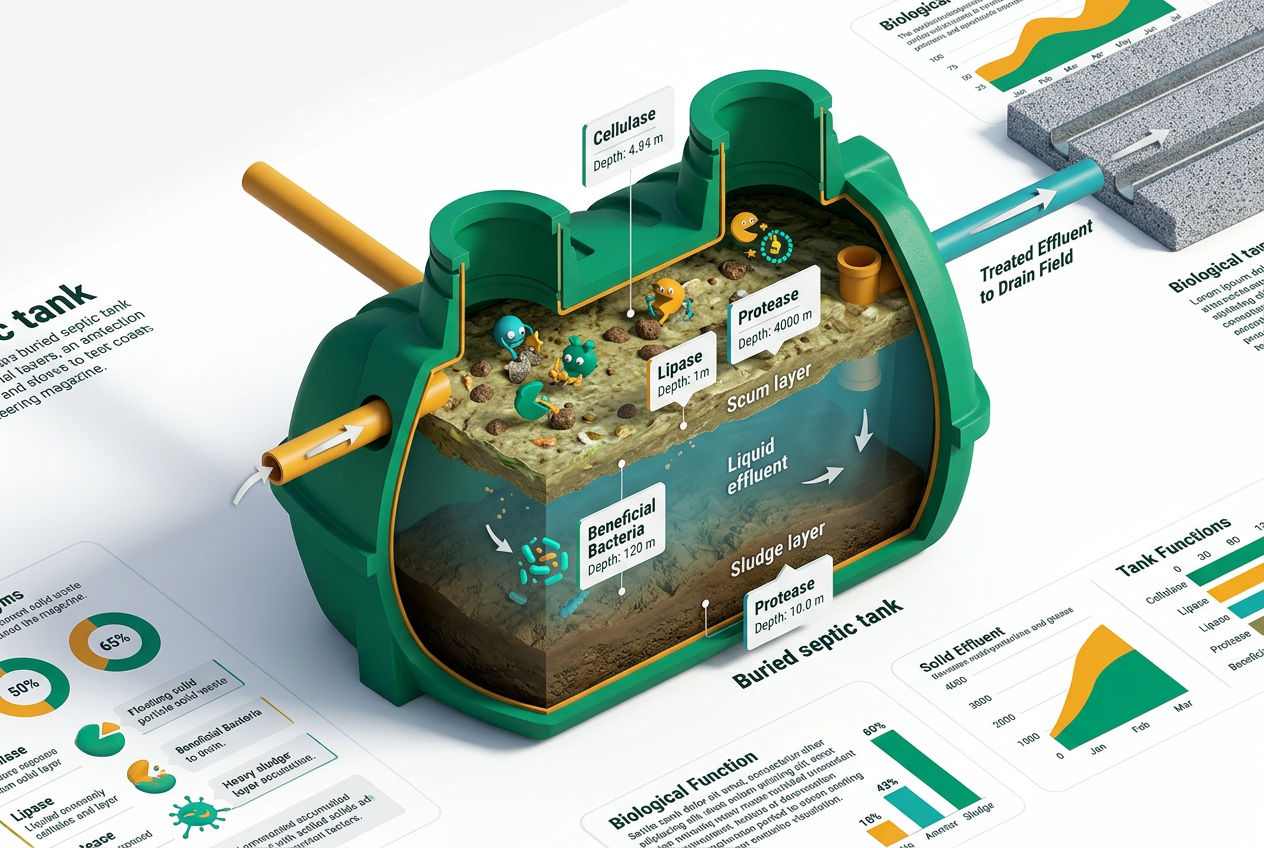
Your septic tank functions as a biological reactor — anaerobic bacteria that thrive without oxygen break down solid waste so that cleaner liquid effluent can flow out to your drain field. Rid-X claims to boost that bacterial colony, helping your system digest waste more efficiently. According to the product label, bacterial activation begins within 2–4 hours of adding a dose. The recommended amount is one packet per 1,000 gallons of tank capacity, used monthly. For the average 1,000–1,500-gallon residential tank, that's one to two packets per treatment.
Whether that addition meaningfully changes what happens inside your tank is a different question — one the research answers pretty clearly.
What Does the Science Say About Septic Tank Additives?
The evidence is not flattering for products like Rid-X. Multiple peer-reviewed studies — including a widely cited University of Minnesota Extension review (Anderson & Gustafson, 2000) that examined biological, enzymatic, and chemical additives across controlled field conditions — have found no statistically significant benefit from septic additives compared to a properly functioning system's natural bacterial population.
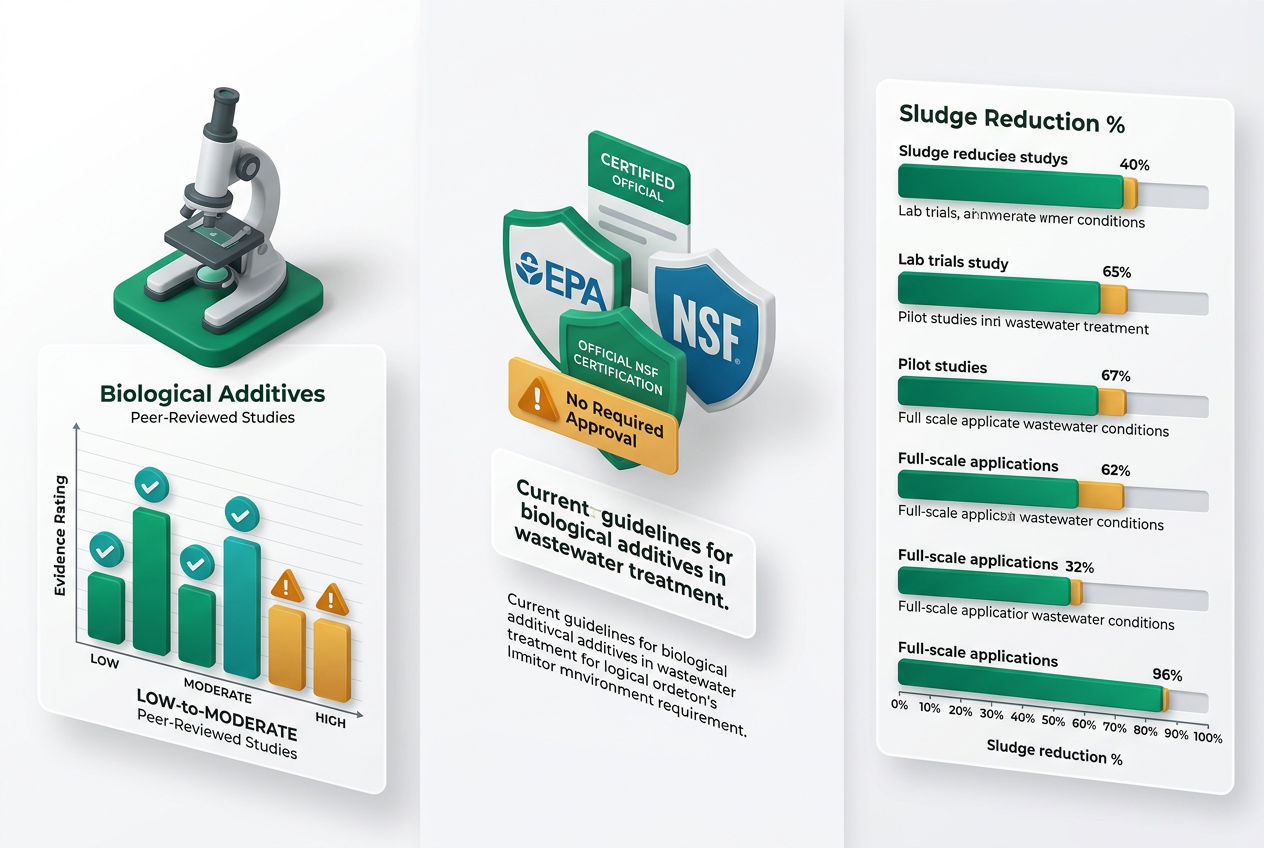
The EPA's official guidance at epa.gov/septic states plainly that additives are "not necessary" for a system in good working order. A healthy 1,000-gallon septic tank already hosts hundreds of billions of anaerobic bacteria. Adding 10 billion CFUs — roughly 1–5% of an established colony — is like pouring a cup of water into a swimming pool and expecting the water level to rise noticeably. The existing ecosystem is robust enough to absorb the addition without meaningful change in performance.
A quick worked example: Say your tank is a standard 1,000-gallon unit serving a four-person household. A healthy tank in steady operation maintains roughly 200–400 billion active CFUs across its anaerobic layers. One Rid-X packet introduces 10 billion CFUs — approximately 2.5–5% of that existing population. Even if every introduced organism survived and thrived, the proportional increase in digestion capacity would be statistically undetectable in any field measurement. The bacteria you already have are doing the heavy lifting.
The research also doesn't show that Rid-X harms a healthy system. The enzymes are organic and degrade naturally. The bacteria strains are non-pathogenic. "No measurable benefit" is the accurate verdict — not "dangerous." Where it gets more interesting is in edge cases — systems that have been stressed, recently pumped, or subjected to heavy antibiotic or chemical exposure. More on that below.
Rid-X vs. Doing Nothing: Key Differences
Here's a side-by-side look at what you're actually comparing:
| Factor | Regular Rid-X Use | No Additive (Healthy System) |
|---|---|---|
| Bacterial input | ~10B CFUs/month | 0 added; natural colony intact |
| Enzyme activity | Cellulase, lipase, protease, amylase | Naturally produced by existing bacteria |
| Cost | $96–$180/year | $0 |
| EPA recommendation | Not necessary | Maintain naturally |
| Pumping requirement | Still every 3–5 years | Every 3–5 years |
| Risk of harm | Minimal for conventional systems | None |
| Effective for failing systems | No | No |
Source: EPA Septic Systems Overview; Rid-X product labeling; NOWRA technical guidelines
On a functioning conventional system, the primary difference between using Rid-X and not using it is about $130 per year — and very little else.
What Are the Pros and Cons of Rid-X?
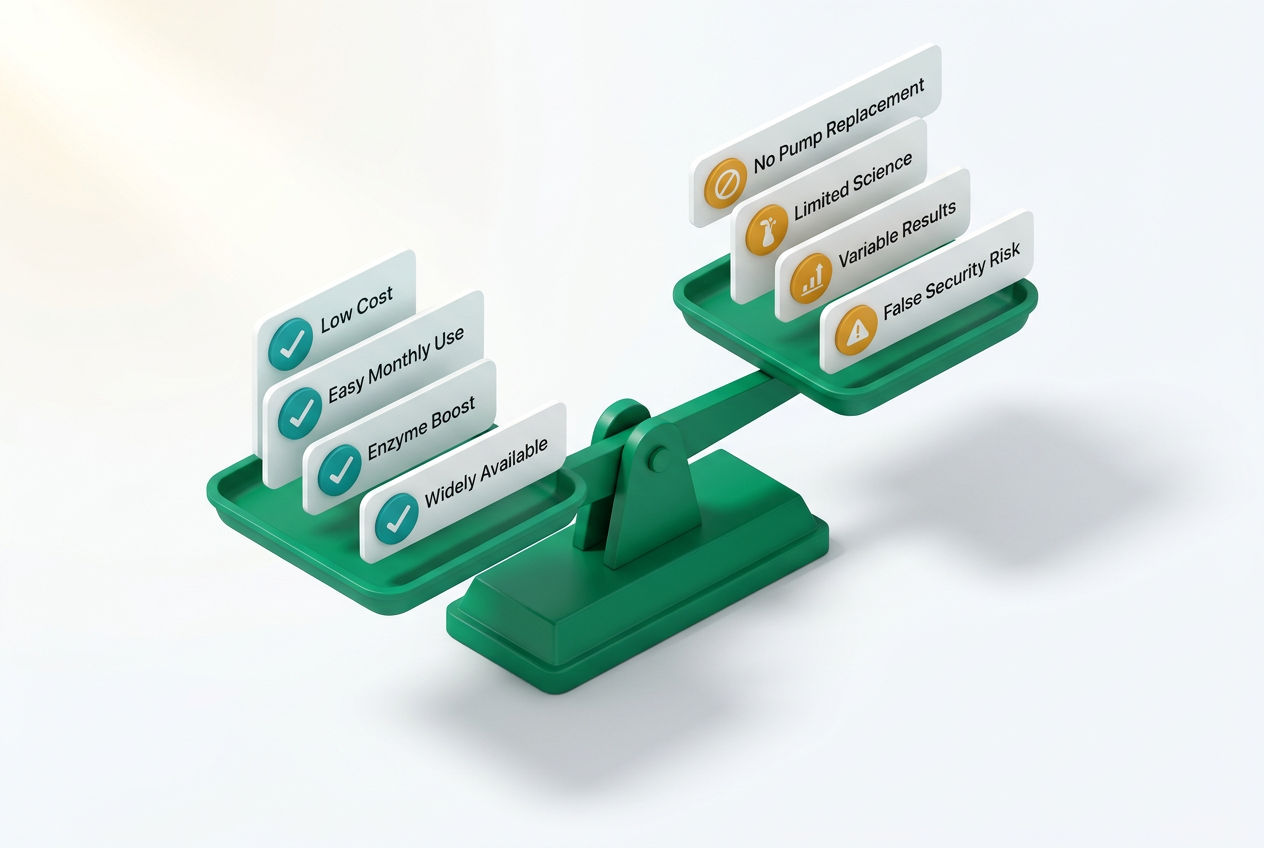
Where Rid-X Might Actually Help
The pros and cons of Rid-X look different depending on your situation. Here are the scenarios where adding a bacterial supplement makes reasonable sense:
After a pump-out. When a pumper truck vacuums out your tank, it removes a significant portion of the established bacterial colony along with the sludge and scum. Introducing a dose of Rid-X in the days following a pump-out can help re-seed the tank faster — though the system will rebuild naturally either way within a few weeks of normal use.
After heavy antibiotic use. If someone in your household has been on a broad-spectrum antibiotic regimen, those drugs pass through the body and into the tank. They don't discriminate — they can suppress the beneficial anaerobic bacteria the same way they fight infection. A bacterial supplement can help counteract that die-off. The same logic applies after a major bleach cleaning event or if a large quantity of disinfectant entered the system.
Vacation homes or seasonal properties. A camp cabin that sits empty from October through April has a cold, idle tank. Low temperatures dramatically slow bacterial metabolism. When you reopen the property in spring, a dose of Rid-X can jump-start biological activity ahead of heavy use. That's a genuinely practical application. Keep in mind that in very cold climates like Minnesota or Michigan's Upper Peninsula, bacterial performance stays suppressed until tank temperatures climb back above 50°F regardless of what you add.
Older systems running at the margins. A 35-year-old conventional system with aging baffles, borderline sludge accumulation, and moderate household load might see a marginal benefit from enzymatic support — not enough to rescue it, but potentially enough to buy a little time before the next pump-out. Marginal, though, is the realistic ceiling for a stressed system.
Where Rid-X Clearly Falls Short
Rid-X cannot fix a failing system. If your toilets are gurgling, you're seeing signs of drain field failure, or your yard has a wet spot with a distinctive smell, no additive will help. Biomat clogging in leach laterals is a physical problem — organic material has clogged the soil pores in your drain field. Enzymes do not dissolve biomat. Only drain field repair or replacement addresses that.
It won't save you from pumping. This is the biggest misconception Rid-X's marketing has generated. Your tank accumulates non-digestible inorganic solids — grit, sand, hair, and inorganic debris — that no bacteria can consume. Sludge builds. Scum builds. A 1,000-gallon tank serving a four-person household still needs pumping every 3–4 years. Add a garbage disposal and that drops to every 2–3 years. Rid-X doesn't change those numbers.
It's not appropriate for all system types. If you're in Texas or Oklahoma with an aerobic treatment unit (ATU), Rid-X is explicitly not designed for your system. ATUs use aerobic (oxygen-dependent) bacteria — a fundamentally different biological process. Introducing anaerobic bacteria can disrupt your system's performance. Check our aerobic vs. conventional septic comparison before using any additive on an ATU.
Does Rid-X Prevent You From Needing to Pump Your Septic Tank?
No — and this is the #1 marketing misconception surrounding septic additives. Pumping removes physical accumulation that biology cannot address. Every licensed septic inspector uses a sludge judge — a clear acrylic pole lowered into the tank — to measure how many inches of sludge have settled on the bottom and how thick the floating scum layer has grown. When combined sludge and scum occupy more than one-third of the tank's working volume, it's time to pump.
Bacteria do not consume glass, sand, hair, or the indigestible fraction of organic waste. That material accumulates regardless of what additives you use. The EPA recommends pumping every 3–5 years for most households. A standard pump-out costs $300–$600 nationally, varying by region and tank size. In rural Iowa or South Dakota, you might pay $275–$350. In coastal Massachusetts or suburban New Jersey, expect $450–$600.
Is Rid-X Worth It? A Practical Decision Framework
Wondering whether to keep buying Rid-X or skip it? Work through this checklist:
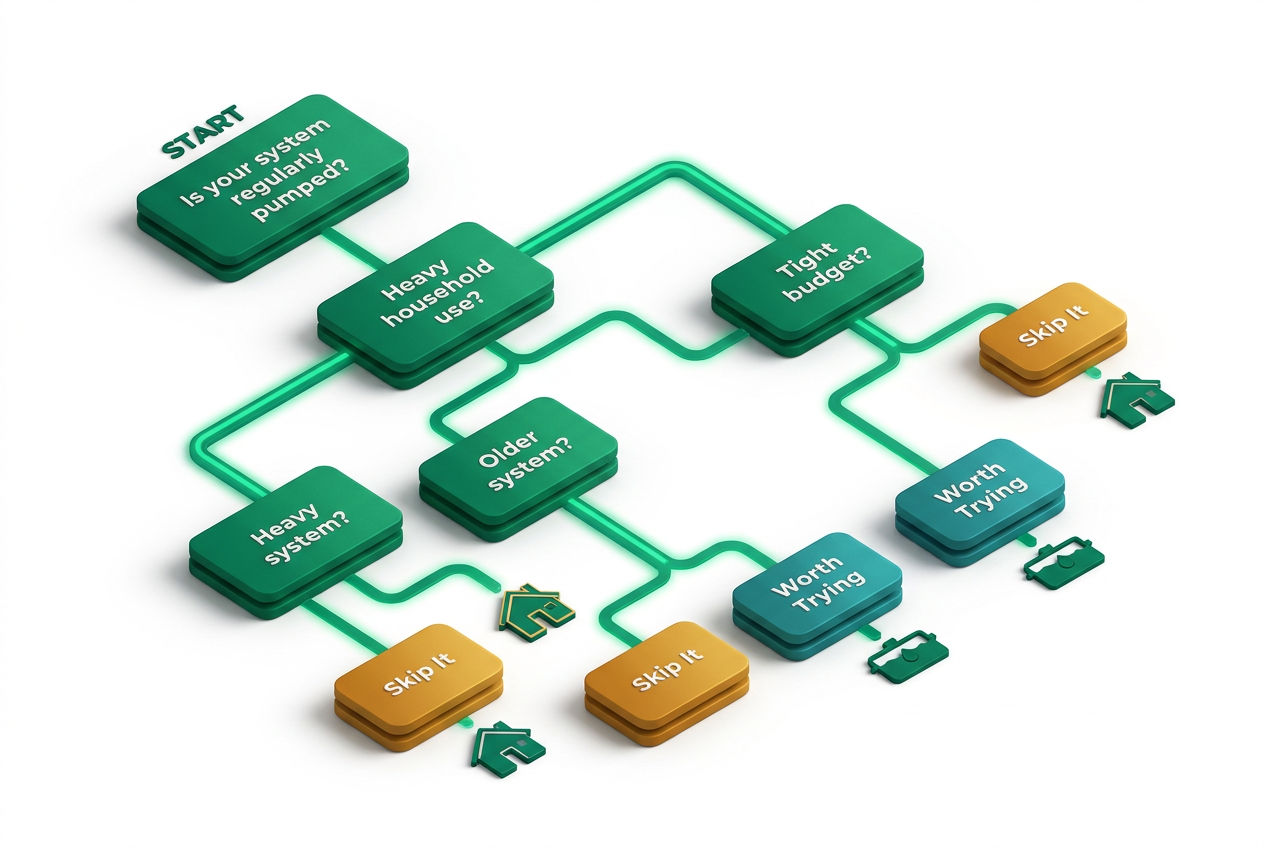
Use Rid-X (or a comparable bacterial supplement) if:
- ☑ You've had your tank pumped in the last 30 days
- ☑ Someone in your household completed a course of broad-spectrum antibiotics in the last 60 days
- ☑ You own a vacation or seasonal property that sits empty for 3+ months
- ☑ A significant cleaning event (large bleach use, chemical drain cleaner) entered your system
- ☑ Your system is older and a licensed inspector has noted marginal performance
Skip Rid-X and put the money toward maintenance if:
- ☑ Your system is functioning normally with no odors, backups, or wet spots
- ☑ You're on a regular pumping schedule and your tank was inspected recently
- ☑ You have an aerobic treatment unit (ATU) — Rid-X is not designed for aerobic systems
- ☑ You're hoping it will replace pumping (it won't)
- ☑ You're hoping it will fix a failing drain field (nothing short of repair will)
For most homeowners reading this on a functioning system with no recent disruptions, the honest answer is: skip it, bank the $130/year, and put it toward your next pump-out.
Rid-X Septic Treatment Reviews: What Users Actually Report
Search "Rid-X septic treatment reviews" or "is Rid-X worth it" in any forum and you'll find a split verdict — not because the science is unclear, but because user experience and controlled research measure different things.
Homeowners who report positive results typically fall into one of the legitimate use cases above: seasonal property owners, households that recently had a tank pumped, or people who noticed a difference after antibiotic disruption. When Rid-X is used in those scenarios, a perceived improvement is plausible and consistent with what the product actually does.
The skeptical reviews — common on Reddit's r/HomeImprovement and r/Plumbing threads — typically come from users who tried Rid-X expecting to extend pump-out intervals or fix a slow drain. Those users were asking the product to do something it was never designed to do. Their disappointment is real, but it's a product expectation problem, not a product failure.
The consistent pattern across honest rid-x septic additive reviews: users get value in edge cases and no detectable benefit on healthy, stable systems. That matches the peer-reviewed record exactly.
What Are the Best Alternatives to Rid-X?
If you're specifically looking for a Rid-X alternative, the category includes:
Comparable bacterial/enzymatic products: Green Gobbler Septic Saver, Bio-Tab, Cabin Obsession, and Walex Bio-Active are all similar in formulation — bacterial CFU counts in the 5–15 billion range with similar enzyme profiles. None of them outperforms Rid-X in controlled studies, and none of them outperforms a healthy natural bacterial colony either. They share the same honest limitations.
Effluent filters: A Polylok PL-122 effluent filter installed at your tank's outlet baffle costs $30–$80 in parts and can be installed during your next pump-out. It physically prevents solid carryover into your drain field — a mechanical protection that no additive can replicate. For drain field longevity, this is a better investment than any monthly additive.
Behavioral changes with quantified impact: A running toilet wastes up to 200 gallons per day — that's hydraulic overload that dilutes your tank's bacterial environment and pushes effluent into the drain field faster than it can percolate. Fixing a running toilet does more for your system than 12 months of Rid-X. Spreading laundry loads across the week rather than running 8 loads on Saturday similarly prevents single-day hydraulic surges.
Regular inspection: A licensed inspector charges $75–$150 per visit. They'll measure sludge depth, check baffles, inspect the outlet, and tell you exactly when you need to pump. That's actionable information. Check our septic inspection cost guide for regional pricing.
For more on this comparison, see our natural septic tank treatment and best septic tank treatment guides.
Regional and Seasonal Considerations
Florida and the Gulf Coast. Warm temperatures year-round mean bacterial metabolism stays active even in winter. Florida homeowners rarely need additive support for seasonal reasons — the tank never goes cold. The more relevant issue in coastal Florida is high water table and sandy soil, which creates drain field challenges no additive addresses. The Florida Department of Health regulates septic additives separately from other states and does not endorse their use for standard systems.
Minnesota, Wisconsin, and the Upper Midwest. This is where seasonal Rid-X use has the clearest legitimate application. A tank that drops below 40°F loses most of its active bacterial metabolism. Seasonal cabin owners reopening properties in April or May after a cold winter layoff are exactly the use case where a bacterial boost makes sense. Pumpers who service seasonal properties in the Upper Midwest often have no objection to a spring dose — with the explicit caveat that it's not a substitute for a pump-out if the tank is overdue.
Mountain West and arid climates. Low water use in drought-conscious households sometimes results in a tank that doesn't receive enough daily flow to maintain a healthy bacterial environment. In those cases, occasional supplementation may have marginal benefit — though the first fix is ensuring adequate water input, not adding bacteria.
Washington State and the Pacific Northwest. Washington State has historically discouraged the use of septic additives for standard systems and has issued specific guidance through the Washington State Department of Health noting that additives have not been demonstrated to benefit properly functioning systems. Homeowners in Washington should check current DOH guidance before using any additive product.
Aging infrastructure and Orangeburg pipe. Homes built between 1945 and 1972 sometimes have Orangeburg pipe — compressed wood pulp and tar paper pressed into pipe form — in their lateral lines. These pipes degrade over decades into a soft, oval-collapsing shape that restricts flow. No enzyme product addresses Orangeburg degradation. If you have a mid-century home and slow drains, have a lateral inspection done before assuming a bacterial additive will help. This is a structural problem, full stop.
What Should You Actually Do for Your Septic System?
The habits that demonstrably extend septic system life have nothing to do with monthly additives. Here's where time and attention actually matter:
Pump on schedule. A 1,000-gallon tank serving four people needs pumping every 3–4 years. A 1,500-gallon tank with two people can often go 5 years. These intervals come from sludge accumulation rates, not from guessing. Don't extend them based on additive use.
Protect your bacterial colony. The bacteria already in your tank are your best asset. What kills them: antibacterial soaps, bleach in large quantities, chemical drain openers (particularly lye-based products), and prescription antibiotics in high doses. Switching to septic-safe cleaning products and understanding what kills septic bacteria will do more for your system than any additive. For more on using enzyme-based supports appropriately, see our septic tank enzymes guide.
Fix water leaks. A running toilet — not a dramatic leak, just a flapper valve that doesn't seal — wastes up to 200 gallons per day. That's 6,000 extra gallons per month entering your tank and drain field. Hydraulic overload is one of the primary causes of premature drain field failure. Fix the toilet.
Install an effluent filter. A Polylok PL-122 or equivalent filter installed at your tank's outlet baffle for $30–$80 prevents solid carryover into your drain field. Ask your pumper to install one at your next service visit. It's a one-time investment with a direct protective benefit.
Spread hydraulic loads. Running eight loads of laundry on Saturday floods your tank and drain field in a single day. The same eight loads spread across the week produces no single-day surge. This is free and immediately actionable.
Get a mound system inspection if you have one. Mound septic systems have specific maintenance requirements around the pump chamber and distribution system that conventional system advice doesn't cover. If you have a mound system, the additive question is mostly irrelevant — the mechanical components need attention first.
Sources & Methodology
This article draws on the following sources:
- U.S. Environmental Protection Agency — Septic Systems Overview (epa.gov/septic). Used for EPA's official position on septic additives and recommended pumping intervals.
- Anderson, J. & Gustafson, D., University of Minnesota Extension (2000) — Peer-reviewed review of biological, enzymatic, and chemical septic additives across controlled field conditions. Primary source for the "no statistically significant benefit" finding.
- National Association of Wastewater Technicians (NAWT) — Technical guidelines on pumping intervals and inspection methodology.
- Rid-X product labeling (Reckitt, current formulation) — Used for CFU count, enzyme types, activation time claims, and dosage recommendations.
- Washington State Department of Health — Septic system additive guidance for standard systems.
- National Onsite Wastewater Recycling Association (NOWRA) — Technical guidelines on system types and additive appropriateness.
- Polylok product specifications — PL-122 effluent filter pricing and installation context.
Pricing data reflects national averages from contractor surveys and regional service provider estimates as of 2025. All internal links reference supporting articles on this site.
Frequently Asked Questions
Is Rid-X worth it for a healthy septic system?
No — for a properly functioning septic system with no recent disruptions, Rid-X is not worth the $96–$180 annual cost. The EPA officially classifies septic additives as "not necessary" for a system in good working order, and peer-reviewed research including the University of Minnesota Extension's 2000 review finds no statistically significant benefit from bacterial additives on established, healthy systems. Your tank already maintains hundreds of billions of active anaerobic bacteria — adding 10 billion CFUs from a Rid-X packet increases that population by roughly 2–5%, a change too small to produce any measurable difference in digestion performance. The money is better spent on your next pump-out or on installing an effluent filter ($30–$80) at your tank's outlet baffle. The honest exception: if you've recently had your tank pumped, completed a course of antibiotics, or own a seasonal property, a single dose of Rid-X has a plausible, limited rationale. For routine maintenance on an otherwise stable system, skip it.
How does Rid-X work, and how long does it take to show results?
Rid-X works by introducing approximately 10 billion colony-forming units (CFUs) of anaerobic bacteria and four enzyme types — cellulase, lipase, protease, and amylase — into your septic tank. According to the product label, bacterial activation begins within 2–4 hours of application. The enzymes begin breaking down fats, starches, proteins, and paper fibers almost immediately upon contact with waste. However, "activation" and "measurable improvement in system performance" are different things. For a healthy tank, peer-reviewed research shows no statistically significant change in effluent quality, sludge accumulation rate, or drain field performance even after months of monthly dosing. In specific scenarios — post-pump-out tank re-seeding, post-antibiotic bacterial recovery, or cold-weather seasonal startup — users may notice reduced odor or improved flushing within a few weeks, which corresponds to the time needed for an introduced bacterial population to establish. Those are the legitimate use cases. On a stable, healthy system, you won't notice a difference because there isn't one to notice.
Can Rid-X damage your septic system or pipes?
No — Rid-X does not damage a conventional gravity-fed septic system or standard household pipes. The bacteria strains are non-pathogenic and naturally occurring. The enzymes are organic compounds that degrade after performing their function. Multiple studies confirm no adverse effects on tank structure, baffle integrity, or effluent quality from regular use. The one meaningful caution involves system type: Rid-X is formulated for anaerobic (conventional) septic systems. If you have an aerobic treatment unit (ATU) — common in Texas, Oklahoma, and parts of the Southeast — introducing anaerobic bacteria can disrupt the aerobic bacterial environment your ATU depends on. A Hiblow HP-80 compressor-equipped ATU, for example, is engineered to maintain dissolved oxygen levels that support aerobic digestion; anaerobic bacteria introduced from Rid-X may compete with and suppress those aerobic organisms. Check your system type before using any additive. For conventional systems, the verdict is clear: no harm, but also no measurable benefit for healthy tanks. "Safe but unnecessary" is the accurate summary.
Should I use Rid-X after pumping my septic tank?
Yes — this is one of the few scenarios where using Rid-X has a reasonable, defensible rationale. When a pumper truck vacuums your tank, it removes not only accumulated sludge and scum but also a substantial portion of the active bacterial colony that was living in that material. Your tank will rebuild its bacterial population naturally through normal household use within 2–4 weeks — human waste itself introduces billions of bacteria with every flush. But applying one packet of Rid-X per 1,000 gallons of tank capacity 24–48 hours after the pump-out can accelerate that re-seeding process and get your tank back to full biological function slightly faster. This is particularly useful if you have a large household that generates heavy waste load immediately after pumping, or if you're reopening a seasonal property after a pump-out and won't have regular daily use to re-seed the tank naturally. Apply the dose, wait 24 hours before heavy water use if possible, and then resume normal use. One post-pump dose is sufficient — you don't need to continue monthly use afterward unless another disruption event occurs.
Does Rid-X replace the need to pump your septic tank?
No — this is the most persistent and damaging myth surrounding Rid-X and septic additives generally. Pumping removes physical material that no biological process can eliminate: inorganic solids like sand, grit, and hair; the indigestible fraction of organic waste; and compacted sludge that has settled beyond the reach of active bacterial digestion. A licensed septic inspector measures sludge depth with a sludge judge pole — when combined sludge and scum occupy more than one-third of the tank's working volume, pumping is required regardless of what additives have been used. A 1,000-gallon tank serving four people accumulates sludge at a rate that requires pumping every 3–4 years under normal conditions. Rid-X does not change that accumulation rate in any measurable way. The EPA recommends pumping every 3–5 years for most households. Skipping or extending pump-outs based on additive use is the single most common cause of preventable drain field damage — repairs that cost $5,000–$20,000 compared to a $300–$600 pump-out. Use Rid-X if it makes sense for your situation, but never in place of scheduled pumping.
What are the best alternatives to Rid-X for septic tanks?
The most effective alternatives to Rid-X aren't other additive products — they're behavioral and mechanical changes that produce measurable, documented results. First, fix any running toilets: a faulty flapper wastes up to 200 gallons per day, creating hydraulic overload that strains your drain field more than any bacterial deficiency ever would. Second, install an effluent filter — a Polylok PL-122 costs $30–$80 and physically prevents solid carryover into drain field laterals. Third, spread laundry loads across the week to prevent single-day hydraulic surges. If you specifically want a bacterial supplement alternative, products like Green Gobbler Septic Saver, Walex Bio-Active, and Bio-Tab offer similar CFU counts and enzyme profiles to Rid-X at comparable or lower price points — but they share the same honest limitation: no controlled study shows meaningful benefit for healthy systems. For more detailed comparisons, see our natural septic tank treatment and best septic tank treatment guides. The single highest-return investment for long-term system health remains a regular pump-out on schedule combined with a septic-safe household product routine.
Is Rid-X safe for older pipes and aging septic systems?
Yes, with one important qualification. Rid-X is safe for cast iron, PVC, clay tile, and concrete pipes — the enzyme and bacterial compounds are non-corrosive and won't accelerate pipe degradation. For conventional aging systems — even 40- or 50-year-old tanks with older concrete baffles — Rid-X presents no chemical risk. The qualification involves Orangeburg pipe: homes built between 1945 and 1972 sometimes have lateral lines made from compressed wood pulp and tar paper. These pipes degrade over decades into a soft, oval-collapsing shape that restricts flow regardless of what enters them. No enzyme product addresses Orangeburg degradation, and adding Rid-X to a system with collapsing Orangeburg laterals won't help — the restriction is structural, not biological. If you have a mid-century home with persistent slow drains, have a lateral inspection performed with a camera before spending money on any additive. For aging systems that a licensed inspector has flagged as borderline — older baffles, marginal sludge levels, moderate household load — a bacterial supplement may offer marginal enzymatic support, but the realistic ceiling is small. Structural maintenance and timely pumping remain the priority for older systems.
Free download
Not ready for the Handbook? Start with the free Fridge Card.
The Do / Don’t card the whole family can see, plus the Survival Kit: emergency flowchart, warning-sign decoder and pump-schedule card. One printable PDF.
Was this article helpful?
Frequently Asked Questions
Recommended Resources
📖 Related Articles
- What Is a Drain Field? (And How Does It Work?)
- Signs Your Drain Field Is Failing (And What to Do)
- Aerobic vs Anaerobic Septic Systems: How They Compare
- How Often Should You Pump Your Septic Tank?
- The Best Natural Septic Tank Treatment (Top Picks)
- Do Septic Tank Treatments Actually Work?
- Septic-Safe Cleaning Products: The Complete List (Safe vs. Avoid)
- What Kills Septic Tank Bacteria? (14 Things to Avoid)
- Septic Tank Enzymes: What You Need to Know
- Mound Septic System: $10K–$25K Cost & How It Works (2026)
🔧 Services
Find Septic Professionals Near You
Compare licensed, verified septic companies by area — top county markets and cities below, or browse all 50 states.
County markets
Popular cities
