
Quick Answer
An off grid cabin is a self-sufficient dwelling that operates independently from municipal water, sewer, and electrical systems. Building one requires planning across four core systems: water, waste, power, and shelter. Costs range from $10,000 for a basic DIY shell to well over $150,000 for a fully outfitted year-round home.
Key Takeaways
- Off grid cabins require four core systems: water, waste management, power, and heating
- Total build costs range from $10,000 (basic DIY) to $150,000+ (fully finished year-round structure)
- Most cabins run 400–800 sq ft — enough to live comfortably without oversizing your systems
- Septic systems cost $3,000–$15,000 installed; composting toilets run $500–$2,000 as an alternative
- Permits are required in most jurisdictions — even on rural land — and skipping them can halt construction
What Is an Off Grid Cabin?
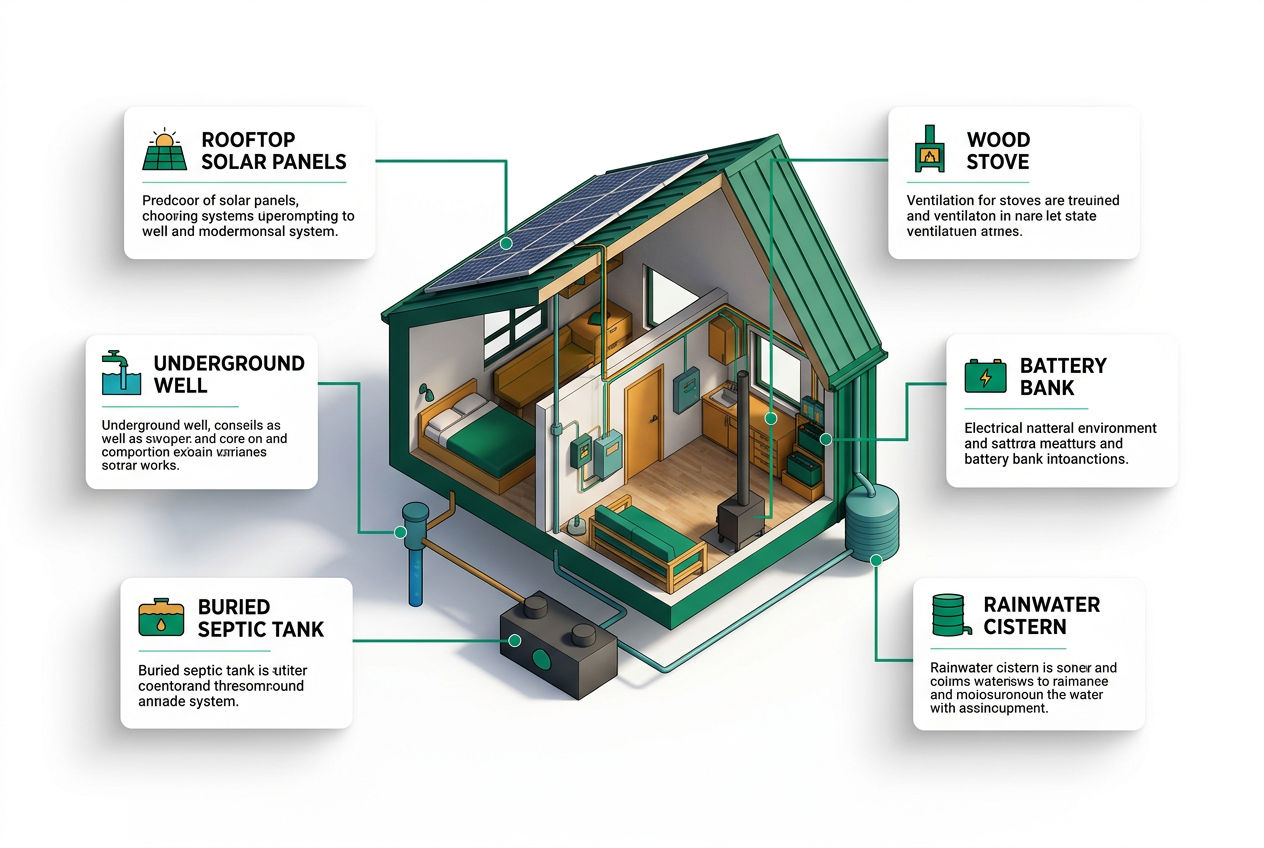
An off grid cabin is any dwelling designed to function without connection to public utility infrastructure. No city water line. No municipal sewer hookup. No electric grid. You generate your own power, source your own water, and manage your own waste.
That sounds radical, but roughly 180,000 American families already live this way full-time, according to U.S. Census Bureau rural housing data. Millions more use off-grid setups at seasonal retreats.
Here's what actually draws people in: lower long-term utility costs, genuine privacy, land freedom, and the kind of self-sufficiency that feels impossible in a suburb. The challenge is equally concrete. Every system you take for granted in a conventional home — turn on the tap, flip the breaker, flush the toilet — has to be deliberately designed and installed.
Off grid living isn't a single product you buy. It's a set of decisions you make before you break ground.
How Do You Plan an Off Grid Cabin?
Planning an off grid cabin means working backward from how you'll live in it. Will you use it year-round or just seasonally? How many people? Do you need a washing machine, a dishwasher, a chest freezer? Each answer shapes the scale of every system you'll build.
Start with these questions before buying land:
- What's the annual rainfall? (Affects rainwater harvesting viability)
- What's the frost depth? (Affects septic and pipe installation depth)
- What are the county zoning and setback rules?
- Is a perc test required for septic installation?
- Are there deed restrictions on the parcel?
Most first-time builders underestimate the permitting timeline. Rural counties that seem lax often still require a building permit, a septic permit, and a well permit — each handled by a different department. Budget 3–6 months for approvals before you swing a hammer.
For a thorough overview of what that permitting process involves, the septic system permit requirements guide on this site is a solid starting point.
How Much Does It Cost to Build an Off Grid Cabin?
A bare-bones owner-built cabin on raw land can come in under $15,000. A fully finished, year-round structure with a modern septic system, solar array, and insulated well house will push $150,000 or higher. Most DIY builders land somewhere between $30,000 and $80,000 for a 400–600 sq ft cabin.
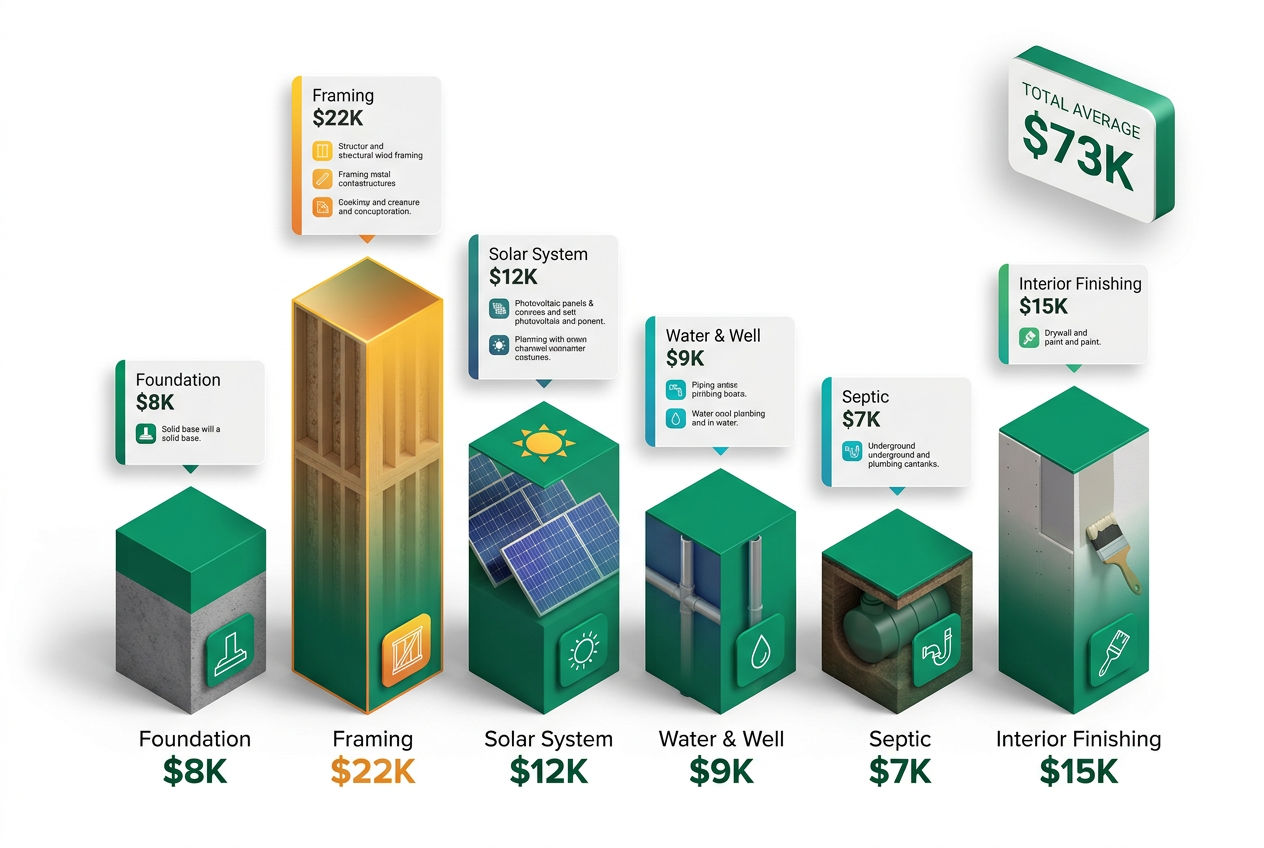
Here's where the money actually goes:
| System | Typical Cost Range | Notes |
|---|---|---|
| Cabin shell (DIY kit) | $8,000–$30,000 | Excludes land and labor |
| Septic system | $3,000–$15,000 | Conventional or alternative |
| Well drilling | $5,000–$15,000 | Depth-dependent |
| Solar system (1–3 kW) | $3,000–$10,000 | Panels + battery bank |
| Rainwater harvesting | $1,000–$5,000 | Tank size varies |
| Propane heating/cooking | $500–$3,000 | Tank + appliances |
| Composting toilet | $500–$2,000 | Alternative to septic |
Source: National averages compiled from USDA Rural Development data, contractor quotes, and manufacturer pricing (2025–2026)
Professional construction runs $100–$300 per square foot in most rural markets. A 500 sq ft cabin at $175/sq ft comes to $87,500 before land costs, permits, or utility systems. Build it yourself and you can cut that number roughly in half — if you have the skills and time.
For a full breakdown of what septic installation adds to your budget, see the septic installation cost guide.
What Off Grid Cabin Plans and Kits Work Best?
Off grid cabin plans fall into three categories: custom architect-drawn plans, pre-drawn stock plans, and prefabricated cabin kits. Each has a different cost profile and skill requirement.
Custom plans run $2,000–$8,000 from an architect or structural engineer and make sense when your land has unusual topography, extreme snow loads, or strict county requirements that a stock plan won't satisfy.
Stock plans from plan services like Family Home Plans or BuildingAdvisor cost $300–$1,500 and work well for standard rectangular footprints in straightforward conditions. You'll often need a local engineer to stamp them for permit submission, which adds $500–$1,500.
Off grid cabin kits — precut log kits, timber frame packages, or panelized wall systems — are the fastest path to a weathertight shell. Manufacturers like Conestoga Log Cabins, Coventry Log Homes, and Lindal Cedar Homes ship packages that include walls, roof framing, windows, and doors. Kit prices range from $8,000 for a 200 sq ft shell to $60,000+ for a 1,000 sq ft timber frame package. Labor to assemble typically runs 30–50% of kit cost.
What to look for in off grid cabin plans:
- Roof pitch designed for local snow load (consult IRC Table R301.2 for your county's ground snow load)
- South-facing roof plane sized for solar panel installation (200–400 sq ft for a 3–6 kW array)
- Utility room or mechanical closet for battery bank, pressure tank, and water filtration
- Crawl space or slab design that matches your frost depth
- Simple rectangular footprint — complex shapes dramatically increase framing cost and heat loss
For cabins in cold climates, a rectangular single-story plan with a steep gable roof consistently outperforms complex designs on both build cost and heating efficiency.
How Do Off Grid Cabins Get Water?
Off grid cabins source water from a drilled well, a hand-dug or bored shallow well, a spring, or a rainwater collection system. The right choice depends on your land's geology, local rainfall patterns, and state law.
Drilled wells are the most reliable option for year-round use. Depths range from 25 feet in the Southeast to 400+ feet in parts of the Mountain West. Drilling costs $15–$30 per foot plus casing and pump installation.
Rainwater harvesting works well in the Pacific Northwest and Southeast but falls short in arid regions. The math: a 1,000 sq ft roof collects roughly 600 gallons per inch of rainfall (using the standard 0.5 gallon/sq ft/inch calculation, accounting for losses). A 2,500-gallon polyethylene storage tank plus basic filtration runs $1,500–$3,500 installed.
State law matters here. California legalized rainwater collection in 2012. Colorado only legalized it in 2016 — and still caps residential collection at 110 gallons. Texas has no state rainwater restrictions, though water rights on your parcel deserve scrutiny. Always check your county before designing a collection system.
For deeper coverage of off-grid water design and filtration options, the off grid water system guide walks through each approach in detail.
Do Off Grid Cabins Need Septic Systems?
Yes — most do. Any off grid cabin with indoor plumbing and a conventional flush toilet needs a permitted waste management system. In most rural counties, that means a septic tank and drain field. "Off the grid" doesn't mean off the county health department's radar.
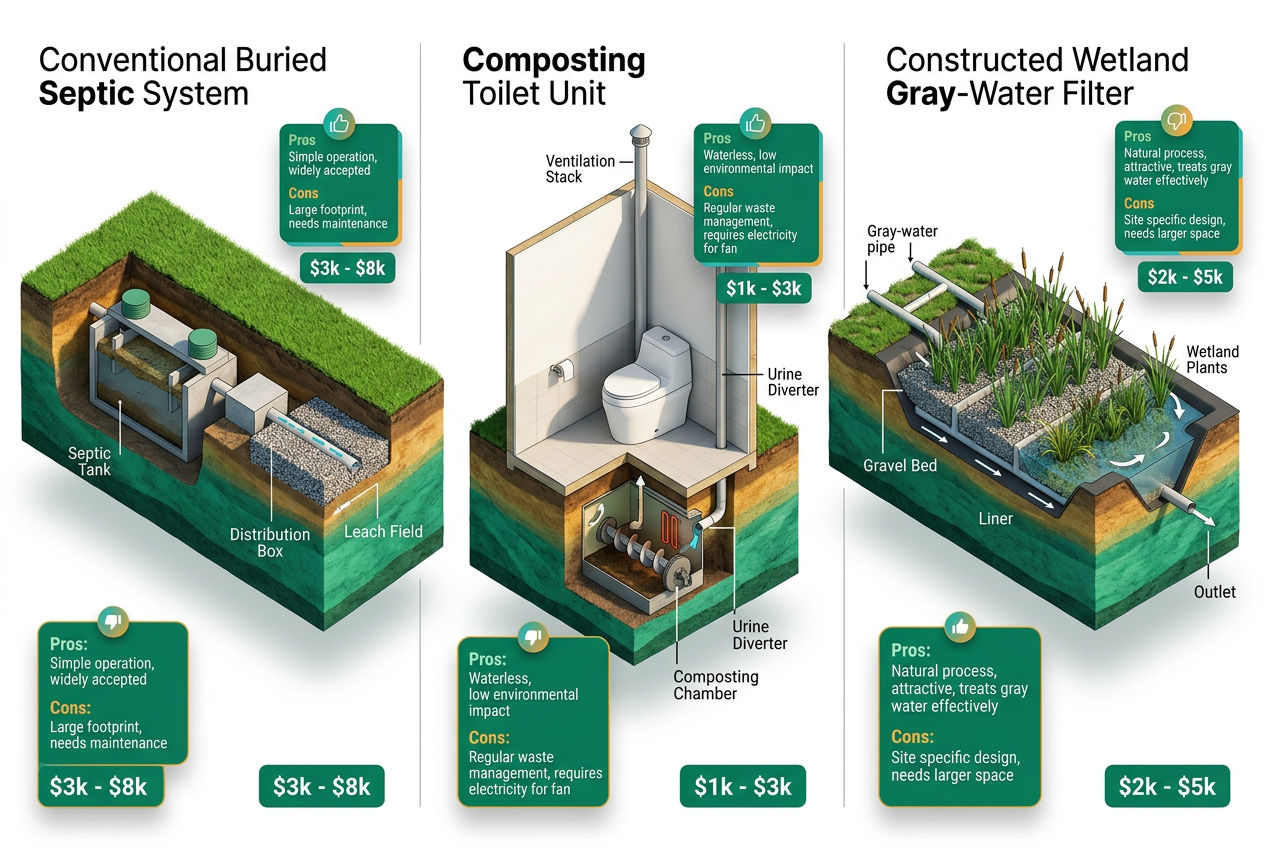
That said, you have real options.
Conventional Septic Systems
A conventional septic system — 1,000- or 1,250-gallon concrete or fiberglass tank feeding a leach field — is the most common choice for year-round cabins. Installed costs run $3,000–$15,000 depending on soil conditions, tank size, and drain field length.
Most counties require at least ½ to 1 acre of suitable land for septic installation, and the system must sit at least 50–100 feet from any well or water source (setback requirements vary by state and county). A percolation test — the perc test — determines whether your soil drains at a rate fast enough to support a conventional drain field. Tight clay soils often require a mound system or alternative design, which pushes costs higher.
A conventional septic system lasts 20–30 years with proper maintenance. Plan on pumping every 3–5 years. A 1,000-gallon tank serving two people in a weekend cabin might go longer between pumpings; a 1,000-gallon tank serving a family of four year-round needs attention closer to every 3 years.
How often you pump your septic tank depends heavily on household size and usage.
Composting Toilets
A composting toilet handles blackwater (toilet waste) without water or a sewer connection. Units like the Sun-Mar Excel or Separett Villa 9215 separate liquid and solid waste, with solids composting aerobically in the unit. A quality self-contained composting toilet runs $900–$2,000. Installation is DIY-friendly.
The catch: many counties still require a permitted greywater system even if you install a composting toilet. Greywater — sink, shower, and laundry water — makes up roughly 65% of household wastewater by volume. It can't just drain into the yard in most jurisdictions.
The composting toilet guide covers sizing, installation, and maintenance in full. If you're weighing both approaches, the composting toilet vs. septic comparison lays out the tradeoffs honestly.
Greywater Systems
A simple greywater system routes sink and shower water through a branched drain to subsurface mulch basins or a constructed wetland. Costs range from a few hundred dollars for a basic laundry-to-landscape setup to $2,000–$5,000 for a permitted subsurface system. See the greywater system guide for a full walkthrough.
For cabins with limited land or unusual soil conditions, an alternative septic system — aerobic treatment units, mound systems, or drip irrigation systems — may be required. The off grid septic system guide covers these options in detail.
Ready to get quotes from licensed septic installers in your area? Use the septic installation service page to connect with local professionals.
What Power System Does an Off Grid Cabin Need?
DIY Septic Blueprint
Thinking about building it yourself?
The complete, plain-English plan to size, permit and install your own septic system — designed for homeowners, not contractors. Skip the $15,000–$25,000 quotes and do it right the first time.
Get the DIY Blueprint — $67 →Instant download · 8 modules + 3 bonus guides · 60-day money-back guaranteeMost off grid cabins run on solar. A typical 400–800 sq ft cabin uses 1–5 kWh of electricity per day depending on appliances, climate, and occupancy. A standard 400-watt solar panel produces roughly 1.6 kWh per day in average sun conditions — so a 3-panel array (1.2 kW) covers a minimalist cabin's basic needs.
A practical 3 kW system with 2–3 days of battery backup (a Lithium Iron Phosphate battery bank of 5–10 kWh) runs $6,000–$10,000 installed. Add a propane backup generator for cloudy stretches.
Propane handles what solar can't easily do: high-heat loads like cooking, water heating, and supplemental heating. A 250-gallon above-ground propane tank costs $400–$800 and keeps a cabin running through extended cloudy periods without oversizing the battery bank.
Mountain West note: Higher elevation and thinner atmosphere actually increase solar yield by 4–8% compared to sea-level installations — but cold temperatures reduce Lithium Iron Phosphate battery output by 15–25% at 14°F (−10°C). Size your battery bank for winter conditions, not peak summer output.
How Do You Heat an Off Grid Cabin?
Heating is where off grid cabin builds most often go wrong. Undersized or inefficient heating systems are the single biggest comfort failure in DIY builds.
Wood stoves remain the most practical primary heat source for most off grid cabins. A quality cast iron stove like the Jøtul F 373 or Drolet HT3000 produces 40,000–80,000 BTUs and heats 800–2,000 sq ft efficiently. Installed cost including stovepipe and ceiling/roof penetration runs $1,500–$4,000. Wood is free if your land has it.
Propane wall heaters and mini-splits work as backup or supplemental heat. The Mitsubishi MUZ-FH series cold-climate mini-split operates down to −13°F and achieves a coefficient of performance (COP) above 2.0 at 5°F — meaning it produces more than twice the heat energy it consumes in electricity. For solar-powered cabins, this efficiency matters.
Insulation is your first heating decision, not your last. IRC recommendations for climate zones 6 and 7 (Minnesota, northern Wisconsin, Montana, northern Maine) call for R-49 to R-60 ceiling insulation and R-20 to R-30 wall insulation. Meeting those numbers in a 500 sq ft cabin is far cheaper than oversizing your heating system to compensate for a leaky envelope.
How Do You Prevent Pipes from Freezing in an Off Grid Cabin?
Pipe freeze is the most common and most expensive maintenance failure in seasonally vacant off grid cabins. A burst pipe in an unoccupied cabin can go unnoticed for weeks, causing structural water damage that runs $5,000–$30,000 to repair.
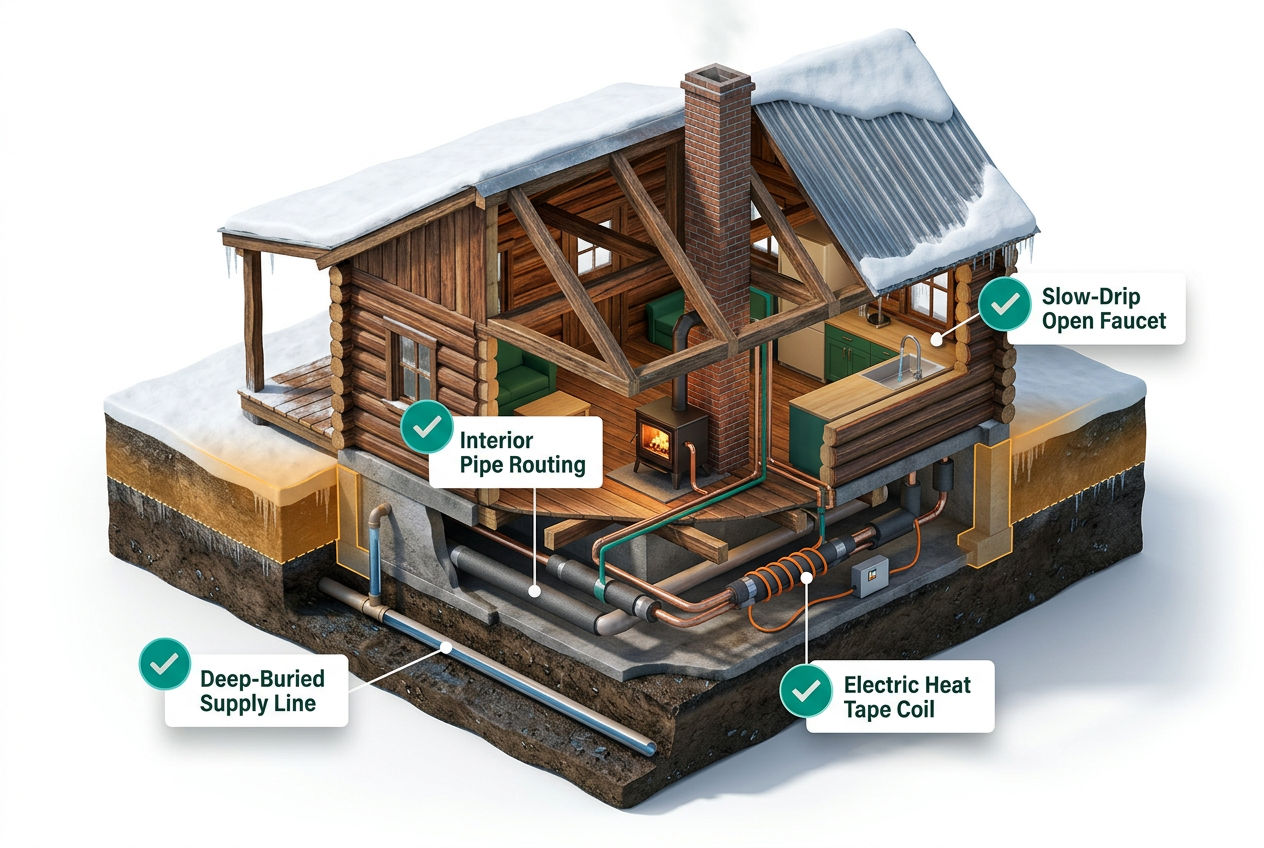
The critical zone is the first 10 feet of pipe exiting the cabin's conditioned space. Wrap this section with 2-inch rigid foam pipe insulation and heat tape rated for outdoor use. Where pipes enter through a foundation or sill plate, pack the penetration with expanding spray foam, then cover with rigid foam board.
For cabins you won't visit all winter, a full winterization protocol beats passive insulation:
- Shut off the water supply at the source (pump or well)
- Open all faucets — hot and cold — and leave them open
- Flush the toilet and hold the handle down until the tank empties
- Pour non-toxic RV antifreeze (propylene glycol) into all drain traps: sink P-traps, toilet bowl, shower drain
- Drain the pressure tank and water heater via their drain valves
- Disconnect and store the battery from any pump pressure switch
In Minnesota, frost depth reaches 42–60 inches. Any water line running underground — including the connection from a well to the cabin — must be buried below that depth or actively heat-traced. A shallow buried line that freezes once typically cracks at the coupling fitting, not the pipe body, which makes the repair deceptively labor-intensive.
See the full septic pipes freeze prevention guide for system-specific winterization steps.
Frequently Asked Questions
How much does an off grid cabin cost to build?
Building an off grid cabin costs between $10,000 and $150,000 depending on size, location, construction method, and the systems you install. A bare-bones 200–400 sq ft DIY shell using a prefabricated cabin kit runs $10,000–$30,000 in materials, assuming you provide most of the labor. A mid-range 400–600 sq ft owner-built cabin with a drilled well, conventional septic system, 3 kW solar array, and wood stove heating typically lands between $40,000 and $80,000 all-in. A fully finished 600–1,000 sq ft year-round structure built by contractors — with a licensed septic install, complete solar and battery system, insulated well house, and propane backup — will reach $100,000–$150,000 or higher in most rural markets.
The biggest single variable after size is whether you're paying contractor rates ($100–$300 per square foot) or building yourself. Self-builders who are comfortable with framing, plumbing rough-in, and electrical can cut structure costs by 40–60%. However, permitted systems — septic, well, electrical panel — still require licensed installers in most jurisdictions regardless of who does the surrounding work. See the cost table earlier in this article for a system-by-system breakdown, and review the cheapest septic system options if wastewater is your tightest budget line.
What are the best off grid toilet options for a cabin?
The three practical off grid toilet options for a cabin are a composting toilet, a conventional flush toilet connected to a permitted septic system, and an incinerating toilet. Which one works depends on your county's regulations, your land's soil conditions, and how often the cabin is occupied.
A composting toilet — such as the Sun-Mar Excel ($1,200–$1,800) or Separett Villa 9215 ($1,000–$1,500) — is the most common choice for seasonal or part-time cabins. It requires no water, no sewer connection, and no drain field. The trade-off: most counties still require a permitted greywater system for sink and shower drainage even when a composting toilet eliminates blackwater. Installation is DIY-friendly, and the units are low-maintenance if used correctly.
A conventional flush toilet connected to a septic system makes more sense for year-round occupancy with multiple residents. The septic system adds $3,000–$15,000 to your build cost but handles all wastewater in a single permitted system with no manual emptying or maintenance beyond routine pumping every 3–5 years.
Incinerating toilets (brands: Incinolet, Cinderella) use electric or propane heat to reduce waste to ash. They cost $2,000–$4,000 and work well for extremely remote locations where soil conditions prevent any drain field. Power consumption is a drawback for solar-powered cabins. See the off grid toilet options guide for a full side-by-side comparison of cost, maintenance requirements, and county approval pathways.
What is off grid cabin heating — and what system works best?
Off grid cabin heating refers to any heat source that operates without connection to a natural gas line or electric grid utility. The most practical systems for most cabins are wood stoves, propane heaters, and cold-climate mini-splits powered by a solar-plus-battery system.
A wood stove is the most cost-effective primary heat source for cabins with access to firewood. A quality unit like the Drolet HT3000 or Jøtul F 373 costs $1,500–$4,000 installed and operates indefinitely with no electricity or propane. For off grid cabins in forested areas, the fuel is often free from land clearing and fallen timber.
Propane wall heaters are a reliable backup. A 30,000 BTU propane heater costs $300–$600 and runs independently of any electrical system. A 250-gallon propane tank ($400–$800) provides several months of supplemental heat for a well-insulated 400–600 sq ft cabin.
Cold-climate mini-splits — particularly the Mitsubishi MUZ-FH series, which operates down to −13°F — are the most energy-efficient electric option when your solar system can support the load. At 5°F, these units still achieve a COP above 2.0, producing more than twice the heat energy they consume. Whatever system you choose, prioritize insulation first: R-49 to R-60 ceilings and R-20 to R-30 walls reduce heating demand dramatically in cold climates and make any off grid heating system more viable.
Do you need a permit to build an off grid cabin on your own land?
Yes — in most U.S. counties, you need permits to build an off grid cabin even on private rural land. The specific permits required vary by jurisdiction, but the most common are a building permit (for the structure), a septic permit (for wastewater), and a well permit (for water). Each is typically issued by a different county department, and timelines for each run 4–12 weeks in most rural areas.
The misconception that remote land is "unregulated" land causes expensive problems for first-time off grid builders. County zoning departments routinely conduct aerial inspections and receive neighbor complaints. An unpermitted structure can result in stop-work orders, mandatory demolition, or inability to sell the property. In Texas, the TCEQ (Texas Commission on Environmental Quality) authorizes county-level oversight of septic systems through its Designated Representatives program — even in counties that appear to have minimal building oversight overall.
The safest approach: call the county planning and zoning office before you buy land. Ask specifically about minimum lot size for septic installation, setback requirements from property lines and water sources, and whether your intended use (seasonal vs. year-round) changes the permit category. Some counties classify seasonal cabins differently from primary dwellings, which affects both permit requirements and property tax assessment. Budget 3–6 months and $500–$3,000 in permit fees before construction begins.
Sources & Methodology
Cost ranges and system specifications in this article were compiled from the following sources:
- USDA Rural Development Housing Programs (rd.usda.gov) — rural construction cost baselines and loan program data
- U.S. Census Bureau American Housing Survey — off-grid household prevalence data
- Colorado Water Conservation Board (cwcb.colorado.gov) — rainwater harvesting legalization history and collection caps
- U.S. Environmental Protection Agency OnSite Wastewater Treatment Systems (epa.gov/septic) — septic system design and maintenance standards
- National Onsite Wastewater Recycling Association (NOWRA) — alternative septic system cost ranges and technology comparisons
- University of Tennessee Agricultural Extension — composting toilet maintenance and greywater management guidance
Regional variation is significant — always get local quotes. Permit requirements, soil conditions, and contractor rates vary enough between counties that national averages should be treated as planning estimates, not bids.
Free download
Not ready for the Blueprint? Start free.
Grab the free DIY Septic Planning Kit — the permit-first checklist, perc-test cheat sheet, and sizing tables that keep your build from getting red-tagged.
Was this article helpful?
Frequently Asked Questions
Recommended Resources
📖 Related Articles
- Septic System Permit Cost & State Requirements (2026 Guide)
- Off Grid Water System: The Complete Guide
- How Often Should You Pump Your Septic Tank?
- Composting Toilets: The Complete Guide (How They Work + Best Models)
- Composting Toilet vs. Septic System: Which Is Right for You?
- Greywater Systems: How They Work & How to Build One
- Alternative Septic Systems: Options When a Standard System Won't Work
- Off-Grid Septic Systems: Legal Options That Actually Work
- Freezing Pipes and Septic: How to Prevent Winter Damage
- What Is the Cheapest Septic System? (Ranked by Total Cost)
- The Best Off Grid Toilet (Top Picks)
🔧 Services
Find Septic Professionals Near You
Compare licensed, verified septic companies by area — top county markets and cities below, or browse all 50 states.
County markets
Popular cities
