
Quick Answer
A composting toilet is a self-contained, waterless waste treatment system that converts human waste into compost through aerobic decomposition. Unlike a flush toilet connected to a septic tank or sewer line, a composting toilet uses no water and produces a small amount of stable, soil-like material instead of liquid sewage.
Key Takeaways
- Composting toilets use zero water — a standard flush toilet uses 1.28–1.6 gallons per flush
- Self-contained units cost $500–$2,000; central systems run $1,500–$5,000+
- A properly maintained unit has little to no odor when the fan and ventilation system work correctly
- Legality varies by state — roughly 30+ U.S. states recognize NSF/ANSI Standard 41 certification
- Most full-time households need to empty the composting chamber every 3–6 weeks
How Does a Composting Toilet Work?
A composting toilet breaks down solid waste through aerobic decomposition — the same oxygen-driven biological process that turns kitchen scraps into garden compost. Oxygen, moisture balance, heat, and a carbon-rich bulking agent are the four conditions that keep the process running.
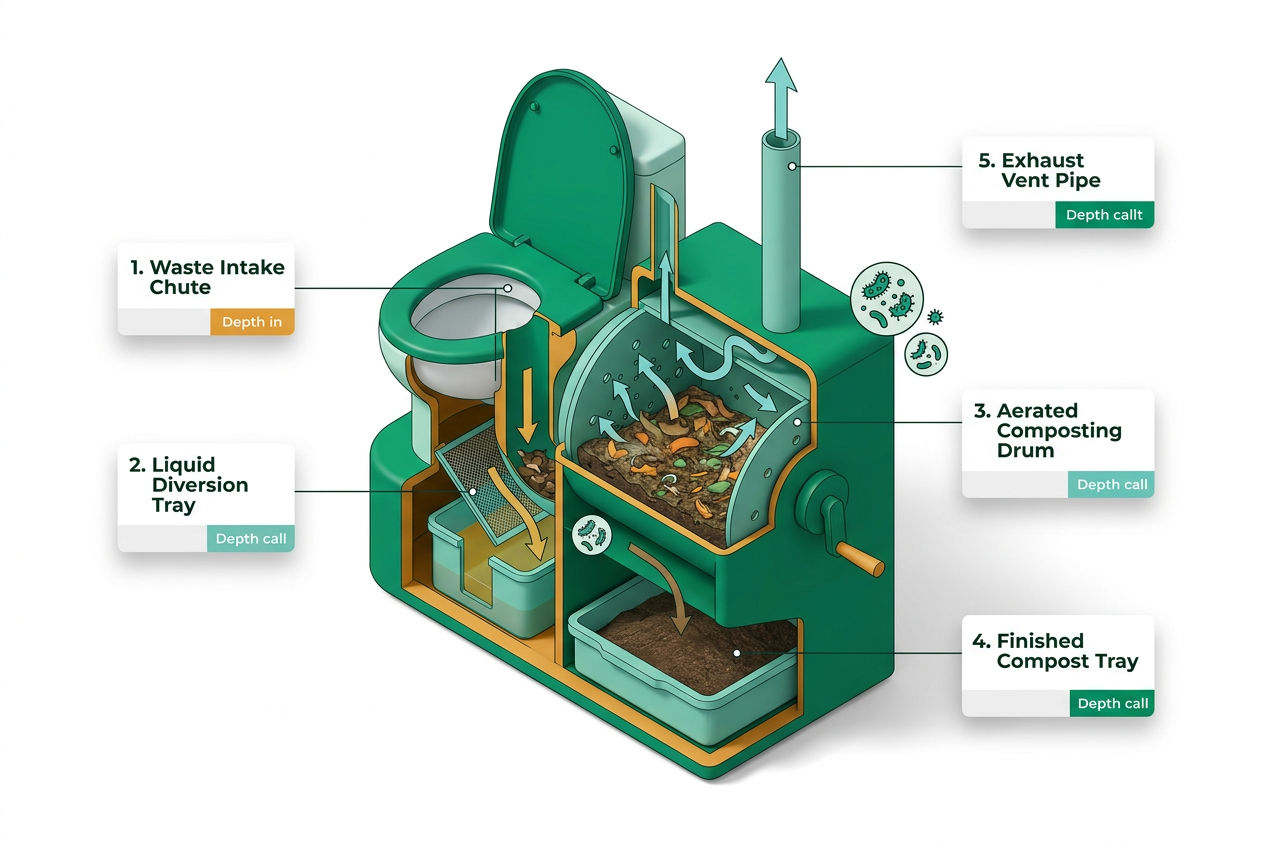
Here's what actually happens inside the unit:
- Waste enters the composting chamber. Most modern units use a urine-diverting design, routing liquid to a separate container or drain tube. Separating urine from solids is critical — excess moisture is the primary cause of odor.
- A bulking agent is added. You add a small scoop of peat moss, coconut coir, or wood shavings after each use. This adds carbon, absorbs excess moisture, and creates air pockets that feed the aerobic bacteria.
- A 12V or 110V fan runs continuously. The fan pulls air through the composting chamber and exhausts odors outside through a 2–3 inch vent pipe. This negative pressure is what keeps smells out of your bathroom.
- Microbes break down the solids. Bacteria, fungi, and other organisms reduce the waste mass by up to 90% over a composting cycle of 3–6 weeks. What remains is a dark, crumbly material similar in appearance to potting soil.
- Liquids drain or evaporate. Urine diverted to a separate bottle (typically 0.7–1 liter capacity per day of use) requires emptying every few days. Some models route liquid to a small evaporating chamber or to a gray water drain.
For a deeper look at the biology and mechanics, see our detailed breakdown of how a composting toilet works.
Do Composting Toilets Smell?
A well-maintained composting toilet with a functioning fan and proper bulking agent should produce no noticeable odor in the bathroom. The negative pressure created by the continuously running vent fan draws air away from the seat opening and exhausts it outside — exactly the same principle used in any exhaust fan system.
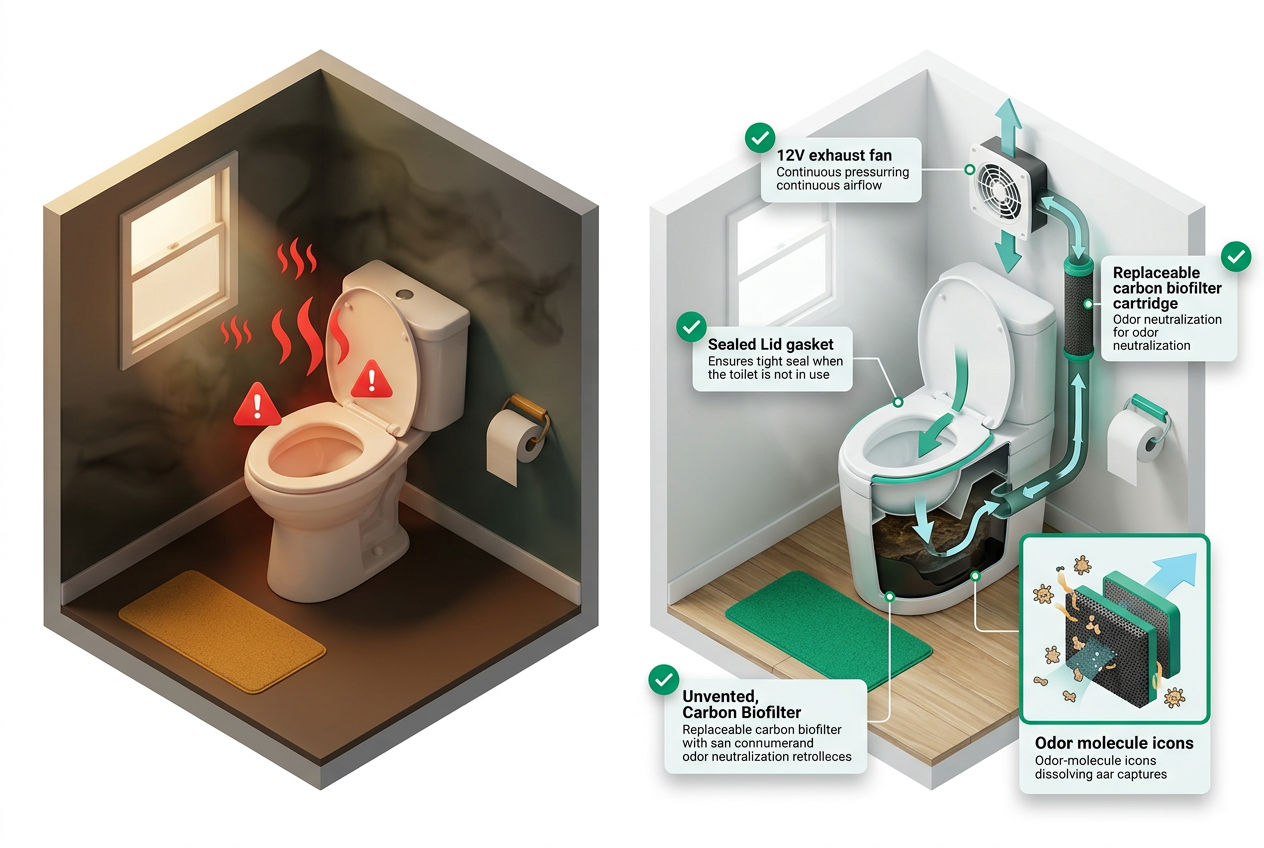
The honest answer, though, is that odor is the number-one complaint when things go wrong. Three situations cause smell problems:
- Fan failure. If the 12V DC or 110V fan motor dies, positive pressure can push odors back into the room. Check the fan first whenever you notice a smell.
- Moisture imbalance. Too little bulking agent or too much liquid entering the solids chamber creates anaerobic (oxygen-free) conditions. Anaerobic decomposition is what produces that sulfur-and-methane sewage odor. Add more peat moss or coconut coir and ensure the urine diverter is positioned correctly.
- Overfilled chamber. An overloaded composting pile can't aerate properly. Most manufacturers recommend emptying at the 2/3 capacity mark, not when completely full.
One practical note: in high-humidity climates — think coastal Georgia or coastal South Carolina in August — moisture management requires more attention. Adding extra bulking agent in humid months helps prevent the soggy, anaerobic conditions that produce odor.
Self-Contained vs. Central Composting Toilet Systems
Self-contained and central composting toilet systems solve different problems for different property types. One puts everything in a single unit under the seat; the other hides a large composting chamber in a basement while the toilet itself looks nearly conventional. Picking the wrong type for your situation is an expensive mistake.
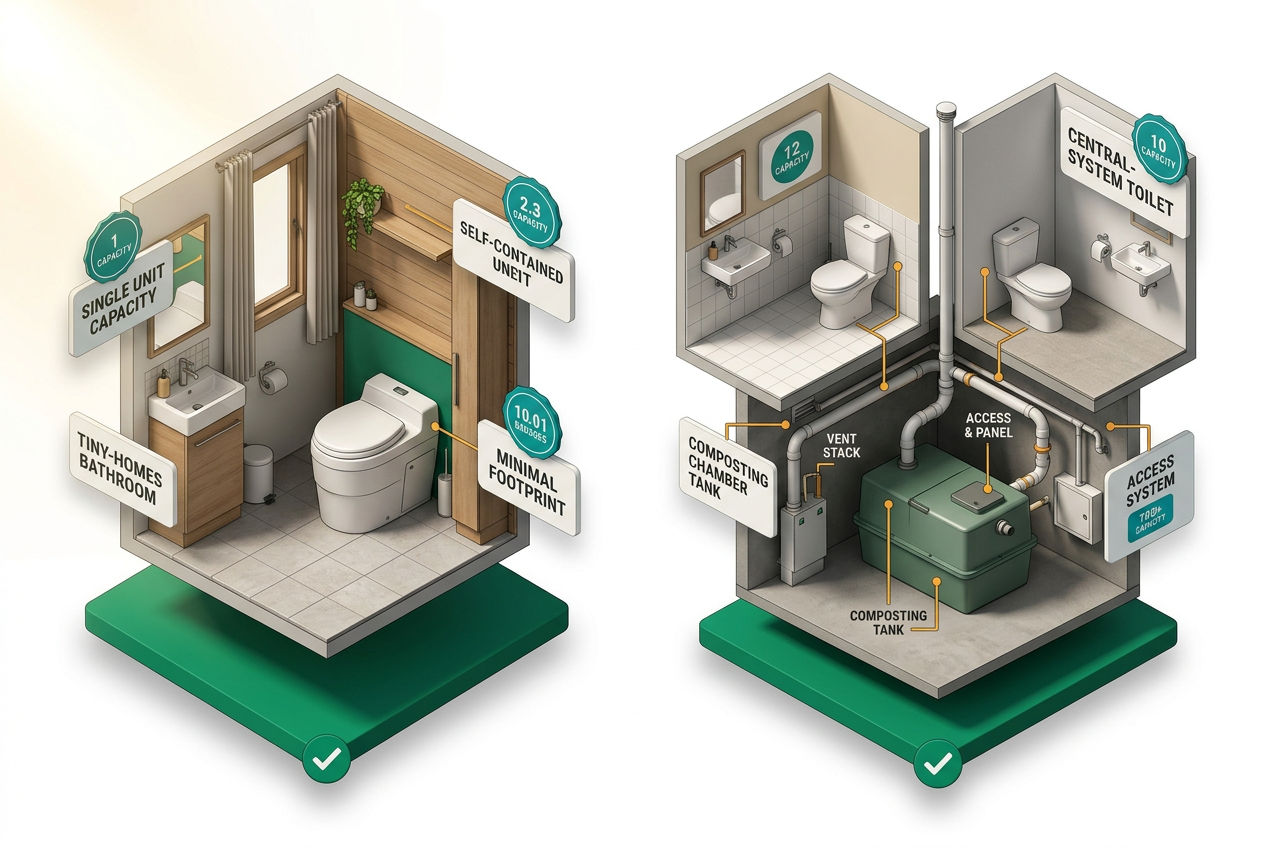
Self-Contained Units
The composting chamber sits directly beneath the toilet seat — everything is in one unit. These are the most popular option for cabins, RVs, tiny houses, and boats.
Pros: Easy installation (no structural modifications needed), portable, lower upfront cost, widely available.
Cons: Smaller capacity, more frequent emptying required, aesthetically bulkier than a standard toilet.
Best for: Single-person to two-person households, seasonal use, RVs, boats, cabins.
Top models in this category:
- Nature's Head: The most popular unit in North America for off-grid and marine use. Uses a spider handle agitator to mix the composting mass. Runs on 12V DC (solar-compatible). Weighs about 28 lbs. Capacity: approximately 80 uses before the solids need emptying. Price: around $960–$1,050.
- Sun-Mar Excel NE: A residential-grade self-contained unit with a rotating drum bio-drum and a three-chamber design. Runs on 110V AC. Handles 1–3 adults on a full-time basis. Price: around $1,400–$1,600.
- Separett Villa 9215: A Swedish-designed unit that strictly separates urine and solids into separate containers. Requires only a standard 110V outlet and a 2-inch vent pipe. No agitation required. Price: approximately $800–$1,000.
Central (Remote) Systems
The toilet fixture itself looks nearly identical to a standard toilet. A small-diameter pipe carries waste down to a large composting unit installed in a basement or crawl space. The composting chamber can handle multiple toilets simultaneously.
Pros: Conventional appearance, higher capacity, suitable for full-time family use, can serve multiple bathrooms.
Cons: Requires adequate vertical drop (typically 3–5 feet minimum from toilet to unit), higher installation cost, needs adequate basement or mechanical space.
Best for: Full-time primary residences, multi-bathroom cabins, commercial off-grid facilities.
Top models in this category:
- Sun-Mar Centrex 3000: Handles up to 6 adults full-time. Requires 110V AC. The composting drum is 52 gallons. Price: around $2,200–$2,800 for the unit alone, plus $300–$800 for installation.
- BioLet 65: A Swedish-manufactured central system with automatic mixing and a thermostatically controlled heating element that maintains the optimal composting temperature of 55°F–95°F. Price: around $1,800–$2,400.
| Feature | Self-Contained | Central System |
|---|---|---|
| Unit cost | $500–$2,000 | $1,500–$5,000+ |
| Installation cost | $0–$500 | $500–$2,000 |
| Capacity (adults) | 1–3 | Up to 6+ |
| Emptying frequency | Every 3–6 weeks | Every 3–6 months |
| Space required | Bathroom only | Basement/crawl space |
| Best use case | Cabin, RV, tiny house | Full-time home |
Source: Manufacturer specifications (Nature's Head, Sun-Mar, BioLet, Separett); cost ranges reflect 2025 retail pricing.
Not sure which system fits your setup? Answer three quick questions below — property type, household size, and whether you have basement access — and the tool will match you to the right system category and top models.
How Much Does a Composting Toilet Cost?
Composting toilet costs break into three buckets: the unit itself, installation, and ongoing maintenance.

Unit cost:
- Budget self-contained units (BioLet 20): $500–$800
- Mid-range self-contained units (Nature's Head, Separett): $900–$1,200
- Premium self-contained units (Sun-Mar Excel): $1,400–$1,800
- Central systems: $1,500–$5,000+
Installation cost:
- Self-contained unit with DIY vent installation: $0–$200 (materials only)
- Professional installation of a self-contained unit: $200–$500
- Central system professional installation: $500–$2,000 depending on complexity, local labor rates, and access to the composting chamber location
Annual maintenance cost: Peat moss or coconut coir runs about $15–$30 per 3.8 cubic foot bag. Most full-time households use 4–8 bags per year. Add occasional vent pipe cleaning and a replacement fan motor every 5–10 years (about $30–$60). Total annual cost: roughly $50–$200/year.
Compare that to a conventional septic system installation: $3,000–$15,000+ depending on system type and soil conditions. Our septic installation cost guide breaks down those numbers by system type and region. For properties where a conventional system would require an engineered solution — mound systems, sand filters — the cost difference is even more dramatic.
Important caveat: A composting toilet handles solids only. You still need a way to manage greywater — sink, shower, and laundry water. A simple greywater system or small leach pit handles this, but it's an additional cost most buyers don't initially factor in. Our greywater system guide covers your options.
Are Composting Toilets Legal in Your State?
Legality is the most complex part of composting toilet ownership, and the answer genuinely varies by state, county, and sometimes municipality. Budget time to research your local rules before you purchase anything.

Here's the framework:
NSF/ANSI Standard 41 is the certification that matters. Issued by NSF International, this standard tests and certifies that a composting toilet system adequately treats waste and protects public health. If a unit carries NSF/ANSI 41 certification, it has cleared the baseline regulatory test most building departments rely on.
Roughly 30+ U.S. states have adopted NSF/ANSI Standard 41 as the basis for approving composting toilets. But "approved" doesn't always mean "approved as a standalone system." This distinction matters enormously.
Three common regulatory frameworks you'll encounter:
- Full standalone replacement permitted: Some states (Oregon, Washington, and parts of Colorado, for example) allow a properly installed, NSF/ANSI 41-certified composting toilet to fully replace a conventional septic system for primary residences — assuming greywater is also managed appropriately.
- Supplemental use only: Many states — including parts of the Northeast and Southeast — require a conventional septic system to remain in place and permit the composting toilet only as a supplemental fixture. You save water but not septic installation costs.
- Permit required, case-by-case approval: Some jurisdictions have no blanket rule. You submit a permit application and the local health department reviews it individually. This is common in rural counties that haven't updated their sanitation codes in decades.
The practical step: Before purchasing, call your county health department and ask two questions: (1) Does your county recognize NSF/ANSI Standard 41-certified composting toilets? (2) Can a certified unit serve as a standalone system, or must a septic system remain in place?
We maintain individual guides for every state including Colorado, Oregon, Texas, and Vermont.
How Often Do You Empty a Composting Toilet?
Emptying frequency depends on three variables: household size, unit capacity, and how well you manage moisture and bulking agent additions.
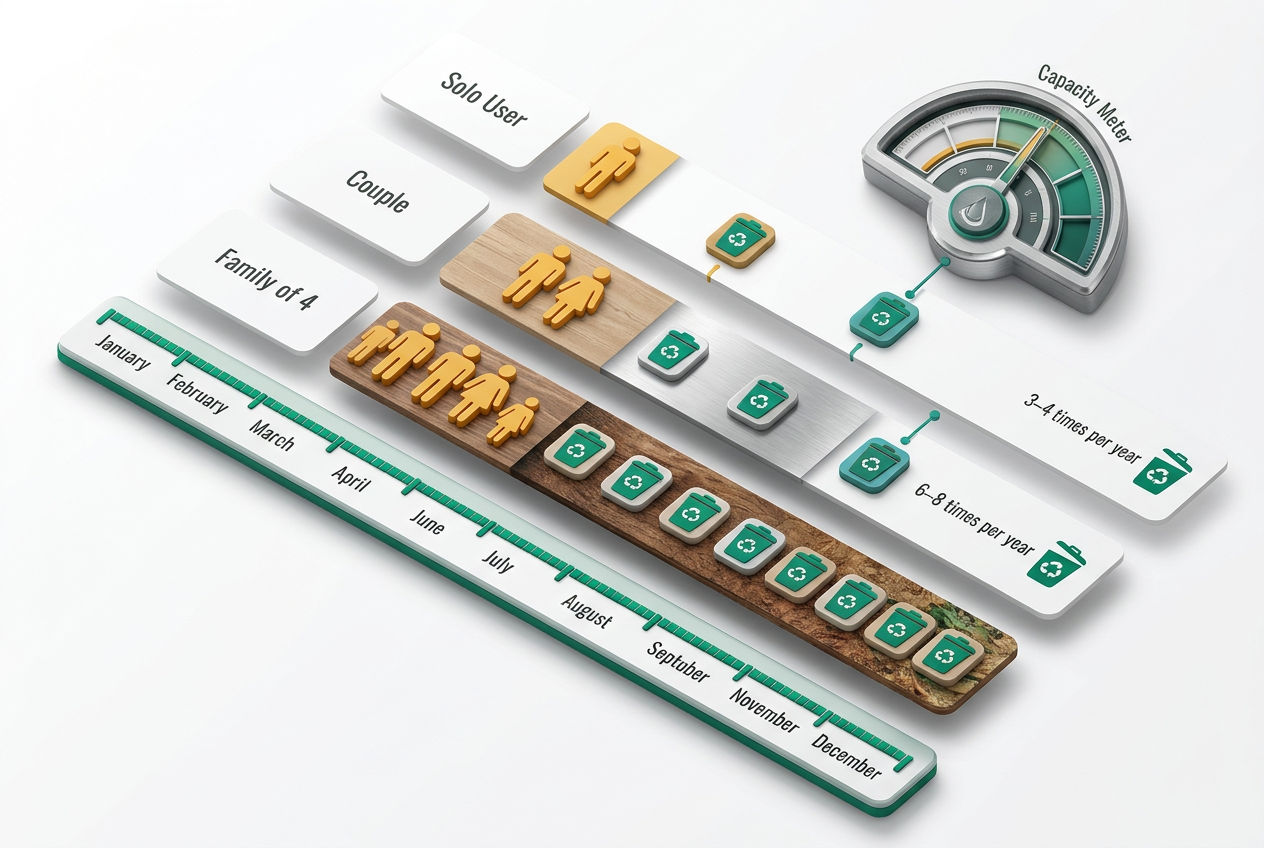
General guidelines by household size:
| Household Size | Self-Contained Unit | Central System |
|---|---|---|
| 1 person | Every 4–6 weeks | Every 4–6 months |
| 2 people | Every 3–4 weeks | Every 3–4 months |
| 3–4 people | Every 2–3 weeks | Every 2–3 months |
| 5–6 people | Not recommended | Every 6–8 weeks |
Based on manufacturer guidelines for Nature's Head, Sun-Mar, and Separett units.
What emptying actually involves:
With a self-contained unit like the Nature's Head, emptying takes about 10 minutes. You remove the solids container, carry it outside, and empty the contents into a hole at least 6 inches deep or into a yard waste bin (depending on local regulations). The material at this stage looks and smells like dark, earthy compost — not raw sewage. Most users report it's significantly less unpleasant than they expected.
The liquid container needs emptying more frequently — every 2–5 days for a single user, daily or more for two users. It can be diluted 8:1 with water and used as a nitrogen-rich fertilizer, or disposed of in a utility sink.
Signs you've waited too long:
- Odor starts appearing despite a working fan
- The solids drum is difficult to turn (Nature's Head) or the indicator shows full
- Liquid is backing up into the solids chamber
Empty at the 2/3 full mark — not when completely packed — to maintain adequate aeration in the composting mass.
Who Should Use a Composting Toilet?
Have you ever looked at a $12,000 septic installation quote for a remote property and thought there had to be another way? That's the situation where composting toilets make the most sense financially and practically.
Composting toilets work best for specific situations — and work poorly for others. Here's a direct breakdown:
Strong fits:
- Off-grid cabins and seasonal properties. A cabin used 3–4 months per year doesn't generate enough waste to justify a full septic system. A $1,000 composting toilet and a simple greywater pit handle the job for a fraction of the cost.
- RVs and liveaboard boats. The Nature's Head was originally designed for the marine market. Its 12V DC power requirement works with solar setups, and the compact footprint fits tight spaces. See our RV composting toilet guide for installation specifics.
- Rural properties with difficult perc tests. When a perc test reveals poor soil drainage, a conventional septic system may require an engineered mound system costing $15,000–$30,000. A composting toilet eliminates the largest waste-loading problem on the property.
- Tiny houses and accessory dwelling units. A 200-square-foot tiny house often can't accommodate a conventional septic system drain field. Composting toilets are the standard solution in the tiny house community.
- Environmentally motivated homeowners. If eliminating 25–30% of your household water use and removing sewage from the waste stream matters to you, a composting toilet delivers on both counts.
Poor fits:
- Full-time households of 4+ people in suburban areas where a conventional sewer connection exists. The capacity, permitting complexity, and maintenance requirements make a composting toilet more trouble than it's worth when a sewer hookup is available.
- Rental properties. Maintenance compliance is non-negotiable. Tenants who don't add bulking agent consistently will create odor problems. This is a management headache most landlords don't need.
- Anyone unwilling to engage with periodic hands-on maintenance. A composting toilet rewards attentive owners and punishes neglect faster than a conventional system does.
For a direct side-by-side of the two approaches, our composting toilet vs. septic system guide walks through cost, permitting, and long-term maintenance for both.
Do Composting Toilets Need Electricity?
DIY Septic Blueprint
Thinking about building it yourself?
The complete, plain-English plan to size, permit and install your own septic system — designed for homeowners, not contractors. Skip the $15,000–$25,000 quotes and do it right the first time.
Get the DIY Blueprint — $67 →Instant download · 8 modules + 3 bonus guides · 60-day money-back guaranteeMost residential composting toilets require some electricity, but the power draw is minimal. The continuously running vent fan is the primary electrical component.
Power requirements by type:
- 12V DC units (Nature's Head, Air Head): Draw approximately 0.5–1.0 amps continuously. A 10-watt solar panel with a small battery easily handles this. These units are fully solar-compatible and common on boats and in off-grid cabins.
- 110V AC units (Sun-Mar Excel, Separett Villa 9215, BioLet): Draw 15–25 watts for the fan. Some models also include a heating element (35–100 watts) that runs thermostatically to maintain composting temperature and accelerate evaporation. Monthly electricity cost: roughly $1–$4 at average U.S. rates.
- Non-electric units: A small number of composting toilets use passive ventilation — a solar-powered roof vent or a naturally drafting vent stack — and require no grid power at all. These work best in sunny climates with consistent airflow. Performance is less reliable in cloudy or low-wind conditions.
What happens during a power outage?
With a 12V DC unit running on battery backup, a power outage changes nothing. For 110V AC units, the fan stops during an outage. Short outages (under 24 hours) are generally fine. Extended outages in warm weather can allow anaerobic conditions to develop — add extra bulking agent when power is restored to reestablish aerobic balance.
For properties developing a complete off-grid water system alongside a composting toilet, planning the 12V power budget together makes sense.
Composting Toilets in Cold Climates: What You Need to Know
Cold weather slows microbial activity — the same reason your backyard compost pile goes dormant in January. A composting toilet in a Vermont cabin sees the same effect.
What actually happens below 55°F:
The aerobic bacteria that drive decomposition slow significantly below 55°F and become largely inactive below 40°F. This doesn't mean your composting toilet stops working entirely, but it does mean:
- The waste mass breaks down more slowly
- Liquids evaporate more slowly, increasing moisture management demands
- Odor risk increases slightly if moisture builds up
Practical solutions:
- Heated bathroom space: If the bathroom stays above 55°F year-round, cold climate is a non-issue. Cabins that are heated during use perform fine even in cold climates.
- Units with built-in heating elements: The Sun-Mar Excel NE and BioLet models include thermostatically controlled heating elements specifically to maintain composting temperature in cold conditions. This adds to electricity consumption but keeps the biology working.
- Seasonal use strategy: For a cabin that sits unheated all winter, the composting process simply pauses and resumes in spring. Empty the unit in late fall before closing the cabin, and start fresh in spring. The freeze-thaw cycle itself doesn't damage the unit.
Vent pipe considerations:
In very cold climates, a vent pipe running through an exterior wall can allow cold air to draft back into the unit when the fan is off. Insulating the vent pipe where it passes through unheated spaces and using a motorized damper that closes when the fan stops are standard solutions in Mountain West and upper Midwest installations.
Composting Toilet Maintenance Checklist
Maintenance is straightforward when you build it into a routine. The problems — odor, moisture buildup, slow decomposition — almost always trace back to skipped steps rather than equipment failure.
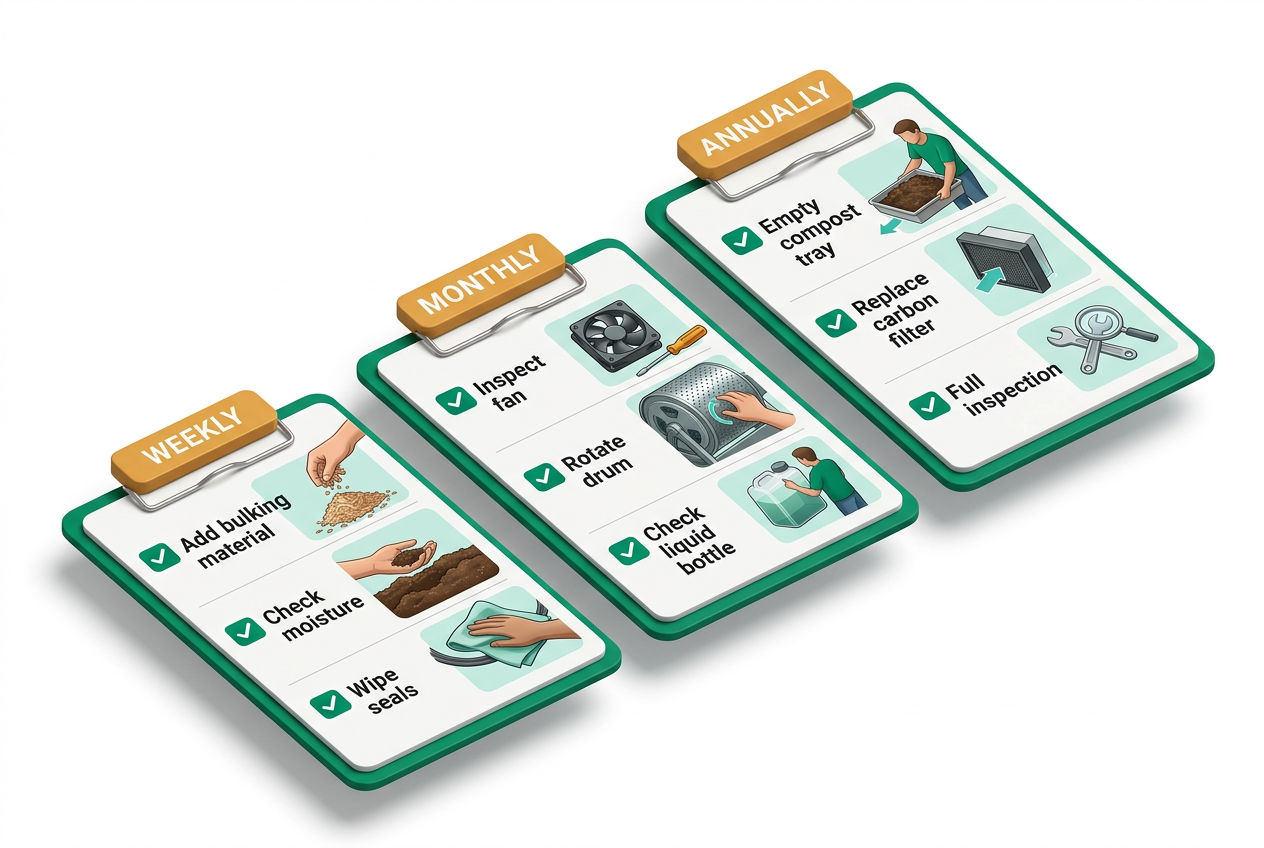
After every use:
- Add one scoop (roughly 1 cup) of peat moss, coconut coir, or wood shavings to the solids chamber
- Verify the urine diverter is positioned correctly (liquid should route to the liquid container, not the solids chamber)
Weekly:
- Check liquid container level — empty if more than 2/3 full
- Verify fan is running (hold a tissue near the seat opening — it should draw inward)
- Turn the agitator handle 3–4 times if your unit has one (Nature's Head spider handle, Sun-Mar drum rotation)
Monthly:
- Inspect vent pipe exterior termination for spider webs, bird nesting material, or debris blocking airflow
- Check moisture level of solids — material should be damp but not wet. Add bulking agent if it looks or smells wet
- Clean the urine bottle or liquid chamber with a dilute vinegar solution to prevent mineral scaling
Every 3–6 weeks (or at 2/3 capacity):
- Empty the solids composting chamber per manufacturer instructions
- Inspect the fan motor and wiring connections
- Add a fresh base layer of bulking agent before resuming use
Annually:
- Clean the vent pipe with a flexible brush
- Inspect all seals and gaskets for wear
- Test fan amperage draw if you have a multimeter — a motor drawing more than rated amperage is near failure
For our complete overview of alternative septic systems including mound systems, aerobic treatment units, and constructed wetlands, see the linked guide.
What's the Difference Between a Composting Toilet and an Incinerating Toilet?
Composting toilets and incinerating toilets both eliminate the need for water and a septic connection, but the underlying technology is completely different.
A composting toilet uses biological decomposition — microbes, moisture, and oxygen — to break down waste over weeks. The end product is a small amount of compost-like material you remove periodically.
An incinerating toilet uses electric heating elements or propane to burn waste to ash at temperatures of 1,000°F+. Each use cycle takes 1–4 hours. The end product is a small amount of sterile ash you empty weekly or monthly.
Key differences:
| Feature | Composting Toilet | Incinerating Toilet |
|---|---|---|
| Power consumption | 5–25 watts (fan only) | 1,500–2,000 watts per cycle |
| Operating cost | Low | High (electricity or propane) |
| End product | Compost material | Sterile ash |
| Odor during use | Minimal with fan | Noticeable burning smell during cycle |
| Per-use time | Normal | Must wait for cycle to complete |
| Best for | Regular daily use | Low-frequency use, cold climates |
For remote seasonal cabins used infrequently, an incinerating toilet's ability to function in freezing temperatures without ongoing biological maintenance makes it competitive. For daily residential use, the operating cost of incineration is prohibitive. See our full incinerating toilet guide for model comparisons and cost analysis.
Composting Toilet vs. Septic System: Which Is Right for You?
Your land usually answers this question before you do.
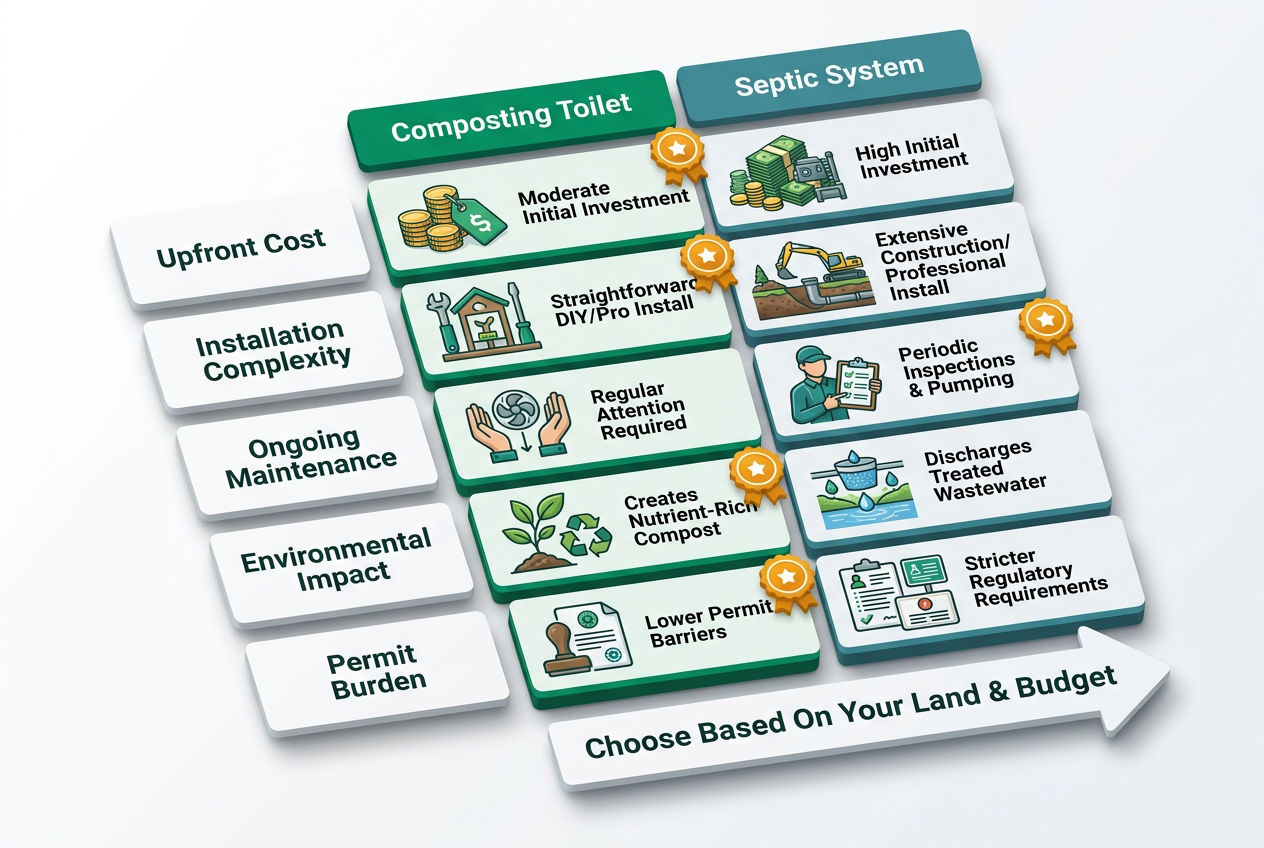
If you're putting a cabin on 10 acres in rural Montana — no municipal sewer, rocky terrain, and a perc test showing marginal drainage — the math on a conventional septic system gets ugly fast. A standard gravity-fed system needs suitable soil within a few feet of the surface. Rocky or clay-heavy ground means an engineered alternative: a mound system or sand filter that can run $15,000–$30,000 before the first flush. Against that number, a $1,000–$1,500 composting toilet setup looks very different.
Conversely, if you're adding a bathroom to a suburban home that already has a functioning septic system and sewer access, replacing a conventional toilet with a composting unit adds complexity without meaningful benefit.
The real decision comes down to four questions:
- Is a sewer connection available? If yes, a composting toilet is rarely worth the trade-offs for a primary residence.
- What would a conventional septic system cost on your specific property? Get a quote. On difficult terrain, the number may surprise you. Our 1,000-gallon septic tank guide covers standard system sizing as a baseline.
- How many people will use the facility full-time? Composting toilets handle 1–3 full-time users well. Above that, a central system or conventional septic becomes more practical.
- What are your county's permitting requirements? In some jurisdictions, you'll pay for both a composting toilet and a septic system. That changes the math entirely.
For properties where the septic alternative is an engineered system, a composting toilet combined with a greywater system is often the most cost-effective and least disruptive path. See our complete off-grid toilet options guide for a full comparison of all alternatives, including pit latrines, vault systems, and aerobic treatment units.
If you're ready to move forward, use our directory to find a licensed septic and alternative sanitation professional near you.
Related Guides in This Series
- How Does a Composting Toilet Work?
- Best Composting Toilet
- How to Build an Outhouse: Plans, Code & Step-by-Step
- Greywater Systems: How They Work & How to Build One
- The Best Off Grid Toilet (Top Picks)
- Off Grid Water System: The Complete Guide
- 'Off Grid Cabin: The Complete Guide'
- 'Composting Toilet vs. Septic System: Which Is Right for You?'
Frequently Asked Questions
Can a composting toilet be used as a full replacement for a septic system?
Yes — in roughly 30+ U.S. states that recognize NSF/ANSI Standard 41 certification, a properly installed composting toilet can legally replace a conventional septic system for managing solid waste. The critical qualifier is that a composting toilet handles solid waste only. You still need a greywater management solution for sink, shower, and laundry water — typically a small leach pit, greywater garden system, or permitted greywater drain. Some states require a septic system to remain in place even when a composting toilet is installed, classifying the composting unit as supplemental only. Before purchasing, call your county health department and confirm whether standalone replacement is permitted in your jurisdiction. State rules vary significantly, and county-level enforcement can differ from state-level guidance.
How long does a composting toilet last before needing to be replaced?
A quality composting toilet should last 10–25 years with proper maintenance. The composting chamber itself — typically high-density polyethylene — is essentially indestructible under normal use. The components that wear out are the fan motor (typically 5–10 years, replacement cost $30–$60), seals and gaskets (inspect annually, replace as needed), and agitator mechanisms on units like the Nature's Head. Sun-Mar and Nature's Head both stock replacement parts for units 15+ years old. The practical lifespan is more often determined by owner maintenance habits than by the hardware itself. Units that receive consistent bulking agent, regular emptying, and annual vent pipe cleaning routinely outlast the manufacturer's stated service life. Budget $20–$50 per year in replacement parts to keep a unit running at full performance indefinitely.
What happens to a composting toilet in freezing temperatures?
Aerobic bacteria slow significantly below 55°F and go largely dormant below 40°F, which means the composting process pauses in cold, unheated spaces. For cabins used only in warmer months, this is manageable — empty the unit before closing the cabin in fall and start fresh in spring. The hardware itself tolerates freezing well. For year-round cold-climate use, choose a unit with a built-in heating element (Sun-Mar Excel NE or BioLet models maintain composting temperatures thermostatically) or ensure the bathroom stays heated above 55°F. Vent pipes running through unheated exterior walls should be insulated to prevent cold backdrafting into the unit. Mountain West and upper Midwest users commonly add a motorized damper on the vent pipe that closes when the fan cycles off, preventing cold air from reversing into the bathroom.
How do waterless composting toilets handle urine differently from solid waste?
Most modern composting toilets use a urine-diverting design that routes liquid and solid waste into completely separate chambers from the moment of deposit. This separation is the most important design feature in modern units — urine is roughly 95% water, and when it mixes with solid waste, it rapidly creates the wet, oxygen-deprived conditions that produce sewage odor. The liquid container (typically 0.7–1 liter capacity per person per day) requires emptying every 2–5 days. Diluted 8:1 with water, urine makes an effective nitrogen fertilizer. Units like the Separett Villa 9215 take diversion further by routing liquid to a separate drain entirely, eliminating the need to empty a liquid bottle. The solid waste chamber, kept dry by this separation, composts cleanly with minimal odor when bulking agent is added consistently after each use.
Are there composting toilets that work without any electricity at all?
Yes, though they represent a small segment of the market. Passive-ventilation composting toilets use a solar-powered roof vent or a naturally drafting vent stack to create airflow without a continuously running electric fan. The Sun-Mar NE (non-electric) series is the most widely available option in North America. Performance depends heavily on consistent airflow and solar exposure — these units work well in sunny, open climates with reliable breeze but underperform in shaded, humid, or low-wind conditions. Standard active-fan units running on 12V DC (Nature's Head, Air Head) are a more reliable middle ground for off-grid use: the fan draws only 0.5–1.0 amps, well within the range of a small solar panel and battery system. For most off-grid setups, the 12V active-fan units outperform passive options in reliability and odor control.
Sources & Methodology
- NSF International — NSF/ANSI Standard 41: Non-Liquid Saturated Treatment Systems. Certification database and state adoption status reviewed June 2025. nsf.org
- U.S. Environmental Protection Agency (EPA) — "Onsite Wastewater Treatment Systems Manual" (EPA/625/R-00/008). Used for greywater management and alternative treatment system context.
- National Onsite Wastewater Recycling Association (NOWRA) — State-by-state regulatory framework data for alternative sanitation systems.
- Manufacturer specifications — Nature's Head, Sun-Mar Corporation, Separett AB, BioLet USA, and Air Head. Product specifications, capacity ratings, power consumption, and pricing current as of June 2025.
- HomeAdvisor / Angi cost data — Septic system installation cost ranges by region. Accessed June 2025 for cost comparison benchmarks in the composting toilet vs. septic analysis.
Free download
Not ready for the Blueprint? Start free.
Grab the free DIY Septic Planning Kit — the permit-first checklist, perc-test cheat sheet, and sizing tables that keep your build from getting red-tagged.
Was this article helpful?
Frequently Asked Questions
Recommended Resources
📖 Related Articles
- How Does a Composting Toilet Work?
- Greywater Systems: How They Work & How to Build One
- The Best Composting Toilet for RV (Top Picks)
- Perc Test (Percolation Test): What It Is & How It Works
- Composting Toilet vs. Septic System: Which Is Right for You?
- Off Grid Water System: The Complete Guide
- Alternative Septic Systems: Options When a Standard System Won't Work
- Incinerating Toilets: How They Work, Cost & Best Models
- 1000-Gallon Septic Tank: Dimensions, Cost & Concrete vs Plastic
- The Best Off Grid Toilet (Top Picks)
📍 Find Local Pros
Find Septic Professionals Near You
Compare licensed, verified septic companies by area — top county markets and cities below, or browse all 50 states.
County markets
Popular cities
