
Quick Answer
The best composting toilet handles daily waste from 1–4 people, eliminates odor, and produces a dry, soil-safe end product in 3–6 weeks — all without a sewer connection or septic tank. These are self-contained, waterless systems that work through aerobic decomposition, the same biological process that turns kitchen scraps into garden compost.
Key Takeaways
- Top-rated models like Nature's Head and Sun-Mar Excel run $960–$1,600 and can last 10–20 years with basic maintenance.
- A composting toilet can save a household roughly 2,920 gallons of water per person annually compared to a conventional flush toilet.
- Only about 20 U.S. states have clear approval frameworks for composting toilets — permits vary widely by county.
- NSF/ANSI Standard 41 certification is the key quality benchmark to look for before buying.
- Composting toilets work best as part of a broader off-grid waste strategy — they handle solids, but you'll still need a plan for greywater.
Which Composting Toilet Is Best in 2026?
The market has settled around a few brands with long track records in off-grid, marine, and residential applications. Here are the five best composting toilets based on capacity, build quality, odor control, and long-term value. Each has been evaluated against NSF/ANSI Standard 41 certification status, real-world user reports, and verified manufacturer specifications.
1. Nature's Head Self-Contained Composting Toilet — Best Overall
Price: $960–$1,050 | Capacity: 1–4 people | Electrical: 12V DC fan (1–2 watts)
The Nature's Head is the most-recommended composting toilet in the off-grid and marine communities. It's a urine-diverting toilet, meaning liquids and solids separate immediately at the bowl. That separation is what kills odor before it starts. Without urine saturating the compost pile, aerobic bacteria work efficiently, and the fan (drawing just 1–2 watts) handles the rest.
The unit measures 20.5" W x 18.75" D x 20.5" H, making it a realistic fit for tight bathroom footprints in tiny homes and boat heads. The spider handle agitator mixes compost without opening the unit. For two full-time users, you'll empty the solid compartment every 4–6 weeks. The liquid bottle needs emptying every 2–3 days — that's the one thing first-time owners underestimate. Empty it into a greywater drain, a leach pit, or dilute it heavily for garden use.
Honest limitation: The Nature's Head is excellent for 1–3 people. Push it to 4 full-timers and the emptying schedule becomes genuinely frequent. If you have 4+ permanent residents, look at the Sun-Mar Excel below.
2. Sun-Mar Excel Non-Electric — Best for Full-Time Residential Use
Price: $1,400–$1,600 | Capacity: Up to 3 adults full-time, 6 weekend users | Electrical: None required
The Sun-Mar Excel is a central composting toilet — meaning it's larger and designed to sit in a bathroom like a conventional toilet rather than a marine-style unit. It's 22" W x 28" D x 29.5" H, so you need real floor space.
What sets Sun-Mar apart is the Bio-drum — a rotating drum that advances composting material in stages. Fresh material enters at the back, partially composted material moves to the middle, and finishing compost drops into the bottom drawer. You pull the drawer, add to a garden compost pile, and done. The cycle takes 3–5 weeks in a heated space.
The non-electric model uses passive ventilation through a 4-inch vent stack. For cold climates — think Vermont or Montana — Sun-Mar recommends the electric model (Sun-Mar Excel Electric, ~$1,550) to maintain the 55–65°F internal temperature aerobic bacteria need.
This is the unit closest to a septic system alternative for full-time homeowners.
3. Separett Villa 9215 — Best for Simplicity and Low Maintenance
Price: $950–$1,100 | Capacity: Family of 4–5 | Electrical: 12V or 110V fan
The Separett Villa 9215 is a urine-diverting dry toilet, but it doesn't try to compost waste inside the unit. Instead, it collects solids in biodegradable bags that you remove and compost externally (or dispose of according to local regulations). Liquids drain separately through a hose.
That design makes it straightforward to manage. There's no drum to rotate, no pile to manage, no bulking material to add. The 5W fan draws enough air through the unit that odor is genuinely a non-issue — comparable to a sealed trash can rather than an outhouse.
Dimensions are 17.7" W x 22" D x 19.3" H. The bag inserts hold about 4 weeks of solid waste for a family of four. Separett markets this as a cabin and vacation home toilet, and that use case is exactly where it excels.
4. OGO Composting Toilet — Best for RVs and Van Life
Price: $775–$850 | Capacity: 1–3 people | Electrical: USB-powered fan (0.5W)
The OGO is compact (14.5" W x 16.5" D x 17" H), runs on a USB-powered fan, and includes an electric agitator — a genuine upgrade over the manual spider handle on the Nature's Head. For RV owners who've already read through our RV composting toilet guide, the OGO is the newer, more refined option.
The liquid bottle holds about 2 liters. For two people, expect to empty it every 1–2 days — realistic for van dwellers who are already managing water and waste daily. The solid compartment lasts 3–4 weeks for two users. At under $850, it's the best value in the market for mobile applications.
5. BioLet 10a — Best for Seasonal Cabins
Price: $1,200–$1,400 | Capacity: 2–3 adults | Electrical: 120V AC (thermostatically controlled heater)
The BioLet 10a uses electric heating to speed evaporation of liquid waste and accelerate composting. That makes it particularly well-suited to seasonal cabins in cold climates where passive composting slows significantly below 50°F. The heater cycles automatically, maintaining internal temperature regardless of ambient conditions.
For a cabin in northern Michigan or the Colorado Rockies that sits empty for weeks at a time, this self-regulation is worth the higher power draw.
One caveat: the BioLet requires a 120V outlet. That's fine for a cabin with grid power or a robust solar setup, but it rules it out for true off-grid minimalists.
Best Composting Toilet Comparison Table
| Model | Price | Capacity | Power | Best For |
|---|---|---|---|---|
| Nature's Head | $960–$1,050 | 1–4 people | 12V, 1–2W | Off-grid, marine, tiny home |
| Sun-Mar Excel | $1,400–$1,600 | 3–6 people | None / 120V | Full-time residential |
| Separett Villa 9215 | $950–$1,100 | 4–5 people | 12V or 110V, 5W | Cabin, vacation home |
| OGO | $775–$850 | 1–3 people | USB, 0.5W | RV, van, mobile |
| BioLet 10a | $1,200–$1,400 | 2–3 adults | 120V AC | Cold-climate seasonal cabin |
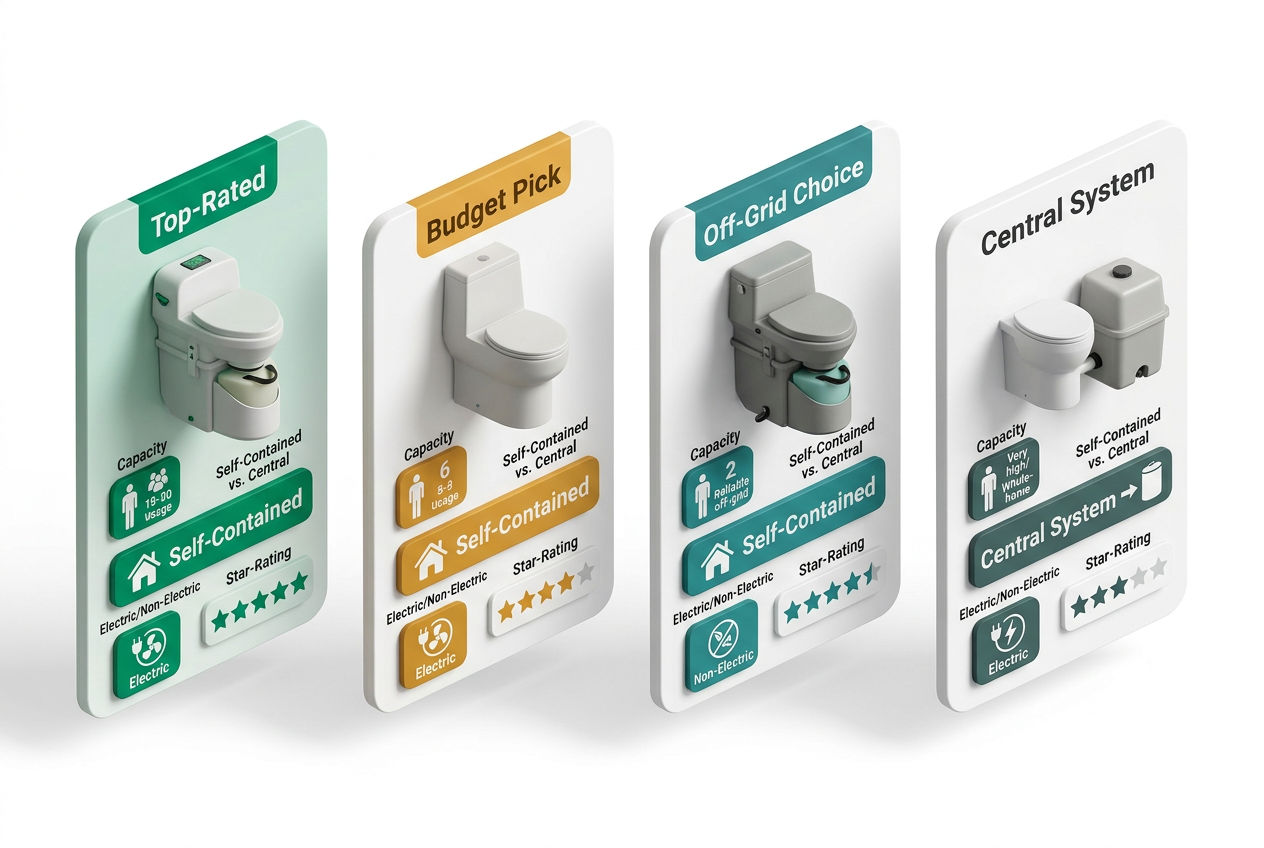
Prices reflect 2026 retail. Capacity ratings based on manufacturer specs and verified user reports.
Do Composting Toilets Actually Work — and Are They Sanitary?
Yes — when installed and maintained correctly, NSF/ANSI Standard 41-certified composting toilets produce end material that meets EPA guidelines for pathogen reduction. The EPA's guidelines on composting toilet systems recognize properly managed units as a legitimate alternative to conventional sewage disposal in many contexts (see EPA Septic Systems).
The process is aerobic decomposition — the same biological process that turns kitchen scraps into garden compost. Thermophilic bacteria raise internal temperatures to 130–160°F in active systems, killing pathogens. The finished product is called humus, not raw waste. It looks and smells like dark garden soil.
What makes a composting toilet smell is almost always one of three things: too much liquid (poor urine diversion), not enough airflow (undersized fan or blocked vent), or anaerobic conditions (pile too wet or packed). Fix those, and odor is genuinely minimal.
How Much Does a Composting Toilet Cost?
Budget self-contained units start around $500–$800. Mid-range models — including the Nature's Head and Separett Villa — run $950–$1,100. Premium residential systems like the Sun-Mar Excel or BioLet 10a range from $1,200 to $1,600.

Compare that to a conventional septic system. A new septic system installation costs $3,000–$15,000 depending on soil conditions, system type, and local labor rates. On rocky terrain in Montana or Idaho, where blasting may be required for drain field trenches, costs can exceed $20,000. A $1,200 composting toilet suddenly looks very reasonable.
Installation costs for a composting toilet are minimal compared to septic — most homeowners handle it themselves in a few hours. You'll need to vent through an exterior wall or roof (a 2–4 inch PVC vent stack), which may require a small carpentry job. Budget $100–$300 for materials if you DIY, or $200–$600 if you hire a handyman.
Can a Composting Toilet Replace a Septic System?
In some cases, yes — but with important caveats. A composting toilet handles solid human waste. It does not handle greywater (sink, shower, and laundry discharge), which makes up roughly 65–70% of household wastewater. Even if you install a composting toilet, you'll still need a greywater system or a downsized septic system for the remaining wastewater.
For a full breakdown of when a composting toilet can legally and practically substitute for a septic tank, see our composting toilet vs. septic system guide.
The scenario where a composting toilet fully replaces a septic system is a remote cabin or seasonal structure with a separate outdoor sink — minimal greywater, no shower, no laundry. In that case, a composting toilet plus a simple greywater drain to a leach pit is a complete waste system for under $2,000.
Do You Need a Permit for a Composting Toilet?
Rules vary significantly by state and county. About 20 U.S. states have explicit approval frameworks for composting toilets. The rest treat them under general plumbing or sanitation codes that may require variance applications or local health department sign-off.
States with established approval pathways include: Oregon, Vermont, Washington, Colorado, and several New England states. Oregon's DEQ has one of the clearest permitting processes — you apply through the county sanitarian and document the system meets NSF/ANSI Standard 41. Vermont Act 250 land use rules require written approval for any alternative waste system on developments above a certain threshold.
States with more complicated pathways include: Florida, Texas, and most Southeast states where high water tables, dense population, and strong plumbing code enforcement create additional hurdles. Florida's high water table makes alternative waste systems particularly scrutinized — the Florida Department of Health reviews composting toilet applications on a case-by-case basis through county health units. For current Florida-specific guidance, check the Florida Department of Health onsite sewage program.
The National Onsite Wastewater Recycling Association (NOWRA) maintains state-by-state policy resources at nowra.org that are updated annually — worth checking before purchasing.
The practical rule: Always confirm with your county health department before purchasing. Ask specifically whether NSF/ANSI Standard 41 certification is sufficient for approval, or whether you need additional documentation. Some counties require an engineered site plan even for a simple composting toilet installation.
What Are the Disadvantages of a Composting Toilet?
DIY Septic Blueprint
Thinking about building it yourself?
The complete, plain-English plan to size, permit and install your own septic system — designed for homeowners, not contractors. Skip the $15,000–$25,000 quotes and do it right the first time.
Get the DIY Blueprint — $67 →Instant download · 8 modules + 3 bonus guides · 60-day money-back guaranteeHonest answer: they require more active management than a flush toilet. Here's what that actually means day-to-day.
Liquid management is the real job. In urine-diverting models, the liquid bottle needs emptying every 1–3 days depending on usage. That's not difficult, but it's daily or near-daily attention. Skip it and the bottle overflows — the most common user complaint across every brand.
Temperature affects performance. Aerobic composting slows significantly below 55°F. In an unheated cabin bathroom in January in Minnesota, composting essentially stops. The waste accumulates safely, but it won't process until temperatures rise. Electric models with thermostatic heaters (BioLet, Sun-Mar Electric) solve this, at the cost of power consumption.
Bulking material is ongoing. Most composting toilets require adding a carbon-rich bulking material — peat moss, coconut coir, or wood shavings — after each solid deposit. A bag of peat moss ($15–$20) lasts roughly one month for two people. It's a minor cost but a behavioral change from flush toilet habits. According to Sun-Mar's technical documentation, the correct bulking agent ratio is roughly 1 cup per solid use for optimal composting performance.
Capacity limits are real. No self-contained composting toilet is designed for more than 4–6 full-time users. Larger households need a central composting system or a conventional septic approach. See our cabin septic system options guide if your household exceeds typical composting toilet capacity.
Regulations may not cooperate. In some jurisdictions, a composting toilet cannot legally replace a required septic system regardless of how well it functions. You may still need to install a septic system to obtain a certificate of occupancy, then use the composting toilet alongside it.
For the full picture on ongoing ownership, see our septic tank maintenance guide — the maintenance philosophy translates directly to composting toilet care.
How Do Composting Toilets Work?
A composting toilet works by separating urine from solid waste, then decomposing the solids aerobically using naturally occurring bacteria, fungi, and sometimes added microorganisms. The fan creates negative pressure inside the unit, drawing air through the composting chamber and out a vent stack — that airflow is what prevents odor from escaping into the bathroom.
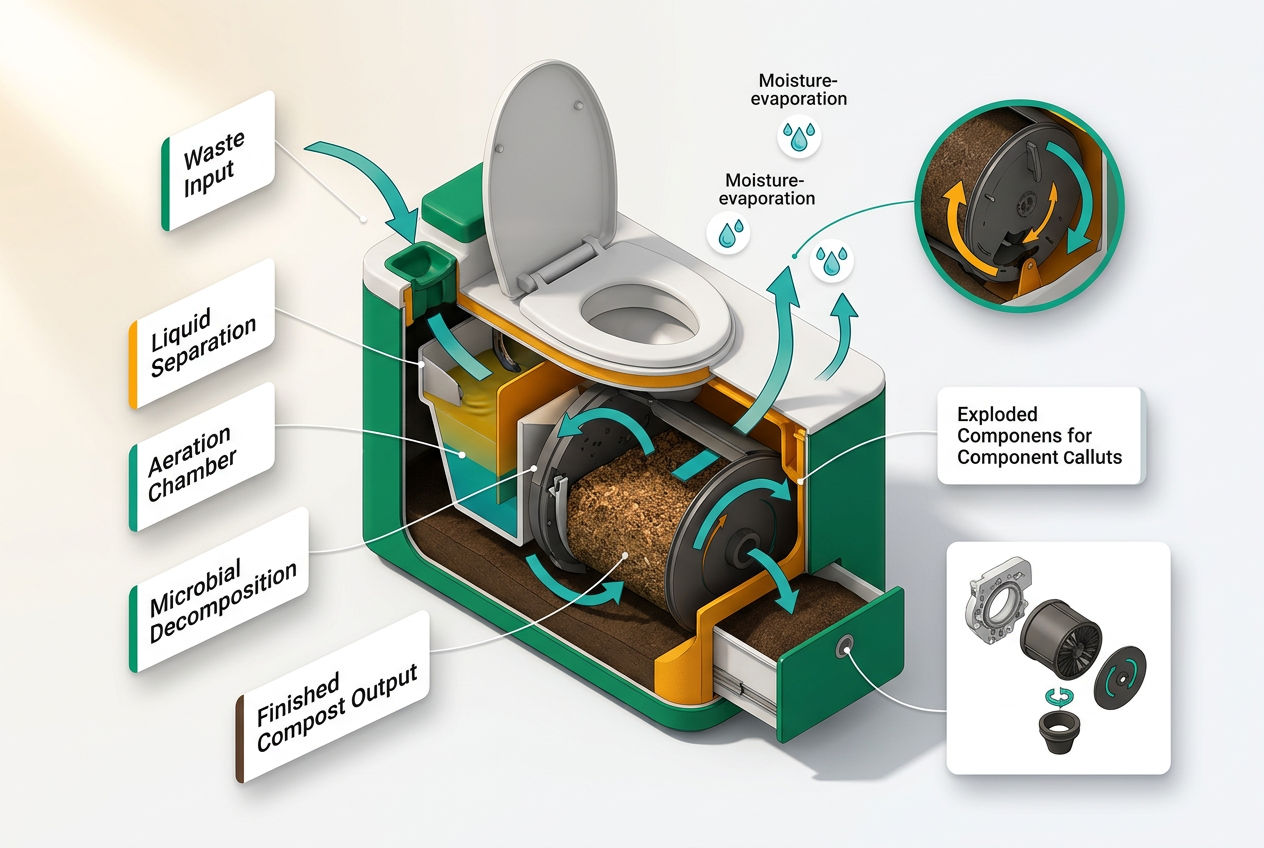
For a detailed breakdown of the biology and airflow mechanics, see our guide on how composting toilets work.
Composting Toilet Buyer's Guide: What Should You Look For?
1. Urine diversion vs. combined systems. Urine-diverting models (Nature's Head, Separett, OGO) are consistently better at odor control. Combined systems that handle both waste streams together are simpler but require more precise management to avoid saturation.

2. Capacity match. Manufacturer capacity ratings are optimistic. For full-time use, size down one category from the listed maximum. A toilet rated for 4 people is reliably comfortable for 2–3 full-timers.
3. Power requirements. Most composting toilets need at minimum a small fan — 0.5 to 5 watts. That's negligible for a solar setup. Electric heater models (120V AC) are a different matter — plan for that load in your electrical budget.
4. NSF/ANSI Standard 41 certification. This is the baseline quality and safety standard for composting toilets sold in the U.S. It confirms pathogen reduction, structural integrity, and liquid containment. Don't buy a composting toilet without it if you're using it as a primary toilet.
5. Vendor support and parts availability. Nature's Head and Sun-Mar have been in the U.S. market for decades. Parts, replacement fans, and technical support are accessible. Newer brands with limited U.S. distribution may leave you waiting weeks for a replacement component.
Frequently Asked Questions
What is the best composting toilet for a tiny house?
The best composting toilet for a tiny house is the Nature's Head Self-Contained Composting Toilet for most builds, and the OGO for loft-heavy or extremely compact layouts where every inch matters. The Nature's Head fits within a standard tiny house bathroom footprint at 20.5" W x 18.75" D x 20.5" H and runs on a 12V fan drawing just 1–2 watts — compatible with even a modest solar setup. For one or two full-time occupants, the solid compartment needs emptying every 4–6 weeks; the liquid bottle every 2–3 days. The OGO is slightly smaller at 14.5" W x 16.5" D x 17" H and adds an electric agitator, which many tiny house owners find more convenient than the manual spider handle. Both are NSF/ANSI Standard 41-certified. For a tiny house with 3–4 residents, step up to the Separett Villa 9215, which handles a family of four without the frequent emptying schedule of smaller units.
What are the best composting toilet reviews saying about odor control?
Consistent user reviews across verified purchasers on manufacturer sites, Amazon, and off-grid forums rate urine-diverting models — Nature's Head, Separett Villa, and OGO — as genuinely odor-free when properly maintained. The mechanism is straightforward: separating urine from solid waste eliminates the chemical reaction that produces the ammonia smell associated with outhouses and pit toilets. The fan then creates negative pressure inside the unit, pulling air through the composting chamber and out the vent stack rather than into the bathroom. Where users report odor problems, the cause is almost always one of three things: a full or overfilled liquid bottle, a blocked or undersized vent stack, or failure to add bulking material after solid deposits. Combined-system models without urine diversion receive lower odor-control ratings in long-term reviews, particularly in warm climates where decomposition is faster. For consistent odor-free performance, urine-diverting models are the clear choice based on composting toilet reviews across independent off-grid communities.
Is a composting toilet for off-grid use legal everywhere?
No — legality varies significantly by state, county, and municipality, and you must verify before purchase. Roughly 20 U.S. states have explicit regulatory frameworks that permit composting toilets as a primary or supplemental waste system. Oregon and Vermont have the most straightforward approval pathways, typically requiring NSF/ANSI Standard 41 certification and county sanitarian sign-off. States like Florida, Texas, and much of the Southeast apply stricter scrutiny due to high water tables, dense development, or strong plumbing code enforcement — approval is possible but requires case-by-case review by the county health department. Some jurisdictions will permit a composting toilet as a secondary system alongside a septic tank but won't allow it to replace a required septic installation entirely. The National Onsite Wastewater Recycling Association maintains updated state-by-state policy resources at nowra.org. The practical step: call your county health department, ask whether NSF/ANSI Standard 41 certification satisfies local requirements, and get the answer in writing before buying.
Can I use a composting toilet in a cabin year-round?
Yes, but cold temperatures require the right model. Aerobic composting slows significantly below 55°F — below 40°F it effectively stops. For a year-round cabin in a cold climate (Vermont, Montana, northern Michigan), a passive non-electric model like the Sun-Mar Excel Non-Electric works through winter only if the bathroom stays above 55°F consistently. If the cabin drops below that threshold during cold snaps or when unoccupied, you need an electric model. The Sun-Mar Excel Electric (~$1,550) and the BioLet 10a ($1,200–$1,400) both use thermostatically controlled heaters to maintain internal composting temperatures regardless of ambient conditions. The BioLet is particularly well-suited to seasonal cabins that sit empty for weeks — it self-regulates without requiring someone to monitor temperatures manually. Budget a 120V outlet for either electric model. For a cabin with solar power, calculate the heater load (typically 100–200 watts when cycling) against your battery bank capacity before committing.
What is the best composting toilet for an RV or camper?
The OGO Composting Toilet is the best composting toilet for RV and camper use in 2026. At 14.5" W x 16.5" D x 17" H and powered by a USB fan drawing just 0.5 watts, it fits standard RV bathroom spaces and adds negligible load to a 12V house battery system. The electric agitator is a practical advantage over manual-turn models — one button press mixes the composting material without opening the unit. For two people, the solid compartment lasts 3–4 weeks; the 2-liter liquid bottle needs emptying every 1–2 days. At $775–$850, it undercuts the Nature's Head by $150–$200 while adding the agitator convenience. The Nature's Head remains a solid alternative for Class A motorhomes with more bathroom space, and its longer track record means replacement parts are slightly more accessible. Our full RV composting toilet guide covers both models alongside installation instructions specific to RV plumbing and venting constraints.
How does a composting toilet compare to a pit toilet or outhouse?
A composting toilet is fundamentally different from a pit toilet in three ways: containment, odor, and output. A pit toilet deposits waste into an open earthen pit where it decomposes anaerobically — a process that produces methane, hydrogen sulfide, and the characteristic outhouse smell, while creating groundwater contamination risk. A composting toilet is a sealed unit that processes waste aerobically, producing no methane, minimal odor, and a finished humus product that meets EPA pathogen reduction guidelines. The practical differences are significant: a properly maintained composting toilet in a bathroom is odor-neutral; a pit toilet is not. Composting toilets require active management (emptying liquid containers, adding bulking material) but produce a sanitary end product. Pit toilets require periodic pumping or relocation and create ongoing leachate risk. For property owners evaluating permanent waste solutions, a composting toilet is the contained, regulatable option — though both require checking local codes, since many jurisdictions that prohibit pit toilets have separate approval frameworks for composting systems.
Sources & Methodology
- EPA Septic Systems Overview — epa.gov/septic — guidance on alternative waste systems including composting toilets
- NSF/ANSI Standard 41 — nsf.org — certification requirements for non-liquid saturating waste management systems
- NOWRA State Policy Resources — nowra.org — state-by-state composting toilet regulatory frameworks
- Sun-Mar Technical Documentation — sun-mar.com — Bio-drum capacity ratings, temperature requirements, and bulking agent ratios
- Nature's Head Product Specifications — natureshead.net — verified dimensions, electrical specs, and capacity data
Prices verified against manufacturer websites and major retailers in January 2026. Capacity ratings reflect manufacturer specifications cross-referenced with long-term user reports from RV forums, off-grid homesteading communities, and verified purchaser reviews.
Need help sizing a waste system for your property? Find a licensed septic professional who can evaluate composting toilet feasibility alongside greywater and site requirements.
Free download
Not ready for the Blueprint? Start free.
Grab the free DIY Septic Planning Kit — the permit-first checklist, perc-test cheat sheet, and sizing tables that keep your build from getting red-tagged.
Was this article helpful?
Frequently Asked Questions
Recommended Resources
📖 Related Articles
- The Best Off Grid Toilet (Top Picks)
- Composting Toilet vs. Septic System: Which Is Right for You?
- The Best Composting Toilet for RV (Top Picks)
- Greywater Systems: How They Work & How to Build One
- Off Grid Cabin: The Complete Guide
- The Complete Septic Tank Maintenance Guide
- How Does a Composting Toilet Work?
🔧 Services
Find Septic Professionals Near You
Compare licensed, verified septic companies by area — top county markets and cities below, or browse all 50 states.
County markets
Popular cities
