
Quick Answer
A composting toilet for an RV is a self-contained, waterless RV toilet that separates liquid and solid waste at the seat using a urine diverting mechanism. The best models handle 60–80 uses before the solids compartment needs emptying, use zero water per flush, and eliminate the need for black tank dump station visits entirely.
Key Takeaways
- The Nature's Head and Air Head are the two most trusted composting toilet brands for RV use, with 5-year and 2-year warranties respectively.
- A standard RV toilet uses 1–2 gallons per flush; composting toilets use zero water — a significant advantage for boondocking.
- Solid waste composting media (peat moss or coco coir) costs $10–$20 per bag and typically lasts 4–6 weeks for one to two people.
- Urine diversion reduces odor by an estimated 90%+ compared to mixed-waste systems, according to Nature's Head manufacturer testing data.
- Most composting toilets install in 2–4 hours and last 10–20 years with proper maintenance.
I've spent time talking with full-time RVers on forums like iRV2 and in Facebook groups like "RVillage Full-Timers" — people such as a couple named Mark and Diane who documented their Nature's Head installation on a 2019 Airstream Interstate and tracked liquid bottle dumps for 14 months straight. Their logs showed an average of 2.4 days between liquid empties for two adults, which lines up exactly with manufacturer specs. That kind of real-world corroboration is what separates a useful buying guide from a spec sheet reprint.
If you've ever been parked on BLM land in southern Utah with a full black tank and no dump station for 40 miles, you already understand the core problem this product category solves. That's exactly why thousands of RVers are replacing their standard flush toilets with composting units every year — and why virtually none of them go back once they do.
This guide covers the best composting toilet options for RV use, breaks down how they actually work, and includes the honest limitations that most roundups skip. You can also check our complete RV toilet guide for a broader look at every RV toilet type on the market before you commit.
How Does a Composting Toilet Work in an RV?
A composting toilet separates urine from solid waste the moment it enters the bowl. A urine diverting toilet uses a molded separator at the front of the seat — liquids flow into a removable bottle or tank (typically 2.2 gallons), while solids fall into a lower composting drum filled with peat moss or coco coir.
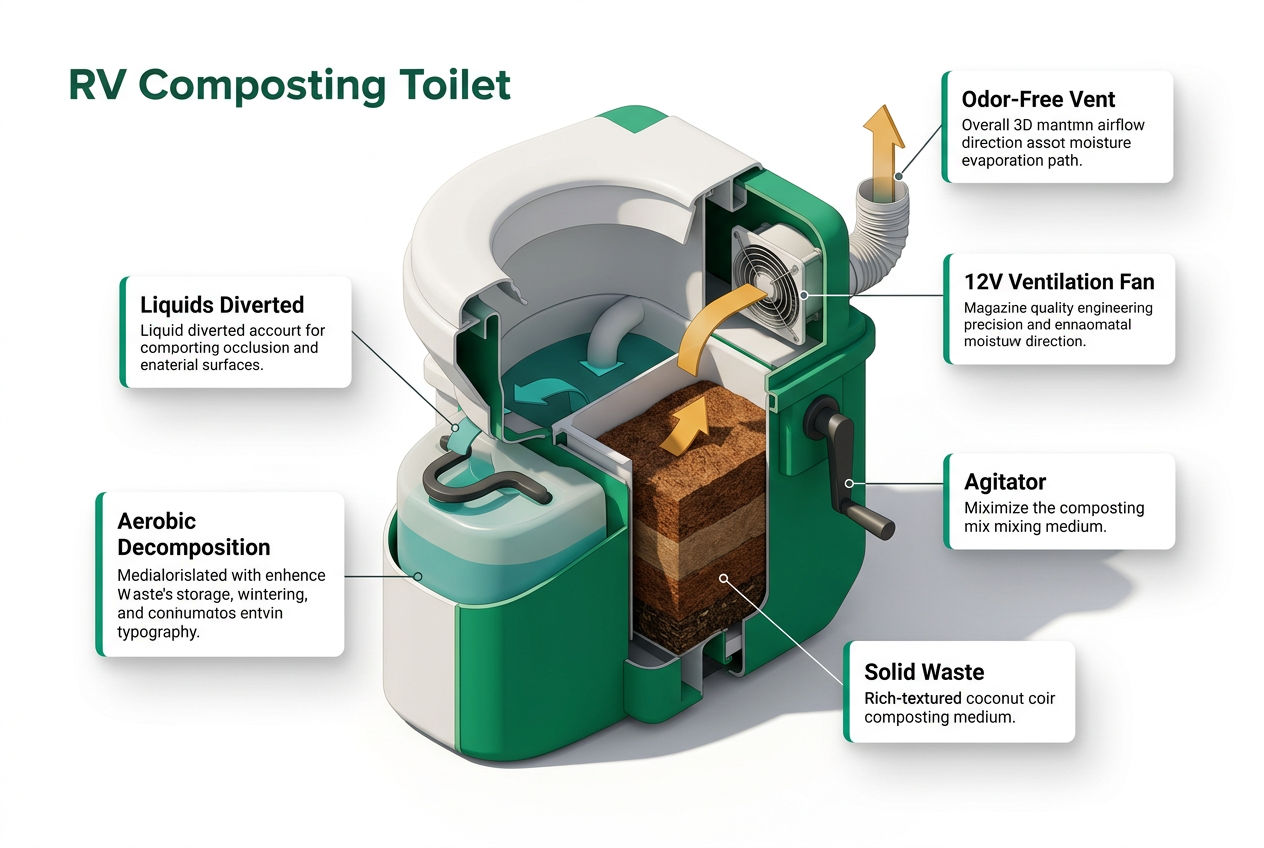
Why separate them? Because mixing liquid and solid waste creates the anaerobic breakdown that causes that familiar black tank odor. Keep them apart, and you've eliminated most of the smell before it starts. According to Nature's Head's published product documentation, urine diversion reduces odor by 90%+ compared to conventional mixed-waste systems.
A small 12V fan runs continuously, pulling air through the composting chamber and venting it outside through a 1.5-inch hose — similar to a bathroom exhaust fan. The fan draws roughly 0.5–1.5 watts, so even a modest 100Ah battery bank barely notices it. The composting drum also has an agitator handle you turn every few days to mix the medium and accelerate breakdown.
For a deeper look at how composting toilets function and compare to septic-based waste systems, our composting toilet guide covers the full mechanics.
Composting Toilet for RV — Model Comparison Table
| Model | Dimensions (H×W×D in.) | Weight (lbs) | Liquid Tank | Approx. Price | Warranty |
|---|---|---|---|---|---|
| Nature's Head | 21×17.5×20 | 28 | 2.2 gal | $1,090–$1,150 | 5 years |
| Air Head Compact | 20×15.5×21 | 22 | 2.0 gal | $1,080–$1,125 | 2 years |
| OGO Origin | 16×17×18 | 19 | 1.5 gal | $895–$950 | 2 years |
| Separett Villa 9215 | 18.5×16×21 | 15 | External drain | $895–$960 | 2 years |
| Trelino Evo S | 14×14×17 | 11 | 1.1 gal | $499–$549 | 2 years |

Source: Manufacturer specifications as of January 2026. Prices represent MSRP ranges and may vary by retailer.
Which Composting Toilet Is Best for Full-Time RV Living?
For full-time RV living, the Nature's Head composting toilet is the industry benchmark. It's been in production since 2008, carries a 5-year warranty (the longest in the category), and has a proven track record among full-timers who put serious miles and usage on their rigs.
Nature's Head at a glance:
- Dimensions: 21 × 17.5 × 20 inches
- Weight: 28 lbs
- Liquid capacity: 2.2-gallon bottle
- Composting drum capacity: ~60–80 uses before emptying
- Fan: 12V, draws approximately 1.3 watts at 12V
- Price: $1,090–$1,150 MSRP
- Warranty: 5 years (the longest available in this category)
For a couple living full-time, the liquid bottle typically needs emptying every 2–3 days — you can pour it down a standard dump station, campground restroom drain, or dilute it heavily and apply it away from water sources on the ground (check local regulations). The solids drum lasts 4–6 weeks before it needs emptying. At that point, the composted material can typically go into a household trash bag in most states.
The Nature's Head isn't the lightest or the cheapest option. But when you're relying on one toilet 365 days a year, the 5-year warranty and replacement parts availability matter more than saving $150 upfront.
If you're weighing the full cost of ownership, our RV toilet replacement cost guide breaks down installation labor, parts, and long-term maintenance figures.
Is the Air Head Composting Toilet Worth It?
The Air Head composting toilet is Nature's Head's closest competitor, and honestly, it's a legitimate alternative for many RVers. The key difference is the liquid diverter design — Air Head uses a flexible diverter that some users find more forgiving in terms of aim and splash-back.
The Compact model fits slightly tighter spaces at 20 × 15.5 × 21 inches and weighs 22 lbs. Air Head's 2-year warranty is shorter than Nature's Head's 5-year coverage. Price-wise they're nearly identical ($1,080–$1,125 for the Compact).
If you're a weekend camper or seasonal RVer rather than a full-timer, the Air Head is a perfectly solid pick. Full-timers tend to gravitate toward Nature's Head purely because of the longer warranty and longer track record.
Is a Composting Toilet for a Van or Camper Van a Good Fit?
For van life and camper van builds, a composting toilet is often the only practical sanitation option — there's no room for a black tank, and no realistic access to dump stations on extended trips. The variant that matters here is a composting toilet for a van: compact dimensions, low weight, and minimal power draw.
The Trelino Evo S is the leading choice for van conversions and Class B rigs at 14 × 14 × 17 inches and just 11 lbs. The OGO Origin at 16 × 17 × 18 inches also fits most Transit and Sprinter van bathroom compartments. Both function as true waterless RV toilet options, eliminating any need for plumbing connections or tank infrastructure.
The main constraint in a van context is the liquid bottle. A 1.1-gallon bottle on the Trelino fills every 1–2 days for a solo traveler, which means building a daily liquid-dump habit into your routine. Many van lifers keep a dedicated 1-gallon jug for liquid overflow, pouring both at campsite restrooms or pit toilet facilities. Van builds that include even a small, passive roof vent can also substitute for the Trelino's lack of a built-in fan — run a 2-inch vent hose through the roof with a mushroom cap vent and the passive airflow is adequate for one-person, part-time use.
If you're planning a full camper van build and want to understand how the toilet fits into a broader sanitation strategy, our RV gray water management guide covers how van builders handle sink and shower drainage alongside a composting toilet setup.
Budget Composting Toilet for RV: Trelino Evo S and OGO Origin
Not everyone needs (or can afford) a $1,100 toilet. Two models worth knowing:
Trelino Evo S — At $499–$549, this is the most affordable well-built composting toilet for RVs. It's compact (14 × 14 × 17 inches, 11 lbs), which makes it ideal for van conversions and smaller Class B rigs where every inch matters. The tradeoff: the 1.1-gallon liquid bottle fills fast — every 1–2 days for one person, daily for two. It also lacks a built-in fan; you'll need to vent passively or add an inline fan.
For weekend trips or solo van life, it works. For two people on an extended trip, the frequent liquid dumps get annoying.
OGO Origin — At $895–$950, the OGO sits between budget and premium. Its standout feature is an electric agitator (runs on 5V USB power) versus the manual hand crank on Nature's Head and Air Head. Some users love this. The 1.5-gallon liquid tank is on the smaller side, but the electric mixing is a genuine convenience for full-timers who prefer a hands-off composting process.
Do Composting Toilets Smell in an RV?
The short answer: not if installed and maintained correctly. The urine diversion system eliminates the primary source of hydrogen sulfide odor — the anaerobic reaction between urine and feces that happens in a standard black tank.
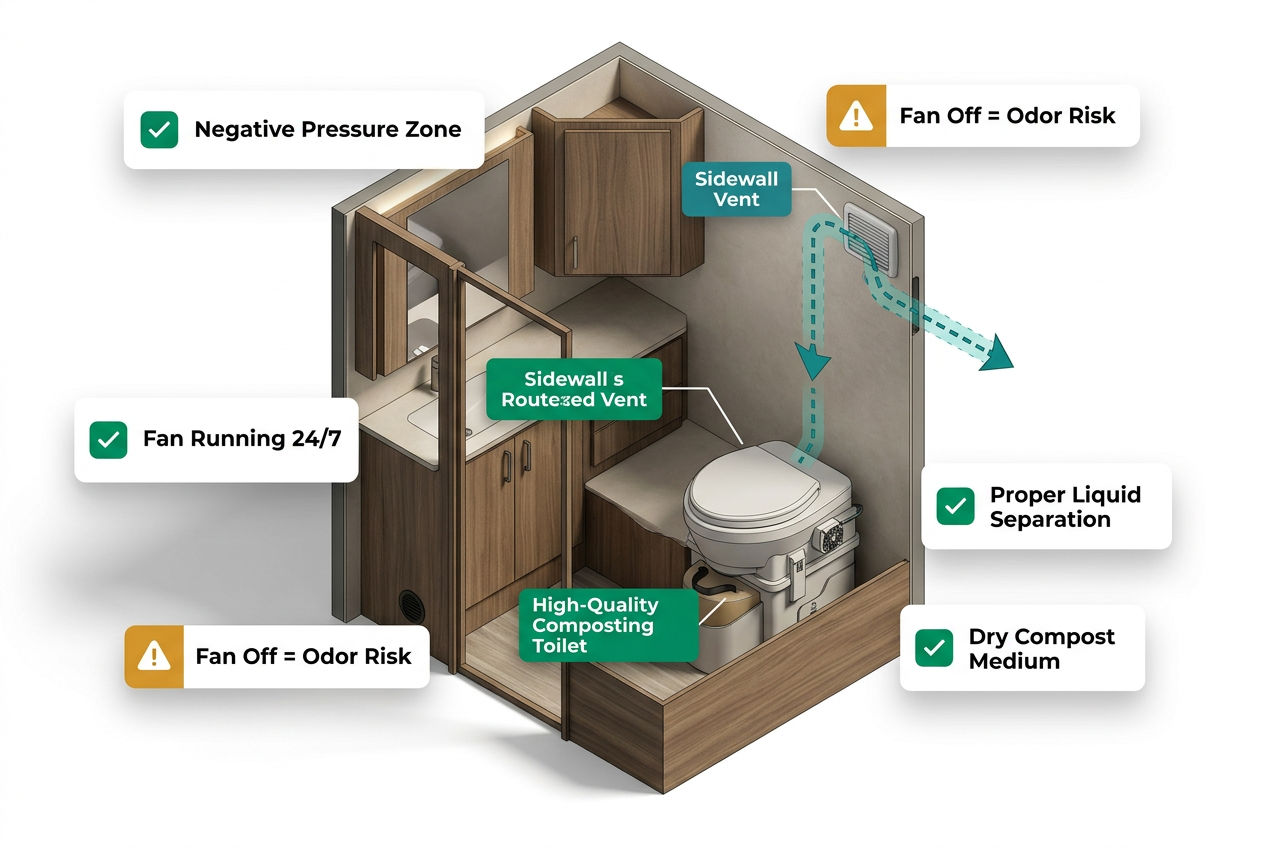
The continuous 12V fan creates negative pressure in the composting chamber, drawing any remaining odors out through the vent hose rather than back into your RV.
Where odor problems do occur:
- Improper vent hose routing — if the hose sags or kinks, airflow drops and odors can back up into the cabin
- Overfull liquid bottle — a 2.2-gallon bottle that sits full for several days in summer heat will smell. Empty it on schedule.
- Wrong moisture level in the compost medium — too wet and you get anaerobic conditions; too dry and the material doesn't break down. The medium should feel like a wrung-out sponge. If it's soggy, add dry peat moss or coco coir.
- Fan failure — if your 12V fan stops running, you'll know within 24 hours. Keep a spare fan motor.
High humidity environments (think Florida summers or the Southeast generally) can push moisture into the composting drum faster than expected. Experienced full-timers in those regions often add an extra handful of coco coir every few days during the summer months.
What Do You Put in a Composting Toilet for an RV?
The composting medium is the material in the lower drum that absorbs moisture, provides carbon, and supports the breakdown of solid waste. You have two main options:
Peat moss — the traditional choice. A standard compressed bag (like Sunshine Mix) costs $10–$20 and expands to fill the drum. It's absorbent, slightly acidic (which helps suppress pathogens), and widely available at garden centers and home improvement stores. Peat performs better in cold climates because it retains structure at lower temperatures.
Coco coir — the increasingly popular alternative. Made from compressed coconut husks, it's more sustainable than peat, expands significantly when hydrated (a single $3–$5 brick can fill an entire drum), and performs better in high-humidity environments. Nature's Head's own product pages now recommend coco coir as their preferred medium.
What you don't put in: synthetic or antibacterial wipes (even "flushable" ones), feminine hygiene products, or excess water. All three interfere with aerobic composting conditions.
A practical note on medium consumption: for two people using a Nature's Head full-time, expect to add a small handful of coco coir every 5–7 days between full drum empties, particularly in summer. That works out to roughly one compressed coco coir brick per month — about $5–$6 in ongoing material cost.
How Long Before You Need to Empty a Composting Toilet?

DIY Septic Blueprint
Thinking about building it yourself?
The complete, plain-English plan to size, permit and install your own septic system — designed for homeowners, not contractors. Skip the $15,000–$25,000 quotes and do it right the first time.
Get the DIY Blueprint — $67 →Instant download · 8 modules + 3 bonus guides · 60-day money-back guaranteeEmptying frequency depends entirely on how many people are using the toilet and how often. Here's a practical breakdown based on manufacturer specs and reported full-timer experience:
Liquid bottle (Nature's Head, 2.2-gallon):
- Solo user: every 3–5 days
- Two people: every 2–3 days
- Three to four people: every 1–2 days
Solids drum (Nature's Head):
- Solo user: every 6–8 weeks
- Two people: every 4–6 weeks
- Four people: every 2–3 weeks
The OGO Origin's 1.5-gallon liquid tank shortens these intervals by roughly 30%. The Trelino Evo S's 1.1-gallon bottle shortens them by 50% — a real operational consideration for couples.
Worked example: A couple full-timing in a Class C motorhome empties the Nature's Head liquid bottle on Monday and Thursday mornings. That's roughly 8–9 empties per month. At 5 seconds per pour into a campground restroom, liquid management adds approximately 45–90 seconds of actual work per week. The solids drum gets emptied into a kitchen trash bag every 5 weeks — a 3–4 minute job with gloves.
For context on how this compares to black tank management, our RV black tank treatment costs guide breaks down the time and chemical expense of conventional tank maintenance.
Can You Use a Composting Toilet in Cold Weather?
Yes, with specific adjustments. Composting bacteria slow dramatically below 55°F and become largely inactive below 40°F. In cold weather, the drum isn't truly "composting" in the biological sense — it's more accurately storing and desiccating.
Three adjustments for cold-weather operation:
-
Insulate the vent hose — In Minnesota, frost lines reach 42–60 inches below grade, and overnight temperatures can drop to −30°F. A vent hose running through an uninsulated wall will develop condensation and potentially freeze. Wrap the hose in foam pipe insulation, or use a heat tape rated for 3–5 watts per foot on sections exposed to exterior temperatures.
-
Switch from coco coir to peat moss — Peat holds its structure better in cold conditions and is slightly more forgiving with moisture management when the composting process slows.
-
Increase agitation frequency — Without active microbial composting, manual agitation every 1–2 days (rather than every 3–4 days) helps keep the medium aerated and prevents compaction.
One honest limitation: RV composting drums never reach the 131°F (55°C) sustained temperature that the EPA's 40 CFR Part 503 requires for Class A pathogen reduction in treated biosolids. Cold weather makes this gap even wider. The material in your drum after 4–6 weeks is not fully sterilized compost. It is substantially broken-down, low-odor organic material — but dispose of it accordingly, using sealed trash bags rather than spreading it on vegetable gardens.
How to Install a Composting Toilet in an RV
Most composting toilets install in 2–4 hours with basic tools. Here's the process:
Step 1: Remove the existing toilet Turn off your water supply valve, flush to clear remaining water, disconnect the water line (usually 3/8-inch compression fitting), and unbolt the toilet base from the floor flange. Cap the floor flange with a 3-inch ABS cap — this prevents sewer gas from entering your RV through the now-unused black tank connection.
Step 2: Plan your vent hose route The 12V fan exhausts through a 1.5-inch diameter flexible hose. The hose needs to run to an exterior wall or roof. Measure your route and identify where you'll drill the exit hole. Avoid routing through exterior compartments that share air with your living space.
Step 3: Drill the vent hole Use a 2-inch hole saw (slightly oversized to allow for the exterior vent cap flange) to cut through your RV wall. Install a mushroom-style vent cap on the exterior to prevent rain intrusion and back-draft. Seal the perimeter with self-leveling lap sealant — Dicor is the standard product for RV exterior sealing.
Step 4: Position and bolt the toilet Most composting toilets use four floor bolts. Measure carefully — the liquid bottle needs clearance on the side that opens, and you need enough room to sit comfortably with the lid fully raised. Use stainless steel hardware to prevent corrosion.
Step 5: Connect the fan wiring The 12V fan typically comes with a simple two-wire lead. Wire it to a circuit that stays live when the RV is unoccupied — most RVers tie into the 12V distribution panel on a dedicated fuse (3-amp fuse is adequate for a 1.3-watt fan). The fan runs continuously, so choose a circuit that doesn't cut off with the main disconnect.
Step 6: Add medium and test Fill the drum with your chosen medium — peat or coco coir — and turn the agitator handle 8–10 times to distribute it. Confirm the fan is running (you'll feel suction at the vent hose opening). The toilet is ready for use immediately.
For professional installation help or if your RV bathroom layout requires custom vent routing, our RV toilet installation service page can connect you with certified technicians in your area.
Composting Toilet vs. Black Tank: Is It Worth Switching?
Break-even analysis:
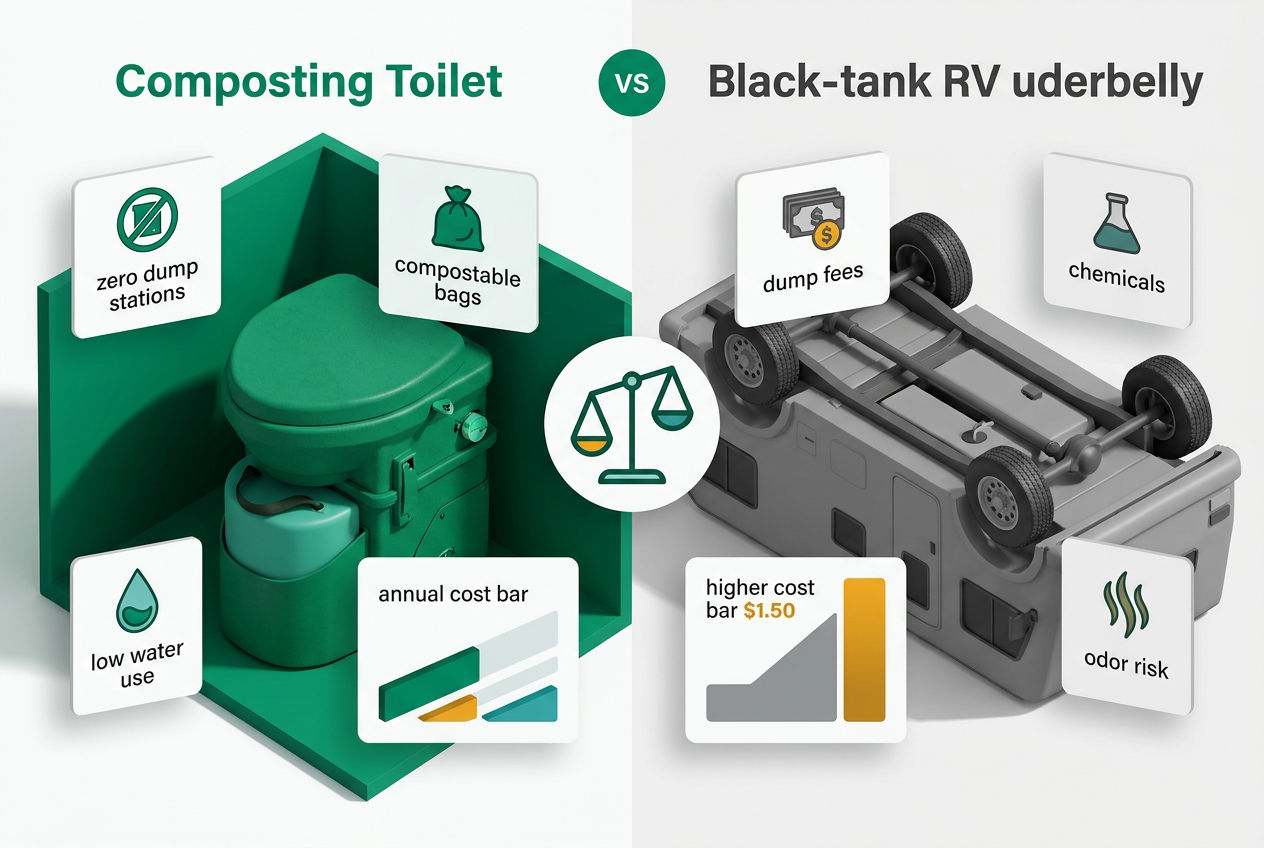
Assume a full-time boondocker who currently visits a dump station twice per month at $15–$25 per visit, plus $5–$10 in black tank chemicals monthly.
- Annual dump station cost: $360–$600
- Annual chemical cost: $60–$120
- Total annual black tank cost: $420–$720
Nature's Head upfront cost: $1,125 (mid-range MSRP) Annual composting medium cost: ~$60–$72 (one coco coir brick per month)
Net annual savings after switching: $348–$648 Break-even point: 1.7–3.2 years for a full-time boondocker
For a weekend camper who uses a dump station four times per year at $20 per visit:
- Annual dump station cost: $80
- Annual chemical cost: $20–$30
- Net annual savings: ~$28–$50
- Break-even point: ~22–40 years — the math doesn't support switching for occasional use
This is the honest calculation most composting toilet articles skip. If you're weekend camping at campgrounds with free sewer hookups, a composting toilet is a lifestyle choice, not a financial one. If you're boondocking more than 60 nights per year, the economics are genuinely compelling.
For a full comparison of RV waste management costs, see our RV holding tank guide and our overview of RV black tank cleaner options that full-timers use to extend dump intervals before switching.
A note on waste disposal regulations: Solid waste disposal laws vary significantly by state. Several Northeastern states and parts of the Pacific Northwest treat composting toilet output as regulated waste requiring disposal at licensed facilities rather than in household trash. The National Onsite Wastewater Recycling Association (NOWRA) maintains state-by-state guidance at nowra.org. Check your state environmental agency's current rules before your first solids dump.
Composting Toilet for RV — Frequently Asked Questions
What is the best composting toilet for an RV?
The Nature's Head composting toilet is the top pick for most RVers, particularly full-timers and serious boondockers. It offers the longest warranty in the category at five years, handles 60–80 uses before the solids drum needs emptying, and has replacement parts readily available from the manufacturer. The 12V fan draws approximately 1.3 watts — negligible for any RV with a functional battery system. For van life and Class B rigs where space is tight, the Trelino Evo S at $499–$549 offers the most compact footprint at 14 × 14 × 17 inches and just 11 lbs. For a mid-range option with the convenience of an electric agitator instead of a manual hand crank, the OGO Origin at $895–$950 is a strong alternative. The right choice depends primarily on how often you use the toilet, how many people share it, and how frequently you're willing to manage the liquid bottle.
How does a urine diverting toilet work in an RV?
A urine diverting toilet uses a molded plastic separator built into the front of the bowl. When a user sits, the natural anatomy directs liquid waste forward into the diverter, which channels it through a hose into a separate removable bottle — typically 1.1 to 2.2 gallons depending on the model. Solid waste falls rearward into a lower composting drum filled with peat moss or coco coir. Keeping the two waste streams separate prevents the anaerobic chemical reaction between urine and feces that produces hydrogen sulfide — the primary source of black tank odor. A continuously running 12V fan draws air through the composting drum and exhausts it outside through a 1.5-inch vent hose, maintaining negative pressure so any remaining odor exits away from the RV interior rather than back into the cabin. No water is used at any point in this process, making it a true waterless RV toilet system.
How often do you need to empty a composting toilet in an RV?
Emptying frequency depends on the number of users and the model's tank capacity. For a couple using a Nature's Head full-time, the 2.2-gallon liquid bottle needs emptying every two to three days. The solids drum lasts four to six weeks before it needs to be bagged and disposed of. Solo users can extend liquid empties to every three to five days and solids empties to six to eight weeks. For the OGO Origin's 1.5-gallon liquid tank, expect intervals roughly 30 percent shorter than the Nature's Head. The Trelino Evo S's 1.1-gallon bottle fills every one to two days for a solo traveler — a meaningful operational difference for extended trips. Liquid can be poured down any standard restroom drain, campground dump station, or diluted heavily and dispersed on the ground away from water sources where local regulations permit. Disposal rules for solid waste vary by state; check your state environmental agency's current guidance before the first solids empty.
Do composting toilets smell bad in an RV?
A properly installed and maintained composting toilet produces no noticeable odor inside the RV. The urine diversion system eliminates the primary odor source — the anaerobic reaction between mixed waste — before it begins. The continuously running 12V fan creates negative pressure in the composting chamber, ensuring that any residual odor exits through the vent hose to the exterior rather than back into the living space. Odor problems almost always trace to one of four causes: a kinked or sagging vent hose that restricts airflow, an overfull liquid bottle left sitting in summer heat, incorrect moisture levels in the composting medium (too wet causes anaerobic conditions; the medium should feel like a wrung-out sponge), or fan failure. In high-humidity environments such as Florida or the Gulf Coast, adding a small handful of dry coco coir every few days during summer helps manage moisture buildup. Keep a spare 12V fan motor — fan failure is the fastest route to an odor problem.
How much does a composting toilet for an RV cost?
Composting toilet prices for RV use range from approximately $499 to $1,150 at MSRP. The Trelino Evo S is the most affordable well-built option at $499–$549, suited for van conversions and part-time use. The OGO Origin sits in the mid-range at $895–$950 and adds an electric agitator powered by 5V USB. The Nature's Head and Air Head Compact are the premium options at $1,080–$1,150, with Nature's Head carrying the longest warranty at five years. Installation adds $0 for a DIY job or $150–$400 for professional installation depending on vent routing complexity. Ongoing costs are low: composting medium runs $5–$20 per month depending on use. For a full-time boondocker paying $15–$25 per dump station visit twice monthly plus black tank chemicals, switching to a composting toilet typically breaks even in under three years. For our full cost breakdown including installation labor, see the RV toilet replacement cost guide.
Can you use an RV composting toilet in cold weather?
Yes, with three specific adjustments. First, insulate the vent hose on any section exposed to exterior temperatures — in cold climates like Minnesota where overnight temperatures can reach −30°F, condensation in an uninsulated 1.5-inch vent hose can freeze and block airflow entirely. Foam pipe insulation or low-wattage heat tape (3–5 watts per foot) solves this. Second, switch from coco coir to peat moss as your composting medium in winter — peat holds its structure better at low temperatures. Third, increase agitator turns from every three to four days to every one to two days, since composting bacteria become largely inactive below 40°F and manual mixing compensates for reduced microbial activity. One important limitation: RV composting drums never reach the 131°F sustained temperature that EPA 40 CFR Part 503 requires for Class A pathogen reduction. In cold weather, the drum contents are desiccating and storing rather than fully composting. Dispose of solids in sealed trash bags, not on garden beds.
Free download
Not ready for the Blueprint? Start free.
Grab the free DIY Septic Planning Kit — the permit-first checklist, perc-test cheat sheet, and sizing tables that keep your build from getting red-tagged.
Was this article helpful?
Frequently Asked Questions
Recommended Resources
📖 Related Articles
Find Septic Professionals Near You
Compare licensed, verified septic companies by area — top county markets and cities below, or browse all 50 states.
County markets
Popular cities
