
Quick Answer
The best RV black tank cleaner breaks down solid waste, neutralizes odors, and keeps your tank sensors reading accurately — all without damaging a private septic system if you're dumping somewhere other than a municipal sewer hookup. With roughly 11.2 million registered RVs on U.S. roads (per RVIA data), black tank maintenance is one of the most common pain points RV owners face. The wrong product can leave you with a reeking tank, stuck sensors, or — if you're dumping at a rural campground with a private septic system — a damaged drain field.
Key Takeaways
- Enzyme-based and bacterial RV black tank cleaners are safer for septic systems than chemical formaldehyde products
- 47 states have restrictions or outright bans on formaldehyde-based holding tank treatments
- Treat your black tank after every dump — add product before adding 1–2 gallons of fresh water
- Stuck sensors are usually a waste coating problem, not a sensor failure — the right cleaner fixes this
- If you dump at rural campgrounds or private properties, septic-safe formulation isn't optional
Quick Comparison: Top RV Black Tank Cleaners
| Product | Type | Septic-Safe | Price Range | Tank Coverage |
|---|---|---|---|---|
| Unique RV Digest-It | Enzyme/Bacterial | ✅ Yes | $18–$22 / 32 oz | Up to 40 gal |
| Happy Campers Organic | Mineral/Enzyme | ✅ Yes | $20–$25 / 18 doses | Up to 40 gal |
| Thetford Aqua-Kem | Chemical (biocide) | ⚠️ Check label | $10–$14 / 64 oz | Up to 40 gal |
| Walex Porta-Pak | Enzyme/Deodorizer | ✅ Yes | $12–$16 / 10 pods | Up to 40 gal |
| Camco TST Ultra-Concentrated | Chemical | ⚠️ Formaldehyde-free version only | $10–$14 / 32 oz | Up to 40 gal |
| Firebelly Outfitters | Enzyme/Bacterial | ✅ Yes | $22–$28 / 32 oz | Up to 40 gal |

Prices reflect national retail averages. Coverage per treatment listed at manufacturer-recommended dosage. Always confirm "formaldehyde-free" on the current product label before purchasing, as formulations can change.
What Is the Best Chemical to Put in an RV Black Tank?
The best treatment for an RV black tank depends on your priorities, but enzyme-based or bacterial formulas outperform traditional chemical options in nearly every category that matters long-term: odor control, waste breakdown, sensor accuracy, and septic system compatibility.
If you've ever pulled into camp after a long drive and been hit with that unmistakable sewer smell the moment you opened the bathroom door, you already know how badly the wrong product fails. That said, the choice between enzyme and chemical treatments isn't purely about smell — it's about what happens downstream when you dump. Here's a breakdown of each top pick.
1. Unique RV Digest-It — Best Overall
Unique RV Digest-It is a concentrated bacterial enzyme formula containing over 300 million CFU (colony-forming units) per ounce of live bacteria. Those bacteria actively digest solid waste and toilet paper rather than just masking odors with fragrance.
What makes it stand out: It's one of the few products marketed specifically for sensor cleaning. If your gray or black tank sensors are stuck reading "full" when the tank is empty, a 24-hour treatment with Digest-It — combined with a few gallons of water — will coat and break down the waste film coating the sensor probes.
Dosage: 2 oz per 10 gallons of tank capacity. For a standard 30-gallon black tank, that's 6 oz per treatment cycle.
Honest limitation: Enzyme products slow down below 50°F. If you're winter camping in the Rockies or Upper Midwest where temperatures drop overnight, bacterial activity will be reduced. In those conditions, you'll need more product or a longer contact time.
Price: Around $18–$22 for 32 oz, which works out to roughly $1.50–$2.00 per treatment.
2. Happy Campers Organic RV Holding Tank Treatment — Best for Odor Control
Happy Campers uses a mineral and enzyme blend rather than a purely bacterial formula. It's one of the most odor-aggressive products on the market — and it works in conditions where pure biological treatments struggle, including colder temperatures.
Dosage: 1 scoop (about 2 tablespoons) per 40-gallon tank. Add to 1 gallon of water, pour into the toilet, flush.
What makes it stand out: It's genuinely odorless itself — no pine scent, no chemical fragrance masking the problem. The mineral component neutralizes hydrogen sulfide (the gas responsible for the "rotten egg" smell) at the chemical level, not just cosmetically.
Septic-safe: Yes. No formaldehyde, no biocides, no bleach. Safe to dump at private septic-connected campgrounds.
Price: Around $20–$25 for an 18-dose container. That's approximately $1.10–$1.40 per treatment — solid value for the odor performance.
3. Thetford Aqua-Kem — Best Budget Chemical Option
Aqua-Kem is one of the most widely available RV tank treatments on shelves, and it works fast. The chemical formula begins deodorizing within 2–4 hours, which makes it a good choice if you're dealing with an urgent odor situation.
The caveat you need to know: The original blue Aqua-Kem formula contains biocide compounds that can kill beneficial bacteria in private septic systems. Thetford does offer a formaldehyde-free version — Aqua-Kem Green — which is septic-safe. If you're dumping exclusively at municipal sewer hookups, the standard formula is fine. But if there's any chance you'll be using a rural campground with a private septic system, buy the Green version. The label distinction matters.
Price: $10–$14 for 64 oz. Cheapest cost-per-treatment in this roundup at roughly $0.60–$0.90 per use.
4. Walex Porta-Pak Drop-Ins — Best for Convenience
Walex Porta-Pak comes as pre-measured dissolvable pods — drop one in the toilet, add a little water, flush. No measuring, no spilling, no mess. Each pod treats up to a 40-gallon tank and contains a blend of enzyme cleaners and deodorizers. The formula is formaldehyde-free and biodegradable — safe for septic-connected dump stations.
Best use case: Casual campers who don't want to fuss with liquid measurements. If you're taking 3–4 trips a season and want dead-simple maintenance, Porta-Pak is hard to beat.
Honest limitation: At about $1.20–$1.60 per pod (buying a 10-pack for $12–$16), it's not the most cost-effective option if you're a full-timer treating your tank every few days.
5. Firebelly Outfitters RV Black Tank Treatment — Best Enzyme Formula for Warm Climates
Firebelly uses an aerobic bacterial formula with a reported 1 billion CFU per application — among the highest bacterial concentration in this category. That high CFU count makes it especially effective in the Southwest and Southeast, where summer temperatures accelerate waste decomposition and odor.
Temperature note: Aerobic bacteria in Firebelly are most active between 60°F and 90°F. In those conditions, waste breakdown begins within 4–6 hours of treatment.
Septic-safe: Fully formaldehyde-free and safe for anaerobic septic systems. In fact, aerobic bacterial products like this one can actually support the bacterial ecosystem in a private septic system's drain field if they pass through — unlike chemical treatments that kill septic bacteria on contact.
Price: $22–$28 for 32 oz, or roughly $2.00–$2.50 per treatment. It's a premium pick, but the bacterial concentration justifies the price for heavy users.
What's the Difference Between Enzyme and Chemical RV Tank Treatments?
Enzyme and bacterial treatments digest waste biologically; chemical treatments kill bacteria to suppress odor. The distinction determines how the product works, when it fails, and whether it's safe where you're dumping.
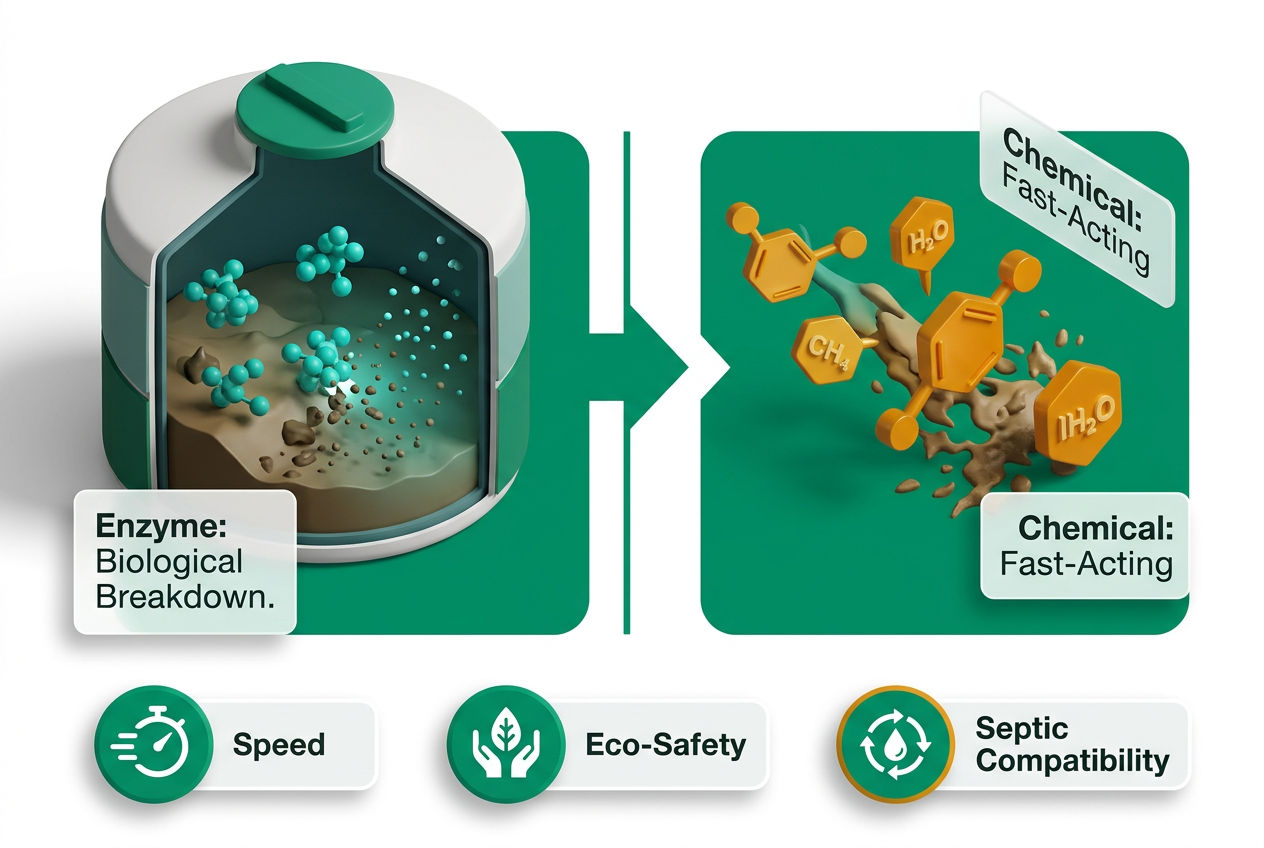
Enzyme/Bacterial treatments introduce live microorganisms (or the enzymes those organisms produce) into your black tank. These microbes actively consume waste, breaking solid matter and toilet paper into liquid that drains cleanly. They also eliminate odor at the source — by digesting the compounds that create it — rather than covering it with fragrance. The tradeoff: bacterial products need warmth to work. Below 45°F, microbial activity slows significantly. Below 35°F, it nearly stops. For cold-weather camping, you'll need to compensate with higher doses or switch to a mineral-based product like Happy Campers.
Chemical treatments use biocides, formaldehyde derivatives, or quaternary ammonium compounds to kill bacteria in the tank and suppress odor chemically. They work faster (2–4 hours vs. 4–8 hours for enzyme products) and are temperature-independent. The problem: those same biocides kill the beneficial anaerobic bacteria inside a septic tank when you dump. According to the EPA, formaldehyde-based holding tank products are one of the documented threats to septic system biological function — which is why 47 states now restrict or ban them.
For most RV owners today, enzyme-based products are the stronger long-term choice. They're safer, increasingly affordable, and they solve the problem at the source rather than temporarily suppressing it.
Are RV Black Tank Chemicals Safe for Septic Systems?
Not all of them — and the stakes are higher than most RV content acknowledges.
Many rural campgrounds, state parks, and private properties use residential or commercial septic systems for their dump stations rather than municipal sewer connections. When you dump formaldehyde-based or heavy biocide treatments into those systems, you risk killing the bacterial colonies that make the septic tank function. A healthy septic system relies on anaerobic bacteria to break down solids in the tank before effluent moves to the drain field. Kill those bacteria — even temporarily — and solids pass into the drain field unconverted, clogging the soil matrix over time.
Drain field replacement can run $5,000–$20,000 depending on soil conditions and system type. For a campground owner, one summer's worth of RVers dumping chemical treatments can accelerate that timeline significantly. For that reason, a growing number of private campgrounds now post signs requiring septic-safe RV tank deodorizer products — and some charge fees or refuse dumping from rigs they suspect are using chemical treatments.
The rule of thumb: if the dump station drains to a municipal sewer, standard chemical treatments are technically permissible, though enzyme products are still preferable for long-term sensor health. If the dump station drains to a septic system — which you often won't know unless you ask — only use septic-safe cleaning products that are explicitly formaldehyde-free and biocide-free.
Enzyme and bacterial RV black tank treatments pass through septic systems harmlessly. Some, like Firebelly, may actually support the septic tank's existing bacterial ecosystem by supplementing the anaerobic population.
Why Does My RV Black Tank Still Smell After Treatment?
Three common causes account for the majority of persistent black tank odors after treatment.
1. Pyramid plug or solid waste buildup If you travel with the black tank valve open (a common mistake), liquid drains while solids accumulate into a hardened plug at the base of the tank. Enzyme treatments can't penetrate solid pyramids effectively. Fix: Close the valve, fill the tank halfway with water, add a double dose of enzyme cleaner, and let it soak for 24–48 hours before dumping. Drive the RV to slosh the water before you dump.
2. Dry toilet seal A cracked or dried-out toilet seal allows sewer gas to seep directly into the RV cabin — no amount of black tank treatment will fix a seal problem. Check the seal around the toilet base for cracks or gaps. See our guide on RV toilet seal replacement for inspection and replacement steps.
3. Sensor probe coating Waste and toilet paper accumulate on sensor probes, which causes both inaccurate readings and localized odor retention. An enzyme soak — filling the tank partially with water plus enzyme treatment, then driving 20–30 minutes to agitate — will break down probe coating. Manually rocking the RV side-to-side while parked accelerates this process if driving isn't practical.
How Often Should You Treat Your RV Black Tank?
Free download
Free: the Septic Fridge Card — what to flush, what never to.
The Do / Don’t card the whole family can see, plus the Survival Kit: emergency flowchart, warning-sign decoder and pump-schedule card. One printable PDF.
Treat your black tank after every dump — no exceptions.
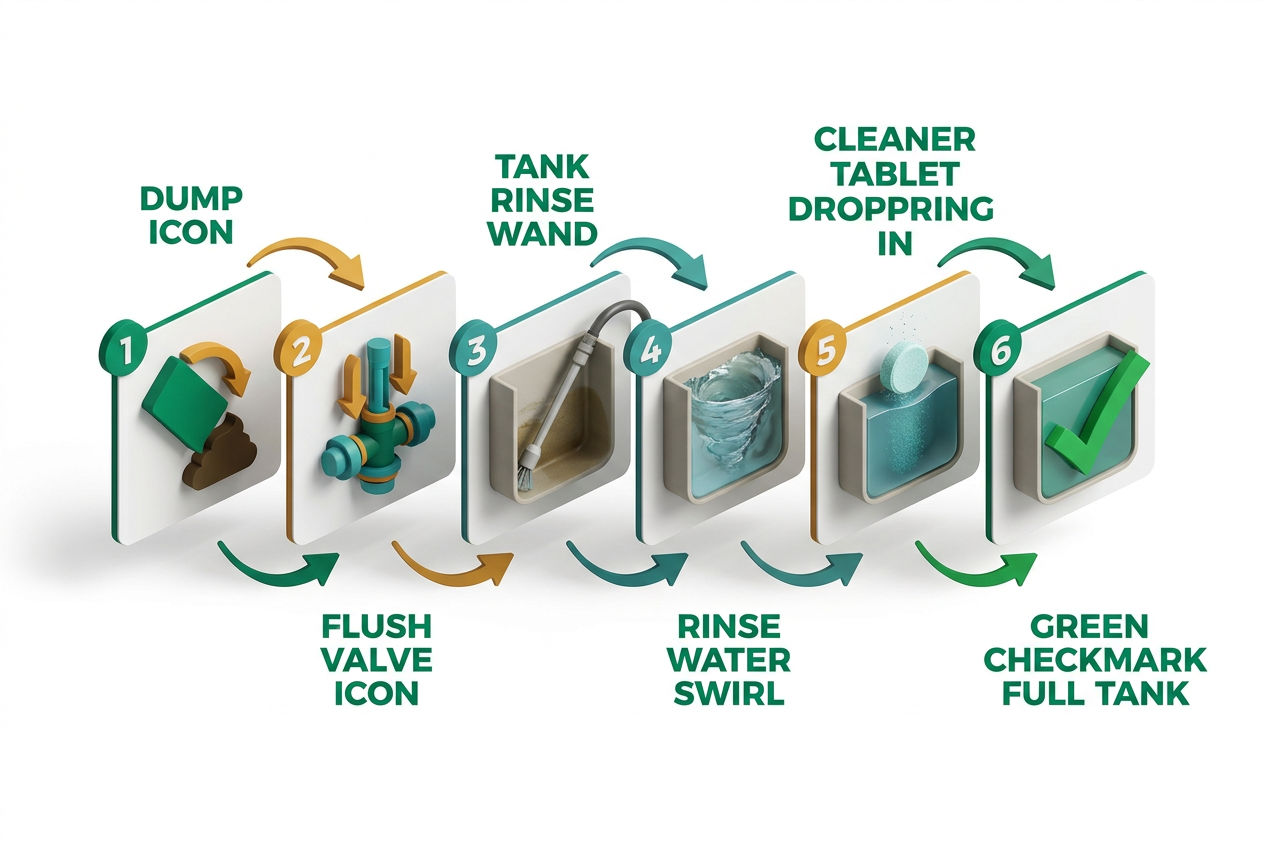
The post-dump window is when the tank is at its cleanest and when treatment is most effective. The sequence: dump fully, rinse the tank with a built-in tank flush or a wand through the toilet, then add your enzyme or mineral treatment directly into the toilet before flushing 1–2 gallons of fresh water to distribute it across the tank floor.
Frequency by use pattern:
- Weekend camper (1–2 trips/month): Treat at dump, then treat again before storage to prevent dried waste accumulation.
- Monthly camper (1–4 nights/month): Standard post-dump treatment is sufficient.
- Full-timer: Treat after every dump, typically every 4–7 days depending on tank size and occupancy. Also add a half-dose mid-cycle if the tank sits more than 5 days between dumps in warm weather.
- Storage (30+ days): Add a full treatment dose with 2 gallons of water before parking. This keeps seals moist and prevents dried residue from coating sensors.
The cost difference between treating consistently vs. intermittently is negligible — roughly $40–$80/year for a full-timer on enzyme treatments. The cost of ignoring the tank until sensors fail or odors become structural is substantially higher.
How to Clean an RV Black Tank: Step-by-Step
- Close the black tank valve at least 24 hours before you plan to dump. Never travel with the valve open — this is the leading cause of solid waste pyramids.
-
Dump the tank fully. Connect your sewer hose, open the black tank valve, and wait until flow stops completely. If your RV has a built-in tank flush port, run it for 3–5 minutes after the initial dump to rinse residue from the tank walls.
-
Rinse with a tank wand if no flush port exists. Insert a curved rinse wand through the toilet and spray the tank walls and floor for 3–5 minutes while the valve remains open.
-
Close the valve and add treatment. Pour your enzyme or mineral black tank enzyme cleaner directly into the toilet. Flush 1–2 gallons of fresh water immediately after to carry product to the tank floor.
-
Add a water buffer. Never leave the tank empty after treatment. At least 1 gallon of water sitting in the tank keeps seals moist, gives enzyme product something to work in, and prevents dried waste from adhering to the tank surface.
For stubborn sensor buildup, add a double dose of enzyme treatment and 3–4 gallons of water, then drive 20–30 minutes before the next dump. The motion distributes product across all sensor probes and loosens dried-on waste.
Can You Use Bleach to Clean an RV Black Tank?
No. Bleach kills the beneficial bacteria that enzyme-based RV holding tank treatment relies on, and it damages rubber seals and gaskets inside the toilet and tank valve assembly over time.
A single bleach treatment will neutralize any enzyme or bacterial product you add for the next 2–3 tank cycles, because residual bleach continues killing microbial colonies long after you've rinsed. If you're trying to reset a tank that was previously treated with bleach, flush the tank 3–4 times with clean water before restarting an enzyme regimen.
For odor emergencies where you need fast results, use a concentrated enzyme treatment with hot water rather than bleach. Products like Unique RV Digest-It at double dosage will show measurable improvement within 4–6 hours in warm temperatures — faster than many RV owners expect.
The only cleaning agents that are safe to use in a black tank alongside enzyme treatments are plain water, septic-safe cleaning products, and RV-specific toilet paper that dissolves rapidly. See our guide on best RV toilet paper for paper options that don't leave residue on sensor probes.
Buying Guide: What Should I Look for in an RV Black Tank Cleaner?
When evaluating any black tank cleaner, rv holding tank treatment, or rv tank deodorizer, these are the specifications that actually predict real-world performance.
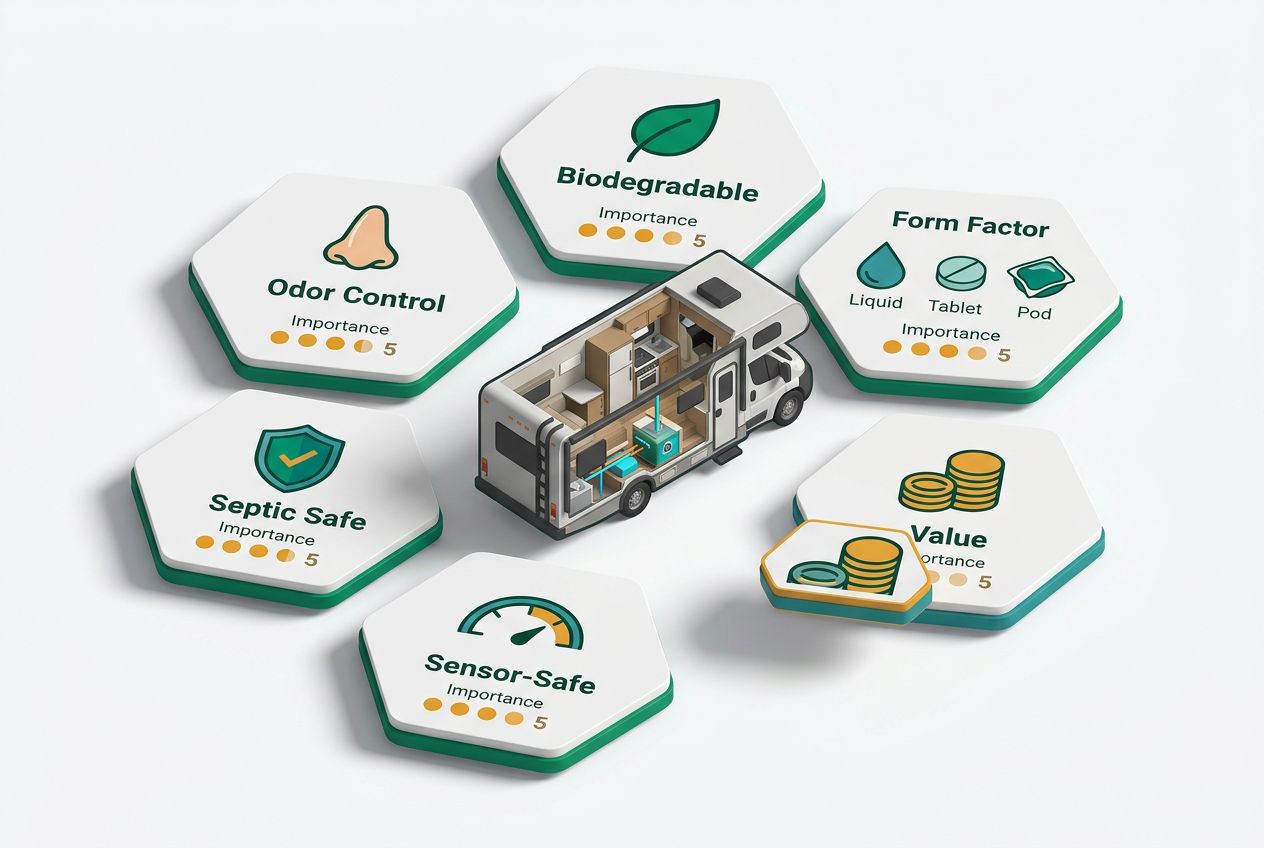
1. Formulation type (enzyme vs. chemical) Enzyme and bacterial formulas are the default recommendation for nearly all use cases. The only scenario where a chemical treatment has a clear edge is urgent odor suppression (2–4 hour result vs. 4–8 hours for enzyme). In every other metric — septic safety, long-term sensor health, environmental impact — enzyme wins. Look for products listing live bacteria CFU counts on the label; higher CFU (500 million+) indicates a more concentrated microbial load.
2. Septic-safe certification Look for "formaldehyde-free" explicitly on the current label — not just on marketing copy. Formulations change, and older stock may have different chemistry than current product. Products certified under NSF/ANSI Standard 46 for recreational vehicle components meet a verified safety threshold for holding tank use.
3. Temperature range If you camp below 50°F, a purely bacterial formula will underperform. Mineral-enzyme blends (like Happy Campers) or chemical options (like Aqua-Kem Green) remain effective in cold. Match your product to your camping season.
4. Concentration and cost-per-treatment Don't compare bottle prices — compare per-treatment cost. A $22 bottle of Firebelly that yields 16 treatments costs less per use than a $12 pack of pods with 10 treatments. For full-timers treating every 5–7 days, the gap between budget and premium picks is roughly $150–$200/year — meaningful, but worth it if the premium product prevents a $300 sensor diagnostic call.
5. Powder vs. liquid Powder formulas (Happy Campers, some Camco products) are preferable for boondocking or backcountry camping because they weigh less and don't risk liquid spills in storage. Liquid concentrates are easier to dose precisely. Pods are most convenient but least cost-effective at scale. Choose the format that matches your storage space and trip style.
6. Best RV toilet treatment for sensors specifically If your sensors are your primary pain point, Unique RV Digest-It is the most specifically engineered product for probe cleaning. Its bacterial colony specifically targets the biofilm layer that coats sensor probes and causes false readings.
Frequently Asked Questions
What is the best rv toilet treatment for full-timers?
For full-timers treating a black tank every 5–7 days, Unique RV Digest-It is the best RV toilet treatment overall. Its concentrated bacterial formula (300+ million CFU per ounce) handles the continuous waste load that full-time living generates, and at $1.50–$2.00 per treatment, it's cost-effective at scale. The key for full-timers is consistency: dose after every dump without exception, add a half-dose mid-cycle in summer when warm temperatures accelerate odor, and do a 24-hour enzyme soak with 3–4 gallons of water monthly to maintain sensor accuracy. Avoid the temptation to use chemical treatments for speed during high-use periods — the biocide residue lingers and undermines your enzyme regimen for several tank cycles afterward. If you're dumping at private campgrounds regularly, enzyme-only products are non-negotiable for septic system compatibility.
Is there an rv tank deodorizer that works in cold weather?
Yes — Happy Campers Organic RV Holding Tank Treatment is the most reliable rv tank deodorizer for cold-weather camping. Most bacterial enzyme products slow significantly below 50°F and nearly stop working below 35°F, making them unreliable for winter camping in the Rockies, Upper Midwest, or higher elevations. Happy Campers uses a mineral-enzyme hybrid that neutralizes hydrogen sulfide at the chemical level rather than relying solely on microbial activity, so it performs even when temperatures drop overnight. Dosage remains the same regardless of temperature: one scoop per 40-gallon tank with one gallon of water. For below-freezing conditions, increase to 1.5 scoops and use warm water when adding to the tank to help activate the mineral component. Thetford Aqua-Kem Green is an alternative for extreme cold, as chemical formulas are fully temperature-independent.
What is the cheapest RV black tank treatment that actually works?
Thetford Aqua-Kem Green is the cheapest effective black tank treatment at roughly $0.60–$0.90 per use from a 64 oz bottle costing $10–$14. For septic-safe use, confirm you're buying the Green (formaldehyde-free) version, not the original blue formula. If you want the cheapest enzyme option, Happy Campers runs approximately $1.10–$1.40 per dose and outperforms Aqua-Kem on odor neutralization for campsite use where neighbors are close. The true cost calculation goes beyond sticker price: a cheaper chemical product that causes sensor failure leading to a diagnostic appointment will cost more in the long run than a premium enzyme treatment used consistently. For budget-conscious weekend campers doing four to six trips per season, Aqua-Kem Green or Walex Porta-Pak pods (about $1.20–$1.60 each in a 10-pack) both offer acceptable performance at low annual cost.
Can I use a black tank enzyme cleaner in a composting toilet system?
No — black tank enzyme cleaners are formulated for wet holding tank environments where waste is suspended in liquid. Composting toilet systems work through aerobic decomposition in a dry or low-moisture environment, and adding liquid enzyme products disrupts the moisture balance that aerobic composting requires. Introducing bacterial enzyme formulas can also introduce the wrong microbial strains, potentially slowing rather than accelerating the composting process. If you're transitioning from a standard black tank system to a composting toilet, flush and clean the holding tank thoroughly before decommissioning it, but apply no enzyme treatment to the new composting unit. Composting toilet maintenance uses separate bulking agents like coco coir or peat moss — not holding tank treatment products. For odor control in a composting system, manufacturer-specific additives or plain bulking material adjustment is the correct approach.
How do I know if my dump station uses a septic system or municipal sewer?
Ask the campground host or office directly — it's a straightforward question and most staff know the answer. Rural campgrounds, state forest sites, private farm stays, and smaller RV parks outside city limits are far more likely to use septic systems than municipal sewer connections. Urban and suburban RV parks connected to city infrastructure almost always drain to municipal sewer. Visual cues can help: a visible septic tank lid or distribution box near the dump station, or a drain field area marked with warning flags, suggests a private system. If you can't confirm, default to a formaldehyde-free, septic-safe rv holding tank treatment. Using a biocide-based product in a septic-connected dump station risks damaging the drain field's bacterial ecosystem — a repair that can cost campground owners $5,000–$20,000 — and some campgrounds have begun holding RV owners liable for documented septic damage. When in doubt, the safe product is always the right call.
Does RV black tank treatment expire?
Yes, bacterial and enzyme products have a shelf life that chemical treatments do not. Live bacterial formulas (like Unique RV Digest-It or Firebelly) typically remain effective for 12–24 months from manufacture date when stored at room temperature away from direct sunlight. Heat above 100°F degrades live bacterial colonies rapidly — storing liquid enzyme products in a hot truck bed or compartment through a desert summer can reduce their effectiveness significantly before the printed expiration date. Check for a manufacture date or expiration date on the bottle before each season. Mineral-enzyme blends like Happy Campers have a longer shelf life of 2–3 years because they don't rely on live organisms. Chemical treatments like Aqua-Kem are indefinitely stable if sealed. If your enzyme product smells off or has separated without reconstituting after shaking, replace it — a degraded product won't adequately protect septic tank bacteria downstream either.
Sources & Methodology
Product specifications (CFU counts, dosage recommendations, temperature ranges) were sourced directly from manufacturer product pages, technical data sheets, and product labels as of Q1 2026. Pricing reflects national retail averages across Amazon, Walmart, and Camping World at time of publication.
Regulatory data on state formaldehyde restrictions is based on EPA guidance documents and the National Onsite Wastewater Recycling Association (NOWRA) state-by-state policy tracking. The 47-state figure reflects states with active restrictions or bans on formaldehyde-based holding tank treatments as reported by NOWRA's policy database.
Septic system biology references draw from University of Arkansas Cooperative Extension Service publications on septic system maintenance and the EPA's "Homeowner's Guide to Septic Systems."
Performance characteristics reflect manufacturer specifications and are not independently lab-verified by SepticTankHub.com. Where possible, dosage and temperature data has been cross-referenced against third-party user reporting in RV forums (iRV2, RV.net) for real-world consistency.
Internal links: what is a septic system · drain field overview · septic tank bacteria guide · septic tank maintenance · septic-safe products · RV toilet seal replacement · how to empty RV black tank · best RV toilet paper · what kills septic bacteria · septic pumping services
Was this article helpful?
Frequently Asked Questions
Recommended Resources
📖 Related Articles
- What Is a Septic System? How It Works (Visual Guide)
- What Is a Drain Field? (And How Does It Work?)
- How Septic Tank Bacteria Work (And Why They Matter)
- The Complete Septic Tank Maintenance Guide
- Septic-Safe Cleaning Products: The Complete List (Safe vs. Avoid)
- How to Replace an RV Toilet Seal (Step by Step)
- How to Empty an RV Black Tank (Without the Mess)
- The Best RV & Septic-Safe Toilet Paper (Our Picks)
- What Kills Septic Tank Bacteria? (14 Things to Avoid)
🔧 Services
Find Septic Professionals Near You
Compare licensed, verified septic companies by area — top county markets and cities below, or browse all 50 states.
County markets
Popular cities
