
Quick Answer
RV toilet paper is designed to dissolve rapidly in black tanks and septic systems — typically within 30–90 seconds in agitated water — compared to 15 minutes or more for premium home brands. Choosing the wrong roll can mean a $150–$500 RV holding tank clog or, worse, a drain field failure that runs $1,000–$5,000 to fix.
How we chose these picks: we did not lab-test or hands-on test these products. The picks below are based on how each paper is designed and labelled (RV-specific, rapid-dissolving, septic-safe), its ply construction, price and availability. Because labels can overstate performance, we also show you the simple jar test you can run at home to check any brand yourself.
The Dissolve Test That Actually Matters
Labels like "septic safe" are self-declared, so the most useful thing you can do is check dissolve speed yourself.
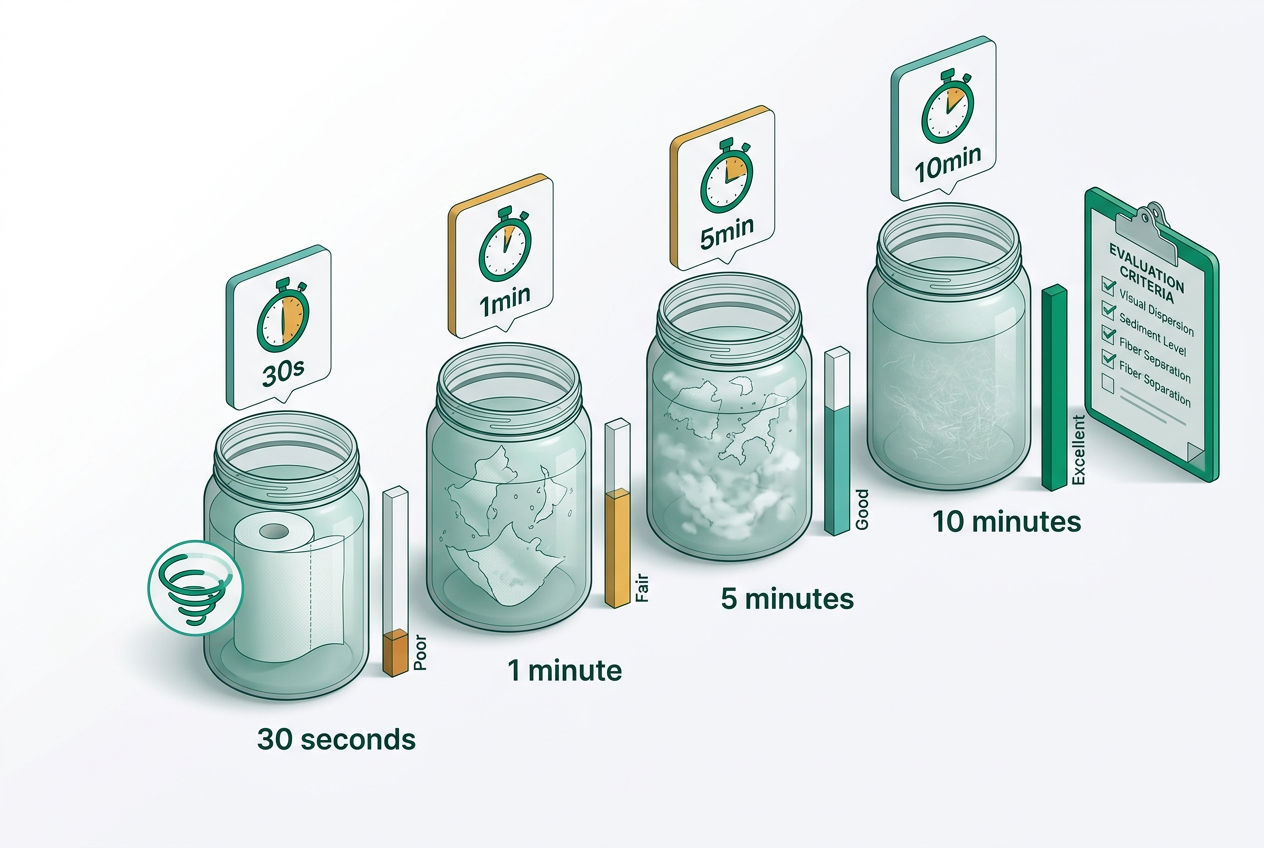
The dissolve test is simple but revealing. Fill a mason jar with 16 oz of room-temperature water. Drop in 2 sheets of toilet paper. Seal the jar. Shake it vigorously 15 times. Check at 30 seconds, 60 seconds, and 5 minutes.
Why this matters: An RV black tank typically holds 15–40 gallons. Waste sloshes during travel, mimicking that jar shake. Paper that won't break apart in the jar won't break apart in your tank either.
A standard septic tank — usually 1,000–1,500 gallons for a 3-4 bedroom home — has resident bacteria doing the breakdown work, but those microbes can't process thick, bonded paper fibers fast enough between pump cycles. The EPA recommends pumping a 1,000-gallon septic tank every 3–5 years for a household of four. Using heavy, slow-dissolving paper can accelerate sludge buildup and shorten that interval significantly — or create a partial blockage in the baffle wall that backs up into the house.
In choosing our picks, we compared each brand on:
- Whether it's designed for RV or septic use and carries a septic-safe label
- Ply construction (ply count and whether it's marketed as rapid-dissolving)
- FSC certification for eco-conscious buyers
- Approximate retail price per roll
Our Top Picks at a Glance
| Brand | Ply | Designed For | Expected Dissolve Speed | Price/Roll (est.) |
|---|---|---|---|---|
| Scott Rapid-Dissolving | 1-ply | RV / marine | Very fast | ~$1.50 |
| Freedom Living RV TP | 2-ply | RV | Fast | ~$1.75 |
| Thetford Aqua-Soft | 2-ply | RV | Fast | ~$2.00 |
| Scott 1000 (standard) | 1-ply | Home (septic-safe label) | Moderate | ~$0.85 |
| Angel Soft (standard) | 2-ply | Home | Slower | ~$0.90 |
| Charmin Ultra Soft | 2-ply | Home (premium) | Slow — avoid in RVs | ~$1.10 |
Expected dissolve speed reflects each product's design and labelling, not our own testing — run the jar test below to check. Prices are approximate retail figures and change often.
Is There a Difference Between RV Toilet Paper and Regular Toilet Paper?
Yes — and it's not just marketing.
Regular toilet paper is engineered to hold together when wet so it doesn't fall apart on the roll or during use. That bonding strength is exactly what causes problems downstream.
RV-specific and septic-safe toilet papers use shorter fiber lengths and weaker bonding agents. They start breaking apart almost immediately on contact with water, while premium home papers are designed to stay intact when wet.
For an RV black tank with a 15–40 gallon capacity, paper that doesn't break down fast enough can create a pyramid plug — a solid mass that builds beneath the toilet flange. Clearing one runs $150–$500 at an RV service shop, and some cases require tank removal.
For home septic systems, the risk plays out more slowly but more expensively. Undissolved paper accumulates in the scum layer above the anaerobic zone in your tank. That forces more frequent pumping — potentially every 1–2 years instead of every 3–5 — and can push partially processed solids into the distribution box and eventually into the leach laterals. Replacing a failed drain field runs $5,000–$25,000 depending on soil conditions, system size, and your state's permitting requirements.
If you're managing an RV holding tank, toilet paper choice is one of the three most impactful decisions you make. The other two are how much water you flush and whether you're using a quality black tank treatment.
The Best RV Toilet Paper: Category Winners
Best Overall: Scott Rapid-Dissolving
Scott Rapid-Dissolving is one of the most widely recommended RV papers, and it's purpose-built to break apart quickly. It's sold in bulk, runs about $1.50 per roll, and it's widely available at Walmart, Camping World, and Amazon.
The trade-off is softness: as a thin 1-ply paper, it's functional but not luxurious. If you're weekend camping, you won't notice much. Full-timers living in their RV 365 days a year sometimes mix Scott Rapid-Dissolving in the master bath with a softer option in a guest bath — accepting slightly higher risk in one tank for daily comfort.
Best for: Weekend campers, budget-conscious buyers, and anyone with an older RV black tank that's already had clog issues.
Best 2-Ply: Freedom Living RV Toilet Paper
Freedom Living aims to balance comfort and dissolve performance. It's a purpose-built RV paper, and its 2-ply construction is softer than thin 1-ply options like Scott Rapid-Dissolving. It runs about $1.75 per roll, which is reasonable for a purpose-built RV product.
The rolls are also slightly shorter (500 sheets vs. 1,000 on a Scott 1000 roll), so factor that into your stocking math before a long trip.
Best for: Full-time RV residents, couples, and anyone who wants comfort without compromising the black tank.
Best Value: Scott 1000
Scott 1000 isn't an RV-specific product, but as a thin single-ply paper with a septic-safe label it's a common baseline for home septic systems — though slower than purpose-built RV paper for a small tank. At roughly $0.85 per roll, it's the cheapest per-sheet option on this list. Each roll has 1,000 sheets, making it an excellent value for a home with a septic system. Many septic service companies suggest single-ply paper like Scott 1000 as a safe everyday choice.
Best for: Home septic system owners who want a budget-friendly everyday option.
Best for Full-Time RV Living: Thetford Aqua-Soft
Thetford makes some of the most popular RV toilet systems on the market, and Aqua-Soft is their purpose-built paper. It's designed specifically for RV holding tanks. The 2-ply, pre-moistened-compatible format works well with Thetford's own toilet systems (Porta Potti, Cassette, and permanent porcelain models). It's the priciest at around $2.00 per roll, but full-timers often prefer brand-matched products, and it comes from a major RV toilet manufacturer.
If you already run a Thetford toilet, this is the natural choice.
Best for: Full-time RVers with Thetford systems, cassette toilet users, boondockers.
Best Eco-Friendly: Caboo Tree-Free Bamboo Toilet Paper
Caboo uses bamboo and sugarcane fibers instead of virgin wood pulp. It's FSC certified and marketed as septic safe. At about $1.90 per roll it's not cheap, but if environmental impact matters to you — especially if you're dry camping near national forests or BLM land — it's a solid pick. Bamboo TP generally performs well in septic systems because the fiber structure is naturally shorter than pine pulp.
Best for: Eco-conscious campers, boondockers, homeowners with septic systems who want a sustainable option.
Does Charmin Clog Septic Tanks? The Honest Answer
This is one of the most searched questions in this category, and the answer isn't a total condemnation — but it's not a clean bill of health either.
Charmin Ultra Soft is a thick, premium 2-ply paper engineered to hold together when wet. Charmin's basic lines are thinner, but none of them are designed to match the dissolve speed of purpose-built RV paper.
The real-world consequence is predictable: a paper doing exactly what it's engineered to do (stay together when wet) in a system that needs the opposite.
If you're on a home septic system with a healthy tank and you pump on schedule, a basic Charmin line probably won't destroy your system immediately. But it shortens margins. For RV black tank toilet paper use, Charmin Ultra Soft is a hard no.
What Makes Toilet Paper Septic Safe? The Science
Free download
Free: the Septic Fridge Card — what to flush, what never to.
The Do / Don’t card the whole family can see, plus the Survival Kit: emergency flowchart, warning-sign decoder and pump-schedule card. One printable PDF.
The term "septic safe" gets thrown around loosely. Here's what it actually means in engineering terms.
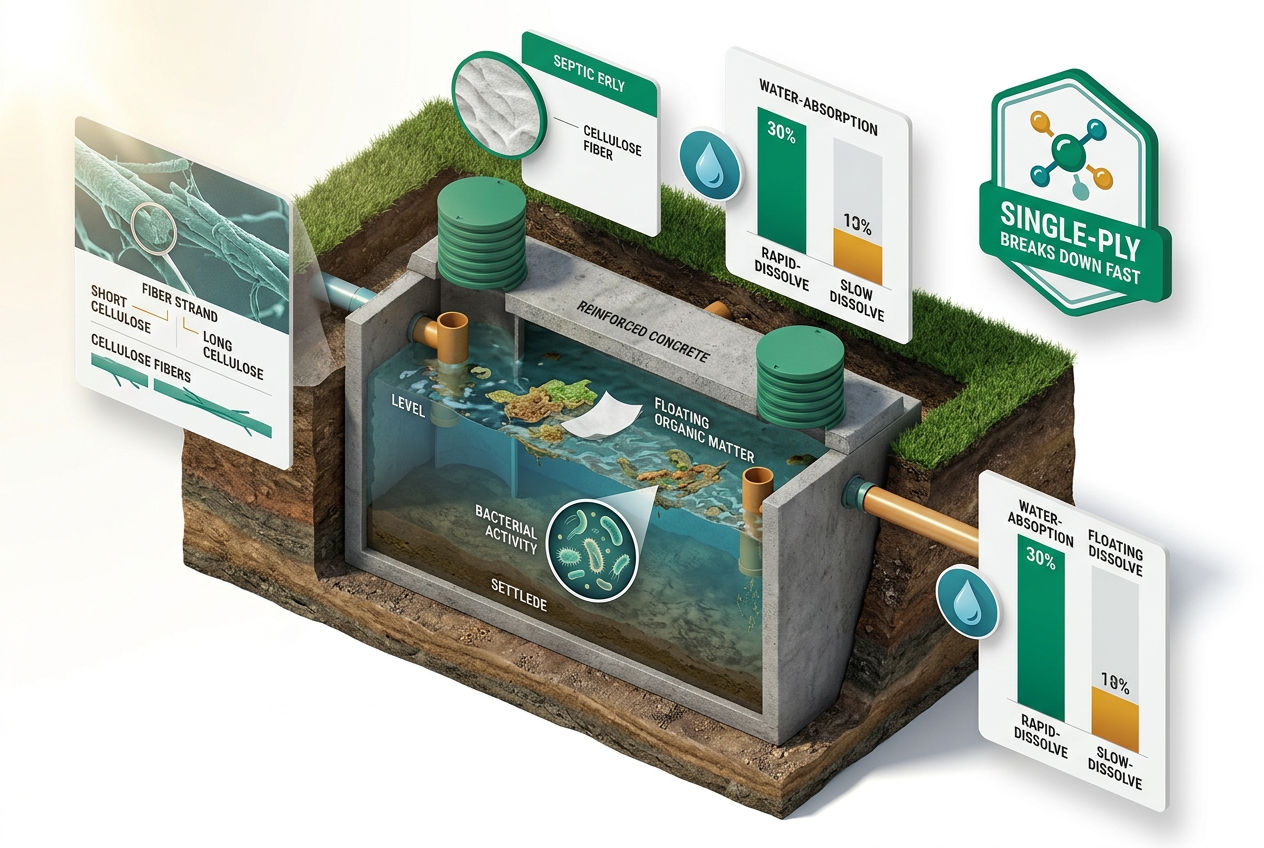
Fiber length: Shorter fibers break apart more easily. Bamboo and recycled paper generally have shorter average fiber lengths than virgin softwood pulp (the primary ingredient in premium brands like Charmin).
Wet strength additives: Premium toilet papers use polyamide-epichlorohydrin (PAE) resins to maintain integrity when wet. These additives are specifically what prevents rapid breakdown. Septic-safe and RV toilet paper brands minimize or eliminate PAE use.
Ply bonding: 2-ply paper bonds two sheets together using adhesive or embossing. Looser bonding = faster separation. Tight bonding (characteristic of ultra-soft brands) delays breakdown in water.
Sheet count and thickness: More plies and higher sheet weight means more material that needs to break down. A single sheet of Charmin Ultra Soft weighs more and holds more resin than two sheets of Scott Rapid-Dissolving.
What certifications mean:
- Septic-safe label: Self-reported by manufacturer; no third-party audit required
- NSF/ANSI 50: Third-party tested; more meaningful but rarely applied to consumer TP
- FSC certified: Forest management only — has no bearing on dissolve speed
The jar test is a rough home check, not a lab standard. It's imperfect — your tank has different temperatures, biology, and chemistry — but it's the best proxy available without lab equipment.
RV Black Tank Toilet Paper vs. Regular: A Side-by-Side Breakdown
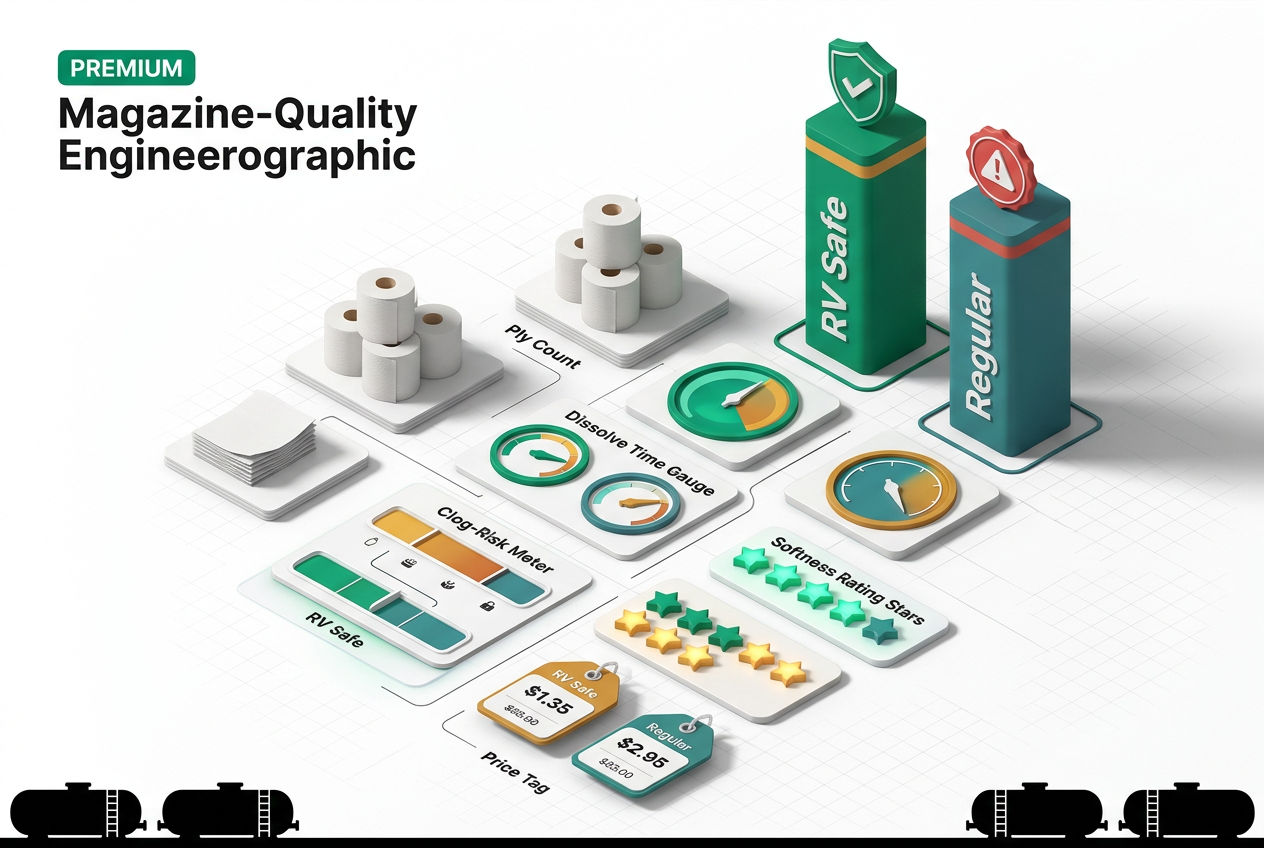
Understanding which rv toilet paper brands perform well across categories helps narrow down choices quickly. Here's how RV-specific products compare to standard grocery store options across every variable that matters:
| Factor | RV Black Tank Toilet Paper | Standard Home Toilet Paper |
|---|---|---|
| Fiber length | Short (breaks apart faster) | Long (engineered for strength) |
| Wet strength additives | Minimal to none | High (PAE resins) |
| Dissolve speed | Fast (designed to break apart) | Slow to moderate |
| Softness | Usually thinner | Usually softer |
| Price per roll | $1.50–$2.00 | $0.75–$1.25 |
| Septic-safe label | Yes (most brands) | Varies |
| Safe for RV tanks | Yes | No (most premium brands) |
The price premium for purpose-built rv toilet paper brands is real — roughly $0.50–$1.00 per roll over standard options. On a full-timing budget of 12 rolls per month, that's $6–$12 more per month. Weighed against a $300 black tank service call, the math is straightforward.
One category where standard paper can substitute: single-ply recycled paper sold in office supply stores. Many of these break down relatively quickly because they use minimal wet-strength additives and short recycled fibers — run the jar test to confirm before committing.
How to Do the Toilet Paper Dissolve Test at Home
You don't have to take our word for any of this. The jar test is something any RV owner or homeowner can do in 10 minutes with zero equipment beyond a mason jar.
What you need:
- A 32-oz mason jar with lid
- Room-temperature tap water (16 oz)
- 2 sheets of the toilet paper you want to test
- A timer
Steps:
- Fill jar with 16 oz of water
- Tear off exactly 2 sheets of toilet paper (standard perforated sheets)
- Drop sheets into the jar; replace lid
- Shake vigorously 15 times in a consistent motion
- Set timer; observe at 30 seconds, 60 seconds, and 5 minutes
- Note how much intact paper remains at each interval
What to look for:
- Excellent: Fully broken apart by 60 seconds (RV-safe)
- Acceptable: Mostly broken apart by 4 minutes (septic-safe for home use)
- Risky: Significant intact paper at 5 minutes (avoid in both systems)
- Dangerous: Still mostly intact at 5 minutes (do not use — Charmin Ultra Soft territory)
If you want to compare multiple brands side-by-side, run the jars at the same time so water temperature and shake force are consistent.
Frequently Asked Questions
What is the best RV toilet paper for black tanks?
Our pick for RV black tanks is Scott Rapid-Dissolving, a purpose-built 1-ply paper designed to break apart quickly. For a softer purpose-built alternative, Thetford Aqua-Soft is engineered specifically for RV black tank use. The key requirement for RV black tank toilet paper is full dissolution in under 60 seconds, since tanks are small (15–40 gallons) and paper that lingers can build into a pyramid plug beneath the toilet flange. Clearing a pyramid plug costs $150–$500 at an RV service shop. Avoid Charmin Ultra Soft, Cottonelle Ultra, and other premium home brands — they're designed to stay intact when wet, which is the exact opposite of what a black tank needs.
Which RV toilet paper brands dissolve the fastest?
Purpose-built RV papers — Scott Rapid-Dissolving, Thetford Aqua-Soft and Freedom Living RV Toilet Paper — are designed to dissolve fastest. Bamboo papers like Caboo are also marketed as septic safe. Standard single-ply home paper such as Scott 1000 is slower but generally fine for home septic systems, while thicker 2-ply home papers are slower still. Premium "ultra soft" papers like Charmin Ultra Soft are engineered to stay intact when wet and are a poor choice for RV black tanks. We haven't lab-tested these brands, so run the jar test on any paper before relying on it. Purpose-built RV brands outperform standard grocery store options consistently because they use shorter fiber lengths and eliminate wet-strength chemical additives.
Is RV black tank toilet paper different from regular septic-safe toilet paper?
Yes — RV black tank toilet paper and home septic-safe toilet paper are related but not identical categories. RV black tank toilet paper must dissolve in under 60 seconds because tanks are small (15–40 gallons) and don't have active bacterial colonies to assist breakdown. Home septic-safe toilet paper is held to a looser standard — typically full dissolution within 4 minutes — because a 1,000–1,500 gallon septic tank with resident anaerobic bacteria can process slower-dissolving paper between pump cycles. Scott 1000, for example, is widely considered safe for home septic systems, but it's borderline for small RV tanks. Products labeled specifically as RV toilet paper — Scott Rapid-Dissolving, Thetford Aqua-Soft, Freedom Living — are engineered to the stricter RV standard and work safely in both applications. The reverse isn't always true: some septic-safe home paper is too slow for a black tank.
Can you use regular toilet paper in an RV?
You can use some regular toilet paper in an RV, but most premium home brands are unsafe. Single-ply standard paper — like Scott 1000 or store-brand single-ply — breaks down relatively quickly and may be acceptable for RV use, particularly in larger tanks. Multi-ply premium brands such as Charmin Ultra Soft, Cottonelle Ultra Comfort, and Quilted Northern Ultra Plush should not be used in RV black tanks. These products use polyamide-epichlorohydrin (PAE) wet-strength resins specifically designed to prevent breakdown when wet — the exact opposite of what an RV system needs. The safest approach is to use toilet paper labeled specifically for RV or septic use, or to run your own jar-shake dissolve test before committing to any brand in your black tank.
What is the best septic-safe toilet paper for home use?
The best septic-safe toilet paper for home use depends on your priorities. For value, Scott 1000 is our top pick — a single-ply, septic-safe-labelled paper at roughly $0.85 per roll that many septic companies suggest as a safe baseline. For more softness, Angel Soft 2-ply is a common compromise, though it breaks down more slowly. For eco-conscious households, Caboo Bamboo is FSC certified and marketed as septic safe. The brands to avoid on a home septic system are the same ones dangerous for RVs: Charmin Ultra Soft, Cottonelle Ultra, and Bounty (paper towels, which should never go in any septic system). If you're on a septic system, the simplest rule is to look for a single-ply or a 2-ply without premium "ultra soft" or "ultra strong" labeling — those descriptors signal the wet-strength additives that slow dissolution.
Does Charmin clog RV tanks and septic systems?
Charmin Ultra Soft is a poor choice for RV black tanks and can accelerate septic system problems over time. It's a thick premium paper engineered to stay intact when wet, which is exactly what makes it risky in a small holding tank. For home septic systems, the risk is slower but real: undissolved paper accumulates in the scum layer, forces more frequent pumping (every 1–2 years instead of 3–5), and can push solids into the drain field. Charmin's thinner basic lines break down faster but still aren't designed for RV use. The short answer: don't use Charmin in an RV black tank, and use it cautiously — if at all — in a home septic system.
The Bottom Line: Which RV Toilet Paper Should You Buy?
Here's how to choose:
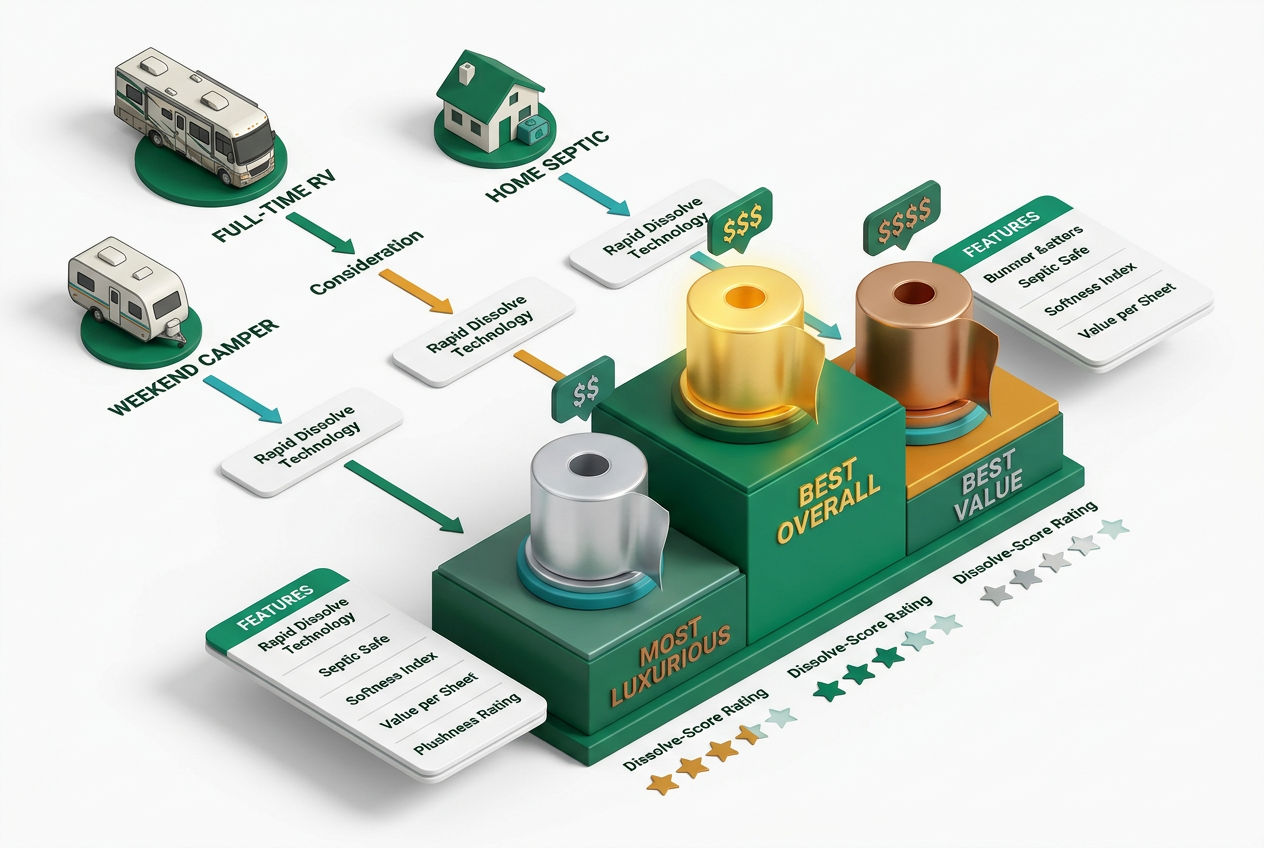
If you have an RV: Use Scott Rapid-Dissolving, Thetford Aqua-Soft, or Freedom Living RV Toilet Paper. All three are purpose-built for black tank use. Don't experiment with premium home brands — the $300 service call isn't worth it.
If you have a home septic system: Scott 1000 is the best everyday value. Caboo Bamboo is the best eco-friendly option. Angel Soft is acceptable but sits at the edge of the safe range. Avoid anything labeled "ultra soft," "ultra strong," or "premium" — those descriptors signal the wet-strength additives that slow breakdown.
If you're full-timing in an RV: Thetford Aqua-Soft or Freedom Living gives you the comfort margin that matters when you're using the same bathroom 365 days a year. The extra $0.50–$1.00 per roll is genuinely worth it at that usage level.
The jar test takes 10 minutes. Run it on whatever you currently buy. If your paper is still holding together at the 5-minute mark, it's a problem waiting to happen — and it's a cheaper problem to fix now than after the tank service call.
Was this article helpful?
Frequently Asked Questions
Recommended Resources
Find Septic Professionals Near You
Compare licensed, verified septic companies by area — top county markets and cities below, or browse all 50 states.
County markets
Popular cities
