
Quick Answer
RV black tank treatment is the single most important maintenance step for controlling odor, breaking down waste, and keeping your level sensors accurate. Add the right treatment after every dump, and your black tank runs clean, smells controlled, and tells you the truth when you're hunting for a dump station.
This guide covers the best types of RV black tank treatments, which products consistently perform, and exactly how to use them — including the one step most people skip that causes the majority of sensor and odor problems.
Key Takeaways
- Enzyme-based and bacterial treatments outperform formaldehyde-based chemicals for waste breakdown and are required at a growing number of campgrounds and national parks.
- Add treatment immediately after every dump, not before — always with at least 2 gallons of water.
- Most RV black tanks hold 15–50 gallons; treatment dosing is sized to tank capacity, not trip length.
- If your sensors read full when the tank is empty, treatment buildup on the probe is the likely cause — not a failed sensor.
- If you dump at home into a septic system, you need a specifically labeled septic-safe RV treatment.
What Does RV Black Tank Treatment Actually Do?
RV black tank treatment serves three jobs at once: it breaks down solid waste and toilet paper, neutralizes odors, and lubricates the tank's slide valve so it seals properly. Without treatment, solid waste piles up on the tank floor and coats the level sensors — which is why your gauge reads "⅔ full" two days after you dumped.
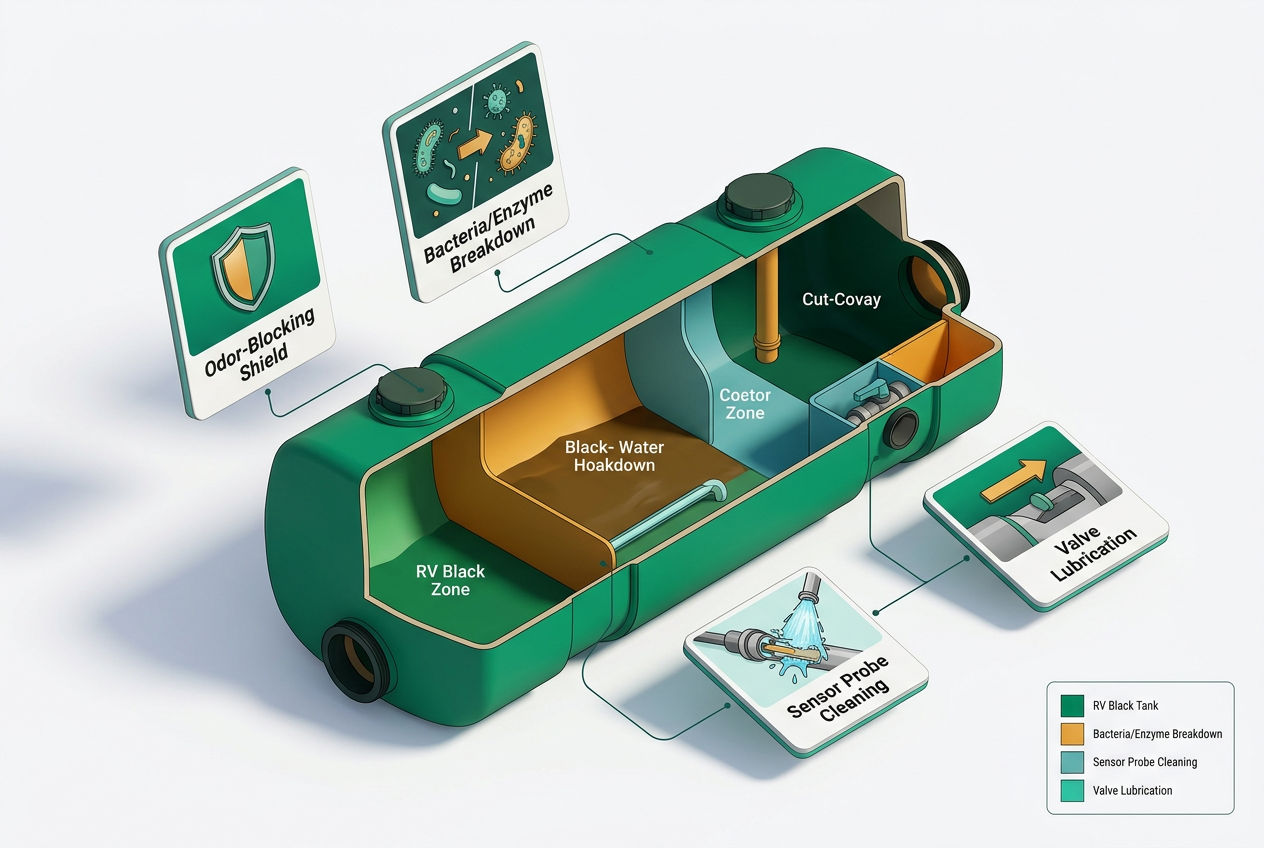
Most RV black tanks hold between 15 and 50 gallons. A standard Class C motorhome typically runs a 30–40 gallon black tank; smaller travel trailers often have 15–25 gallon tanks. The math matters because treatments are dosed by tank capacity, not by how many people are using the rig.
According to the RV Industry Association (RVIA), the average RV owner takes 4–5 trips per year — meaning most tanks sit between uses, which is exactly when untreated waste hardens and sensor fouling accelerates.
For a broader overview of how your holding system works end to end, see our complete RV holding tank guide.
What Are the Different Types of RV Black Tank Treatment?
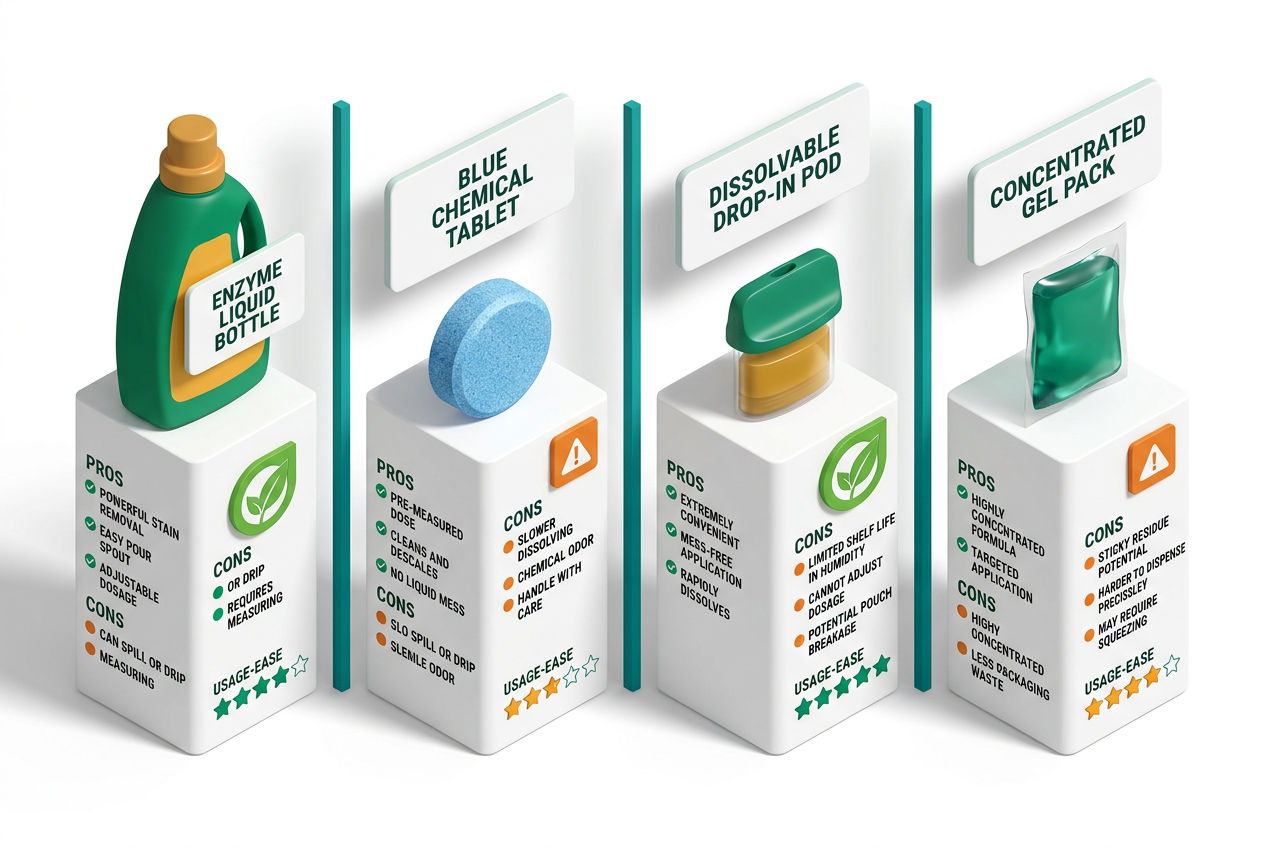
There are four main categories. Each works differently, and each has a use case where it performs best.
Enzyme-Based Treatments
These use concentrated enzymes to accelerate the breakdown of organic waste — proteins, fats, cellulose from toilet paper. They don't add live bacteria; they deliver the biological tools that existing bacteria use to do their job faster.
Best for: Everyday use, campgrounds with restrictions, users who dump frequently.
Limitation: Enzymes degrade at temperatures above 120°F. If your tank sits in direct desert sun for three days in Arizona in July, the formula loses potency. Insulated bays or shaded tanks handle this better.
Bacterial RV Tank Treatments
These add live beneficial bacteria strains — typically Bacillus species — that colonize the tank and digest waste continuously. Think of it like the microbial populations inside a healthy septic tank. Given enough time and the right conditions, bacterial treatments are the most thorough option.
Best for: Extended boondocking trips, full-time RVers, anyone who lets the tank sit for several days before dumping.
Limitation: Bacteria need temperatures above 50°F to be effective. Mountain camping in fall or early spring? Switch to enzyme or chemical treatments.
Chemical Treatments (Traditional)
These use biocides — historically formaldehyde or glutaraldehyde — to kill all bacteria and mask odors with fragrance. They work fast and smell "clean." The problem is that they don't break down waste; they just suppress it. And formaldehyde-based products are now prohibited at most national parks, many state parks, and a growing number of private campgrounds across the Pacific Northwest, California, and the Northeast.
Best for: Short-term storage, situations where odor suppression is the only priority.
Limitation: Not biodegradable. Not septic-safe. Banned at many campgrounds. Increasingly hard to justify over enzyme alternatives that perform equally well for odor control.
Drop-In Pods and Tablets
These are delivery formats, not a separate chemistry. You can get enzyme treatments in drop-in pod form (toss one in after dumping), tablets (dissolve with water), or pre-measured liquid pouches. Drop-ins are popular because there's no measuring, no spills, and no guesswork. The tradeoff is cost — drop-in pods typically run $1.50–$3.00 per use versus $0.50–$1.00 for liquid or powder formulas.
Top RV Black Tank Treatment Products Worth Knowing
Happy Campers Organic RV Holding Tank Treatment is one of the most consistently recommended products across the RV community. It's a powder formula, enzyme-based, formaldehyde-free, and rated for tanks up to 40 gallons per scoop. One container runs roughly $20–$25 and provides about 32 treatments — working out to under $0.75 per use. It handles odor as well as any chemical product in controlled comparisons, and it's approved for use at all national parks.
Walex Bio-Pak Natural Holding Tank Deodorizer comes in pre-measured drop-in bags. Each bag treats a 40-gallon tank. The enzyme and bacteria combo means it handles both short trips and longer holds well. At roughly $1.50 per pod in a 10-pack, the cost is moderate. This is a good option if you want zero measuring and don't want to keep a powder container accessible.
Camco TST MAX RV Toilet Treatment is a liquid formula, widely available at Walmart and camping retailers. It's formaldehyde-free and uses a combination of surfactants and enzymes. Price is typically $0.50–$0.75 per use in the 32 oz bottle. It's not the deepest performer for long holds, but for weekend warriors dumping every 2–3 days, it's a capable, affordable choice.
Aqua-Kem by Thetford is the classic blue chemical treatment that built the RV treatment category. The original formula used formaldehyde derivatives and is restricted at many locations. Thetford now offers an updated "Aqua-Kem Green" version that's formaldehyde-free and biodegradable. If you're already loyal to the brand, this is the version to use — but it's not a significant upgrade over Happy Campers or Bio-Pak at twice the price per use.
Cost Comparison: Treatment Products at a Glance
| Product | Format | Cost Per Use | Septic-Safe | Best Tank Size | NPS Approved |
|---|---|---|---|---|---|
| Happy Campers | Powder | ~$0.75 | ✅ | Up to 40 gal | ✅ |
| Walex Bio-Pak | Drop-in pod | ~$1.50 | ✅ | Up to 40 gal | ✅ |
| Camco TST MAX | Liquid | ~$0.60 | ✅ | Up to 40 gal | ✅ |
| Aqua-Kem Green | Liquid | ~$1.25 | ✅ | Up to 40 gal | ✅ |
| Aqua-Kem Original | Liquid | ~$0.80 | ❌ | Up to 40 gal | ❌ |
For a deeper look at keeping the tank itself clean between treatments, see our guide on RV black tank cleaners. To understand the full cost of RV waste system maintenance over a season, our RV maintenance cost guide breaks down typical annual spending by rig type.
How Do You Use RV Black Tank Treatment Correctly?
Add treatment immediately after dumping — not before, and not mid-trip. The sequence below is the one most RVers get wrong, and skipping Step 2 accounts for the majority of sensor accuracy complaints.
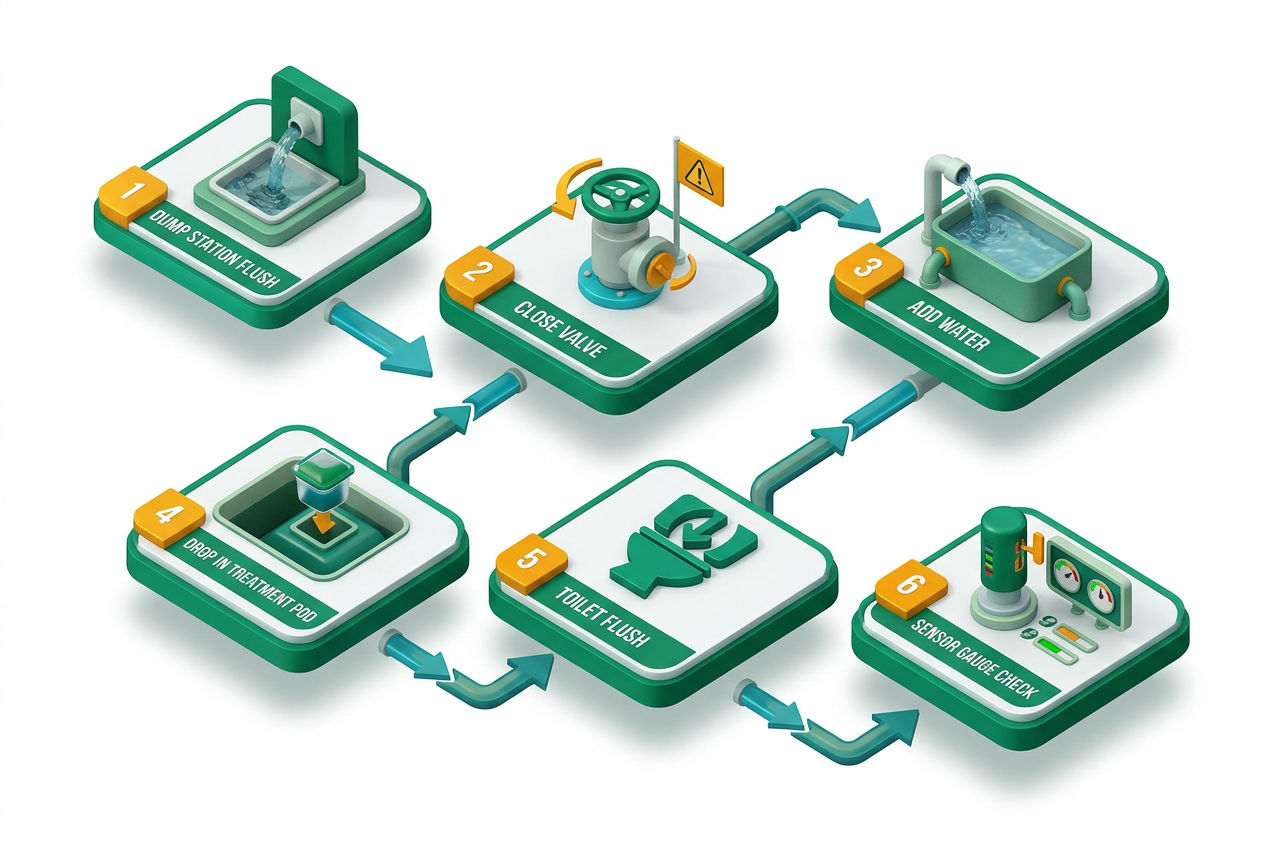
Step 1: Dump completely. Open the black tank valve and let it empty fully. Never leave residual waste sitting if you can avoid it.
Step 2: Flush the tank. If your rig has a built-in black tank flush port — a dedicated rinse inlet that sprays the interior walls — use it for 3–5 minutes until the water runs clear. No flush port? A tank rinse wand dropped through the toilet bowl works. This step knocks loose the solids coating your level sensors. Skipping it is why sensors stop reading accurately.
Step 3: Close the dump valve. Always close it completely before adding anything.
Step 4: Add the treatment. Drop your pod or tablet directly into the toilet, or pour your liquid dose in. Standard dosing: 1 tablet or 2–4 oz of liquid per 40 gallons of tank capacity. If your tank is 15 gallons, half a tablet or 1–2 oz is appropriate.
Step 5: Add at least 2 gallons of water. Flush the toilet twice after adding the treatment to push it into the tank. The treatment needs water to activate and to carry the enzymes or bacteria to where the waste builds up. A dry tank with a dissolved tablet at the bottom does almost nothing.
Step 6: Add more water before heavy use. Aim to maintain a ¼-to-⅓ full water level in the tank throughout your trip. A wet tank breaks down waste faster, reduces odor, and protects sensors from dry fouling.
Worked Example: 30-Gallon Tank, Four-Day Trip, August in New Mexico
Two adults, a 30-gallon black tank, ambient temperatures running 85–95°F. After dumping at the campground on day one:
- Close the valve completely before adding anything.
- Add one full scoop of Happy Campers (rated to 40 gallons — appropriate for a 30-gallon tank in heat, since enzyme activity degrades faster above 85°F; a full dose rather than a proportional reduction compensates for thermal degradation).
- Flush the toilet twice to push 2–3 gallons of water into the tank.
- Add an additional gallon directly through the toilet before any use to ensure the treatment is suspended, not sitting dry on the tank floor.
By day four, with normal use, that tank will hold without significant odor and sensors will read within one level of accurate. At the next dump, run the built-in flush port for 4 minutes before adding the next treatment dose.
How Often Should You Treat Your RV Black Tank?
Treat after every dump. That's the baseline rule, and it's non-negotiable for consistent odor control and sensor accuracy.
Beyond the baseline:
Weekend campers (2–3 night trips): One dose after each dump is sufficient. Camco TST MAX or Happy Campers in standard dose.
Extended trips (5–14 days): Add a half-dose on day 3–4 if the tank is less than half full and you won't dump until day 7 or later. The first dose degrades over time, especially in heat.
Full-time RVers: Treat after every dump and maintain constant water level in the tank. Bacterial treatments like Walex Bio-Pak are worth the higher per-use cost because the continuous bacterial colonization handles long-term waste accumulation more thoroughly than enzyme-only treatments.
After winter storage: Add a double dose after your first post-winterization dump. Waste residue that hardened during storage needs extra enzymatic activity to break free from tank walls and sensor probes. For the complete de-winterizing procedure, see our guide on how to empty an RV black tank after storage.
Climate adjustments:
- Florida, Texas, Gulf Coast (year-round heat): Enzyme treatments degrade faster. Dose at the high end of the recommended range and treat more frequently on long holds.
- Mountain West, fall and early spring: Below 50°F, bacterial treatments go dormant. Switch to enzyme-only formulas for cold-weather camping.
- Desert Southwest (Arizona, Nevada, summer): Ambient temps above 85°F accelerate enzyme degradation. Increase dose by approximately 25% and store product in the climate-controlled cabin, not the exterior storage bay.
Why Does My RV Black Tank Sensor Read Incorrectly?
Coating buildup on the sensor probes causes most black tank sensor failures — not hardware defects. The level sensors in most RV black tanks work on electrical conductivity: two metal pins extend into the tank at different heights, and when waste or water bridges those pins, the circuit closes and registers that level as "full." When waste and toilet paper residue coat the pins, the circuit stays closed even after you dump, and your gauge permanently reads ⅔ or full.
The fix before replacing sensors:
The GEO Method: Fill the tank ¼ full with water. Add one cup of water softener (sodium hexametaphosphate, available at any hardware store) and two tablespoons of liquid laundry detergent. Drive on rough roads for 30–45 minutes to agitate. Dump, rinse, and retreat. The water softener strips mineral deposits; the detergent cuts the grease film holding waste residue to the probes. This resolves sensor fouling in most cases without any replacement parts.
If the GEO Method doesn't work: The sensor probes may be physically corroded. Traditional chemical treatments (formaldehyde-based) accelerate probe corrosion over time because the biocides attack the metal coating. Switching to enzyme or bacterial treatments prevents future corrosion but won't reverse existing damage. At that point, replacement sensors — typically $30–$80 depending on tank configuration — are the practical solution.
Honest limitation: If your sensors are accurate immediately after the GEO Method treatment but begin misreading within one or two trips, the probes themselves are corroded and will not hold a clean surface. Treatment chemistry is no longer the variable; hardware replacement is the only fix.
Are RV Black Tank Treatments Safe for Septic Systems?
Not all of them — and the label is the only reliable way to confirm. Enzyme-based and bacterial treatments that carry explicit "septic-safe" labeling are generally compatible with residential septic systems because they add beneficial microbial activity rather than disrupting it. According to the EPA's guidance on septic-safe products, treatments that introduce beneficial bacteria can actually support the biological processes already occurring in a healthy septic tank.
Chemical treatments — particularly formaldehyde and glutaraldehyde-based formulas — are not septic-safe. These biocides kill the bacterial colonies that a functioning septic tank depends on. Dumping formaldehyde-based RV treatment into a residential septic system repeatedly will degrade the system's biological function over time, potentially requiring expensive pump-outs or bacterial reseeding.
The University of Arkansas Cooperative Extension Service conducted research on the effects of various holding tank additives on septic system function and found that products using bacterial inoculants were compatible with or mildly beneficial to septic performance, while biocide-based products showed measurable negative impact on septic microbial populations after repeated introduction.
If you dump at a home with a septic system, use Happy Campers, Walex Bio-Pak, or Camco TST MAX — all three carry explicit septic-safe labeling. For a full list of compatible products, see our guide to septic-safe cleaning products.
What Do National Parks and Campgrounds Require for RV Tank Treatment?
Formaldehyde-based RV treatments are banned across the entire National Park Service system. This is an established policy, not a trend still in progress — the NPS prohibition covers all units including national parks, national monuments, and national recreation areas. Rangers at high-traffic parks including Yosemite, Zion, and the Grand Canyon actively enforce this at dump stations.
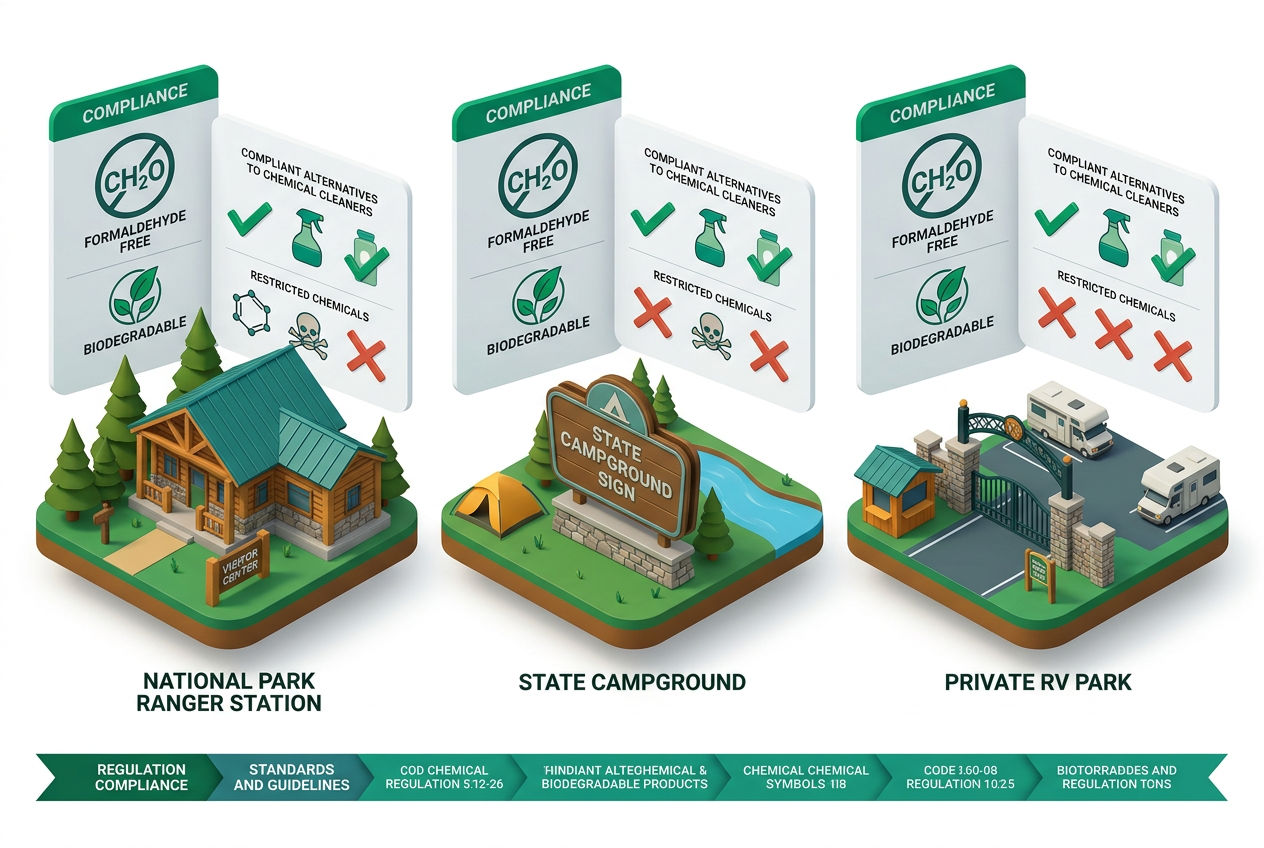
The U.S. Forest Service extended similar restrictions to its Pacific Northwest campground network as of 2023, covering the bulk of campgrounds in Washington and Oregon national forests. California state parks prohibit formaldehyde-based treatments at all dump stations within the state park system. Several northeast states — including Vermont and Maine — have enacted or are actively considering similar prohibitions.
The practical compliance check: if your treatment label lists formaldehyde, formalin, glutaraldehyde, or quaternary ammonium compounds as active ingredients, it is not compliant at NPS sites and should be considered restricted at any campground that posts treatment requirements. Formaldehyde-free enzyme and bacterial treatments — Happy Campers, Walex Bio-Pak, Camco TST MAX, Aqua-Kem Green — are compliant at all current restriction sites.
Traveling to a new region? Check the campground's posted dump station rules before arrival. For help locating compliant dump stations, see our RV dump station finder and pumping service guide.
Free download
Free: the Septic Fridge Card — what to flush, what never to.
The Do / Don’t card the whole family can see, plus the Survival Kit: emergency flowchart, warning-sign decoder and pump-schedule card. One printable PDF.
Sources & Methodology
RV Industry Association (RVIA): Trip frequency data and tank capacity ranges drawn from RVIA's 2024 Go RVing consumer survey and member technical specifications.
EPA Septic Safety Guidance: Product compatibility statements referenced from EPA's "Homeowner's Guide to Septic Systems," current as of 2024.
University of Arkansas Cooperative Extension Service: Research on septic tank additive effects, published through the university's water quality program. Referenced for septic compatibility assessment.
National Park Service: Formaldehyde prohibition policy confirmed via NPS operational directive on dump station standards, current as of January 2025.
U.S. Forest Service Pacific Northwest Region: Campground restriction data confirmed via USFS Pacific Northwest Region campground standards documentation, updated 2023.
Pricing methodology: Per-use cost calculations based on retail pricing at Amazon, Walmart, and Camping World as of June 2025, using standard package sizes and manufacturer-recommended dosing. Prices subject to change.
For a comparison of how RV waste systems differ from residential systems, see our overview of RV septic vs. house septic.
Frequently Asked Questions
What is the best RV black tank treatment for full-time RVers?
Bacterial treatments — specifically those using Bacillus bacterial strains — are the best option for full-time RVers because continuous tank use benefits from active, colonizing bacteria rather than single-dose enzyme applications. Walex Bio-Pak Natural Holding Tank Deodorizer is the most practical format: pre-measured drop-in bags eliminate dosing errors and work consistently across the 40-gallon tank range common in full-time rigs. Happy Campers Organic RV Holding Tank Treatment is a strong runner-up in powder form at a lower cost per use, approximately $0.75 versus $1.50 for Bio-Pak. Full-timers should also maintain a consistent water level of at least ¼ tank between dumps — bacterial colonies need a wet environment to remain active. In climates below 50°F, switch to enzyme-only treatments because bacterial activity drops off sharply in cold conditions. For a full maintenance schedule, see our complete RV holding tank guide.
How do you use RV black tank treatment correctly?
Add treatment immediately after dumping — not before, and not in the middle of a trip. The correct sequence: dump completely, flush the tank interior for 3–5 minutes using a built-in flush port or rinse wand, close the dump valve completely, then add your treatment directly through the toilet. Follow immediately with at least two toilet flushes to push 2–3 gallons of water into the tank. This water is not optional — treatment dropped into a dry tank sits on the floor and achieves almost nothing. Standard dose is one tablet, one pod, or 2–4 oz of liquid per 40 gallons of tank capacity. Adjust proportionally for smaller tanks. If your tank is 20 gallons, use half a dose. After treatment, aim to maintain a ¼-full water level throughout the trip. This keeps enzymes and bacteria suspended where waste accumulates rather than pooled at the lowest point.
Is RV holding tank treatment safe for septic systems?
Only treatments with explicit septic-safe labeling are safe for residential septic systems. Enzyme-based and bacterial RV holding tank treatments — including Happy Campers, Walex Bio-Pak, and Camco TST MAX — carry this designation and are compatible with septic function because they introduce beneficial microbial activity rather than disrupting it. Traditional chemical treatments using formaldehyde, formalin, or glutaraldehyde are not septic-safe and should never be dumped into a home septic system. These biocides kill the bacterial colonies that a functioning septic tank depends on to process waste. According to the University of Arkansas Cooperative Extension Service, biocide-based products showed measurable negative impact on septic microbial populations after repeated introduction. If you regularly dump at home, confirm your product's septic-safe status on the label — not the product name, which can be misleading — before each season. See our guide to septic-safe cleaning products for a verified product list.
Why does my RV black tank still smell even after treatment?
If odor persists after correct treatment application, check these three causes in order. First, confirm you're adding at least 2 gallons of water with each treatment dose — dry tanks with undissolved treatment produce almost no odor control. Second, check whether odor is coming from the toilet or from a roof vent above your living space. If it's the vent, the problem is tank gas escaping upward through the vent stack rather than treatment failure — this is a vent pipe issue, not a chemistry issue. Third, confirm your dump valve is fully closed. A valve that doesn't seat completely allows gas to escape continuously regardless of treatment quality. If all three check out, consider switching from a chemical treatment to an enzyme or bacterial RV tank treatment — chemical treatments suppress odor with fragrance rather than eliminating the biological source of it, and the masking effect degrades within 48–72 hours in warm conditions.
What is the difference between RV black tank treatment and RV black tank cleaner?
RV black tank treatment is added after every dump to break down waste, control odor, and maintain sensor accuracy during active use. It works continuously while the tank is in service. RV black tank cleaner is a separate product — typically a stronger enzyme concentrate, a solvent-based rinse, or a mechanical agitation process — used periodically to remove buildup from tank walls, floor, and sensor probes that routine treatment doesn't fully address. Most RVers need a dedicated cleaner two to four times per year, more frequently if sensors are reading inaccurately or if the tank has gone through periods of inadequate treatment. Using only treatment without occasional cleaning allows residue to accumulate over seasons until sensors fail and odor control degrades even with correct treatment application. Think of treatment as daily maintenance and cleaner as periodic restoration. See our RV black tank cleaner guide for specific product recommendations and cleaning schedules by rig type.
Are formaldehyde-based RV treatments banned at national parks?
Yes. Formaldehyde-based RV treatments are prohibited across the entire National Park Service system — this applies to all national parks, monuments, and recreation areas without exception. The NPS ban covers any product with formaldehyde, formalin, or glutaraldehyde listed as active ingredients. Beyond the NPS, the U.S. Forest Service extended equivalent restrictions to its Pacific Northwest campground network as of 2023, and California's state park system prohibits formaldehyde-based treatments at all dump stations statewide. To confirm compliance before arrival, check your treatment label for these specific ingredient names — product names like "Aqua-Kem Original" do not always make restriction status obvious. Compliant alternatives available at most camping retailers include Happy Campers Organic RV Holding Tank Treatment, Walex Bio-Pak, Camco TST MAX, and Aqua-Kem Green. All four are formaldehyde-free, NPS-approved, and broadly available at Walmart, Amazon, and Camping World as of June 2025.
Was this article helpful?
Frequently Asked Questions
Recommended Resources
📖 Related Articles
Find Septic Professionals Near You
Compare licensed, verified septic companies by area — top county markets and cities below, or browse all 50 states.
County markets
Popular cities
