
Quick Answer
A greywater system captures household wastewater from sinks, showers, bathtubs, and washing machines and redirects it for outdoor irrigation instead of sending it to your septic tank or sewer. Greywater makes up 50–80% of total indoor water use, meaning a typical family of four generates 40–60 gallons of reusable greywater every single day.
Key Takeaways
- Greywater is wastewater from sinks, showers, and laundry — not toilets. Toilet waste is blackwater and cannot be reused.
- A laundry-to-landscape system is the easiest DIY greywater entry point, costing $50–$500 in materials.
- Greywater reuse can reduce septic system load by 40–50%, extending tank life and reducing pump-out frequency.
- Legality varies dramatically by state. California allows up to 250 gallons/day; Arizona allows up to 400 gallons/day without a permit.
- Never apply greywater to edible plant surfaces, and always use plant-safe, low-sodium soaps.
What Is the Difference Between Greywater and Blackwater?
Greywater is wastewater that has never contacted toilet waste. It comes from your bathroom sink, bathtub, shower, and clothes washer. Blackwater is everything that goes down your toilet — urine, feces, and toilet paper — along with water from kitchen sinks, which carry high concentrations of food particles and grease. Blackwater requires full septic treatment. Greywater, with the right handling, can be safely reused for subsurface irrigation.
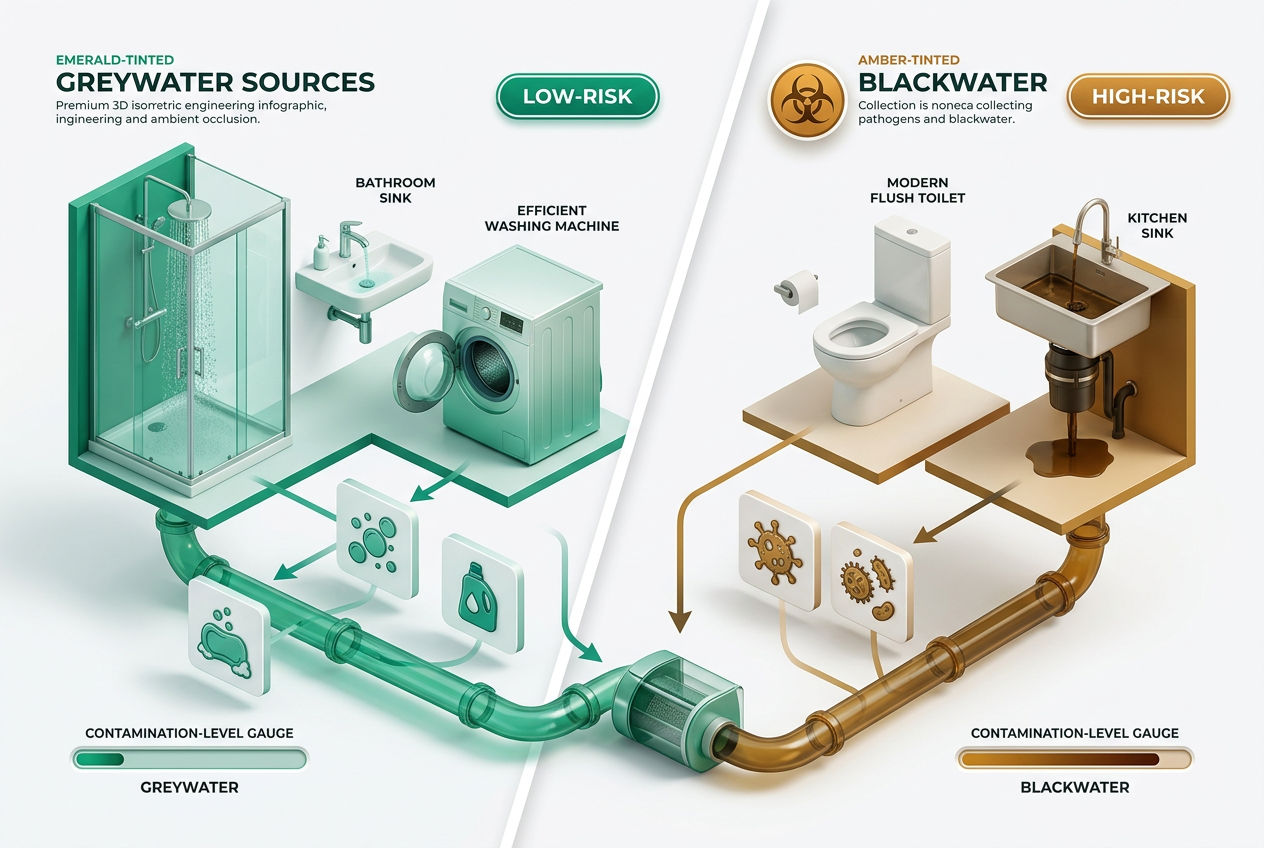
This distinction matters legally and mechanically. Most state greywater codes explicitly prohibit kitchen sink water from entering a greywater system because of pathogen and fats/oils/grease (FOG) content. If your system accidentally picks up kitchen drain lines, you've got a grease trap problem on your hands, not a greywater system.
The rule of thumb: if it touched human waste or raw food, it's blackwater. Everything else is potentially greywater.
How Does a Greywater System Work?
A greywater system intercepts household wastewater at the drain level — before it reaches your septic tank — and routes it to a secondary use point, typically subsurface landscape irrigation. The mechanics depend on system type, but all greywater systems share three core functions: collection, minimal treatment, and dispersal.
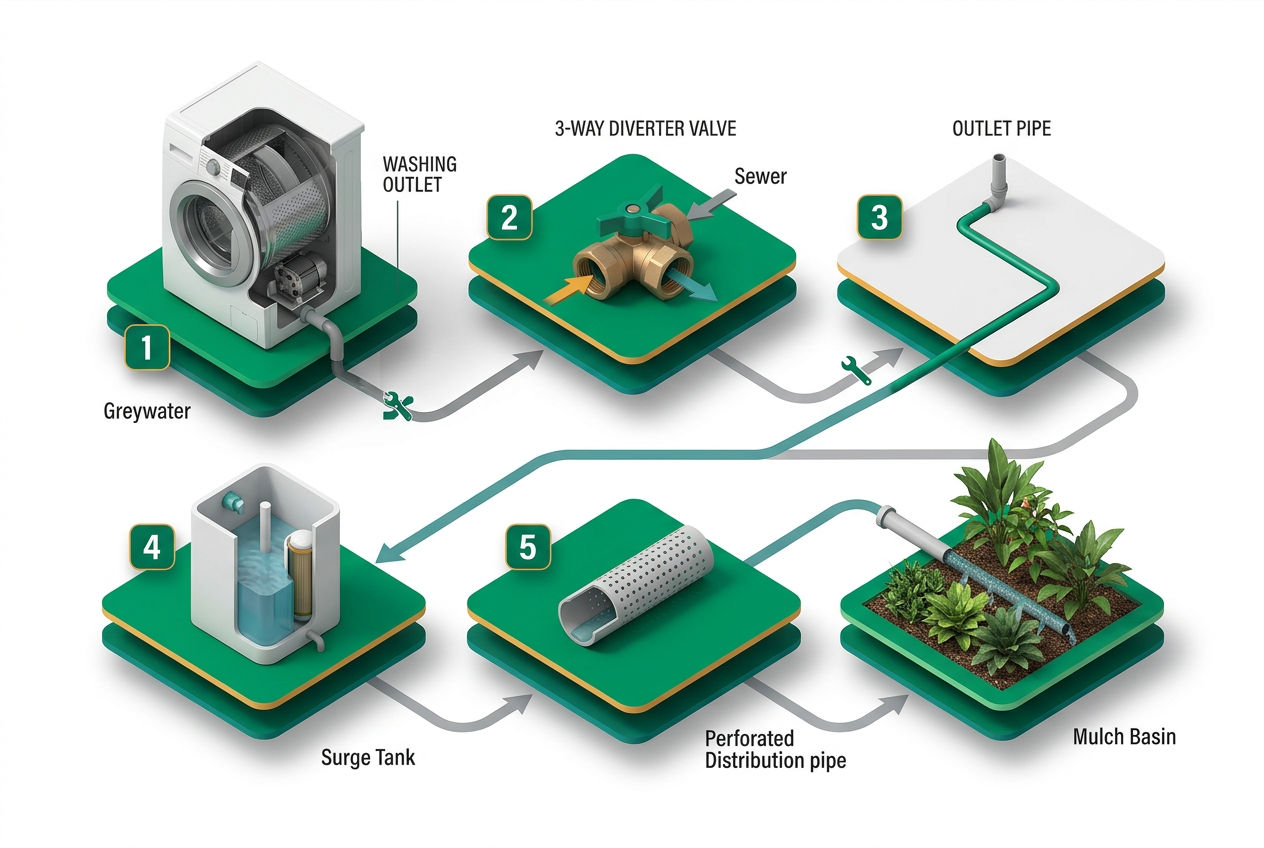
Collection happens at the source drain. A three-way diverter valve (sometimes called a drum valve or laundry diverter) splits flow between your existing septic/sewer connection and the greywater outlet. In a laundry-to-landscape system, this valve is typically installed at the washing machine drain standpipe using 1.5-inch ABS or PVC pipe.
Treatment in basic systems is minimal — a simple mesh or lint filter catches hair, fibers, and solids. More advanced systems use a surge tank (a 30–55 gallon holding vessel) to buffer irregular flow, followed by a gravel or sand filter, and sometimes a constructed wetland for additional biological treatment.
Dispersal almost universally means subsurface application into mulch basins around trees and shrubs. Surface application of untreated greywater is illegal in most states. Water moves through the soil at rates that depend on your soil type — sandy loam drains roughly 1–2 inches per hour, while clay soils may only manage 0.1–0.5 inches per hour. That affects how you size your mulch basins.
What Types of Greywater Systems Are There?
There are five main greywater system types, ranging from simple DIY greywater setups you can build in an afternoon to professionally installed treatment systems designed for whole-house reuse. Choosing the right one depends on your household water volume, property size, soil type, and budget.
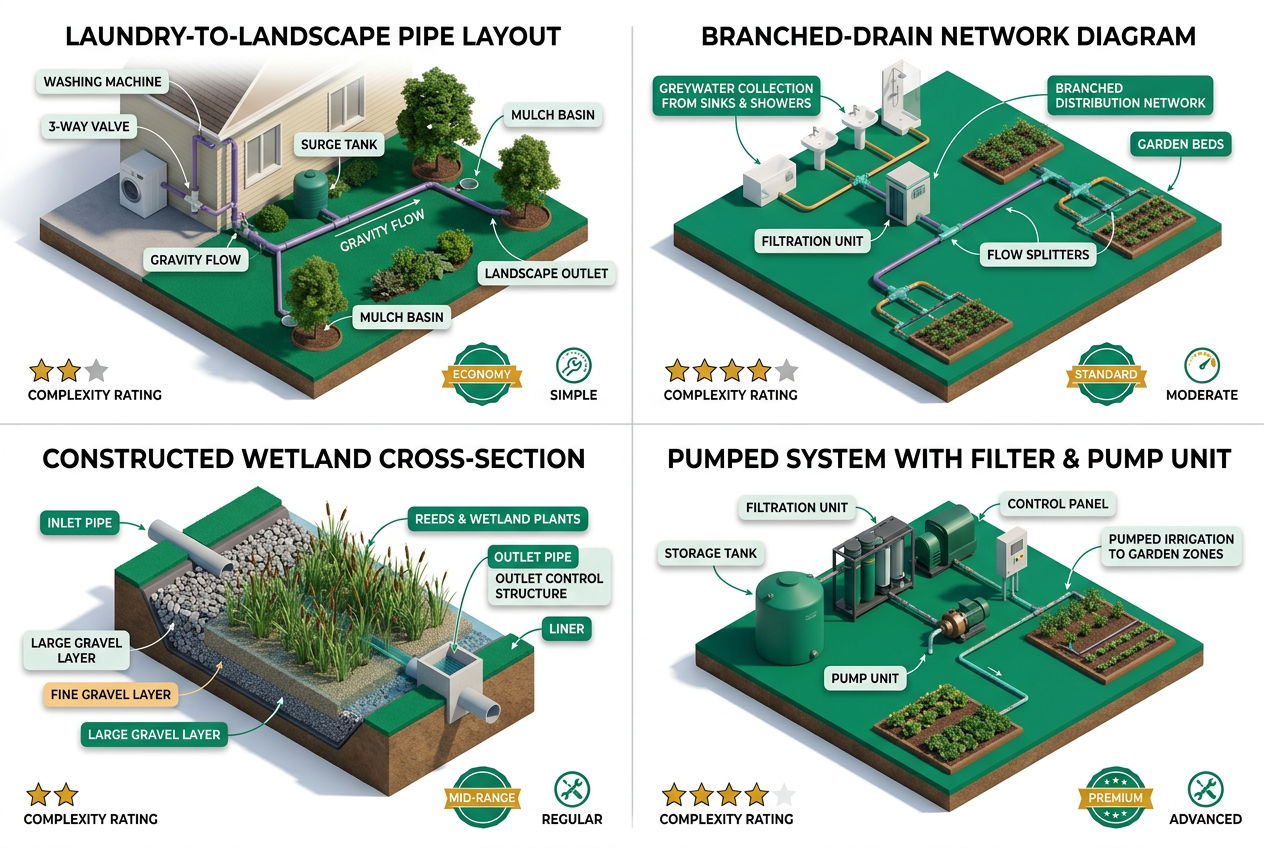
| System Type | Typical Cost (DIY) | Complexity | Best For |
|---|---|---|---|
| Laundry-to-Landscape | $50–$500 | Low | Single-source irrigation |
| Branched Drain System | $200–$800 | Medium | Multi-fixture gravity fed |
| Surge Tank System | $800–$2,500 | Medium-High | Higher volume, more control |
| Constructed Wetland | $1,500–$5,000 | High | Naturalized treatment |
| Professional Treatment System | $5,000–$20,000+ | Installed | Full household reuse |
Sources: Oasis Design Greywater Guidelines; Arizona Department of Environmental Quality; California State Water Resources Control Board
Laundry-to-landscape (L2L) is by far the most common DIY setup. Your washing machine already has a pump, so no additional pump is needed — the machine ejects water under pressure directly into your outdoor distribution lines.
Branched drain systems use gravity to distribute sink and shower water through a network of 2-inch ABS pipes that "branch" using 1/8-bend fittings. Every branch must maintain a minimum ¼-inch drop per foot of horizontal run. These systems require careful planning but zero moving parts.
Surge tanks collect greywater temporarily and release it in controlled doses, which works better for soil absorption and prevents flooding mulch basins. A 55-gallon polyethylene tank with a float valve and a 1/3 HP effluent pump is a common setup.
Constructed wetlands use gravel beds, sand filters, and wetland plant species like bulrushes or cattails to provide biological treatment before water reaches irrigation zones. These are well-suited to rural properties with more space, and they align naturally with off-grid water system planning.
Is a Greywater System Legal in My State?
Greywater reuse law is determined at the state level and often varies further at the county or municipal level. As of 2024, more than 20 states have explicit greywater reuse statutes or administrative guidelines, according to the EPA's WaterSense program and state water board records.
Here's what the regulations look like across key regions:
California (Title 22, California Code of Regulations): Single-family residential systems may discharge up to 250 gallons per day. Laundry-to-landscape systems under 250 gallons/day require no permit but must follow specific setback rules — 100 feet from a water well, 5 feet from property lines, and water must be applied subsurface.
Arizona (Arizona Administrative Code R18-9-711): Allows greywater reuse up to 400 gallons per day without a permit for single-family homes. One of the most permissive frameworks in the country.
Colorado: Legalized greywater reuse in 2013 under HB13-1044. Municipalities must opt in, so check with your county before building.
Texas: Regulations are handled at the county level through Designated Representatives under the Texas Commission on Environmental Quality (TCEQ). Rules vary significantly from county to county.
Northeast states: Many northeastern states historically restricted or prohibited greywater reuse outright, though this is slowly changing. Check with your state health department directly.
The bottom line: Before you buy a single fitting, call your county health department and ask specifically about greywater reuse permits. In many states, an unpermitted system that's discovered during a property sale can create real legal and financial headaches. Our septic system permit requirements guide covers the inspection and permitting landscape in more depth.
Does a Greywater System Reduce Septic Tank Load?
Yes — substantially. A functioning greywater diversion system can reduce the volume of wastewater entering your septic tank by 40–50%, according to guidance published by the University of Arizona Cooperative Extension. For a household generating 200 gallons of daily wastewater, that's 80–100 gallons per day that never reaches your tank.
What does that mean practically? If you're on a 1,000-gallon septic tank serving four people, you'd normally pump every 3–4 years. Divert the laundry and shower water, and that interval can extend to 5–6 years — potentially saving you $300–600 per pump-out cycle. Check our septic pumping cost guide for current pricing in your region.
For homeowners with a struggling drain field or elevated effluent levels, greywater diversion isn't a cure — but it reduces hydraulic load long enough to buy time for repairs. If your drain field is already saturated and failing, greywater diversion alone won't save it. You'll need professional drain field repair alongside any water conservation effort.
How Do You Build a Laundry-to-Landscape Greywater System?
The laundry-to-landscape system is the right starting point for most homeowners. Here's how to build one.
What You'll Need
- 3-way diverter valve (Orbit or similar, ¾-inch barb fittings)
- 1–1.5-inch diameter polyethylene tubing (200 psi rated)
- Mulch (wood chips work best — bark mulch can get slimy)
- A drill with a spade bit for wall penetration
- Zip ties, pipe clamps, and UV-resistant tape
- Optional: inline filter sock (100-micron mesh) to catch lint
Total material cost for a basic setup: $75–$200 at a home improvement store.
Step 1 — Check Your Local Rules
Before anything else, confirm your county allows L2L systems. In California, you're typically in the clear for systems under 250 gallons/day without a permit. In Texas, you'll need to contact your county.
Step 2 — Install the Diverter Valve
Locate your washing machine's drain standpipe (the vertical pipe your washer hose empties into). Install the 3-way diverter valve inline. One outlet goes to your existing drain line (your septic or sewer connection stays intact — you want to be able to flip back to normal drainage in wet weather or if you're washing clothes with bleach). The second outlet connects to your outdoor greywater line. Most diverter valves have a simple lever handle. Flip it one way: water goes to septic. Flip the other way: water heads to the yard.
Step 3 — Run Your Greywater Line
Use 1-inch polyethylene tubing (not standard garden hose — it won't handle the pressure from a washing machine pump). Route the tubing through a drilled hole in your foundation wall or under a door threshold, then out to your distribution zone. Keep the line as short and direct as possible. Every additional 10 feet of tubing adds minor friction losses, though the washing machine pump can typically handle runs up to 150 feet.
Step 4 — Build Your Mulch Basins
Dig shallow basins (6–8 inches deep, 2–3 feet wide) around the base of each target tree or shrub. Fill with 4–6 inches of wood chip mulch. Your greywater line terminates just above the mulch surface — never spray or surface-apply. The mulch acts as a biological filter and distributes water across a wider root zone. For greywater irrigation of an established fruit tree, a single basin handles roughly 10–15 gallons per wash cycle effectively.
Step 5 — Test and Monitor
Run a test cycle with plain water first. Watch for pooling, runoff, or slow absorption. If water ponds for more than 30 minutes, your basin is undersized for your soil drainage rate. Expand the basin footprint or add a second distribution point. After the first real laundry cycle, check for odors — fresh greywater shouldn't smell bad. Any sulfur or sewage smell means the water is going anaerobic in a blockage somewhere in the line.
Is Greywater Safe to Use in the Garden?
DIY Septic Blueprint
Thinking about building it yourself?
The complete, plain-English plan to size, permit and install your own septic system — designed for homeowners, not contractors. Skip the $15,000–$25,000 quotes and do it right the first time.
Get the DIY Blueprint — $67 →Instant download · 8 modules + 3 bonus guides · 60-day money-back guaranteeProperly applied greywater is safe for irrigating trees, shrubs, and ornamental plants. The critical factors are application method, soap chemistry, and what you're growing.
What greywater irrigation can water safely:
- Established fruit trees (subsurface application only — no contact with fruit)
- Ornamental shrubs and perennials
- Lawn grass (with appropriate treatment systems only)
- Native plants with moderate water tolerance
What greywater should never touch:
- Leafy vegetables, root vegetables, or any food crop where water contacts the edible portion
- Seedlings or newly germinated plants (more sensitive to sodium and pathogens)
- Edible herbs grown close to the soil surface
The chemistry of your soaps and detergents matters enormously. Standard detergents high in sodium can cause sodium buildup in your soil over time, degrading soil structure through a process measurable by the sodium adsorption ratio (SAR) — a methodology detailed by Oasis Design's greywater guidelines. Soaps with a SAR above 6–9 are considered damaging to most soils with extended use.
Greywater-safe products recommended for L2L systems include:
- Ecos Free & Clear (plant-derived, low sodium)
- Seventh Generation Free & Clear (phosphate-free, biodegradable)
- Oasis Laundry Detergent (formulated specifically for greywater reuse)
Avoid any detergent containing boron, chlorine bleach, or optical brighteners. These compounds are toxic to soil microorganisms and can accumulate in plant tissue. For more on detergent compatibility with your overall system, see our guide on septic-safe laundry detergent.
What Does a Greywater System Cost?
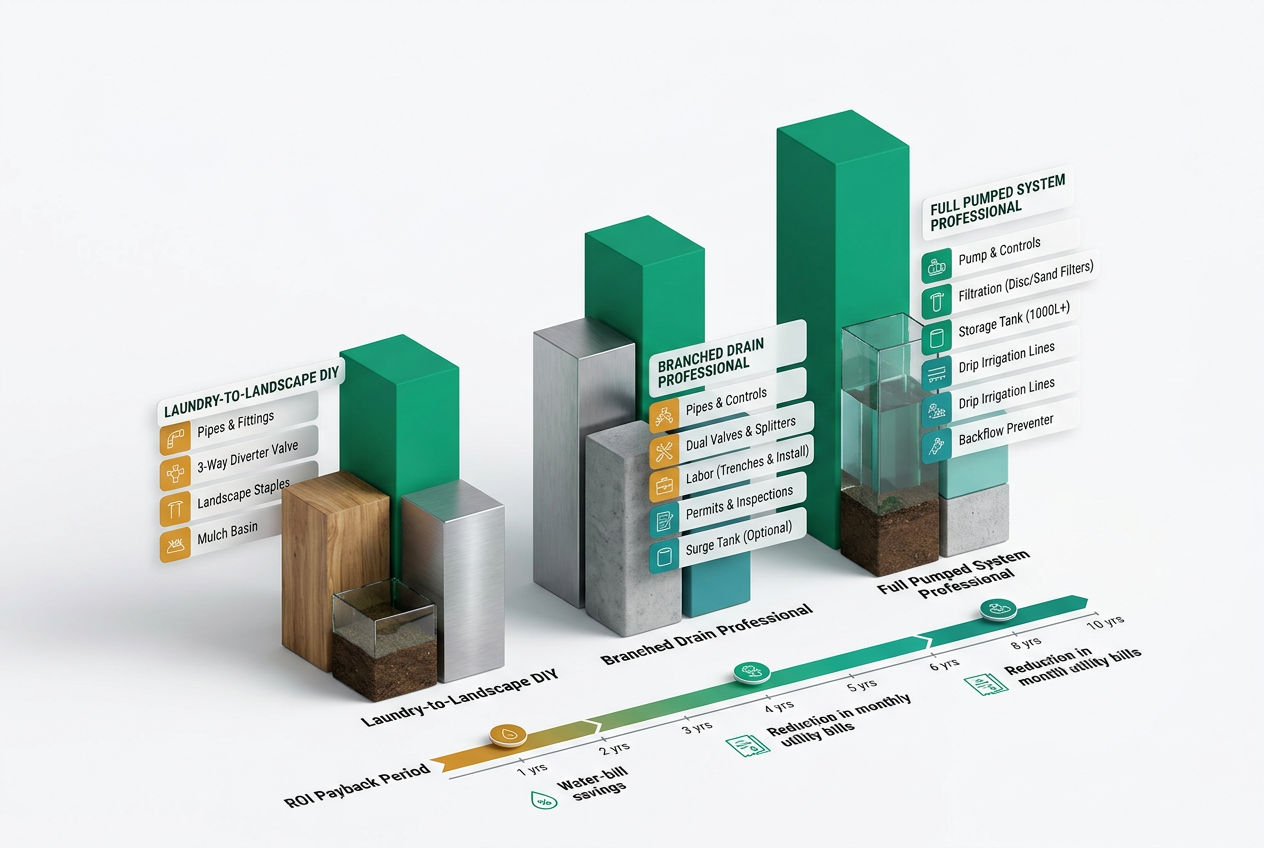
Building a basic laundry-to-landscape system yourself costs $50–$500 in materials, making it one of the most accessible home water conservation projects available. Installed costs scale significantly with system complexity.
| System Type | DIY Material Cost | Professionally Installed |
|---|---|---|
| Laundry-to-Landscape | $50–$500 | $500–$2,000 |
| Branched Drain | $200–$800 | $1,500–$4,000 |
| Surge Tank System | $800–$2,500 | $3,000–$8,000 |
| Constructed Wetland | $1,500–$5,000 | $5,000–$15,000 |
| Full Treatment System | N/A DIY | $10,000–$25,000+ |
Where the money goes in a DIY greywater build:
- Diverter valve: $20–$60
- Polyethylene tubing (50 ft): $30–$80
- Fittings, clamps, and hardware: $20–$50
- Mulch (1–2 cubic yards): $30–$80
- Optional lint filter: $15–$40
- Optional surge tank (55-gallon poly drum): $80–$150
Return on investment depends heavily on your local water rates and climate. In water-stressed regions like Southern California or Arizona, payback periods on mid-range installed systems typically run 2–5 years. In areas where water is cheap and abundant, the financial case is weaker — but septic system longevity benefits still apply regardless of water cost.
A septic inspection before installing any greywater system is worthwhile. If your tank or drain field is already stressed, knowing that upfront helps you right-size the greywater diversion volume for maximum impact.
How Do You Winterize Your Greywater System?
If you're in USDA Hardiness Zones 1–6 (Minnesota, Wisconsin, Montana, and most of the Northeast), your outdoor greywater lines need to be winterized before the first hard freeze. Water left sitting in polyethylene tubing below 32°F will expand and crack fittings, split tubing, and potentially damage your diverter valve.
Basic winterization procedure:
- Flip your diverter valve back to the septic/sewer position before the first freeze. This stops any greywater from entering outdoor lines.
- Disconnect the outdoor tubing at the exterior wall penetration point.
- Install a blow-out fitting — a ¾-inch Schrader valve adapter — at the highest point of your outdoor line.
- Use a shop vac on reverse (blowing mode) or a compressor set to 15–20 PSI to push remaining water out through the open end of your distribution tubing.
- Leave the end caps off your mulch basin emitters through winter so any residual moisture can drain and evaporate.
- Bring any above-ground surge tank components (float valves, effluent pump) indoors for winter storage.
In USDA Zones 7–8 (Pacific Northwest, mid-Atlantic, upper South), light freeze events may not require full winterization — but it's worth insulating any above-ground sections of tubing with pipe wrap foam and monitoring the forecast. A single hard freeze night can crack an uninsulated fitting even in normally mild climates.
Come spring, flush your system with clean water before putting it back into greywater service. This clears any debris that settled over winter and confirms all fittings held through the freeze-thaw cycle.
Frequently Asked Questions About Greywater Systems
What is a greywater system and how does it work?
A greywater system is a plumbing setup that captures wastewater from household sinks, showers, bathtubs, and washing machines — but not toilets — and redirects it for outdoor irrigation rather than sending it to a septic tank or municipal sewer. The system works through three core stages: collection via a diverter valve installed at the source drain, minimal treatment through mesh filters or a surge tank, and dispersal into subsurface mulch basins around trees and shrubs. In a laundry-to-landscape system, the washing machine's built-in pump provides the pressure needed to move water outdoors without any additional equipment. More complex systems add surge tanks, gravel filters, and even constructed wetlands for greater biological treatment. The key principle is that greywater must be applied below the soil surface — direct surface spraying of untreated greywater is illegal in most U.S. states and creates pathogen exposure risks.
Is greywater irrigation safe for gardens and plants?
Greywater irrigation is safe for established trees, shrubs, and ornamental plants when applied subsurface through mulch basins and when plant-safe soaps are used. The two main risks are pathogen exposure and sodium accumulation in soil. Pathogen risk is managed by never allowing greywater contact with edible plant surfaces — fruit trees irrigated at the root zone are fine, but leafy vegetables or root crops should never receive greywater. Sodium risk is managed by choosing low-sodium, biodegradable detergents such as Ecos Free & Clear, Seventh Generation Free & Clear, or Oasis Laundry Detergent — all of which are formulated with greywater reuse in mind. Avoid detergents containing boron, bleach, or optical brighteners, which are toxic to soil microorganisms. With correct soap selection and subsurface application, greywater irrigation poses minimal risk and significant water savings.
How much does a DIY greywater system cost to build?
A DIY greywater system costs between $50 and $500 in materials for a basic laundry-to-landscape setup, making it one of the most affordable home water conservation projects available. The core components are a three-way diverter valve ($20–$60), polyethylene tubing ($30–$80 for 50 feet), fittings and clamps ($20–$50), and wood chip mulch for basins ($30–$80 per cubic yard). An optional inline lint filter adds $15–$40 and significantly extends system lifespan by preventing fiber buildup in distribution lines. More complex systems — surge tanks, branched drain networks, or constructed wetlands — run $800 to $5,000 in DIY materials. Professionally installed systems range from $500 for a basic L2L setup to over $25,000 for a full household treatment system. In water-stressed regions like Arizona or Southern California, payback on mid-range installed systems typically runs 2–5 years based on reduced water bills and extended septic pump-out intervals.
What is the difference between greywater and blackwater?
Greywater is household wastewater that has never contacted toilet waste — it originates from bathroom sinks, showers, bathtubs, and washing machines. Blackwater is wastewater from toilets (containing urine, feces, and toilet paper) and kitchen sinks (which carry food particles, grease, and high pathogen loads). The distinction is critical both legally and mechanically. Blackwater requires full septic treatment and cannot be safely reused through a residential greywater system. Kitchen sink water is specifically excluded from greywater reuse in most state codes due to its high fats, oils, and grease (FOG) content, which clogs distribution lines and creates pathogen risks. Most state greywater regulations define this boundary explicitly — Arizona Administrative Code R18-9-711 and California Title 22 both draw the line at toilet and kitchen waste. The practical rule: if water touched human waste or raw food, treat it as blackwater.
Do you need a permit for a greywater system?
Permit requirements for a greywater system vary by state and county. In California, laundry-to-landscape systems under 250 gallons per day require no permit for single-family homes under Title 22, but must meet setback requirements — 100 feet from a water well and 5 feet from property lines. Arizona is the most permissive state, allowing greywater reuse up to 400 gallons per day without a permit under Arizona Administrative Code R18-9-711. Colorado legalized greywater reuse statewide in 2013 under HB13-1044 but requires municipalities to opt in, so county-level verification is essential. Texas handles permits at the county level through the Texas Commission on Environmental Quality, with rules varying significantly by jurisdiction. Many northeastern states historically restricted greywater reuse entirely, though regulations are evolving. Before purchasing any materials, contact your county health department directly and ask specifically about greywater reuse permits to avoid legal complications during future property sales.
What is a greywater filter and do I need one?
A greywater filter is a screening device installed in-line with your greywater system to remove hair, lint, food particles, and solid debris before water reaches your distribution lines or mulch basins. For laundry-to-landscape systems, the most common option is an inline filter sock — a 100-micron mesh sleeve that fits over the outlet pipe and captures washing machine lint before it can clog polyethylene tubing or compact mulch basins. Filter socks cost $15–$40 and need cleaning every two to four weeks depending on laundry volume. More advanced systems use gravel pre-filters or sand filters ahead of surge tanks to handle higher solids loads from multiple fixtures. A greywater filter is not legally required in most jurisdictions for basic L2L systems, but it is strongly recommended: clogged distribution lines are the most common cause of greywater system failure, and a simple filter sock prevents the majority of blockages with minimal maintenance effort.
Sources & Methodology
-
California State Water Resources Control Board — Title 22, California Code of Regulations, greywater reuse standards for single-family residential systems. waterboards.ca.gov
-
Arizona Department of Environmental Quality — Arizona Administrative Code R18-9-711, Type 1 Recycled Water General Permit for greywater reuse. azdeq.gov
-
University of Arizona Cooperative Extension — "Residential Greywater Reuse," publication detailing septic load reduction estimates of 40–50% for functioning greywater diversion systems.
-
Oasis Design — "The New Create an Oasis with Greywater" by Art Ludwig. Primary reference for branched drain system design, sodium adsorption ratio methodology, and system sizing guidelines. oasisdesign.net
-
U.S. Environmental Protection Agency WaterSense Program — State greywater reuse statute tracking, confirming 20+ states with explicit reuse guidelines as of 2024. epa.gov/watersense
Free download
Not ready for the Blueprint? Start free.
Grab the free DIY Septic Planning Kit — the permit-first checklist, perc-test cheat sheet, and sizing tables that keep your build from getting red-tagged.
Was this article helpful?
Frequently Asked Questions
Recommended Resources
📖 Related Articles
💰 Cost Guides
🔧 Services
Find Septic Professionals Near You
Compare licensed, verified septic companies by area — top county markets and cities below, or browse all 50 states.
County markets
Popular cities
