
Quick Answer
A composting toilet works by separating liquid from solid waste, then using aerobic decomposition, heat, and airflow to break solids down into a dry, soil-like material called humus. The process uses no water, produces virtually no wastewater, and can reduce your original waste volume by up to 90% — making it one of the most practical off-grid toilet solutions available.
Key Takeaways
- Composting toilets use aerobic decomposition — not chemicals or water — to process human waste safely.
- Most self-contained units reduce waste volume by up to 90%, leaving a small amount of finished humus behind.
- A household of four may only empty the compost chamber 2–4 times per year.
- Composting toilets are legal in all 50 states in some form, but local health codes govern exactly how and where you can use one.
- Units range from $500 for basic self-contained models to $10,000+ for central systems with remote composting chambers.
What Actually Happens Inside a Composting Toilet?
The core process is aerobic decomposition — the same biological breakdown that turns your kitchen scraps into garden compost. Aerobic means the microbes doing the work need oxygen to survive. That's why airflow is built into every composting toilet design.
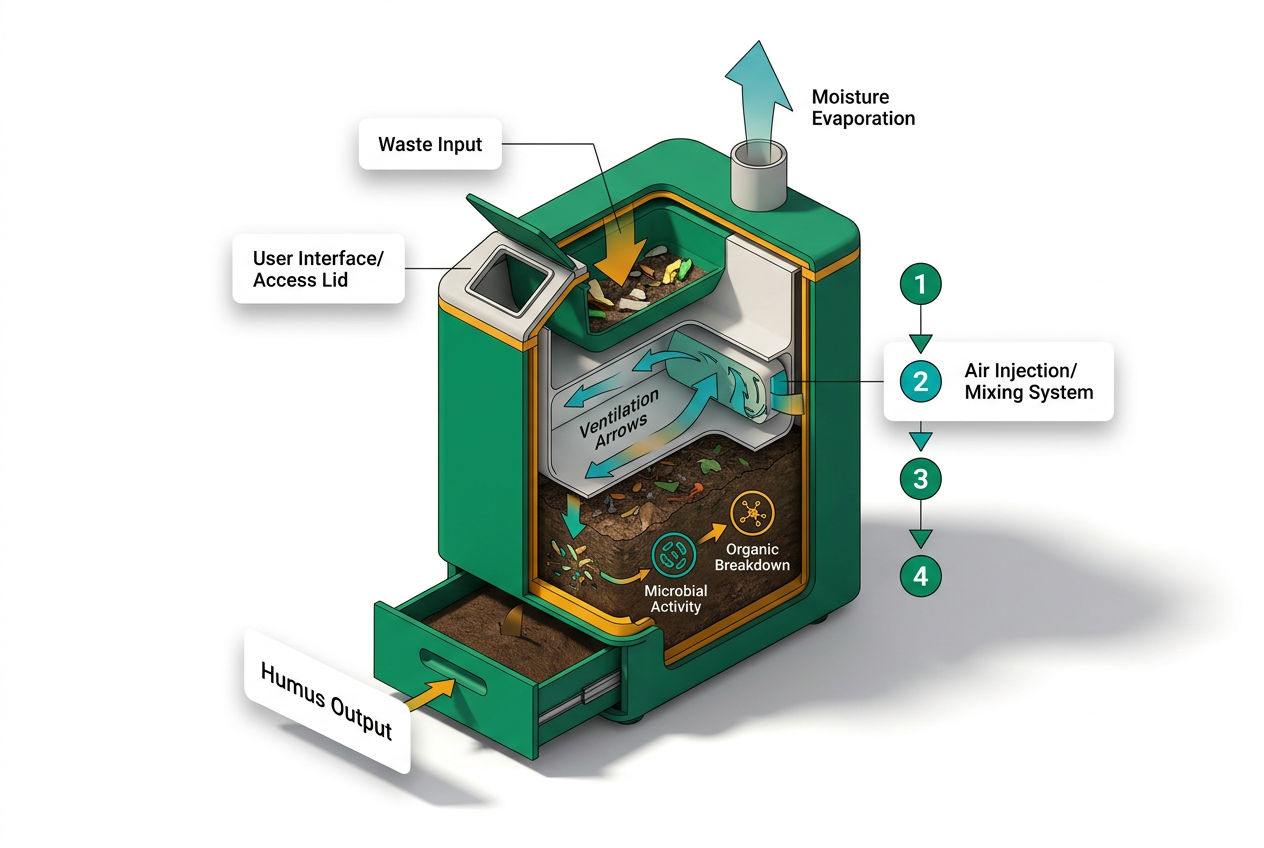
Here's the sequence, step by step:
- Waste enters the composting chamber. Solid waste falls directly into an insulated composting drum or bin. Most modern units use urine diversion — a shaped bowl that routes liquid to a separate container or evaporation chamber — because too much moisture kills the aerobic microbes that do the heavy lifting.
- You add a bulking agent. After each use, you drop in a small handful of carbon material — typically peat moss or coconut coir. This absorbs moisture, balances the carbon-to-nitrogen ratio, and adds the air pockets microbes need to thrive.
- A fan moves air through the system. Most units have a small 12V or 120V fan that pulls air through the waste chamber and vents it outside through a small pipe (similar in diameter to a dryer vent). This keeps odors from drifting back into the room and supplies oxygen to the decomposers.
- Heat speeds things up. Optimal decomposition happens between 55°F and 95°F (13°C–35°C). Many units include a low-wattage heating element to maintain temperature and boost evaporation. In a heated cabin or tiny home, ambient warmth often does the job on its own.
- Time finishes the work. The full composting cycle takes 3–6 months before the end product is safe to handle. Finished humus is a dark, dry, odorless material — closer to potting soil than anything you'd associate with a toilet. The 10:1 reduction in waste mass is why emptying is so infrequent.
When the system is maintained correctly — consistent bulking agent, functional urine diversion, unobstructed vent — the biology does exactly what it's supposed to do.
What Are the Different Types of Composting Toilets?
The two main types are self-contained units and central (remote) systems, and they serve very different installation scenarios.
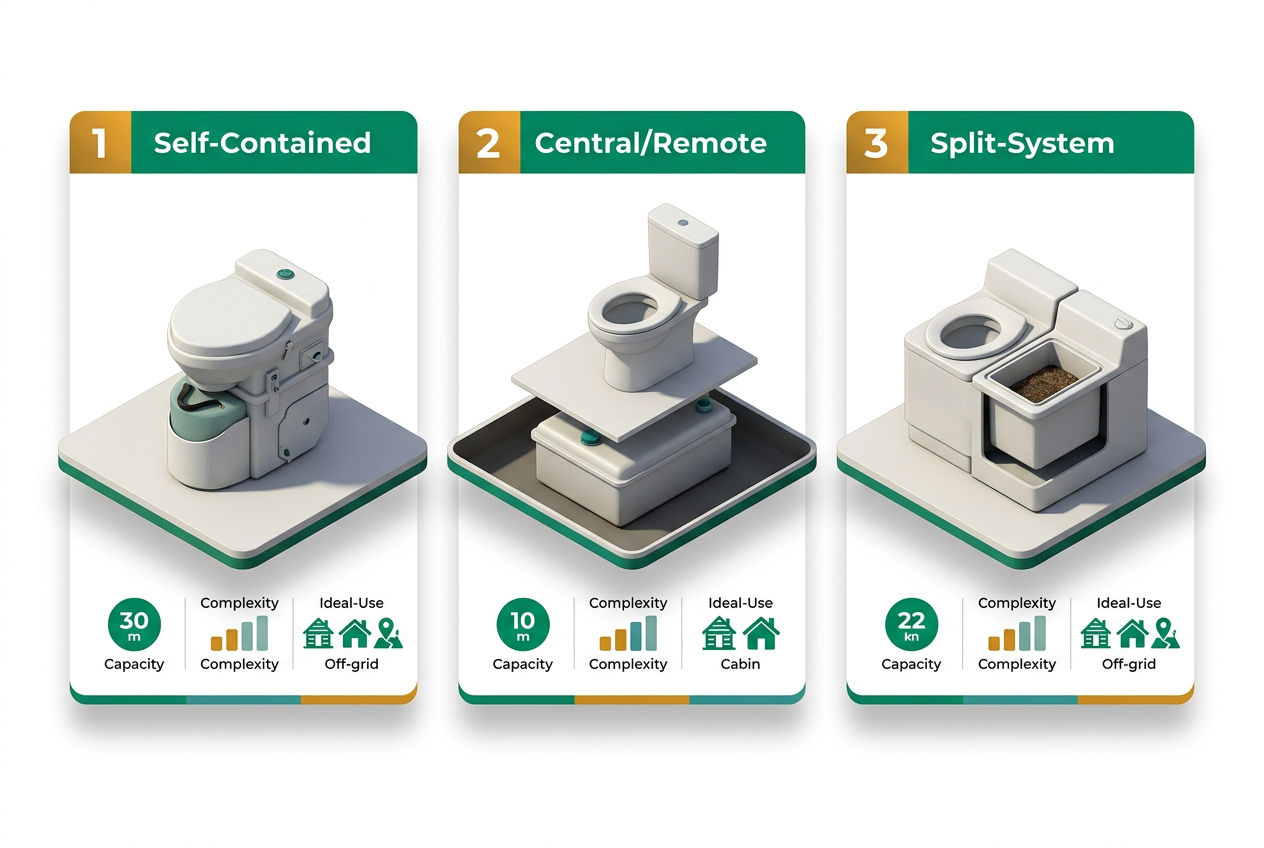
Self-contained composting toilets house everything — the seat, composting chamber, and fan — in a single unit that sits where a conventional toilet would. Brands like Nature's Head and Sun-Mar build popular self-contained models in the $900–$1,500 range. These are common in tiny homes, RVs, boats, and seasonal cabins. They're compact and relatively easy to install, but the composting chamber is small, so proper urine diversion and bulking agent discipline matter more.
Central/remote composting systems keep a larger composting tank in a basement, crawlspace, or outbuilding, connected to one or more toilet fixtures above. Clivus Multrum makes well-known central systems that can handle multiple toilets and higher daily use. These installations cost $1,500–$10,000+ depending on complexity, but the larger chamber means less frequent emptying and more flexibility.
Some systems use vermiculture — composting worms (typically red wigglers) — to accelerate breakdown. This is less common in residential settings but produces an exceptionally rich finished compost.
For RV-specific options, see our RV composting toilet guide.
Does a Composting Toilet Smell Bad?
Managed correctly, a composting toilet should produce less odor than a conventional flush toilet — not more. The negative-pressure fan is the key. It pulls air downward into the composting chamber and exhausts it outside, so any gas produced during decomposition exits through the vent stack before it ever reaches your nose. The fan creates a continuous draw from room air down through the bowl and out the pipe — odor moves away from you, not toward you.
Odor problems almost always trace back to one of three causes:
- Too much liquid in the chamber. If urine diversion isn't working or the evaporation chamber is full, excess moisture shuts down aerobic activity and anaerobic (smelly) decomposition takes over.
- Not enough bulking agent. Skipping the peat moss or coconut coir after each solid deposit throws off the carbon balance. The fix costs you about ten seconds per use.
- A blocked or undersized vent pipe. A 1.5-inch vent will restrict airflow; most manufacturers specify a 2–3 inch pipe run with minimal bends.
High humidity environments — think coastal Georgia or Louisiana in August — can challenge evaporation efficiency. If you're in the Southeast, look for units with active heating elements rather than passive evaporation designs.
How Often Do You Have to Empty a Composting Toilet?
Far less often than you'd expect. A household of four using a properly managed self-contained unit empties the solid chamber roughly 2–4 times per year. A solo occupant in a weekend cabin might go a full year between empties.

The liquid container is a different story. Urine diverted to a separate bottle (common in Nature's Head and Air Head units) needs emptying every 1–3 days for a single person, or every day for two people. That's the trade-off for keeping the solid chamber dry and functional.
When you do empty the solid chamber, finished humus from a unit meeting NSF/ANSI Standard 41 certification can typically be buried or used on non-food ornamental plants — but check your local health department rules first. Some jurisdictions require disposal through a licensed waste hauler regardless of certification status.
Compare this to a conventional septic system installation that costs $3,000–$15,000+ and requires professional pump-outs every 3–5 years. For a remote property where a pump truck can't easily reach, the composting math gets very attractive.
Are Composting Toilets Legal?
Composting toilets are legal in all 50 states in some form, but "legal" and "approved for full-time residential use without any other sanitation system" are very different things.
The benchmark certification you'll see on most quality units is NSF/ANSI Standard 41, the American national standard for non-liquid-discharge composting toilets. The EPA recognizes NSF 41 as the appropriate standard for evaluating these systems. Units without this certification face a harder road to regulatory approval.
Here's where it gets complicated by geography:
- Oregon and Washington have relatively progressive health codes and fairly clear permitting pathways for composting toilets as primary waste systems.
- Colorado and Montana commonly allow them in off-grid cabins and hunting lodges, often with variance permits through county environmental health offices.
- New England states tend to have stricter health codes. In Massachusetts, composting toilets are generally permitted as an alternative system but often still require a conventional greywater system to handle sink and shower discharge.
- Texas delegates sanitation regulation to county-level Designated Representatives, so approval in Travis County (Austin) can look completely different from what's allowed in a rural West Texas county.
- Florida's Department of Health regulates composting toilets under its Onsite Sewage Treatment and Disposal Systems rules — approval is possible but requires an engineered design in most cases.
One point many homeowners miss: a composting toilet only handles toilet waste. Your sinks, shower, and laundry still produce greywater that needs somewhere to go. Most jurisdictions require a separate greywater system or a small-capacity drain field even when a composting toilet is approved. Factor that into your planning.
Composting Toilet vs. Septic System: Which Is Right for Your Property?
| Factor | Composting Toilet | Conventional Septic |
|---|---|---|
| Upfront cost | $500–$10,000+ | $3,000–$15,000+ |
| Water use | Zero (toilet only) | 18–24 gal/day average |
| Maintenance | Empty 2–4x/year + bulking agent | Pump every 3–5 years |
| Permit complexity | Varies widely by county | Established process in most areas |
| Handles greywater? | No — separate system needed | Yes — all household wastewater |
| Best for | Off-grid, cabins, low-use sites | Full-time homes, higher daily use |
| Electricity needed | 12V–120V fan; some heating elements | Required for aerobic/pump systems |
Data sources: EPA SepticSmart program; NSF International; manufacturer specifications from Nature's Head, Sun-Mar, and Clivus Multrum.
A composting toilet isn't a complete replacement for a septic system in most full-time households — it handles toilet waste only, while a septic system manages everything that goes down any drain in the house. Where composting toilets win decisively is rocky or wet terrain where a conventional alternative septic system would require blasting or engineered fill, remote properties where pump truck access is genuinely difficult, and seasonal structures where water conservation is the primary driver.
If your situation is a full-time home on a standard suburban lot with municipal sewer available, a composting toilet solves a problem you don't have. If you're planning a cabin with limited septic options on acreage without perc-friendly soil, it may be the most practical solution on the table. Run the numbers for your specific site — installation cost, permit fees, greywater handling, and emptying logistics — before settling on either direction.
Can You Use a Composting Toilet in Cold Weather?
DIY Septic Blueprint
Thinking about building it yourself?
The complete, plain-English plan to size, permit and install your own septic system — designed for homeowners, not contractors. Skip the $15,000–$25,000 quotes and do it right the first time.
Get the DIY Blueprint — $67 →Instant download · 8 modules + 3 bonus guides · 60-day money-back guaranteeYes, but cold temperatures require deliberate management. Microbial activity slows significantly below 55°F, and if the composting chamber itself freezes, decomposition stops entirely until temperatures recover.
For year-round use in Vermont or Minnesota, the practical strategies are:
- Install in a conditioned space. A composting toilet inside a heated bathroom maintains adequate chamber temperature without any additional equipment. Most tiny home and cabin installations fall into this category.
- Use a unit with an integrated heating element. Sun-Mar's electric models, for example, maintain chamber temperature actively. The draw is modest — 60 to 120 watts — but it prevents stalling in shoulder seasons.
- Size the chamber for reduced winter use. If the structure is a seasonal hunting cabin that sees heavy use in November deer season and then sits empty until spring, the composting process doesn't need to be running in real time. The chamber continues passive breakdown even at cooler temperatures; it just takes longer.
The vent pipe can also cause problems in cold climates if condensation freezes and blocks airflow. Running the vent pipe through conditioned space as much as possible, or insulating the exterior run, addresses this directly. Some installers add a small inline duct heater near the exterior termination point in extreme cold climates.
For off-grid toilet options in northern climates, composting systems consistently outperform incinerating toilets on operating cost and vault privies on user experience — the cold-weather management overhead is real but manageable.
What Does a Composting Toilet Cost?
Composting toilet costs break into three categories: the unit itself, installation, and ongoing consumables.

Unit costs:
- Basic self-contained units (non-electric, low capacity): $500–$900. The Nature's Head and Separett Villa sit at the lower end of this range.
- Mid-range self-contained with fan and heating element: $900–$1,500. This covers most Nature's Head configurations and Sun-Mar Compact models.
- Central/remote systems with multiple toilet hookups: $1,500–$10,000+, not including installation labor or the cost of running a vent stack.
Installation costs: Self-contained units in an existing bathroom can be installed in a few hours if a 120V outlet and an exterior wall for venting are accessible. Professional installation typically runs $200–$500. Central systems require plumbing rough-in, a dedicated composting vault (often poured concrete), and a vent stack — labor costs of $500–$2,500 are realistic depending on complexity.
Consumables: Peat moss or coconut coir costs roughly $15–$30 per bag, and a typical household uses 1–2 bags per month. Annual consumable cost runs $180–$360 — a fraction of what municipal water and sewer fees cost in most metro areas.
Compare all of this against septic system installation costs on difficult terrain, and the economics shift substantially in favor of composting for low-use or remote applications. A water conservation and greywater system paired with a composting toilet can cut total sanitation infrastructure costs by 60–70% on off-grid builds where a conventional drain field isn't feasible.
Is a Composting Toilet Right for You?
The right candidate is someone whose property or use pattern makes conventional sanitation impractical, expensive, or unnecessary — not someone looking to avoid the complexity of a permitted system.
Composting toilets make the most sense when:
- You're building or retrofitting on land where a standard septic system isn't viable — high water table, shallow bedrock, small lot size, or no available drain field area.
- The structure is seasonal or low-occupancy, where the cost of a conventional system is hard to justify against actual use.
- Water conservation is a genuine operational priority — boats, off-grid homesteads, and drought-prone properties where every gallon matters.
- You're willing to manage the system correctly: consistent bulking agent use, regular liquid emptying, and annual inspection of the vent line.
Where composting toilets are a poor fit: full-time households with four or more people and a single self-contained unit, properties in jurisdictions that require conventional primary systems regardless of alternatives, and situations where the owner isn't prepared to engage with the maintenance routine. A neglected composting toilet performs worse than a neglected septic system — there's no large-volume dilution buffer when things go wrong.
If you're in the research phase, pull your county's environmental health regulations before committing to a unit. Call the health department directly — the staff who handle onsite sanitation permits can tell you exactly what's approvable in your jurisdiction in one conversation, saving you significant time and money.
Frequently Asked Questions
Can you use a composting toilet in a regular house?
Yes — composting toilets can be installed in a standard residential bathroom, and some homeowners do exactly that as a water-conservation measure or to reduce load on an aging septic system. The practical requirements are modest: access to an exterior wall or roof for a 2–3 inch vent pipe, a standard 120V outlet for the fan and heating element, and enough floor space for the unit (most self-contained models have a footprint similar to a conventional toilet). The bigger constraint is usually regulatory rather than physical. Many municipalities require homes connected to municipal sewer to remain connected; substituting a composting toilet without permit approval can create liability during a home sale. Before installing one in an existing house, check with your local building and health departments to confirm whether a permit is required and whether your jurisdiction allows it as a primary toilet in a full-time residence.
Do composting toilets really not smell?
A properly maintained composting toilet produces less odor than a conventional flush toilet — not more. The fan system creates negative pressure inside the composting chamber, pulling air downward through the bowl and exhausting it outside through the vent pipe. Odor moves out of the building before it reaches nose level. The caveat is "properly maintained." Smell problems almost always trace to one of three failures: excess liquid in the chamber (usually from urine diversion not working correctly), insufficient bulking agent after solid deposits, or a blocked or undersized vent pipe restricting airflow. Fix any one of those three issues and odor resolves quickly. According to NSF International's testing criteria for Standard 41 certification, certified units must demonstrate adequate odor control under normal operating conditions — so units carrying that certification have cleared a documented performance bar, not just a manufacturer claim.
What do you do with the waste from a composting toilet?
Finished humus from a composting toilet is a dark, dry, odorless material with a texture similar to potting soil — it's the end product of complete aerobic decomposition, not raw waste. What you're legally allowed to do with it depends on your jurisdiction and whether your unit carries NSF/ANSI Standard 41 certification. In most states, NSF 41-certified compost can be buried on your property at a minimum depth (typically 6–12 inches) or used as a soil amendment around non-food ornamental plants. Some counties require disposal through a licensed waste hauler regardless of certification status. A few progressive jurisdictions allow certified compost on food gardens, but that remains the exception. Before your first emptying, call your local health department and ask specifically about approved disposal methods — the rules vary enough by county that general guidance can lead you wrong. Never apply uncomposted or partially composted material to any surface.
How much does a Nature's Head composting toilet cost?
A Nature's Head self-contained composting toilet retails for approximately $960–$1,040 depending on the handle configuration (standard crank versus spider handle) and where you purchase it. That price includes the unit, a small exhaust fan, the vent hose, and mounting hardware — everything needed for installation except the vent pipe itself and any electrical work. Nature's Head is one of the most widely used composting toilets in the marine and tiny home markets because of its relatively compact footprint, durable construction, and separation design that keeps the solid chamber dry. Ongoing costs add roughly $180–$300 per year in peat moss or coconut coir bulking agent. Compared to a septic system installation that starts around $3,000 even for simple systems, the Nature's Head represents a substantially lower entry cost for off-grid or low-use applications where a full septic system isn't warranted or feasible.
Can I get a permit for a composting toilet in my state?
Composting toilets are legal in all 50 states in some form, but permit requirements vary significantly by state and county. The strongest path to approval is a unit certified to NSF/ANSI Standard 41, which the EPA recognizes as the appropriate evaluation standard for non-liquid-discharge composting toilets. States like Oregon, Washington, Colorado, and Montana have relatively clear permitting pathways for composting toilets as primary waste systems, particularly on rural and off-grid properties. States like Massachusetts and Florida allow them but typically require additional documentation — an engineered greywater system, a site evaluation, or both. Texas handles sanitation permitting at the county level, so requirements vary dramatically within the state. The most reliable approach: identify your county's environmental health or onsite sanitation office, ask specifically whether NSF 41-certified composting toilets are approvable as primary systems, and get the answer in writing before purchasing a unit.
Sources & Methodology
- EPA SepticSmart Program (epa.gov/septic) — Household water use figures, septic system maintenance intervals, and regulatory framework for onsite sanitation systems. Used for comparison table data and cost benchmarks.
- NSF International — NSF/ANSI Standard 41 (nsf.org) — Technical standard for non-liquid-discharge composting toilets, including performance requirements for pathogen reduction, odor control, and end-product quality. Used as the primary regulatory benchmark throughout.
- Nature's Head (natureshead.net) — Manufacturer specifications for liquid emptying frequency, bulking agent recommendations, fan power requirements, and installation dimensions. Used for self-contained unit operational guidance.
- Sun-Mar Corporation (sun-mar.com) — Manufacturer specifications for self-contained and central composting systems, including cold-weather heating element data and capacity ratings. Used for cold-climate management guidance.
- Clivus Multrum (clivusmultrum.com) — Manufacturer specifications for central/remote composting systems, installation cost ranges, and multi-fixture capacity guidance. Used for central system section.
Free download
Not ready for the Blueprint? Start free.
Grab the free DIY Septic Planning Kit — the permit-first checklist, perc-test cheat sheet, and sizing tables that keep your build from getting red-tagged.
Was this article helpful?
Frequently Asked Questions
Recommended Resources
📖 Related Articles
🔧 Services
Find Septic Professionals Near You
Compare licensed, verified septic companies by area — top county markets and cities below, or browse all 50 states.
County markets
Popular cities
