
Quick Answer
The best off grid toilet handles human waste without a water line, a septic tank, or a sewer connection — and still doesn't make your cabin smell like an outhouse. For most homesteaders and cabin owners, a self-contained composting toilet hits that mark. But the right choice depends on your climate, household size, power access, and budget.
Key Takeaways
- Self-contained composting toilets cost $900–$2,000 and suit most off-grid cabins
- Incinerating toilets cost $2,000–$5,000 but are the better option in freezing climates
- A standard flush toilet wastes up to 10,000 gallons of water per person annually — waterless options eliminate that entirely
- All 50 U.S. states allow composting toilets, but local county codes vary — always verify before you buy
- Composting slows significantly below 55°F; climate matters more than people realize
What Is the Best Toilet for Off-Grid Living?
For most off-grid setups, the Nature's Head Self-Contained Composting Toilet is the top overall pick. It separates liquid from solid waste, handles roughly 60–80 uses before needing to be emptied, runs on minimal 12V DC power (about the draw of an LED bulb), and fits in tight spaces at 16.5 inches wide. It's NSF/ANSI Standard 41 certified — the benchmark regulators look for — and carries a 5-year warranty.
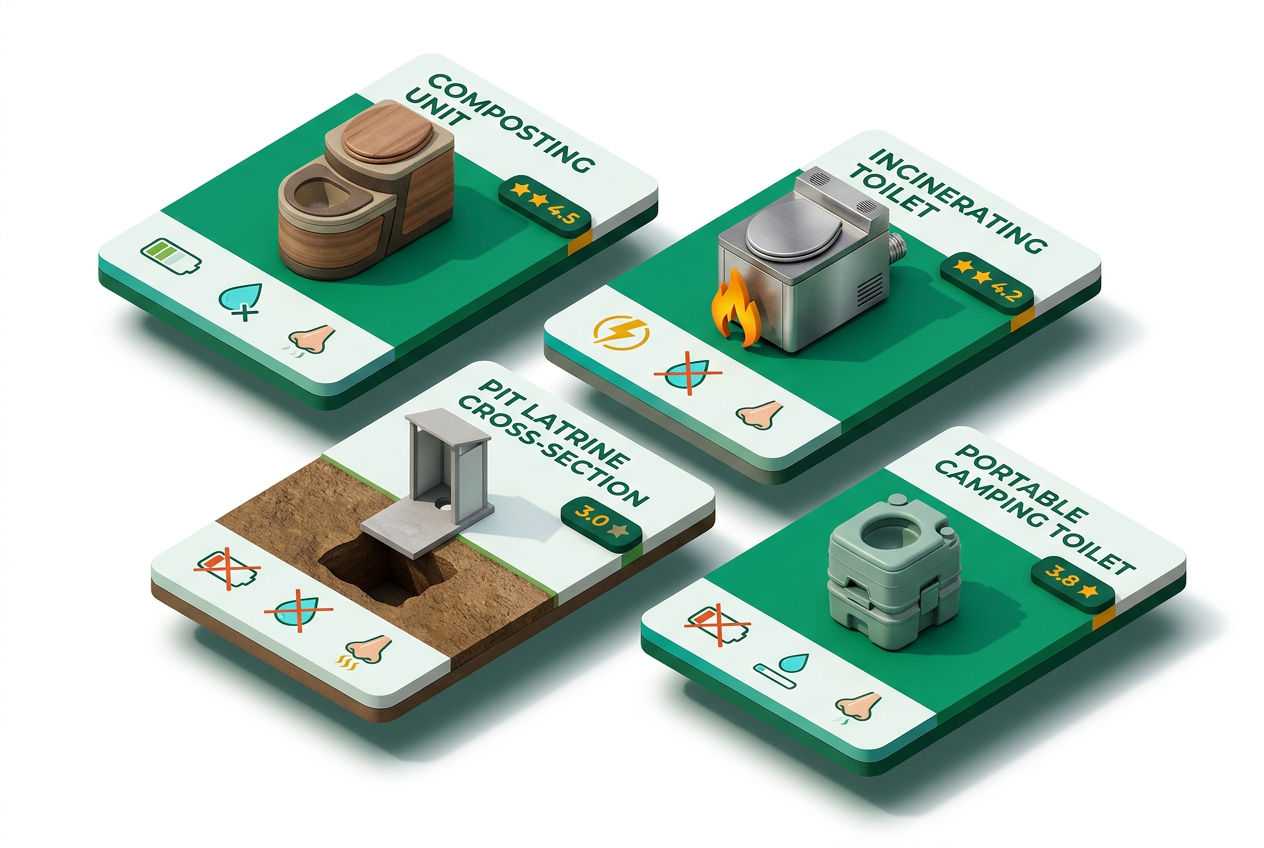
That said, "best" is situational. A winter cabin in Montana has different needs than a summer homestead in Oregon. The sections below break down the top picks by category so you can match the right unit to your actual situation.
Top Off Grid Toilet Picks by Category
Best Overall: Nature's Head Self-Contained Composting Toilet
Price: ~$960–$1,050
Power: 12V DC fan (low draw)
Capacity: 60–80 uses before emptying solids
Warranty: 5 years
The Nature's Head is the most widely used self-contained composting toilet in off-grid circles, and for good reason. It separates urine into a removable 2.2-gallon liquid container — divert it daily or every few days depending on how many people are using it. The solid side gets a small amount of peat moss or coconut coir mixed in after each use, and a hand crank agitates the material to speed decomposition.
Odor control is handled through a small 12V fan that creates negative pressure and vents through a 1.5-inch hose out the wall or roof. Run that vent line properly and you genuinely don't smell it. Run it poorly — too many bends, wrong direction — and you will.
Installation takes 2–3 hours. You need a 1.5-inch vent penetration, a 12V power source (easily tied to a solar panel system), and a drain option for the liquid tank. That's it. No plumbing, no drain field, no pump.
For a deep dive on how these units work mechanically, see our guide on how a composting toilet works.
Best for Cold Climates: Cinderella Comfort Incinerating Toilet
Price: ~$4,200–$4,800
Power: Electric (1,600–1,800W per cycle)
Fuel: Electric (propane version also available)
Warranty: 2 years
If you're building an off-grid cabin in Alaska, northern Minnesota, or anywhere composting chemistry slows to a crawl in winter, an incinerating toilet is worth serious consideration. Composting bacteria become sluggish below 55°F and essentially stop working below 40°F. An incinerating toilet doesn't care about temperature — it burns waste to sterile ash at roughly 1,000°F.
The Cinderella Comfort (Norway-based manufacturer, widely distributed in North America) uses electricity to complete a 45–75 minute incineration cycle per use. Each cycle produces about a teaspoon of ash. A 5-liter ash container holds roughly 100 uses' worth — you empty it into the trash or compost pile every few weeks.
The tradeoff? Power consumption. Each cycle draws 1.6–1.8 kW. On a solar setup, you need to plan for this load. The propane version (Cinderella Journey) sidesteps that issue entirely and is popular in remote Alaskan cabins. Expect to use one 1-lb propane cylinder per 5–6 uses.
These units also have a paper liner system — you place a paper bowl liner before each use — which adds an ongoing consumable cost of roughly $0.50–$1.00 per use.
More details on this category: incinerating toilets explained.
Best Mid-Range: Sun-Mar Excel Non-Electric Composting Toilet
Price: ~$1,450–$1,750
Power: None (passive ventilation)
Capacity: 3-4 people continuous use
Warranty: 3 years
The Sun-Mar Excel is the most popular non-electric composting toilet for cabins without reliable solar or grid power. It uses a larger drum design — 30-inch width, so this is not a small bathroom unit — and relies on passive airflow through a 4-inch vent stack to manage odor and dry the composting mass.
The larger drum increases capacity significantly. Sun-Mar rates it for 3–4 people in continuous residential use, or 6–8 people in weekend/vacation use. The 3-chamber design separates fresh waste from maturing compost from finished humus. Properly managed, you're emptying finished compost every 2–3 months rather than every few weeks.
The catch: passive ventilation is more dependent on vent stack height and prevailing conditions. In a high-humidity environment like the Gulf Coast or Southeast, airflow may need supplementing with a small solar-powered fan to prevent anaerobic conditions (which cause odor). Sun-Mar makes a fan kit for exactly this purpose.
Best Budget Option: DIY Bucket Composting Toilet
Price: Under $50
Power: None
Capacity: Limited — empty every 1–3 days
Warranty: N/A
A five-gallon bucket, a toilet seat adapter, and sawdust or peat moss. That's the whole system. It sounds primitive, but a properly managed bucket toilet — popularized by Joseph Jenkins' The Humanure Handbook — is a legitimate, legal off-grid waste management approach in most jurisdictions.
After each use, you cover solids with a carbon material (sawdust, wood shavings, peat moss). Liquids can be directed separately with a urine diverter attachment, or composted together. The full bucket goes to an outdoor compost pile where thermophilic composting — reaching 131–160°F over several weeks — destroys pathogens.
This is not ideal for full-time residential use in cold climates, and it requires diligent outdoor composting management. But for a seasonal hunting cabin or weekend retreat on an extreme budget? It works.
Best Portable Option: Nature's Head or OGO Composting Toilet
Price: $950–$1,150
Best for: RVs, tiny homes, boat living, seasonal cabins
The OGO Origin composting toilet competes directly with the Nature's Head in the portable self-contained category. It runs a 5V USB fan (extremely low draw), has a larger liquid tank than the Nature's Head (2.4 gallons vs. 2.2 gallons), and a built-in agitator motor that automates the crank step. Footprint is similar — under 17 inches wide.
For RV and van-life users, see our full RV composting toilet guide for a more detailed comparison of portable units.
Off Grid Toilet Comparison at a Glance
| Type | Avg. Cost | Power Needed | Best Climate | Emptying Frequency |
|---|---|---|---|---|
| Self-contained composting | $900–$1,800 | Low (12V fan) | Temperate | Every 2–6 weeks |
| Non-electric composting | $1,200–$2,000 | None | Temperate/dry | Every 2–3 months |
| Incinerating (electric) | $3,500–$5,000 | High (1.6–1.8 kW/use) | Cold climates | Every 100 uses |
| Incinerating (propane) | $2,500–$4,000 | None | Remote/cold | Every 100 uses |
| DIY bucket system | Under $50 | None | All (managed) | Every 1–3 days |
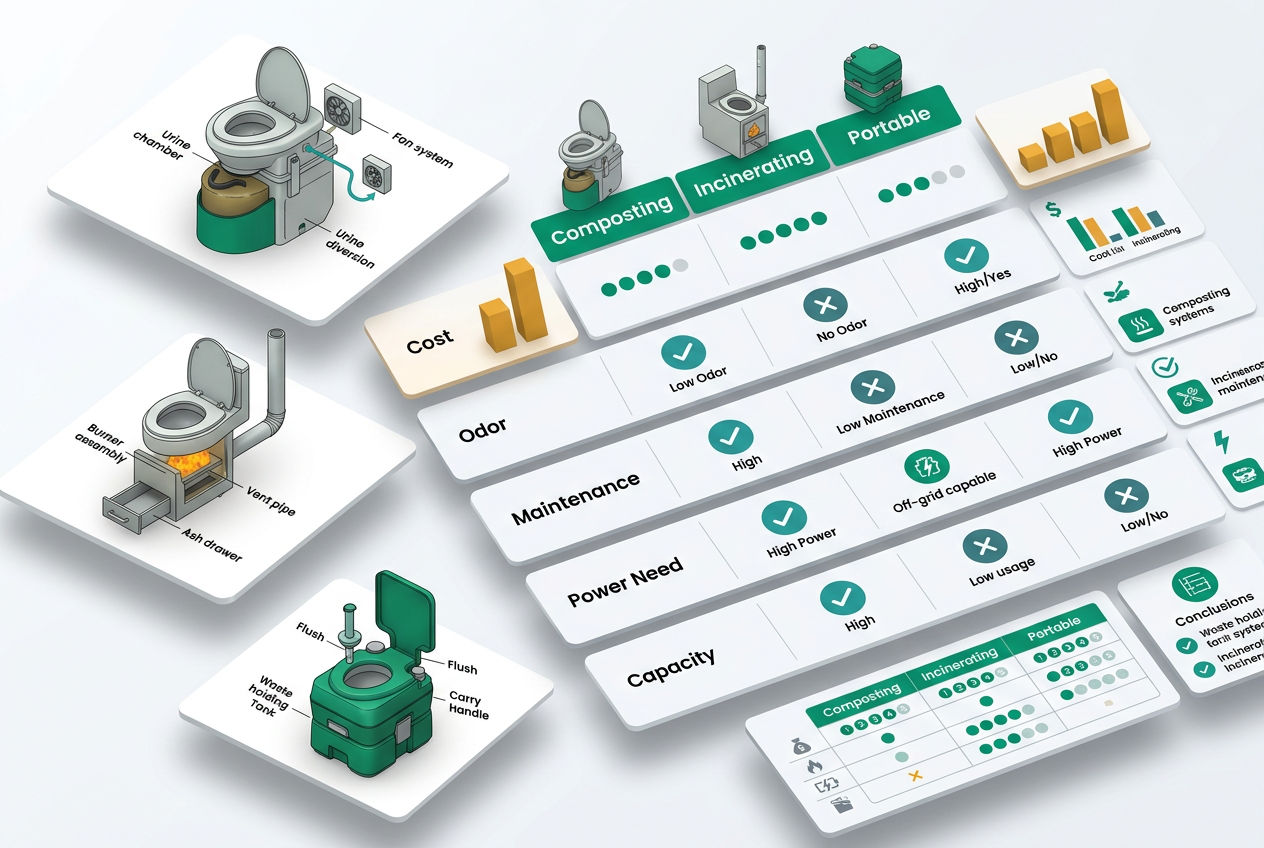
Sources: Manufacturer pricing (Nature's Head, Sun-Mar, Cinderella); NSF/ANSI Standard 41 certification registry
How Does a Composting Toilet Work Off the Grid?
DIY Septic Blueprint
Thinking about building it yourself?
The complete, plain-English plan to size, permit and install your own septic system — designed for homeowners, not contractors. Skip the $15,000–$25,000 quotes and do it right the first time.
Get the DIY Blueprint — $67 →Instant download · 8 modules + 3 bonus guides · 60-day money-back guaranteeA composting toilet separates urine and solid waste, then uses heat, airflow, and microbial activity to break down solids into a compost-like material. Liquid diversion is critical — it keeps the solid chamber aerobic (oxygen-rich), which prevents odor and accelerates decomposition.
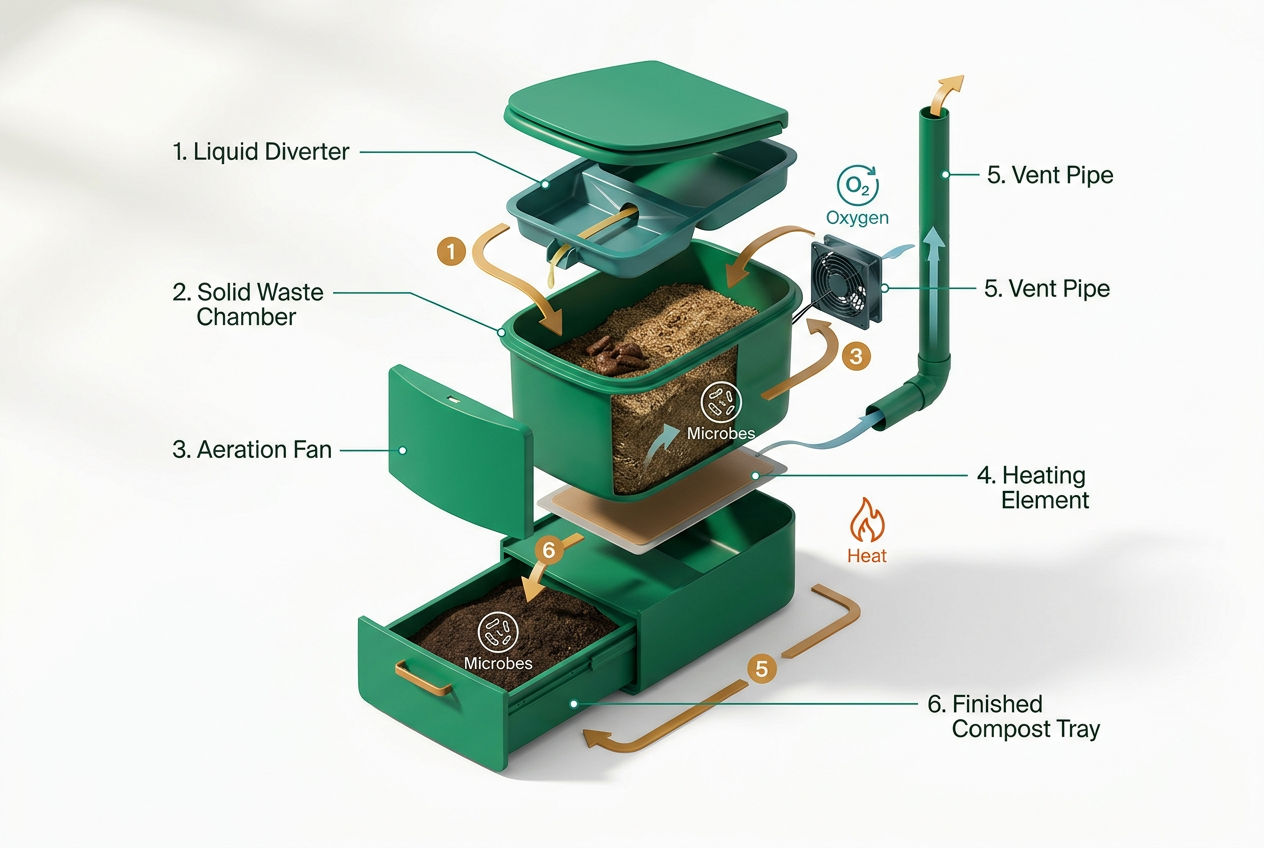
The average composting cycle takes 3–6 months for full breakdown under warm conditions. Temperatures below 55°F significantly slow microbial activity. This is why cabin owners in the Upper Midwest, Pacific Northwest, and mountain states often winterize their units or switch to alternative management during cold months.
Adding a carbon bulking agent — coconut coir, peat moss, or fine wood shavings — after each solid deposit maintains the right carbon-to-nitrogen ratio and absorbs excess moisture. Think of it like maintaining a compost pile: balance is everything.
If you want the full technical breakdown, our composting toilet guide covers the microbiology, maintenance schedule, and troubleshooting in detail.
Do Composting Toilets Smell?
Honestly — a well-maintained composting toilet should have minimal odor. The key word is "well-maintained." Here's what creates smell and how to prevent it:
Fan failure. The 12V fan on self-contained units creates negative pressure that pulls air down through the bowl and out the vent. If that fan fails and you don't catch it, the composting chamber will off-gas into the room. Check your fan monthly — replacement fans cost $15–$30.
Vent line problems. A 1.5-inch vent line with too many 90-degree bends, too short a run, or a downward slope creates back-pressure. The vent line should exit the structure and terminate above roofline level to take advantage of stack effect and wind-induced draft.
Liquid overflow into the solid chamber. If the liquid container isn't emptied frequently enough (or if the urine diverter seals fail), liquid saturates the solid chamber. That creates anaerobic conditions — the same ones that make a poorly managed outhouse smell bad. In a 2-person household, the liquid container on a Nature's Head typically needs emptying every 2–3 days.
Neglected carbon material. Skipping the coir/peat moss after solid deposits means wet, nitrogen-heavy material without enough carbon to manage it. Cover every solid deposit without fail.
Can You Use a Regular Toilet Off the Grid?
You can — but you'll need a septic system to handle the blackwater it produces. A conventional 1,000-gallon septic tank with a drain field costs $4,500–$12,000+ to install depending on soil conditions and local regulations. In rocky terrain, steep grades, or areas with high water tables, that number climbs further.
Standard flush toilets use 1.28–1.6 gallons per flush. At five flushes per person per day, a two-person household generates over 4,500 gallons of blackwater annually — all of which needs to go somewhere. Without municipal sewer access, that means a septic system, which requires land, soil suitable for percolation, and permits.
For remote properties where septic installation isn't feasible or affordable, a waterless off-grid toilet is often the practical solution. See septic system costs to compare the math against a composting toilet purchase.
Do You Need a Permit for a Composting Toilet?
All 50 U.S. states legally permit composting toilets in some form, but local county and municipal codes are where things get complicated.
In Massachusetts, Vermont, and Oregon, composting toilets must meet NSF/ANSI Standard 41 certification — units without this certification may not receive approval. California generally allows them but requires a permit and may require a greywater system to handle sink and shower drainage separately.
Some counties in New York and Florida have additional inspection requirements on top of state regulations. Hawaii maintains a specific state-approved product list — not every certified unit makes the cut there.
The permitting process typically involves submitting product specifications, a site plan, and sometimes demonstrating you have a compliant greywater system for other household wastewater.
Bottom line: always verify with your county health department before purchasing. Buying a unit that your jurisdiction won't approve is an expensive mistake. If you're unsure where to start, a licensed septic professional in your area can help navigate local permitting.
How Often Do You Empty a Composting Toilet?
Emptying frequency depends on the unit type, household size, and how well you manage the system.
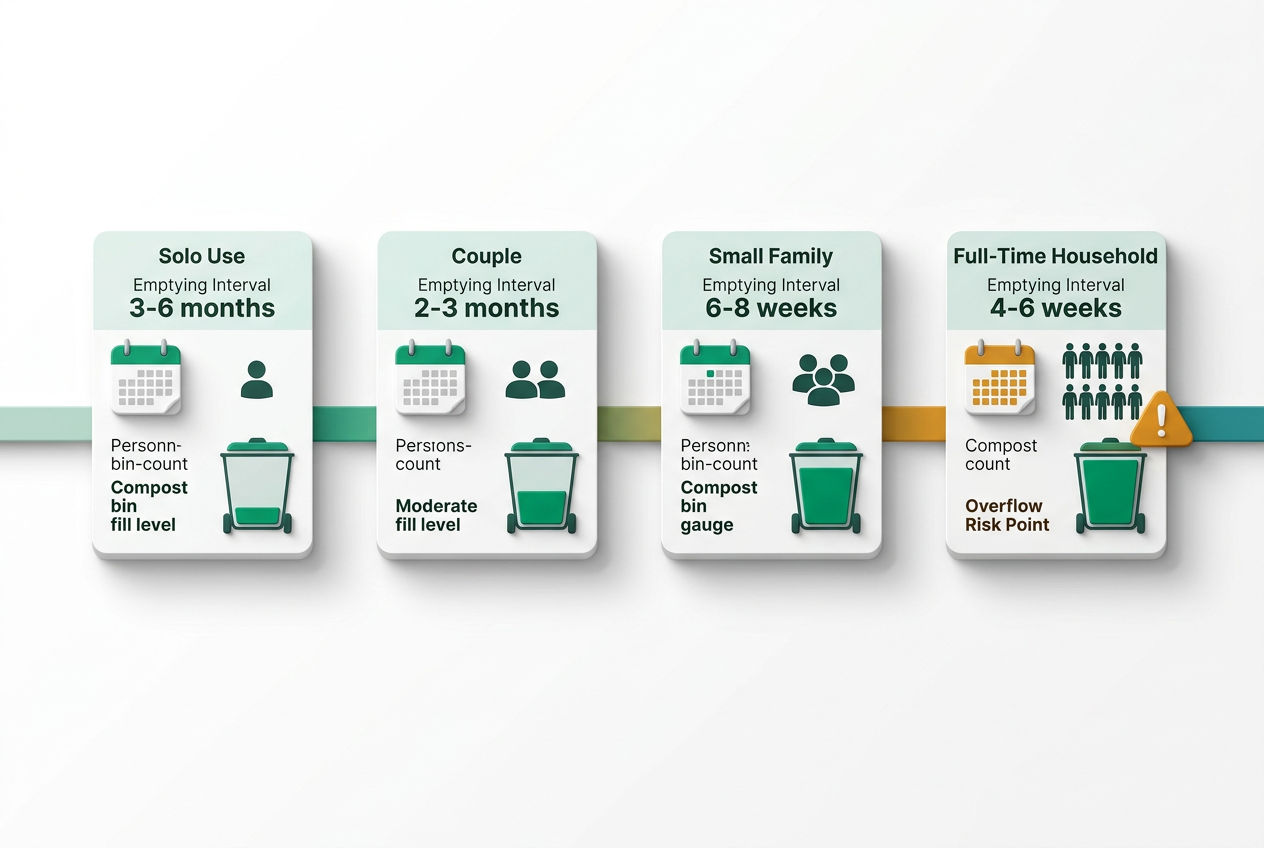
Liquid container: In a self-contained unit like the Nature's Head, a 2-person household empties the liquid tank every 2–3 days. A single person might stretch it to 4–5 days. Liquid can be diluted 8:1 with water and used as fertilizer on non-edible plants, poured into a greywater system, or disposed of in a designated area per your local code.
Solid chamber: The solid/compost side on a self-contained unit handles roughly 60–80 uses before it's full enough to need attention. For two people using it 2–3 times each daily, that's every 3–5 weeks. For a vacation cabin with weekend use, you might go all season without emptying.
For a larger non-electric unit like the Sun-Mar Excel serving a family of four, the three-chamber design allows continuous composting — you empty finished humus from the bottom drawer every 2–3 months. The material that comes out looks and smells like dark, crumbly soil.
The finished compost from a properly managed unit is safe to use on ornamental plants and trees. Most health codes prohibit applying humanure compost to food crops — follow your local regulations.
Setting Up a Complete Off-Grid Bathroom
A composting or incinerating toilet handles blackwater, but a complete off-grid bathroom also needs a plan for greywater — the wastewater from sinks, showers, and laundry.
Greywater is significantly less problematic than blackwater but still requires management. Simple options include a constructed wetland, a greywater mulch basin, or a small leach pit sized for your household's output. See our greywater system guide for design options.
Your off-grid water system also plays a role — if you're hauling water or relying on a small rainwater collection setup, eliminating toilet water consumption saves 30–40% of your household water budget.
For more complex rural property setups that still need some form of septic infrastructure, cabin septic system options covers the middle ground between full conventional systems and purely composting-based approaches.
Sources & Methodology
- NSF/ANSI Standard 41 — The certification standard for composting toilets in the U.S., administered by NSF International. Used to verify product compliance claims.
- EPA WaterSense Program (epa.gov/watersense) — Source for household water use statistics and per-flush consumption data for standard toilets.
- Nature's Head, Sun-Mar, Cinderella — Manufacturer product specifications, installation manuals, and warranty documentation for capacity, power, and performance data.
- Joseph Jenkins, The Humanure Handbook — Reference for DIY bucket composting methodology and thermophilic composting pathogen destruction temperatures.
- State health department regulations — Vermont Agency of Natural Resources, Massachusetts DEP, Oregon DEQ, California State Water Board, Hawaii DOH — referenced for permitting and certification requirements.
Need help finding a licensed professional who can advise on off-grid waste management in your area? Search our directory to find vetted septic contractors near you.
Free download
Not ready for the Blueprint? Start free.
Grab the free DIY Septic Planning Kit — the permit-first checklist, perc-test cheat sheet, and sizing tables that keep your build from getting red-tagged.
Was this article helpful?
Frequently Asked Questions
Recommended Resources
📖 Related Articles
- How Does a Composting Toilet Work?
- Incinerating Toilets: How They Work, Cost & Best Models
- The Best Composting Toilet for RV (Top Picks)
- Composting Toilets: The Complete Guide (How They Work + Best Models)
- What Is a Septic System? How It Works (Visual Guide)
- Composting Toilet vs. Septic System: Which Is Right for You?
- Greywater Systems: How They Work & How to Build One
- Off Grid Water System: The Complete Guide
- Off Grid Cabin: The Complete Guide
🔧 Services
Find Septic Professionals Near You
Compare licensed, verified septic companies by area — top county markets and cities below, or browse all 50 states.
County markets
Popular cities
