
Quick Answer
An incinerating toilet burns human waste at temperatures between 1,000°F and 1,400°F, reducing it to a small amount of sterile ash. No water line. No drain field. No septic tank. For properties where conventional waste systems aren't practical, they're one of the most self-contained solutions available.
Key Takeaways
- Incinerating toilets use electricity or propane to burn waste to ash — zero water required
- Purchase prices range from $2,000 (Incinolet) to $4,800 (Cinderella Freedom propane)
- Operating costs run $150–$400 per year, plus $50–$150 annually for paper liners
- Each use produces roughly one tablespoon of sterile ash; the ash chamber needs emptying every 60–80 uses
- Both Cinderella and Incinolet carry NSF/ANSI 41 certification, but local permits still apply — always verify with your county health department
What Is an Incinerating Toilet?
An incinerating toilet is a self-contained, waterless toilet system that destroys waste through high-heat combustion rather than transporting it to a septic tank or sewer. It belongs to the broader category of no-water toilet systems, alongside composting toilets and chemical toilets.
Standard toilets flush 1.6 to 3.5 gallons per use. Multiply that across a two-person household and you're looking at 6,000–10,000 gallons per year, all of which has to go somewhere — usually a drain field that needs properly permeable soil, adequate setbacks, and thousands of dollars to install. On a rocky Vermont hillside, Alaskan permafrost, or a flood-prone Gulf Coast lot, that drain field may not be feasible at all.
That's the gap incinerating toilets fill. They're a true alternative to a conventional septic system — not a supplement to one. If you're weighing one against a full DIY septic system for a remote build, the cost math below is worth running first.
How Does an Incinerating Toilet Work?
An incinerating toilet completes a full burn cycle after each use (or batch of uses, depending on the model), reducing all waste — liquid and solid — to sterile ash at temperatures between 1,000°F and 1,400°F (540°C–760°C). At those temperatures, pathogens, bacteria, and organic compounds are completely destroyed.
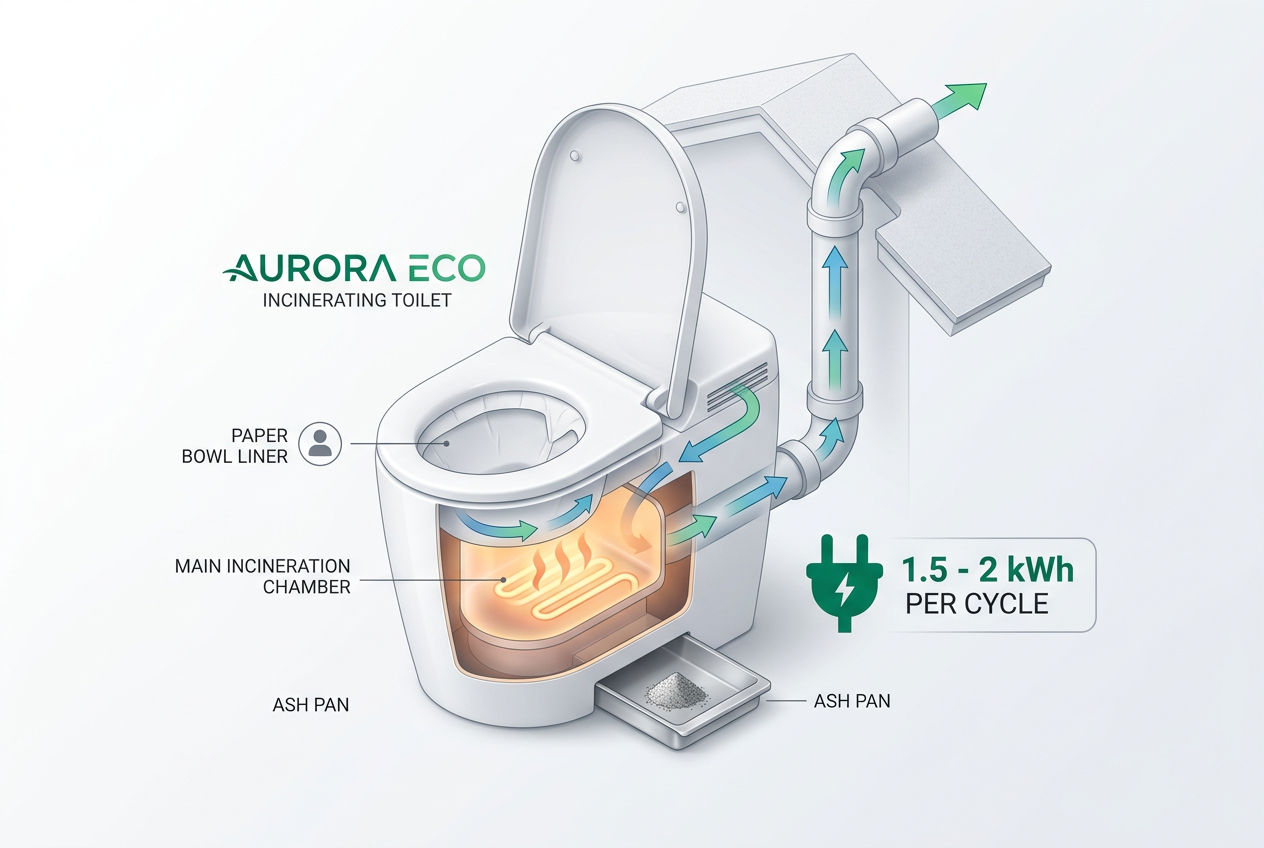
Here's the process from start to finish:
- You place a paper liner into the bowl before sitting. The liner holds waste and keeps the bowl clean.
- You use the toilet normally. The lid stays closed during the burn cycle.
- You press the start button. The burn cycle initiates after you close the lid.
- The heating element or gas burner ignites, bringing the combustion chamber to full temperature.
- Waste incinerates completely. The exhaust vents through a 4-inch stainless steel flue pipe to the outside.
- A tablespoon of sterile ash is deposited into the ash drawer below the combustion chamber.
- The toilet resets and is ready for the next use — though on some models, there's a short cooldown before the next cycle can begin.
The whole process is odor-neutral outdoors because exhaust goes through the flue, though there can be a brief warm smell when the lid is first opened before a cycle. More on that below.
Electric Incinerating Toilets
Electric models are the most popular choice for cabins and tiny homes with shore power or a reliable solar/generator setup. They plug into a 120V/15A or 240V dedicated circuit depending on the model — confirm your electrical capacity before buying.
The Incinolet, made by Research Products/Blankenship in Dallas, runs on 120V and completes one burn cycle at a time in 45 minutes to 1 hour. It draws approximately 1.5–2 kWh per cycle, which translates to roughly $0.15–$0.30 per use at national average electricity rates. The Cinderella Comfort electric model allows batching — up to four uses before initiating a 1–2 hour burn cycle, which is more energy-efficient per use.
Propane/Gas Incinerating Toilets
Propane incinerating toilets are the go-to for true off-grid setups with no reliable power source. The Cinderella Freedom is the dominant model in this category, running entirely on propane without any electrical connection required (beyond a battery ignition).
Gas models consume approximately 0.25–0.35 gallons of propane per burn cycle. At current propane prices of roughly $2.50–$3.50/gallon, that's $0.63–$1.23 per cycle — noticeably more expensive than electric per use, but if you're 40 miles from the nearest power line, cost-per-cycle isn't your primary concern. Burn cycles on gas models run 1.5–3 hours because the combustion chamber is often larger.
How Much Does an Incinerating Toilet Cost?
Incinerating toilets carry a higher upfront price than composting toilets, but lower installation costs than a full septic system. Here's the full picture.
Purchase Prices
- Incinolet (electric, WB & CB models): $2,000–$2,400
- EcoJohn SR (gas models): $2,500–$4,000+
- Cinderella Comfort (electric): $4,000–$4,500
- Cinderella Freedom (propane): $4,200–$4,800
Ongoing Operating Costs
- Electricity: ~$0.15–$0.30 per burn cycle
- Propane: ~$0.63–$1.23 per burn cycle
- Paper liners: ~$0.10–$0.20 each; sold in packs of 200–600; annual cost $50–$150
- Annual operating total (2-person household): approximately $150–$400
5-Year Cost of Ownership Comparison
| System | Upfront Cost | Annual Operating | 5-Year Total |
|---|---|---|---|
| Incinerating toilet (electric) | $2,000–$4,500 | $200–$350 | $3,000–$6,250 |
| Incinerating toilet (propane) | $2,500–$4,800 | $300–$500 | $4,000–$7,300 |
| Composting toilet | $1,000–$2,500 | $50–$150 | $1,250–$3,250 |
| Basic septic system (rural) | $3,500–$10,000+ | $200–$400 | $4,500–$12,000+ |
Sources: Manufacturer retail pricing (Cinderella, Incinolet); EPA septic cost estimates; author research on composting toilet market.
The composting toilet wins on pure cost. But composting toilets require hands-on maintenance — turning compost, monitoring moisture levels, separate liquid diversion, and a dedicated place to dispose of finished compost. If that sounds like your idea of a bad Saturday, the incinerating toilet's higher cost buys you significantly simpler operation.
For properties where septic installation costs run $15,000–$30,000 due to difficult soil or remote location, even a $4,800 Cinderella Freedom starts looking like a bargain. If you're not sure which side of that line your property falls on, get quotes from local septic pros before ruling a conventional system out.
DIY Septic Blueprint
Thinking about building it yourself?
The complete, plain-English plan to size, permit and install your own septic system — designed for homeowners, not contractors. Skip the $15,000–$25,000 quotes and do it right the first time.
Get the DIY Blueprint — $67 →Instant download · 8 modules + 3 bonus guides · 60-day money-back guaranteeBest Incinerating Toilet Models Compared
Cinderella Incinerating Toilet (Freedom & Comfort)
Cinderella is a Norwegian brand with decades of engineering behind it. The Freedom (propane) and Comfort (electric) are widely regarded as the premium tier of the incinerating toilet market.
The Freedom requires zero electricity — just propane and a battery ignition. That makes it uniquely suited for remote Alaskan cabins or properties in the Mountain West where power reliability is seasonal. The Comfort allows batching up to 4 uses per cycle, which reduces energy consumption per use and makes it more practical for households with 2–4 people using the toilet regularly.
Both models carry a 3-year limited warranty and NSF/ANSI 41 certification for non-water-carried waste treatment. Replacement heating elements run $200–$400 when needed.
The honest downside: price. At $4,000–$4,800, they're the most expensive option in the category. And the burn cycle on the Comfort runs 1–2 hours — during that time, the toilet is locked and unavailable.
Incinolet
Made in the U.S. by Research Products/Blankenship, the Incinolet has been around since the 1970s. It's the most affordable credible option at $2,000–$2,400, carries a 2-year limited warranty, and operates on standard 120V household current.
The key limitation: it's a one-use-per-cycle model. Each use triggers an individual 45–60 minute burn. For a solo cabin user or seasonal hunting camp, that's perfectly fine. For a couple sharing a one-bathroom cabin on a weekend morning, it can create a waiting-room situation.
The Incinolet weighs about 30 lbs — the lightest model in the category — which makes it popular for smaller installations and retrofits.
EcoJohn
EcoJohn's SR series offers propane models in the $2,500–$4,000 range, positioning them as a mid-market alternative to the Cinderella Freedom at a lower price point. They're less widely distributed and carry a smaller service network, which matters when you need a heating element replaced five years from now in rural Montana.
Where Incinerating Toilets Make the Most Sense
Incinerating Toilet for a Cabin
This is the dominant use case. Seasonal cabin owners in states like Minnesota, Maine, Wisconsin, Vermont, and Alaska face a real dilemma: a conventional septic system costs $5,000–$20,000+ to install, requires annual maintenance, and needs winterizing before the first hard freeze. For a cabin you visit 15 weekends a year, that ROI is brutal.
An incinerating toilet eliminates the septic system entirely. You connect the 4-inch flue, run an electrical circuit or propane line, and you're done. There's no pump to fail, no drain field to saturate, and nothing to winterize except the flue cap.
Properties in high water table areas — common on lakefront lots throughout the upper Midwest — often can't support a conventional drain field at all. An incinerating toilet sidesteps the problem completely.
Incinerating Toilet for an RV
The incinerating toilet for RV use is a more niche application, mostly relevant for converted buses (skoolies) and large Class A motorhomes where the builder wants to eliminate the black water holding tank entirely. Standard RV incinerating toilets need to accommodate the vehicle's vibration tolerances and propane or 120V shore power access.
Most RV-specific users look at the Incinolet or smaller Cinderella models. The tradeoff: the flue pipe needs to exit the roof or side wall securely, and the burn cycle locks the unit for 45–60 minutes — workable on a stationary overnight stay, less ideal mid-travel day.
For the 72+ million U.S. households that camped in 2023 (KOA Annual Camping Report), most will stick with holding tanks. But for full-time RV residents who want to stop paying dump station fees and managing black water, the incinerating option has real appeal.
Tiny Homes and Off-Grid Builds
The tiny home market is projected to reach $3.57 billion by 2026 (Allied Market Research). Many tiny homes are placed on private rural land where a septic system for a tiny home is either cost-prohibitive or code-complicated. An incinerating toilet paired with a gray water system for sink and shower drainage is a clean, legally defensible solution in most jurisdictions.
Composting Toilet vs. Incinerating Toilet: Which Is Right for You?
Both are waterless. Both eliminate the need for a septic connection. The differences matter a lot in practice.
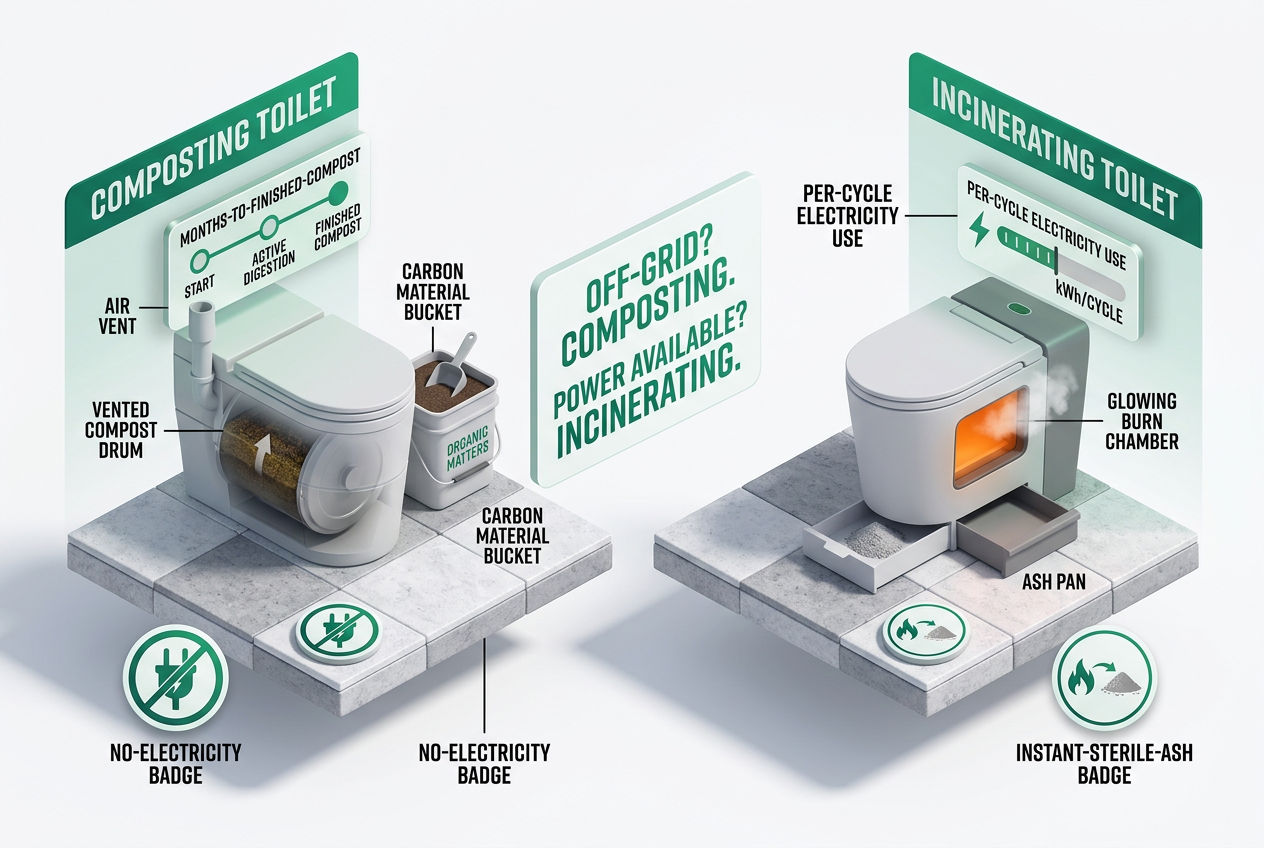
A composting toilet breaks down waste through microbial activity over weeks. The finished compost must be removed periodically — typically every 3–6 months for a full-time single user — and disposed of in compliance with local health codes (often as garden mulch, but regulations vary). Upfront cost is $1,000–$2,500. Operating costs are minimal. But it requires active monitoring: moisture levels, carbon-to-nitrogen ratios, occasional turning. And liquid diversion is usually separate.
An incinerating toilet destroys waste immediately and completely. Maintenance is emptying a tablespoon of ash every 60–80 uses. Operating cost is higher. Zero organic residue. Zero odor management. Zero biology to keep alive through winter.
If you're comfortable with a bit of hands-on maintenance and want the lowest cost option, composting wins. If you want the simplest possible system with near-zero active maintenance, incineration is your answer.
You can read more about how incinerating toilets fit into the broader landscape of alternative septic systems — including mound systems, aerobic units, and sand filters — on SepticTankHub.
Pros and Cons of Incinerating Toilets
Pros:
- Zero water usage — saves 6,000–10,000 gallons per year for a 2-person household
- No septic system, drain field, or plumbing connection required
- Sterile ash output is biologically safe to handle
- Works in freezing temperatures without winterization concerns
- NSF/ANSI 41 certified models are code-compliant in most U.S. jurisdictions
- Expected lifespan of 15–25+ years with proper maintenance
Cons:
- High upfront cost ($2,000–$4,800)
- Burn cycle locks the toilet for 45 minutes to 2+ hours
- Ongoing liner and energy costs ($150–$400/year)
- Requires a 4-inch stainless steel flue through the roof or wall
- Electric models need a dedicated 120V or 240V circuit
- Not appropriate as a primary toilet for families of 4+ without batching capability
Installation Requirements and Local Regulations
Every incinerating toilet installation requires a 4-inch stainless steel exhaust flue — typically routed through the ceiling and roof, though side-wall venting is possible on some models. The flue must terminate above the roofline per standard building code. Run lengths affect draft; keep elbows to a minimum and follow manufacturer specs.
Electric models need a dedicated circuit — 120V/15A for the Incinolet, 240V for some Cinderella Comfort configurations. This is not a plug-in-and-go appliance. Factor in licensed electrical work if you're adding a new circuit.
On the regulatory side: both Cinderella and Incinolet are NSF/ANSI 41 certified, which is the nationally recognized standard for non-water-carried waste treatment systems. Most state health departments accept NSF 41 certification as proof of compliance. But "most" is not "all."
Alaska has some of the highest per-capita incinerating toilet adoption in the country, and the Alaska Department of Environmental Conservation has specific guidance for remote waste system approvals. Maine and Vermont have state-level oversight through their respective Departments of Environmental Protection. Some counties in Colorado require a variance permit even for NSF-certified alternative systems.
Before you buy, call your county health department — not the state — and ask specifically whether NSF/ANSI 41 certified incinerating toilets are permitted as a primary waste disposal system on your parcel. If you want a local professional who understands your county's code environment, find a septic professional near you through the SepticTankHub directory.
Do Incinerating Toilets Smell?
Briefly, yes — and then no. During the burn cycle, the combustion is self-contained in the unit's chamber and exits through the flue. You won't smell anything from inside the room while a cycle runs. However, when you first open the lid after a previous user has triggered a cycle that's still completing, there can be a faint warm odor for 1–2 seconds. It dissipates immediately.
The exhaust leaving the flue cap outside does have a faint smell — described by owners as similar to a charcoal grill or burning paper, not sewage. In practice, most users report it's mild enough that neighbors and guests don't notice it unless they're standing directly adjacent to the vent exit point.
Smell is substantially lower than a standard outhouse and dramatically lower than a failing septic system. For context on what a malfunctioning conventional system smells like, see our guide to septic system odor problems.
Sources & Methodology
- Cinderella Climate AS — Product specifications, burn cycle data, and pricing for the Freedom and Comfort models sourced from manufacturer documentation.
- Research Products/Blankenship (Incinolet) — Technical specifications and operating requirements for WB and CB model series.
- U.S. Environmental Protection Agency (EPA) — Water usage benchmarks and septic system cost context. epa.gov/septic
- NSF International — NSF/ANSI 41 certification standard for non-water-carried waste treatment systems; confirmed for Cinderella and Incinolet models.
- KOA (Kampgrounds of America) 2023 North American Camping Report — Camping participation statistics cited for RV market context.
- Allied Market Research — Tiny home market growth projection ($3.57B by 2026).
Free download
Not ready for the Blueprint? Start free.
Grab the free DIY Septic Planning Kit — the permit-first checklist, perc-test cheat sheet, and sizing tables that keep your build from getting red-tagged.
Was this article helpful?
Frequently Asked Questions
Recommended Resources
📖 Related Articles
- What Is a Drain Field? (And How Does It Work?)
- Alternative Septic Systems: Options When a Standard System Won't Work
- Should You Pump Your Septic Tank Before Winter?
- High Water Table and Septic Systems: What You Need to Know
- Tiny House Septic Systems: Cost, Tank Size & Options (2026)
- Why Does My Septic System Smell? Causes & Fixes
🔧 Services
Find Septic Professionals Near You
Compare licensed, verified septic companies by area — top county markets and cities below, or browse all 50 states.
County markets
Popular cities
