
Quick Answer
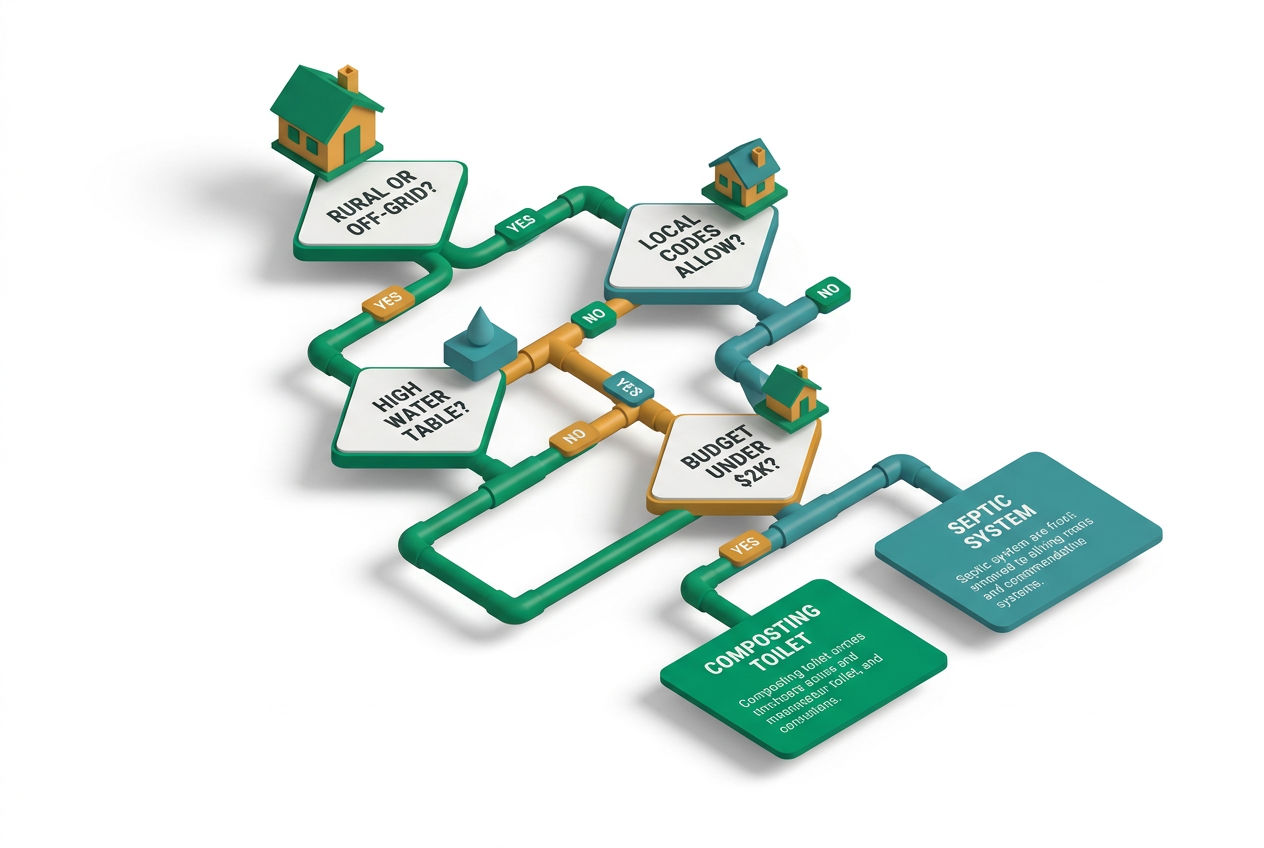
A composting toilet is a waterless, self-contained waste system that converts human waste into compost through aerobic decomposition. A septic system uses underground tanks and a drain field to treat wastewater from every fixture in your home. Composting toilets cost $900–$2,500 upfront versus $7,000–$25,000 for septic installation — but most homes still need greywater management regardless of which toilet system they choose.
Key Takeaways
- Composting toilets eliminate blackwater discharge entirely, saving 6,000–10,000+ gallons of water per person per year.
- Septic system installation runs $7,000–$25,000+; a quality self-contained composting toilet costs $900–$2,500.
- A composting toilet does NOT eliminate the need for greywater handling — your sinks, showers, and washing machines still produce wastewater.
- State regulations vary widely; some states require a backup septic system even if you install a composting toilet.
- NSF/ANSI Standard 41 certification is the benchmark to look for when shopping for a composting toilet unit.
Key Differences at a Glance
| Factor | Composting Toilet | Septic System |
|---|---|---|
| Upfront Cost | $900–$8,000+ | $7,000–$25,000+ |
| Annual Maintenance | $20–$50 (bulking material) | $100–$300 |
| Water Use | Zero (waterless) | 1.6 GPF per flush |
| Handles Greywater? | No | Yes |
| Lifespan | 15–25 years | 20–40 years |
| Installation Complexity | Low–Medium | High |
| Regulatory Acceptance | Varies by state | Universal |
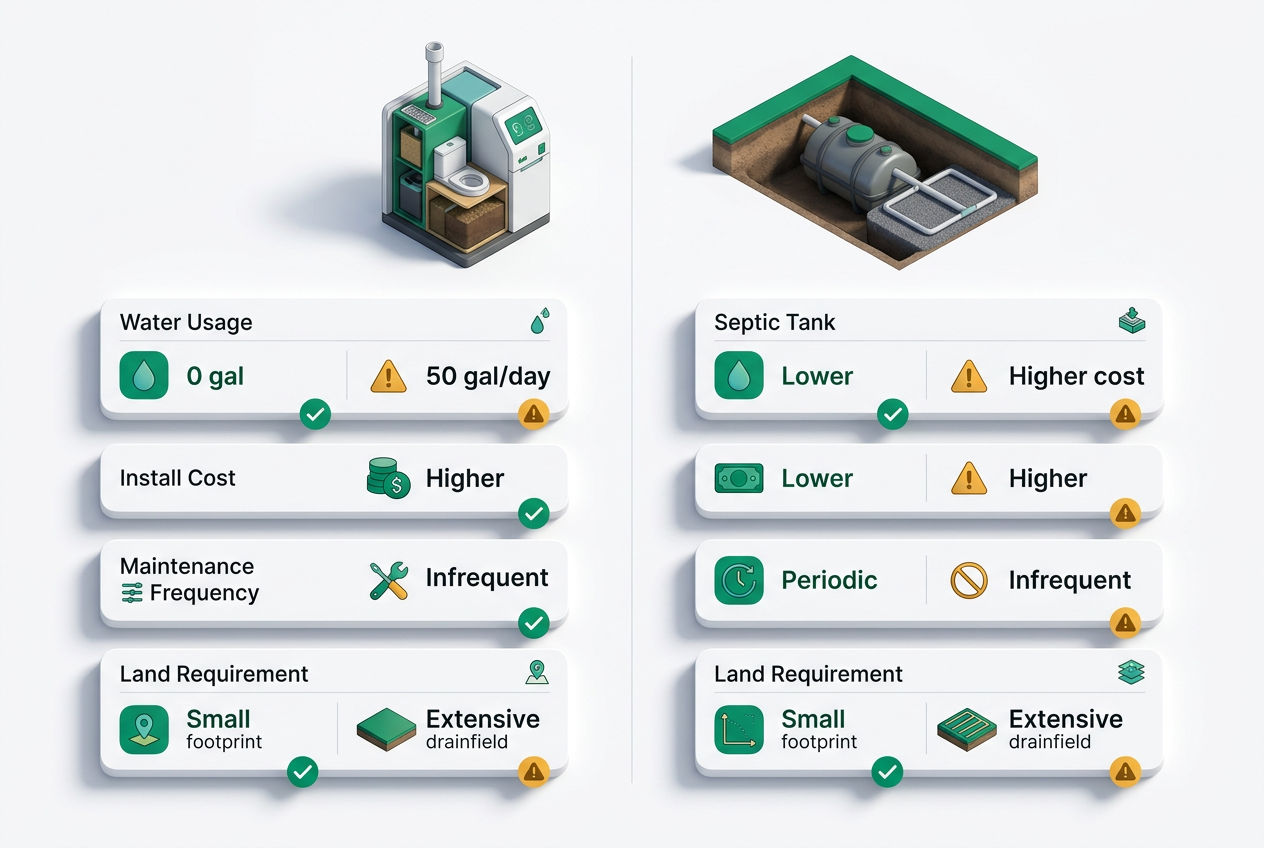
Sources: EPA Septic Systems Program; NSF/ANSI Standard 41; manufacturer specs (Nature's Head, Sun-Mar)
How Each System Actually Works
How Does a Composting Toilet System Work?
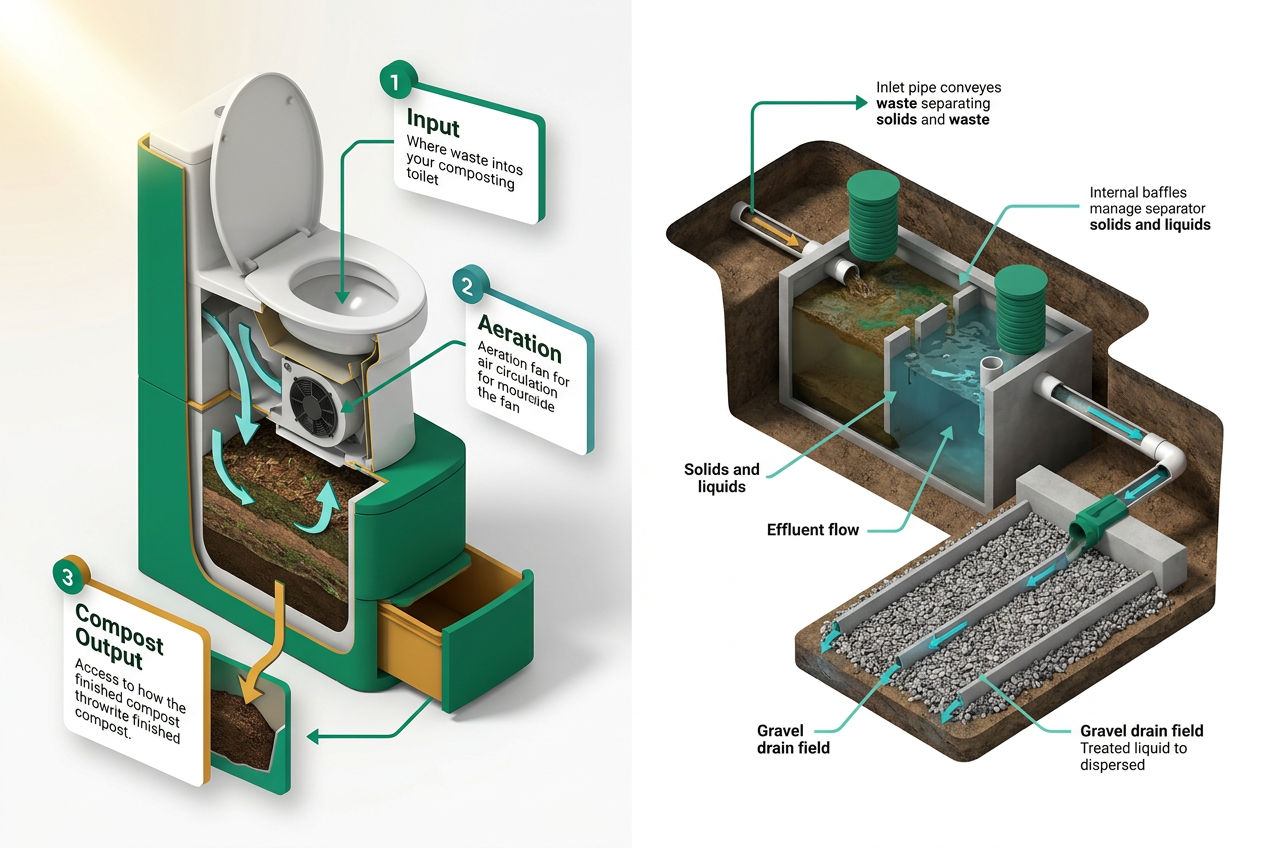
A composting toilet collects human waste — both solid and liquid — and separates them to promote aerobic decomposition. Solid waste drops into a composting chamber. A small fan vents gases outside. You add a bulking agent like peat moss or coconut coir after each use to maintain the right carbon-to-nitrogen ratio and keep things aerobic. Given the right moisture, temperature, and airflow, the material breaks down into a soil-like end product called humanure within 6–12 months.
Self-contained units like the Nature's Head ($960) or Sun-Mar Excel ($1,800–$2,000) house the entire system in one compact unit — ideal for tiny homes, cabins, and RVs. Central or split systems use a remote composting drum in a basement or utility room and serve multiple bathrooms; these run $3,000–$8,000+.
One important nuance: composting toilets only handle blackwater — the waste from your toilet. Your kitchen sink, bathroom sink, shower, and washing machine produce greywater, and that still needs to go somewhere. Usually that means a greywater system or a smaller holding tank. For a deeper dive on how these units function day-to-day, the composting toilet guide covers the full picture.
How Does a Conventional Septic System Work?
A septic system is an underground wastewater treatment system. Wastewater flows from every drain in your house into a buried concrete or polyethylene tank — typically 1,000 to 1,500 gallons for a 3–4 bedroom home. Inside the tank, solids settle to the bottom as sludge, fats and oils float to the top as scum, and relatively clarified effluent exits through outlet baffles into a drain field (also called a leach field).
The drain field consists of perforated distribution pipes buried in gravel-filled trenches. Effluent slowly percolates through the soil, which filters and treats it naturally before it reaches groundwater.
A properly maintained septic system handles all household wastewater — toilet, sinks, showers, laundry. It requires pumping the tank every 3–5 years (a 1,000-gallon tank serving a 4-person household is a good benchmark). You can read about how often to pump your septic tank based on household size.
Composting Toilet Pros and Cons
Pros:
- Dramatically lower upfront cost. A Nature's Head self-contained unit runs about $960. A Sun-Mar central system tops out around $2,000. Either is a fraction of a $12,000–$20,000 conventional septic installation.
- Zero water use. Each flush of a standard toilet uses 1.6 gallons (the federal minimum since 1994; older toilets can use 3.5–7 GPF). A composting toilet uses none. For a 4-person household, that's roughly 8,000–10,000 gallons of water saved per year from toilet flushing alone — about 25–30% of total household water consumption.
- No drain field required. Properties with clay-heavy soils, high water tables, or limited lot size often can't support a conventional leach field. A composting toilet sidesteps the problem entirely.
- Near-zero effluent discharge. Conventional septic systems can contribute nitrogen and phosphorus to groundwater, particularly near sensitive waterways. A composting toilet produces no liquid effluent discharge at all, per EPA guidance on alternative sanitation technologies.
- Perfect for off-grid and remote properties. If you're building a cabin in the Montana wilderness or an off-grid homestead in New Mexico, hauling in a septic contractor and excavator is expensive and logistically brutal.
Cons:
- Doesn't handle greywater. This is the big one. Your sinks and showers still produce wastewater, and that has to go somewhere legal. Most composting toilet installs still require at minimum a greywater system or a small holding tank. Some states require a full septic system regardless.
- Requires active management. You need to add bulking material after each use, monitor moisture levels, and empty the finished compost chamber every 4–8 weeks depending on household size. A self-contained unit typically serves 2–4 people comfortably full-time.
- Regulatory headaches. Composting toilet regulations vary enormously by state and county. More on this below.
- Temperature sensitivity. Aerobic decomposition slows dramatically in cold temperatures. In Minnesota, Vermont, or Alaska, an unheated or poorly insulated installation can stall the composting process entirely. Central systems connected to conditioned space work better in cold climates.
- Odor if managed poorly. A properly functioning composting toilet is nearly odorless — the fan creates negative pressure that pulls air through the compost and vents it outside. A unit with a clogged vent line, excess moisture, or neglected maintenance can develop odor fast.
Septic System Pros and Cons
Pros:
- Handles all household wastewater. One system takes care of toilet waste, sink drainage, shower water, and laundry. You don't need to piece together multiple solutions.
- Universally accepted by code. Every jurisdiction in the United States permits properly designed conventional septic systems. No permitting uncertainty. No inspector calling your county health department for a variance.
- Long lifespan. A properly maintained septic system lasts 20–40 years. The drain field typically outlasts the tank itself if you don't overload it.
- Increases property value. A home with a functioning, permitted septic system is easier to sell and finance than one with an alternative system or no system at all. Picture this: you're selling your rural property and the buyer's lender requires a standard septic inspection. An NSF-certified composting toilet with a greywater pit might give their underwriter pause.
Cons:
- High upfront cost. Septic system installation nationally averages $7,000–$15,000 for a conventional system. In New England or the Pacific Northwest, where soil conditions require engineered systems and permitting is strict, costs regularly reach $20,000–$30,000+. A mound system on a high-water-table site in coastal Maine? Easily $25,000–$35,000.
- Ongoing maintenance costs. Pumping a 1,000-gallon tank runs $300–$600 nationally. Budget $100–$300 per year for general septic maintenance. Drain field repairs — if you ever need them — can run $5,000–$20,000+ depending on the system. See drain field replacement costs for current estimates.
- Soil and space dependent. You need land that passes a percolation test, a minimum lot size to meet setback requirements, and soil that can accept effluent. Homes on small lots, rocky terrain, or in high water table areas often can't install a conventional system at all.
- Environmental footprint. Septic systems can contribute nitrogen and phosphorus to groundwater over time, especially aging systems without effluent filters. A failing system near a well or waterway is a real environmental and legal liability.
For a full breakdown of what types of septic systems are available — from conventional gravity-fed to aerobic treatment units (ATUs) to mound and sand filter systems — that article covers the alternatives for challenging sites.
Are Composting Toilets Legal in All States?
DIY Septic Blueprint
Thinking about building it yourself?
The complete, plain-English plan to size, permit and install your own septic system — designed for homeowners, not contractors. Skip the $15,000–$25,000 quotes and do it right the first time.
Get the DIY Blueprint — $67 →Instant download · 8 modules + 3 bonus guides · 60-day money-back guaranteeNo. Composting toilet regulations vary significantly by state, and sometimes by county within a state. This is the single most important factor in the composting toilet vs. septic decision, and most homeowners don't find out until they're mid-project.
Composting-toilet-friendly states include Oregon, Washington, Colorado, Maine, and Vermont. These states generally allow certified composting toilets as a primary toilet system, though most still require permitted greywater management.
More restrictive states include New Jersey, which generally requires conventional septic or sewer connections. Parts of the Southeast — Arkansas, Alabama, Mississippi — have ambiguous or restrictive codes that effectively require septic systems even on rural properties. Check our state-level regulation guides for Alabama, Oregon, and Colorado for specific code language.
The baseline standard you need to know: NSF/ANSI Standard 41 is the certification that composting toilets must meet to be approved by most state health departments. If a unit doesn't carry NSF/ANSI 41 certification, don't expect it to get permitted. The EPA recognizes composting toilets as an accepted alternative sanitation technology, but defers to state and local regulation for approvals.
Before you buy anything, call your county health department. Ask specifically whether a composting toilet can serve as the primary system and what's required for greywater management.
How Much Does a Composting Toilet Cost Compared to a Septic System?
The gap is significant. Here's a worked comparison for a 2-person cabin in rural Colorado:

Composting toilet setup:
- Nature's Head self-contained unit: $960
- Permitted greywater system (simple mulch basin): $500–$1,500
- Total: $1,500–$2,500
Conventional septic system (same site):
- Perc test: $250–$500
- Permit fees: $200–$500
- Tank installation (1,000-gallon concrete): $3,500–$5,000
- Drain field installation: $3,000–$8,000
- Total: $7,000–$14,000+
Over a 20-year period, add septic pumping every 3–5 years at $300–$500 per service (4–6 pump-outs = $1,200–$3,000), versus composting toilet bulking material at $20–$50/year ($400–$1,000 over 20 years). The long-term cost advantage of the composting toilet remains substantial for low-occupancy, remote properties.
For a full cost breakdown on septic installation by region, see our septic installation cost guide. If you're evaluating septic pumping costs specifically, the septic pumping cost guide has current regional data.
Do Composting Toilets Smell?
A properly maintained composting toilet does not smell inside your home. The fan system — which typically runs on 12V DC or 120V AC and draws minimal power — creates negative pressure inside the unit, pulling air down through the compost and out through a vent pipe to the exterior. That same airflow promotes aerobic decomposition, which is far less odor-intensive than anaerobic breakdown.
Odor problems happen when:
- The vent line is kinked, clogged, or improperly installed
- The compost is too wet (from urine overflow or excess moisture)
- The unit is overloaded beyond its rated capacity
- Bulking material isn't added consistently
If you've ever walked past a dumpster in August, you already know what anaerobic decomposition smells like. A healthy composting toilet smells like fresh soil, if anything at all.
Do You Need a Septic System If You Have a Composting Toilet?
Probably, for greywater. A composting toilet handles only toilet waste — the blackwater fraction. Every time you wash dishes, take a shower, run the washing machine, or brush your teeth over the sink, you produce greywater. That water doesn't disappear just because your toilet doesn't flush.
Your greywater options depend on local code:
- Simple greywater system: Laundry-to-landscape systems or mulch basins can handle limited greywater in permissive states. Oregon, California, and Arizona have relatively clear greywater codes.
- Greywater treatment system: More complex and permitted; required in stricter jurisdictions.
- Small conventional septic: Some installers will size a much smaller tank and drain field for greywater only — potentially cutting septic costs by 40–60% if the composting toilet handles toilet waste.
- Holding tank: Not a long-term solution, but workable for very-low-use seasonal properties.
For off-grid properties exploring the full range of off-grid toilet options, a composting toilet paired with a code-compliant greywater system is often the most cost-effective and environmentally sound combination.
Which Is Right for You?
Choose a composting toilet system if:
- You're building or owning a cabin, tiny home, or seasonal property with low occupancy (1–4 people)
- Your property has poor soil percolation, a high water table, or rocky terrain that makes septic installation impractical or prohibitively expensive
- You're in a composting-toilet-friendly state and can get the installation permitted
- Water conservation is a priority — you're on a well, in a drought-prone area, or operating entirely off-grid
- The property is remote enough that bringing in septic excavation equipment is a logistical or financial obstacle
- You're comfortable with the hands-on maintenance the system requires
Choose a septic system if:
- This is your primary year-round residence serving a family of 3 or more
- You're in a state or county that requires conventional wastewater treatment
- You plan to sell the property and need a system that satisfies lender and inspector requirements
- Your lot has soil that passes a perc test and you have space for a proper drain field
- You want a set-it-and-mostly-forget-it system that handles all household wastewater without active management
The hybrid path: A composting toilet for toilet waste plus a smaller, cheaper septic or engineered greywater system for sink and shower drainage. This combination can reduce your septic footprint — and cost — significantly, while keeping you fully code-compliant. A cabin septic system designed solely for greywater is a much lighter, cheaper build than a full residential system.
Still weighing your options for a rural or off-grid build? A local septic professional can tell you exactly what your county requires, what your soil can support, and what a compliant system realistically costs on your land. Find a septic contractor near you to get a site-specific quote before committing to either path.
Sources & Methodology
- U.S. Environmental Protection Agency — Septic Systems (epa.gov/septic): Used for effluent standards, environmental impact data, and recognition of composting toilets as alternative sanitation technology.
- NSF International — NSF/ANSI Standard 41: Certification standard for composting toilet systems; used for regulatory compliance guidance.
- Nature's Head and Sun-Mar manufacturer specifications: Used for unit pricing, capacity ratings, and power requirements.
- NOWRA (National Onsite Wastewater Recycling Association) (nowra.org): Referenced for industry cost benchmarks and alternative system acceptance data.
- State health department codes (Oregon DEQ, Colorado CDPHE, Alabama ADEM): Referenced for state-specific composting toilet permitting requirements.
Cost data reflects national averages as of 2025. Regional variation is significant — always obtain local contractor quotes for site-specific pricing.
Free download
Not ready for the Blueprint? Start free.
Grab the free DIY Septic Planning Kit — the permit-first checklist, perc-test cheat sheet, and sizing tables that keep your build from getting red-tagged.
Was this article helpful?
Frequently Asked Questions
Recommended Resources
📖 Related Articles
- Composting Toilets: The Complete Guide (How They Work + Best Models)
- What Is a Septic System? How It Works (Visual Guide)
- What Is a Drain Field? (And How Does It Work?)
- How Often Should You Pump Your Septic Tank?
- Greywater Systems: How They Work & How to Build One
- How to Handle Septic Drain Field Maintenance: Step by Step
- The Complete Septic Tank Maintenance Guide
- Types of Septic Systems: Complete Comparison Guide
- The Best Off Grid Toilet (Top Picks)
- Off Grid Cabin: The Complete Guide
💰 Cost Guides
🔧 Services
Find Septic Professionals Near You
Compare licensed, verified septic companies by area — top county markets and cities below, or browse all 50 states.
County markets
Popular cities
