
Quick Answer
An off grid water system collects, stores, treats, and delivers potable water independently of any municipal supply. Whether you're drawing from a drilled well, harvesting rainwater off a metal roof, or tapping a hillside spring, every successful system shares three things: a reliable source, adequate storage, and proper treatment before the water reaches your tap.
Key Takeaways
- The average off-grid household uses 20–50 gallons per person per day — far less than the national average of 80–100 gallons (USGS)
- Drilled wells cost $3,750–$15,300 installed and remain the most reliable year-round source for most properties
- A 2,000 sq ft roof in a 30"/year rainfall region can collect roughly 30,000–36,000 gallons annually
- Every 2.31 feet of vertical elevation produces 1 PSI of water pressure in a gravity-fed system
- UV sterilization eliminates 99.99% of bacteria and viruses — no chemicals required
What Is the Best Water Source for an Off-Grid Home?
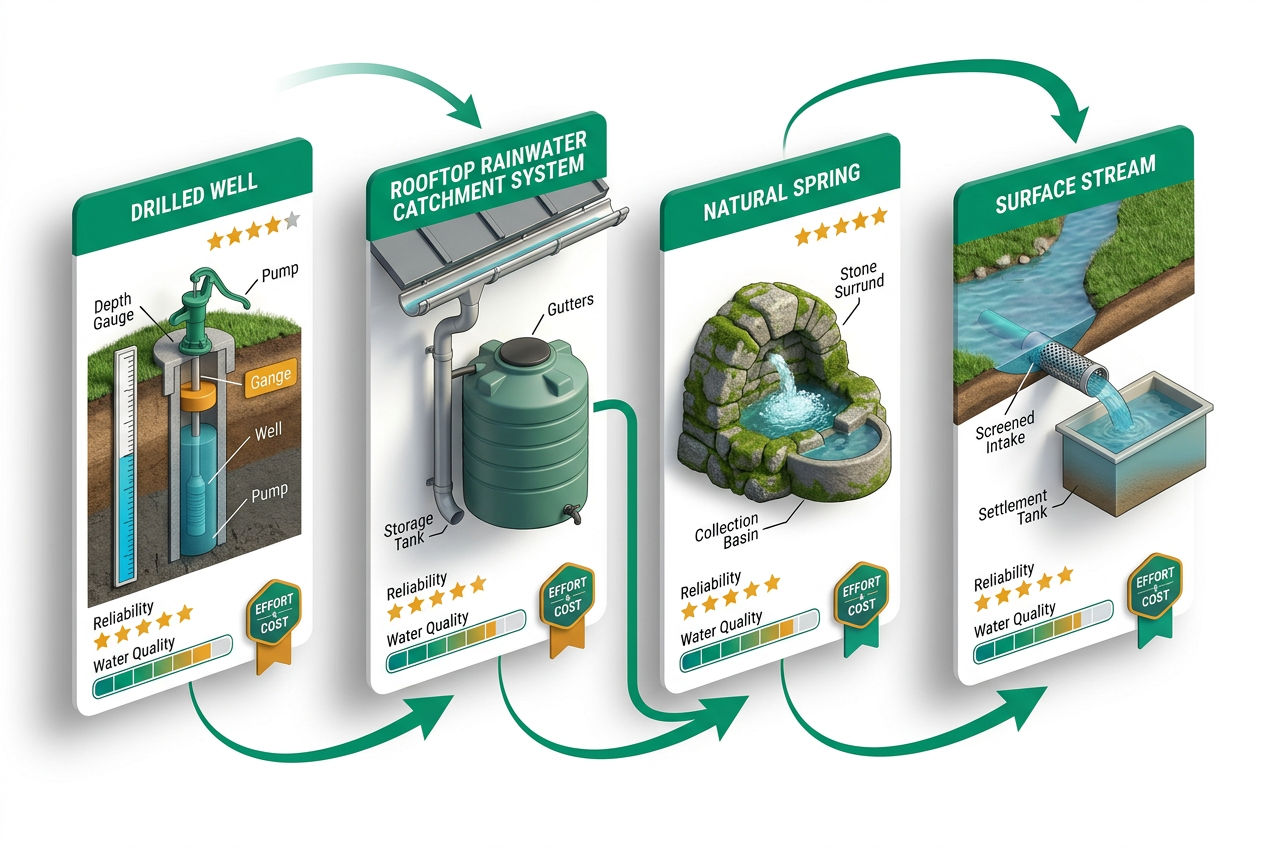
The best water source for an off-grid home depends on your land, your climate, and your budget. Drilled wells are the most dependable option for most North American properties. Rainwater harvesting works exceptionally well in high-rainfall regions. Spring collection is viable where a reliable spring exists on the property. Most serious off-grid setups combine two sources — a primary and a backup.
Drilled Wells
A drilled well taps a subsurface aquifer. A licensed driller sends a rotary rig down 100–400 feet in most regions, though desert properties in Arizona or Nevada sometimes exceed 500 feet to reach usable water. You need a minimum yield of 3–5 gallons per minute (GPM) to reliably support a household.
The complete drilled well system — casing, wellhead, submersible pump, pressure tank, and basic treatment — runs $8,000–$25,000 nationally. Well drilling alone averages $5,500–$9,000, though that number climbs fast in hard bedrock states like Vermont or New Hampshire. Submersible pumps like the Grundfos SQ series last 8–15 years under normal use.
If you're planning off-grid water and wastewater together, understand well and septic setback requirements before you drill — most states require 50–100 feet of separation between a well and any septic component.
Rainwater Harvesting System
Rainwater harvesting captures precipitation off your roof and routes it into storage tanks. The math is straightforward: a standard roof collects roughly 0.5–0.6 gallons per square foot per inch of rainfall. A 2,000 sq ft metal roof in a region receiving 30 inches of rain per year can yield 30,000–36,000 gallons annually — enough for a frugal household of two to three people.
First-flush diverters are non-negotiable. They discard the first gallon of runoff per 100 square feet of roof area, flushing away bird droppings, dust, and debris before cleaner water enters the tank. Skip this component and your filtration system works twice as hard.
Basic DIY rainwater systems start around $1,000–$5,000. A professionally installed system with poly tanks, first-flush diverters, gutters, and treatment runs $5,000–$20,000+.
Rainwater's big limitation: you cannot predict drought. In arid climates like the Sonoran Desert or the Texas Hill Country in a dry year, your collection tanks may sit empty for months. That's why sizing storage for 1–2 months of consumption is standard practice for rainwater-dependent systems.
Is rainwater harvesting legal? In most states, yes — and actively encouraged. Washington and Oregon both permit and promote it. Colorado historically restricted collection but now allows residents to collect up to 110 gallons in two containers for outdoor use without a permit. Utah permits up to 2,500 gallons per household. Nevada lifted most restrictions in 2017. If you're in a western state, check your current state water authority rules — this area has changed significantly in the past decade. Western states operate under prior appropriation water law ("first in time, first in right"), which can complicate larger collection systems.
Spring Water Collection System
If your land includes a natural spring, you have the lowest-cost off-grid water source available. A simple spring box — a concrete or rock collection chamber placed at the spring's eye — captures the flow, and gravity does the rest. A basic gravity-fed spring system costs $500–$3,000 installed, making it the most affordable option on this list.
The catch: springs aren't guaranteed. Flow rates drop in drought years. Springs in agricultural regions carry contamination risk from surface runoff, especially in spring (the season, not the water source). Test the water quarterly during your first year to establish a baseline, then annually after that.
How Much Water Does an Off-Grid Household Use Per Day?
The average American uses 80–100 gallons of water per day, according to USGS data. An intentional off-grid household typically cuts that to 20–50 gallons per person per day through water-efficient fixtures, composting toilets, and mindful habits.
Here's how a 4-person off-grid family at 30 gallons per person per day breaks down:
| Use Category | Gallons/Day | Notes |
|---|---|---|
| Drinking & cooking | 2–4 | Potable water priority |
| Bathing/hygiene | 8–12 | Low-flow shower heads help |
| Laundry | 5–10 | 2–3 loads per week, efficient washer |
| Dishes | 2–4 | Handwashing vs. dishwasher |
| Toilet flushing | 0–8 | Zero if using composting toilet |
Source: USGS Water Science School; EPA WaterSense program estimates
A family of four at 30 gallons per person needs 120 gallons per day, or 3,600 gallons per month. That calculation drives every storage and source decision you make.
If you want to reduce that toilet number to zero, off-grid toilet options covers composting toilets, incinerating toilets, and outhouses in detail. A quality composting toilet can eliminate 25–30% of household water consumption overnight.
How Do You Get Water to an Off-Grid Property With No Well?
If your land has no well and no spring, you have four realistic options: drill a well, install a rainwater harvesting system, haul water by truck and store it in tanks, or access a nearby surface water source (subject to significant treatment requirements and water rights law).
Water hauling is underestimated as a bridging strategy. Many rural homesteaders haul water in 275-gallon IBC totes while their permanent system is permitted and installed. At $0.05–$0.15 per gallon delivered, that's $14–$41 per tote — manageable short-term, not a long-term solution.
For a property with zero infrastructure, the realistic build order is:
- Assess water sources (hire a hydrogeologist if budget allows — $500–$1,500 for a report that can save you a $15,000 dry hole)
- Pull well permits or rainwater system permits from your county
- Install primary source and storage
- Install distribution system (pump, pressure tank, or gravity feed)
- Install treatment system before any water reaches potable taps
The greywater system guide is worth reading at this stage too — separating greywater from blackwater reduces how hard your water supply and your waste system work simultaneously.
How Big of a Water Storage Tank Do You Need for Off-Grid Living?
For a rainwater-dependent system, target 1–2 months of storage as a minimum buffer. For a well-based system, a pressure tank handles daily demand fluctuations and you need far less bulk storage — typically 80–120 gallons in the pressure tank itself.
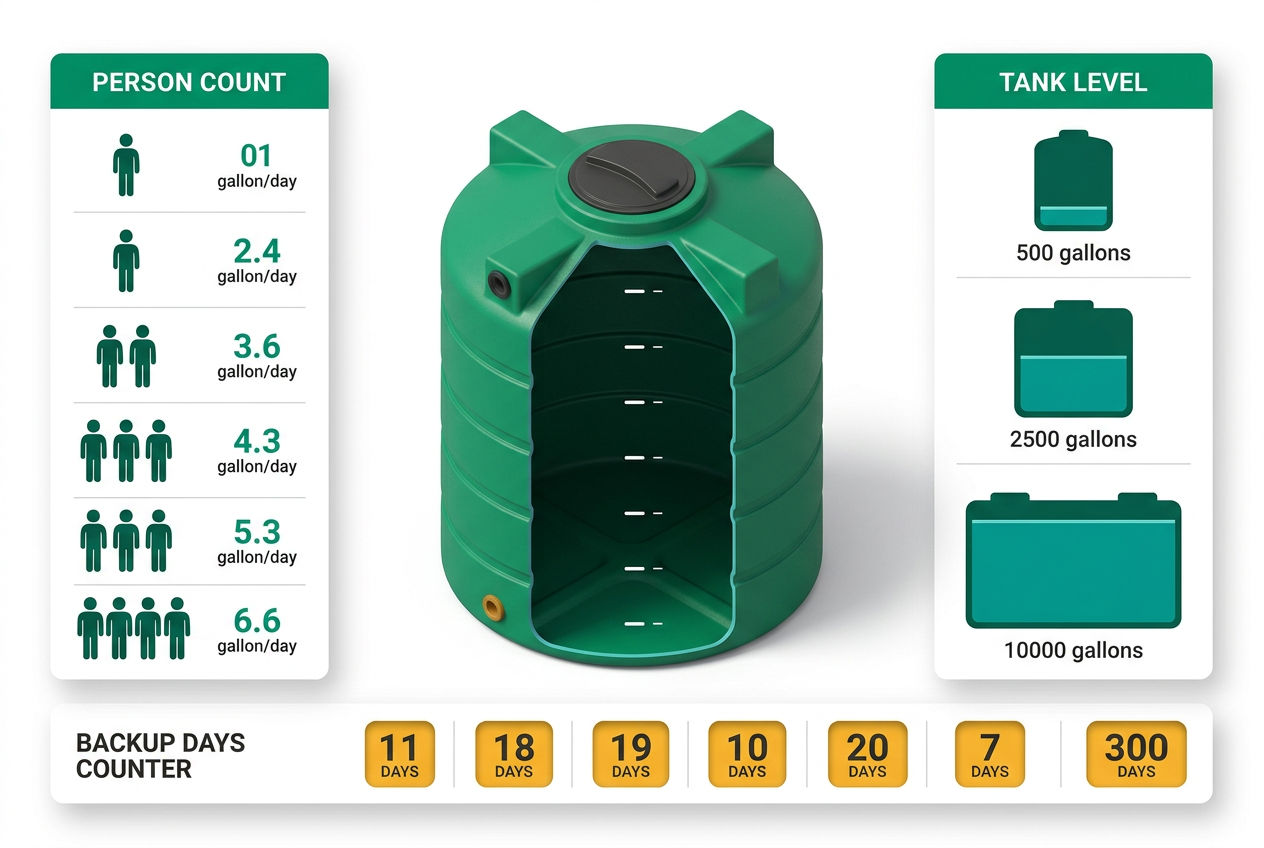
Here's a quick sizing example. A 4-person household using 30 gallons per person per day (120 gallons/day) needs:
- 30-day buffer: 3,600 gallons
- 60-day buffer: 7,200 gallons
Common polyethylene storage tanks come in 500, 1,000, 2,500, 5,000, and 10,000-gallon sizes. Quality poly tanks from manufacturers like Norwesco or Snyder Industries last 20–30 years with UV-stabilized construction. For most 2–4 person homesteads on rainwater, two 2,500-gallon tanks in series (5,000 gallons total) hit the sweet spot between cost and security.
Tanks must be rated for potable water storage — food-grade polyethylene only. Never repurpose a tank that held chemicals or fuel, regardless of how thoroughly it's cleaned.
How Do You Filter and Purify Water Off the Grid?
No off-grid water source is safe to drink untreated. Not wells. Not springs. Not even mountain rainwater collected off a brand-new roof. Treatment is mandatory.
Multi-Stage Filtration
A proper off-grid water filtration system works in stages:
Stage 1 — Sediment pre-filter: Removes particles, sand, and debris. Standard ratings run 5–50 microns. A 20-micron filter is a solid starting point for most raw water sources.
Stage 2 — Carbon filter: Removes chlorine byproducts, VOCs, and taste/odor compounds. Whole-house carbon filters from brands like Pentek or Watts use granular activated carbon (GAC) or block carbon media.
Stage 3 — UV sterilization: UV systems like the Viqua D4 or Trojan UVMax Pro10 expose water to UV-C light at 254 nanometers, destroying the DNA of bacteria, viruses, and protozoa. Effective at eliminating 99.99% of biological contaminants. No chemicals. No byproducts. Replace the bulb annually.
Stage 4 (drinking water) — Reverse osmosis: RO systems filter down to 0.0001 microns, removing heavy metals, nitrates, fluoride, and dissolved solids. Point-of-use systems under the kitchen sink (iSpring or APEC are common brands) handle drinking and cooking water. RO produces a waste stream of 2–4 gallons per gallon of purified water — factor that into your consumption math.
The EPA recommends testing private well water at least once per year. For spring or rainwater systems, test before first use and after any flood or contamination event. Your county health department can usually point you to a certified lab — tests run $50–$200 depending on the panel.
Gravity Fed Water System vs. Pump-Based Distribution
How water moves from storage to tap is a separate decision from how you collect it.
Gravity Fed Systems
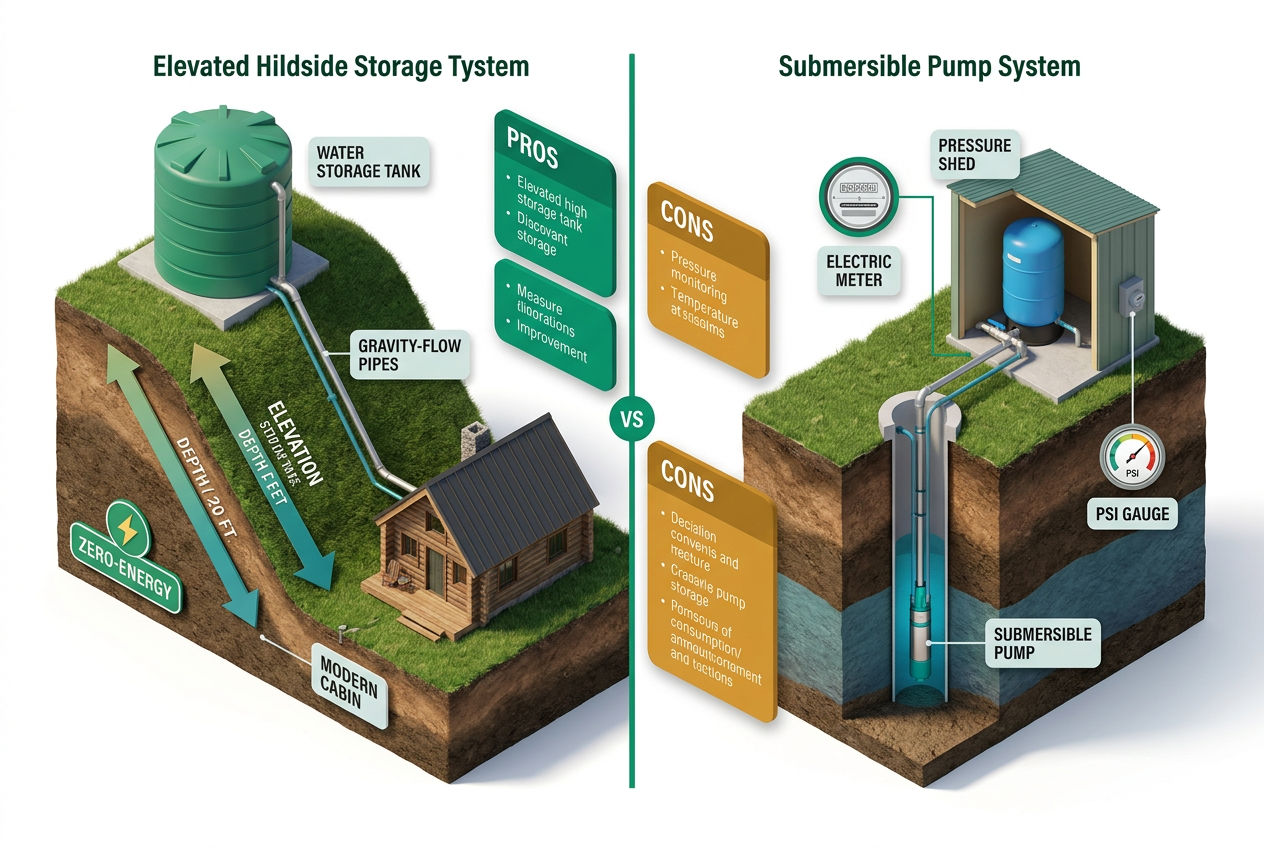
If your storage tank sits above your house — on a hill, a tower, or an elevated platform — gravity does the work. Every 2.31 feet of vertical elevation generates 1 PSI of pressure. For minimum comfortable household pressure (20–40 PSI), you need 46–92 feet of vertical head between the tank and the lowest fixture.
That's a lot of elevation. Most properties don't have it naturally, which is why gravity-fed systems are most practical in hilly or mountainous terrain — Northeast ridgelines, Appalachian homesteads, Pacific Northwest slopes. No electricity required, no pump to fail. Simple and bulletproof.
Pump-Based Distribution
Most off-grid homes use a submersible pump (in a well) or a jet pump (for surface water or storage tank) paired with a pressure tank. The pressure tank — a steel or composite vessel with a bladder — stores pressurized water so the pump isn't cycling on every time you open a faucet. Common residential pressure tanks run 20–80 gallons capacity.
A solar powered water pump is the obvious choice for off-grid energy independence. Systems like the Grundfos SQFlex or Lorentz PS2 series run directly off solar panels with no battery bank required during daylight hours. A complete solar pump system adds $1,500–$5,000 to your build, depending on pump depth and panel array size.
A hand pump well serves as the ultimate backup. Bison Pumps and Simple Pump both manufacture stainless-steel hand pumps capable of lifting water from 200+ feet. Budget $1,500–$3,500 installed. You'll never appreciate it more than the first time the power goes out in January.
What Does a Complete Off Grid Water System Cost?

DIY Septic Blueprint
Thinking about building it yourself?
The complete, plain-English plan to size, permit and install your own septic system — designed for homeowners, not contractors. Skip the $15,000–$25,000 quotes and do it right the first time.
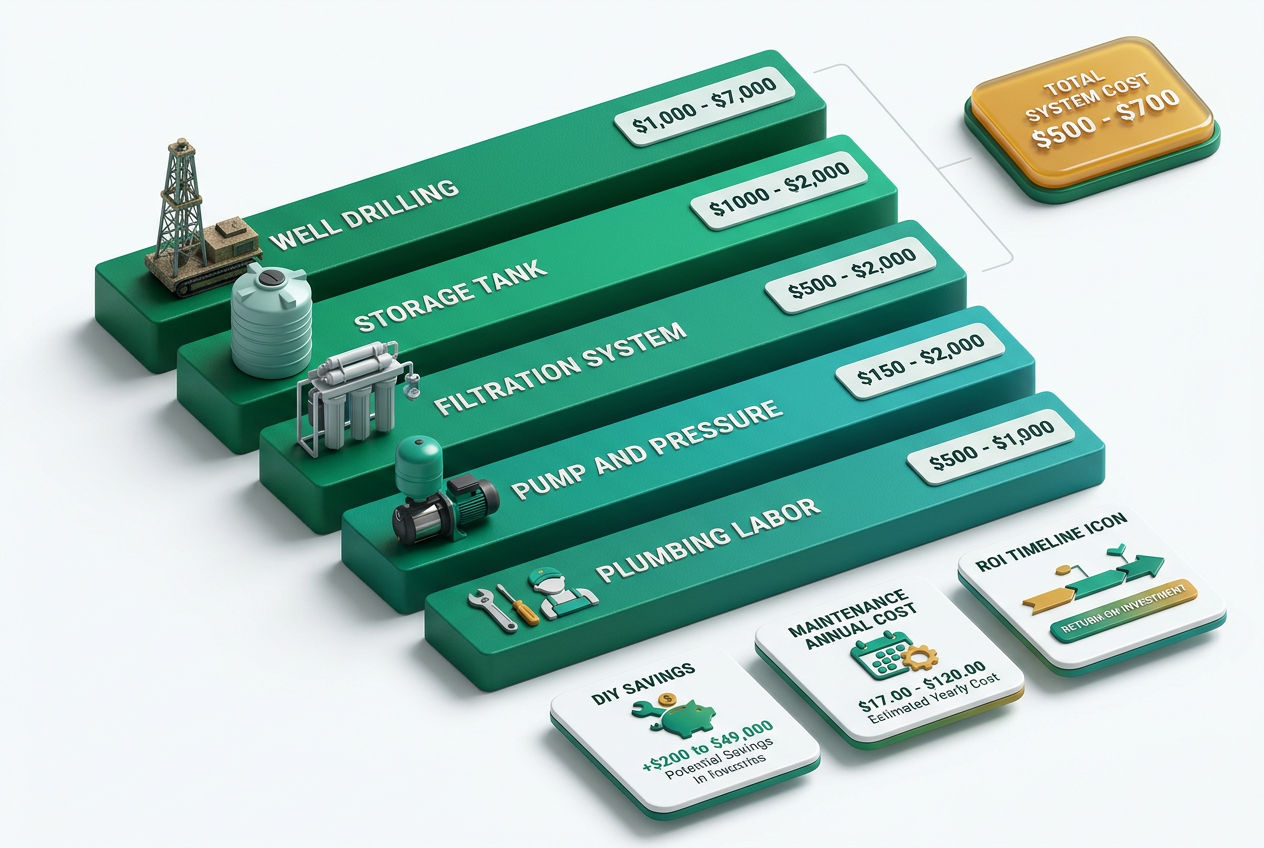
Get the DIY Blueprint — $67 →Instant download · 8 modules + 3 bonus guides · 60-day money-back guaranteeCosts swing dramatically based on source type, lot conditions, and treatment requirements. Here are realistic installed ranges:
| System Type | DIY Range | Professionally Installed |
|---|---|---|
| Drilled well (complete) | Not recommended | $8,000–$25,000+ |
| Rainwater harvesting | $1,000–$5,000 | $5,000–$20,000+ |
| Spring collection | $500–$2,000 | $1,500–$5,000 |
| Solar pump addition | $800–$2,500 | $1,500–$5,000 |
| Full filtration (multi-stage) | $400–$1,200 | $1,500–$4,000 |
Ranges reflect 2025 national data; costs vary by region and site conditions
Well drilling in granite bedrock (common in New Hampshire, Vermont, and Maine) can add $3,000–$8,000 over sedimentary formation costs because drilling progress slows to 5–10 feet per hour instead of 30+. In contrast, shallow sand-and-gravel aquifers in the Southeast often allow driven or bored wells at a fraction of the cost.
Most off-grid homesteaders building a complete system from scratch — well, storage, solar pump, and multi-stage filtration — should plan for $15,000–$30,000 for a professionally installed setup that reliably serves a family of four.
If you're also planning your waste system, see our septic installation cost guide to budget both together. Well and septic are almost always co-planned on raw land.
Seasonal and Regional Considerations
Water systems that work perfectly in August can fail in February without proper planning.
Freeze protection: In Minnesota, Wisconsin, or Montana, frost penetrates 42–60 inches deep. Any supply line shallower than the local frost depth needs heat tape, foam insulation, or burial below the frost line. Pipes connecting a storage tank to a structure are particularly vulnerable. A thaw-out service call runs $800–$2,500 depending on location and access. Bury deep and insulate the first 10 feet from any structure entry point.
Summer drought: Spring-fed systems are the most drought-sensitive. A spring that flows at 3 GPM in April may drop to 0.5 GPM in September after a dry summer. If your property is in the Southwest — Nevada, Utah, New Mexico, Arizona — a rainwater-only system is simply not viable as a primary source. Average annual rainfall in Phoenix is under 8 inches. A 2,000 sq ft roof there yields roughly 8,000–9,600 gallons per year. A 4-person household needs 43,000+ gallons. The math doesn't work.
Pacific Northwest: Seattle's 38 inches of annual rainfall, concentrated in fall and winter, makes rainwater harvesting highly viable as a supplemental or even primary source. Washington State actively encourages collection.
Southeast: High rainfall (50–60+ inches/year in much of Florida, Georgia, and the Carolinas) supports harvesting, but warm temperatures accelerate algae growth in storage tanks. Light-blocking (opaque) tanks and quarterly cleaning prevent the biofilm problems that plague improperly maintained systems in humid climates.
For properties with a septic system alongside the water setup, heavy rainfall events create a different problem — how heavy rain affects septic systems explains what happens when saturated soil backs up your drain field during the same storm that's filling your cistern.
Off-Grid Plumbing: Connecting It All
Once water reaches a pressure tank or gravity feed point, standard residential plumbing applies. PEX tubing (cross-linked polyethylene) is the dominant choice for off-grid plumbing because it handles freeze-thaw cycling better than copper or CPVC. It's flexible, runs in long continuous lengths to minimize fittings, and costs $0.30–$0.80 per linear foot in 1/2" and 3/4" sizes.
Off-grid plumbing differs from grid-connected homes primarily in the pressure source and the treatment integration points. Every potable fixture branch should run through the full treatment train. Non-potable lines — irrigation, toilet flushing if you're not using a composting system — can bypass RO and UV stages, conserving consumable filter capacity.
If you're running a cabin septic system alongside your water supply, coordinate pipe trench routing during initial excavation. Digging one trench for both supply and drain lines saves significant excavation cost on raw property.
Sources & Methodology
-
U.S. Geological Survey (USGS) — Water Science School: Source for per capita daily water use data (80–100 gallons/day national average). usgs.gov
-
U.S. Environmental Protection Agency (EPA) — Private Drinking Water Wells: Source for annual testing recommendations and treatment standards for private water supplies. epa.gov
-
EPA WaterSense Program: Source for water-efficient fixture performance data and consumption benchmarks used in sizing calculations.
-
USDA Rural Development: Programs and technical guidance for rural water system infrastructure, including well grants for qualifying homeowners. rd.usda.gov
-
State water authority regulations: Rainwater collection legality data referenced from Colorado, Utah, Nevada, Washington, and Oregon state statutes current as of 2025. Verify current limits with your state water authority before installing a collection system.
Frequently Asked Questions
Q: How do I choose between a well water system and rainwater harvesting for off-grid use?
A: The decision comes down to three factors: annual rainfall, aquifer accessibility, and budget. If you receive 30+ inches of rainfall annually and have a metal roof with adequate collection area, rainwater harvesting is a viable primary or supplemental source costing $1,000–$20,000 depending on scale. If your land sits over a reliable aquifer at 100–300 feet depth, a drilled well delivers more year-round reliability for $8,000–$25,000 installed. In arid regions like the Southwest, where rainfall is under 15 inches per year, rainwater alone won't meet household demand — a drilled well or trucked water is necessary. Many off-grid homesteads run both: a well as the primary source and rainwater collection to reduce pump runtime and electricity consumption. Test your aquifer before committing to drilling; a hydrogeologist report costs $500–$1,500 and can prevent a costly dry hole.
Q: How do I filter and purify water for potable use off the grid?
A: A reliable off-grid water filtration system uses multiple stages in sequence. Start with a sediment pre-filter rated at 5–20 microns to remove particulates. Follow with a granular activated carbon (GAC) filter for organic compounds and taste/odor. Then run water through a UV sterilizer — systems like the Viqua D4 eliminate 99.99% of bacteria and viruses without chemicals. For drinking and cooking water, add a point-of-use reverse osmosis system (0.0001 micron filtration) to remove heavy metals, nitrates, and dissolved solids. Replace UV bulbs annually and sediment filters every 3–6 months depending on source water quality. The EPA recommends testing private water supplies at least once per year — contact your county health department for certified lab referrals. Test panels run $50–$200 and confirm whether your treatment train is performing as designed.
Q: How big should a water storage tank be for a 4-person off-grid household?
A: A 4-person off-grid household using 30 gallons per person per day consumes 120 gallons daily, or about 3,600 gallons per month. For a rainwater-dependent system, target 30–60 days of storage as a drought buffer — that means 3,600–7,200 gallons of usable storage capacity. Two 2,500-gallon polyethylene tanks in series (5,000 gallons total) is a practical and cost-effective solution for most families. For a well-based system, a pressure tank of 40–80 gallons handles daily demand without needing bulk storage. All storage tanks must be food-grade (potable water rated) polyethylene — Norwesco and Snyder Industries are standard manufacturers. Quality poly tanks last 20–30 years with UV-stabilized construction. Size conservatively and account for seasonal demand peaks; summer water use typically runs 20–40% higher than winter on most homesteads.
Q: Is rainwater harvesting legal in my state?
A: Rainwater harvesting is legal in the majority of U.S. states, but collection limits and permitted uses vary significantly. Western states have historically been most restrictive due to prior appropriation water rights law. Colorado now allows up to 110 gallons in two containers for outdoor use without a permit — expanded but still limited compared to eastern states. Utah permits residential collection up to 2,500 gallons. Nevada lifted most restrictions in 2017. Washington and Oregon actively encourage collection with no residential volume caps. In eastern states using riparian water rights doctrine, rainwater collection is generally unrestricted. Some states restrict harvested rainwater to non-potable uses (irrigation, toilet flushing) unless the system includes a full treatment train meeting state standards. Always verify current regulations with your state water authority and county health department before installing a system — laws in this area have shifted frequently since 2015.
Q: What is a gravity fed water system and when does it make sense for off-grid use?
A: A gravity fed water system stores water in a tank elevated above the home and uses gravity to deliver it at pressure — no pump required during distribution. Every 2.31 feet of vertical height between the tank and the lowest fixture produces 1 PSI of pressure. To achieve 20 PSI minimum (enough for showers and basic fixtures), your tank needs to sit at least 46 feet above the lowest outlet. To reach comfortable 40 PSI, you need 92 feet of elevation. Gravity systems make the most sense on hilly or mountainous terrain — Appalachian homesteads, Pacific Northwest slopes, and mountain properties in Colorado or Montana often have natural topography that makes this viable. They're exceptionally reliable because there are no pump components to fail. The primary limitation is that most flat or gently sloping land can't generate enough head pressure without building an expensive elevated tower, making pump-based systems more practical for the majority of off-grid properties.
Planning your full off-grid property setup? Read our guide to off-grid toilet options and explore how a composting toilet can dramatically reduce your daily water demand — often eliminating 25–30% of household consumption. When you're ready to find licensed well drillers or septic professionals in your area, use our directory to get quotes from vetted service providers near you.
Free download
Not ready for the Blueprint? Start free.
Grab the free DIY Septic Planning Kit — the permit-first checklist, perc-test cheat sheet, and sizing tables that keep your build from getting red-tagged.
Was this article helpful?
Frequently Asked Questions
Recommended Resources
📖 Related Articles
- Septic System Setback Requirements: How Far From the House?
- The Best Off Grid Toilet (Top Picks)
- Greywater Systems: How They Work & How to Build One
- Heavy Rain and Septic Systems: What Happens and What to Do
- Off Grid Cabin: The Complete Guide
- Composting Toilets: The Complete Guide (How They Work + Best Models)
Find Septic Professionals Near You
Compare licensed, verified septic companies by area — top county markets and cities below, or browse all 50 states.
County markets
Popular cities
