
Quick Answer
An off-grid septic system is any permitted wastewater treatment solution that operates independently of municipal sewer infrastructure. Legal options include conventional septic tanks, mound systems, aerobic treatment units (ATUs), composting toilets, constructed wetlands, and holding tanks. The best choice depends on your soil, climate, county regulations, and whether you're living there year-round or just on weekends.
Key Takeaways
- Most off-grid properties still need a permit — even for composting toilets and greywater systems
- County health departments set the rules, not state agencies, so your neighbor's system may not be legal on your lot
- A percolation test (perc test) is typically required before any permit is issued
- Conventional septic costs $3,000–$10,000; engineered alternatives run $8,000–$20,000+
- Combining a composting toilet with a greywater system can dramatically reduce costs on the right property
Can You Have a Septic System Completely Off the Grid?
Yes — roughly 60 million Americans (about 20% of U.S. households, per the EPA) already use on-site wastewater treatment that has nothing to do with city sewer. Many of those systems serve rural cabins, remote homesteads, and off-grid properties. The catch? "Off the grid" does not mean "off the regulatory radar." Every county in the United States has some form of sewage disposal law. Violating it can mean fines, forced removal of your system, and a very difficult property sale down the road.
The good news: there are more legal off-grid septic options now than at any point in history. And if you plan to do the work with your own hands, our step-by-step DIY septic guide covers the build process in detail. Here's what actually works.
Do You Need a Permit for an Off-Grid Septic System?
Almost certainly, yes. A septic system permit is required in virtually every U.S. county before installing any wastewater system — conventional or alternative. Permit and perc test fees typically run $250–$1,000 depending on your county.
Here's what surprises most first-time off-grid builders: regulations are almost always set and enforced at the county level, not the state level. Two lots in the same state — even in the same ZIP code — can have different approved system types depending on which county health district covers them. Your neighbor's mound system doesn't automatically mean you can build one. Your county's environmental health office is the only source of truth for what's allowed on your specific parcel.
Before you buy land, before you design a cabin, call the county health department. Ask two questions: What systems are approved here? And has a perc test been done on this property? If the answer to question two is no, budget $300–$700 for a percolation test before you commit to anything.
What Are Your Legal Off-Grid Septic Options?
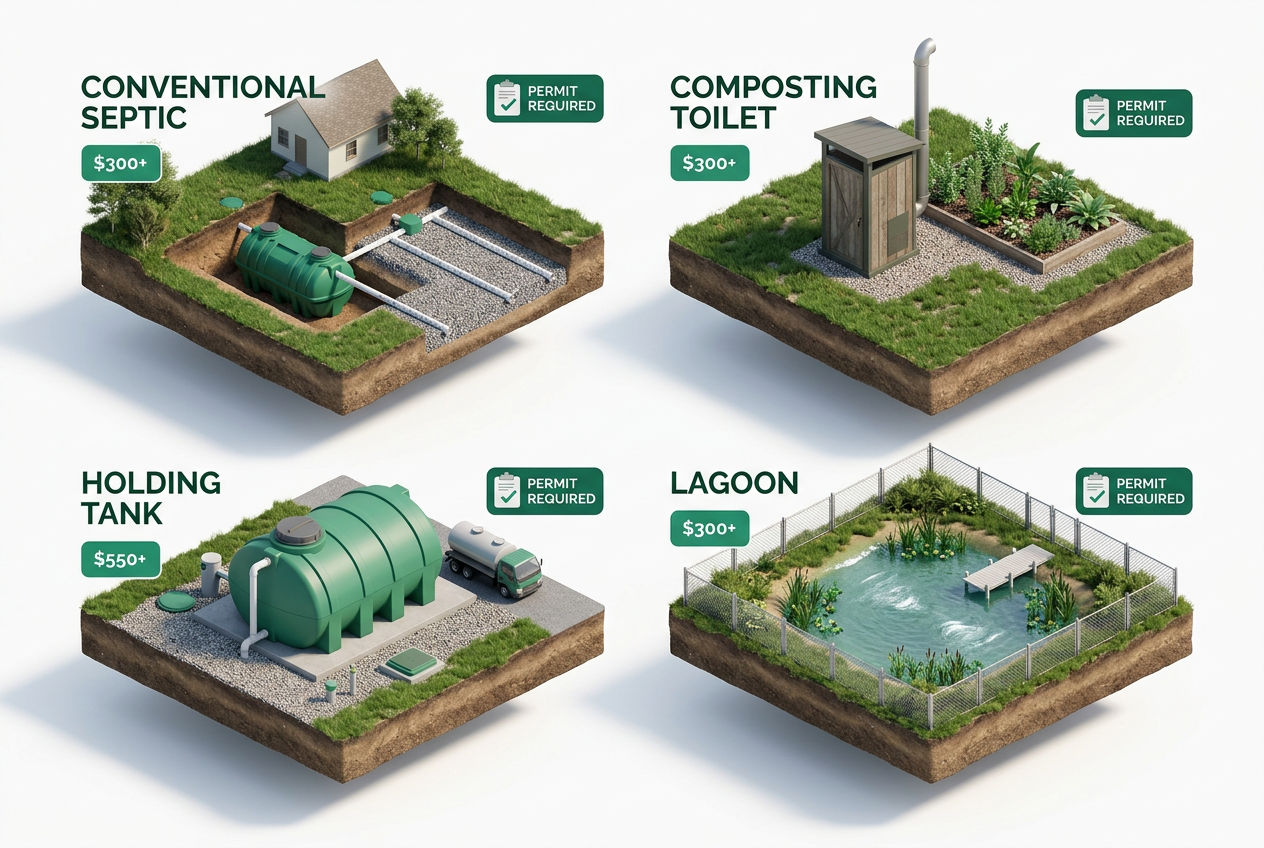
1. Conventional Septic Tank + Drain Field
If your soil passes a perc test, a conventional septic tank with a leach field is almost always the cheapest and most straightforward option. Wastewater flows from the house into a buried tank (typically 1,000–1,500 gallons for a cabin), where solids settle and anaerobic bacteria break down waste. Clarified effluent then disperses through perforated drain field laterals into the soil.
Cost: $3,000–$10,000 installed, with a national average around $7,000. See the full septic installation cost guide for regional breakdowns.
Lifespan: 20–30 years with proper maintenance.
Best for: Properties with good soil drainage, moderate lot size, and year-round use.
Limitation: Requires permeable soil. Fails perc test = no conventional system. Also requires water usage — a 1-bedroom cabin is typically designed for 150 gallons per day (GPD), which is easily met. But if you're using a gravity-fed rainwater system producing only 10–20 GPD, the system may not function properly.
For a small septic tank option, some counties approve 500-gallon or 750-gallon tanks for very low-flow seasonal cabins. Check our septic tank size chart to find the right fit.
2. Mound Septic System
When soil is too shallow, too dense (heavy clay), or the water table is too high for a conventional drain field, a mound septic system raises the treatment zone above grade. A pump chamber pushes effluent up into a sand-filled mound that acts as a constructed drain field.
Cost: $10,000–$20,000+, depending on mound size and pump system complexity.
Best for: Southeast clay soils (Tennessee, North Carolina, Arkansas), high water table areas in the Upper Midwest, and rocky mountain terrain where digging a conventional leach field is impossible.
Limitation: The mound is visible — it sits several feet above ground. It also requires a pump with a float switch, which means an electrical connection. On a fully off-grid solar setup, you'll need to account for pump load. A typical Hiblow HP-80 aerator compressor draws about 80 watts; a submersible effluent pump may draw 300–500 watts on each cycle.
3. Aerobic Treatment Unit (ATU)
An aerobic treatment unit injects air into the waste stream to accelerate bacterial breakdown. The result is a significantly higher quality effluent than a conventional anaerobic septic tank — clean enough that many states allow surface application or drip irrigation discharge.
ATUs are governed by NSF/ANSI Standard 40, which most states use as the approval benchmark for residential wastewater treatment systems. Orenco Systems and Infiltrator Water Technologies are two widely used manufacturers in this space.
Cost: $10,000–$20,000 installed.
Maintenance: Required inspections 1–3 times per year. In most states, this maintenance contract is legally mandated as a condition of your permit. Budget $200–$500 per year for service.
Lifespan: 15–25 years with regular maintenance.
Best for: Properties where soil quality is poor, conventional drain fields are prohibited, or the county requires advanced treatment near sensitive water bodies.
For a deeper look at how these compare to standard systems, read our aerobic vs. anaerobic septic systems breakdown.
4. Constructed Wetland Septic System
A constructed wetland uses a gravel-filled bed planted with wetland vegetation (cattails, bulrush, reeds) to filter septic effluent through biological and physical processes. It's one of the more eco-friendly off-grid wastewater treatment options and is gaining traction in counties that prioritize low-impact development.
Cost: $8,000–$15,000 installed.
Best for: Pacific Northwest properties with suitable land area, eco-conscious homesteaders, and sites near sensitive water bodies where low-nutrient discharge is required.
Limitation: Requires more horizontal land area than conventional systems. Performance drops in cold climates during winter months unless the bed is properly insulated. Not approved in every county — confirm with your health department.
5. Composting Toilet + Greywater System
This is where a lot of off-grid builders start — and where many get tripped up legally.
A composting toilet handles blackwater (toilet waste) through aerobic decomposition, eliminating the need for a septic tank to process human waste. Brands like Sun-Mar, Separett, and Nature's Head produce NSF/ANSI Standard 41-certified units. Most residential models handle 1–4 people full-time and cost $1,000–$4,000.
But a composting toilet alone doesn't solve your whole wastewater problem. You still produce greywater — sink, shower, and laundry water — which must be legally managed. A greywater system routes this water through a simple treatment process (sand filter, mulch basin, or constructed wetland) before soil dispersal. Greywater systems cost $500–$3,000 depending on complexity.
Combined, a composting toilet + greywater setup can handle full off-grid waste disposal at a fraction of the cost of a conventional septic system — if your county allows it.
Are composting toilets legal? More than 30 states allow them as a primary sanitation option with conditions. But "state allows it" doesn't always mean "your county allows it." Some of the most permissive states include Alaska, Montana, Arizona, and Missouri. New Jersey, Massachusetts, and parts of California are among the most restrictive.
Important: Many counties require a greywater permit even for simple systems. Don't assume a $1,200 composting toilet and a French drain out back is legal — call your county health department first.
For more detail, read our full guide on alternative septic systems.
6. Incinerating Toilet
An incinerating toilet burns waste to sterile ash using electric or propane heat, eliminating the need for any water or drainage system for toilet waste. Popular in Alaska, remote mountain cabins, and seasonal hunting camps.
Cost: $2,000–$5,000 per unit.
Best for: Seasonal use properties, extreme cold climates, or sites where even a composting toilet would struggle.
Limitation: High energy consumption per use (a single incineration cycle uses roughly 1.5–2.5 kWh for electric models). On a solar system with a small battery bank, that's significant. Also, most units can only handle one use at a time — a family of four during morning rush is problematic. Like composting toilets, you still need to manage greywater separately.
See our dedicated guide on incinerating toilets for brand comparisons and installation requirements.
7. Holding Tank
A holding tank is exactly what it sounds like — a sealed tank that stores all wastewater with no treatment and no discharge. When it fills, a pump truck empties it.
Cost: $2,000–$5,000 installed.
Ongoing cost: $200–$500 per pump-out, every 2–6 weeks for full-time use. That adds up fast — potentially $2,600–$13,000 per year for a full-time household.
Best for: Seasonal cabins with very low use (a few weekends per year), temporary installations during construction, or remote sites where no other system is feasible.
Limitation: Holding tanks are not a long-term solution for full-time living. The pump-out costs alone make it economically unsustainable at full occupancy.
DIY Septic Blueprint
Thinking about building it yourself?
The complete, plain-English plan to size, permit and install your own septic system — designed for homeowners, not contractors. Skip the $15,000–$25,000 quotes and do it right the first time.
Get the DIY Blueprint — $67 →Instant download · 8 modules + 3 bonus guides · 60-day money-back guaranteeOff-Grid Septic System Comparison Table
| System | Installed Cost | Best Use Case | Permit Required | Maintenance |
|---|---|---|---|---|
| Conventional Septic | $3,000–$10,000 | Good soil, year-round | Yes | Pump every 3–5 yrs |
| Mound System | $10,000–$20,000+ | Poor soil, high water table | Yes | Annual inspection |
| Aerobic Treatment Unit | $10,000–$20,000 | Difficult sites, advanced treatment | Yes | 1–3x/year (mandated) |
| Constructed Wetland | $8,000–$15,000 | Eco-sensitive sites, mild climates | Yes (varies) | Seasonal maintenance |
| Composting Toilet + Greywater | $1,500–$7,000 | Low-water use, permissive counties | Varies by county | Monthly composting |
| Incinerating Toilet + Greywater | $2,500–$8,000 | Remote/seasonal, no water system | Varies | Clean ash weekly |
| Holding Tank | $2,000–$5,000 | Seasonal/temporary only | Yes | Pump every 2–6 wks |
Cost data sourced from national contractor averages and EPA on-site wastewater treatment cost estimates. Costs vary significantly by region.
Which System Is Right for Your Off-Grid Property?
Work through these four questions:
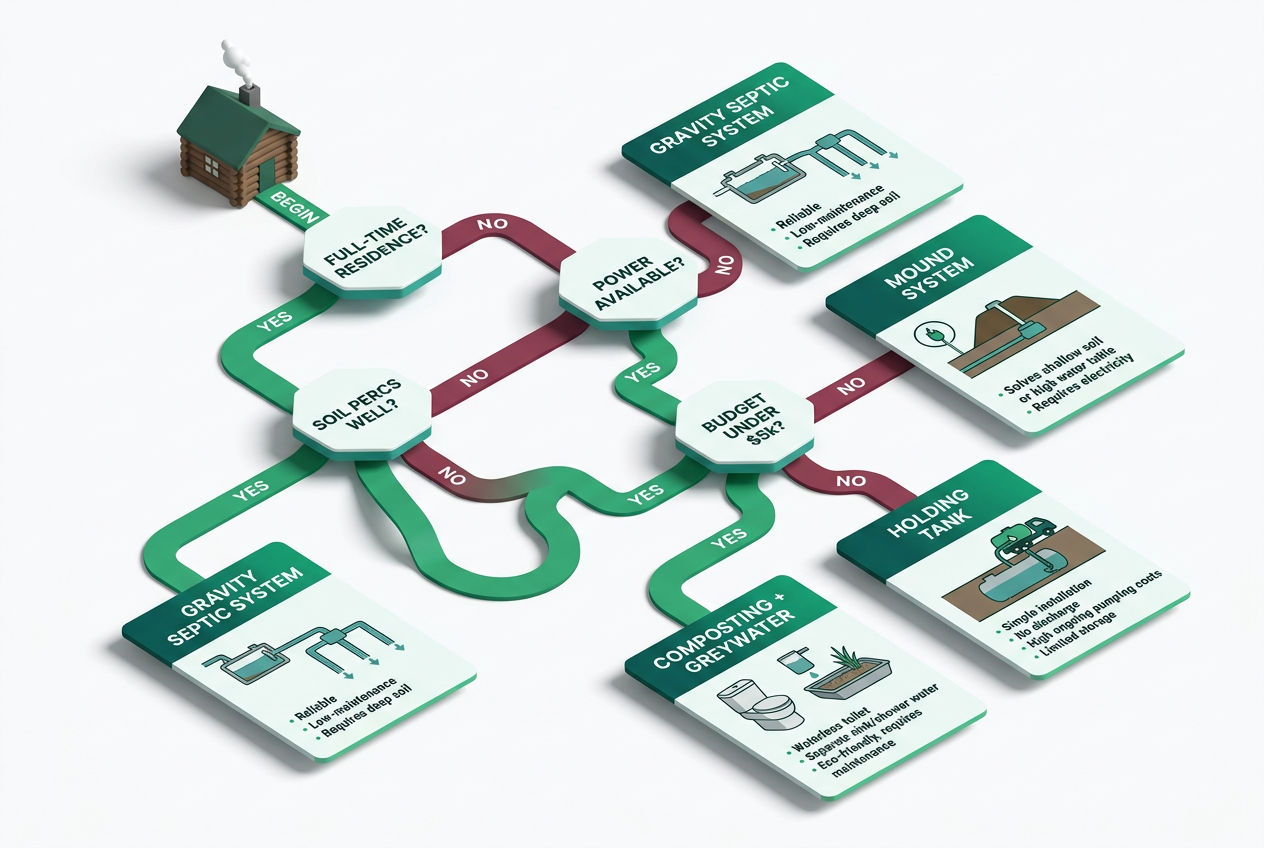
1. What does your soil do? Start with a perc test. If water drains at 1–60 minutes per inch, you likely qualify for a conventional system. Slower than that? You're looking at a mound system, ATU, or alternative approach. If you've already failed a perc test, our guide on failed perc test options walks through what comes next.
2. Is this full-time or seasonal? A family of four living off-grid full-time at 20–30 gallons per person per day generates roughly 80–120 GPD. A composting toilet + greywater system can handle that. A weekend cabin used 10 times a year? A holding tank might pencil out — do the math on pump-out frequency before committing.
3. What's your climate? In the Mountain West, frost lines reach 36–72 inches. Septic pipes within the first 10 feet of the house are vulnerable — insulating with rigid foam board can prevent a $1,500–$2,500 freeze-and-thaw repair call. In the Southwest, the dry climate makes evapotranspiration beds viable and some counties are more open to "dry" composting systems.
4. What does your county actually allow? This is the only question that matters at the end of the planning process. Every other answer is hypothetical until your county health department signs off. A licensed local septic installer who works in your county regularly is invaluable here — they know which systems the local inspector approves and which ones get rejected regardless of what the state code technically allows.
Use our directory to find a licensed septic installer near you who knows your local regulations.
What Is the Cheapest Septic System for a Cabin?
A conventional septic tank with a gravity-fed drain field is the cheapest option when soil conditions allow — typically $3,000–$6,000 for a simple single-bedroom cabin system. If your soil fails the perc test, a composting toilet paired with a basic greywater system is the next most affordable route at $1,500–$7,000 combined, provided your county permits it.
A holding tank is cheap to install ($2,000–$5,000) but expensive to operate. For a seasonal cabin used 20–30 days a year with minimal water use, the pump-out costs stay manageable. Run it full-time and you'll spend more on pump-outs than you would have on a proper system. Getting bids from local septic installation companies will show you what each option actually costs in your county.
For a full cost breakdown by system type, see our septic installation cost guide.
Regional Considerations for Off-Grid Septic
The Pacific Northwest brings high water tables and heavy rainfall — conventional drain fields frequently fail in coastal Oregon and Washington counties. Constructed wetlands and mound systems dominate here.
In Alaska, regulations are the most permissive of any state. Many communities have no central sewer and minimal county oversight. However, extreme cold demands specialized designs: insulated tank lids, heat tape on supply lines, and tanks buried deep enough to avoid freezing. See Alaska septic regulations for specifics.
Missouri is frequently cited by off-grid builders as one of the most permissive states in the lower 48 for alternative septic options — Missouri septic regulations allow a range of composting and greywater approaches that stricter states prohibit.
In the Southeast, clay soils in Tennessee, North Carolina, and Arkansas often make conventional drain fields impossible. Mound systems and ATUs are standard — not the exception.
For your specific state, find detailed regulatory guidance through our state septic regulation pages — every state is covered.
Sources & Methodology
- U.S. Environmental Protection Agency — Septic Systems Overview (epa.gov/septic): Used for the 20% household statistic, general treatment standards, and system design guidance.
- NSF International — NSF/ANSI Standard 40 and Standard 41: Referenced for ATU and composting toilet certification benchmarks.
- National Onsite Wastewater Recycling Association (NOWRA) (nowra.org): Referenced for alternative system design standards and professional licensing guidance.
- National Association of Wastewater Technicians (NAWT) (nawt.org): Referenced for maintenance frequency standards and inspection protocols.
- State and county health department guidance: Regulatory data cross-referenced with publicly available onsite wastewater rules from Alaska DEC, Missouri DNR, and Oregon DEQ.
Cost ranges reflect national contractor averages compiled from multiple regional installer quotes and public permit databases. Individual costs vary significantly by site conditions, local labor rates, and material availability.
Free download
Not ready for the Blueprint? Start free.
Grab the free DIY Septic Planning Kit — the permit-first checklist, perc-test cheat sheet, and sizing tables that keep your build from getting red-tagged.
Was this article helpful?
Frequently Asked Questions
Recommended Resources
📖 Related Articles
- Septic System Permit Cost & State Requirements (2026 Guide)
- Perc Test (Percolation Test): What It Is & How It Works
- Small Septic Tanks: Options for Cabins, Tiny Homes & Guest Houses
- Septic Tank Sizes & Dimensions Chart (by Bedrooms)
- Mound Septic System: $10K–$25K Cost & How It Works (2026)
- Aerobic vs Anaerobic Septic Systems: How They Compare
- Alternative Septic Systems: Options When a Standard System Won't Work
- Incinerating Toilets: How They Work, Cost & Best Models
- Land Failed the Perc Test? Here Are Your Options
🔧 Services
Find Septic Professionals Near You
Compare licensed, verified septic companies by area — top county markets and cities below, or browse all 50 states.
County markets
Popular cities
