
Quick Answer
A small septic tank is any residential tank under 1,000 gallons — typically used for cabins, tiny homes, guest houses, and seasonal properties with limited daily wastewater flow. Most states require a minimum tank size of 750–1,000 gallons regardless of structure size, though some counties allow smaller tanks for seasonal or limited-use permits.
Key Takeaways
- Most states require 750–1,000 gallons minimum, even for one-bedroom structures
- A 500-gallon polyethylene tank costs $400–$900 for the tank alone; full installed systems run $3,000–$8,000
- Smaller tanks need more frequent pumping — a 500-gallon tank serving two people typically needs service every 1–2 years
- Regulations are hyperlocal: county health departments, not just state agencies, set the rules
- Tiny homes on wheels may be classified as RVs, which changes your septic options entirely
What Counts as a "Small" Septic System?
A small septic system is designed to handle low daily wastewater flow — typically from structures with one or two bedrooms and one to three occupants. The EPA estimates the average person generates 50–75 gallons of wastewater per day. A one-bedroom cabin with two occupants produces roughly 150 gallons per day, which is the standard design flow used by most state health departments when sizing a tank.
The tank itself is only part of the equation. A complete septic system also includes a drain field (also called a leach field), where treated effluent disperses into the soil. Even if you only need a compact 750-gallon tank, your soil still needs to pass a percolation test — a perc test — before any permit gets issued. More on that below.
What Are the Smallest Septic Tank Sizes Available?
The smallest septic tanks sold for residential use start at 300 gallons. Here's a breakdown of what's on the market and what each size is realistically suited for:
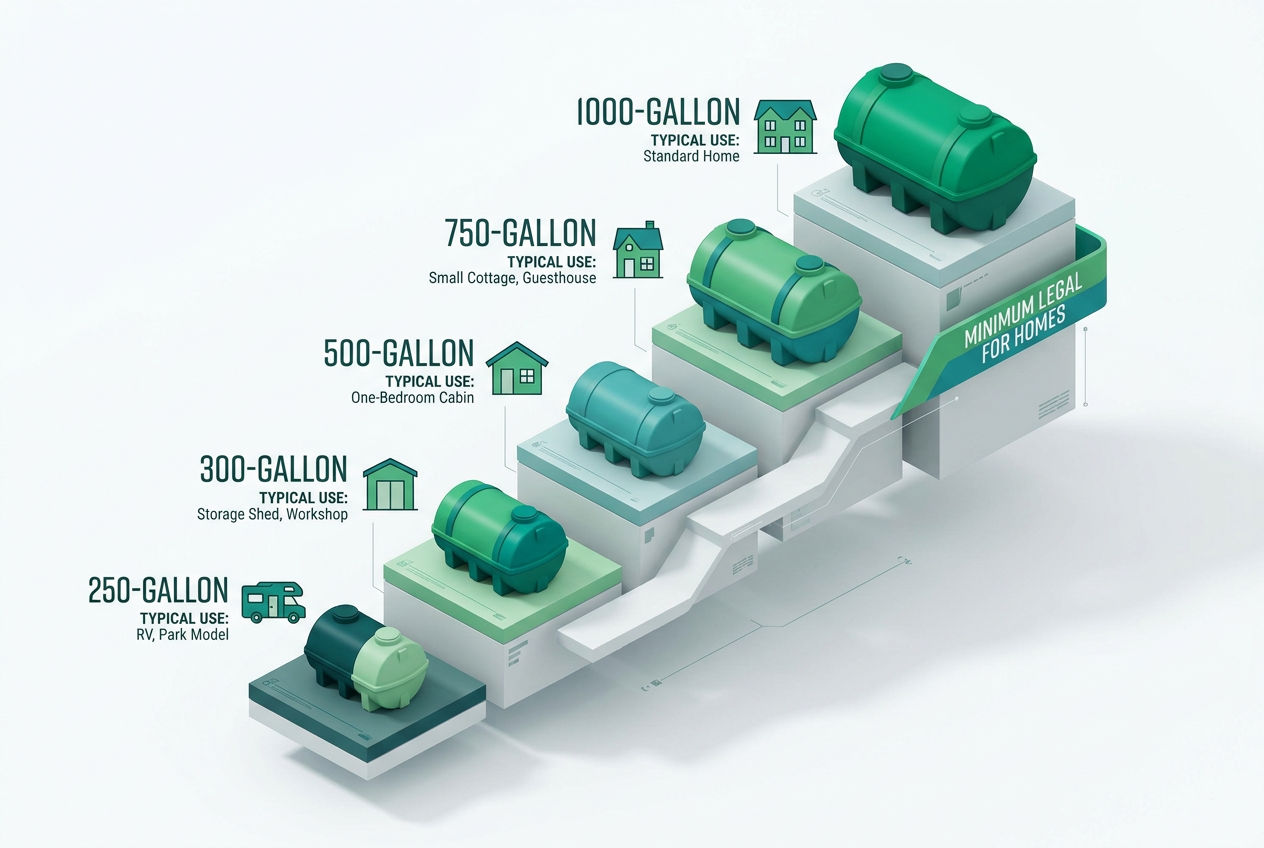
300-gallon tank: Primarily used as a holding tank or pump tank in two-stage systems. At 150 gallons per day design flow, a 300-gallon tank fills up in roughly two days of normal use. That's not a functional standalone septic tank for most situations — it's a collection vessel that needs very frequent pump-outs or serves as one stage in a larger engineered system.
500-gallon tank: The smallest tank that functions realistically as a standalone system for a single occupant in a seasonal cabin. A 500-gallon polyethylene tank from Infiltrator Water Technologies measures approximately 5' long × 3.5' wide × 4' tall and weighs under 200 lbs empty — light enough for two people to maneuver by hand. That portability is why 500-gallon poly tanks feature in many a DIY septic setup on remote land, assuming the county signs off.
750-gallon tank: The most common minimum size approved for one-bedroom seasonal use in states like Texas and several southeastern states. Texas, for example, sets 750 gallons as the minimum for structures with two or fewer bedrooms, per the Texas Commission on Environmental Quality (TCEQ).
1,000-gallon tank: The minimum legal size in the majority of U.S. states, regardless of home size. If you're building a tiny home intended for full-time occupancy, start here. See our 1,000-gallon septic tank guide for full specs and costs.
Small Septic Tank Comparison
| Tank Size | Best Use Case | Material Options | Tank-Only Cost | Pump Frequency (2 people) |
|---|---|---|---|---|
| 300 gal | Holding tank / pump tank | Poly | $200–$500 | Very frequent / N/A standalone |
| 500 gal | Seasonal cabin, 1 person | Poly, Fiberglass | $400–$900 | Every 1–2 years |
| 750 gal | 1-bed cabin / guest house | Concrete, Poly, FG | $500–$1,200 | Every 2–3 years |
| 1,000 gal | Tiny home / full-time use | Concrete, Poly, FG | $700–$1,500 | Every 3–5 years |
Source: Tank pricing from Infiltrator Water Technologies dealer pricing, 2024–2025. Pumping frequency based on EPA septic system guidelines and two-occupant design flow.
What Size Septic Tank Do You Need for a Cabin or Tiny Home?
Sizing is based on two factors: bedroom count and expected daily flow. Most state health departments use a bedroom-based formula, not actual occupancy. Here's the standard breakdown:
- 1 bedroom: 750–1,000 gallons (varies by state)
- 2 bedrooms: 750–1,250 gallons
- 3 bedrooms: 1,000–1,500 gallons
Use our septic tank size chart for a full state-by-state comparison.
A worked example: You're building a 400-square-foot cabin in western North Carolina. One bedroom, two loft sleeping areas. The county health department counts lofts with sleeping areas as bedrooms for septic sizing purposes — so you may be required to size for two bedrooms, not one. That pushes your minimum tank from 750 gallons to 1,000 gallons. This is exactly the kind of detail that trips up cabin builders who rely on general sizing charts without calling the county.
For a complete breakdown of how to size a septic system, including soil type and lot size considerations, that guide walks through the full calculation.
DIY Septic Blueprint
Thinking about building it yourself?
The complete, plain-English plan to size, permit and install your own septic system — designed for homeowners, not contractors. Skip the $15,000–$25,000 quotes and do it right the first time.
Get the DIY Blueprint — $67 →Instant download · 8 modules + 3 bonus guides · 60-day money-back guaranteeWhat Materials Are Small Septic Tanks Made From?
Polyethylene (Plastic)
Plastic septic tanks are the most popular choice for small installations. They're lightweight, corrosion-resistant, and easier to transport to remote sites — a real advantage when your cabin sits a quarter-mile down a logging road. Infiltrator Water Technologies and Norwesco both manufacture polyethylene tanks in 300-, 500-, and 750-gallon sizes.
The downside: polyethylene tanks can shift or float in high water table conditions. If your site has seasonal groundwater rise, the tank must be properly anchored or ballasted.
Fiberglass
Fiberglass tanks hit the middle ground between plastic and concrete. They're stronger than polyethylene under soil load and lighter than concrete. A 750-gallon fiberglass tank weighs roughly 200–400 lbs, versus 2,000+ lbs for a comparable concrete unit. See how these materials stack up in our fiberglass vs. concrete septic tank comparison.
Concrete
Concrete is the industry standard for a reason — it's durable, heavy (which prevents floating), and widely available. The weight also makes it harder to install in remote locations. A 750-gallon precast concrete tank typically requires a mini-excavator or small crane to place. If your site has road access and flat terrain, concrete is a solid choice. If you're hauling materials over a mountain trail, stick with poly or fiberglass.
Is a 300-Gallon Septic Tank Legal?
In most states, a 300-gallon tank does not meet minimum requirements for a permitted septic system serving a residence. Most jurisdictions require at least 750–1,000 gallons for any occupied structure.
That said, 300-gallon tanks are legally used in two specific contexts:
- As a pump or dosing chamber in a two-compartment or advanced system, where the 300-gallon tank receives pre-treated effluent from a primary tank and pumps it to a drain field or aerobic treatment unit (ATU).
- As a holding tank on seasonal properties under a limited-use permit. A holding tank collects all waste with zero soil discharge — it has no drain field. You're required to have it pumped every two to six weeks, at $200–$400 per service call. That adds up fast.
Holding Tank vs. Septic Tank: Which Is Right for a Seasonal Cabin?
A holding tank stores waste. A septic tank treats it. That's the core difference.
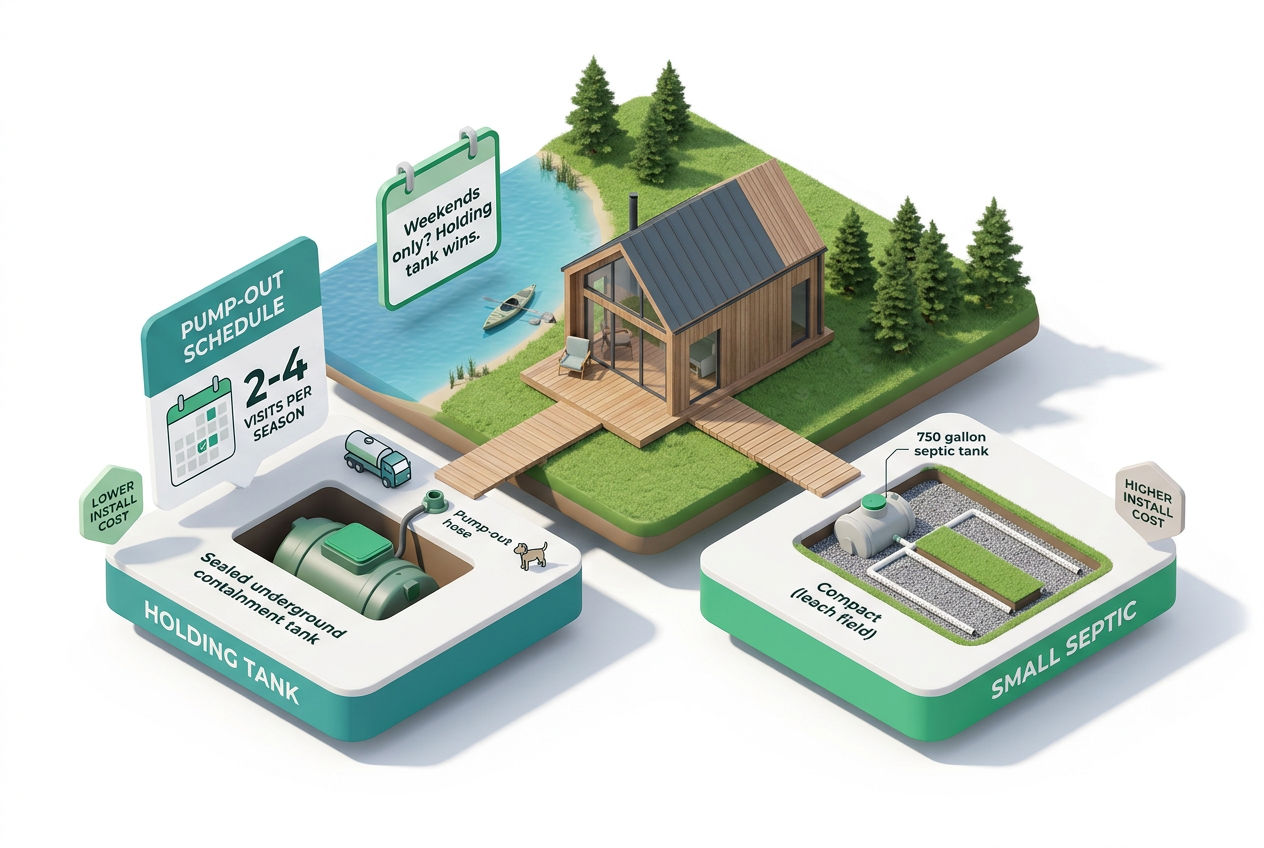
With a holding tank, everything you flush collects in the tank until a pump truck empties it. There's no drain field, no soil treatment, and no ongoing biological process. For a cabin you use four weekends a year, a holding tank can be practical. For a cabin you use every summer for three months, the pump-out costs alone — potentially $200–$400 every few weeks — make a true septic system far more economical over time.
A conventional small septic system works by allowing solids to settle in the tank (forming a sludge layer at the bottom and a scum layer at the top), while clarified effluent flows out through the outlet baffle into the drain field, where soil microbes complete the treatment process.
If you're debating which route to take, the full holding tank vs. septic comparison covers long-term costs and permit requirements in detail.
What Does a Small Septic System Cost to Install?
The tank is rarely the biggest expense. Labor, the drain field, and the permit usually cost more than the tank itself.
Here's a realistic cost breakdown for a small system installed in 2026:
- Tank only (750-gallon poly): $500–$1,200
- Perc test and soil evaluation: $300–$1,500 depending on the state and number of test holes required
- Septic permit: $200–$1,000 (highly variable by county)
- Excavation and installation labor: $1,500–$4,000
- Drain field materials and installation: $1,500–$5,000
- Total for a basic conventional system: $3,000–$8,000
Advanced systems cost more. If your soil fails the perc test, you'll need a mound system, an aerobic treatment unit (ATU), or another alternative septic system — those run $8,000–$15,000+.
Regional example: In rural Tennessee, a 750-gallon tank with a conventional gravity drain field typically comes in at $4,500–$6,500 all-in. The same system in coastal Maine — where frost depth reaches 48–60 inches, requiring deeper excavation, and state environmental regulations are more rigorous — runs $7,000–$12,000. The only way to pin down your number is to gather local septic installation quotes from contractors who work in your county.
Our septic installation cost guide breaks down pricing by system type and region.
Regulations: What's the Smallest Legal Septic Tank?
This is where most cabin builders get tripped up: regulations are hyperlocal.
Your state may set a minimum tank size of 1,000 gallons, but your county health department may allow a variance for seasonal structures. Or vice versa — a state might allow 750-gallon minimums, but your specific county requires 1,000 gallons based on local soil conditions.
A few concrete examples:
- Texas (TCEQ): 750 gallons minimum for structures with two or fewer bedrooms
- Most northeastern states (ME, VT, NH, NY): 1,000 gallons minimum regardless of home size; some require 1,250 gallons as the baseline
- Florida Department of Health: 900 gallons minimum for new installations in most counties; licensed contractors must hold a Registered Septic Tank Contractor (RSTC) license through the Florida DOH
- Colorado: County health departments have primary jurisdiction; requirements vary significantly between counties
Before you buy a tank or break ground, call your county health department — not just your state agency. Ask specifically about seasonal-use or limited-use permits if your structure won't be occupied year-round. You can also review septic system permit requirements for a broader overview of what the process involves.
Nearly every jurisdiction also requires a perc test before issuing a permit. No perc test, no permit.
Small Septic Systems for Tiny Homes: Special Considerations
Tiny homes on permanent foundations follow standard residential septic rules — you'll need a permitted system sized by bedroom count, same as any other house.
Tiny homes on wheels (THOWs) are a different story. Many jurisdictions classify them as recreational vehicles (RVs). In that case, you may only be permitted to connect to an RV hookup or dump station, not install a permanent septic system. Some states, including Oregon, Colorado, and North Carolina — which have the most developed tiny-home regulatory frameworks in the country — have created specific classifications for THOWs that allow permanent septic connections under certain conditions.
If you're planning a tiny home on wheels and want to connect to a septic system, read our dedicated guide to tiny home septic systems before you design the property.
For off-grid builds where municipal or county oversight is limited, off-grid septic options cover alternative approaches including composting toilets, constructed wetlands, and permitted mound systems.
Maintenance: How Often Does a Small Tank Need Pumping?
More often than you'd think — and more often than a full-size tank.
A 1,000-gallon tank serving two people needs pumping roughly every 3–5 years, per EPA guidelines. A 500-gallon tank serving those same two people reaches that same threshold in 1–2 years. The math is simple: less capacity means solids accumulate faster relative to tank volume.
A pumper will use a sludge judge — a clear calibrated tube — to measure the sludge layer at the bottom of the tank. When sludge and scum together occupy more than one-third of tank capacity, it's time to pump. For a 500-gallon tank, that threshold arrives quickly.
Nationally, a standard pump-out runs $300–$600. Remote cabin locations with limited road access can push that to $600–$900. See current pricing by region in our septic pumping cost guide.
One maintenance item often skipped on small systems: the effluent filter. A Polylok PL-122 or similar filter installs in the outlet baffle and prevents solids from reaching your drain field. On a small system, a clogged drain field is expensive — drain field replacement runs $5,000–$20,000. A $40 filter and annual cleaning is worth every penny.
How to Choose the Right Small Septic Tank
Use this decision framework:
- Call your county health department first. Ask for the minimum tank size for your structure type and intended use (seasonal vs. full-time).
- Schedule a perc test. No permit gets issued without one. If the soil fails, you'll need an alternative system — plan your budget accordingly.
- Match tank size to realistic occupancy. Size for the bedrooms the county counts, not your weekend headcount.
- Choose material based on site access. Remote location with no heavy equipment access? Go polyethylene or fiberglass. Road-accessible flat site? Concrete works fine.
- Build in pumping costs. A smaller tank costs less upfront but more over time. Factor pump-out frequency into your five-year budget.
- Get at least three installer quotes. Pricing for small system installation varies by 40–60% between contractors in the same county.
Ready to connect with a licensed installer in your area? Find a septic professional near you through the SepticTankHub directory — or get quotes from local contractors to compare pricing before you commit.
Sources & Methodology
- U.S. Environmental Protection Agency — Septic Systems Overview (epa.gov/septic): Used for daily wastewater flow estimates (50–75 gallons per person per day) and general pumping frequency recommendations.
- Texas Commission on Environmental Quality (TCEQ): Referenced for Texas minimum septic tank size requirements (750 gallons for ≤2 bedrooms).
- Florida Department of Health — Environmental Health: Referenced for Florida minimum tank size (900 gallons) and RSTC licensing requirements.
- Infiltrator Water Technologies: Referenced for polyethylene tank dimensions, weights, and product availability in small sizes.
- National Onsite Wastewater Recycling Association (NOWRA) (nowra.org): Referenced for industry standards on system sizing and design flow calculations.
Free download
Not ready for the Blueprint? Start free.
Grab the free DIY Septic Planning Kit — the permit-first checklist, perc-test cheat sheet, and sizing tables that keep your build from getting red-tagged.
Was this article helpful?
Frequently Asked Questions
Recommended Resources
📖 Related Articles
- What Is a Septic System? How It Works (Visual Guide)
- 1000-Gallon Septic Tank: Dimensions, Cost & Concrete vs Plastic
- Septic Tank Sizes & Dimensions Chart (by Bedrooms)
- What Size Septic System Do I Need?
- Plastic Septic Tanks: Sizes, Prices, Pros & Cons
- Fiberglass vs Concrete vs Poly Septic Tanks Compared
- Cesspool vs Septic Tank: Differences & What Replaces a Cesspool
- Alternative Septic Systems: Options When a Standard System Won't Work
- Septic System Permit Cost & State Requirements (2026 Guide)
- Perc Test (Percolation Test): What It Is & How It Works
- Tiny House Septic Systems: Cost, Tank Size & Options (2026)
- Off-Grid Septic Systems: Legal Options That Actually Work
💰 Cost Guides
🔧 Services
Find Septic Professionals Near You
Compare licensed, verified septic companies by area — top county markets and cities below, or browse all 50 states.
County markets
Popular cities
