
Quick Answer
Plastic septic tanks are a polyethylene or HDPE alternative to traditional concrete tanks — lighter, easier to install, and increasingly common on rural properties across the U.S. They come in sizes from 500 to 2,000 gallons, cost $500–$3,000 for the tank alone, and can last 20–40+ years with proper care.
Key Takeaways
- Poly tanks weigh 150–250 lbs empty — concrete equivalents weigh 4,000–5,000 lbs
- A 1,000-gallon plastic tank costs $800–$1,500 for the tank; $3,000–$6,500 installed
- Expected lifespan is 20–40+ years, shorter than concrete's 40–50+ years
- Buoyancy in high water table areas is the #1 installation risk — anchoring is required
- Not all states accept plastic tanks; always verify with your local health department before buying
What Is a Plastic Septic Tank?
A plastic septic tank is an underground wastewater holding vessel molded from polyethylene (PE) or high-density polyethylene (HDPE). Most are manufactured through a process called rotational molding — liquid resin is poured into a mold that spins on two axes simultaneously, distributing material evenly across the interior walls. The result is a seamless, one-piece tank with no welded joints to leak.
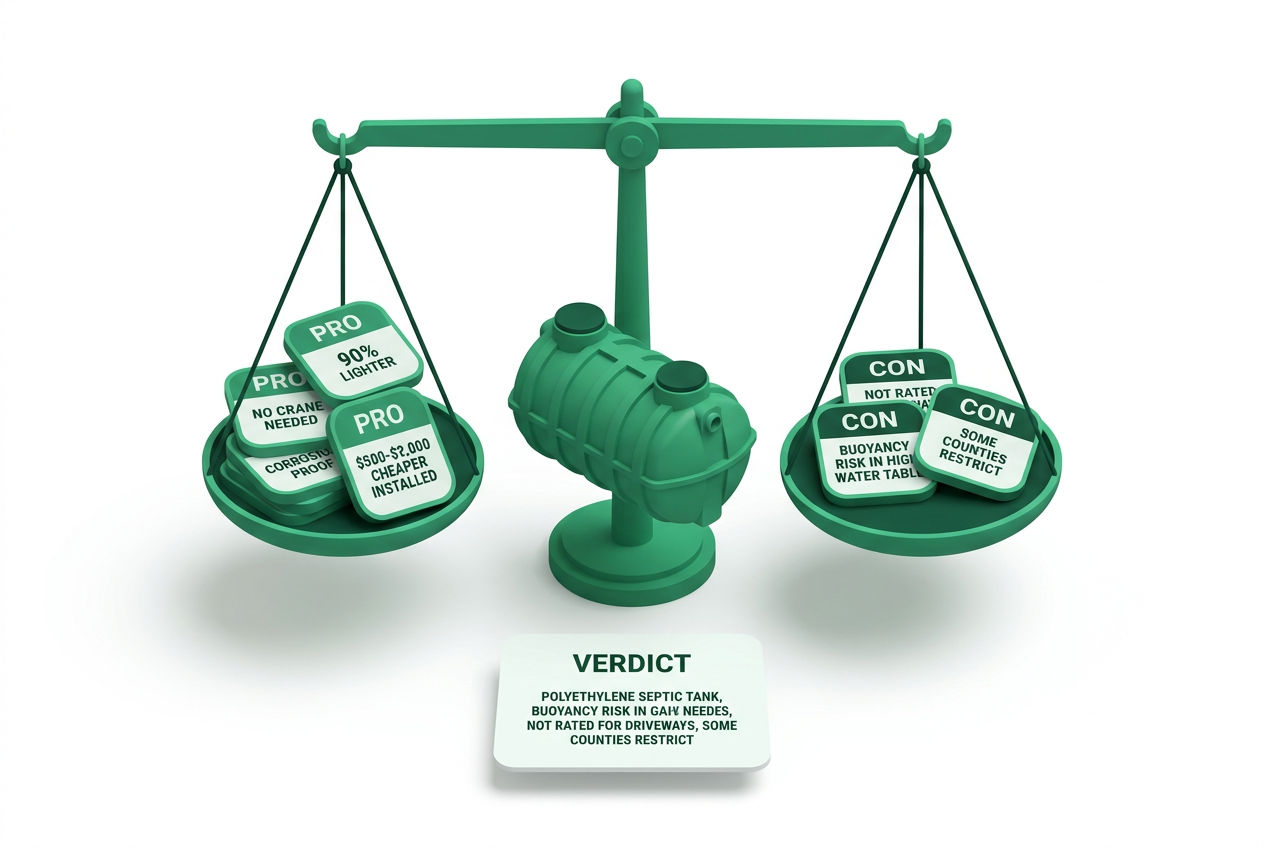
Wall thickness typically runs ¼ inch to ½ inch depending on manufacturer and tank size. Larger tanks may use ribbed or corrugated exteriors to add structural rigidity without adding excessive weight.
A polyethylene septic tank works the same way any septic tank does: solids sink to the bottom as sludge, grease and scum float to the top, and clarified effluent exits through an outlet baffle into the drain field. The material has no effect on the biological treatment process — bacteria don't care whether the walls are plastic or concrete.
If you're new to how these systems work, our guide on what a septic system is covers the full picture before you start shopping for tanks.
What Sizes Do Plastic Septic Tanks Come In?
Standard residential plastic septic tanks run from 500 to 2,000 gallons. The right size depends on your home's bedroom count, daily water use, and local code minimums — most states require at least a 1,000-gallon tank for a 3-bedroom home.
Here's a sizing reference for common poly tanks:
| Size | Approx. Dimensions (L×W×H) | Empty Weight | Min. Bedrooms |
|---|---|---|---|
| 500 gal | 80″ × 51″ × 43″ | ~75–100 lbs | 1–2 |
| 750 gal | 96″ × 58″ × 48″ | ~100–130 lbs | 2–3 |
| 1,000 gal | 102″ × 60″ × 54″ | ~150–200 lbs | 3 |
| 1,250 gal | 115″ × 64″ × 57″ | ~175–225 lbs | 3–4 |
| 1,500 gal | 126″ × 68″ × 60″ | ~200–260 lbs | 4–5 |
| 2,000 gal | 156″ × 72″ × 64″ | ~280–350 lbs | 5–6 |
Dimensions and weights are approximate and vary by manufacturer. Source: Infiltrator Water Technologies product specifications and industry averages.
Compare that to concrete: a 1,000-gallon concrete tank tips the scales at 4,000–5,000 lbs. Two people can position a 1,000-gallon poly tank by hand. You need a crane for the concrete version. That manageable weight is a big reason poly tanks show up in so many DIY septic system builds — the tank is one of the few components a homeowner can realistically set without heavy equipment.
Want to see how bedroom count maps to tank capacity in more detail? Our septic tank size chart breaks it down state by state.
For smaller properties — a cabin, tiny home, or seasonal rental — a 500-gallon plastic septic tank may be enough, but check local minimums first. Many counties won't permit anything smaller than 750 or 1,000 gallons even for a one-bedroom structure.
How Much Does a Plastic Septic Tank Cost in 2026?
A 1,000-gallon plastic septic tank costs $800–$1,500 for the tank itself and $3,000–$6,500 fully installed. Prices below reflect 2025 national ranges — expect higher numbers in California, New York, and the Pacific Northwest, and lower numbers in rural Midwest and Southeast markets.
| Tank Size | Tank-Only Price | Installed Price Range |
|---|---|---|
| 500 gallon | $500–$900 | $2,000–$4,000 |
| 750 gallon | $700–$1,200 | $2,500–$5,000 |
| 1,000 gallon | $800–$1,500 | $3,000–$6,500 |
| 1,250 gallon | $1,100–$1,800 | $3,500–$7,500 |
| 1,500 gallon | $1,400–$2,200 | $4,000–$8,500 |
| 2,000 gallon | $1,800–$3,000 | $5,000–$10,000+ |
Prices are 2025 estimates. Regional labor rates, permit fees, soil conditions, and access difficulty all affect final cost.
What drives the installed price up?
- Excavation difficulty. Rocky soil or tight access adds $500–$2,000 to excavation.
- Permits. Most counties charge $200–$600 for a septic permit; some charge more.
- Anti-flotation measures. In high water table areas, concrete deadman anchors or tank strapping add $300–$800 to the job.
- Backfill material. Pea gravel or clean fill is often required around the tank — this adds cost if it must be imported to your site.
- Riser installation. Installing septic tank risers at the time of installation adds $100–$500 but saves significantly on future pump-out costs.
For a complete breakdown of what goes into the total price, see our septic installation cost guide.
DIY Septic Blueprint
Thinking about building it yourself?
The complete, plain-English plan to size, permit and install your own septic system — designed for homeowners, not contractors. Skip the $15,000–$25,000 quotes and do it right the first time.
Get the DIY Blueprint — $67 →Instant download · 8 modules + 3 bonus guides · 60-day money-back guaranteeWhat Are the Pros of Plastic Septic Tanks?
1. They're dramatically lighter
A two-person crew can unload and position a 1,000-gallon poly tank without heavy equipment. This matters when your property has limited access — a narrow driveway, a hillside lot, or a site where a 20-ton crane simply can't reach.
2. Resistant to rust, corrosion, and chemical attack
Concrete is vulnerable to hydrogen sulfide gas, which forms naturally in septic environments and gradually degrades concrete from the inside out. HDPE doesn't react. In acidic soils — common throughout the Southeast and Pacific Northwest — plastic tanks outlast concrete by years because they simply don't corrode.
3. Watertight from the factory
Rotational molding produces a one-piece seamless tank. There are no joints to crack, no seams to seal, and no grout to deteriorate. Concrete tanks are typically poured in two or three sections; those joints are a chronic leak point as the tank ages.
4. Faster, simpler installation
No crane. No waiting for concrete to cure. A typical plastic septic tank installation wraps up in a single day. See what the full septic system installation process looks like from start to finish.
5. Lower cost — especially for the tank itself
The tank-only price for plastic is consistently lower than comparable concrete tanks, which typically run $1,200–$2,000+ for a 1,000-gallon unit. Even on total installed cost, plastic often comes in $500–$1,500 cheaper because you skip the crane rental.
6. Available as low-profile designs
Low profile plastic septic tanks are available in wider, shallower configurations — helpful when burial depth is restricted by bedrock, high water tables, or local setback rules.
7. No shrinkage or cracking from freeze-thaw cycles
Plastic flexes slightly with ground movement. Concrete cracks. In climates with significant freeze-thaw cycling — Minnesota, Wisconsin, upstate New York — that flexibility is a genuine advantage.
What Are the Problems with Plastic Septic Tanks?
1. Buoyancy — the biggest risk in wet ground
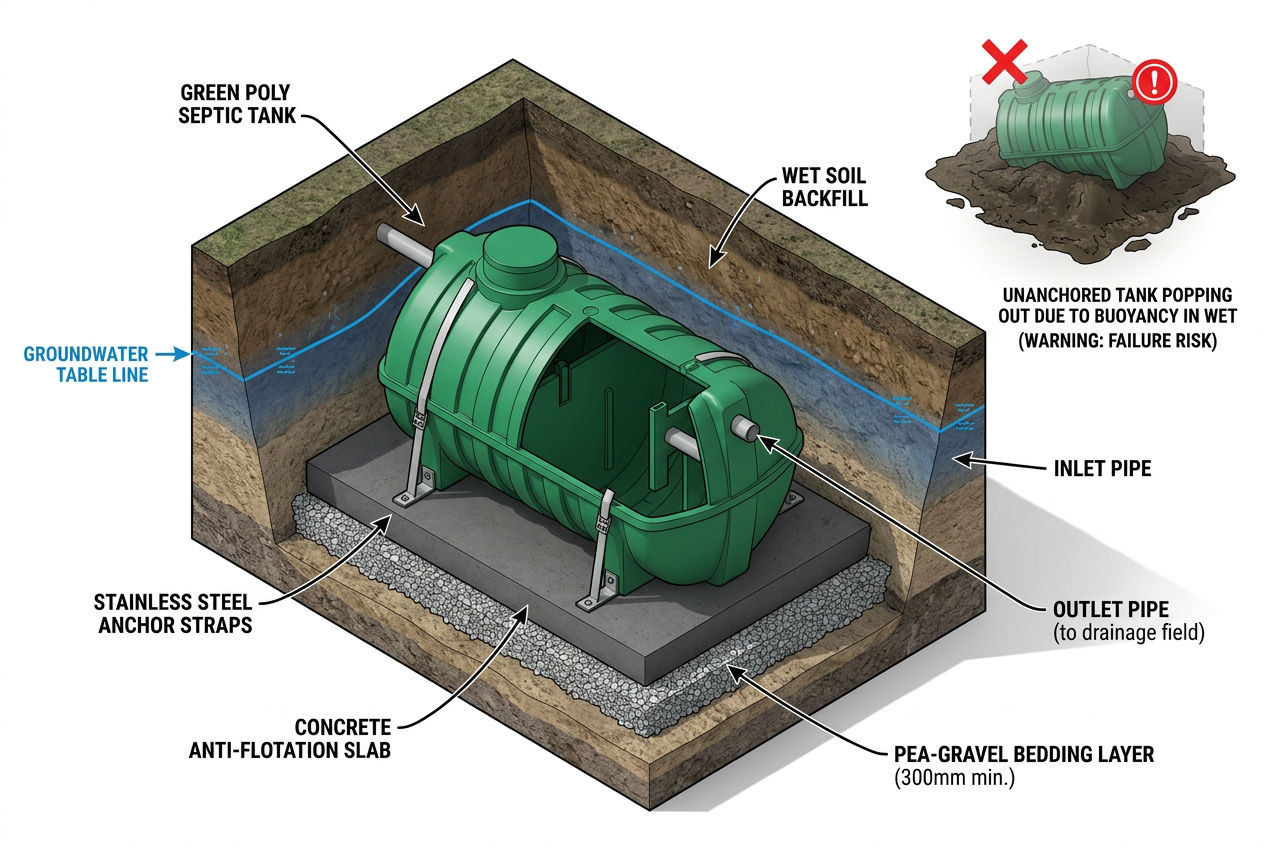
An empty plastic tank weighs 150–250 lbs. A saturated soil environment can exert enough upward pressure to literally push an empty tank out of the ground. This is called hydrostatic uplift, and it's a real problem in Florida, Louisiana, coastal South Carolina, and anywhere the water table sits near the surface.
The fix is anti-flotation anchoring — concrete deadman blocks cast around the tank or heavy strapping anchored to a concrete pad poured beneath it. This adds cost but is non-negotiable in high water table areas. Our guide on septic systems in high water table conditions explains this in detail.
2. Shorter lifespan than concrete
Expect 20–40 years from a poly tank, versus 40–50+ years from a well-made concrete tank. The gap narrows considerably in corrosive soil conditions where concrete degrades faster — but on paper, concrete wins on longevity.
3. Thinner walls mean less structural support under heavy loads
A ¼-inch to ½-inch HDPE wall doesn't handle compressive soil loads the way a 4-inch concrete wall does. Most manufacturers prohibit more than 36 inches of soil cover without reinforcement. Drive a loaded dump truck over the wrong spot and you can crush the tank. Mark your tank location and keep vehicle traffic away from it.
4. Not universally accepted by local codes
This is the problem that catches buyers off guard. Some jurisdictions — portions of Indiana, parts of New York state, and scattered counties elsewhere — either prohibit plastic tanks outright or require specific NSF/ANSI Standard 40 or IAPMO certification. You can find a beautiful, perfectly functional poly tank online for $900 and discover after delivery that your county won't issue a permit for it. Always call your local health department before you buy.
5. Can deform under improper backfill
Plastic tanks need proper backfill — clean fill or pea gravel compacted in lifts around the tank. Dump heavy clay or large rocks directly against the sidewalls during backfill and you can permanently deform the tank. This is an installer issue more than a material issue, but it happens.
Plastic vs. Concrete Septic Tank: Which One Should You Choose?
This is the comparison most buyers are trying to make. The short answer: plastic wins on cost, weight, and corrosion resistance. Concrete wins on lifespan, structural strength, and code acceptance. Here's how they stack up across the factors that matter most:
| Factor | Plastic | Concrete |
|---|---|---|
| Empty weight (1,000 gal) | ~150–200 lbs | ~4,000–5,000 lbs |
| Tank-only cost (1,000 gal) | $800–$1,500 | $1,200–$2,000+ |
| Installation complexity | No crane needed | Crane often required |
| Lifespan | 20–40+ years | 40–50+ years |
| Crack resistance | Excellent (flexible) | Moderate |
| Corrosion/chemical resistance | Excellent | Poor (H₂S degrades concrete) |
| Buoyancy risk | High | Low |
| Code acceptance | Varies by jurisdiction | Near-universal |
| Structural load tolerance | Moderate | High |
| Available certifications | NSF/ANSI 40, IAPMO | NSF/ANSI 40 |
For an even deeper comparison, our dedicated concrete vs. plastic septic tank guide walks through real-world scenarios for each.
Choose plastic when: Your soil is acidic or corrosive, access to your property is limited, budget is a primary concern, or your installer recommends it for your soil conditions.
Choose concrete when: Your jurisdiction requires it, you're in a high water table area without a strong preference for plastic, or you want maximum lifespan and structural overhead.
Plastic vs. Fiberglass Septic Tank: A Briefer Look
Fiberglass sits between plastic and concrete on most metrics. It's lighter than concrete, corrosion-resistant like plastic, but typically costs more than poly tanks and is less widely available. For a full breakdown, see our fiberglass vs. concrete septic tank guide.
The short version: unless a contractor specifically recommends fiberglass for your site conditions, poly is the more cost-effective option among the lightweight alternatives.
What to Expect During Plastic Septic Tank Installation
A one-day job is realistic for a straightforward plastic tank installation on accessible, favorable soil. Most homeowners hire out professional septic installation for this work — permits and inspections generally require a licensed contractor anyway. Here's the typical sequence:
- Permits pulled. Your contractor handles this. Expect 1–4 weeks of lead time depending on county workload. Review our septic system permit guide if you're unsure what's required.
- Excavation. A mini excavator or full excavator digs the pit, sized to allow 6–12 inches of clearance on all sides of the tank for proper backfill.
- Bedding layer installed. A 6-inch layer of pea gravel or compacted sand is placed at the pit bottom to level and support the tank.
- Tank set in place. Two people can handle tanks up to 1,000 gallons. Larger tanks may need a small boom lift or excavator arm assist.
- Anti-flotation measures installed (if required). Concrete deadman anchors are cast beside the tank, and strapping is threaded through factory tie-down points.
- Inlet and outlet piping connected. The inlet pipe from the house connects to the inlet baffle; the outlet connects to the distribution box or drain field. An effluent filter (such as a Polylok PL-122) installed in the outlet baffle is worth the $50–$100 — it keeps solids from reaching the drain field.
- Backfill placed in compacted lifts. Clean fill or pea gravel is backfilled in 12-inch lifts, hand-tamped around the tank to avoid deformation.
- Risers and lids installed. If your tank will be more than 12 inches below grade, risers bring access to surface level.
- Inspection. The county health department or inspector confirms the installation before the excavation is fully closed.
For a step-by-step guide to the full process, see how to install a septic tank.
How Do You Maintain a Plastic Septic Tank?
Maintaining a poly tank is identical to maintaining any other septic tank. The material doesn't change the maintenance schedule.
Pump on schedule. A 1,000-gallon tank serving a four-person household needs pumping every 3–4 years. Add a garbage disposal and that drops to every 2 years — solids accumulate faster. The EPA recommends inspecting and pumping every 3–5 years for most residential systems. Our septic pumping cost guide covers what you'll pay by region.
Protect the access points. Plastic risers can crack if driven over. Keep vehicle traffic off the tank lid area entirely.
Watch what goes down the drain. Flushable wipes, grease, and harsh chemical cleaners (bleach in high concentrations, drain cleaners) disrupt the bacterial ecosystem inside the tank. For a complete list of what to avoid, see our septic tank maintenance guide.
Inspect the effluent filter annually. Pull the Polylok or equivalent filter from the outlet tee every year or two and rinse it back into the tank with a garden hose. A clogged effluent filter is the most common cause of slow drains in an otherwise healthy system.
State and Local Code Considerations
Plastic septic tank approval varies dramatically by jurisdiction. Florida, Georgia, Texas, and most Western states accept poly tanks broadly. Parts of Indiana and New York state have historically preferred or required concrete; some counties still don't permit plastic tanks without specific brand or certification approval.
Across the board, look for tanks certified to NSF/ANSI Standard 40 or carrying IAPMO (International Association of Plumbing and Mechanical Officials) certification. These designations indicate the tank has been tested for structural integrity, watertightness, and effluent quality. Manufacturers like Infiltrator Water Technologies publish their certification status on their product pages.
Before purchasing, call your county health department and ask two questions:
- Does the county permit polyethylene septic tanks?
- Is there a specific certification (NSF/ANSI 40, IAPMO) or approved product list requirement?
Getting answers to those questions before you order a tank saves you from an expensive return shipping problem. Your state's health department website is a good starting point — and our state septic regulations pages cover the basics for each state. Once you've confirmed a poly tank is allowed, find septic companies near you to start collecting installation quotes.
Related: buying a septic tank
Sources & Methodology
- U.S. Environmental Protection Agency — Septic systems overview, pumping frequency recommendations. epa.gov/septic
- Infiltrator Water Technologies — Poly tank product specifications, dimensions, and installation guides. Referenced for sizing data and weight figures.
- NSF International / IAPMO — Certification standards for septic tank materials (NSF/ANSI Standard 40). Referenced for certification guidance.
- National Onsite Wastewater Recycling Association (NOWRA) — Industry benchmarks and installation guidelines. nowra.org
- Contractor interviews and regional cost surveys — Installed price ranges based on aggregated 2024–2025 estimates from septic contractors across five regions. Prices reflect national averages; individual quotes will vary.
Free download
Not ready for the Blueprint? Start free.
Grab the free DIY Septic Planning Kit — the permit-first checklist, perc-test cheat sheet, and sizing tables that keep your build from getting red-tagged.
Was this article helpful?
Frequently Asked Questions
Recommended Resources
📖 Related Articles
- What Is a Septic System? How It Works (Visual Guide)
- Septic Tank Sizes & Dimensions Chart (by Bedrooms)
- 500-Gallon Septic Tank: Dimensions, Uses & When It's Too Small
- How to Install Septic Tank Risers (and Why You Should)
- What to Expect During Septic System Installation
- High Water Table and Septic Systems: What You Need to Know
- Fiberglass vs Concrete vs Poly Septic Tanks Compared
- Septic System Permit Cost & State Requirements (2026 Guide)
- How to Install a Septic Tank: Step-by-Step Guide
- The Complete Septic Tank Maintenance Guide
Find Septic Professionals Near You
Compare licensed, verified septic companies by area — top county markets and cities below, or browse all 50 states.
County markets
Popular cities
