
Quick Answer
Septic tanks for sale are available through local precast yards, septic suppliers, and online retailers in three main materials: concrete, plastic, and fiberglass. Tank-only prices range from $500 to $3,000 depending on material and size, with most homeowners spending $3,000–$10,000 for a fully installed system. The right tank depends on your soil type, local code, and how you plan to install it.
Key Takeaways
- Concrete tanks ($700–$2,000) last 40+ years and suit most climates; plastic tanks ($500–$2,500) are lighter and easier to ship but need anti-flotation anchoring in high water table areas
- A 3-bedroom home typically needs a 1,000–1,250-gallon tank based on estimated daily wastewater flow of 60–70 gallons per person
- You cannot legally buy and install a septic tank without a permit — a percolation test is required in virtually every jurisdiction before sizing or purchasing
- Tank price is only part of the total cost; excavation, delivery, and drain field work often push total project cost to $5,000–$10,000+
- Your best source for local pricing and code-compliant tanks is a licensed septic contractor or precast supplier in your county
Where Can You Buy a Septic Tank?
You have four realistic options, and they're not all equal.
Local Septic Suppliers and Precast Yards
This is where most tanks actually get sold. Precast concrete suppliers manufacture tanks on-site and deliver them by flatbed truck with a crane. A quick search for "precast concrete supplier" or "septic tank supplier" plus your county name will usually surface two or three local options. These suppliers know your county's code requirements, approved tank specs, and soil conditions — that knowledge is worth a lot when you're trying to buy the right tank on the first try.
Call them before you drive out. Ask whether they supply directly to homeowners or only to contractors. Many precast yards will sell to the public, but they won't touch installation.
Home Improvement Stores
Big-box stores like Home Depot occasionally carry plastic septic tanks — typically in the 500–1,000-gallon range — either in-store or available for special order. Selection is limited, and staff are rarely trained to advise you on sizing, code compliance, or perc test requirements. These stores work best if you already know exactly what you need and just want a convenient pickup point.
Online Retailers and Direct-from-Manufacturer
Companies like Norwesco and Snyder Industries sell polyethylene septic tanks direct or through distribution networks. You can find plastic tanks for sale online at agricultural supply retailers and specialty plumbing distributors. The challenge is shipping: a 1,000-gallon plastic tank weighs 150–300 lbs and ships via freight. That adds $200–$600 to your cost depending on distance, and you'll still need a contractor to handle installation.
Fiberglass tanks from manufacturers like Xerxes or similar specialty producers are rarely stocked locally — most are made-to-order, which adds lead time.
How to Find Septic Tanks for Sale Near Me
The fastest path is to find a licensed septic installer in your area through SepticTankHub's directory. Most installation contractors have preferred supplier relationships and can source the right tank for your county's code at contractor pricing — sometimes cheaper than buying direct. They also handle permits, delivery coordination, and inspection scheduling, which saves you significant headaches.
What Types of Septic Tanks Are for Sale?
Three materials dominate the market. Each has a real use case — and real limitations.
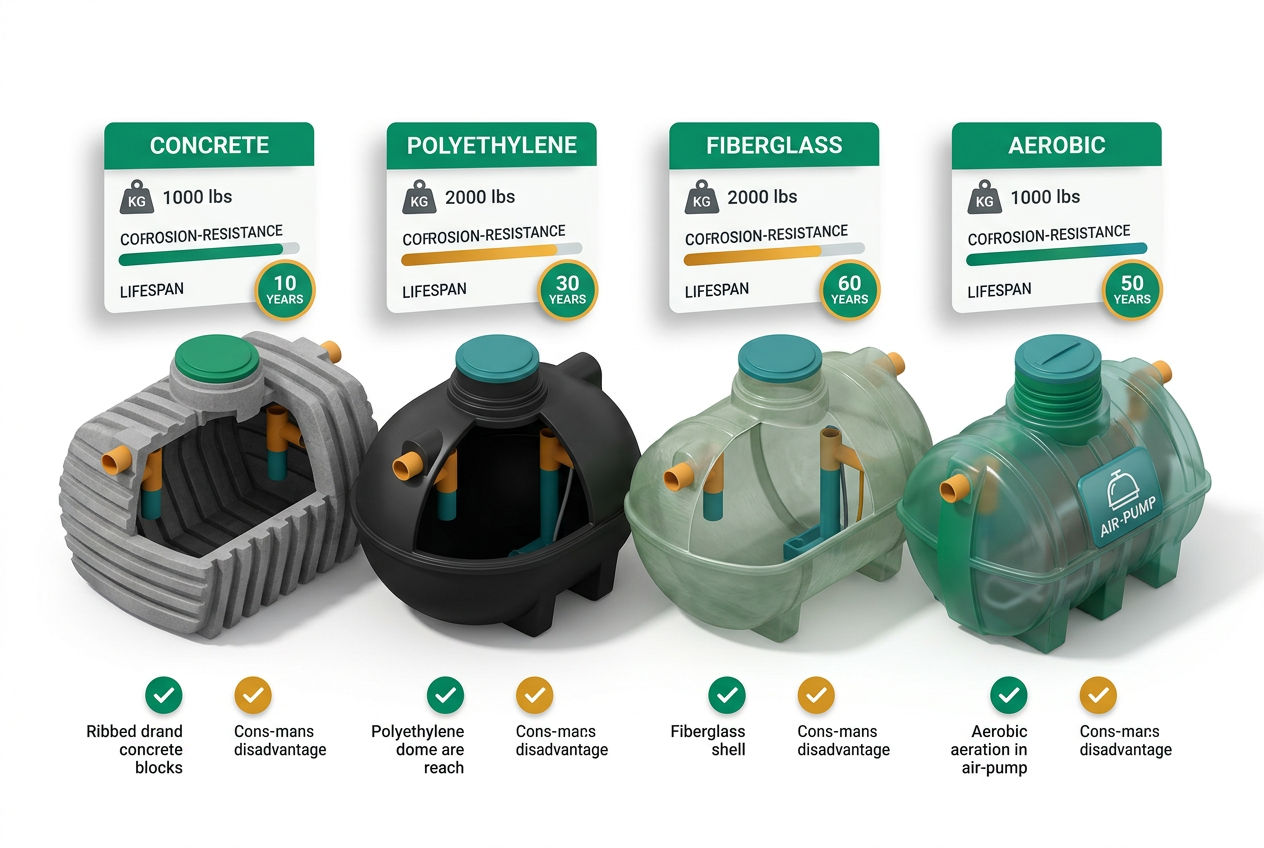
Concrete Septic Tanks
Concrete is the workhorse of the septic world. A precast concrete tank is cast at a facility, cured for several days, then delivered as a single- or two-piece unit. The standard 1,000-gallon precast tank weighs 8,000–10,000 lbs, so delivery requires a crane truck — budget $200–$500 for that alone.
The payoff for that weight: concrete tanks last 40+ years in most conditions, resist shifting even in clay soils, and are approved in every jurisdiction in the country. They're the dominant choice in the Northeast and Midwest, where freeze-thaw cycles and rocky soils reward mass and durability.
The downside? Concrete can crack over decades, and cracked walls allow groundwater infiltration and sewage leakage. Inspect the inlet and outlet baffles annually — a deteriorated baffle wall lets raw scum pass into your drain field and causes expensive damage.
For a deeper comparison, see our guide on concrete vs. plastic septic tanks.
Plastic (Polyethylene) Septic Tanks
Plastic septic tanks — technically high-density polyethylene (HDPE) — have become popular for good reason. A 1,000-gallon polyethylene tank weighs just 150–300 lbs. You can move it with two people and a pickup truck. No crane. No special delivery window. That's a genuine logistical advantage in rural areas with poor road access.
HDPE tanks are also watertight by nature — they won't crack or corrode. The tradeoff is buoyancy. An empty plastic tank in a high water table area can literally float up out of the ground. In Florida, Louisiana, and coastal Georgia, installers use anti-flotation concrete collars or backfill anchoring to prevent this. If your installer skips that step, you could end up with a septic tank in your yard rather than under it.
Plastic tanks are approved in most states but not all. Check with your county health department before purchasing. Our detailed guide on plastic septic tanks covers state-by-state approval status in more depth.
Fiberglass Septic Tanks
Fiberglass tanks split the difference between concrete and plastic. They're lighter than concrete (a 1,000-gallon unit runs 200–400 lbs), more rigid than plastic, and highly resistant to corrosion. They're a solid choice in arid climates like the Southwest, where soil movement and UV exposure are concerns.
The limitations: fiberglass costs more upfront ($1,200–$3,000 for the tank alone), and it's more susceptible to cracking under heavy surface loads — driving equipment over a buried fiberglass tank is a common installation mistake. They're also less widely available than concrete or HDPE, so lead times can run 2–4 weeks in some markets.
For a full side-by-side breakdown of these two alternatives, see fiberglass vs. concrete septic tank.
Septic Tank Comparison: Concrete vs. Plastic vs. Fiberglass
| Feature | Concrete | Plastic (HDPE) | Fiberglass |
|---|---|---|---|
| Tank-only price | $700–$2,000 | $500–$2,500 | $1,200–$3,000 |
| Typical lifespan | 40+ years | 30–40 years | 25–30 years |
| Weight (1,000 gal) | 8,000–10,000 lbs | 150–300 lbs | 200–400 lbs |
| Delivery method | Crane required | Truck/pickup | Truck, no crane |
| Buoyancy risk | Low | High | Moderate |
| Availability | Nationwide | Nationwide | Regional |
Source: National Onsite Wastewater Recycling Association (NOWRA); manufacturer spec sheets from Infiltrator Water Technologies and Norwesco.
How Much Do Septic Tanks Cost by Size and Type?
Tank-only cost is just the starting point. Here's what you're actually looking at.
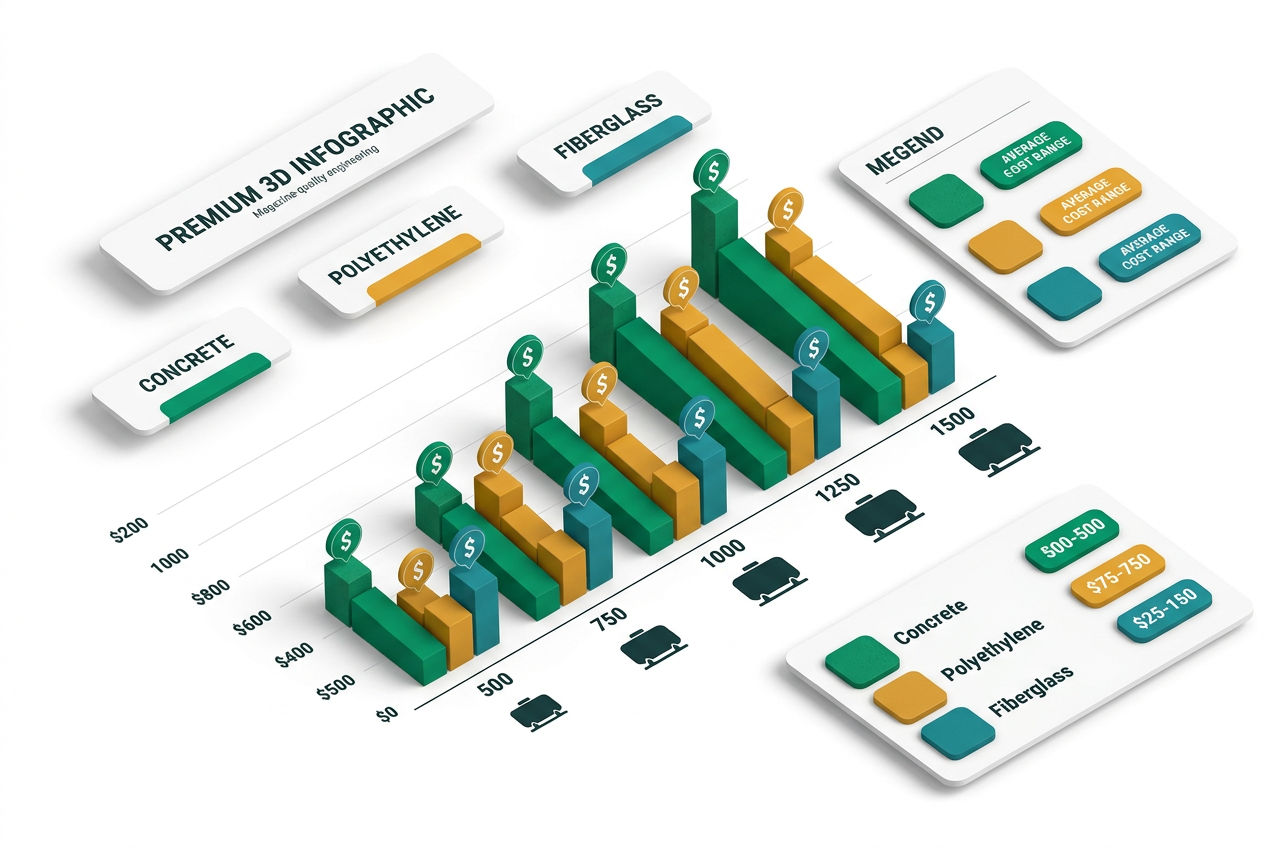
A standard 1,000-gallon concrete tank runs $700–$1,200 for the tank itself in most markets. Add crane delivery ($200–$500), permits ($150–$400 depending on county), excavation ($500–$1,500), and installation labor ($800–$2,000), and your total easily reaches $3,500–$5,500 before you account for the drain field.
A full septic installation cost — tank, drain field, permits, and labor — typically runs $5,000–$10,000 for a conventional gravity system on a straightforward lot. Rocky soil, high water tables, or mound systems push that to $12,000–$20,000+.
Regional labor variation is significant. Installation labor in rural Alabama might run $1,500–$2,000. The same scope of work in suburban New Jersey commonly exceeds $4,000–$5,000.
What Size Septic Tank Do You Need?
DIY Septic Blueprint
Thinking about building it yourself?
The complete, plain-English plan to size, permit and install your own septic system — designed for homeowners, not contractors. Skip the $15,000–$25,000 quotes and do it right the first time.
Get the DIY Blueprint — $67 →Instant download · 8 modules + 3 bonus guides · 60-day money-back guaranteeThe EPA bases septic tank sizing on daily wastewater flow — roughly 60–70 gallons per person per day. Most local codes translate that into a bedroom-based sizing formula, since bedrooms represent potential occupants.
Here's the standard sizing guide used by most county health departments:
| Bedrooms | Estimated Occupants | Recommended Tank Size |
|---|---|---|
| 1–2 | 1–3 people | 750–1,000 gallons |
| 3 | 2–5 people | 1,000–1,250 gallons |
| 4 | 3–6 people | 1,250–1,500 gallons |
| 5+ | 5+ people | 1,500+ gallons |
The 1,000-gallon tank is by far the most common residential size in the U.S. — it's the default minimum in many counties regardless of bedroom count. But don't size down just to save $200 on the tank. A properly sized tank protects your drain field by allowing solids to settle and effluent to clarify before it exits. An undersized tank sends partially treated waste into the drain field, which is the fastest way to ruin a $5,000–$15,000 leach system.
One practical note: if you have or plan to add a garbage disposal, your tank's effective capacity shrinks significantly because disposal waste loads the system with additional solids. Our guide on garbage disposal and septic systems breaks that down in detail.
For a full sizing chart including commercial applications, see the septic tank size chart.
7 Questions to Ask Before You Buy a Septic Tank
Don't hand over a deposit without getting clear answers to these.

1. Do I have my permit and perc test results? A percolation test (perc test) measures how quickly your soil absorbs water. It's required before tank sizing in virtually every county in the U.S. Without passing perc test results, you can't pull a permit. Without a permit, you can't legally install. Buying a tank before completing this step is putting the cart before the horse — the perc test may reveal your soil requires a mound system or aerobic system instead of a conventional tank.
Learn more about what happens if your perc test fails.
2. Is this tank approved for my county? Tank specifications — wall thickness, baffle design, riser requirements — vary by jurisdiction. Concrete tanks in Texas must meet TCEQ structural standards. Florida requires specific certifications for tanks in flood-prone areas. Ask the supplier to confirm the tank meets your county's current health department specs, and get that confirmation in writing.
3. What are the delivery logistics and costs? For concrete tanks: does delivery include crane service? Who is responsible if the crane damages your driveway? For plastic tanks: what's the freight cost, and how is the tank secured during transport? A 1,000-gallon concrete tank delivered with a boom truck to a property with soft ground in spring can be a messy situation if nobody planned for it.
4. Does the tank include inlet and outlet baffles? Baffles are critical. The inlet baffle slows incoming wastewater and directs flow downward. The outlet baffle prevents floating scum from exiting the tank into your drain field. Some precast tanks come with concrete baffles; others require separate installation of sanitary tees or Polylok effluent filters. Ask specifically — don't assume.
5. What warranty comes with the tank? Concrete tanks from reputable precast suppliers typically carry a 1–5 year structural warranty against cracking or defect. HDPE tanks from manufacturers like Norwesco often carry longer warranties on the material itself. Get the warranty terms in writing before purchase.
6. Can you recommend a licensed installer? A reputable supplier will have relationships with local licensed contractors. In most states, septic installation requires a licensed contractor — attempting to DIY a septic system is illegal without specific permits and often results in a failed inspection. If the supplier can't recommend anyone, that's a red flag.
7. What maintenance schedule does this tank require? All tanks need pumping. A 1,000-gallon tank serving a four-person household needs pumping every 3–4 years on average, per EPA guidance. Add a garbage disposal and that drops to every 2 years. Ask whether the tank has or needs an effluent filter (like the Polylok PL-122) and whether access risers are included — digging to find a buried lid for every pump-out gets old fast.
For a full maintenance timeline, our septic tank maintenance guide covers what to do and when.
Can You Install a Septic Tank Yourself?
Technically possible in a handful of states with significant restrictions. Practically speaking, most homeowners can't and shouldn't.
Here's why: most states require a licensed septic contractor to pull the installation permit. The county health department typically inspects the excavation, tank placement, and drain field before and after burial. If your installation fails inspection, you're paying to dig it up and redo it.
A handful of states — including Texas and parts of the rural Midwest — allow homeowners to install their own system on their own property, but still require permits, inspections, and compliance with state code. Even where it's technically legal, you'll be operating heavy equipment near underground utilities, setting a multi-thousand-pound tank in an excavation, and making decisions about drain field layout that affect your groundwater for decades.
The DIY septic system installation guide covers the states where this is allowed and what's actually involved. If you're weighing that route honestly, read it first.
For most homeowners, the right move is hiring a licensed pro. Use our directory to find a licensed septic installation contractor in your area.
Regional Notes: Material Preferences by Area
Where you live often determines which tank type makes the most sense — not just by preference, but by code and conditions.
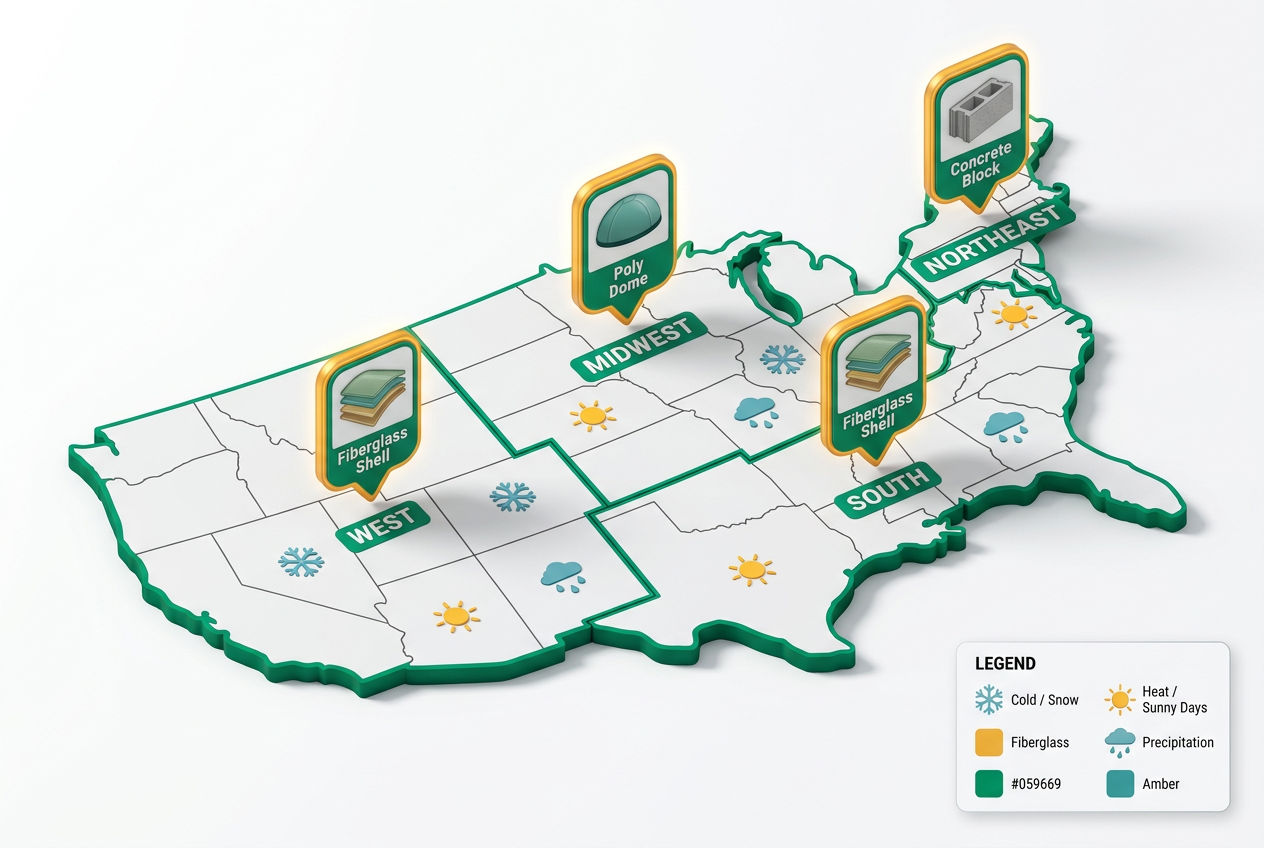
Northeast and Midwest: Concrete dominates. Frost lines in Minnesota reach 42–60 inches, and freeze-thaw cycles put stress on lighter tanks. Concrete's mass and strength hold up. Installation costs run higher here — $4,000–$7,000 for a basic system in New Jersey vs. $3,000–$4,500 in rural Ohio.
Southeast and Gulf Coast: Plastic tanks are popular, especially in sandy coastal soils where a lighter tank is easier to set. But high water tables in coastal Florida, Louisiana, and the Carolinas require anti-flotation anchoring. Aerobic septic systems are also more common in this region — see aerobic vs. anaerobic septic systems to understand when an aerobic system might be required instead of a conventional tank.
West and Southwest: Fiberglass sees more market share in arid regions like Arizona and Nevada, where soil stability and chemical resistance matter. Water conservation-oriented systems are popular, and some counties require specific treatment levels before effluent can reach the drain field.
If you're unsure what's required in your state, our state-specific septic regulation pages cover each jurisdiction's rules — for example, Texas septic regulations or Florida septic regulations.
Find Septic Tanks for Sale Near You
Ready to move forward? The best first call isn't to a big-box store — it's to a licensed local contractor who knows your county's soil conditions, required tank specs, and permit process.
Find licensed septic tank installers and suppliers near you through the SepticTankHub directory. Enter your zip code to see rated professionals in your area who can source the right tank, pull your permit, and handle installation from excavation to final inspection.
Sources & Methodology
This article draws on the following primary sources:
- U.S. Environmental Protection Agency — Septic Systems: Sizing guidance, daily wastewater flow estimates, and pumping frequency recommendations. epa.gov/septic
- National Onsite Wastewater Recycling Association (NOWRA): Material comparison data and industry installation standards. nowra.org
- Infiltrator Water Technologies: Manufacturer specifications for polyethylene tank weights, dimensions, and warranty terms.
- Norwesco Inc.: Polyethylene tank product specifications and distribution pricing data.
- State health department regulations: Permit requirements, contractor licensing rules, and approved tank specifications referenced from Texas TCEQ, Florida DOH, and Minnesota MPCA regulatory guidance.
Cost ranges reflect national averages compiled from contractor quotes and regional pricing surveys. Prices vary by location, soil conditions, and local labor markets. Always obtain multiple quotes from licensed local contractors before purchasing.
Free download
Not ready for the Blueprint? Start free.
Grab the free DIY Septic Planning Kit — the permit-first checklist, perc-test cheat sheet, and sizing tables that keep your build from getting red-tagged.
Was this article helpful?
Frequently Asked Questions
Recommended Resources
📖 Related Articles
- Concrete vs Plastic Septic Tanks: Which Is Better?
- Plastic Septic Tanks: Sizes, Prices, Pros & Cons
- Fiberglass vs Concrete vs Poly Septic Tanks Compared
- Can You Use a Garbage Disposal with a Septic System?
- Septic Tank Sizes & Dimensions Chart (by Bedrooms)
- Land Failed the Perc Test? Here Are Your Options
- DIY Septic System: How to Build Your Own (Step-by-Step)
- The Complete Septic Tank Maintenance Guide
- Can You Install a Septic System Yourself?
- Aerobic vs Anaerobic Septic Systems: How They Compare
🔧 Services
Find Septic Professionals Near You
Compare licensed, verified septic companies by area — top county markets and cities below, or browse all 50 states.
County markets
Popular cities
