
Quick Answer
A 500-gallon septic tank is a single-compartment, wastewater-holding vessel designed for minimal-use properties—typically a one-bedroom cabin, tiny home, or outbuilding with a single restroom. It measures roughly 5 ft × 3.5 ft × 4 ft in concrete and holds exactly 500 gallons of combined scum, effluent, and sludge layers before requiring pumping. Most states now prohibit it for new full-time residential construction, requiring 750–1,000 gallons minimum instead.
Key Takeaways
- A 500-gallon concrete septic tank typically measures about 5 ft × 3.5 ft × 4 ft; plastic versions run shallower at roughly 80 in × 40 in × 32 in.
- Standard sizing rules (150 gallons per bedroom, per the International Residential Code) limit a 500-gallon tank to one-bedroom properties.
- Most states require 750–1,000 gallons minimum for new construction—check local code before purchasing.
- A 2-person household using a 500-gallon tank should plan to pump every 1–2 years versus every 3–5 years for a 1,000-gallon tank.
- The cost difference between installing a 500-gallon and a 1,000-gallon system is often only $500–$1,500—rarely worth skimping on.
Install one under the wrong conditions and you'll be calling a pump truck every year and still watching your drain field fail ahead of schedule. Below: exact dimensions, what a 500-gallon septic tank size can realistically handle, what it costs, and whether you should upgrade before you even start.
What Are the Dimensions of a 500-Gallon Septic Tank?
Dimensions vary slightly by manufacturer and material, but the ranges below apply to the vast majority of tanks sold in the U.S.
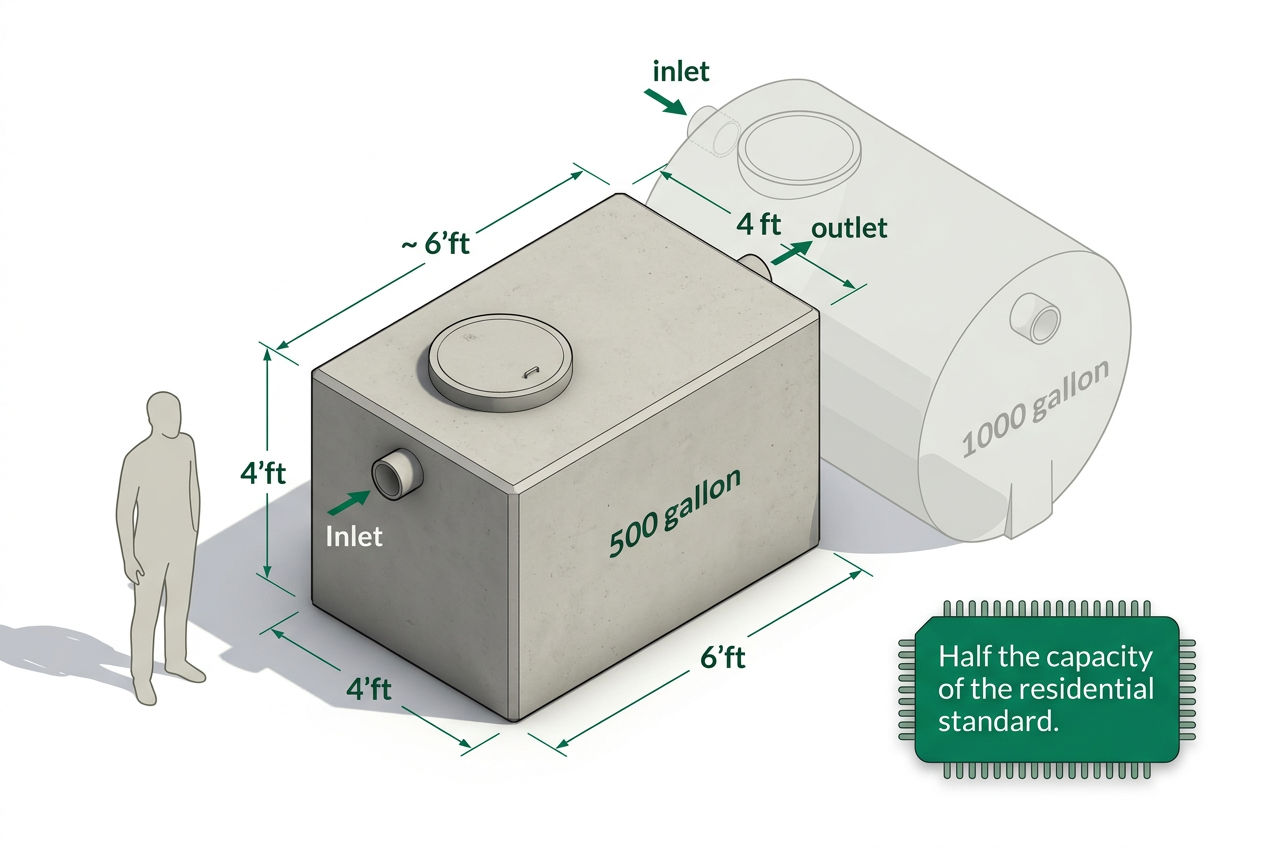
Concrete 500-Gallon Septic Tank Dimensions
A 500-gallon concrete septic tank typically runs 4.5–5.5 ft long, 3–3.5 ft wide, and 3.5–4.5 ft deep on the exterior. Wall thickness is 2–3 inches of reinforced precast concrete. That gives you an interior volume that hits the 500-gallon mark once you account for the inlet baffle, outlet baffle, and the scum/sludge/effluent layers inside.
Empty weight runs 2,500–3,000 pounds. You're not moving one of these without a crane or a large excavator—plan for equipment access during installation.
Plastic (Polyethylene) 500-Gallon Septic Tank Dimensions
A 500-gallon plastic septic tank—also sold as a 500-gallon polyethylene septic tank—has a shallower profile: roughly 80 inches long × 40 inches wide × 32 inches tall for most rotomolded polyethylene models. Wall thickness is 0.25–0.5 inches. Empty weight is only 80–120 pounds, which makes transport and placement far easier—one or two people can maneuver it by hand.
The tradeoff is buoyancy. In high-water-table areas—parts of Florida, coastal Georgia, or Louisiana—an empty plastic tank can float if groundwater rises before backfill is complete. Installers typically anchor plastic tanks with concrete deadman anchors or backfill immediately after placement.
500-Gallon Septic Tank Dimension Comparison
| Feature | Concrete | Plastic (Poly) |
|---|---|---|
| Length | ~5 ft (60 in) | ~80 in |
| Width | ~3.5 ft (42 in) | ~40 in |
| Depth/Height | ~4 ft (48 in) | ~32 in |
| Wall Thickness | 2–3 in | 0.25–0.5 in |
| Empty Weight | 2,500–3,000 lbs | 80–120 lbs |
| Buoyancy Risk | Low | Moderate–High |
| Typical Lifespan | 40–50+ years | 30–40 years |
Dimensions are exterior measurements and vary by manufacturer. Always confirm with your supplier's product spec sheet before excavation.
For a deeper comparison of materials, see our guide on concrete vs. plastic septic tanks.
What Is a 500-Gallon Septic Tank Actually Used For?
A 500-gallon septic tank works for low-occupancy, low-frequency, or non-residential applications. Outside those conditions, it's undersized for safe long-term use.
Cabins and Seasonal Properties
This is the sweet spot for a 500-gallon tank. A weekend cabin used 90 days a year, with two people flushing and showering, generates a fraction of the annual load that a full-time household does. Daily flow stays well under the 250-gallon-per-day maximum that a 500-gallon tank can realistically handle (the industry rule of thumb is that daily flow shouldn't exceed 50% of tank capacity).
For off-grid septic systems on remote properties, the lighter weight of a plastic 500-gallon tank also lowers installation costs significantly when equipment access is limited. Many of those remote installs are owner-built — if you plan to build your own septic system, a tank two people can carry makes the job far more manageable.
Tiny Homes and ADUs
The tiny home market has driven renewed interest in smaller tanks. A well-designed tiny home with one or two full-time occupants can work with a 500-gallon system—but only if your local health department approves it. Many jurisdictions have minimum tank size requirements that override bedroom count calculations entirely.
Before ordering a tank for your tiny home septic system, call your county health department and ask specifically about minimums for new construction.
Workshops and Small Commercial Buildings
A workshop bathroom, a bait shop restroom, or a farm outbuilding with a single toilet and hand sink is an ideal 500-gallon application. Low daily flow, no laundry, no kitchen waste. These are exactly the conditions where a small tank performs reliably.
When a 500-Gallon Tank Doesn't Work
Full-time households with two or more people should look elsewhere. So should any home with a garbage disposal, properties in states or counties with a 1,000-gallon minimum (which now includes most of the Southeast and growing portions of the Midwest and Mountain West), and any new construction where the local health department requires engineered sizing calculations. If you're building a new home—even a small one—confirm local code before you commit to a 500-gallon tank.
Is a 500-Gallon Septic Tank Big Enough?
A 500-gallon septic tank is typically sufficient only for a single-bedroom property with no more than two full-time occupants. For most families and many regions, it is too small for new construction under current codes.
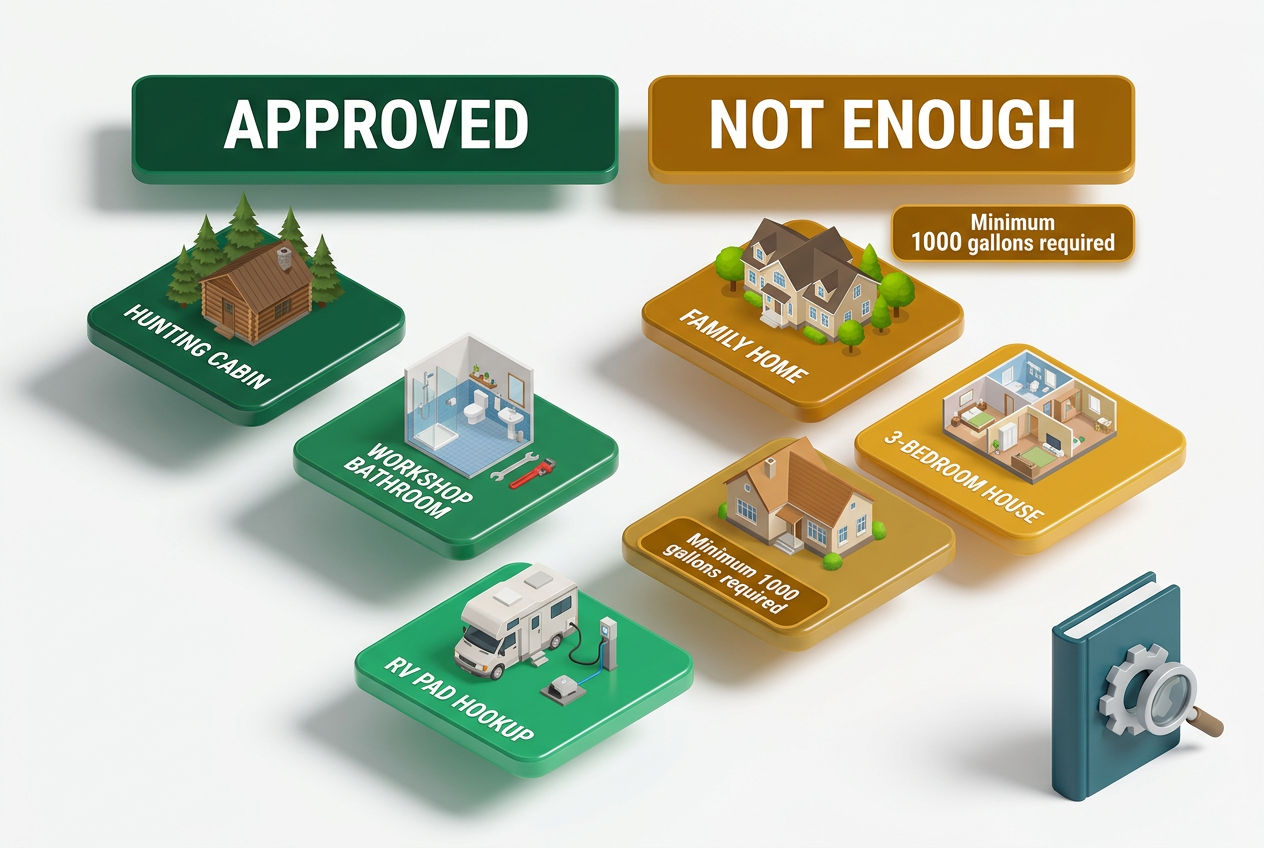
Sizing by Bedroom Count
The International Residential Code (IRC Sections P2901–P2906) uses 150 gallons per bedroom as the baseline sizing standard. At that rate:
- 1 bedroom = 150 gallons minimum → 500-gallon tank is adequate
- 2 bedrooms = 300 gallons minimum → 500-gallon tank is marginal at best
- 3 bedrooms = 450 gallons minimum → 500-gallon tank is undersized
Those are minimums based on theoretical bedroom counts, not actual occupancy. According to the U.S. Environmental Protection Agency's Septic Systems Overview (EPA 832-F-12-057), average daily water use runs approximately 82 gallons per person per day. A two-person household pushing 164 gallons daily is already approaching 33% of total tank capacity—every single day.
To see how that math plays out over a full year: a two-person household generates roughly 59,860 gallons of wastewater annually (164 gallons/day × 365 days). A 500-gallon tank needs to settle and pass effluent continuously to handle that load. Any disruption—a heavy laundry day, a weekend with extra guests, or an inlet baffle failure—pushes the system past its limits. A standard washing machine uses 20–40 gallons per load, which means four loads of laundry in a single day can spike daily flow to 240+ gallons, above the 50%-capacity threshold.
Use our septic tank size guide to run the numbers for your specific household before making a decision.
Local Code Requirements: Most States Have Moved On
This is the number that matters more than the IRC formula: most states now set a minimum of 750 or 1,000 gallons for new residential septic installations, regardless of bedroom count.
States like Florida, Georgia, and the Carolinas commonly require 1,000-gallon minimums for single-family construction. Many Midwestern states like Wisconsin and Minnesota require 1,000 gallons for year-round residences. The Mountain West states often require 750–1,000 gallons depending on soil conditions and design daily flow calculations.
One specific example worth noting: Florida Administrative Code Chapter 64E-6 sets 900 gallons as the minimum tank capacity for new single-family homes—a rule that has been in effect since the early 2000s and catches many out-of-state buyers off guard when they assume a 500-gal septic tank will pass inspection.
Check our septic system permit requirements guide to understand what your state demands before you buy anything.
Existing 500-gallon tanks are often grandfathered under older codes—you can typically keep using one that was legally installed. But if you're replacing a failed tank on a 2-bedroom home, most inspectors will require you to upsize to meet current standards.
Signs Your 500-Gallon Tank Is Too Small
These are red flags that your tank is being overwhelmed:
- Drains are slow even though there's no obvious clog in the pipes
- Wet spots or unusually green grass over the drain field between rain events
- Sewage odor near the tank or drain field, especially in warm months
- Your pump truck comes every year and the tank is always near capacity
- Gurgling sounds from toilets or floor drains after heavy water use
Any one of these deserves attention. Multiple symptoms together mean the tank isn't keeping up with your household's load. See signs your septic tank is full for a full breakdown of warning signals.

DIY Septic Blueprint
Thinking about building it yourself?
The complete, plain-English plan to size, permit and install your own septic system — designed for homeowners, not contractors. Skip the $15,000–$25,000 quotes and do it right the first time.
Get the DIY Blueprint — $67 →Instant download · 8 modules + 3 bonus guides · 60-day money-back guaranteeHow Much Does a 500-Gallon Septic Tank Cost?
Tank-Only Costs
- 500-gallon concrete septic tank: $400–$800 for the tank alone, depending on your region and supplier. Precast tanks from local manufacturers in the Southeast often run $400–$550. In the Northeast or Mountain West, expect $600–$800 due to transport costs and thicker wall requirements for frost depth compliance.
- 500-gallon plastic septic tank: $300–$600. Infiltrator Water Technologies and similar manufacturers sell polyethylene tanks in this range, with regional pricing variation similar to concrete.
Full Installation Costs
Tank price is the smallest part of the bill. A complete 500-gallon septic system installation—including excavation, tank placement, inlet/outlet baffles, drain field trenching, and backfill—typically runs $2,000–$5,000 depending on:
- Soil conditions: Rocky soil in Colorado or Idaho can add $1,000–$2,500 in excavation costs alone.
- Drain field size: Even a 500-gallon tank requires a properly sized leach field based on your perc test results. Don't assume a small tank means a small drain field—drain field size is determined by soil absorption rate, not tank volume.
- Regional labor rates: Installation in rural Montana costs less than in suburban New Jersey, often by $800–$1,500 on an identical system.
See our full septic installation cost guide for a detailed regional breakdown.
Is It Worth Upgrading to 1,000 Gallons?
The upgrade math is straightforward. If a 500-gallon system costs $2,500 to install and a 1,000-gallon system costs $3,500, you're spending $1,000 more upfront. But a 500-gallon tank for a two-person household needs pumping every 1–2 years at $300–$600 per pump-out. A 1,000-gallon tank for the same household pumps every 3–5 years. Over a 10-year period, the smaller tank costs $1,500–$6,000 in extra pump-outs versus $600–$2,000 for the larger tank—a difference of $900–$4,000 in operating costs alone, not counting the accelerated drain field wear. The upgrade pays for itself within 3–5 years in most scenarios.
How Often Does a 500-Gallon Septic Tank Need to Be Pumped?
A 500-gallon septic tank serving a two-person full-time household should be pumped every 1–2 years. For a seasonal cabin with two part-time occupants, every 3–5 years is more realistic. Both figures assume normal water use and no garbage disposal.
Why Pumping Frequency Matters More with Small Tanks
The sludge and scum layers in any septic tank grow at a rate of roughly 100–150 gallons per person per year, according to the National Onsite Wastewater Recycling Association (NOWRA). In a 1,000-gallon tank, that leaves ample effluent zone buffer. In a 500-gallon tank serving two people, those same layers can accumulate 200–300 gallons of solids annually—meaning the working liquid zone shrinks to 200–300 gallons within 12–18 months.
Once the sludge layer reaches within 12 inches of the outlet baffle, solids begin passing into the drain field. That's the point of no return for most leach fields—solid contamination clogs the soil matrix and the field requires replacement at $5,000–$20,000.
How to Know When to Pump
Don't guess. Use a sludge judge—a clear acrylic tube that you lower into the tank to measure sludge depth directly. When the combined sludge and scum layers occupy more than one-third of the tank's liquid volume, it's time to call a pump truck. For a 500-gallon tank, that threshold is reached when roughly 165 gallons of solids have accumulated.
See our guide on how often to pump your septic tank for the full measurement method and a pumping schedule calculator.
The Holiday Weekend Problem
Consider a realistic scenario: a 500-gallon tank sized for a two-person cabin. Thanksgiving weekend arrives—eight people stay for four days. At 82 gallons per person per day, that's 656 gallons of daily flow into a 500-gallon tank. The tank physically cannot process that load in real time. Solids that would normally settle instead get pushed toward the outlet baffle. If the tank was already at 60% capacity before the holiday, that weekend alone may trigger the need for an emergency pump-out. Schedule pumping before or shortly after any extended high-occupancy period—not six months later.
When Should You Upgrade to a Larger Septic Tank?
Upgrade to a 750- or 1,000-gallon septic tank when your current 500-gallon system no longer matches your actual usage—not when it fails completely.
The clearest signals that an upgrade is overdue:
- Your household has grown. Adding a permanent occupant—a partner, a child, an aging parent—increases daily flow by 82+ gallons. A 500-gallon tank that was marginal for two people cannot reliably serve three.
- You're converting a seasonal property to full-time use. What worked for 90 days a year at intermittent occupancy will not work for 365 days of continuous use. The math on annual sludge accumulation changes entirely.
- You're adding a bedroom or bathroom. Most jurisdictions will require a septic system upgrade as part of the permitting process for any addition that increases theoretical occupancy.
- Your drain field is showing stress. Wet spots, odors, or slow drains are symptoms—the root cause is usually a tank that can't keep pace with load. Replacing the tank before the drain field fails costs a fraction of replacing both.
- A local code change now requires a larger minimum. Municipalities do update their minimum size requirements. If your grandfathered 500-gallon tank fails, the replacement must meet current code.
A critical limitation worth stating plainly: we can't tell you remotely whether your specific tank needs replacement. Soil conditions, local water table, actual daily flow, and the age and condition of your drain field all factor into that decision in ways that vary dramatically by property. A licensed septic inspector should assess the system before you commit to a replacement or upgrade—get that inspection before you get quotes, not after. When you do reach the quote stage, find septic pros in your area and compare at least two bids.
See our comparison of 1,000-gallon septic tank options if you're actively evaluating an upgrade path.
Sources & Methodology
- U.S. Environmental Protection Agency. Septic Systems Overview (EPA 832-F-12-057). Used for the 82-gallon-per-person-per-day average daily water use figure cited in the sizing section. Available at epa.gov/septic.
- International Residential Code (IRC), Sections P2901–P2906. Source for the 150-gallon-per-bedroom minimum septic sizing standard referenced throughout this article.
- National Onsite Wastewater Recycling Association (NOWRA). Septic System Owner's Guide. Source for sludge and scum accumulation rate estimates (100–150 gallons per person per year).
- Florida Administrative Code, Chapter 64E-6. Cited as a specific state-level regulatory example for minimum tank size requirements (900-gallon minimum for new single-family construction).
- Infiltrator Water Technologies. Manufacturer product specifications for polyethylene septic tanks. Used for plastic tank dimension and weight ranges. Available at infiltratorwater.com.
Pricing data reflects contractor quotes and supplier pricing gathered from multiple U.S. regions. Get at least two local quotes before committing to a system—septic pumping costs and installation labor vary significantly by geography.
Ready to install or upgrade? Find a licensed septic installer near you to get a site-specific assessment before you buy.
Free download
Not ready for the Blueprint? Start free.
Grab the free DIY Septic Planning Kit — the permit-first checklist, perc-test cheat sheet, and sizing tables that keep your build from getting red-tagged.
Was this article helpful?
Frequently Asked Questions
Recommended Resources
📖 Related Articles
- Concrete vs Plastic Septic Tanks: Which Is Better?
- Off-Grid Septic Systems: Legal Options That Actually Work
- Tiny House Septic Systems: Cost, Tank Size & Options (2026)
- What Size Septic System Do I Need?
- Septic System Permit Cost & State Requirements (2026 Guide)
- 8 Signs Your Septic Tank Needs to Be Pumped
- Leach Field Size by Bedrooms: Drain Field Sizing Chart (2026)
- How Often Should You Pump Your Septic Tank?
- 1000-Gallon Septic Tank: Dimensions, Cost & Concrete vs Plastic
💰 Cost Guides
🔧 Services
Find Septic Professionals Near You
Compare licensed, verified septic companies by area — top county markets and cities below, or browse all 50 states.
County markets
Popular cities
