
Quick Answer
A cesspool is a buried pit that collects raw sewage and allows it to seep directly into the surrounding soil with zero wastewater treatment. A septic tank is a sealed chamber that separates solids from liquid waste before releasing partially treated effluent to a drain field. One treats waste. The other just buries it.
If you've just had a home inspection come back with the word "cesspool" on it, or you're buying an older property in New York, New England, or Hawaii, this page will tell you everything you need to know — what each system is, why it matters, what replacement costs, and what your options are.
Key Takeaways
- A cesspool provides no wastewater treatment — raw sewage percolates directly into soil through perforated walls
- Septic tanks use anaerobic digestion to separate solids and release treated effluent to a drain field
- Large-capacity cesspools (serving 20+ people/day) have been federally banned since April 5, 2005
- Converting a cesspool to a septic system typically costs $5,000–$15,000, and can exceed $25,000 in high-cost areas
- Hawaii and New York have active statewide phase-out programs with financial assistance available
What Is a Cesspool?
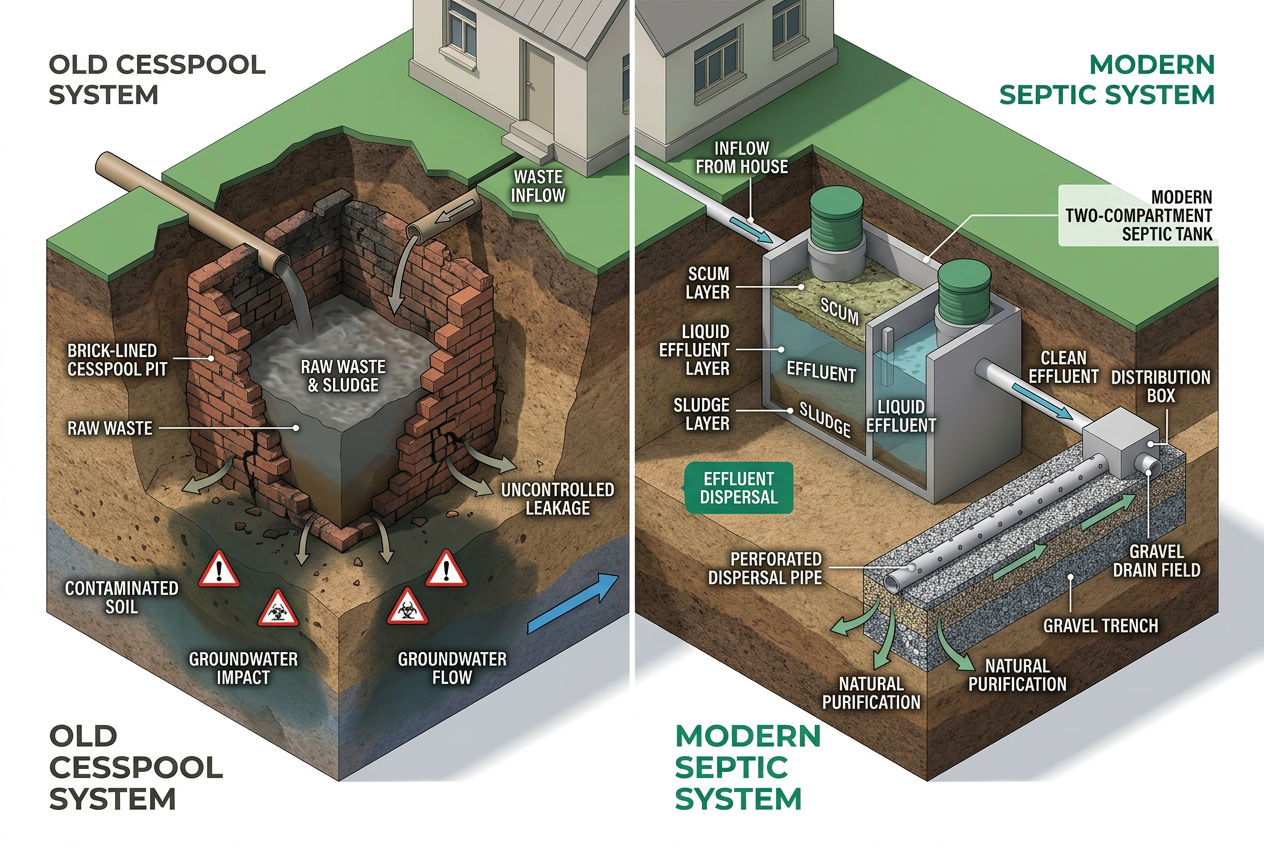
A cesspool — sometimes called a cesspit or, in the Northeast, a leaching pool — is one of the oldest forms of sewage disposal still in use. Picture a large cylindrical pit lined with concrete block, stone, or perforated precast rings. Sewage from the house flows in. Liquids seep out through the gaps and holes in the walls. Solids accumulate at the bottom.
That's it. No baffles. No treatment. No drain field. Just a hole in the ground that slowly absorbs raw sewage into the surrounding soil.
The cesspool meaning hasn't changed in 200 years. What has changed is our understanding of what that raw sewage does to groundwater. Nitrogen, bacteria, viruses, and pharmaceuticals pass through with the liquid. In areas with shallow water tables or dense housing — think Long Island or coastal Hawaii — that contamination reaches drinking water wells and coastal waterways.
Older cesspools were typically sized between 500 and 1,000 gallons in capacity, though many predate standardized sizing entirely. They typically last 20–40 years before the surrounding soil becomes so saturated with solids and biomat that liquids can no longer percolate out. At that point, you get backups — or worse, a cesspool collapse, which is a genuine structural safety hazard.
For cesspool pumping, expect to pay $200–$400 per service. That sounds manageable until you realize an older, heavily used cesspool may need pumping every 6–12 months rather than every few years. The costs add up fast. Learn more about what septic and cesspool pumping actually costs.
How a Septic Tank Works
A conventional septic system does something a cesspool doesn't: it actually treats waste before releasing it into the ground. The design is straightforward enough that some rural homeowners even look into installing a modern septic system yourself where county codes allow owner-installs.
Here's the basic process. Wastewater from your home flows into a sealed 1,000–1,500-gallon concrete or polyethylene tank. Inside, three layers form naturally. A scum layer of fats and grease floats on top. A liquid middle layer called effluent sits in the middle. A sludge layer of settled solids builds at the bottom.
Anaerobic bacteria break down solids in the tank over time. The partially treated effluent — and only the effluent — exits through an outlet baffle and flows to a drain field (also called a leach field). There, perforated pipes distribute the liquid through gravel trenches and into the soil, where biological and physical filtration removes remaining pathogens.
That's the key difference: a septic system separates treatment from disposal. The drain field receives liquid that's already had solids removed. A cesspool receives everything raw.
Modern tanks also include effluent filters — products like the Polylok PL-122 — that prevent solids from reaching the drain field even if the tank gets overfull. Older systems lack this protection entirely.
For a deeper look at how the whole system fits together, read our guide on what a septic system is and how it works.
Cesspool vs Septic Tank: Key Differences
| Feature | Cesspool | Septic Tank |
|---|---|---|
| Wastewater treatment | None | Partial (anaerobic digestion) |
| Drain field required | No | Yes |
| Groundwater protection | Minimal | Significantly better |
| Pumping frequency | Every 6–12 months (heavy use) | Every 3–5 years |
| Average lifespan | 20–40 years | 20–40 years (concrete) |
| Federal legal status | Banned (large-capacity, 2005) | Legal with permit |
| Typical install cost | N/A (legacy only) | $7,000–$25,000 |
Sources: U.S. EPA Underground Injection Control Program; National Onsite Wastewater Recycling Association (NOWRA)
Free download
Planning your own septic system?
Grab the free DIY Septic Planning Kit — the permit-first checklist, perc-test cheat sheet, and sizing tables that keep your build from getting red-tagged.
Are Cesspools Legal?
This is where it gets complicated — because the answer depends on where you live and what type of cesspool you have.
At the federal level, the EPA banned large-capacity cesspools under the Safe Drinking Water Act's Underground Injection Control program. As of April 5, 2005, any cesspool serving 20 or more people per day is illegal. That covers apartment buildings, small commercial properties, and any shared system with multiple dwellings. You can read the EPA's official guidance at epa.gov/uic.
For residential cesspools, federal law doesn't mandate removal — but state and county laws increasingly do.
Hawaii is the most aggressive. Act 125 (2017) mandates phasing out approximately 88,000 residential cesspools statewide by 2050. If your cesspool is within 200 feet of a shoreline or surface water, the deadline is 2024. The state Department of Health oversees compliance. See our Hawaii septic regulations page for specifics.
New York's Suffolk County has historically been home to over 360,000 cesspools on Long Island. The Suffolk County Septic Improvement Program offers rebates of up to $20,000–$30,000 for homeowners who upgrade to nitrogen-reducing septic systems. That's real money on the table. Details are on our New York septic regulations page.
New England states — Massachusetts, Connecticut, Rhode Island — each have their own Title 5 and similar codes that restrict cesspool use, especially during real estate transactions. In Massachusetts, a failed cesspool inspection during a home sale typically requires upgrade before transfer of title.
The bottom line: even where your cesspool isn't technically illegal today, it may trigger mandatory replacement when you sell your home, apply for a permit, or fail a septic inspection.
How Do You Know If You Have a Cesspool or a Septic Tank?
If your home was built before 1970 and you're on private sewage disposal, there's a reasonable chance you have a cesspool — especially if you're in New England, New York, New Jersey, or Hawaii.
Here are the practical ways to find out:
Check your property records. Your county health department keeps records of permitted sewage systems. A cesspool may be listed as a cesspool, drywell, or seepage pit. Some older ones were installed before permits were required and won't appear in records at all.
Look at the access lid. A cesspool typically has a single access point — one round lid, usually concrete, sometimes directly over the pit. A conventional septic tank has two lids (inlet and outlet ends of the tank), plus a separate distribution box and drain field.
Ask a licensed inspector. A professional septic inspection involves probing the tank with a sludge judge, checking for baffles, and assessing whether a drain field exists. If there's no drain field on your property, you almost certainly have a cesspool. Our septic inspection cost guide covers what to expect to pay.
Check the system diagram. If a previous owner pulled a permit or had work done, the local health department file may include a site plan showing exactly what was installed.
Why Are Cesspools Bad?
Beyond the legal issues, cesspools create three serious problems.
Groundwater contamination. Raw sewage contains nitrogen compounds, coliform bacteria, viruses, and pharmaceutical residues. A cesspool discharges all of it directly into the soil. The EPA and state health departments have documented clear links between high-density cesspool areas and elevated nitrate levels in private wells and coastal waters. In Suffolk County, cesspool nitrogen discharge is considered a primary driver of algal blooms in local bays.
Structural failure risk. A cesspool collapse isn't theoretical. When the surrounding soil becomes saturated and can no longer support the pit walls, the structure can cave in without warning. People have fallen into failing cesspools. This is a physical safety issue, not just an environmental one.
Maintenance costs that keep climbing. As a cesspool ages, the soil around it becomes clogged with solids. Pumping frequency increases. You're eventually paying $200–$400 every few months for a system that still isn't treating waste. At that point, you're spending money to maintain a problem rather than solve it.
Cesspool Replacement Options
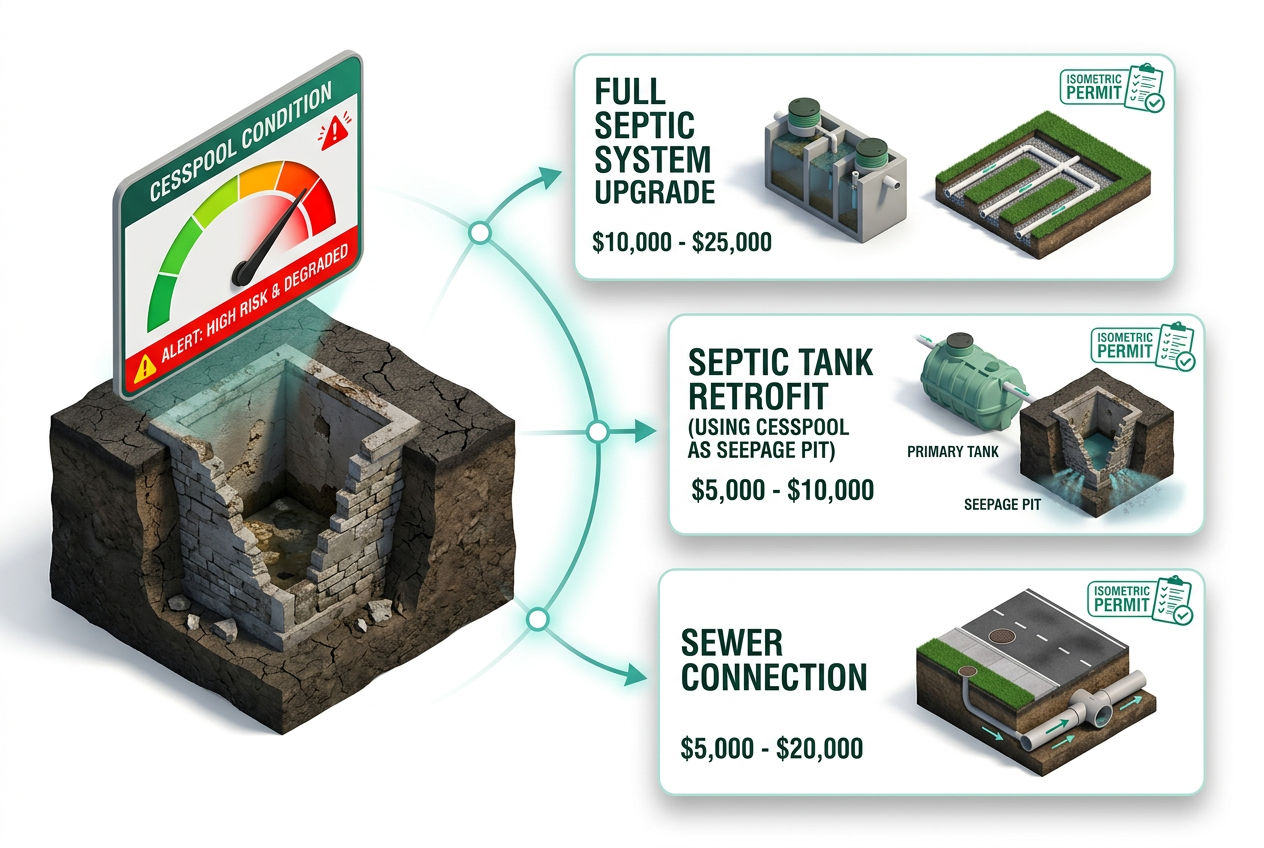
You have more choices than just "dig everything up and install a conventional septic system." What's available depends on your lot size, soil type, and local regulations — which is why a perc test is almost always the first step. Learn how perc tests work and what a perc test costs.
Conventional Septic System
The standard replacement. A 1,000–1,500-gallon concrete or polyethylene tank feeds a gravel-and-pipe drain field. Works on most standard lots with decent soil percolation. Total installed cost: $7,000–$15,000 in most regions. See full septic installation cost breakdowns.
Aerobic Treatment Unit (ATU)
If your lot is small, your soil has poor percolation, or you're near sensitive water, an aerobic septic system introduces oxygen into the treatment process, producing significantly cleaner effluent. These systems cost more — typically $10,000–$20,000 installed — and require ongoing maintenance contracts. In Suffolk County, aerobic systems with nitrogen reduction often qualify for the full $20,000–$30,000 rebate. Read more about aerobic vs. anaerobic septic systems.
Mound System
When the water table is too high or the soil is too dense for a standard drain field, a mound system elevates the leach field above grade using engineered fill. Common in coastal Florida, parts of Minnesota, and other areas with high seasonal water tables. Installed cost: $10,000–$25,000. See our mound septic system guide for details.
Engineered or Alternative Systems
Sand filter systems, drip irrigation systems, and other alternative septic systems may be required on difficult lots where conventional systems can't meet setback requirements or soil conditions. These are more complex but often the only option on constrained properties.
How Much Does Cesspool-to-Septic Conversion Cost?
Nationally, converting a cesspool to a septic system costs $5,000–$15,000 for a straightforward residential conversion. That range assumes decent soil, a standard lot, and no unusual permitting complications.
In high-cost markets, the number climbs sharply. A conversion in Nassau or Suffolk County, New York, or on Oahu, Hawaii, can run $15,000–$25,000 or more — before you factor in engineering fees, permits, and soil testing.
Here's a realistic breakdown for a mid-size suburban property:
- Cesspool abandonment and filling: $1,000–$3,000
- Perc test and site engineering: $500–$2,000
- New 1,000-gallon septic tank (concrete): $1,500–$3,000 in materials
- Drain field installation: $3,000–$8,000 depending on size and soil
- Permits and inspections: $500–$1,500
- Total typical range: $6,500–$17,500
If you're in Suffolk County, apply for the Septic Improvement Program before you spend a dollar. The rebate can cover a substantial portion — sometimes all — of the upgrade cost for qualifying nitrogen-reducing systems.
For broader repair and replacement cost data, see our septic repair cost guide.
Which Option Is Right for You?
Convert to a conventional septic system if your lot is at least a half-acre, your soil passes a perc test, and you're not in a nitrogen-sensitive watershed. This is the lowest-cost path and works reliably for most single-family homes.
Choose an aerobic treatment unit if you're in a nutrient-sensitive area, your lot is small, or state/county regulations require advanced nitrogen reduction. The higher upfront cost is often offset by available rebates — especially on Long Island and in Hawaii.
Consider a mound or engineered system if your soil fails a standard perc test, your water table is high, or your lot has unusual setback challenges. Get an engineer involved early — trying to force a conventional design onto a bad lot wastes time and money.
Do nothing only if your cesspool is recently inspected, functioning without backups, and local law doesn't require replacement. That situation won't last forever, but if the system is genuinely working and you're not near a sale, you may have time to plan and save.
Whatever path you choose, start with a licensed inspection to understand exactly what you have. Use the SepticTankHub directory to find a qualified inspector in your area. Once you know exactly what's in the ground, compare septic installers in your area to get competitive bids on the conversion. If you're negotiating a real estate purchase where a cesspool was disclosed, our guide on negotiating septic repairs after an inspection is worth reading before you go back to the seller.
Sources & Methodology
-
U.S. Environmental Protection Agency — Underground Injection Control Program (epa.gov): Federal regulations on large-capacity cesspool prohibition (effective April 5, 2005) and general septic system guidance.
-
Hawaii Department of Health — Act 125 (2017): State cesspool phase-out mandate requiring conversion of approximately 88,000 cesspools by 2050, with accelerated deadlines for systems near surface water.
-
Suffolk County, NY — Septic Improvement Program: County-administered rebate program offering up to $20,000–$30,000 for nitrogen-reducing septic upgrades; program details sourced from Suffolk County Department of Health Services documentation.
-
National Onsite Wastewater Recycling Association (NOWRA) (nowra.org): Industry standards for onsite wastewater system classification, design, and terminology.
-
National Association of Wastewater Technicians (NAWT) (nawt.org): Pumping frequency guidelines, inspection standards, and technician certification references.
Cost ranges reflect aggregated contractor data and regional market rates current as of 2025. Always obtain 2–3 local quotes before proceeding with any cesspool conversion project.
Was this article helpful?
Frequently Asked Questions
Recommended Resources
📖 Related Articles
- What Is a Septic System? How It Works (Visual Guide)
- What Happens During a Septic Inspection?
- Perc Test (Percolation Test): What It Is & How It Works
- Aerobic vs Anaerobic Septic Systems: How They Compare
- Mound Septic System: $10K–$25K Cost & How It Works (2026)
- Alternative Septic Systems: Options When a Standard System Won't Work
- How to Negotiate Septic Repairs After a Home Inspection
💰 Cost Guides
🔧 Services
Find Septic Professionals Near You
Compare licensed, verified septic companies by area — top county markets and cities below, or browse all 50 states.
County markets
Popular cities
